Unless otherwise noted the content of this course
- Slides: 42
Unless otherwise noted, the content of this course material is licensed under a Creative Commons Attribution – Non-Commercial 3. 0 License. http: //creativecommons. org/licenses/by-nc/3. 0/ Copyright 2008, Yan Chen You assume all responsibility for use and potential liability associated with any use of the material. Material contains copyrighted content, used in accordance with U. S. law. Copyright holders of content included in this material should contact open. michigan@umich. edu with any questions, corrections, or clarifications regarding the use of content. The Regents of the University of Michigan do not license the use of third party content posted to this site unless such a license is specifically granted in connection with particular content objects. Users of content are responsible for their compliance with applicable law. Mention of specific products in this recording solely represents the opinion of the speaker and does not represent an endorsement by the University of Michigan. For more information about how to cite these materials visit http: //michigan. educommons. net/about/terms-of-use 1
SI 563 Lecture 5 Repeated Games and Reputation Professor Yan Chen Fall 2008 Some material in this lecture drawn from http: //gametheory. net/lectures/level. pl 2
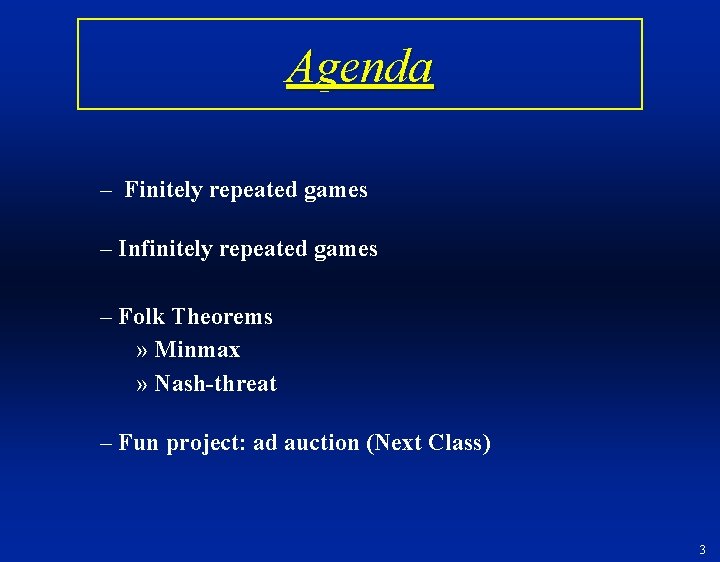
Agenda – Finitely repeated games – Infinitely repeated games – Folk Theorems » Minmax » Nash-threat – Fun project: ad auction (Next Class) 3
Repeated Games and Reputation (Watson Chapter 22) 4
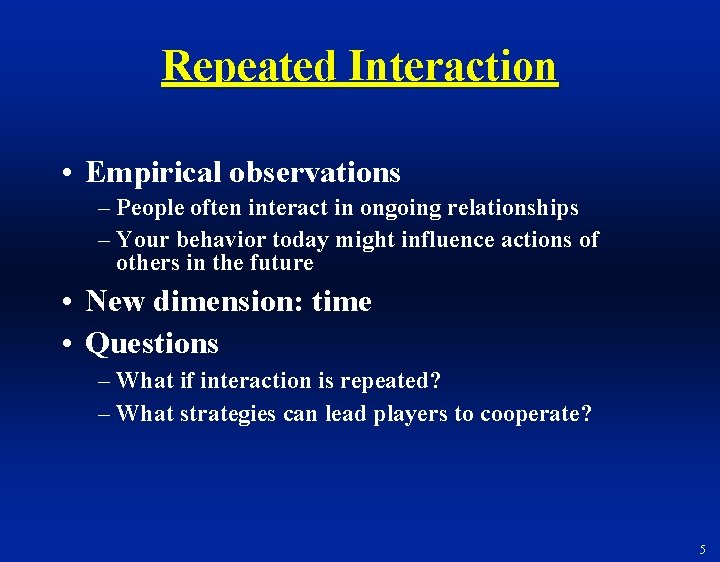
Repeated Interaction • Empirical observations – People often interact in ongoing relationships – Your behavior today might influence actions of others in the future • New dimension: time • Questions – What if interaction is repeated? – What strategies can lead players to cooperate? 5
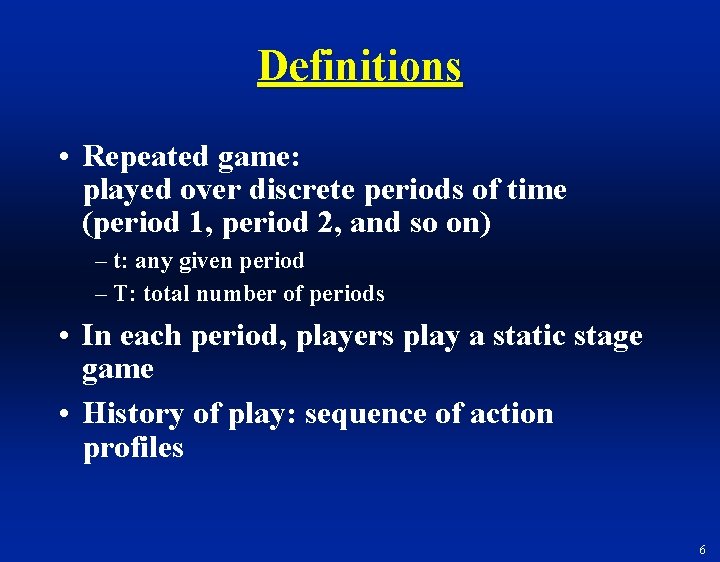
Definitions • Repeated game: played over discrete periods of time (period 1, period 2, and so on) – t: any given period – T: total number of periods • In each period, players play a static stage game • History of play: sequence of action profiles 6
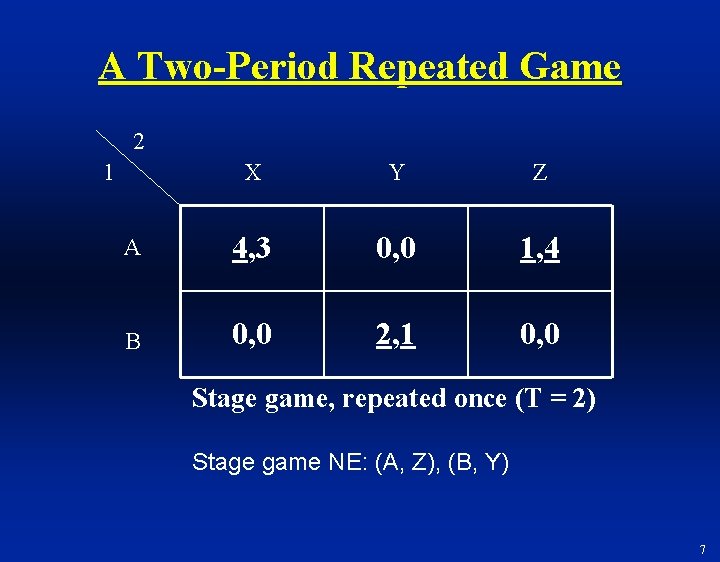
A Two-Period Repeated Game 2 1 X Y Z A 4, 3 0, 0 1, 4 B 0, 0 2, 1 0, 0 Stage game, repeated once (T = 2) Stage game NE: (A, Z), (B, Y) 7
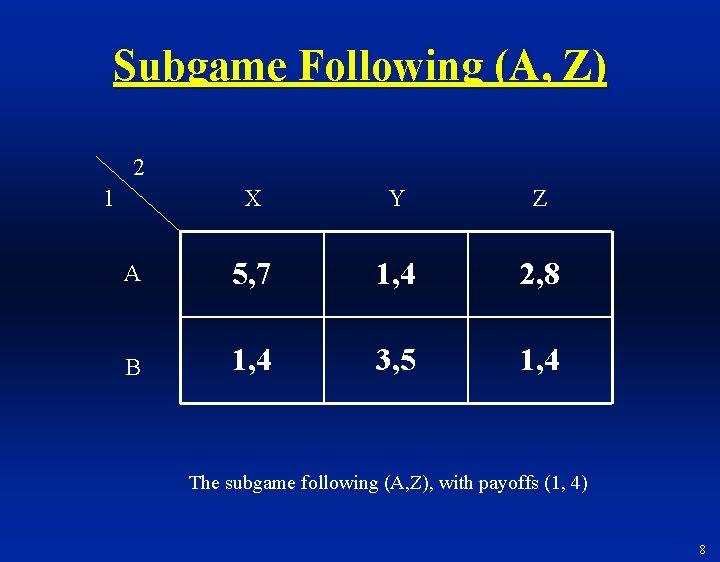
Subgame Following (A, Z) 2 1 X Y Z A 5, 7 1, 4 2, 8 B 1, 4 3, 5 1, 4 The subgame following (A, Z), with payoffs (1, 4) 8
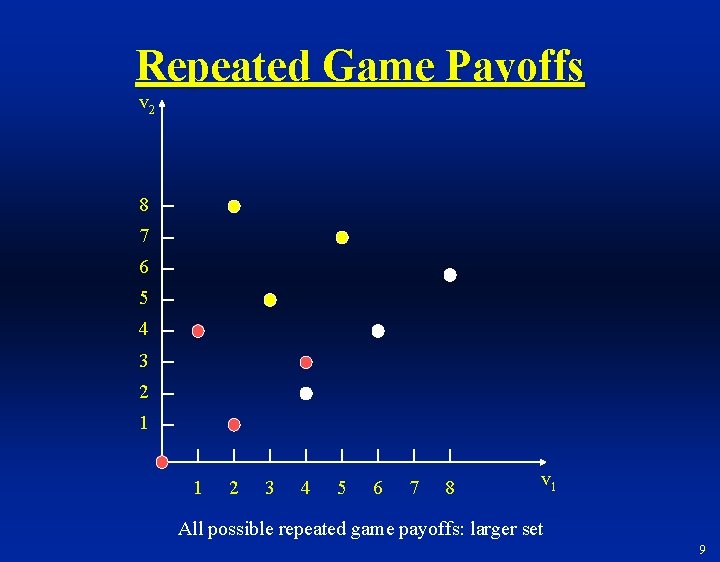
Repeated Game Payoffs v 2 8 7 6 5 4 3 2 1 1 2 3 4 5 6 7 8 v 1 All possible repeated game payoffs: larger set 9
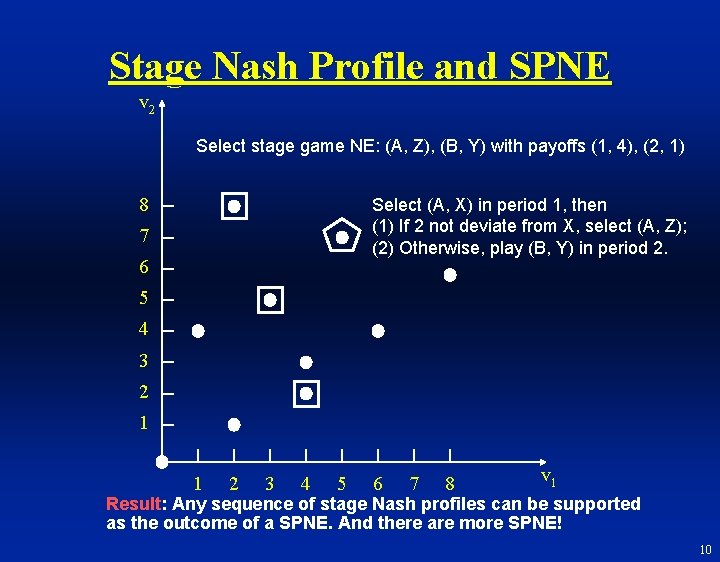
Stage Nash Profile and SPNE v 2 Select stage game NE: (A, Z), (B, Y) with payoffs (1, 4), (2, 1) 8 Select (A, X) in period 1, then (1) If 2 not deviate from X, select (A, Z); (2) Otherwise, play (B, Y) in period 2. 7 6 5 4 3 2 1 1 2 3 4 5 6 7 8 v 1 Result: Any sequence of stage Nash profiles can be supported as the outcome of a SPNE. And there are more SPNE! 10
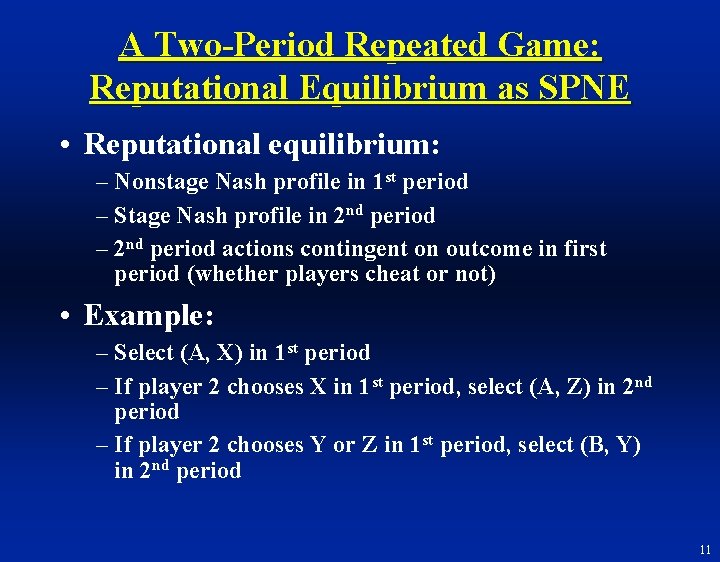
A Two-Period Repeated Game: Reputational Equilibrium as SPNE • Reputational equilibrium: – Nonstage Nash profile in 1 st period – Stage Nash profile in 2 nd period – 2 nd period actions contingent on outcome in first period (whether players cheat or not) • Example: – Select (A, X) in 1 st period – If player 2 chooses X in 1 st period, select (A, Z) in 2 nd period – If player 2 chooses Y or Z in 1 st period, select (B, Y) in 2 nd period 11
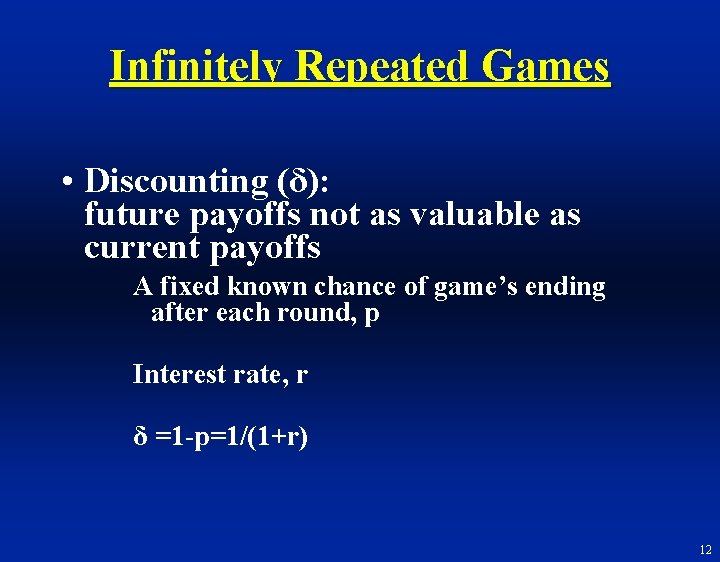
Infinitely Repeated Games • Discounting (δ): future payoffs not as valuable as current payoffs A fixed known chance of game’s ending after each round, p Interest rate, r δ =1 -p=1/(1+r) 12
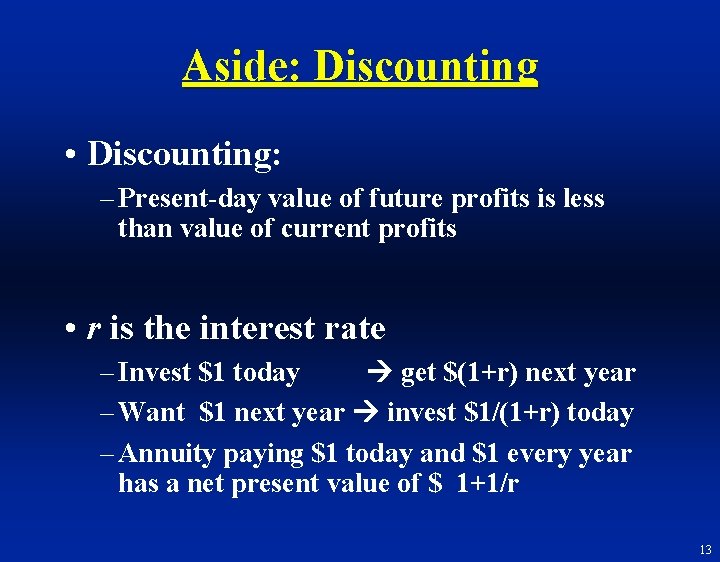
Aside: Discounting • Discounting: – Present-day value of future profits is less than value of current profits • r is the interest rate – Invest $1 today get $(1+r) next year – Want $1 next year invest $1/(1+r) today – Annuity paying $1 today and $1 every year has a net present value of $ 1+1/r 13
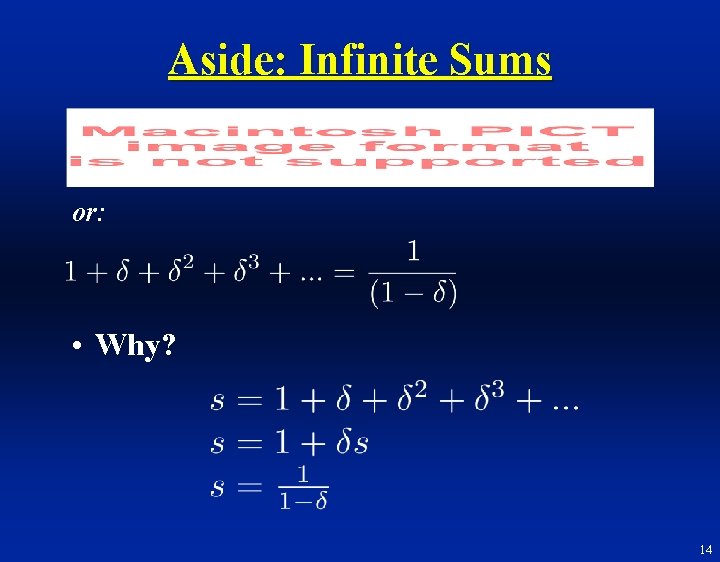
Aside: Infinite Sums or: • Why? 14
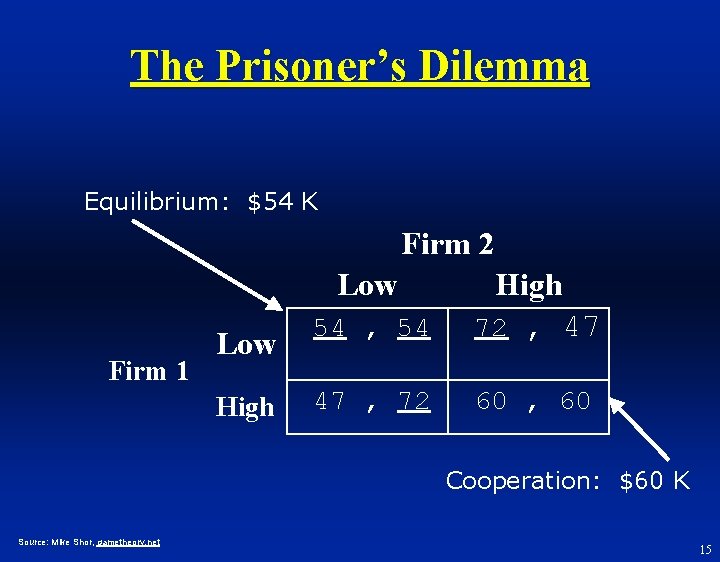
The Prisoner’s Dilemma Equilibrium: $54 K Firm 2 Low Firm 1 Low 54 , 54 High 72 , 47 High 47 , 72 60 , 60 Cooperation: $60 K Source: Mike Shor, gametheory. net 15
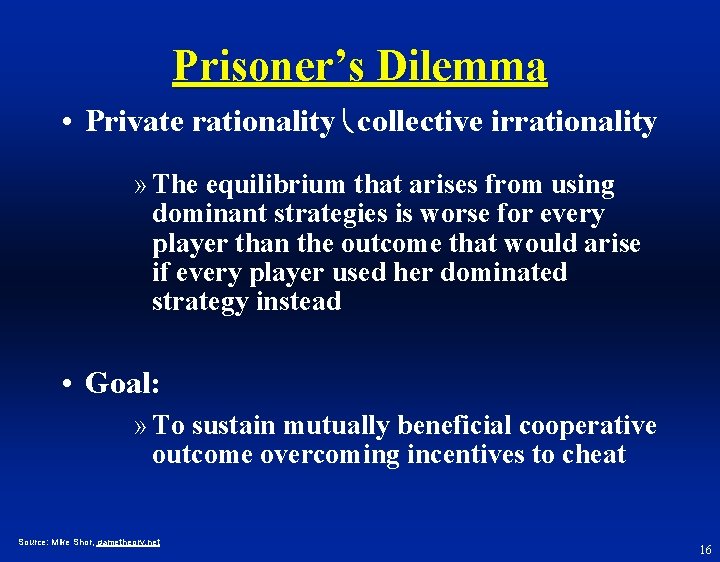
Prisoner’s Dilemma • Private rationality collective irrationality » The equilibrium that arises from using dominant strategies is worse for every player than the outcome that would arise if every player used her dominated strategy instead • Goal: » To sustain mutually beneficial cooperative outcome overcoming incentives to cheat Source: Mike Shor, gametheory. net 16
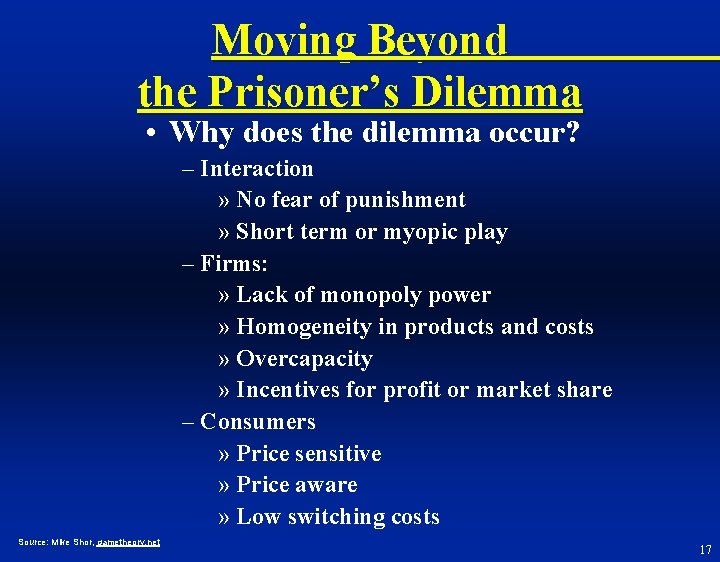
Moving Beyond the Prisoner’s Dilemma • Why does the dilemma occur? – Interaction » No fear of punishment » Short term or myopic play – Firms: » Lack of monopoly power » Homogeneity in products and costs » Overcapacity » Incentives for profit or market share – Consumers » Price sensitive » Price aware » Low switching costs Source: Mike Shor, gametheory. net 17
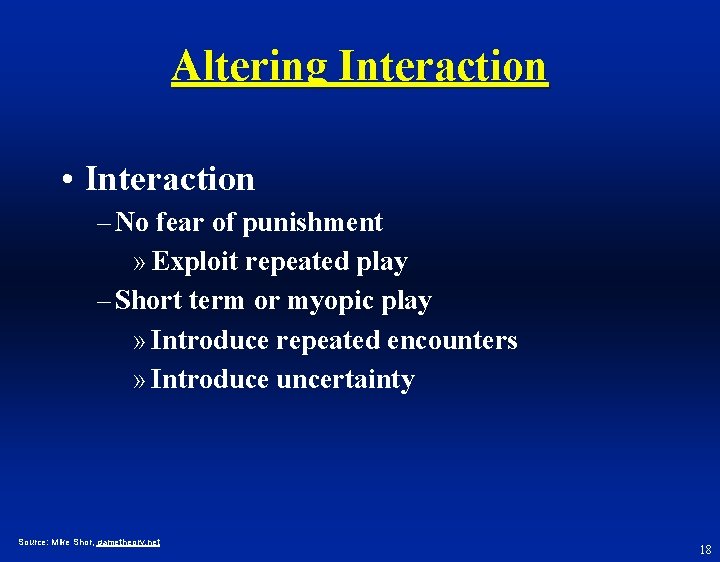
Altering Interaction • Interaction – No fear of punishment » Exploit repeated play – Short term or myopic play » Introduce repeated encounters » Introduce uncertainty Source: Mike Shor, gametheory. net 18
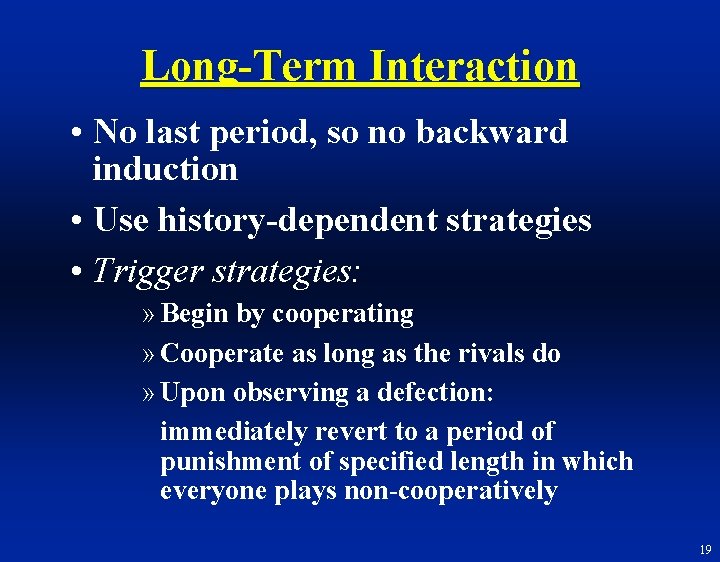
Long-Term Interaction • No last period, so no backward induction • Use history-dependent strategies • Trigger strategies: » Begin by cooperating » Cooperate as long as the rivals do » Upon observing a defection: immediately revert to a period of punishment of specified length in which everyone plays non-cooperatively 19
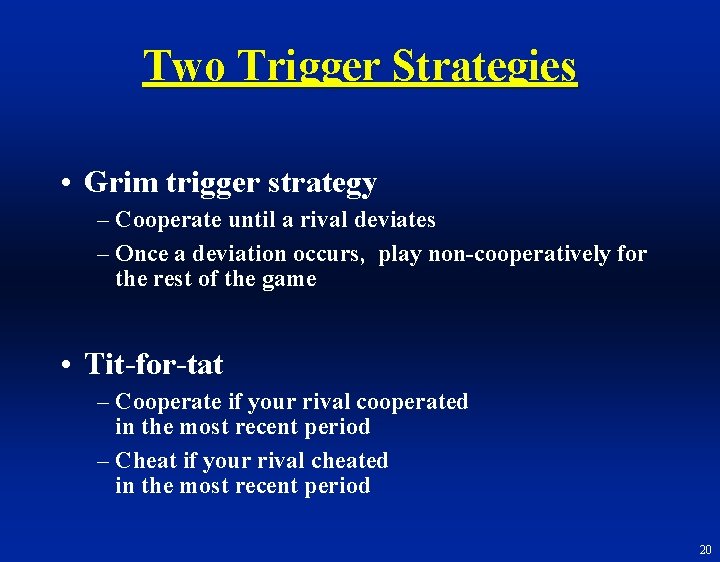
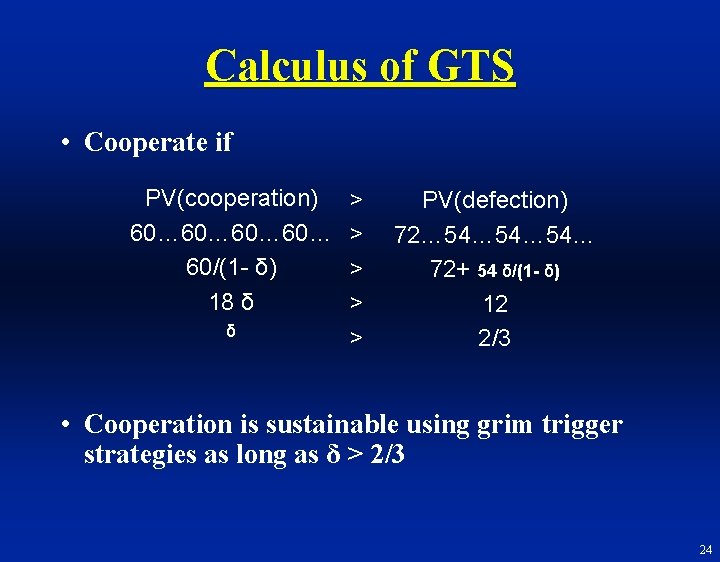
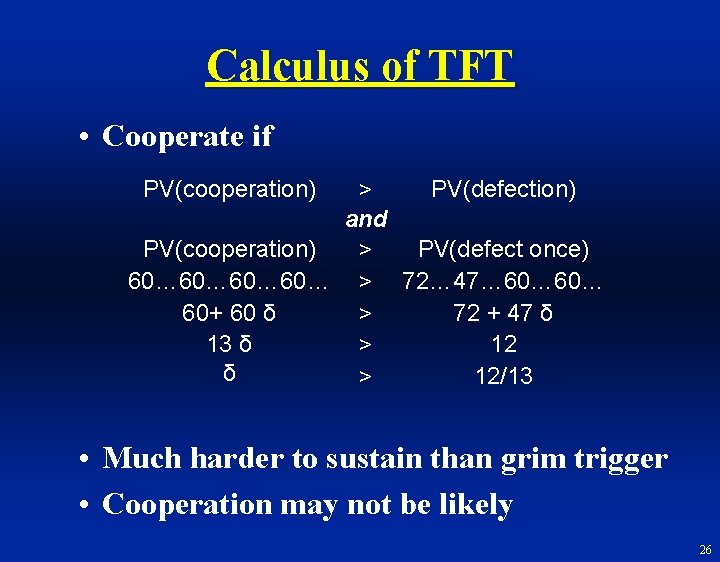
Two Trigger Strategies • Grim trigger strategy – Cooperate until a rival deviates – Once a deviation occurs, play non-cooperatively for the rest of the game • Tit-for-tat – Cooperate if your rival cooperated in the most recent period – Cheat if your rival cheated in the most recent period 20
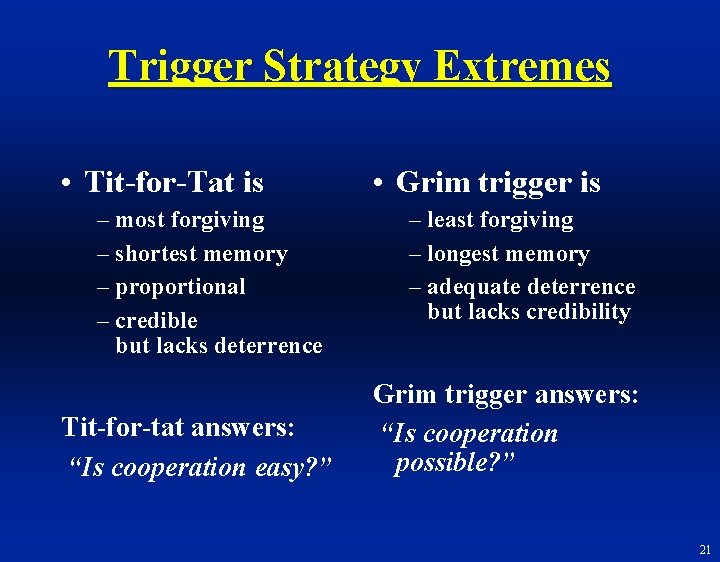
Trigger Strategy Extremes • Tit-for-Tat is – most forgiving – shortest memory – proportional – credible but lacks deterrence Tit-for-tat answers: “Is cooperation easy? ” • Grim trigger is – least forgiving – longest memory – adequate deterrence but lacks credibility Grim trigger answers: “Is cooperation possible? ” 21
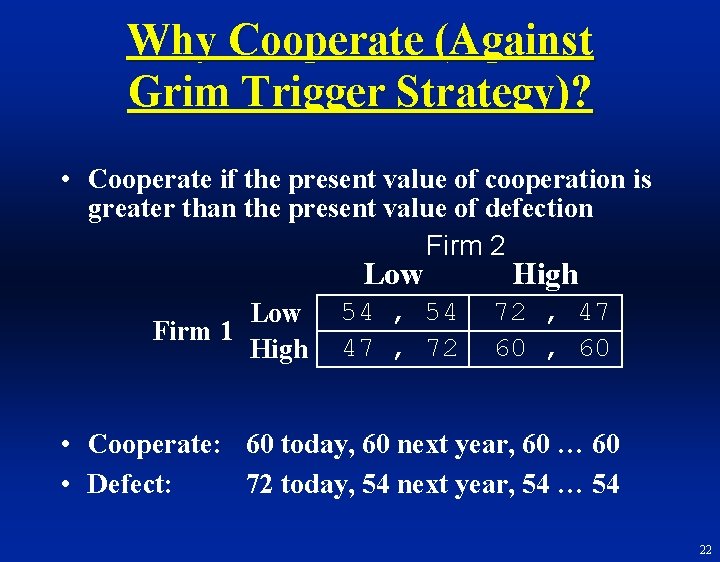
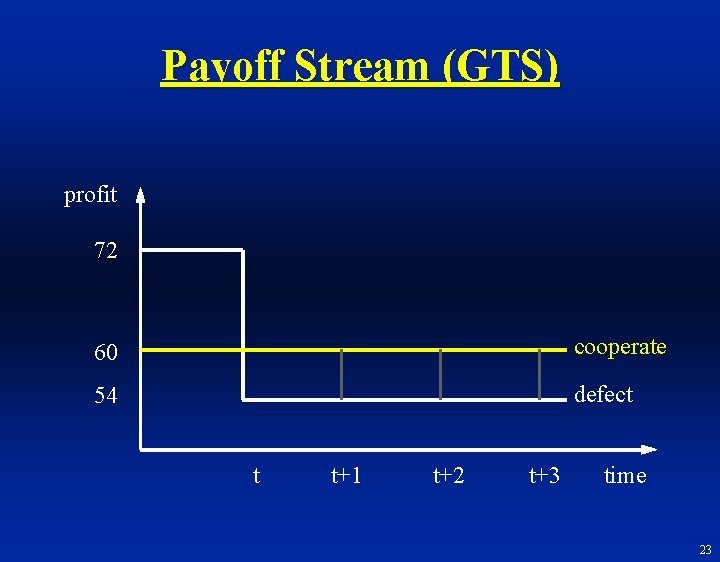
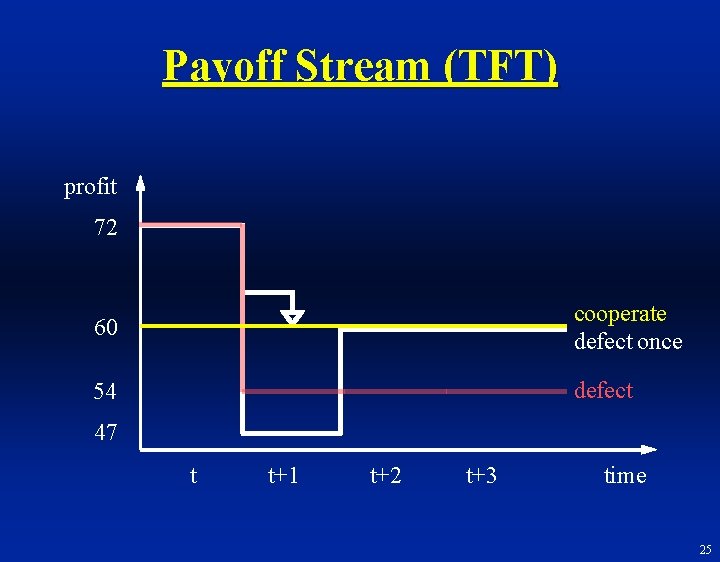
Why Cooperate (Against Grim Trigger Strategy)? • Cooperate if the present value of cooperation is greater than the present value of defection Firm 2 Low Firm 1 High Low High 54 , 54 47 , 72 72 , 47 60 , 60 • Cooperate: 60 today, 60 next year, 60 … 60 • Defect: 72 today, 54 next year, 54 … 54 22
Payoff Stream (GTS) profit 72 60 cooperate 54 defect t t+1 t+2 t+3 time 23
Calculus of GTS • Cooperate if PV(cooperation) 60… 60… 60/(1 - δ) 18 δ δ > > > PV(defection) 72… 54… 54… 72+ 54 δ/(1 - δ) 12 2/3 • Cooperation is sustainable using grim trigger strategies as long as δ > 2/3 24
Payoff Stream (TFT) profit 72 60 cooperate defect once 54 defect 47 t t+1 t+2 t+3 time 25
Calculus of TFT • Cooperate if PV(cooperation) PV(defection) > and PV(cooperation) PV(defect once) > 60… 60… > 72… 47… 60… 60+ 60 δ 72 + 47 δ > 13 δ 12 > δ 12/13 > • Much harder to sustain than grim trigger • Cooperation may not be likely 26
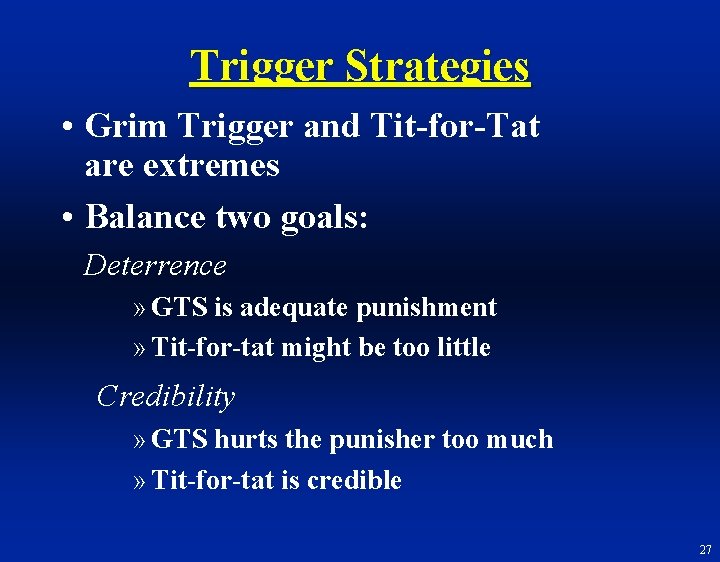
Trigger Strategies • Grim Trigger and Tit-for-Tat are extremes • Balance two goals: Deterrence » GTS is adequate punishment » Tit-for-tat might be too little Credibility » GTS hurts the punisher too much » Tit-for-tat is credible 27
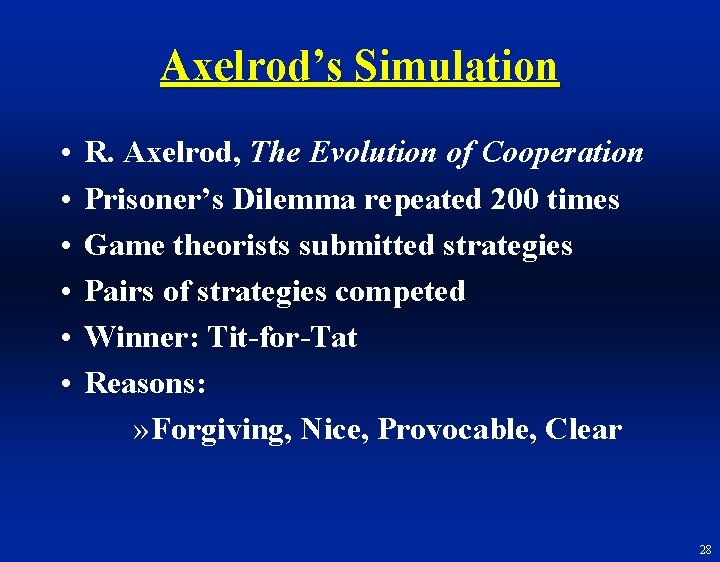
Axelrod’s Simulation • • • R. Axelrod, The Evolution of Cooperation Prisoner’s Dilemma repeated 200 times Game theorists submitted strategies Pairs of strategies competed Winner: Tit-for-Tat Reasons: » Forgiving, Nice, Provocable, Clear 28
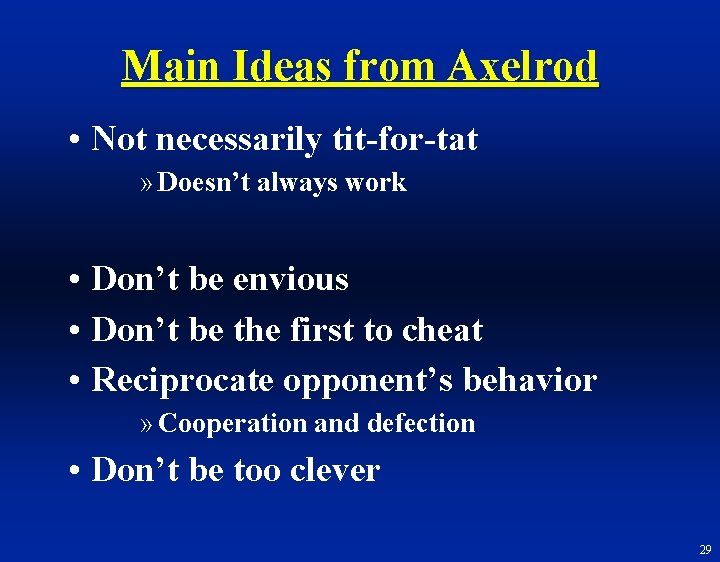
Main Ideas from Axelrod • Not necessarily tit-for-tat » Doesn’t always work • Don’t be envious • Don’t be the first to cheat • Reciprocate opponent’s behavior » Cooperation and defection • Don’t be too clever 29
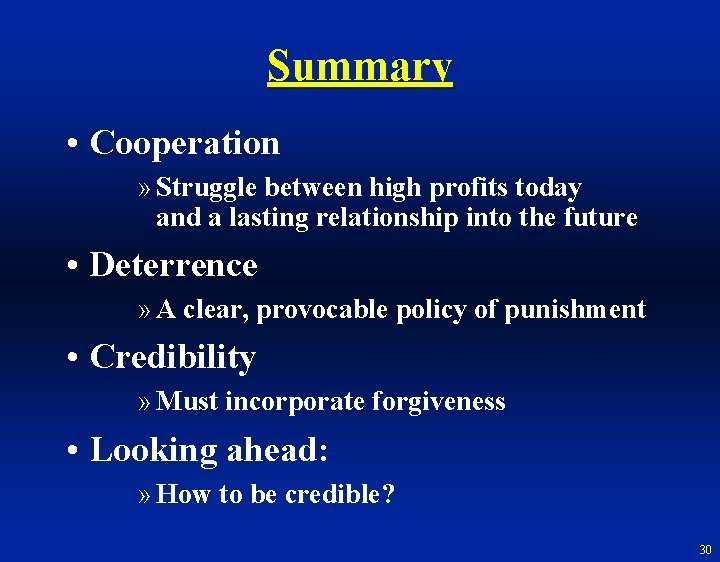
Summary • Cooperation » Struggle between high profits today and a lasting relationship into the future • Deterrence » A clear, provocable policy of punishment • Credibility » Must incorporate forgiveness • Looking ahead: » How to be credible? 30
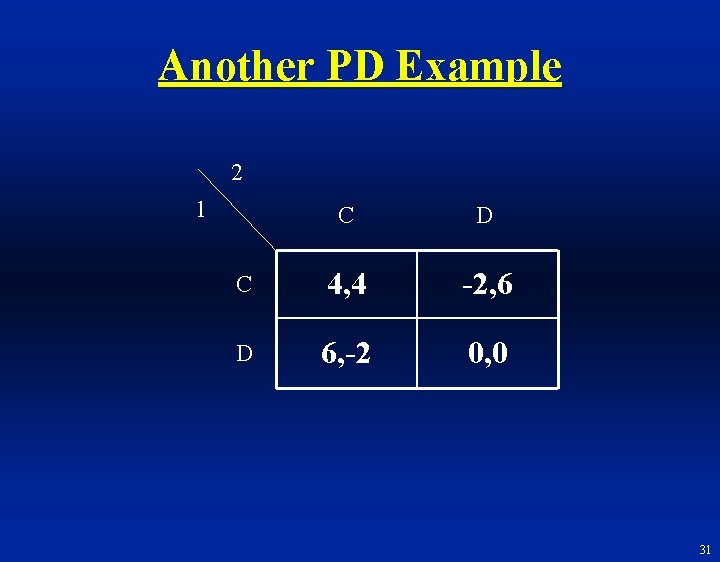
Another PD Example 2 1 C D C 4, 4 -2, 6 D 6, -2 0, 0 31
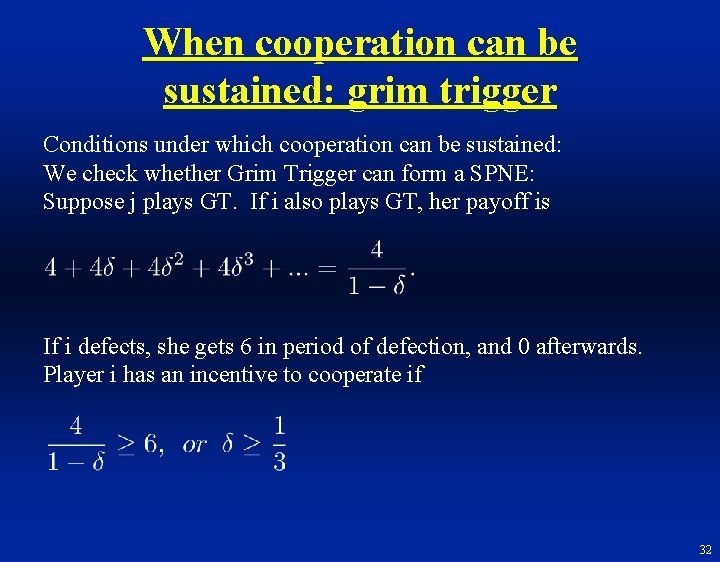
When cooperation can be sustained: grim trigger Conditions under which cooperation can be sustained: We check whether Grim Trigger can form a SPNE: Suppose j plays GT. If i also plays GT, her payoff is If i defects, she gets 6 in period of defection, and 0 afterwards. Player i has an incentive to cooperate if 32
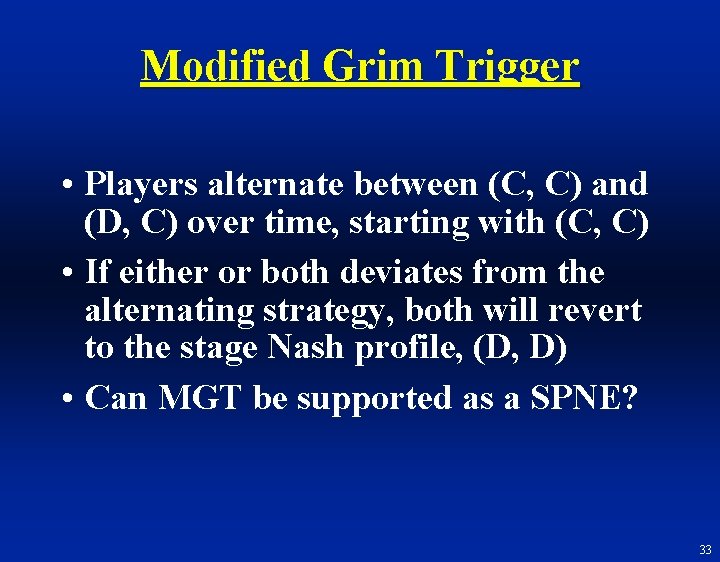
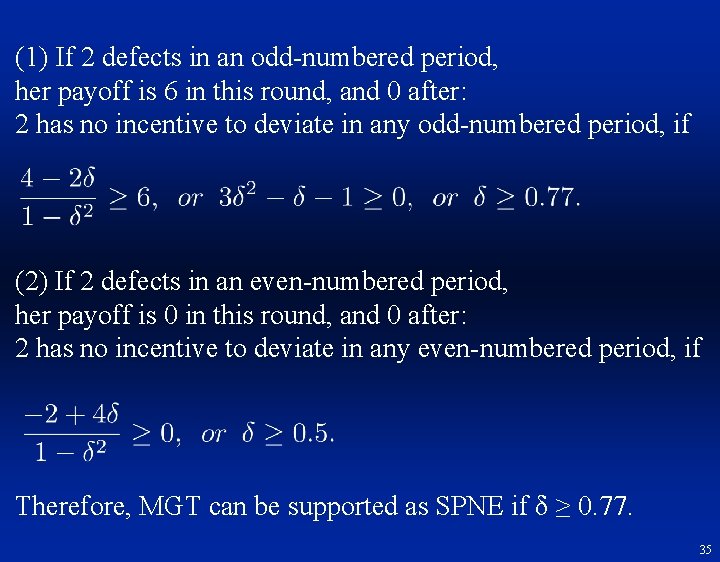
Modified Grim Trigger • Players alternate between (C, C) and (D, C) over time, starting with (C, C) • If either or both deviates from the alternating strategy, both will revert to the stage Nash profile, (D, D) • Can MGT be supported as a SPNE? 33
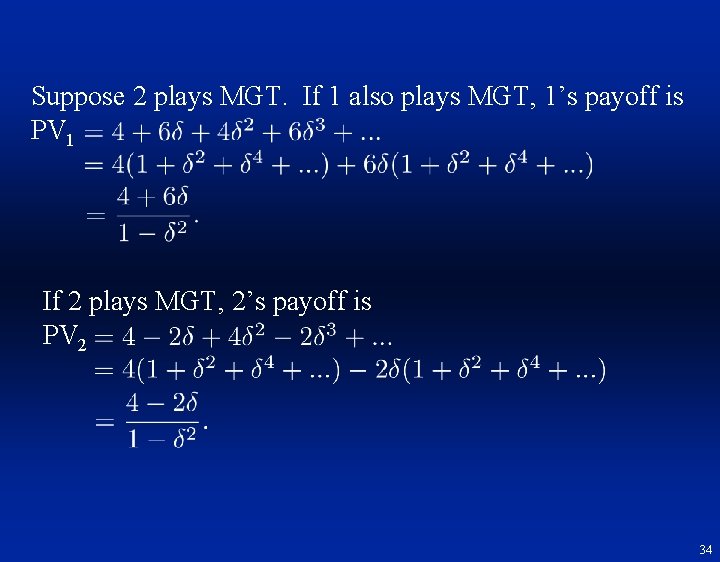
Suppose 2 plays MGT. If 1 also plays MGT, 1’s payoff is PV 1 If 2 plays MGT, 2’s payoff is PV 2 34
(1) If 2 defects in an odd-numbered period, her payoff is 6 in this round, and 0 after: 2 has no incentive to deviate in any odd-numbered period, if (2) If 2 defects in an even-numbered period, her payoff is 0 in this round, and 0 after: 2 has no incentive to deviate in any even-numbered period, if Therefore, MGT can be supported as SPNE if δ ≥ 0. 77. 35
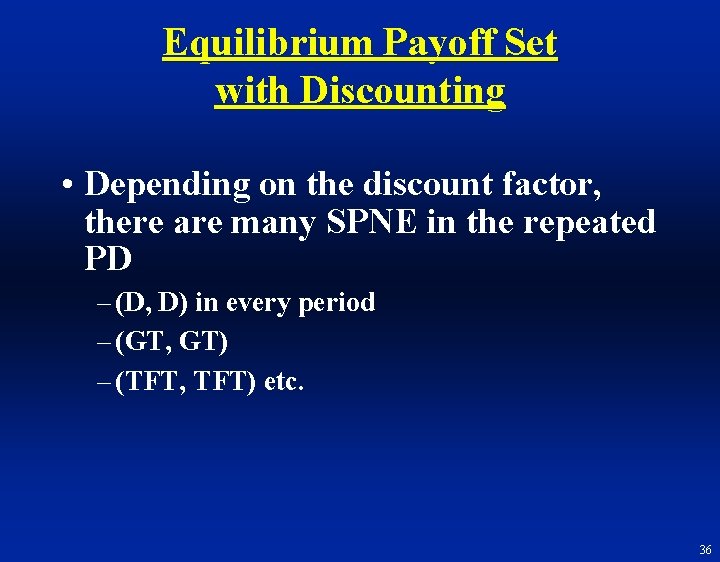
Equilibrium Payoff Set with Discounting • Depending on the discount factor, there are many SPNE in the repeated PD – (D, D) in every period – (GT, GT) – (TFT, TFT) etc. 36
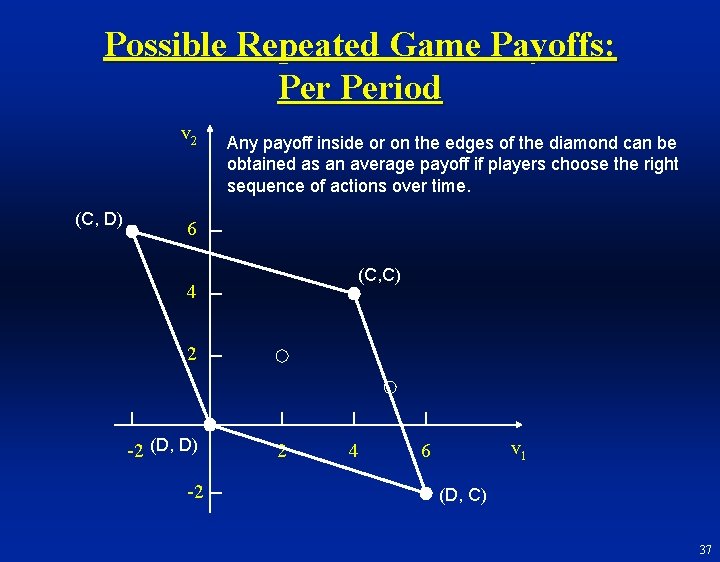
Possible Repeated Game Payoffs: Period v 2 (C, D) Any payoff inside or on the edges of the diamond can be obtained as an average payoff if players choose the right sequence of actions over time. 6 (C, C) 4 2 -2 (D, D) -2 2 4 v 1 6 (D, C) 37
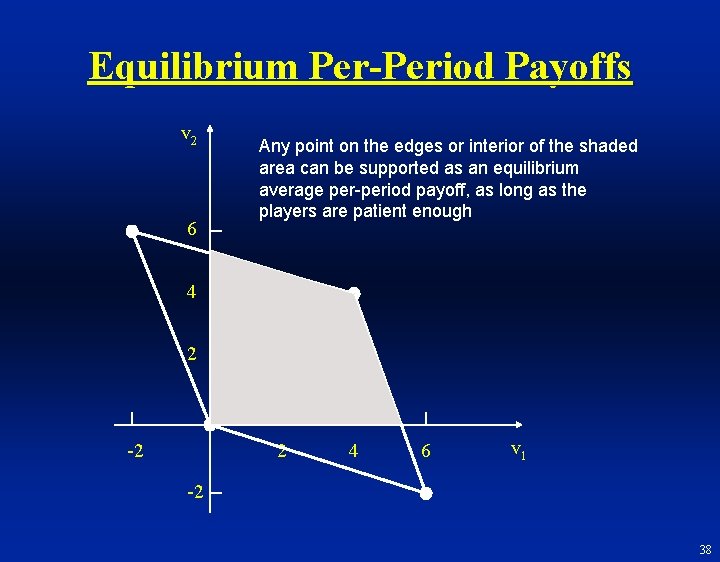
Equilibrium Per-Period Payoffs v 2 6 Any point on the edges or interior of the shaded area can be supported as an equilibrium average per-period payoff, as long as the players are patient enough 4 2 -2 2 4 6 v 1 -2 38
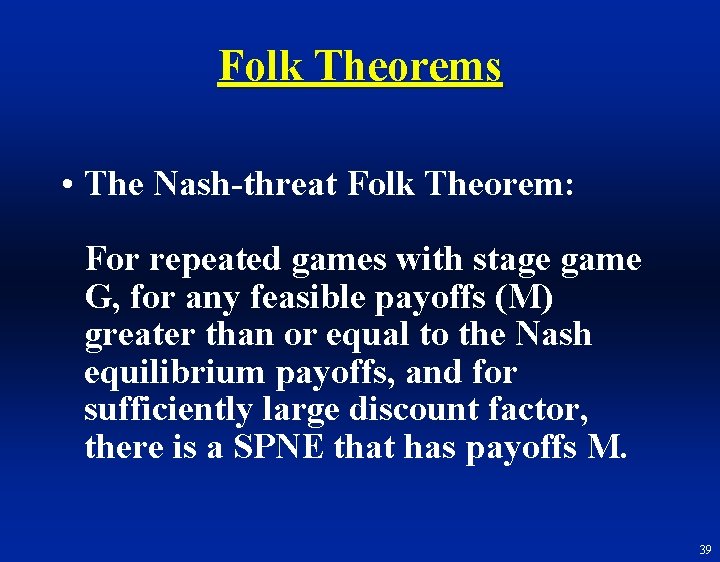
Folk Theorems • The Nash-threat Folk Theorem: For repeated games with stage game G, for any feasible payoffs (M) greater than or equal to the Nash equilibrium payoffs, and for sufficiently large discount factor, there is a SPNE that has payoffs M. 39
Applications • Governing the Commons – The Evolution of Institutions for Collective Action by Elinor Ostrom • International trade agreements • e. Bay’s reputation system (Check out Chapter 23) 40
Highlights • Finitely repeated games • Infinitely repeated games • Folk theorems • Next week: Games with Incomplete Information • Fun exercise: ad words auction 41
Homework Assignment • Chapter 22: #1, 2, 3, 5 42