
Unless otherwise noted the content of this course

- Slides: 14
Unless otherwise noted, the content of this course material is licensed under a Creative Commons Attribution-Non-Commercial. Share. Alike 3. 0 License. http: //creativecommons. org/licenses/by-nc-sa/3. 0/ Copyright © 2008, Annemarie Sullivan Palincsar. You assume all responsibility for use and potential liability associated with any use of the material. Material contains copyrighted content, used in accordance with U. S. law. Copyright holders of content included in this material should contact open. michigan@umich. edu with any questions, corrections, or clarifications regarding the use of content. The Regents of the University of Michigan do not license the use of third party content posted to this site unless such a license is specifically granted in connection with particular content. Users of content are responsible for their compliance with applicable law. Mention of specific products in this material solely represents the opinion of the speaker and does not represent an endorsement by the University of Michigan. For more information about how to cite these materials visit http: //michigan. educommons. net/about/terms-of-use. Any medical information in this material is intended to inform and educate and is not a tool for self-diagnosis or a replacement for medical evaluation, advice, diagnosis or treatment by a healthcare professional. You should speak to your physician or make an appointment to be seen if you have questions or concerns about this information or your medical condition. Viewer discretion is advised: Material may contain medical images that may be disturbing to some viewers.
ED 403 Week 4
Agenda • • • Book Talk Problems of Practice Out of the Dust activity Word study in the upper elementary years Teaching for fluency The productive enactment of writer’s workshop
Out of the Dust activity • Responses to the novel • Focus on making meaning with the novel – Images – Connections – Finding instructional opportunities – Appreciating the Author’s Craft
How do children learn to read words? • • Contextual guessing Letter-sound decoding Analogy Sight
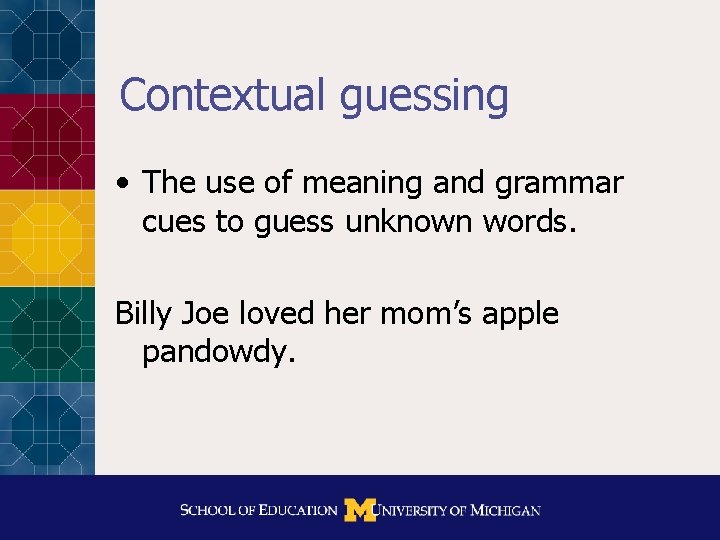
Contextual guessing • The use of meaning and grammar cues to guess unknown words. Billy Joe loved her mom’s apple pandowdy.
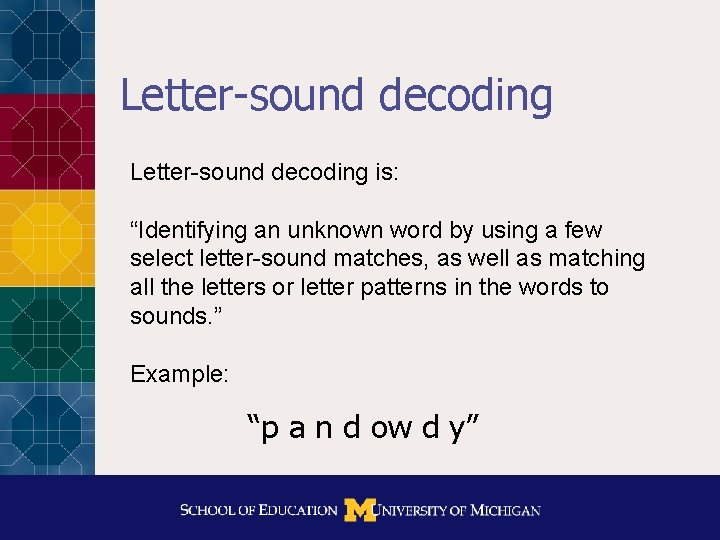
Letter-sound decoding is: “Identifying an unknown word by using a few select letter-sound matches, as well as matching all the letters or letter patterns in the words to sounds. ” Example: “p a n d ow d y”
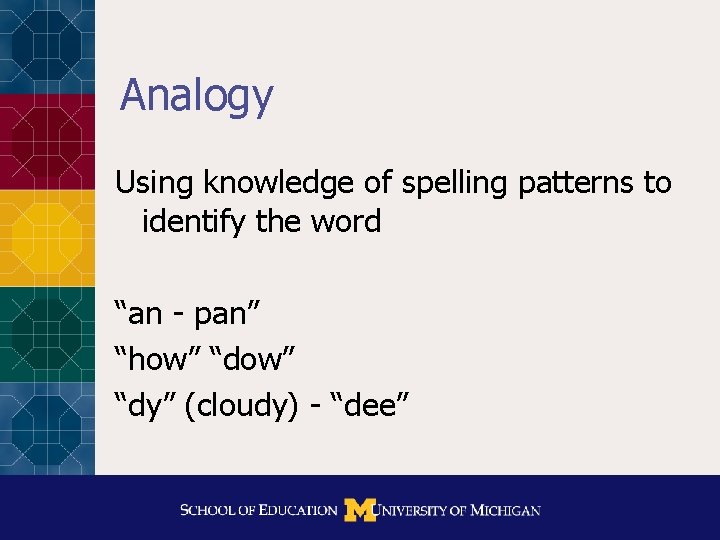
Analogy Using knowledge of spelling patterns to identify the word “an - pan” “how” “dy” (cloudy) - “dee”
Sight • Recognizing the word as they see it • Words are read from memory, not from conscious and deliberate decoding and blending
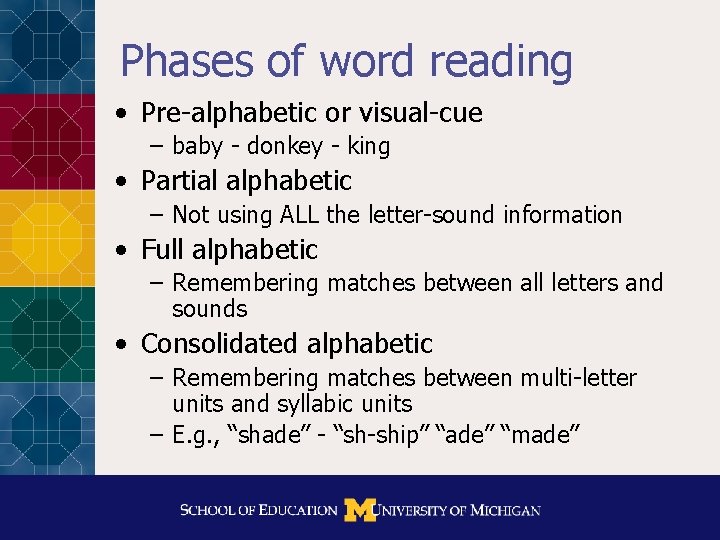
Phases of word reading • Pre-alphabetic or visual-cue – baby - donkey - king • Partial alphabetic – Not using ALL the letter-sound information • Full alphabetic – Remembering matches between all letters and sounds • Consolidated alphabetic – Remembering matches between multi-letter units and syllabic units – E. g. , “shade” - “sh-ship” “ade” “made”
Benchmark’s Word Identification Approach • Let’s focus on the practices of the teacher as she teaches her students to read unfamiliar words by analogy.
But, we’re not done yet! We need to teach for fluency
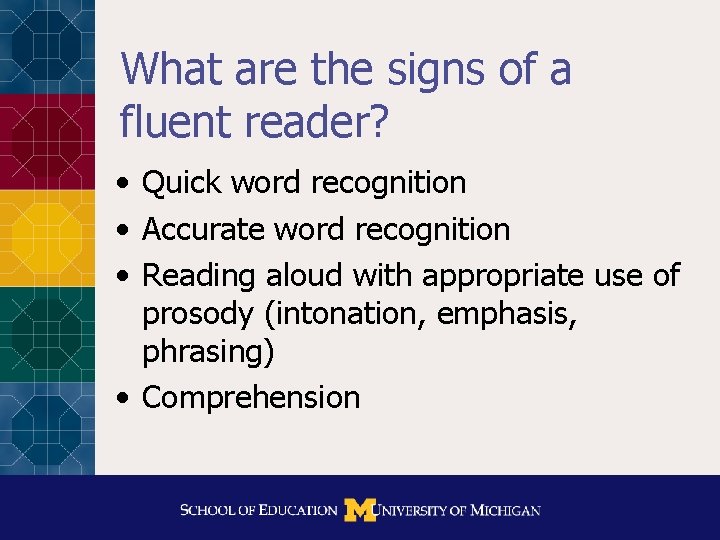
What are the signs of a fluent reader? • Quick word recognition • Accurate word recognition • Reading aloud with appropriate use of prosody (intonation, emphasis, phrasing) • Comprehension
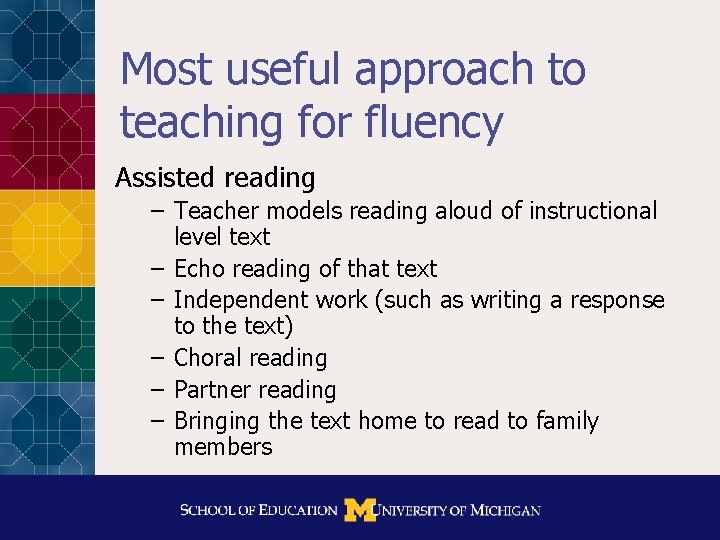
Most useful approach to teaching for fluency Assisted reading – Teacher models reading aloud of instructional level text – Echo reading of that text – Independent work (such as writing a response to the text) – Choral reading – Partner reading – Bringing the text home to read to family members