Trends in Higher Education Presentation to the Kazakh
- Slides: 33
Trends in Higher Education Presentation to the Kazakh National Medical University named after S. D. Asfendiyarov Shigeo Katsu President Nazarbayev University December 2, 2011
Outline of Presentation • Why education and skills, and in particular higher education is important • Importance for Kazakhstan within framework of “Asia 2050” • Trends in Higher Education and import for Kazakhstan – with emphasis on research universities • Nazarbayev University and its role in promoting research universities in Kazakhstan 12/02/2011 Trends in Higher Education 2
Importance of Education • Education (from ECD to tertiary education), skills, and research capabilities are increasingly tied to countries’ abilities to generate economic growth and sustain it: – “a well educated population is essential for economic and social development; societies therefore have a real interest in ensuring that children and adults have access to a wide range of educational opportunities” (OECD 2011) – “good education lies at the heart of economic growth and development” (World Bank, 2011) • But important to note that we talk about quality education leading to acquisition of skills relevant to today’s world 12/02/2011 Trends in Higher Education 3
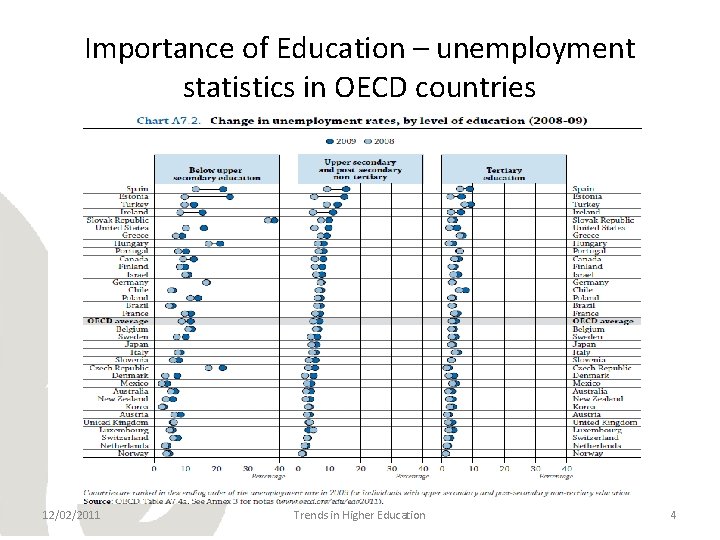
Importance of Education – unemployment statistics in OECD countries 12/02/2011 Trends in Higher Education 4
Importance of Education • Some socio-economic evidence from OECD countries: – Unemployment rates among secondary school drop-outs was 11. 5% on avg. vs. 4. 4% for university graduates (in 2009 – i. e. during crisis), adding to huge problem of youth unemployment ( > 17% in 2010) – “Cost to individuals and to society of young people leaving schools without qualifications keeps rising” (OECD SG A. Gurria) (>50% of 15 -19 year olds outside of schools are out of work) => spectre of “lost generation” – Governments need to invest in education even in difficult fiscal times: it’s about the future 12/02/2011 Trends in Higher Education 5
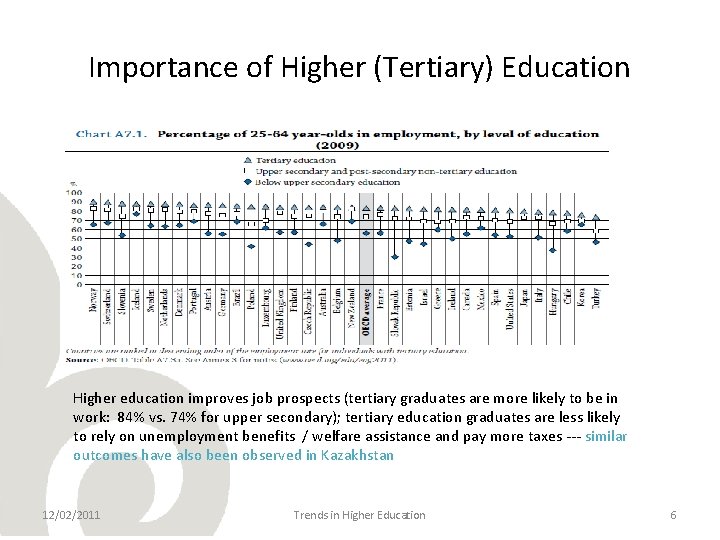
Importance of Higher (Tertiary) Education Higher education improves job prospects (tertiary graduates are more likely to be in work: 84% vs. 74% for upper secondary); tertiary education graduates are less likely to rely on unemployment benefits / welfare assistance and pay more taxes --- similar outcomes have also been observed in Kazakhstan 12/02/2011 Trends in Higher Education 6
How much do OECD countries spend on Education? • • Countries collectively spent 6. 1% of GDP on education (2008), an increase of about 1/3 over 2000, with tertiary education accounting for 1. 9% of combined GDP (Canada, Chile, Korea, Norway, and USA spent between 2. 0 and 2. 7%), and tertiary education spending keeping at least pace with GDP growth in all but 3 countries --the corresponding numbers for Kazakhstan are 4. 2% (2011), and tertiary education 0. 4% (2010) Countries spent 12. 9% of total public expenditures on education (2008), ranging from <1 O% (Czech Republic, Italy, Japan) to >20% (Mexico), on average at a ratio of 1 : 3 between tertiary and all other forms of education (ratios vary depending on the private share of higher education) Private funding(households, businesses, other) in tertiary education ranged from less than 5% (Denmark, Finland, Norway) to more than 40% (Australia, Canada, Israel, Japan, UK, USA), and even over 75% (Chile, Korea) R&D in tertiary education accounts for about 0. 4% of GDP, with higher shares in the USA, Canada, UK, Switzerland, and Nordic countries --- in Kazakhstan, total R&D expenditures are less than ¼ percent of GDP, though slated to grow to 1% by 2015 12/02/2011 Trends in Higher Education 7
Importance of Higher (Tertiary) Education • Some socio-economic evidence from OECD countries: – The earnings premium for tertiary education on average exceeds 50% compared with non-tertiary education and has in most countries been rising over the last 10 years (D > S) – Gross earnings premium (in present value ) for an individual with tertiary degree exceeds US$ 300 K (men), US$ 200 K (women) – Net financial return (in present value), i. e. private benefits (increased lifetime earnings) minus private costs (tuition fees and foregone earnings) are for women in the order of US$ 110 K, and for men close to US$175 12/02/2011 Trends in Higher Education 8
Importance of Measuring Education Outcomes (1) • PISA (OECD’s Programme for International Student Assessment) measures the quality, equity, and efficiency of school systems around the world (some 65 countries and regions): – Held every three years, most recent round in 2009 – Assesses performance of 15 year olds, in reading, mathematics, and science – The results are of concern for CIS countries in general, including for Kazakhstan: • A large proportion of 15 year olds have such poor numeracy and literacy skills that their success in the modern workplace is highly doubtful (while primary level – grade 4 assessments are positive) • As to fundamental cognitive skills, CIS education systems are adept at imparting basic skills, but not at higher order skills such as problem solving -- these are the skills sought by employers 12/02/2011 Trends in Higher Education 9
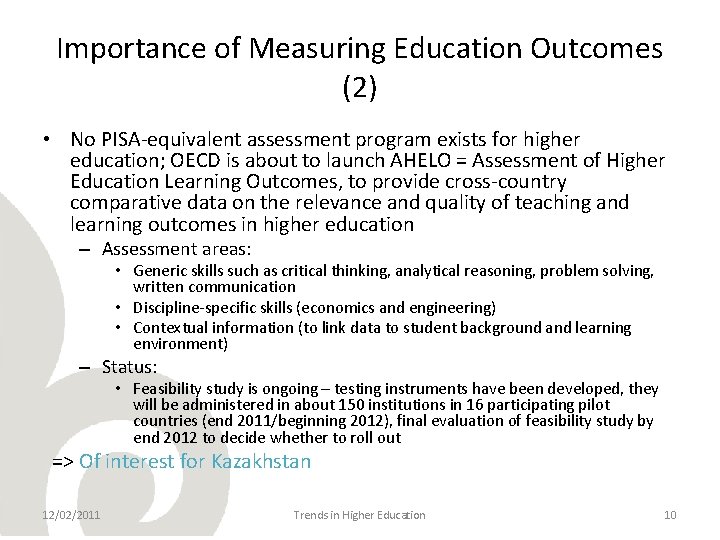
Importance of Measuring Education Outcomes (2) • No PISA-equivalent assessment program exists for higher education; OECD is about to launch AHELO = Assessment of Higher Education Learning Outcomes, to provide cross-country comparative data on the relevance and quality of teaching and learning outcomes in higher education – Assessment areas: • Generic skills such as critical thinking, analytical reasoning, problem solving, written communication • Discipline-specific skills (economics and engineering) • Contextual information (to link data to student background and learning environment) – Status: • Feasibility study is ongoing – testing instruments have been developed, they will be administered in about 150 institutions in 16 participating pilot countries (end 2011/beginning 2012), final evaluation of feasibility study by end 2012 to decide whether to roll out => Of interest for Kazakhstan 12/02/2011 Trends in Higher Education 10
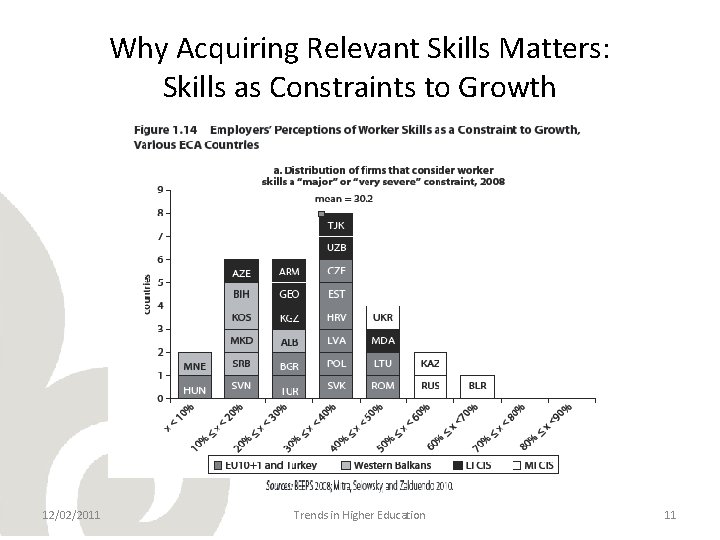
Why Acquiring Relevant Skills Matters: Skills as Constraints to Growth 12/02/2011 Trends in Higher Education 11
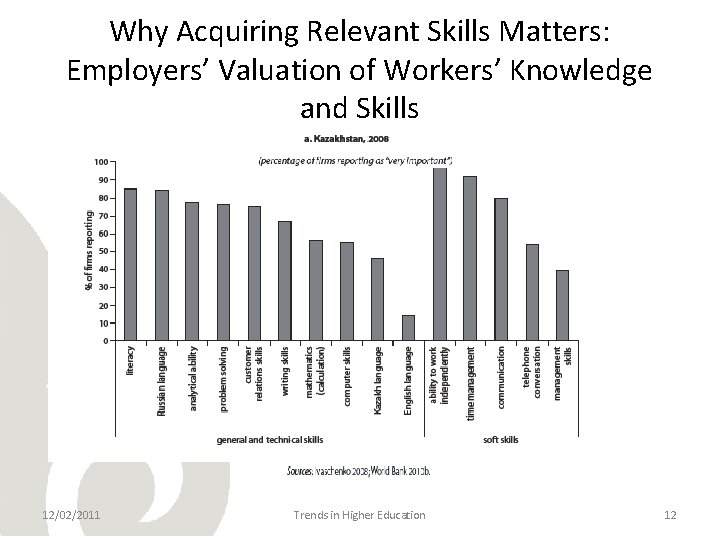
Why Acquiring Relevant Skills Matters: Employers’ Valuation of Workers’ Knowledge and Skills 12/02/2011 Trends in Higher Education 12
Now, let’s look at some additional indications of why education is important 12/02/2011 Trends in Higher Education 13
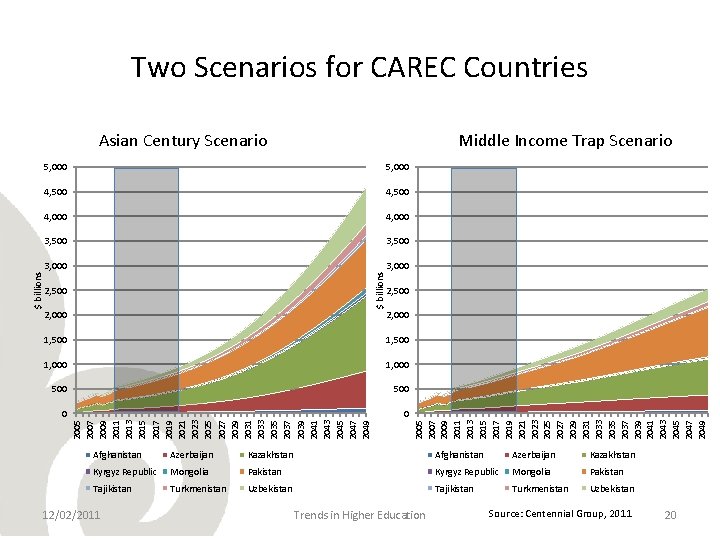
Asia 2050 – Realizing the Asian Century…. . or • By 2050 Asia could account for more than half of global trade, investment and GDP • Asia’s per capita income is up sixfold. Three billion additional Asian’s would be affluent by today’s standards • Asia regains its global economic position of 250 years ago; and there would be no poor country • GDP per capita in PPP terms would be up to $40, 900 in 2050 • Asia accounts for 52. 2 % ($175 trillion) of global GDP ($334 trillion in market ER) 12/02/2011 Trends in Higher Education 15
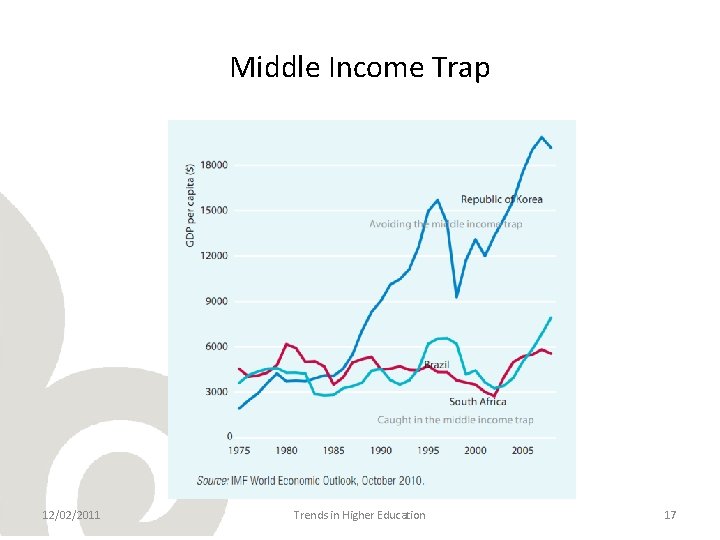
…. . Asia 2050 – Mired in the Middle Income Trap • Countries stuck in MIT – Countries enjoy short periods of growth followed by stagnation or even decline – stuck at low growth rates • GDP per capita in PPP terms would be $20, 600 in 2050, i. e. only half of that of the Asian Century scenario • Asia accounts for 31 % ($65 trillion) of global GDP ($209 trillion), i. e. just 37 % of that of the Asian Century scenario; global GDP in this scenario would only be 63% of the one under the Asian Century 12/02/2011 Trends in Higher Education 16
Middle Income Trap 12/02/2011 Trends in Higher Education 17
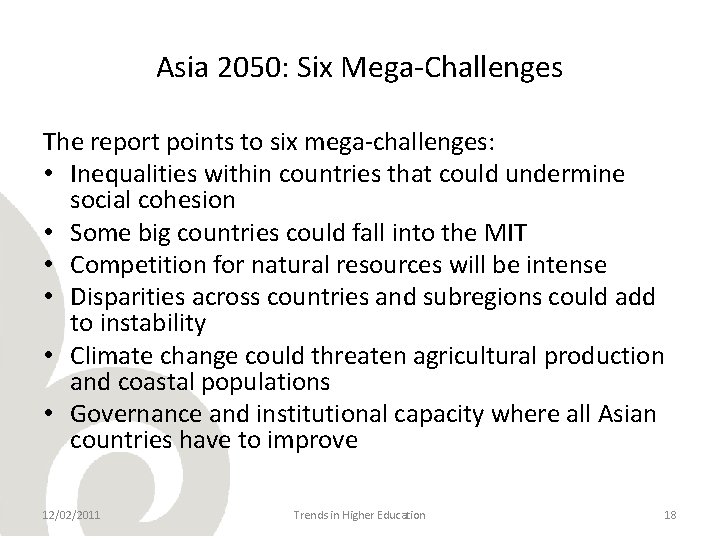
Asia 2050: Six Mega-Challenges The report points to six mega-challenges: • Inequalities within countries that could undermine social cohesion • Some big countries could fall into the MIT • Competition for natural resources will be intense • Disparities across countries and subregions could add to instability • Climate change could threaten agricultural production and coastal populations • Governance and institutional capacity where all Asian countries have to improve 12/02/2011 Trends in Higher Education 18
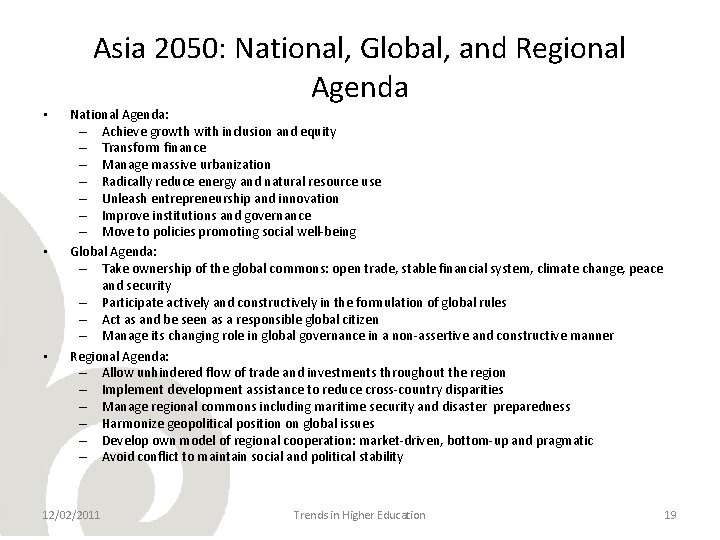
Asia 2050: National, Global, and Regional Agenda • • • National Agenda: – Achieve growth with inclusion and equity – Transform finance – Manage massive urbanization – Radically reduce energy and natural resource use – Unleash entrepreneurship and innovation – Improve institutions and governance – Move to policies promoting social well-being Global Agenda: – Take ownership of the global commons: open trade, stable financial system, climate change, peace and security – Participate actively and constructively in the formulation of global rules – Act as and be seen as a responsible global citizen – Manage its changing role in global governance in a non-assertive and constructive manner Regional Agenda: – Allow unhindered flow of trade and investments throughout the region – Implement development assistance to reduce cross-country disparities – Manage regional commons including maritime security and disaster preparedness – Harmonize geopolitical position on global issues – Develop own model of regional cooperation: market-driven, bottom-up and pragmatic – Avoid conflict to maintain social and political stability 12/02/2011 Trends in Higher Education 19
Two Scenarios for CAREC Countries Asian Century Scenario Middle Income Trap Scenario 4, 500 4, 000 3, 500 3, 000 $ billions 5, 000 2, 500 2, 000 1, 500 1, 000 500 0 0 2005 2007 2009 2011 2013 2015 2017 2019 2021 2023 2025 2027 2029 2031 2033 2035 2037 2039 2041 2043 2045 2047 2049 1, 500 2005 2007 2009 2011 2013 2015 2017 2019 2021 2023 2025 2027 2029 2031 2033 2035 2037 2039 2041 2043 2045 2047 2049 2, 000 Afghanistan Azerbaijan Kazakhstan Kyrgyz Republic Mongolia Pakistan Tajikistan Turkmenistan Uzbekistan 12/02/2011 Trends in Higher Education Source: Centennial Group, 2011 20
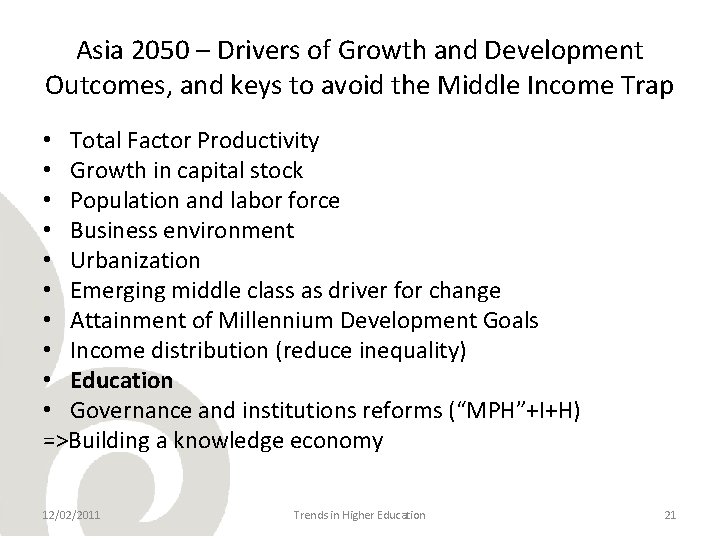
Asia 2050 – Drivers of Growth and Development Outcomes, and keys to avoid the Middle Income Trap • Total Factor Productivity • Growth in capital stock • Population and labor force • Business environment • Urbanization • Emerging middle class as driver for change • Attainment of Millennium Development Goals • Income distribution (reduce inequality) • Education • Governance and institutions reforms (“MPH”+I+H) =>Building a knowledge economy 12/02/2011 Trends in Higher Education 21
Kazakhstan and 2020 /2050 – the Challenges • • • TFP still lagging behind: How to close gap with e. g. USA (lag by 40 years) Capital Stock: in Kazakhstan, over the last 20 years, growth in capital/labor ratio has been between 2 -3%/year, compared with 5 -6% in many ASEAN countries, and 8 -9% in China, India, Vietnam; CAREC will be had pressed to close gap with rest of Asia Population and labor force: challenge of creating employment (diversification); stabilizing labor force over the next decade, implying aging population by 2030 Business environment: good progress overall, now in the top 50 according to “Doing Business 2012” (World Bank), but challenges in property rights and judicial reforms Urbanization and middle class: a key driver – demands for increased quality of life and voice will grow, challenges include investments in urban and rural infrastructure and services, institutions will matter more and more MDGs: slow on reducing child mortality rates, combating HIV/AIDS and other diseases, and ensuring environmental sustainability Inequality: absence of data is unfortunate, need more research Education and skills: skills systematically collect and analyze data on learning and employment outcomes; introduce autonomy and accountability of school systems and embrace performance – oriented management instead of input –oriented compliance monitoring systems; improve efficiency of financial resource use Governance and institutions: key enabler for meeting above challenges and to build a knowledge economy 12/02/2011 Trends in Higher Education 22
Trends in Higher Education – the Challenges of building a World Class Research University (1) (key messages from a recent (2011) World Bank research publication: “The Road to Academic Excellence - The Making of World-Class Research Universities”) • • • New institutions can have an easier path than existing ones, But even so, it will at least take several decades Three key factors have to be aligned from the beginning and maintained over a long period: – Talent; resources; governance New research universities need to present a convincing alternative to existing institutions – easier with specialization Success is fragile and entirely dependent on continued existence of the 3 key factors Research universities do not operate in a vacuum – the tertiary education ecosystem is vital: enabling public policy framework ( the three essential factors), plus vision and leadership at the national level, implementation capacity, accountability mechanism (goes together with good governance), quality assurance framework (accreditation and benchmarking), location, IT infrastructure, communication links to the secondary school system, and balancing technical skills and methodological rigor with ethical values 12/02/2011 Trends in Higher Education 23
Trends in Higher Education – the Challenges of building a World Class Research University (2) (Philip Altbach, from the same WB publication) Why research universities? Because they – stand at the center of the 21 st century global knowledge economy and technology-intensive society – are the key link between global science and scholarship and a nation’s scientific and knowledge system – produce much of the new information and analysis that lead to important advancements in science and technology, but as importantly, but also to better understanding of the human condition through the social sciences and humanities The best research universities are both – national institutions that contribute to culture, technology, and society; and – international institutions that link to global intellectual and scientific trends They are elite , complex institutions with multiple academic and societal roles Because of what they stand for, international competition is intense, and the race is on to build great research universities Nazarbayev University, created in 2010, is Kazakhstan’s entry into this global race. 12/02/2011 Trends in Higher Education 24
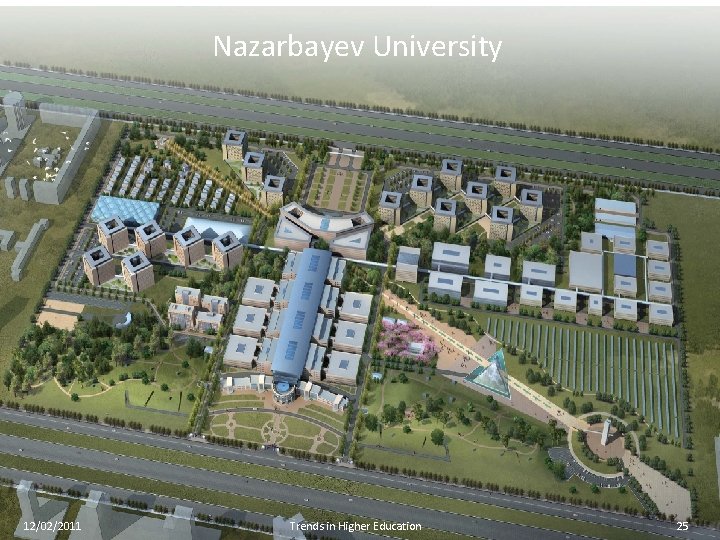
Nazarbayev University 12/02/2011 Trends in Higher Education 25
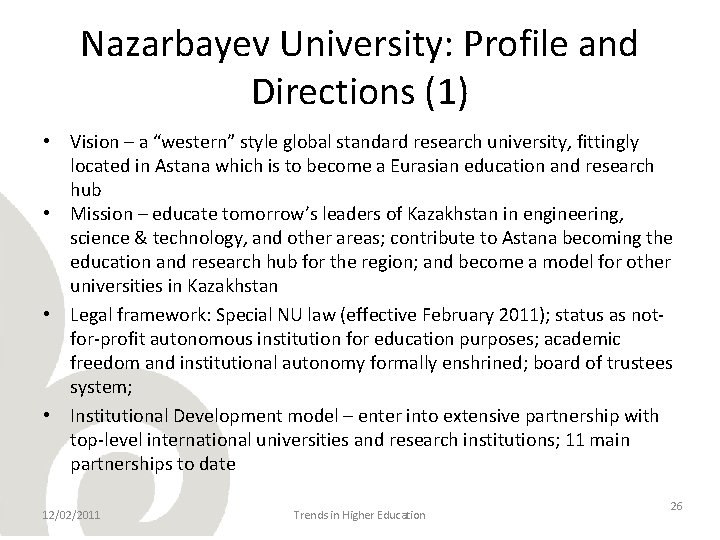
Nazarbayev University: Profile and Directions (1) • Vision – a “western” style global standard research university, fittingly located in Astana which is to become a Eurasian education and research hub • Mission – educate tomorrow’s leaders of Kazakhstan in engineering, science & technology, and other areas; contribute to Astana becoming the education and research hub for the region; and become a model for other universities in Kazakhstan • Legal framework: Special NU law (effective February 2011); status as notfor-profit autonomous institution for education purposes; academic freedom and institutional autonomy formally enshrined; board of trustees system; • Institutional Development model – enter into extensive partnership with top-level international universities and research institutions; 11 main partnerships to date 12/02/2011 Trends in Higher Education 26
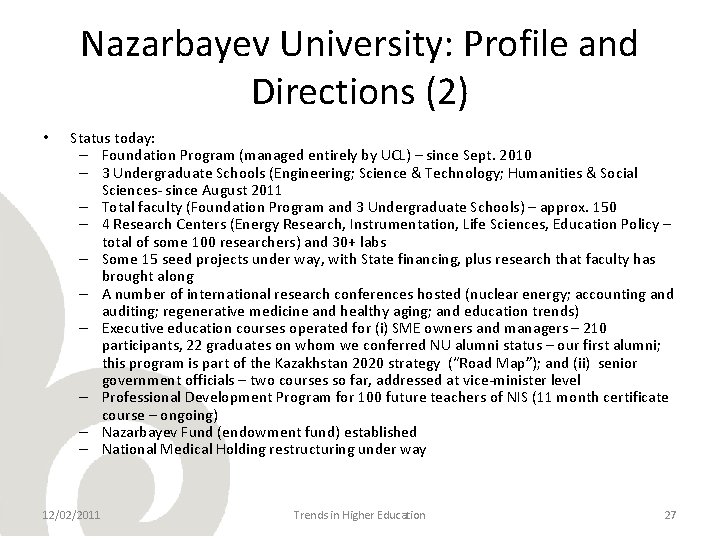
Nazarbayev University: Profile and Directions (2) • Status today: – Foundation Program (managed entirely by UCL) – since Sept. 2010 – 3 Undergraduate Schools (Engineering; Science & Technology; Humanities & Social Sciences- since August 2011 – Total faculty (Foundation Program and 3 Undergraduate Schools) – approx. 150 – 4 Research Centers (Energy Research, Instrumentation, Life Sciences, Education Policy – total of some 100 researchers) and 30+ labs – Some 15 seed projects under way, with State financing, plus research that faculty has brought along – A number of international research conferences hosted (nuclear energy; accounting and auditing; regenerative medicine and healthy aging; and education trends) – Executive education courses operated for (i) SME owners and managers – 210 participants, 22 graduates on whom we conferred NU alumni status – our first alumni; this program is part of the Kazakhstan 2020 strategy (“Road Map”); and (ii) senior government officials – two courses so far, addressed at vice-minister level – Professional Development Program for 100 future teachers of NIS (11 month certificate course – ongoing) – Nazarbayev Fund (endowment fund) established – National Medical Holding restructuring under way 12/02/2011 Trends in Higher Education 27
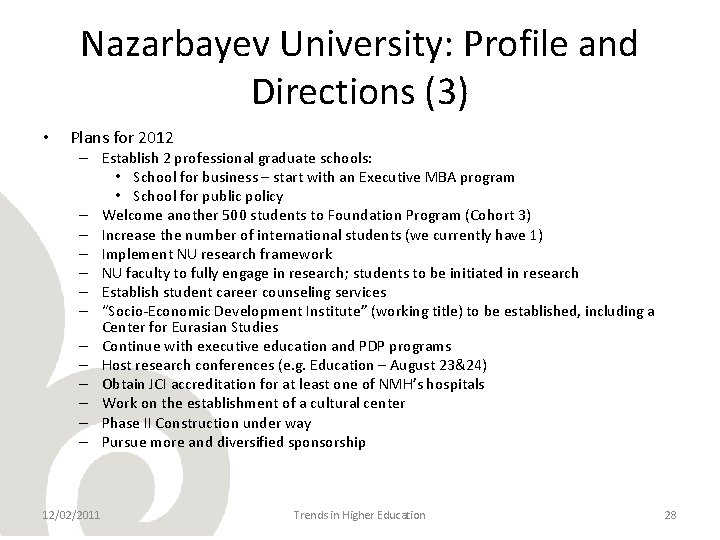
Nazarbayev University: Profile and Directions (3) • Plans for 2012 – Establish 2 professional graduate schools: • School for business – start with an Executive MBA program • School for public policy – Welcome another 500 students to Foundation Program (Cohort 3) – Increase the number of international students (we currently have 1) – Implement NU research framework – NU faculty to fully engage in research; students to be initiated in research – Establish student career counseling services – “Socio-Economic Development Institute” (working title) to be established, including a Center for Eurasian Studies – Continue with executive education and PDP programs – Host research conferences (e. g. Education – August 23&24) – Obtain JCI accreditation for at least one of NMH’s hospitals – Work on the establishment of a cultural center – Phase II Construction under way – Pursue more and diversified sponsorship 12/02/2011 Trends in Higher Education 28
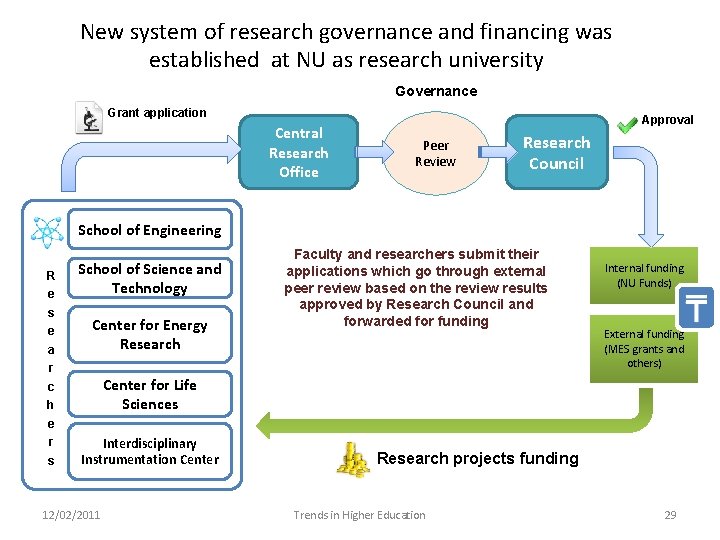
New system of research governance and financing was established at NU as research university Governance Grant application Central Research Office Approval Peer Review Research Council School of Engineering R e s e a School of Science and Technology Center for Energy Research r Faculty and researchers submit their applications which go through external peer review based on the review results approved by Research Council and forwarded for funding Internal funding (NU Funds) External funding (MES grants and others) Center for Life Sciences c h e r s Interdisciplinary Instrumentation Center 12/02/2011 Research projects funding Trends in Higher Education 29
Nazarbayev University: Profile and Directions (4) • Plans for 2013 – – – 12/02/2011 Establish a Graduate School of Education Operate graduate schools of business and public policy Welcome at least some 500 new students to NU’s FP/U-G schools Further diversify student body Launch student (and faculty) exchanges with international universities Intensify alumni-relations Continue to offer executive education and PDP courses Intensify research and conference activities JCI accreditation for at least another 2 NMH hospitals Phase II construction advanced; launch Phase III construction Pursue diversified sponsorship Trends in Higher Education 30
Nazarbayev University: Profile and Directions (5) • Plans for 2014 – – Class of 2014 – first graduates from School of Engineering Establish Graduate School of Engineering Finalize establishment preparations for NU School of Medicine Further scale up all activities mentioned in preceding year • Plans for 2015 – Class of 2015 – first graduates from Schools of Science and Technology, and School of Humanities and Social Sciences, together with Cohort 2 of School of Engineering – Establish Graduate Schools of Science and Technology, and Humanities and Social Sciences – Open NU School of Medicine and initiate NU’s integrated academic health care system (teaching, research, and clinical practice) under “Nazarbayev Medicine” brand – Further scale up all activities mentioned in preceding year 12/02/2011 Trends in Higher Education 31
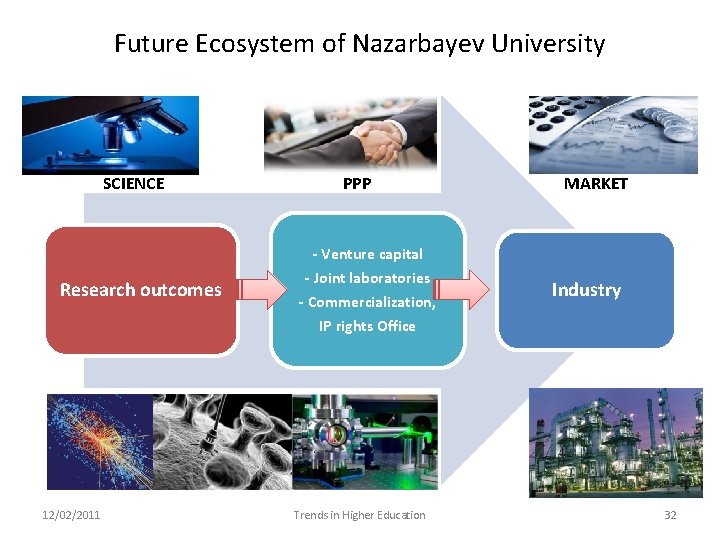
Future Ecosystem of Nazarbayev University SCIENCE Research outcomes PPP - Venture capital - Joint laboratories - Commercialization, MARKET Industry IP rights Office 12/02/2011 Trends in Higher Education 32
Thank you for your attention!