
Higher Education Access Tracker Helping member universities to
Higher Education Access Tracker Helping member universities to target, monitor and evaluate outreach programmes Sharon Smith - Director of HEAT project Email: support@heat. ac. uk, Visit: www. heat. ac. uk
Higher Education Access Tracker Session: § About HEAT § The Heat track – what is this? § HEAT track outcomes § Challenges: analysis and findings for impact evidence
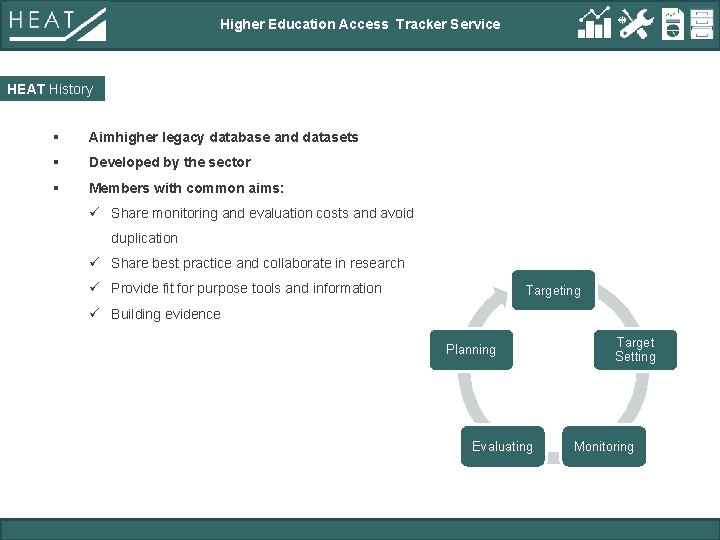
Higher Education Access Tracker Service HEAT History § Aimhigher legacy database and datasets § Developed by the sector § Members with common aims: ü Share monitoring and evaluation costs and avoid duplication ü Share best practice and collaborate in research ü Provide fit for purpose tools and information Targeting ü Building evidence Planning Evaluating Target Setting Monitoring
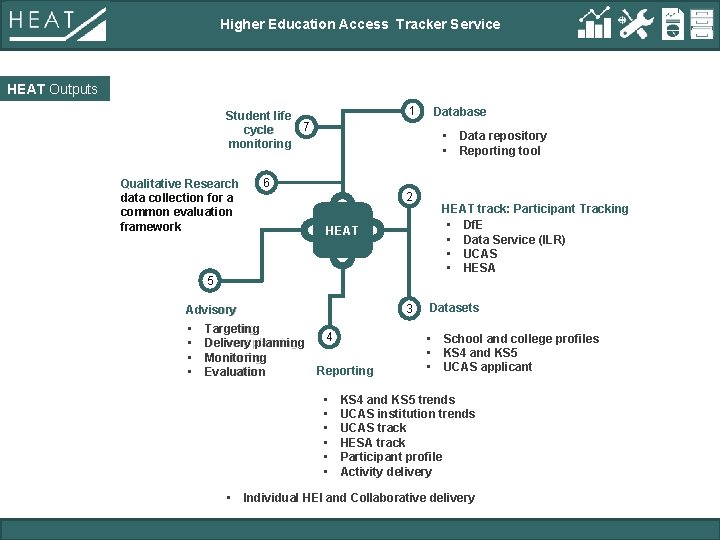
Higher Education Access Tracker Service HEAT Outputs 1 Student life 7 cycle monitoring Qualitative Research data collection for a common evaluation framework Database • • 6 2 HEAT track: Participant Tracking • Df. E • Data Service (ILR) • UCAS • HESA HEAT 5 3 Advisory • • Targeting Delivery planning Monitoring Evaluation 4 Reporting • • Data repository Reporting tool Datasets • • • School and college profiles KS 4 and KS 5 UCAS applicant KS 4 and KS 5 trends UCAS institution trends UCAS track HESA track Participant profile Activity delivery Individual HEI and Collaborative delivery
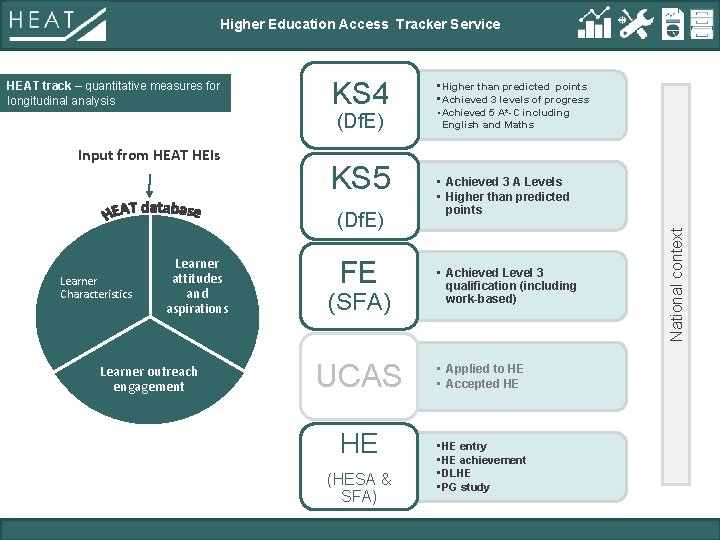
Higher Education Access Tracker Service KS 4 (Df. E) Input from HEAT HEIs KS 5 (Df. E) Learner Characteristics Learner attitudes and aspirations Learner outreach engagement FE (SFA) UCAS HE (HESA & SFA) • Higher than predicted points • Achieved 3 levels of progress • Achieved 5 A*-C including English and Maths • Achieved 3 A Levels • Higher than predicted points • Achieved Level 3 qualification (including work-based) • Applied to HE • Accepted HE • HE entry • HE achievement • DLHE • PG study National context HEAT track – quantitative measures for longitudinal analysis
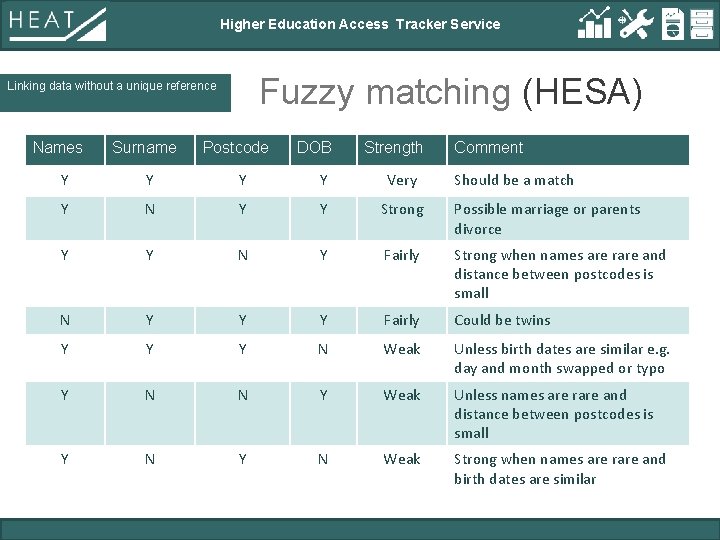
Higher Education Access Tracker Service Fuzzy matching (HESA) Linking data without a unique reference Names Surname Postcode DOB Strength Comment Y Y Very Should be a match Y N Y Y Strong Possible marriage or parents divorce Y Y N Y Fairly Strong when names are rare and distance between postcodes is small N Y Y Y Fairly Could be twins Y Y Y N Weak Unless birth dates are similar e. g. day and month swapped or typo Y N N Y Weak Unless names are rare and distance between postcodes is small Y N Weak Strong when names are rare and birth dates are similar
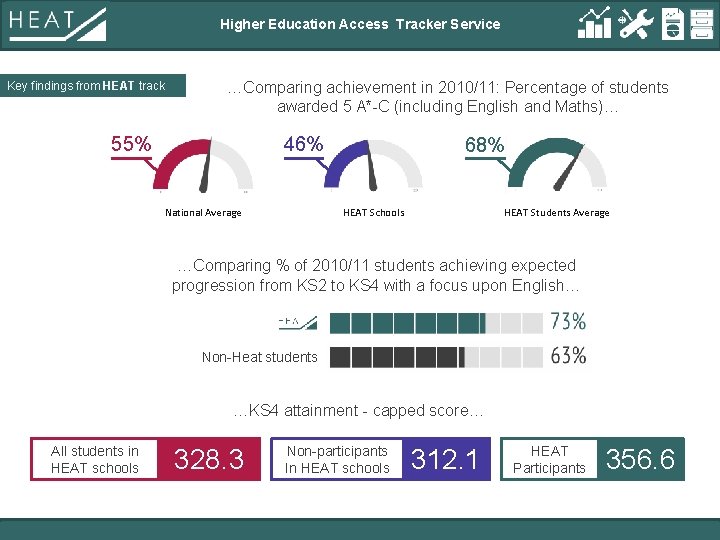
Higher Education Access Tracker Service Key findings from HEAT track …Comparing achievement in 2010/11: Percentage of students awarded 5 A*-C (including English and Maths)… 55% 46% National Average 68% HEAT Schools HEAT Students Average …Comparing % of 2010/11 students achieving expected progression from KS 2 to KS 4 with a focus upon English… Non-Heat students …KS 4 attainment - capped score… All students in HEAT schools 328. 3 Non-participants In HEAT schools 312. 1 HEAT Participants 356. 6
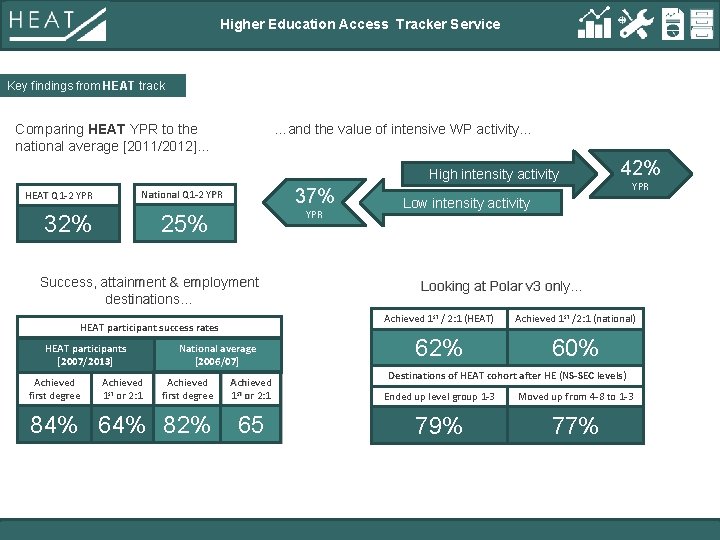
Higher Education Access Tracker Service Key findings from HEAT track Comparing HEAT YPR to the national average [2011/2012]… …and the value of intensive WP activity… High intensity activity HEAT Q 1 -2 YPR National Q 1 -2 YPR 37% 25% YPR 32% Success, attainment & employment destinations… HEAT participant success rates HEAT participants [2007/2013] Achieved first degree Achieved 1 st or 2: 1 National average [2006/07] Achieved first degree 84% 64% 82% Achieved 1 st or 2: 1 65 % 42% YPR Low intensity activity Looking at Polar v 3 only… Achieved 1 st / 2: 1 (HEAT) Achieved 1 st /2: 1 (national) 62% 60% Destinations of HEAT cohort after HE (NS-SEC levels) Ended up level group 1 -3 Moved up from 4 -8 to 1 -3 79% 77%
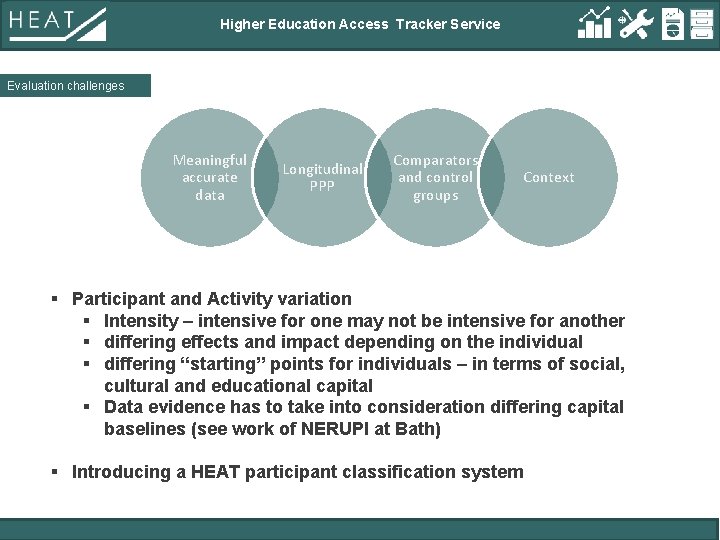
Higher Education Access Tracker Service Evaluation challenges Meaningful accurate data Longitudinal PPP Comparators and control groups Context § Participant and Activity variation § Intensity – intensive for one may not be intensive for another § differing effects and impact depending on the individual § differing “starting” points for individuals – in terms of social, cultural and educational capital § Data evidence has to take into consideration differing capital baselines (see work of NERUPI at Bath) § Introducing a HEAT participant classification system
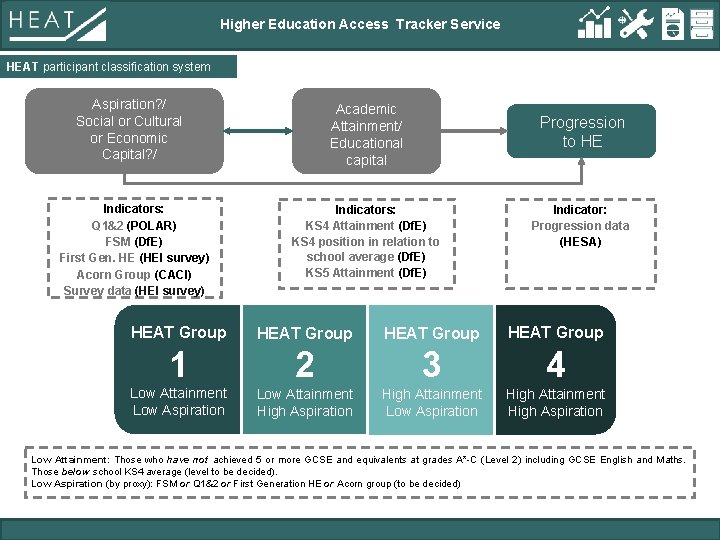
Higher Education Access Tracker Service HEAT participant classification system Aspiration? / Social or Cultural or Economic Capital? / Indicators: Q 1&2 (POLAR) FSM (Df. E) First Gen. HE (HEI survey) Acorn Group (CACI) Survey data (HEI survey) Academic Attainment/ Educational capital Progression to HE Indicators: KS 4 Attainment (Df. E) KS 4 position in relation to school average (Df. E) KS 5 Attainment (Df. E) Indicator: Progression data (HESA) HEAT Group 1 2 3 4 Low Attainment Low Aspiration Low Attainment High Aspiration High Attainment Low Aspiration High Attainment High Aspiration Low Attainment: Those who have not achieved 5 or more GCSE and equivalents at grades A*-C (Level 2) including GCSE English and Maths. Those below school KS 4 average (level to be decided). Low Aspiration (by proxy): FSM or Q 1&2 or First Generation HE or Acorn group (to be decided)
Higher Education Access Tracker Service We want to hear from you… § Collaborative research? Specific groups, themes § Test methodology? § Common evaluation questions across members § Please contact Sharon Smith or Anna Anthony on support@heat. ac. uk
- Slides: 11