Transgender Health Care and Policy Erica M Metz


- Slides: 49
Transgender Health Care and Policy Erica M. Metz, MD Medical Director for Transgender Health, Kaiser Permanente NCAL KP-GW Resident Elective in Health Policy October 24, 2017 1
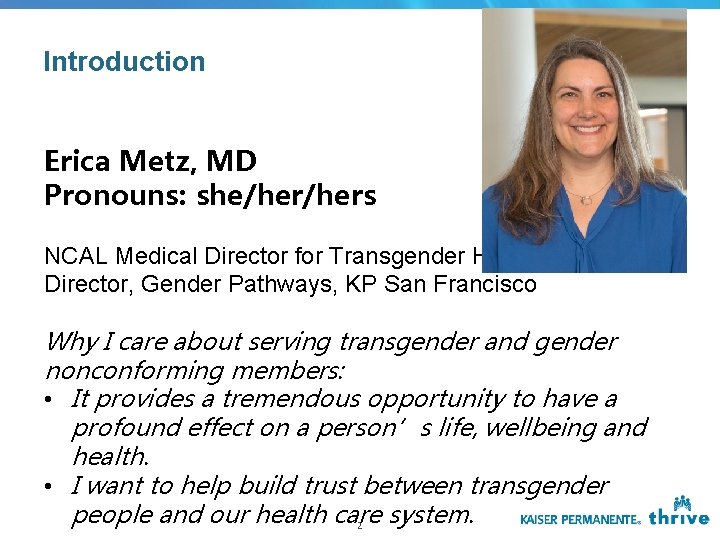
Introduction Erica Metz, MD Pronouns: she/hers NCAL Medical Director for Transgender Health Director, Gender Pathways, KP San Francisco Why I care about serving transgender and gender nonconforming members: • It provides a tremendous opportunity to have a profound effect on a person’s life, wellbeing and health. • I want to help build trust between transgender people and our health care system. 2
Objectives 1. Become familiar with definitions and terminology related to gender identity. 2. Explore health disparities that transgender and gender nonconforming people face. 3. Discuss how recent state and federal health policy changes affect transgender people and KP benefits and care. 4. Develop skills to provide sensitive and respectful care to transgender and gender nonconforming patients. Fifth Agenda 3
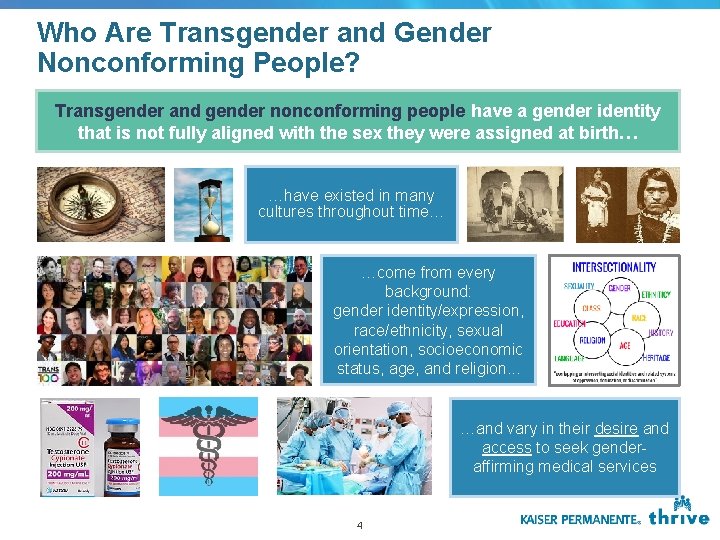
Who Are Transgender and Gender Nonconforming People? Transgender and gender nonconforming people have a gender identity that is not fully aligned with the sex they were assigned at birth… …have existed in many cultures throughout time… …come from every background: gender identity/expression, race/ethnicity, sexual orientation, socioeconomic status, age, and religion. . . …and vary in their desire and access to seek genderaffirming medical services 4
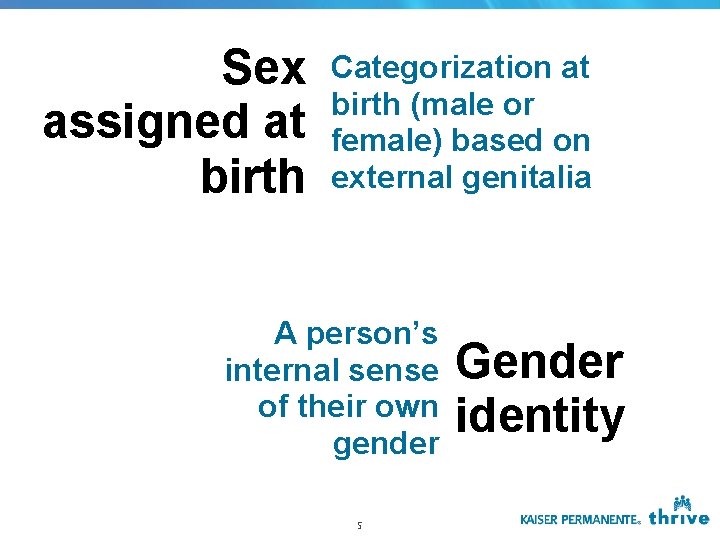
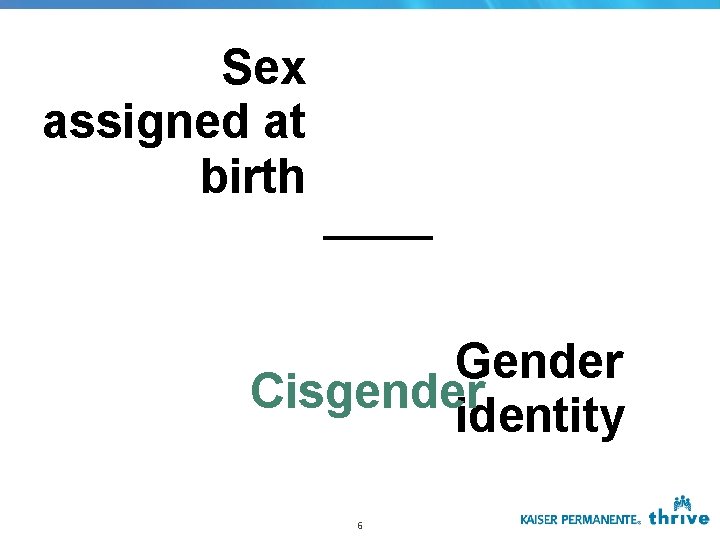
Sex assigned at birth Categorization at birth (male or female) based on external genitalia A person’s internal sense of their own gender 5 Gender identity
Sex assigned at birth Gender Cisgender identity 6
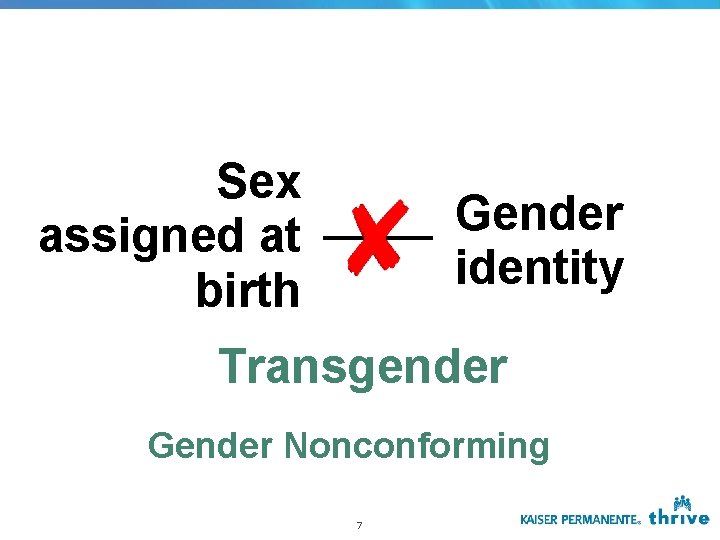
Sex assigned at birth Gender identity Transgender Gender Nonconforming 7
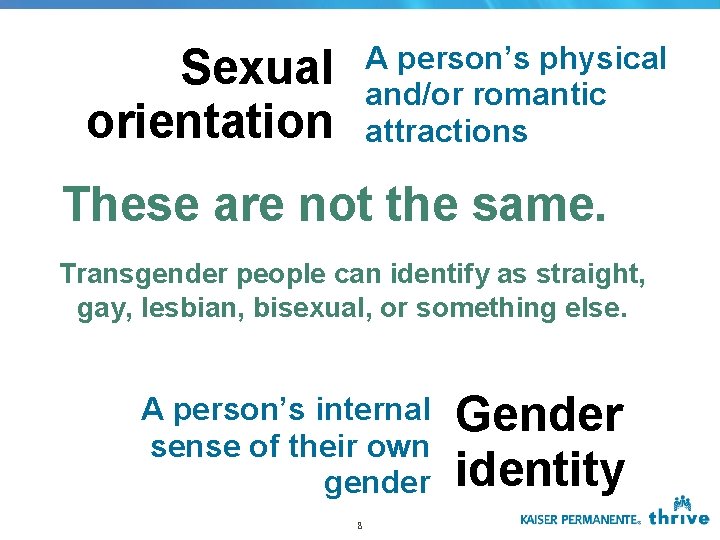
A person’s physical and/or romantic attractions Sexual orientation These are not the same. Transgender people can identify as straight, gay, lesbian, bisexual, or something else. A person’s internal sense of their own gender 8 Gender identity
Objectives 1. Become familiar with definitions and terminology related to gender identity. 2. Explore health disparities that transgender and gender nonconforming people face. 3. Discuss how recent state and federal health policy changes affect transgender people and KP benefits and care. 4. Develop skills to provide sensitive and respectful care to transgender and gender nonconforming patients. Fifth Agenda 9
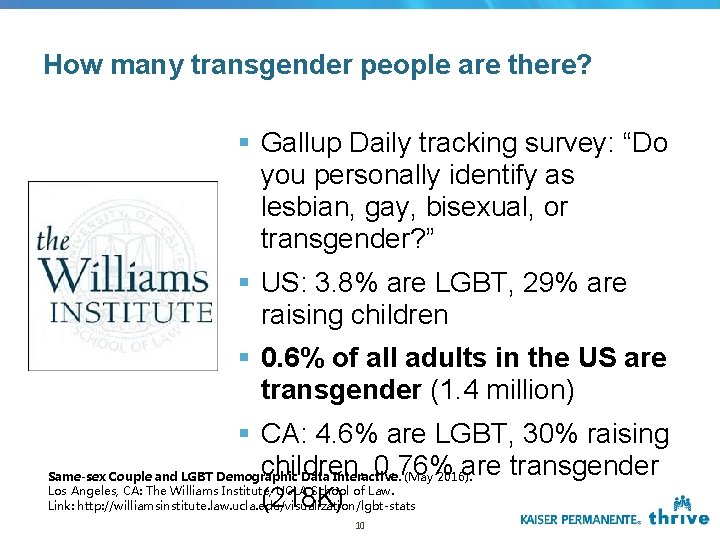
How many transgender people are there? § Gallup Daily tracking survey: “Do you personally identify as lesbian, gay, bisexual, or transgender? ” § US: 3. 8% are LGBT, 29% are raising children § 0. 6% of all adults in the US are transgender (1. 4 million) § CA: 4. 6% are LGBT, 30% raising children, 0. 76% are transgender Same-sex Couple and LGBT Demographic Data Interactive. (May 2016). Los Angeles, CA: The Williams Institute, UCLA School of Law. (218 K) Link: http: //williamsinstitute. law. ucla. edu/visualization/lgbt-stats 10
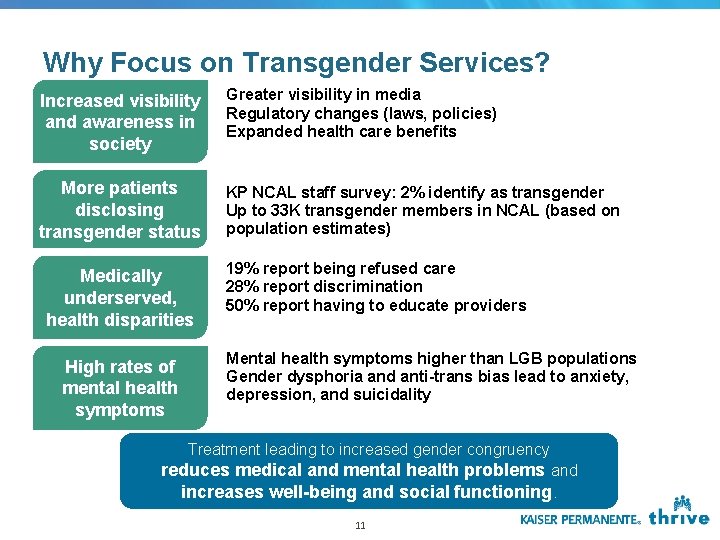
Why Focus on Transgender Services? Increased visibility and awareness in society Greater visibility in media Regulatory changes (laws, policies) Expanded health care benefits More patients disclosing transgender status KP NCAL staff survey: 2% identify as transgender Up to 33 K transgender members in NCAL (based on population estimates) Medically underserved, health disparities High rates of mental health symptoms 19% report being refused care 28% report discrimination 50% report having to educate providers Mental health symptoms higher than LGB populations Gender dysphoria and anti-trans bias lead to anxiety, depression, and suicidality Treatment leading to increased gender congruency reduces medical and mental health problems and increases well-being and social functioning. 11
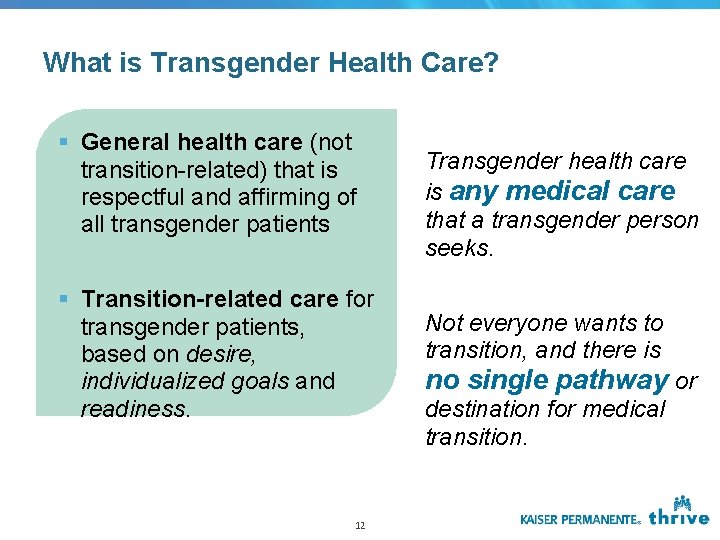
What is Transgender Health Care? § General health care (not transition-related) that is respectful and affirming of all transgender patients § Transition-related care for transgender patients, based on desire, individualized goals and readiness. 12 Transgender health care is any medical care that a transgender person seeks. Not everyone wants to transition, and there is no single pathway or destination for medical transition.
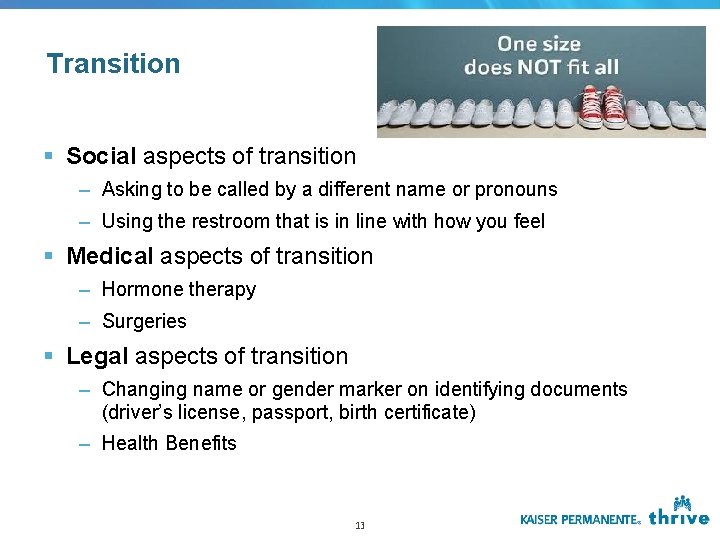
Transition § Social aspects of transition – Asking to be called by a different name or pronouns – Using the restroom that is in line with how you feel § Medical aspects of transition – Hormone therapy – Surgeries § Legal aspects of transition – Changing name or gender marker on identifying documents (driver’s license, passport, birth certificate) – Health Benefits 13
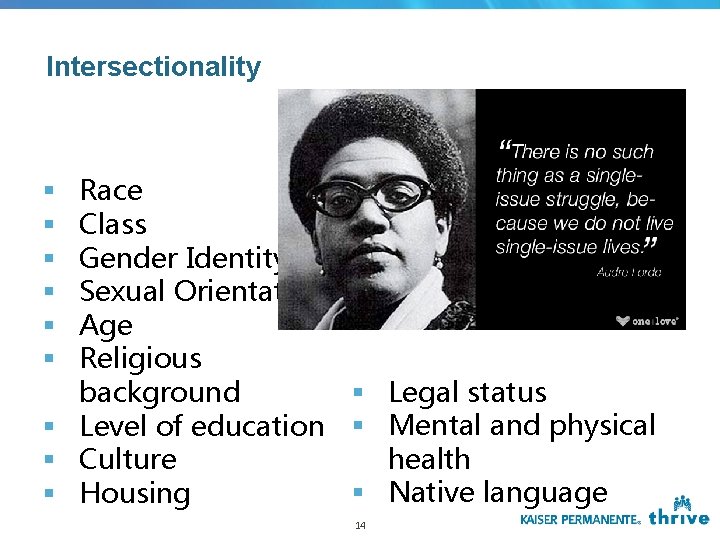
Intersectionality Race Class Gender Identity Sexual Orientation Age Religious § Legal status background § Level of education § Mental and physical health § Culture § Native language § Housing § § § 14
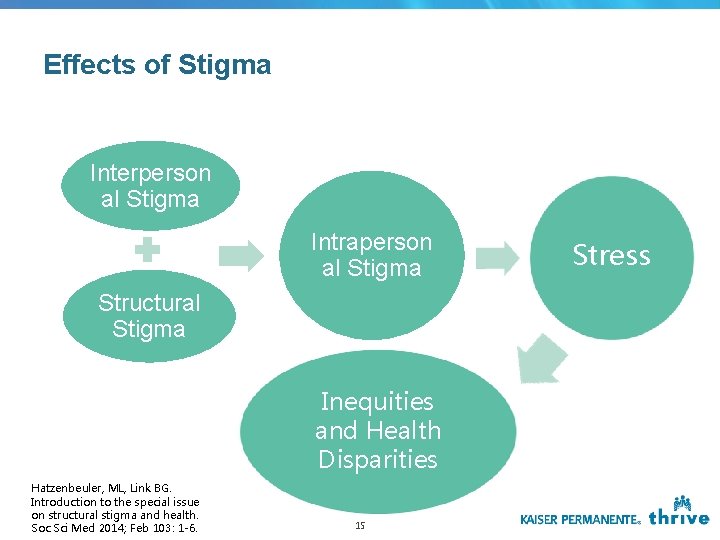
Effects of Stigma Interperson al Stigma Intraperson al Stigma Structural Stigma Inequities and Health Disparities Hatzenbeuler, ML, Link BG. Introduction to the special issue on structural stigma and health. Soc Sci Med 2014; Feb 103: 1 -6. 15 Stress
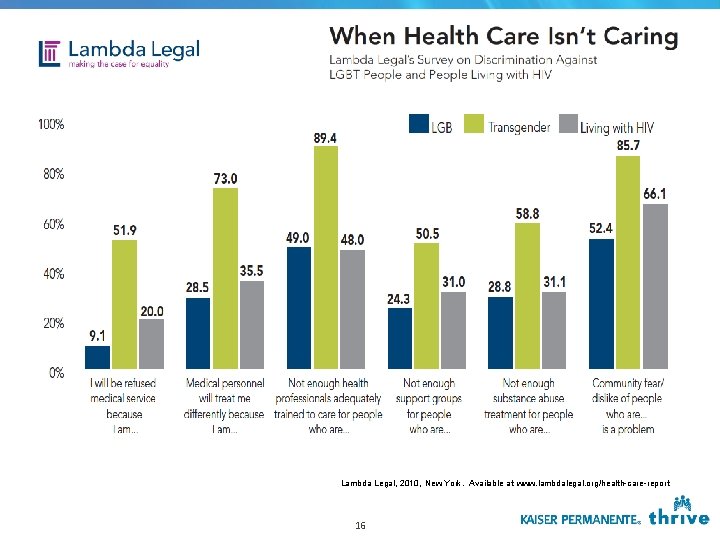
Lambda Legal, 2010, New York. Available at www. lambdalegal. org/health-care-report 16
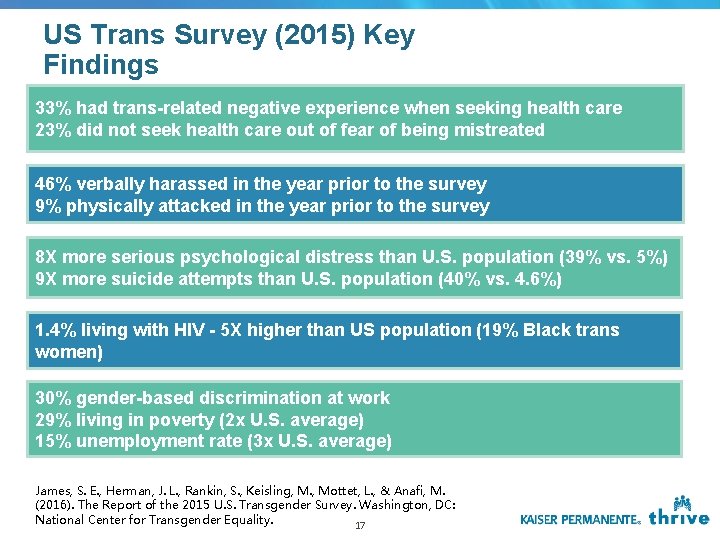
US Trans Survey (2015) Key Findings 33% had trans-related negative experience when seeking health care 23% did not seek health care out of fear of being mistreated 46% verbally harassed in the year prior to the survey 9% physically attacked in the year prior to the survey 8 X more serious psychological distress than U. S. population (39% vs. 5%) 9 X more suicide attempts than U. S. population (40% vs. 4. 6%) 1. 4% living with HIV - 5 X higher than US population (19% Black trans women) 30% gender-based discrimination at work 29% living in poverty (2 x U. S. average) 15% unemployment rate (3 x U. S. average) James, S. E. , Herman, J. L. , Rankin, S. , Keisling, M. , Mottet, L. , & Anafi, M. (2016). The Report of the 2015 U. S. Transgender Survey. Washington, DC: National Center for Transgender Equality. 17
Objectives 1. Become familiar with definitions and terminology related to gender identity. 2. Explore health disparities that transgender and gender nonconforming people face. 3. Discuss how recent state and federal health policy changes affect transgender people and KP benefits and care. 4. Develop skills to provide sensitive and respectful care to transgender and gender nonconforming patients. Fifth Agenda 18
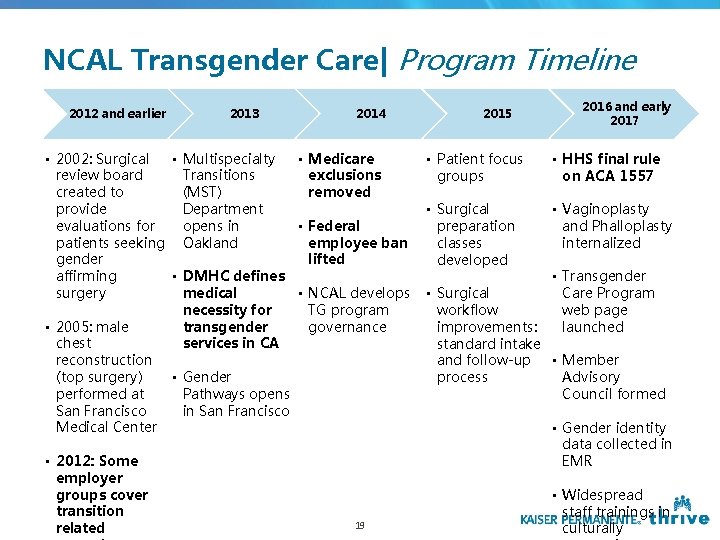
NCAL Transgender Care| Program Timeline 2013 2012 and earlier • 2002: Surgical • review board created to provide evaluations for patients seeking gender • affirming surgery • 2005: male chest reconstruction (top surgery) performed at San Francisco Medical Center • 2012: Some employer groups cover transition related Multispecialty Transitions (MST) Department opens in Oakland 2014 • Medicare exclusions removed • Federal employee ban lifted 2015 2016 and early 2017 • Patient focus groups • HHS final rule on ACA 1557 • Surgical preparation classes developed • Vaginoplasty and Phalloplasty internalized DMHC defines • Transgender medical • NCAL develops • Surgical Care Program necessity for TG program web page workflow transgender governance launched improvements: services in CA standard intake and follow-up • Member • Gender Advisory process Pathways opens Council formed in San Francisco • Gender identity data collected in EMR 19 • Widespread staff trainings in culturally
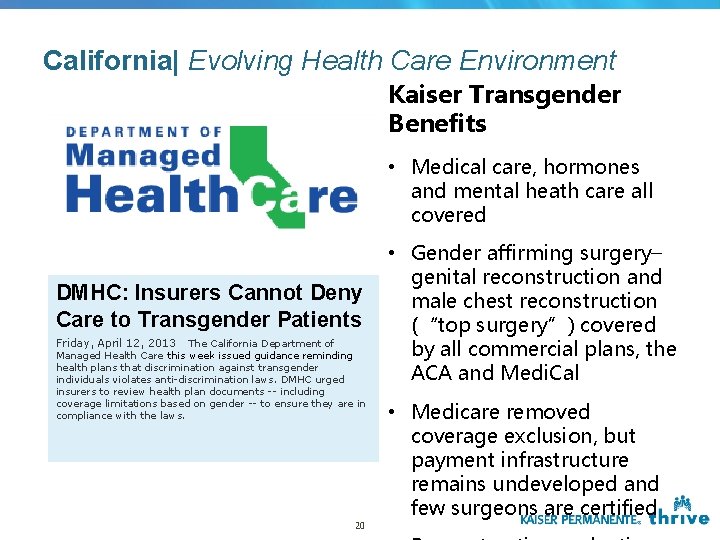
California| Evolving Health Care Environment Kaiser Transgender Benefits • Medical care, hormones and mental heath care all covered DMHC: Insurers Cannot Deny Care to Transgender Patients Friday, April 12, 2013 The California Department of Managed Health Care this week issued guidance reminding health plans that discrimination against transgender individuals violates anti-discrimination laws. DMHC urged insurers to review health plan documents -- including coverage limitations based on gender -- to ensure they are in compliance with the laws. 20 • Gender affirming surgery– genital reconstruction and male chest reconstruction (“top surgery”) covered by all commercial plans, the ACA and Medi. Cal • Medicare removed coverage exclusion, but payment infrastructure remains undeveloped and few surgeons are certified
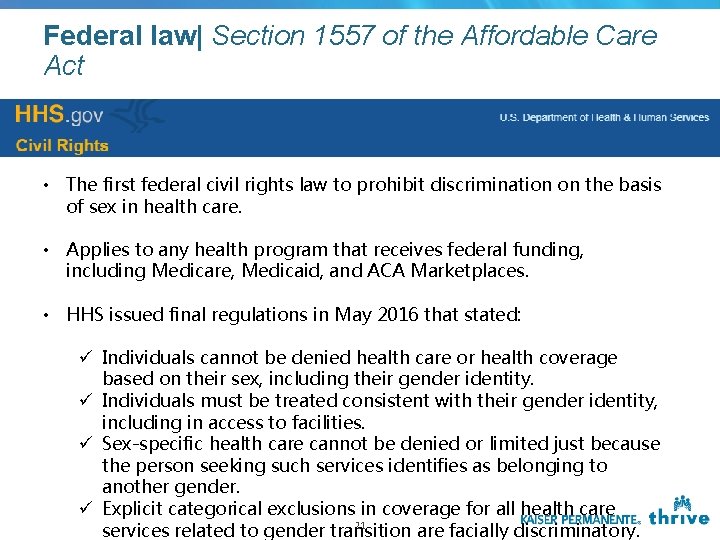
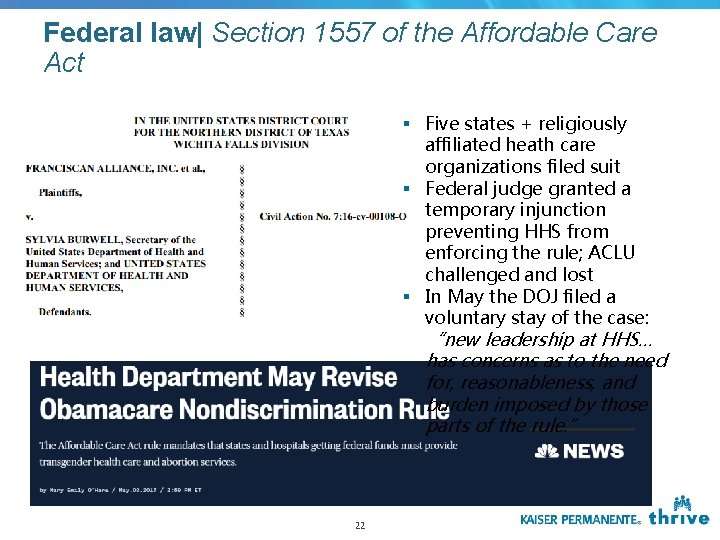
Federal law| Section 1557 of the Affordable Care Act • The first federal civil rights law to prohibit discrimination on the basis of sex in health care. • Applies to any health program that receives federal funding, including Medicare, Medicaid, and ACA Marketplaces. • HHS issued final regulations in May 2016 that stated: ü Individuals cannot be denied health care or health coverage based on their sex, including their gender identity. ü Individuals must be treated consistent with their gender identity, including in access to facilities. ü Sex-specific health care cannot be denied or limited just because the person seeking such services identifies as belonging to another gender. ü Explicit categorical exclusions in coverage for all health care 21 services related to gender transition are facially discriminatory.
Federal law| Section 1557 of the Affordable Care Act § Five states + religiously affiliated heath care organizations filed suit § Federal judge granted a temporary injunction preventing HHS from enforcing the rule; ACLU challenged and lost § In May the DOJ filed a voluntary stay of the case: “new leadership at HHS… has concerns as to the need for, reasonableness, and burden imposed by those parts of the rule. ” 22
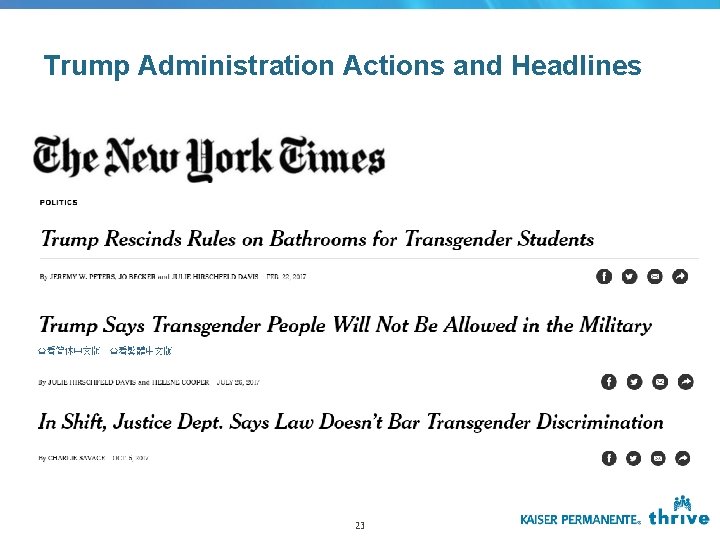
Trump Administration Actions and Headlines 23
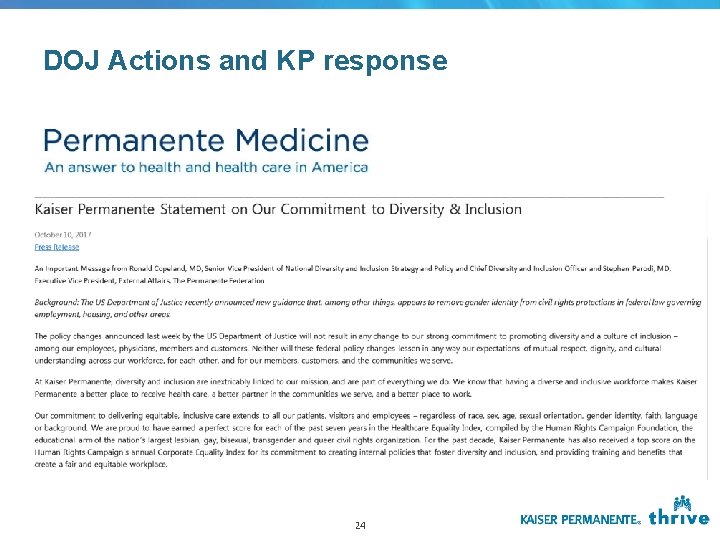
DOJ Actions and KP response 24
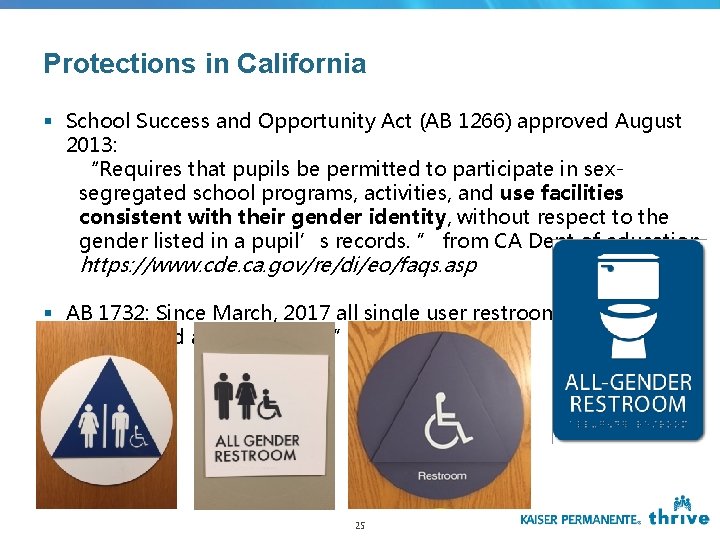
Protections in California § School Success and Opportunity Act (AB 1266) approved August 2013: “Requires that pupils be permitted to participate in sexsegregated school programs, activities, and use facilities consistent with their gender identity, without respect to the gender listed in a pupil’s records. ” from CA Dept of education https: //www. cde. ca. gov/re/di/eo/faqs. asp § AB 1732: Since March, 2017 all single user restrooms must be labeled as “all gender” facilities 25
Objectives 1. Become familiar with definitions and terminology related to gender identity. 2. Explore health disparities that transgender and gender nonconforming people face. 3. Discuss how recent state and federal health policy changes affect transgender people and KP benefits and care. 4. Develop skills to provide sensitive and respectful care to transgender and gender nonconforming patients. Fifth Agenda 26
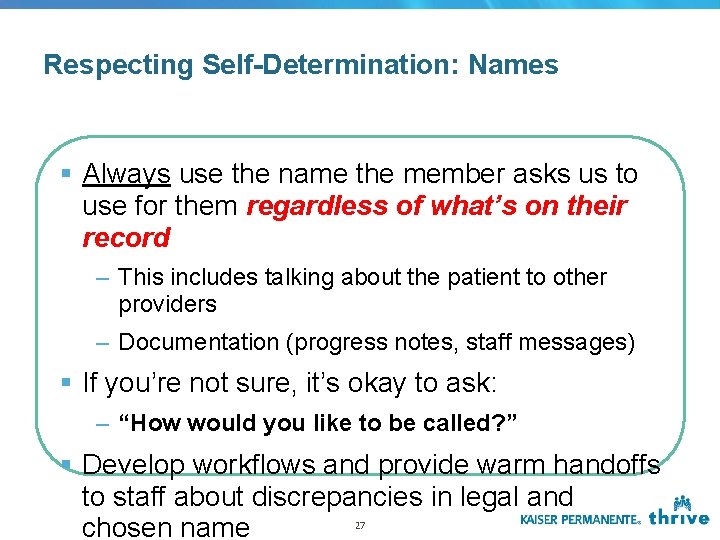
Respecting Self-Determination: Names § Always use the name the member asks us to use for them regardless of what’s on their record – This includes talking about the patient to other providers – Documentation (progress notes, staff messages) § If you’re not sure, it’s okay to ask: – “How would you like to be called? ” § Develop workflows and provide warm handoffs to staff about discrepancies in legal and chosen name 27
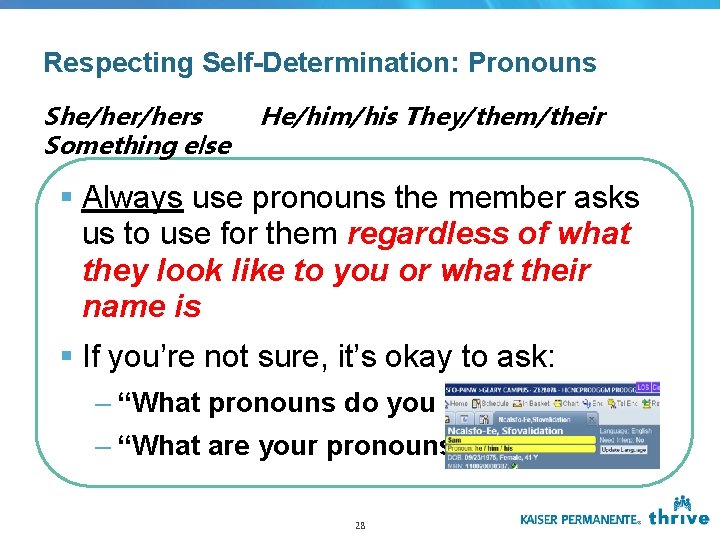
Respecting Self-Determination: Pronouns She/hers Something else He/him/his They/them/their § Always use pronouns the member asks us to use for them regardless of what they look like to you or what their name is § If you’re not sure, it’s okay to ask: – “What pronouns do you use? ” – “What are your pronouns” 28
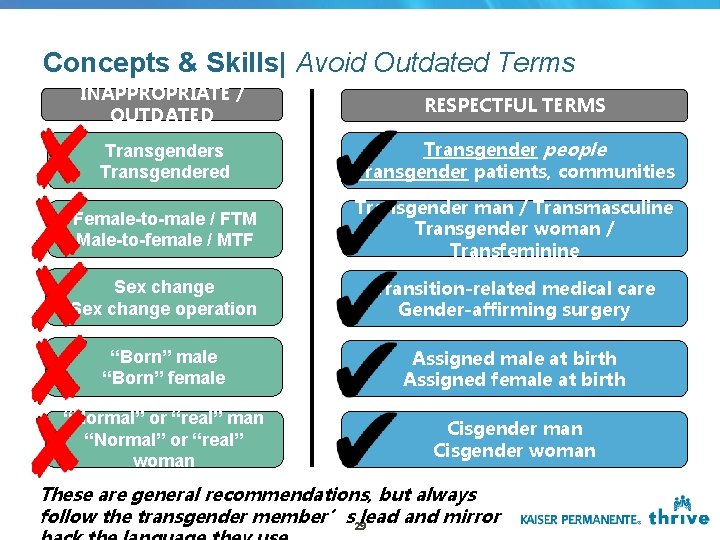
Concepts & Skills| Avoid Outdated Terms INAPPROPRIATE / OUTDATED RESPECTFUL TERMS Transgenders Transgendered Transgender people Transgender patients, communities Female-to-male / FTM Male-to-female / MTF Transgender man / Transmasculine Transgender woman / Transfeminine Sex change operation Transition-related medical care Gender-affirming surgery “Born” male “Born” female Assigned male at birth Assigned female at birth “Normal” or “real” man “Normal” or “real” woman Cisgender woman These are general recommendations, but always follow the transgender member’s 29 lead and mirror
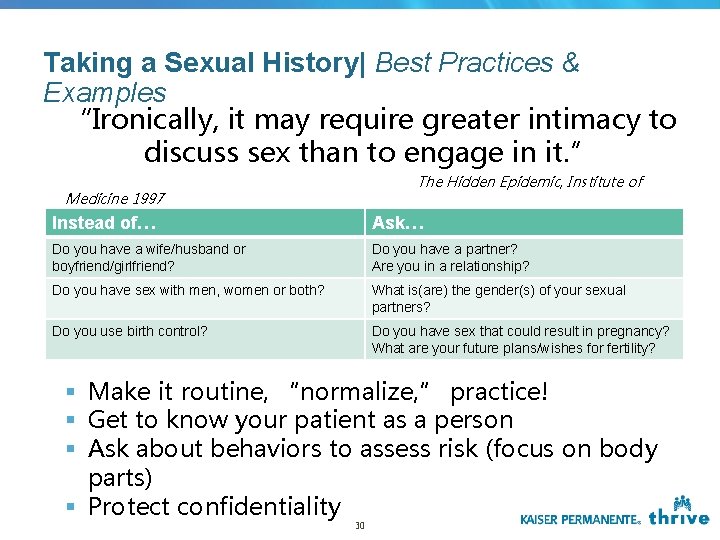
Taking a Sexual History| Best Practices & Examples “Ironically, it may require greater intimacy to discuss sex than to engage in it. ” Medicine 1997 The Hidden Epidemic, Institute of Instead of… Ask… Do you have a wife/husband or boyfriend/girlfriend? Do you have a partner? Are you in a relationship? Do you have sex with men, women or both? What is(are) the gender(s) of your sexual partners? Do you use birth control? Do you have sex that could result in pregnancy? What are your future plans/wishes for fertility? § Make it routine, “normalize, ” practice! § Get to know your patient as a person § Ask about behaviors to assess risk (focus on body parts) § Protect confidentiality 30
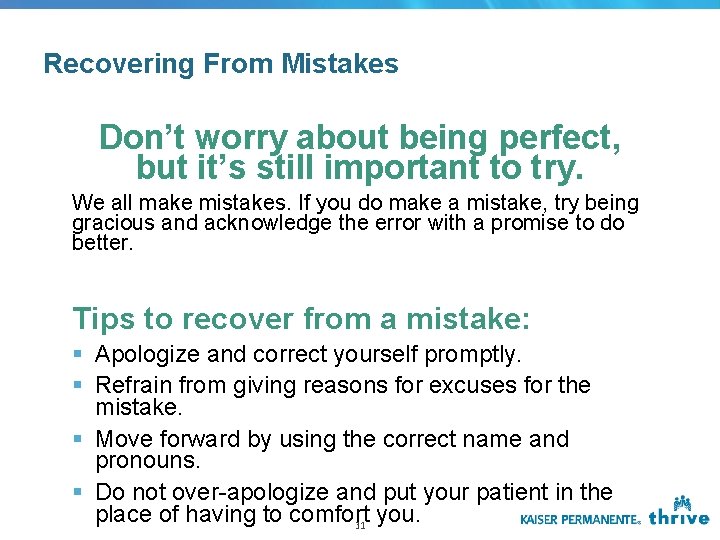
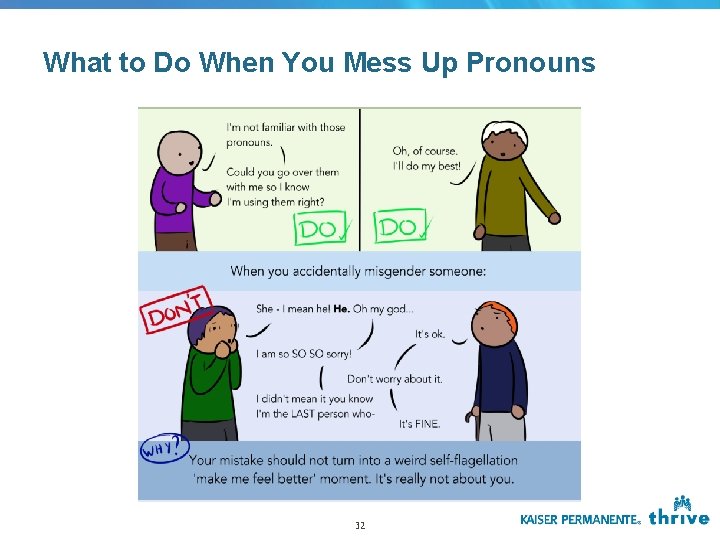
Recovering From Mistakes Don’t worry about being perfect, but it’s still important to try. We all make mistakes. If you do make a mistake, try being gracious and acknowledge the error with a promise to do better. Tips to recover from a mistake: § Apologize and correct yourself promptly. § Refrain from giving reasons for excuses for the mistake. § Move forward by using the correct name and pronouns. § Do not over-apologize and put your patient in the place of having to comfort you. 31
What to Do When You Mess Up Pronouns 32
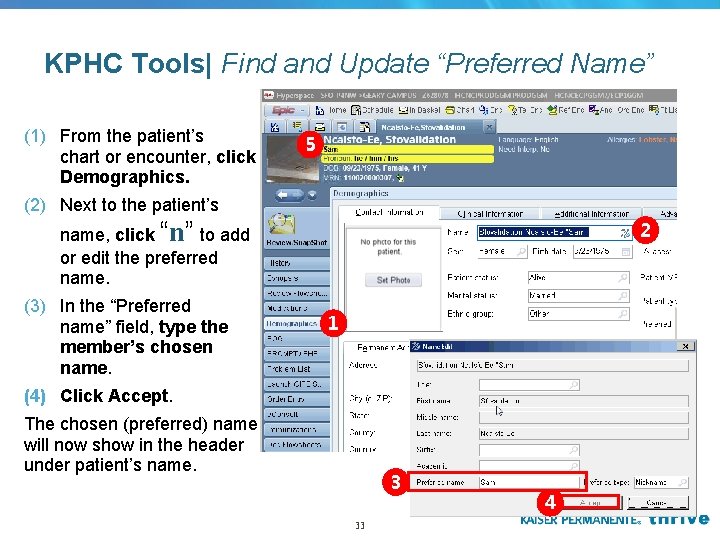
KPHC Tools| Find and Update “Preferred Name” (1) From the patient’s chart or encounter, click Demographics. 5 (2) Next to the patient’s name, click “n” to add or edit the preferred name. (3) In the “Preferred name” field, type the member’s chosen name. 2 1 (4) Click Accept. The chosen (preferred) name will now show in the header under patient’s name. 3 33 4
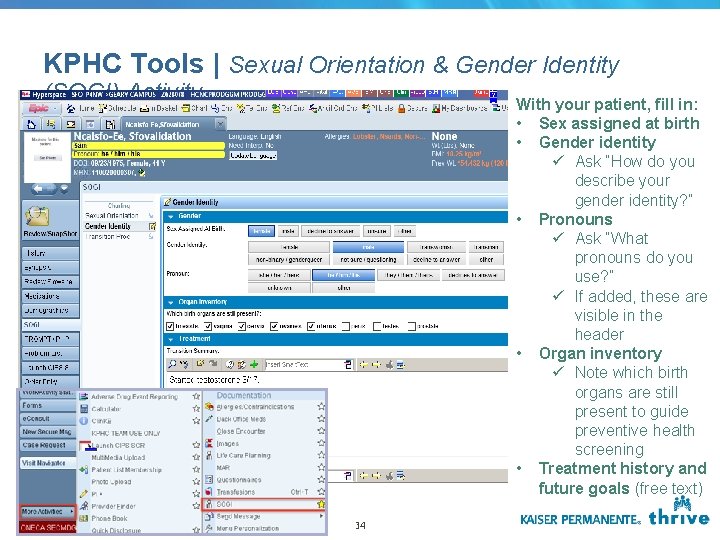
KPHC Tools | Sexual Orientation & Gender Identity (SOGI) Activity With your patient, fill in: • Sex assigned at birth • Gender identity ü Ask “How do you describe your gender identity? ” • Pronouns ü Ask “What pronouns do you use? ” ü If added, these are visible in the header • Organ inventory ü Note which birth organs are still present to guide preventive health screening • Treatment history and future goals (free text) 34
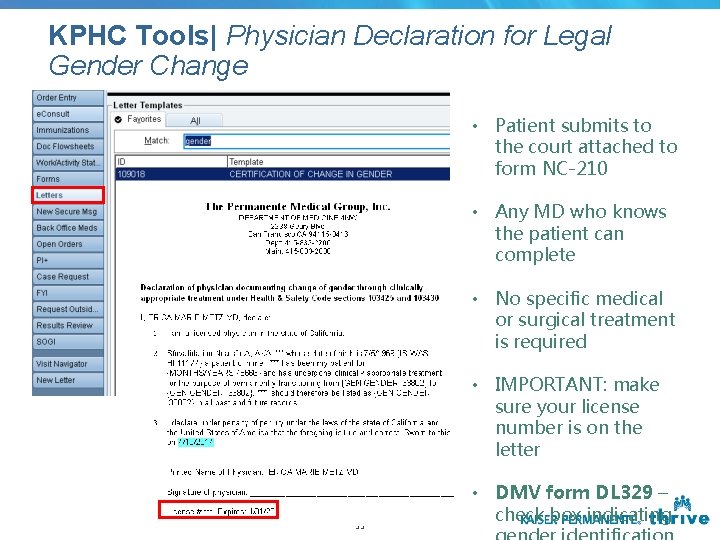
KPHC Tools| Physician Declaration for Legal Gender Change • Patient submits to the court attached to form NC-210 • Any MD who knows the patient can complete • No specific medical or surgical treatment is required • IMPORTANT: make sure your license number is on the letter 35 • DMV form DL 329 – check box indicating
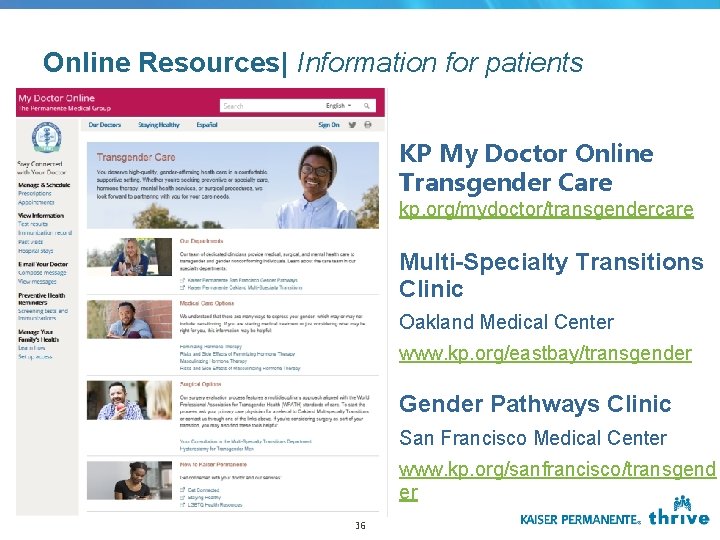
Online Resources| Information for patients KP My Doctor Online Transgender Care kp. org/mydoctor/transgendercare Multi-Specialty Transitions Clinic Oakland Medical Center www. kp. org/eastbay/transgender Gender Pathways Clinic San Francisco Medical Center www. kp. org/sanfrancisco/transgend er 36
Appendix 37
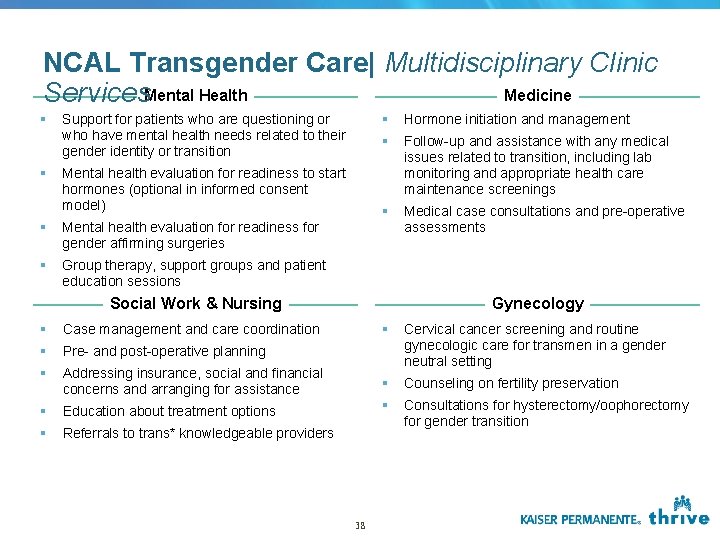
NCAL Transgender Care| Multidisciplinary Clinic Medicine Services. Mental Health § § Support for patients who are questioning or who have mental health needs related to their gender identity or transition Mental health evaluation for readiness to start hormones (optional in informed consent model) § Mental health evaluation for readiness for gender affirming surgeries § Group therapy, support groups and patient education sessions § Hormone initiation and management § Follow-up and assistance with any medical issues related to transition, including lab monitoring and appropriate health care maintenance screenings § Medical case consultations and pre-operative assessments Social Work & Nursing § Case management and care coordination § Pre- and post-operative planning § Addressing insurance, social and financial concerns and arranging for assistance § Education about treatment options § Referrals to trans* knowledgeable providers Gynecology 38 § Cervical cancer screening and routine gynecologic care for transmen in a gender neutral setting § Counseling on fertility preservation § Consultations for hysterectomy/oophorectomy for gender transition
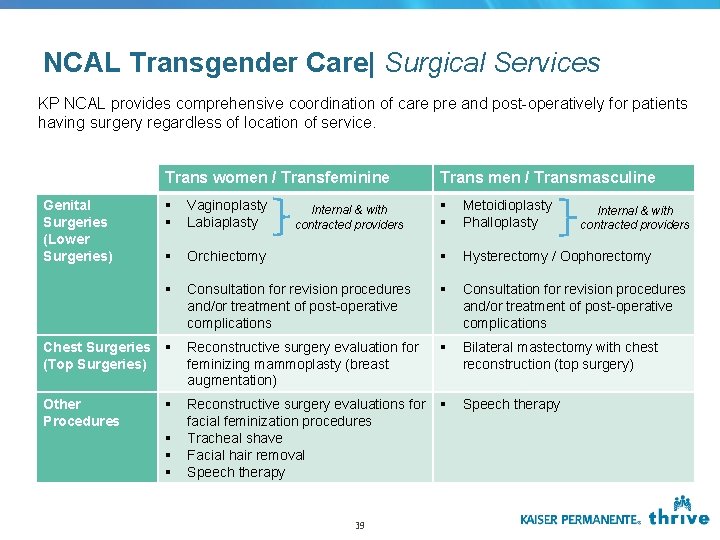
NCAL Transgender Care| Surgical Services KP NCAL provides comprehensive coordination of care pre and post-operatively for patients having surgery regardless of location of service. Trans women / Transfeminine Trans men / Transmasculine § § Vaginoplasty Labiaplasty § § Metoidioplasty Phalloplasty § Orchiectomy § Hysterectomy / Oophorectomy § Consultation for revision procedures and/or treatment of post-operative complications Chest Surgeries (Top Surgeries) § Reconstructive surgery evaluation for feminizing mammoplasty (breast augmentation) § Bilateral mastectomy with chest reconstruction (top surgery) Other Procedures § Reconstructive surgery evaluations for facial feminization procedures Tracheal shave Facial hair removal Speech therapy § Speech therapy Genital Surgeries (Lower Surgeries) § § § Internal & with contracted providers 39 Internal & with contracted providers
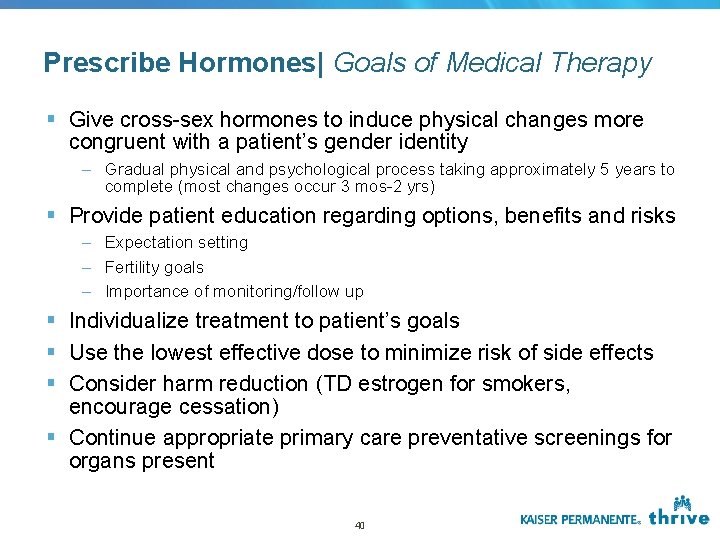
Prescribe Hormones| Goals of Medical Therapy § Give cross-sex hormones to induce physical changes more congruent with a patient’s gender identity – Gradual physical and psychological process taking approximately 5 years to complete (most changes occur 3 mos-2 yrs) § Provide patient education regarding options, benefits and risks – Expectation setting – Fertility goals – Importance of monitoring/follow up § Individualize treatment to patient’s goals § Use the lowest effective dose to minimize risk of side effects § Consider harm reduction (TD estrogen for smokers, encourage cessation) § Continue appropriate primary care preventative screenings for organs present 40
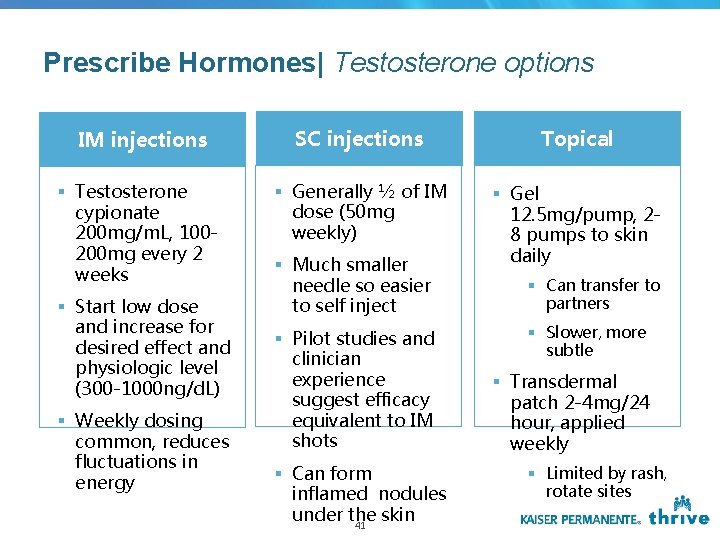
Prescribe Hormones| Testosterone options IM injections SC injections Topical § Testosterone cypionate 200 mg/m. L, 100200 mg every 2 weeks § Generally ½ of IM dose (50 mg weekly) § Gel 12. 5 mg/pump, 28 pumps to skin daily § Start low dose and increase for desired effect and physiologic level (300 -1000 ng/d. L) § Weekly dosing common, reduces fluctuations in energy § Much smaller needle so easier to self inject § Pilot studies and clinician experience suggest efficacy equivalent to IM shots § Can form inflamed nodules under the skin 41 § Can transfer to partners § Slower, more subtle § Transdermal patch 2 -4 mg/24 hour, applied weekly § Limited by rash, rotate sites
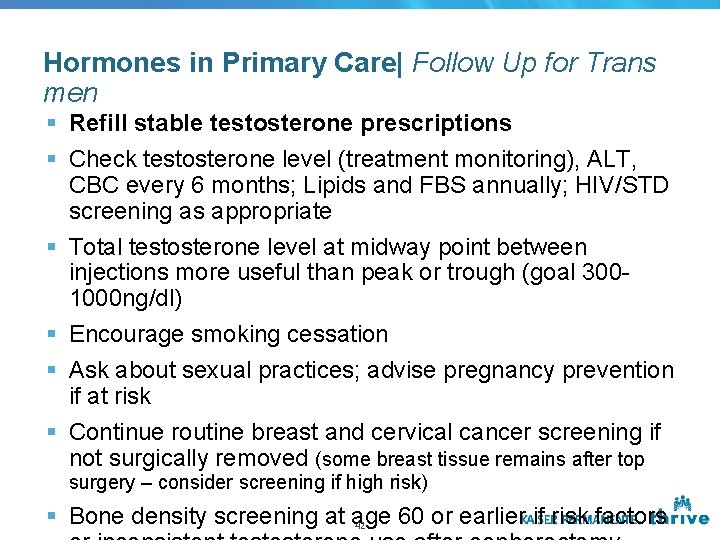
Hormones in Primary Care| Follow Up for Trans men § Refill stable testosterone prescriptions § Check testosterone level (treatment monitoring), ALT, CBC every 6 months; Lipids and FBS annually; HIV/STD screening as appropriate § Total testosterone level at midway point between injections more useful than peak or trough (goal 3001000 ng/dl) § Encourage smoking cessation § Ask about sexual practices; advise pregnancy prevention if at risk § Continue routine breast and cervical cancer screening if not surgically removed (some breast tissue remains after top surgery – consider screening if high risk) § Bone density screening at age 60 or earlier if risk factors 42
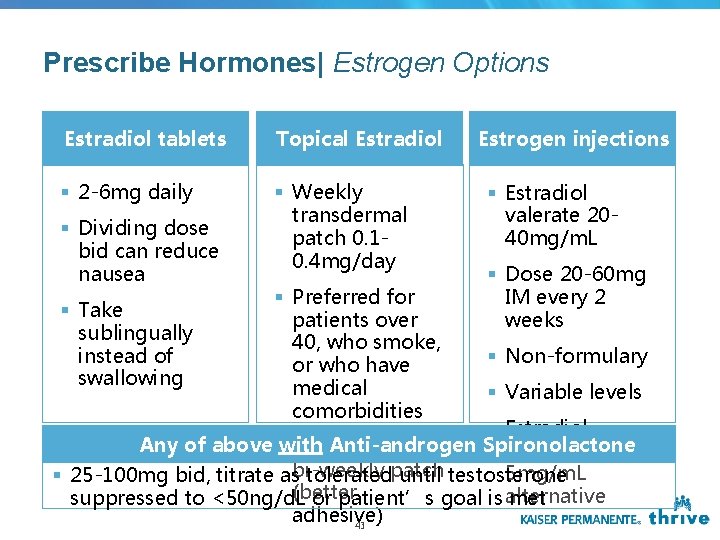
Prescribe Hormones| Estrogen Options Estradiol tablets Topical Estradiol § 2 -6 mg daily § Weekly transdermal patch 0. 10. 4 mg/day § Dividing dose bid can reduce nausea § Take sublingually instead of swallowing § Preferred for patients over 40, who smoke, or who have medical comorbidities Estrogen injections § Estradiol valerate 2040 mg/m. L § Dose 20 -60 mg IM every 2 weeks § Non-formulary § Variable levels § Estradiol Any of above §with Anti-androgen Spironolactone Non-formulary cypionate bi-weekly patch 5 mg/m. L § 25 -100 mg bid, titrate as tolerated until testosterone (better alternative suppressed to <50 ng/d. L or patient’s goal is met adhesive) 43
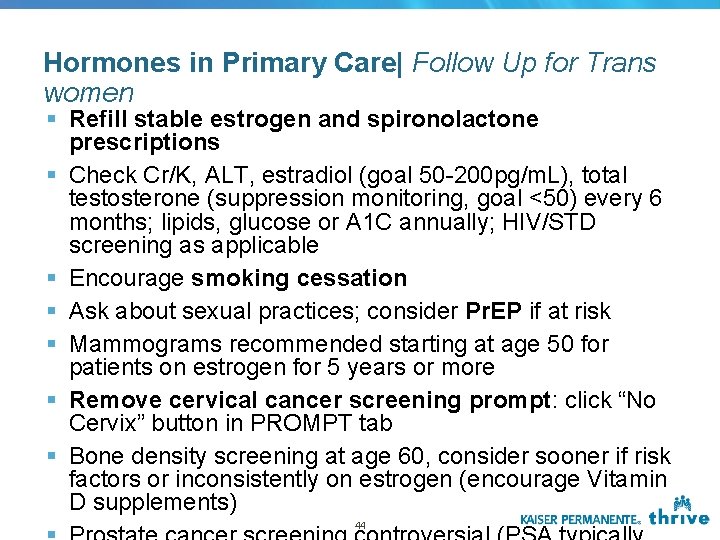
Hormones in Primary Care| Follow Up for Trans women § Refill stable estrogen and spironolactone prescriptions § Check Cr/K, ALT, estradiol (goal 50 -200 pg/m. L), total testosterone (suppression monitoring, goal <50) every 6 months; lipids, glucose or A 1 C annually; HIV/STD screening as applicable § Encourage smoking cessation § Ask about sexual practices; consider Pr. EP if at risk § Mammograms recommended starting at age 50 for patients on estrogen for 5 years or more § Remove cervical cancer screening prompt: click “No Cervix” button in PROMPT tab § Bone density screening at age 60, consider sooner if risk factors or inconsistently on estrogen (encourage Vitamin D supplements) 44
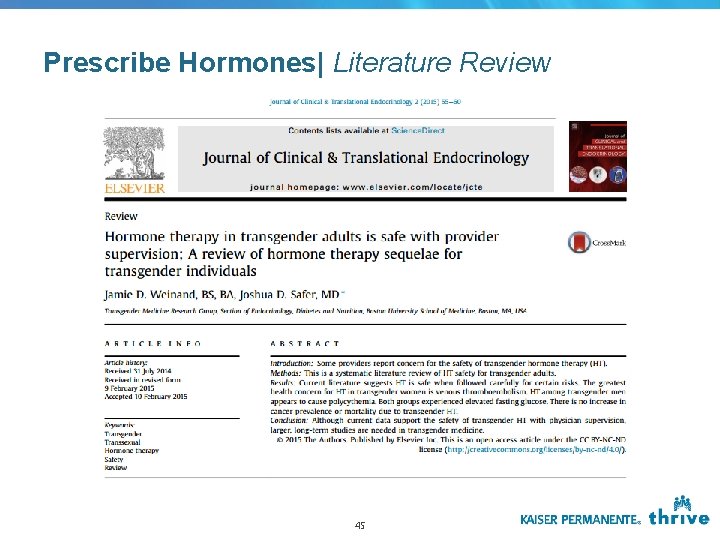
Prescribe Hormones| Literature Review 45
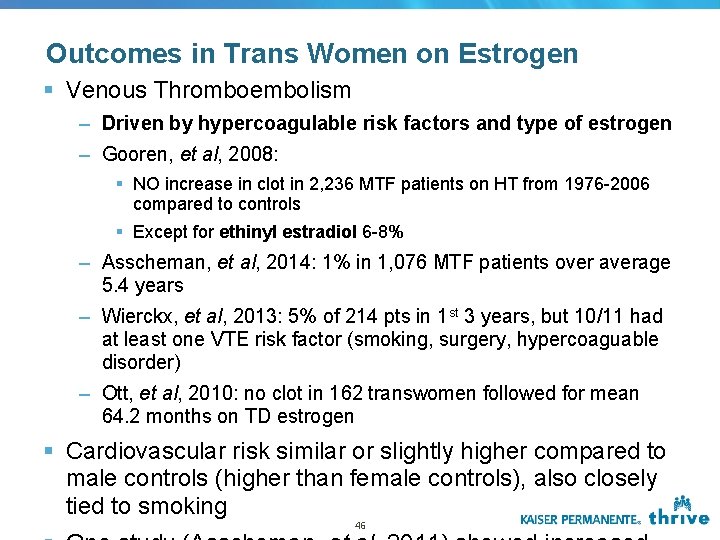
Outcomes in Trans Women on Estrogen § Venous Thromboembolism – Driven by hypercoagulable risk factors and type of estrogen – Gooren, et al, 2008: § NO increase in clot in 2, 236 MTF patients on HT from 1976 -2006 compared to controls § Except for ethinyl estradiol 6 -8% – Asscheman, et al, 2014: 1% in 1, 076 MTF patients over average 5. 4 years – Wierckx, et al, 2013: 5% of 214 pts in 1 st 3 years, but 10/11 had at least one VTE risk factor (smoking, surgery, hypercoaguable disorder) – Ott, et al, 2010: no clot in 162 transwomen followed for mean 64. 2 months on TD estrogen § Cardiovascular risk similar or slightly higher compared to male controls (higher than female controls), also closely tied to smoking 46
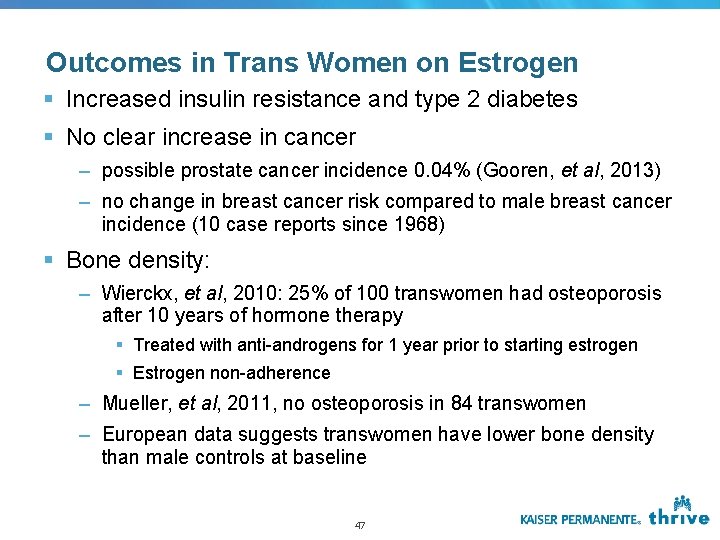
Outcomes in Trans Women on Estrogen § Increased insulin resistance and type 2 diabetes § No clear increase in cancer – possible prostate cancer incidence 0. 04% (Gooren, et al, 2013) – no change in breast cancer risk compared to male breast cancer incidence (10 case reports since 1968) § Bone density: – Wierckx, et al, 2010: 25% of 100 transwomen had osteoporosis after 10 years of hormone therapy § Treated with anti-androgens for 1 year prior to starting estrogen § Estrogen non-adherence – Mueller, et al, 2011, no osteoporosis in 84 transwomen – European data suggests transwomen have lower bone density than male controls at baseline 47
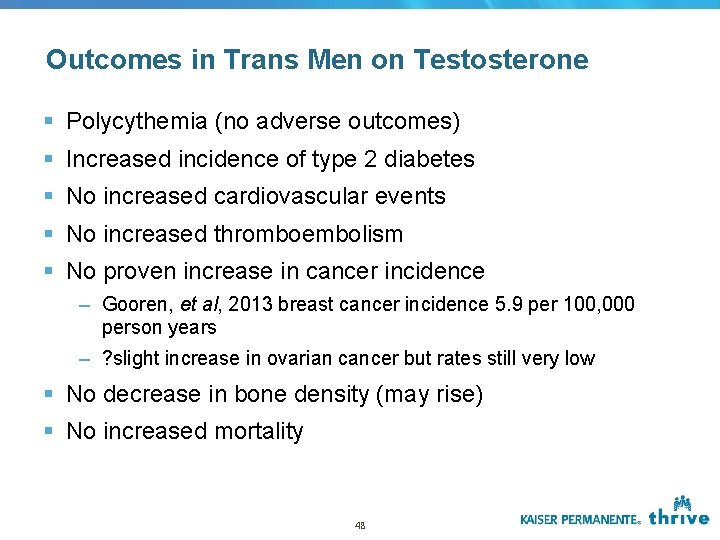
Outcomes in Trans Men on Testosterone § Polycythemia (no adverse outcomes) § Increased incidence of type 2 diabetes § No increased cardiovascular events § No increased thromboembolism § No proven increase in cancer incidence – Gooren, et al, 2013 breast cancer incidence 5. 9 per 100, 000 person years – ? slight increase in ovarian cancer but rates still very low § No decrease in bone density (may rise) § No increased mortality 48
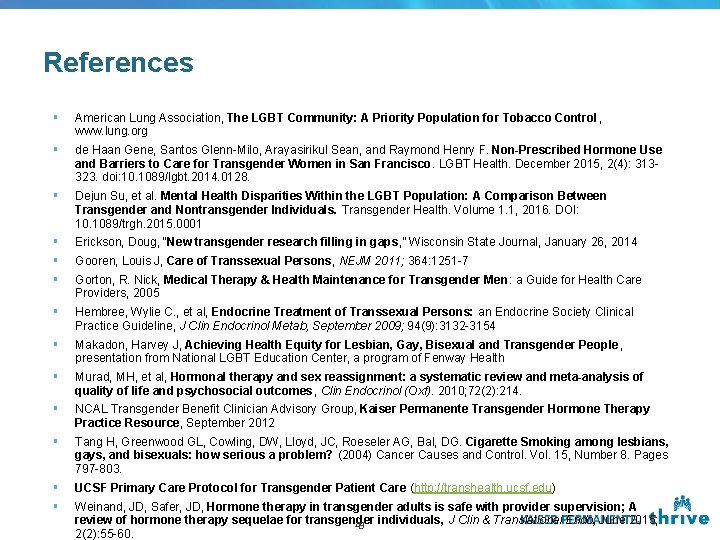
References § American Lung Association, The LGBT Community: A Priority Population for Tobacco Control , www. lung. org § de Haan Gene, Santos Glenn-Milo, Arayasirikul Sean, and Raymond Henry F. Non-Prescribed Hormone Use and Barriers to Care for Transgender Women in San Francisco. LGBT Health. December 2015, 2(4): 313323. doi: 10. 1089/lgbt. 2014. 0128. § Dejun Su, et al. Mental Health Disparities Within the LGBT Population: A Comparison Between Transgender and Nontransgender Individuals. Transgender Health. Volume 1. 1, 2016. DOI: 10. 1089/trgh. 2015. 0001 § § § Erickson, Doug, “New transgender research filling in gaps, ” Wisconsin State Journal, January 26, 2014 § Hembree, Wylie C. , et al, Endocrine Treatment of Transsexual Persons: an Endocrine Society Clinical Practice Guideline, J Clin Endocrinol Metab, September 2009; 94(9): 3132 -3154 § Makadon, Harvey J, Achieving Health Equity for Lesbian, Gay, Bisexual and Transgender People, presentation from National LGBT Education Center, a program of Fenway Health § Murad, MH, et al, Hormonal therapy and sex reassignment: a systematic review and meta-analysis of quality of life and psychosocial outcomes, Clin Endocrinol (Oxf). 2010; 72(2): 214. § NCAL Transgender Benefit Clinician Advisory Group, Kaiser Permanente Transgender Hormone Therapy Practice Resource, September 2012 § Tang H, Greenwood GL, Cowling, DW, Lloyd, JC, Roeseler AG, Bal, DG. Cigarette Smoking among lesbians, gays, and bisexuals: how serious a problem? (2004) Cancer Causes and Control. Vol. 15, Number 8. Pages 797 -803. § § UCSF Primary Care Protocol for Transgender Patient Care (http: //transhealth. ucsf. edu) Gooren, Louis J, Care of Transsexual Persons, NEJM 2011; 364: 1251 -7 Gorton, R. Nick, Medical Therapy & Health Maintenance for Transgender Men: a Guide for Health Care Providers, 2005 Weinand, JD, Safer, JD, Hormone therapy in transgender adults is safe with provider supervision; A review of hormone therapy sequelae for transgender individuals, J Clin & Translational Endo, June 2015; 49 2(2): 55 -60.