TOUR 101 Introduction to Tourism Lecture 9 2







- Slides: 19
TOUR 101: Introduction to Tourism Lecture 9. 2: Sociocultural Impacts of Tourism
Lecture 9. 2: Overview • Relationship between economic and socio-cultural impacts • Socio-cultural benefits of tourism • Socio-cultural costs of tourism – ‘coca-colonisation’ • Responses of residents: Doxey’s irridex
Lecture 9. 2: Readings • Course Text: – Weaver & Lawton (2014). Chapter 9: Sociocultural and Environmental Impacts of Tourism (pp. 253– 284).
The relationship between economic and social impacts • Close relationship between economic impacts and socio-cultural impacts: – For example, employment conditions/income have socio-cultural impacts Ø (What is the nature of this relationship? ) – Hyper-dependency on tourism results in an (over-) reliance on tourism industry • May allow inappropriate tourist activity and development Ø (What is ‘inappropriate’ tourist activity and development? )
Socio-cultural impacts of tourism • Socio-cultural impact: – “the manner in which tourism and travel effects changes in collective and individual value systems, behaviour patterns, community structures, lifestyle and quality of life” (Hall, 1998, p. 202). • “tourism is often regarded by the host community as an economic necessity but a social evil” (Collier, 2003, p. 315) Ø Why is tourism often regarded as a ‘social evil’?
Socio-cultural benefits of tourism • Promotion of cross-cultural understanding – contact between cultures may reduce ethnocentrism (and xenophobia? ): • a view that one’s culture is superior to all others • powerful contributor to prejudice and stereotyping • Incentive to preserve culture and heritage – provides economic returns for preservation of cultural festivals, artefacts, buildings etc. – re-energises interest and pride in one’s own culture/ heritage
Socio-cultural benefits of tourism • Improvement in lifestyles of local residents – tourism employment brings higher standard of living (economic) – tourism brings amenities, attractions, recreational facilities that can be used by locals – publicity through tourism can moderate actions of repressive governments • Nature of employment – Frontline employment can be seasonal, unskilled, casualised work, with weak unions and high turnover – Benefits in LDCs and regions limited if training or retraining not provided; top jobs go to ‘outsiders’
Socio-cultural costs of tourism • Demonstration effect – residents attempt to copy the behaviour of tourists in their activities, clothing, food preferences etc – Undermines cultural values • Growth in criminal activity – Prostitution and crime – Tourists as victims of crime (examples from the class? ) – Tourists as perpetrators of crime (examples from the class? )
Socio-cultural costs of tourism • Loss of sense of place and local pride due to commodification of culture – The process/phenomenon of packaging and selling culture (a commodity) • Residents of tourist destinations are forced to ‘stage’ their culture – In order to meet the requirements of tourists (what are their requirements? ) – In order to conform to the destination images presented by the tourism industry – In order to protect their own lives (what does this mean? )
Commodification of culture: stages 1. Tourists are rare, and are treated as ‘honoured guests’ during cultural performances. They may be given genuine cultural artefacts as gifts 2. Tourists become more frequent, they are able to watch cultural performances for a small fee, and may buy genuine cultural artefacts 3. Community is visited by large numbers of tourists. Ceremonies are altered to appeal to tourists (in terms of content, length etc. ) and performances are given regularly for the sake of tourists. Copies of cultural artefacts are made and sold to tourists 4. The meaning and integrity of the culture is lost as a result of this ‘staged authenticity’ and thwarts the tourists’ desire for authentic experience.
Results of commodification • Destruction of traditional ways of life • Bastardisation and faking of culture and cultural artefacts (e. g. , ‘airport art’) • Diminishing significance of religious and traditional rituals • Commodification can be summarised as the: – ‘Trivialisation’, ‘Disneyfication’, and ‘Museumisation’ of culture Ø HOWEVER: tourism is not the only cause of socio-cultural change
‘Coca colonisation’ • • Tourism seen as a form of invasion, particularly in LDCs. Relationships experienced in tourism are little different from the earliest forms of colonial power: • It is a form of invasion (‘neo-colonialism’; the ‘golden hordes’ (English, 1975): – Locals lose their autonomy: little choice/involvement in tourism decision making – Locals often disenfranchised from their land, beaches etc. – Little economic benefit in destination community because of revenue leakage
‘Coca colanisation’ • Clear inequality displayed between tourist and host – Culture of ‘servility’ prevalent in destination community – Tourists’ ethnocentrism reveals lack of respect for local culture
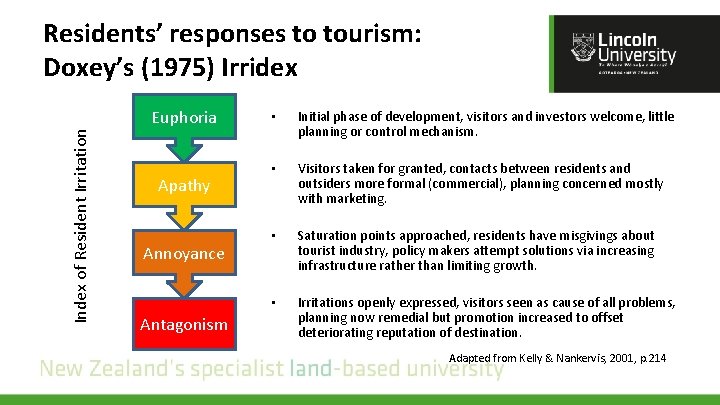
Residents’ responses to tourism: Doxey’s (1975) Irridex Index of Resident Irritation Euphoria Apathy Annoyance Antagonism • Initial phase of development, visitors and investors welcome, little planning or control mechanism. • Visitors taken for granted, contacts between residents and outsiders more formal (commercial), planning concerned mostly with marketing. • Saturation points approached, residents have misgivings about tourist industry, policy makers attempt solutions via increasing infrastructure rather than limiting growth. • Irritations openly expressed, visitors seen as cause of all problems, planning now remedial but promotion increased to offset deteriorating reputation of destination. Adapted from Kelly & Nankervis, 2001, p. 214
Limits to understanding between tourists and local community • Contacts are brief and usually superficial • Contacts temporary and non-repetitive: open to deceit and exploitation • Asymmetric nature of relationship: – locals are servile – relationship is commercialised – relationship is formal, lacking spontaneity – tourists may remain in ‘environmental bubble’
Limits to understanding between tourists and local community • Tourists’ views of hosts is often highly distorted: stereotypes • Often language barriers • Often differences in values, attitudes, behaviour: • Reduced interpersonal attractiveness • lack understanding of the nature (‘rules’) of social interaction • Different motivators: fantasy, social contact, money
Limits to understanding between tourists and local community Host–Guest relationships characterised traditionally by four key points (do these apply to all situations of contact? ): 1. 2. 3. 4. They involve transitory relationships: visitors are usually in a community for only a short period of time, so any interaction between hosts and guests has little chance to progress beyond casual and superficial levels. There are temporal and spatial constraints to host-guest interaction: visits are usually seasonal and nonrepeated events, so the hospitality business often becomes exploitative to take advantage of this situation. With the development of mass tourism, host-guest meetings lack the spontaneity associated with individual schedules. When hosts and guests meet, it is generally an unequal and unbalanced experience: hosts often feel inferior when they compare their situation to a visitor’s apparent wealth and can become resentful at this contrast. Similarly, tourists may exhibit behaviour whilst on holiday that would be considered unacceptable in their home environment.
Limits to understanding between tourists and local community This last point raises the question of whether or not tourist behaviour is typical of the tourist in their home environment. Inskeep (1991), in addressing this issue, states: • “The tourists’ culture is somewhat different from their home culture, with tourists feeling emancipated from their ordinary cultural bounds and adopting the symbols and behaviour patterns of a non-ordinary (sic) lifestyle. Tourists have fewer social constraints and typically feel less inhibited when travelling than they do in their home cultures, with some tourists seeking experiences that would not be socially accepted in their own cultures” (p. 367). Ø Does this apply to all situations of host–guest contact?
End of lecture