Total Place in Lewisham Kevin Sheehan Head of

- Slides: 34
Total Place in Lewisham Kevin Sheehan, Head of Strategy London Borough of Lewisham
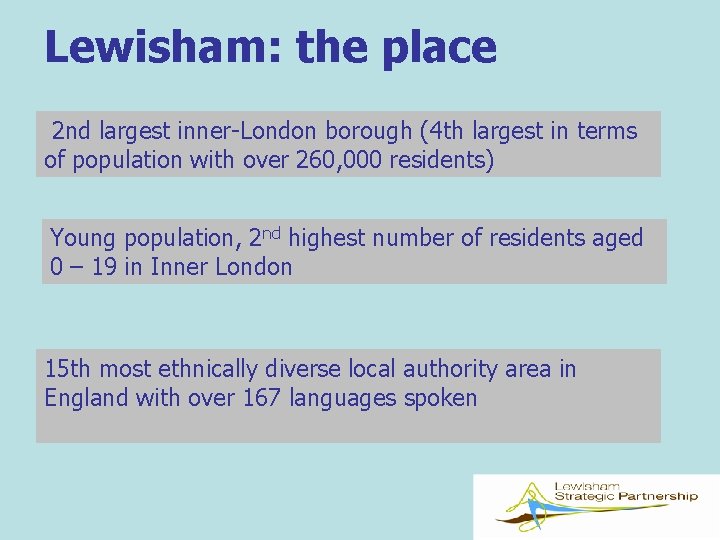
Lewisham: the place 2 nd largest inner-London borough (4 th largest in terms of population with over 260, 000 residents) Young population, 2 nd highest number of residents aged 0 – 19 in Inner London 15 th most ethnically diverse local authority area in England with over 167 languages spoken
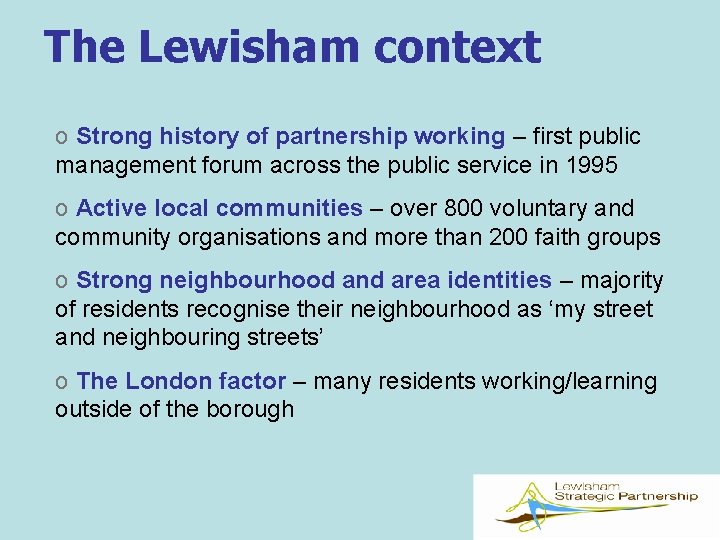
The Lewisham context o Strong history of partnership working – first public management forum across the public service in 1995 o Active local communities – over 800 voluntary and community organisations and more than 200 faith groups o Strong neighbourhood and area identities – majority of residents recognise their neighbourhood as ‘my street and neighbouring streets’ o The London factor – many residents working/learning outside of the borough
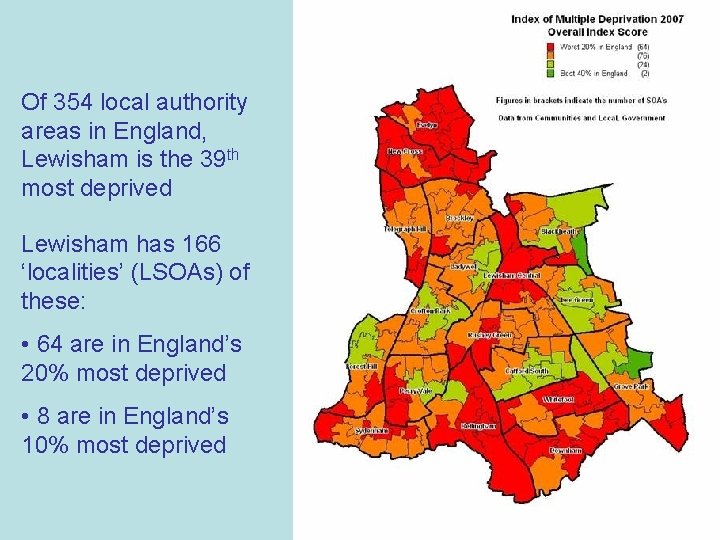
Of 354 local authority areas in England, Lewisham is the 39 th most deprived Lewisham has 166 ‘localities’ (LSOAs) of these: • 64 are in England’s 20% most deprived • 8 are in England’s 10% most deprived
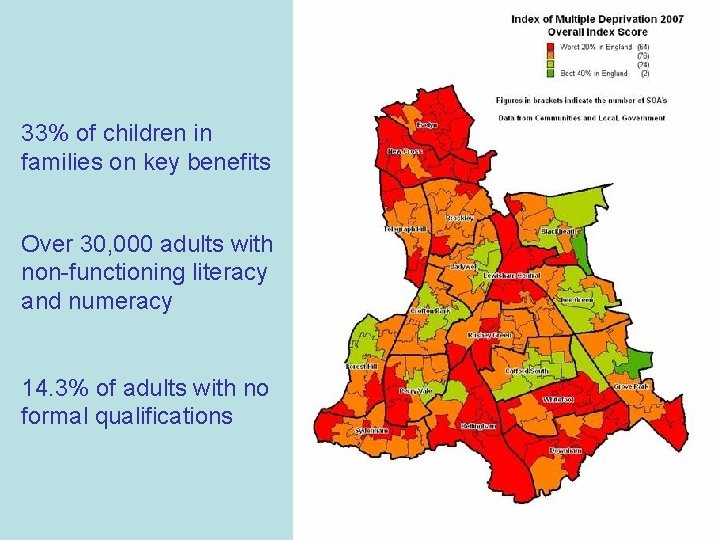
33% of children in families on key benefits Over 30, 000 adults with non-functioning literacy and numeracy 14. 3% of adults with no formal qualifications
Although Lewisham has the second highest employment rate in Inner London, we have the lowest average earnings per resident
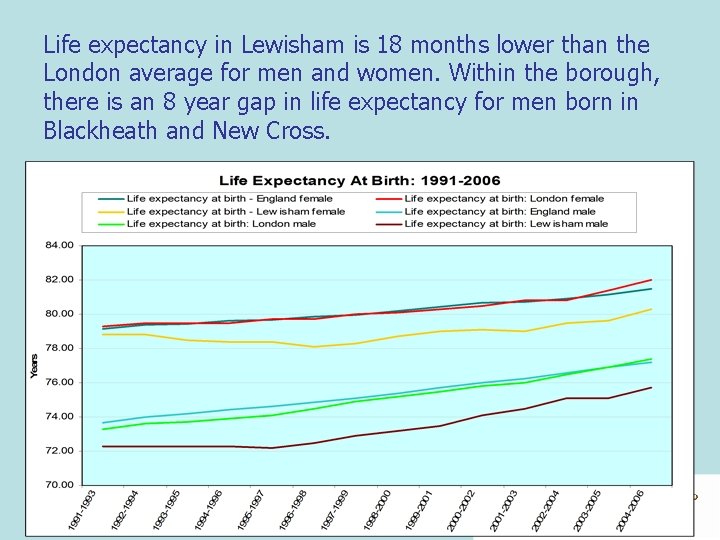
Life expectancy in Lewisham is 18 months lower than the London average for men and women. Within the borough, there is an 8 year gap in life expectancy for men born in Blackheath and New Cross.
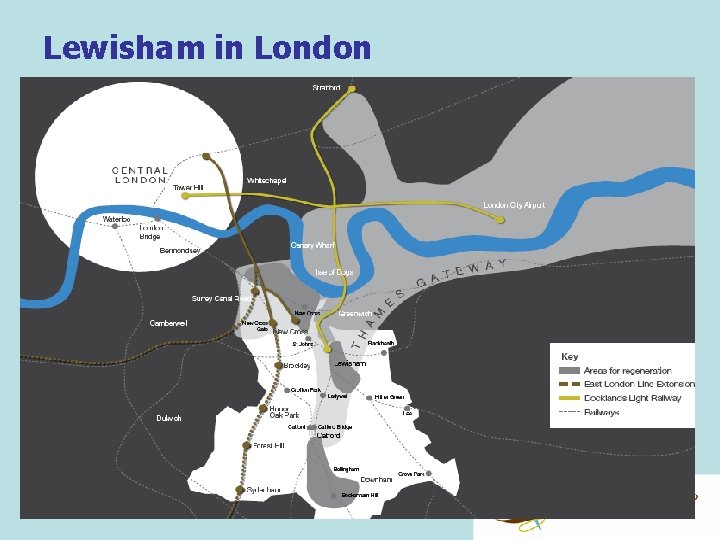
Lewisham in London
Where Lewisham residents travel to work
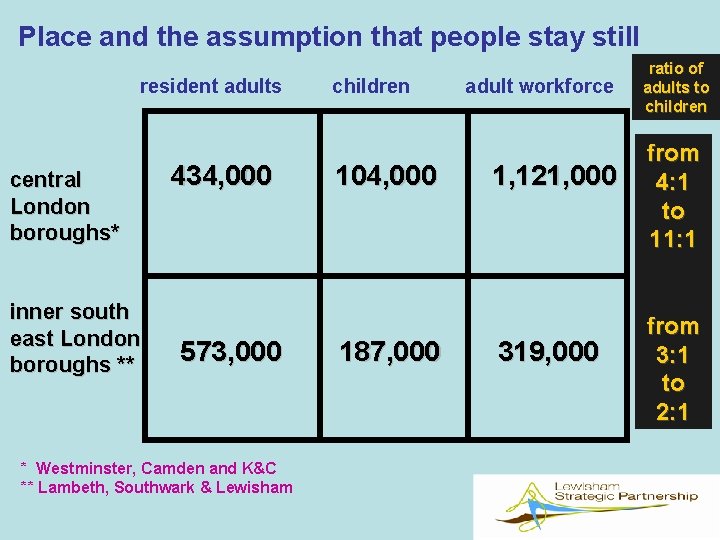
Place and the assumption that people stay still resident adults central London boroughs* inner south east London boroughs ** 434, 000 573, 000 * Westminster, Camden and K&C ** Lambeth, Southwark & Lewisham children 104, 000 187, 000 adult workforce 1, 121, 000 319, 000 ratio of adults to children from 4: 1 to 11: 1 from 3: 1 to 2: 1
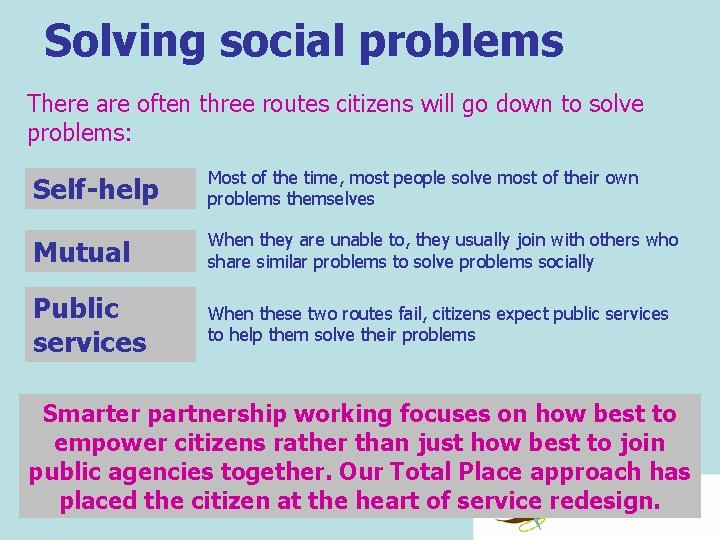
Solving social problems There are often three routes citizens will go down to solve problems: Self-help Most of the time, most people solve most of their own problems themselves Mutual When they are unable to, they usually join with others who share similar problems to solve problems socially Public services When these two routes fail, citizens expect public services to help them solve their problems Smarter partnership working focuses on how best to empower citizens rather than just how best to join public agencies together. Our Total Place approach has placed the citizen at the heart of service redesign.
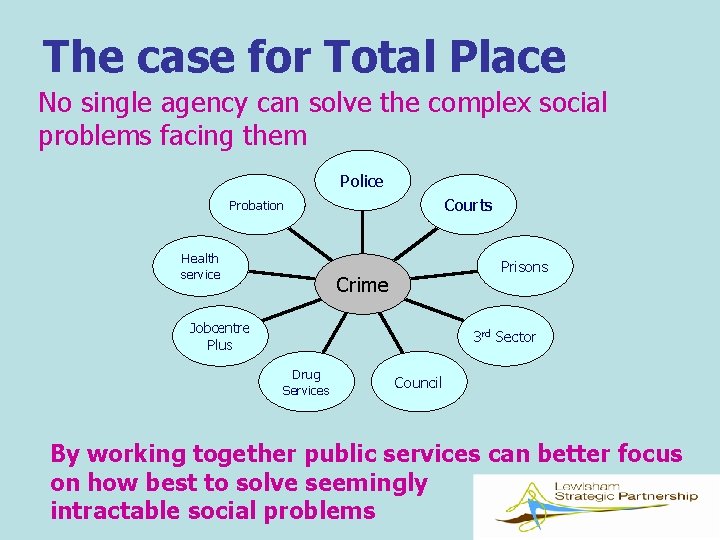
The case for Total Place No single agency can solve the complex social problems facing them Police Courts Probation Health service Prisons Crime Jobcentre Plus 3 rd Sector Drug Services Council By working together public services can better focus on how best to solve seemingly intractable social problems
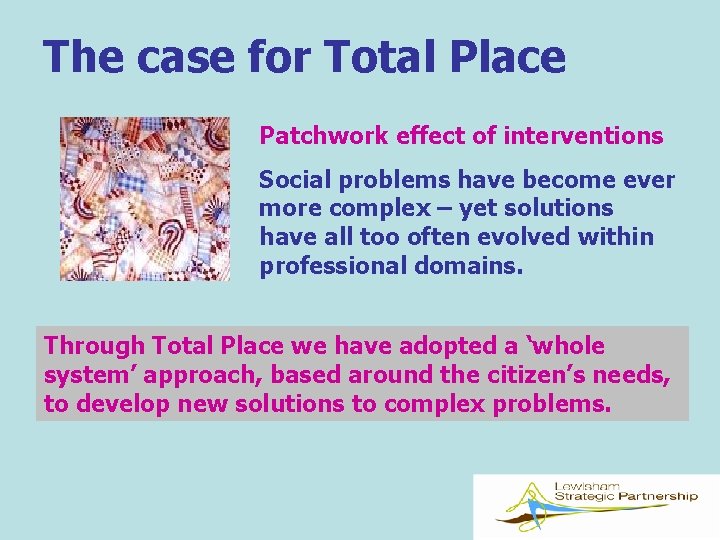
The case for Total Place Patchwork effect of interventions Social problems have become ever more complex – yet solutions have all too often evolved within professional domains. Through Total Place we have adopted a ‘whole system’ approach, based around the citizen’s needs, to develop new solutions to complex problems.
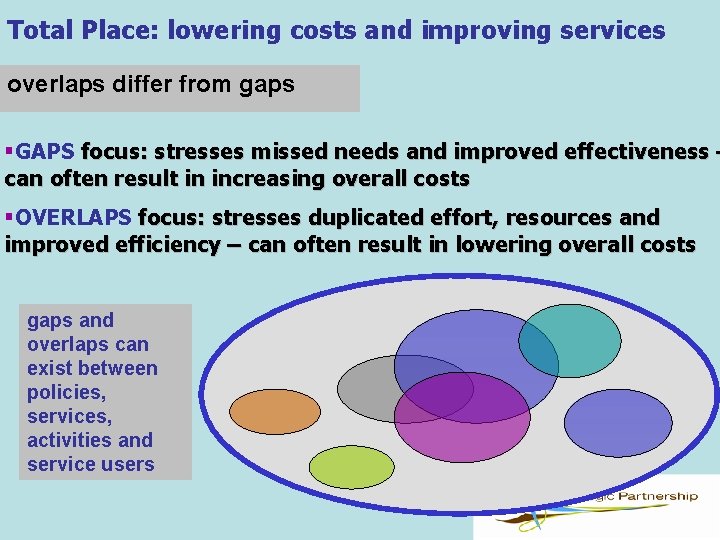
Total Place: lowering costs and improving services overlaps differ from gaps §GAPS focus: stresses missed needs and improved effectiveness – can often result in increasing overall costs §OVERLAPS focus: stresses duplicated effort, resources and improved efficiency – can often result in lowering overall costs gaps and overlaps can exist between policies, services, activities and service users
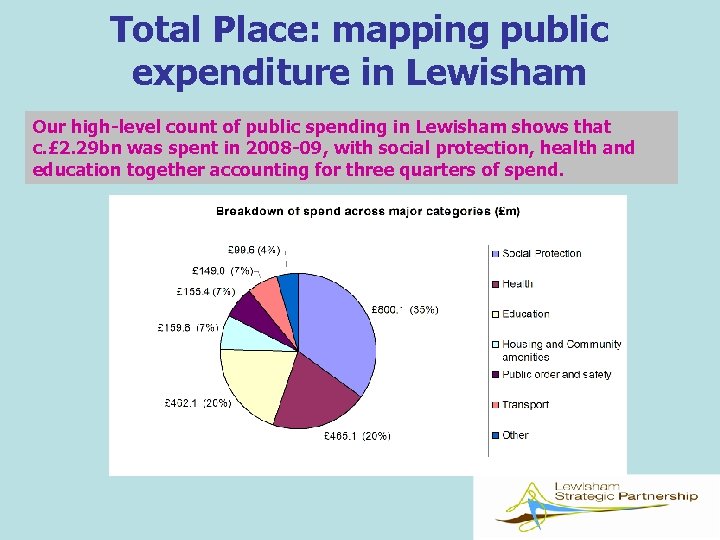
Total Place: mapping public expenditure in Lewisham Our high-level count of public spending in Lewisham shows that c. £ 2. 29 bn was spent in 2008 -09, with social protection, health and education together accounting for three quarters of spend.
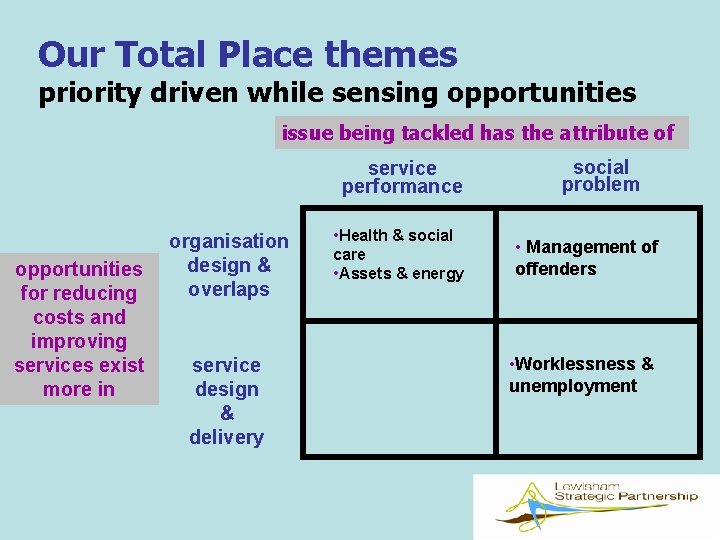
Our Total Place themes priority driven while sensing opportunities issue being tackled has the attribute of service performance opportunities for reducing costs and improving services exist more in organisation design & overlaps service design & delivery • Health & social care • Assets & energy social problem • Management of offenders • Worklessness & unemployment
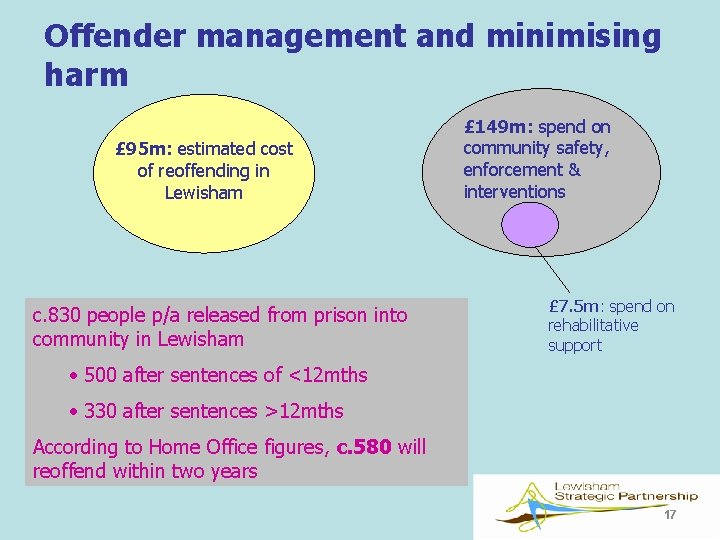
Offender management and minimising harm £ 95 m: estimated cost of reoffending in Lewisham c. 830 people p/a released from prison into community in Lewisham £ 149 m: spend on community safety, enforcement & interventions £ 7. 5 m: spend on rehabilitative support • 500 after sentences of <12 mths • 330 after sentences >12 mths According to Home Office figures, c. 580 will reoffend within two years 17
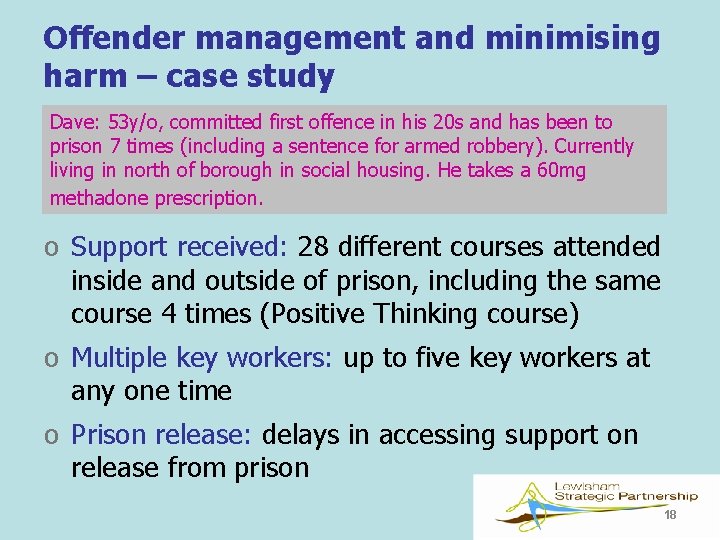
Offender management and minimising harm – case study Dave: 53 y/o, committed first offence in his 20 s and has been to prison 7 times (including a sentence for armed robbery). Currently living in north of borough in social housing. He takes a 60 mg methadone prescription. o Support received: 28 different courses attended inside and outside of prison, including the same course 4 times (Positive Thinking course) o Multiple key workers: up to five key workers at any one time o Prison release: delays in accessing support on release from prison 18
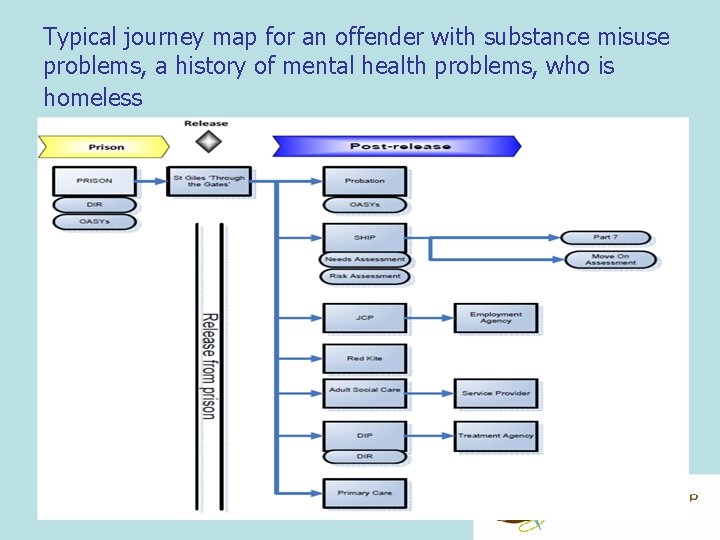
Typical journey map for an offender with substance misuse problems, a history of mental health problems, who is homeless
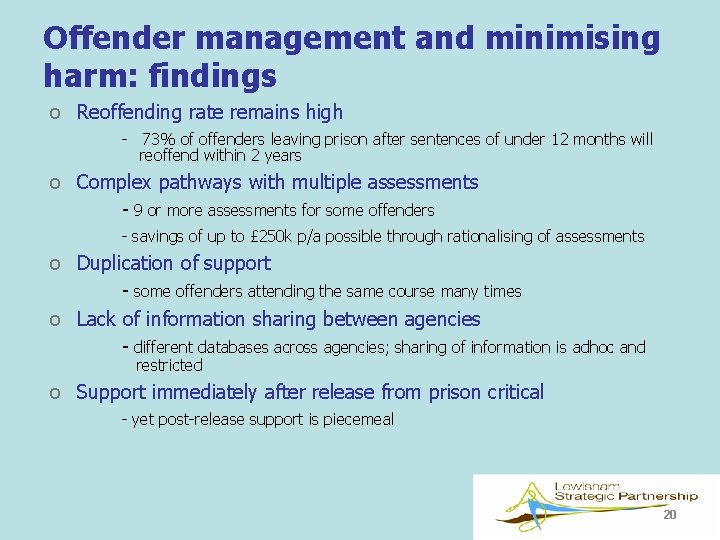
Offender management and minimising harm: findings o Reoffending rate remains high - 73% of offenders leaving prison after sentences of under 12 months will reoffend within 2 years o Complex pathways with multiple assessments - 9 or more assessments for some offenders - savings of up to £ 250 k p/a possible through rationalising of assessments o Duplication of support - some offenders attending the same course many times o Lack of information sharing between agencies - different databases across agencies; sharing of information is adhoc and restricted o Support immediately after release from prison critical - yet post-release support is piecemeal 20
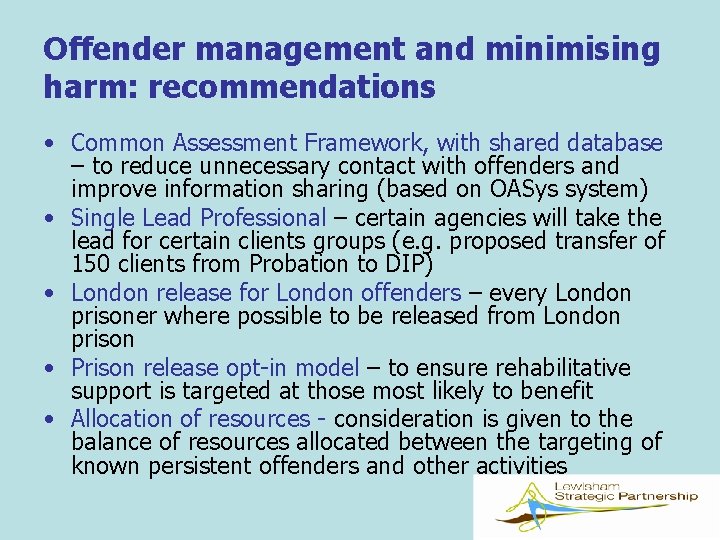
Offender management and minimising harm: recommendations • Common Assessment Framework, with shared database – to reduce unnecessary contact with offenders and improve information sharing (based on OASys system) • Single Lead Professional – certain agencies will take the lead for certain clients groups (e. g. proposed transfer of 150 clients from Probation to DIP) • London release for London offenders – every London prisoner where possible to be released from London prison • Prison release opt-in model – to ensure rehabilitative support is targeted at those most likely to benefit • Allocation of resources - consideration is given to the balance of resources allocated between the targeting of known persistent offenders and other activities
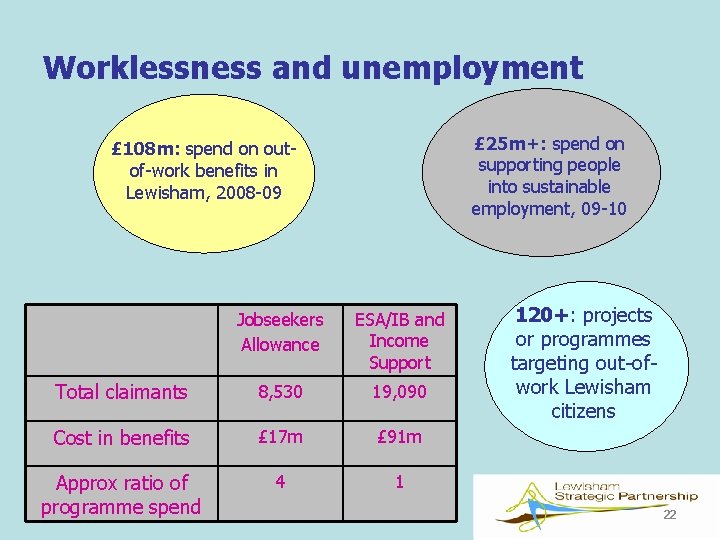
Worklessness and unemployment £ 25 m+: spend on supporting people into sustainable employment, 09 -10 £ 108 m: spend on outof-work benefits in Lewisham, 2008 -09 Jobseekers Allowance ESA/IB and Income Support Total claimants 8, 530 19, 090 Cost in benefits £ 17 m £ 91 m Approx ratio of programme spend 4 1 120+: projects or programmes targeting out-ofwork Lewisham citizens 22
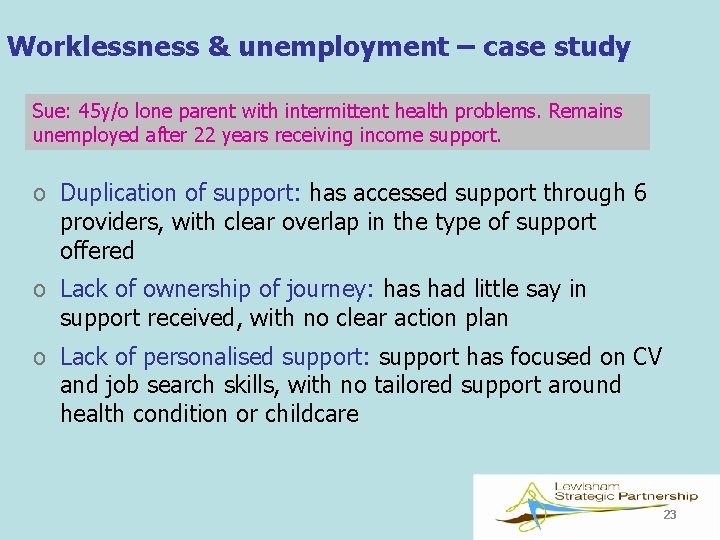
Worklessness & unemployment – case study Sue: 45 y/o lone parent with intermittent health problems. Remains unemployed after 22 years receiving income support. o Duplication of support: has accessed support through 6 providers, with clear overlap in the type of support offered o Lack of ownership of journey: has had little say in support received, with no clear action plan o Lack of personalised support: support has focused on CV and job search skills, with no tailored support around health condition or childcare 23
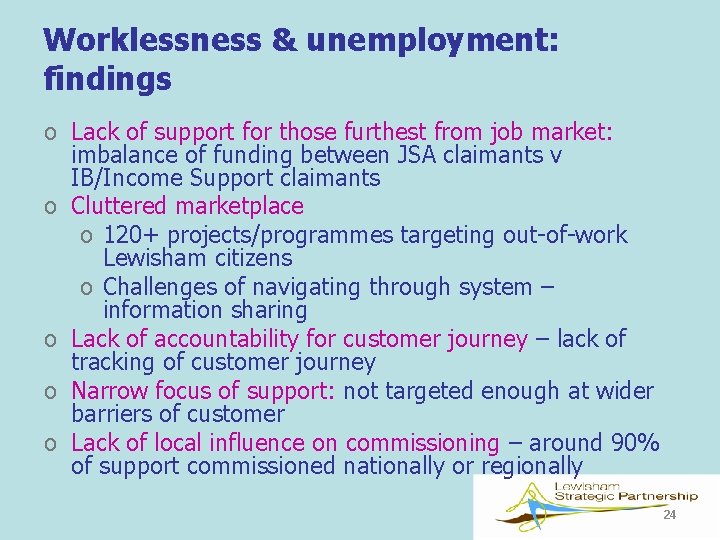
Worklessness & unemployment: findings o Lack of support for those furthest from job market: imbalance of funding between JSA claimants v IB/Income Support claimants o Cluttered marketplace o 120+ projects/programmes targeting out-of-work Lewisham citizens o Challenges of navigating through system – information sharing o Lack of accountability for customer journey – lack of tracking of customer journey o Narrow focus of support: not targeted enough at wider barriers of customer o Lack of local influence on commissioning – around 90% of support commissioned nationally or regionally 24
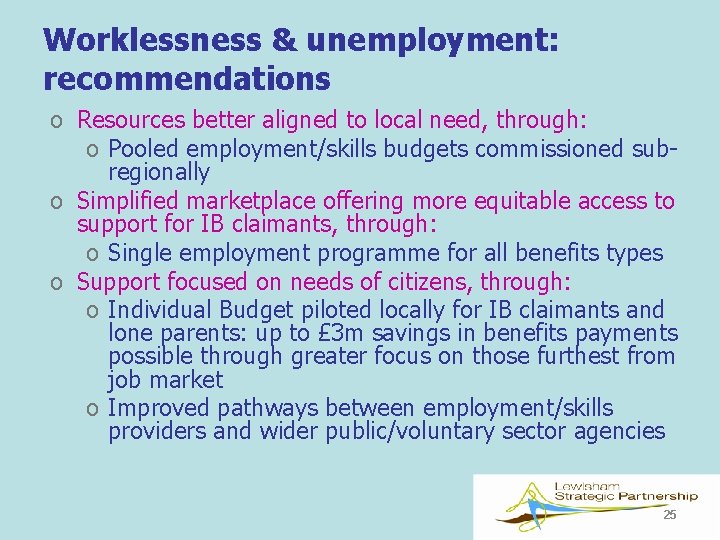
Worklessness & unemployment: recommendations o Resources better aligned to local need, through: o Pooled employment/skills budgets commissioned subregionally o Simplified marketplace offering more equitable access to support for IB claimants, through: o Single employment programme for all benefits types o Support focused on needs of citizens, through: o Individual Budget piloted locally for IB claimants and lone parents: up to £ 3 m savings in benefits payments possible through greater focus on those furthest from job market o Improved pathways between employment/skills providers and wider public/voluntary sector agencies 25
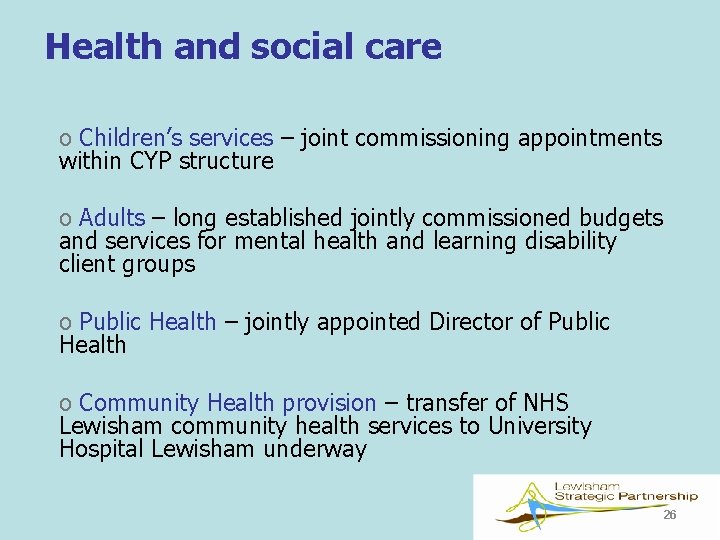
Health and social care o Children’s services – joint commissioning appointments within CYP structure o Adults – long established jointly commissioned budgets and services for mental health and learning disability client groups o Public Health – jointly appointed Director of Public Health o Community Health provision – transfer of NHS Lewisham community health services to University Hospital Lewisham underway 26
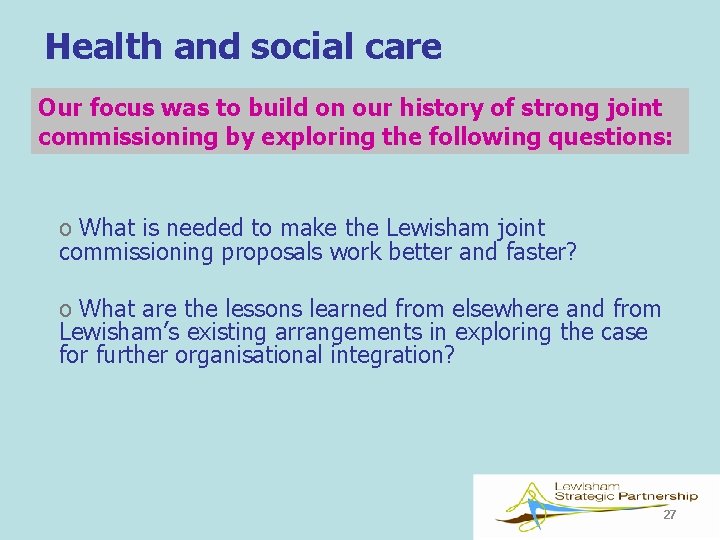
Health and social care Our focus was to build on our history of strong joint commissioning by exploring the following questions: o What is needed to make the Lewisham joint commissioning proposals work better and faster? o What are the lessons learned from elsewhere and from Lewisham’s existing arrangements in exploring the case for further organisational integration? 27
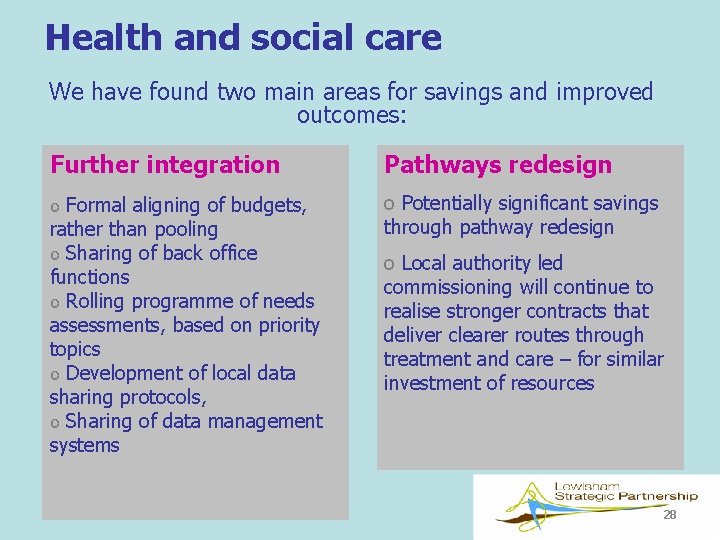
Health and social care We have found two main areas for savings and improved outcomes: Further integration Pathways redesign o Formal aligning of budgets, rather than pooling o Sharing of back office functions o Rolling programme of needs assessments, based on priority topics o Development of local data sharing protocols, o Sharing of data management systems o Potentially significant savings through pathway redesign o Local authority led commissioning will continue to realise stronger contracts that deliver clearer routes through treatment and care – for similar investment of resources 28
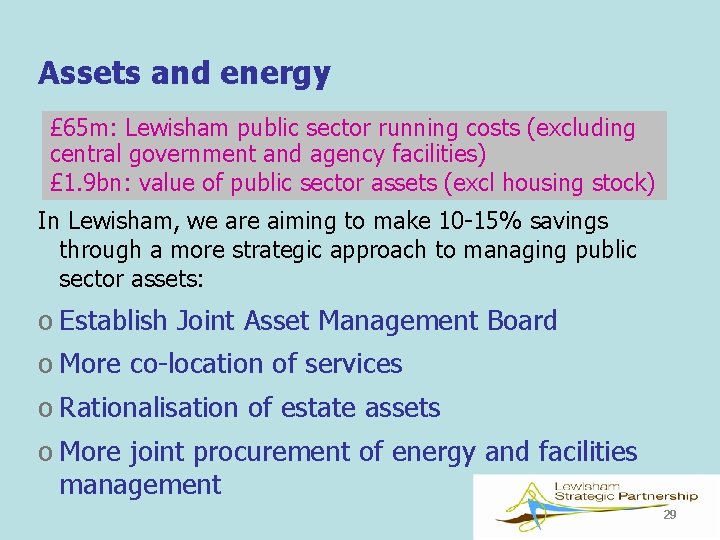
Assets and energy £ 65 m: Lewisham public sector running costs (excluding central government and agency facilities) £ 1. 9 bn: value of public sector assets (excl housing stock) In Lewisham, we are aiming to make 10 -15% savings through a more strategic approach to managing public sector assets: o Establish Joint Asset Management Board o More co-location of services o Rationalisation of estate assets o More joint procurement of energy and facilities management 29
Barriers, burdens and bureaucracy 50+ : the number of inspections, assessments and performance reviews faced by agencies in Lewisham Regulation and inspection o demands on public sector agencies remains high despite efforts to streamline inspection regime o Performance management o agencies accountable to more than one master (e. g. agencies required to report on crime issues to NOMS, Met Police, Home Office, Mo. J, DCSF) o Management information & data o targets remain focused too much on outputs and process rather than outcomes o many indicators/data required of limited value to those delivering services 30
Total Place: challenges of reducing cost in a non-integrated system Reducing duplication and costs across public agencies through smarter strategic coordination: e. g. pooling of budgets, Common Assessment Frameworks, improved information sharing o Relies on effective collaboration around service users’ needs o Challenge of crystallising savings – savings for one agency must not be at the expense of shunting costs elsewhere o Organisational inertia can be a barrier – where the difficulties of change loom larger than the needs of service users or the taxpayer
Total Place: challenges of reducing cost in a non-integrated system User-directed change: engagement of service users in the direct purchase of services e. g. individualised budgets in health & social care o Change occurs through a process of user choice o Challenge of ensuring costs of transition do not outweigh rate at which existing services are decommissioned
Total Place: challenges of reducing cost in a non-integrated system New innovative enterprises e. g. through introduction of new service providers into the system, such as through health & social care commissioning, or Flexible New Deal o Role of new providers is to disturb existing status quo and inject innovation. It may be of particular benefit when: o strategic coordination has resulted in additional complexity o user-directed change has resulted in short to medium term cost increases
Questions