
Tonsillectomy and Adenoidectomy 1 History Celsus 50 A

- Slides: 54
Tonsillectomy, and Adenoidectomy 1
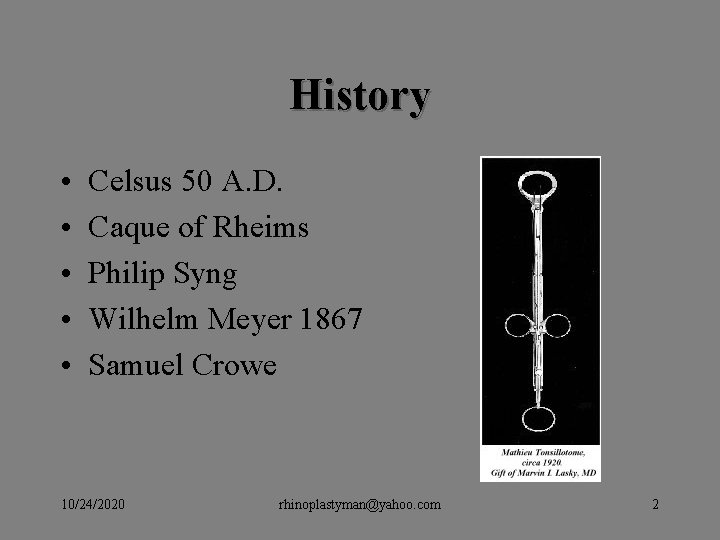
History • • • Celsus 50 A. D. Caque of Rheims Philip Syng Wilhelm Meyer 1867 Samuel Crowe 10/24/2020 rhinoplastyman@yahoo. com 2
Embryology • 8 weeks: Tonsillar fossa and palatine tonsils develop from the dorsal wing of the 1 st pharyngeal pouch and the ventral wing of the 2 nd pouch; tonsillar pillars originate from 2 nd/3 rd arches • Crypts 3 -6 months; capsule 5 th month; germinal centers after birth • 16 weeks: Adenoids develop as a subepithelial infiltration of lymphocytes 10/24/2020 rhinoplastyman@yahoo. com 3
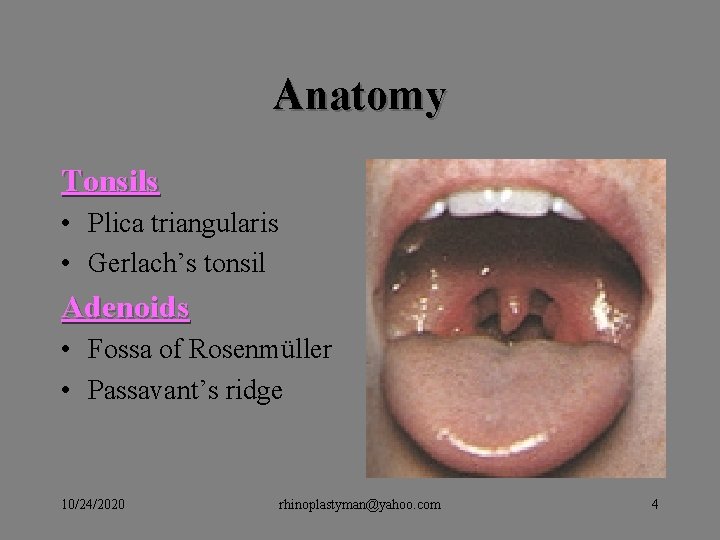
Anatomy Tonsils • Plica triangularis • Gerlach’s tonsil Adenoids • Fossa of Rosenmüller • Passavant’s ridge 10/24/2020 rhinoplastyman@yahoo. com 4
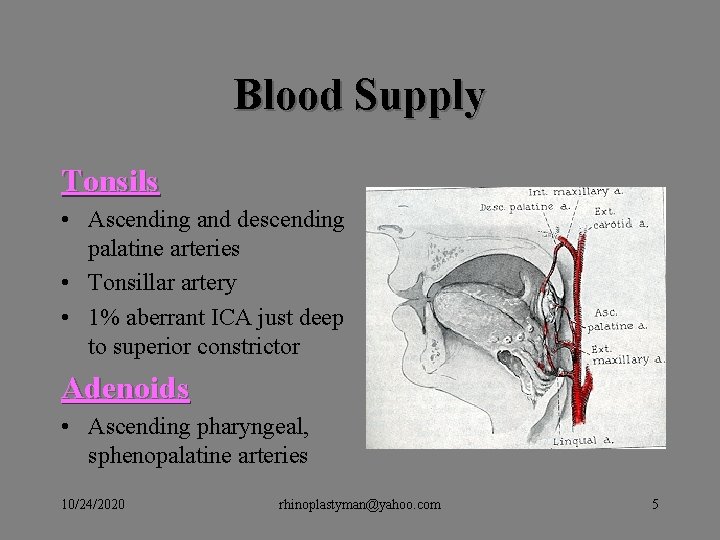
Blood Supply Tonsils • Ascending and descending palatine arteries • Tonsillar artery • 1% aberrant ICA just deep to superior constrictor Adenoids • Ascending pharyngeal, sphenopalatine arteries 10/24/2020 rhinoplastyman@yahoo. com 5
Common Diseases of the Tonsils and Adenoids • • Acute adenoiditis/tonsillitis Recurrent/chronic adenoiditis/tonsillitis Obstructive hyperplasia Malignancy 10/24/2020 rhinoplastyman@yahoo. com 6
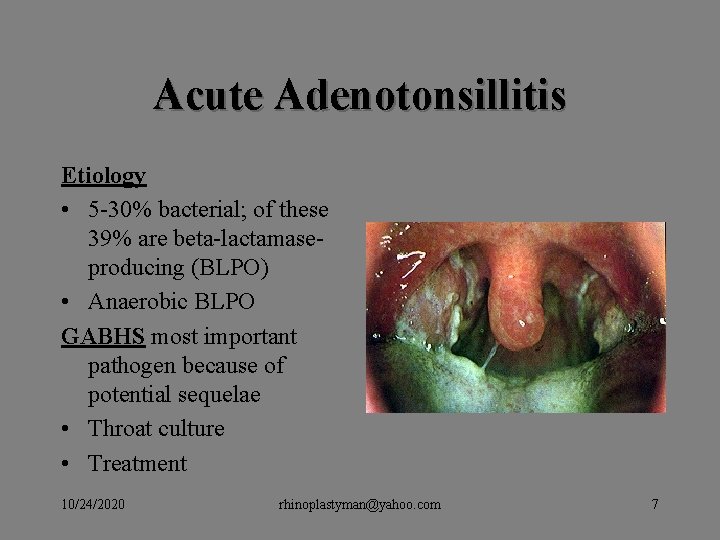
Acute Adenotonsillitis Etiology • 5 -30% bacterial; of these 39% are beta-lactamaseproducing (BLPO) • Anaerobic BLPO GABHS most important pathogen because of potential sequelae • Throat culture • Treatment 10/24/2020 rhinoplastyman@yahoo. com 7
Microbiology of Adenotonsillitis Most common organisms cultured from patients with chronic tonsillar disease (recurrent/chronic infection, hyperplasia): • Streptococcus pyogenes (Group A beta-hemolytic streptococcus) • H. influenza • S. aureus • Streptococcus pneumoniae Tonsil weight is directly proportional to bacterial load. 10/24/2020 rhinoplastyman@yahoo. com 8
Acute Adenotonsillitis Differential diagnosis Infectious mononucleosis Malignancy: lymphoma, leukemia, carcinoma Diptheria Scarlet fever Agranulocytosis 10/24/2020 rhinoplastyman@yahoo. com 9
Medical Management • PCN is first line, even if throat culture is negative for GABHS • For acute UAO: NP airway, steroids, IV abx, and immediate tonsillectomy for poor response • Recurrent tonsillitis: PCN injection if concerned about noncompliance or antibiotics aimed against BLPO and anaerobes • For chronic tonsillitis or obstruction, antibiotics directed against BLPO and anaerobes for 3 -6 weeks will eliminate need for surgery in 17% • Co-amoxiclav or clindamycin or PCN+Rifampin 10/24/2020 rhinoplastyman@yahoo. com 10
Obstructive Hyperplasia • Adenotonsillar hypertrophy most common cause of SDB in children • Diagnosis: snoring, restless sleep, FTT, daytime symptoms… poor mentation, decreased attn span, poor scholastic performance, dysphagia, nocturnal enuresis, chronic mouth breathing • Indications for polysomnography • Interpretation of polysomnography • Perioperative considerations 10/24/2020 rhinoplastyman@yahoo. com 11
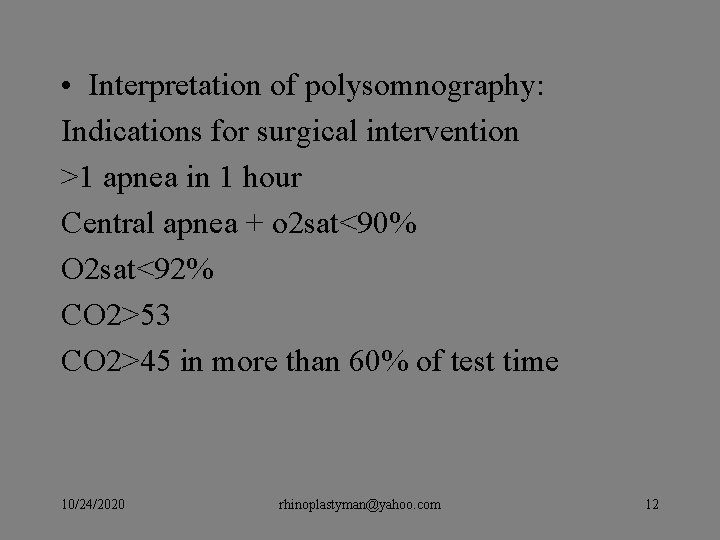
• Interpretation of polysomnography: Indications for surgical intervention >1 apnea in 1 hour Central apnea + o 2 sat<90% O 2 sat<92% CO 2>53 CO 2>45 in more than 60% of test time 10/24/2020 rhinoplastyman@yahoo. com 12
Unilateral Tonsillar Enlargement Apparent enlargement vs true enlargement Non-neoplastic: • Acute infective • Chronic infective • Hypertrophy • Congenital Neoplastic 10/24/2020 rhinoplastyman@yahoo. com 13
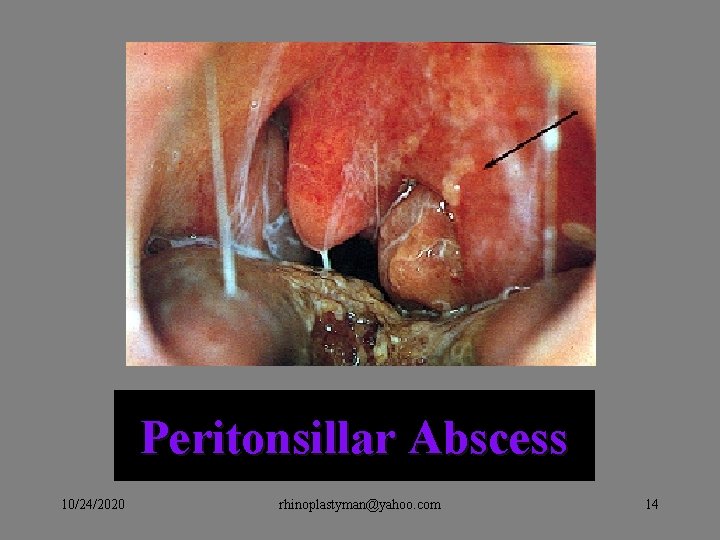
Peritonsillar Abscess 10/24/2020 rhinoplastyman@yahoo. com 14
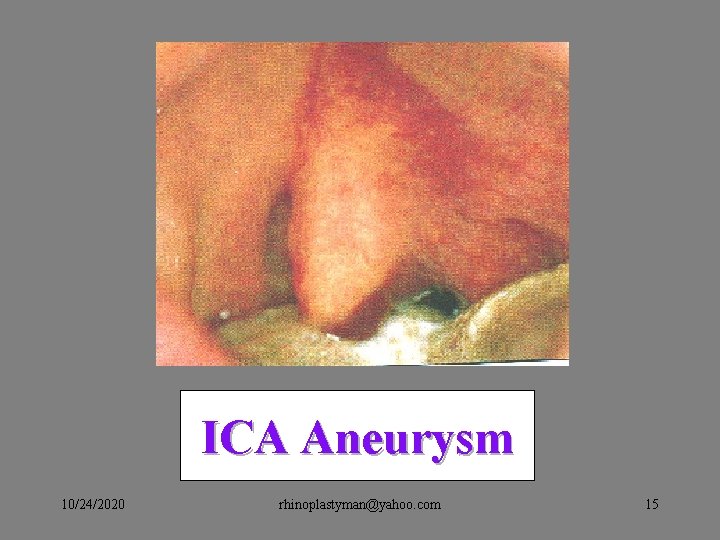
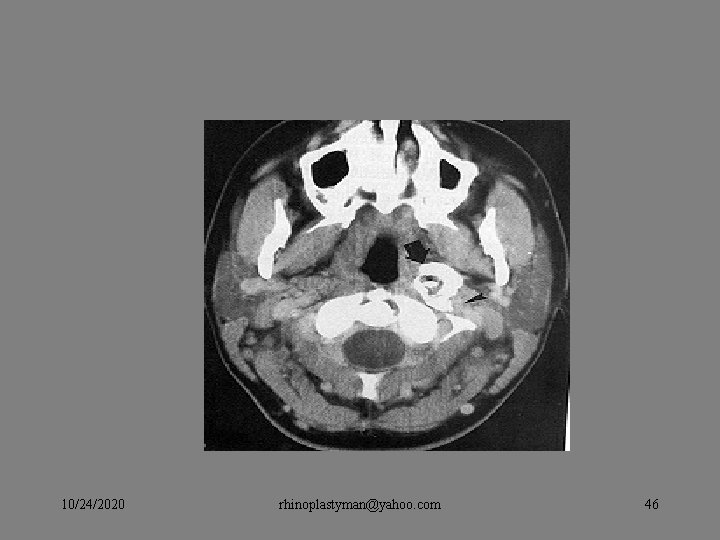
ICA Aneurysm 10/24/2020 rhinoplastyman@yahoo. com 15
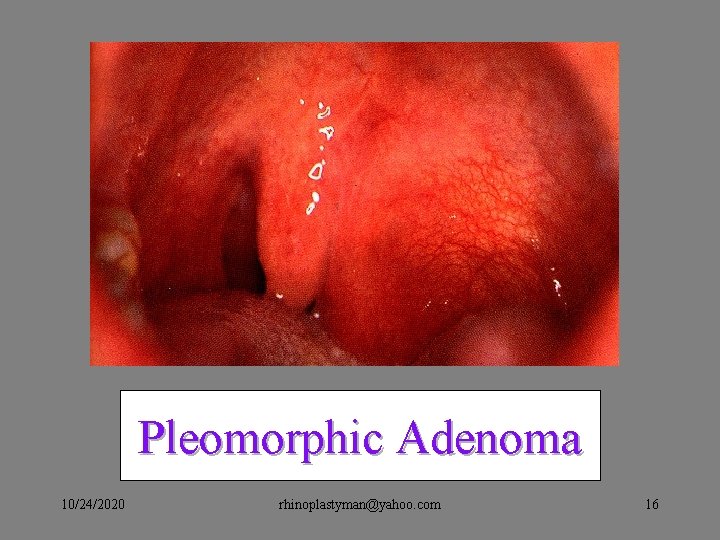
Pleomorphic Adenoma 10/24/2020 rhinoplastyman@yahoo. com 16
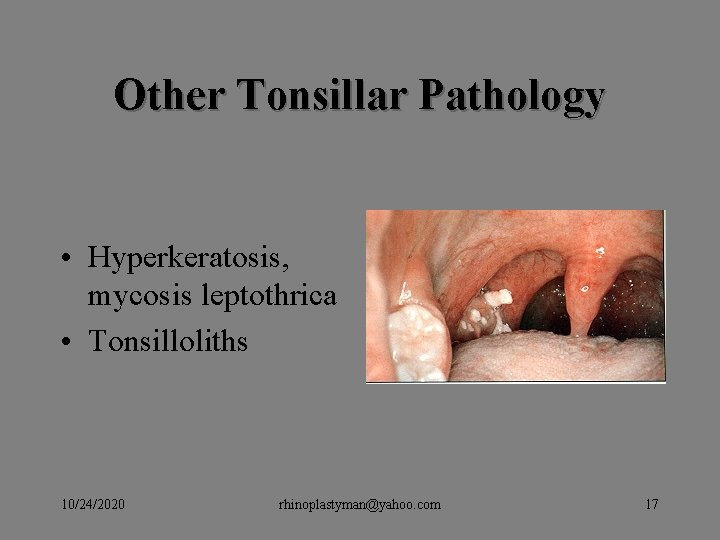
Other Tonsillar Pathology • Hyperkeratosis, mycosis leptothrica • Tonsilloliths 10/24/2020 rhinoplastyman@yahoo. com 17
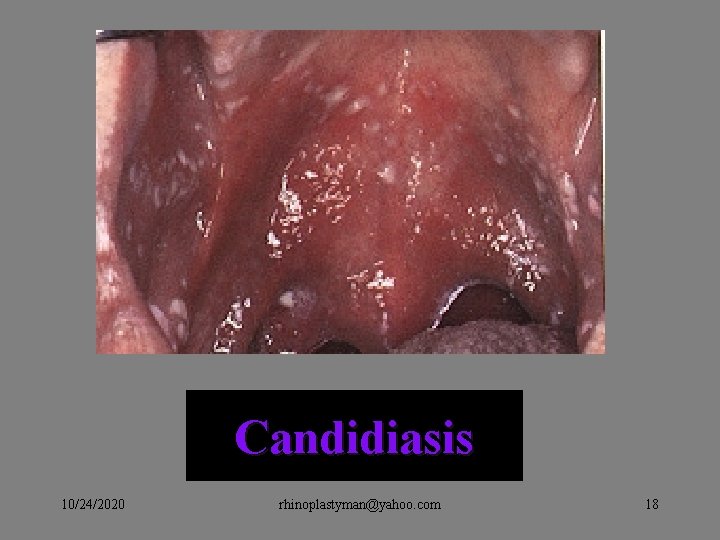
Candidiasis 10/24/2020 rhinoplastyman@yahoo. com 18
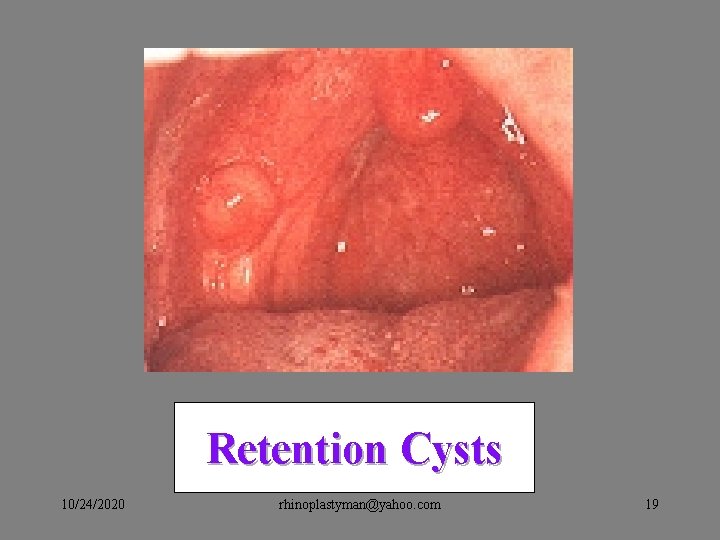
Retention Cysts 10/24/2020 rhinoplastyman@yahoo. com 19
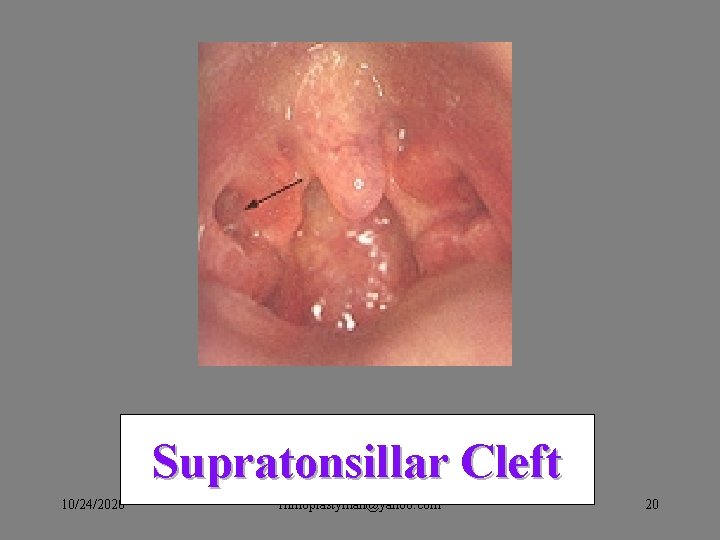
Supratonsillar Cleft 10/24/2020 rhinoplastyman@yahoo. com 20
Indications for Tonsillectomy; Historical Evolution 10/24/2020 rhinoplastyman@yahoo. com 21
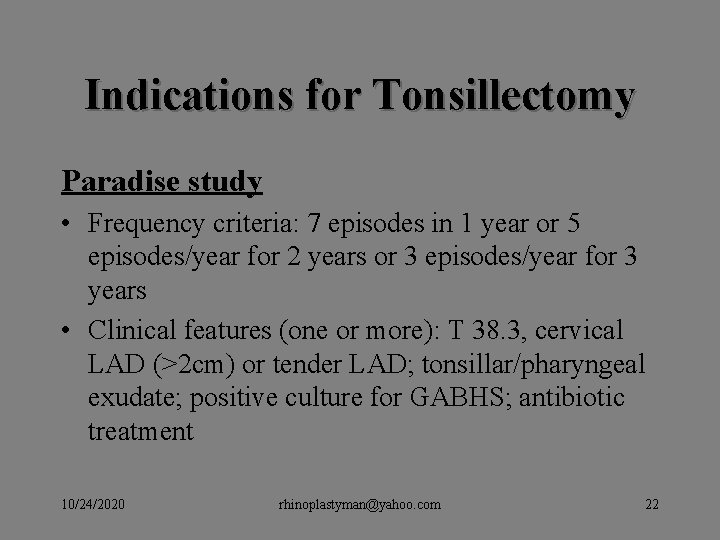
Indications for Tonsillectomy Paradise study • Frequency criteria: 7 episodes in 1 year or 5 episodes/year for 2 years or 3 episodes/year for 3 years • Clinical features (one or more): T 38. 3, cervical LAD (>2 cm) or tender LAD; tonsillar/pharyngeal exudate; positive culture for GABHS; antibiotic treatment 10/24/2020 rhinoplastyman@yahoo. com 22
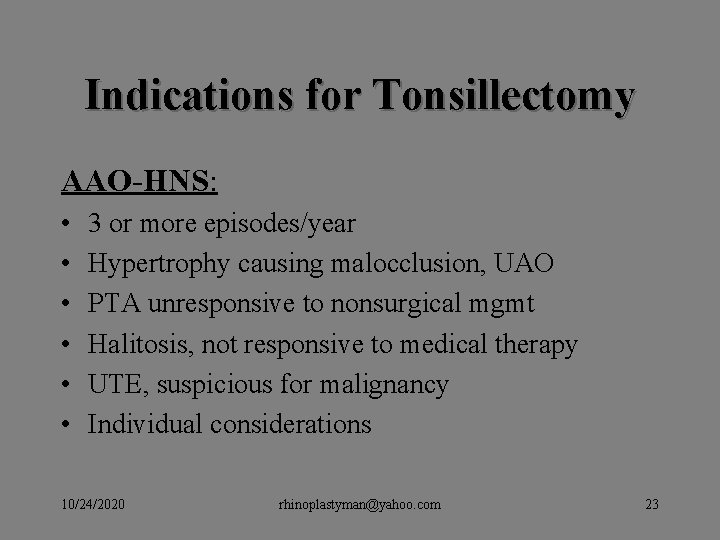
Indications for Tonsillectomy AAO-HNS: • • • 3 or more episodes/year Hypertrophy causing malocclusion, UAO PTA unresponsive to nonsurgical mgmt Halitosis, not responsive to medical therapy UTE, suspicious for malignancy Individual considerations 10/24/2020 rhinoplastyman@yahoo. com 23
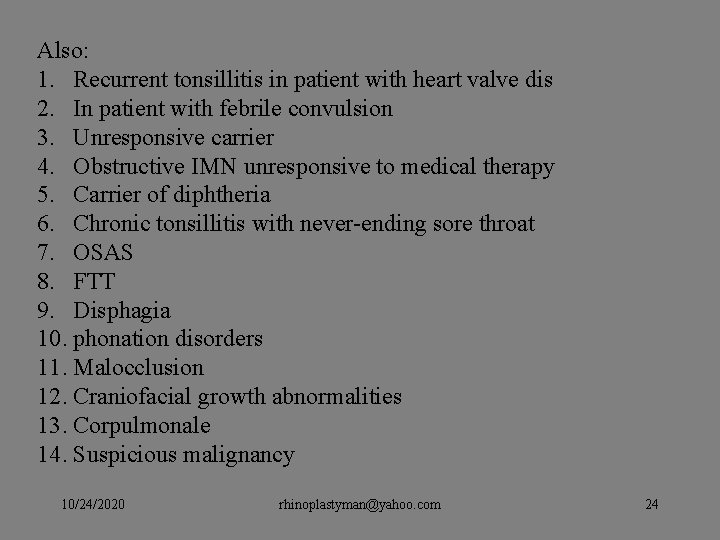
Also: 1. Recurrent tonsillitis in patient with heart valve dis 2. In patient with febrile convulsion 3. Unresponsive carrier 4. Obstructive IMN unresponsive to medical therapy 5. Carrier of diphtheria 6. Chronic tonsillitis with never-ending sore throat 7. OSAS 8. FTT 9. Disphagia 10. phonation disorders 11. Malocclusion 12. Craniofacial growth abnormalities 13. Corpulmonale 14. Suspicious malignancy 10/24/2020 rhinoplastyman@yahoo. com 24
Pathophysiology of corpulmonale in OSA: 1. 2. 3. 4. 5. 6. 7. 8. 10/24/2020 URT obstruction Alveolar hypovantilation Chronic hypoxia and hypercapnea Respiratory acidosis Vasoconstriction of alveolar capillaries Right atrial dilatation Pulmonary hypertension Corpulmonale and CHF rhinoplastyman@yahoo. com 25
Pathophysiology of enuresis: 1. SDB 2. REM abnormalities 3. Irregularities in ADH secretion Pathophysiology of FTT: 1. SDB 2. REM abnormalities 3. Irregularities in GH secretion, may sometimes stop totally Both return to normal following A&T 10/24/2020 rhinoplastyman@yahoo. com 26
ADHD (Attention Deficit Hyperactivity Disorder) is the most Common psychiatric diagnosis in children. In direct correlation with Sleep Disordered Breathing(SDB) Pathophysiology uncertain, Maybe due to abnormal sleep pattern Neurocognitive development delays: Healthy sleeping pattern: important component of brain growth Frontal cortex growth continues up to puberty Most critical age: 3 -7 10/24/2020 rhinoplastyman@yahoo. com 27
Indications for Adenoidectomy Paradise study • 28 -35% fewer acute episodes of OM with adenoidectomy in kids with previous tube placement • Adenoidectomy or T & A not indicated in children with recurrent OM who had not undergone previous tube placement Gates et al • Recommend adenoidectomy with M & T as the initial surgical treatment for children with MEE > 90 days and CHL > 20 d. B 10/24/2020 rhinoplastyman@yahoo. com 28
Indications for Adenoidectomy Obstruction: • • • Chronic nasal obstruction or obligate mouth breathing SDB with FTT, cor pulmonale Dysphagia Speech problems Severe orofacial/dental abnormalities Infection: • Recurrent/chronic adenoiditis (3 or more episodes/year) • Recurrent/chronic OME (+/- previous BMT) 10/24/2020 rhinoplastyman@yahoo. com 29
Also: • Chronic sinusitis: first step biofilm in 95% adenoid specimen vs. 2% in SDB • Chronic recurrent AOM • Chronic otorrhea • VT and persistent discharge • Suspecious malignancy 10/24/2020 rhinoplastyman@yahoo. com 30
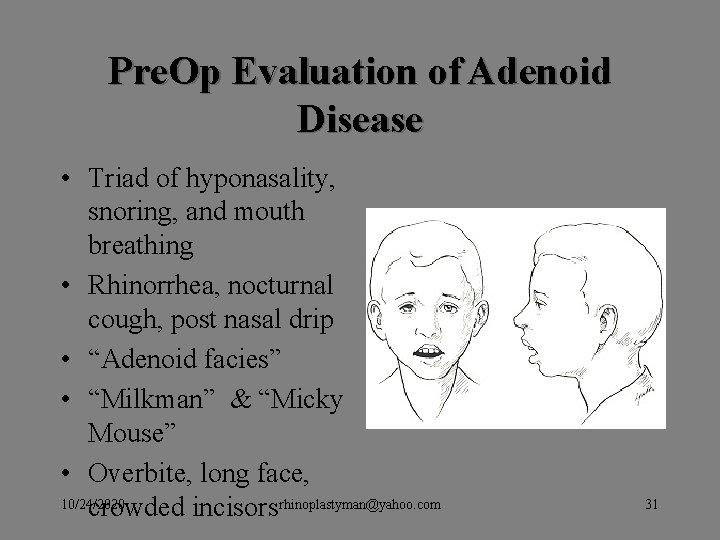
Pre. Op Evaluation of Adenoid Disease • Triad of hyponasality, snoring, and mouth breathing • Rhinorrhea, nocturnal cough, post nasal drip • “Adenoid facies” • “Milkman” & “Micky Mouse” • Overbite, long face, 10/24/2020 crowded incisorsrhinoplastyman@yahoo. com 31
Pre. Op Evaluation of Adenoid Disease Differential diagnoses • • Allergic rhinitis Sinusitis GERD For concomitant sinus disease, treat adenoids first 10/24/2020 rhinoplastyman@yahoo. com 32
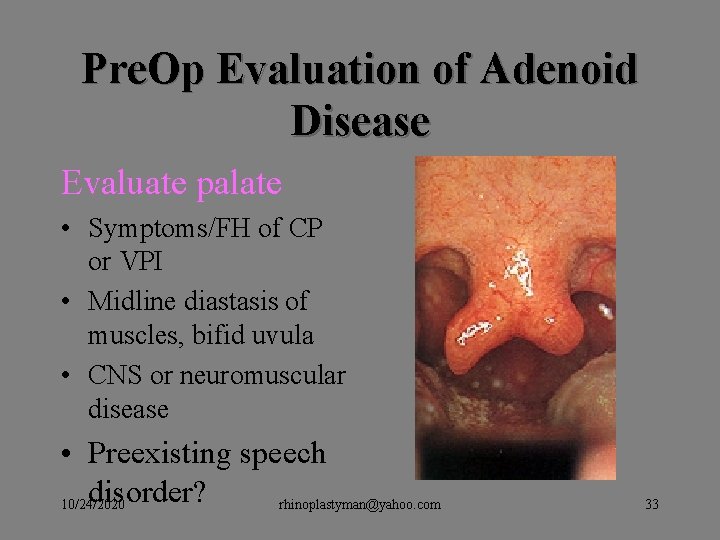
Pre. Op Evaluation of Adenoid Disease Evaluate palate • Symptoms/FH of CP or VPI • Midline diastasis of muscles, bifid uvula • CNS or neuromuscular disease • Preexisting speech disorder? 10/24/2020 rhinoplastyman@yahoo. com 33
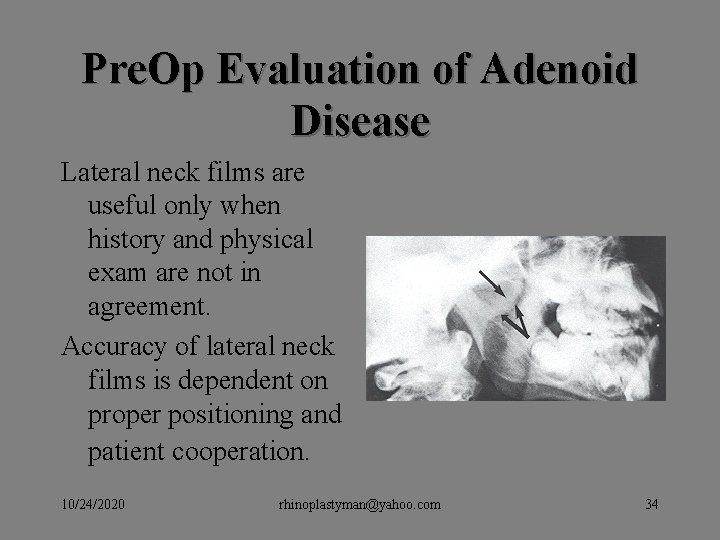
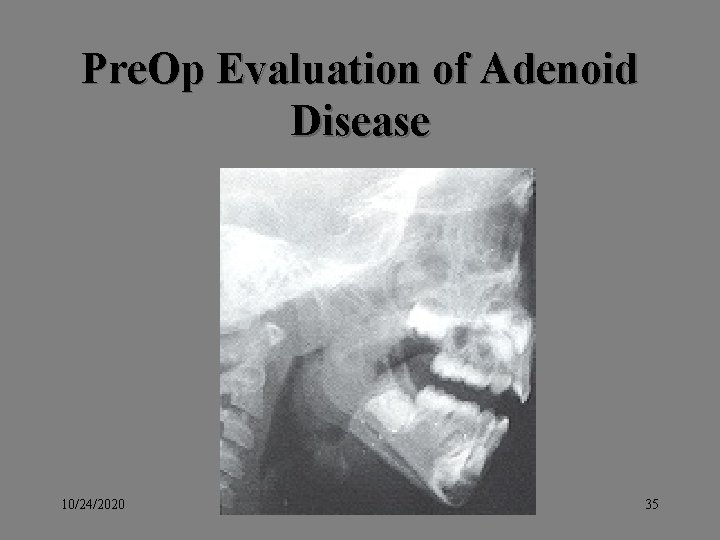
Pre. Op Evaluation of Adenoid Disease Lateral neck films are useful only when history and physical exam are not in agreement. Accuracy of lateral neck films is dependent on proper positioning and patient cooperation. 10/24/2020 rhinoplastyman@yahoo. com 34
Pre. Op Evaluation of Adenoid Disease 10/24/2020 rhinoplastyman@yahoo. com 35
Pre. Op Evaluation of Tonsillar Disease History • • • Documentation of episodes by physician FTT Cor pulmonale Poststreptococcal GN Rheumatic fever 10/24/2020 rhinoplastyman@yahoo. com 36
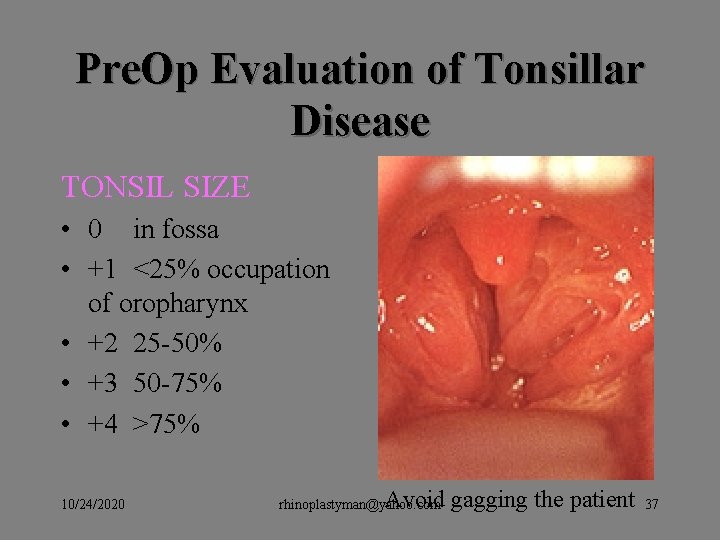
Pre. Op Evaluation of Tonsillar Disease TONSIL SIZE • 0 in fossa • +1 <25% occupation of oropharynx • +2 25 -50% • +3 50 -75% • +4 >75% 10/24/2020 Avoid gagging the patient rhinoplastyman@yahoo. com 37
Pre. Op Evaluation of Tonsillar Disease Down syndrome • 10% have Atlanto. Axial laxity • Obtain lateral cervical films (flexion/extension) when positive findings on history, PE • If unstable, need neurosurgical evaluation preoperatively • Large tongue and small mandible… difficult intubation • Prone to cardiac arrhythmias/hypotension during induction 10/24/2020 rhinoplastyman@yahoo. com 38
Pre. Op Evaluation for Adenotonsillar Disease Coagulation disorders • • • Historical screening CBC, PT/PTT, BT, v. WF activity Hematology consult von Willebrand’s disease ITP Sickle cell anemia 10/24/2020 rhinoplastyman@yahoo. com 39
Principles of Surgical Management Numerous techniques: • Guillotine • Tonsillotome • Beck’s snare • Dissection with snare (Scissor dissection, Fisher’s knife dissection, Finger dissection • Electrodissection • Laser dissection (CO 2, KTP) • Coblation • Radio. Frequency … Surgeon’s preference 10/24/2020 rhinoplastyman@yahoo. com 40
Post Operative Managment Criteria for Overnight Observation • • Poor oral intake, vomiting, hemorrhage Age < 3 Home > 45 minutes away Poor socioeconomic condition Comorbid medical problems Surgery for OSA or PTA Abnormal coagulation values (+/- identified disorder) in patient or family member 10/24/2020 rhinoplastyman@yahoo. com 41
Complications #1 Postoperative bleeding Other: • • • Sore throat, otalgia, uvular swelling Respiratory compromise Dehydration Burns and iatrogenic trauma Dental problems and trauma 10/24/2020 rhinoplastyman@yahoo. com 42
Rare Complications • • Velopharyngeal Insufficiency Nasopharyngeal stenosis Atlantoaxial subluxation/ Grisel’s syndrome Regrowth Eustachian tube injury Depression Laceration of ICA/ pseudoaneursym of ICA 10/24/2020 rhinoplastyman@yahoo. com 43
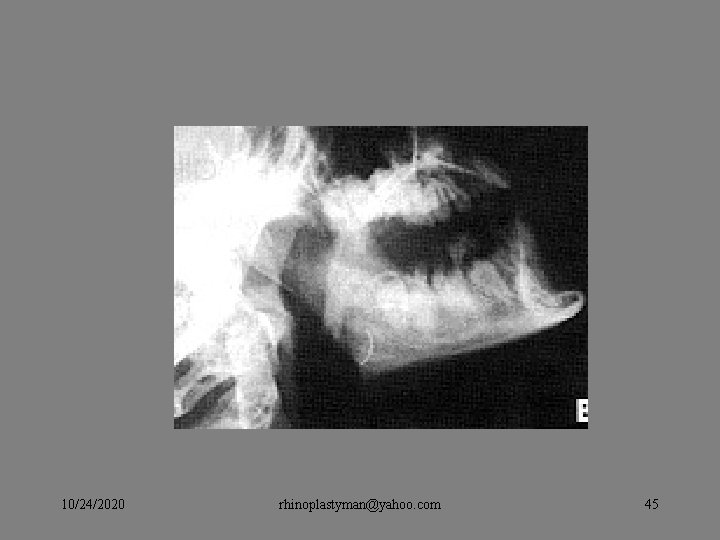
Management of Hemorrhage • • • Ice water gargle, afrin Overnight observation and IV fluids Dangerous induction ECA ligation Arteriography 10/24/2020 rhinoplastyman@yahoo. com 44
10/24/2020 rhinoplastyman@yahoo. com 45
10/24/2020 rhinoplastyman@yahoo. com 46
Case study • 13 year old female referred by PCP for frequent throat infections • “She’s always sick. She’s been on four different antibiotics this year. ” • You call her pediatrician… he is out of town and his nurse can’t find the chart 10/24/2020 rhinoplastyman@yahoo. com 47
Case study • No known medical problems, no prior surgical procedures • Takes motrin for menustrual cramps • No personal history of bleeding other than occasional nose bleeds and extremely heavy periods. • Family history unknown. Patient is adopted. 10/24/2020 rhinoplastyman@yahoo. com 48
Case study • Physical exam is unremarkable. • Mom breaks down in tears when you tell her you do not have enough documentation of illness to warrant T & A. “I had to go on welfare because I’ve missed so much work from her being out sick. ” • You hesitate. She adds, “Her grades have dropped from all A’s to all F’s. If she misses any more school, she’ll be held 10/24/2020 rhinoplastyman@yahoo. com 49 back. ”
Case study • You confirm with her pediatrician that she has had 4 episodes of tonsillitis this year and agree to T & A. • Because of her history of epistaxis and menorrhagia, you order a PT, PTT, CBC, BT. • She has a mild microcytic anemia and prolonged bleeding time. • You order v. WF activity level and consult 10/24/2020 rhinoplastyman@yahoo. com 50 hematology
Case study • She has a subnormal level of v. WF, which responds to a DDAVP challenge (rise in v. WF and Factor VII greater than 100%). • You advise her to stop taking motrin. • Before surgery, she receives desmopressin 0. 3 microg/kg IV over 30 min and amicar 200 mg/kg. 10/24/2020 rhinoplastyman@yahoo. com 51
Case study • She receives the same dose of DDVAP 12 hours postoperatively and every morning. • Amicar is given 100 mg/kg PO q 6 hr. • Before each dose of DDAVP, serum sodium is drawn. Sodium levels drop to 130. • Desmopressin is discontinued and substituted with cryoprecipitate. 10/24/2020 rhinoplastyman@yahoo. com 52
Case study • Patient presents to the ER on POD # 7 complaining of intermittent bleeding from her mouth. • You order cryoprecipitate, draw a Factor VII level and CBC, and call her hematologist. • Hemoglobin has dropped from 11. 9 to 9. 6. 10/24/2020 rhinoplastyman@yahoo. com 53
Case study • PE reveals no active bleeding; an old clot is present • You establish IV access, admit the patient for overnight observation, have her gargle with ice water, and administer crypoprecipitate • No further bleeding occurs, patient is discharged the next day 10/24/2020 rhinoplastyman@yahoo. com 54