Tommys Voice Inc Dawn M Cordeiro PresidentAdvocate IEP

- Slides: 31
Tommy’s Voice, Inc. Dawn M. Cordeiro President/Advocate IEP Training
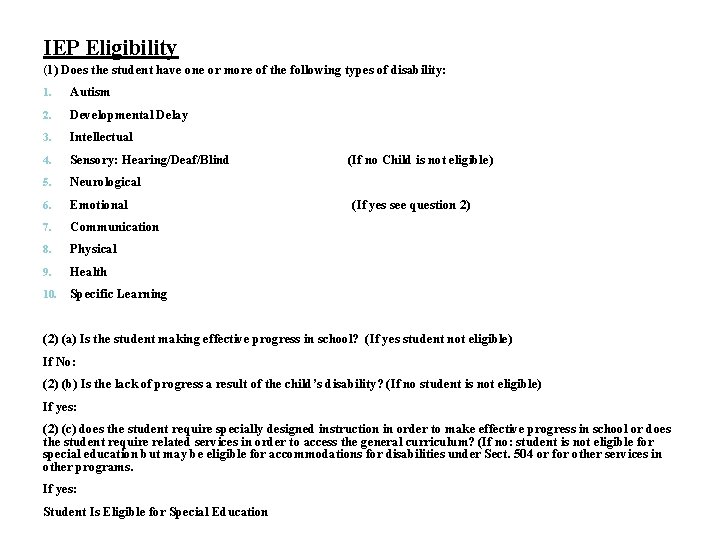
IEP Eligibility (1) Does the student have one or more of the following types of disability: 1. Autism 2. Developmental Delay 3. Intellectual 4. Sensory: Hearing/Deaf/Blind 5. Neurological 6. Emotional 7. Communication 8. Physical 9. Health 10. Specific Learning (If no Child is not eligible) (If yes see question 2) (a) Is the student making effective progress in school? (If yes student not eligible) If No: (2) (b) Is the lack of progress a result of the child’s disability? (If no student is not eligible) If yes: (2) (c) does the student require specially designed instruction in order to make effective progress in school or does the student require related services in order to access the general curriculum? (If no: student is not eligible for special education but may be eligible for accommodations for disabilities under Sect. 504 or for other services in other programs. If yes: Student Is Eligible for Special Education
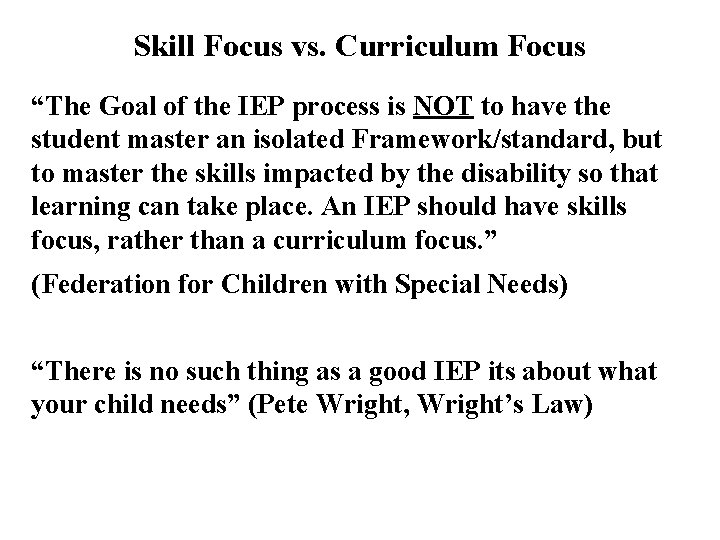
Skill Focus vs. Curriculum Focus “The Goal of the IEP process is NOT to have the student master an isolated Framework/standard, but to master the skills impacted by the disability so that learning can take place. An IEP should have skills focus, rather than a curriculum focus. ” (Federation for Children with Special Needs) “There is no such thing as a good IEP its about what your child needs” (Pete Wright, Wright’s Law)
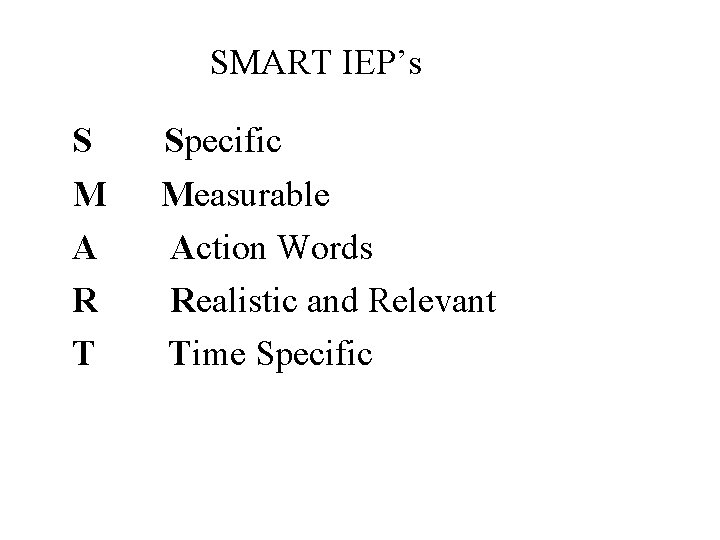
SMART IEP’s S M A R T Specific Measurable Action Words Realistic and Relevant Time Specific
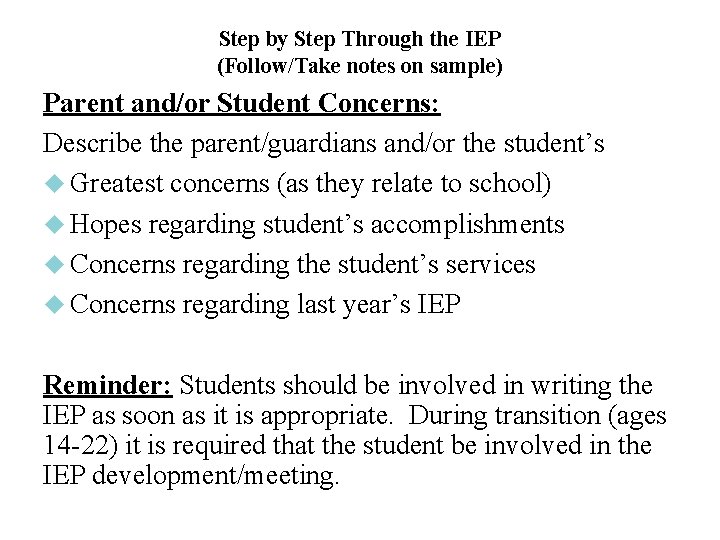
Step by Step Through the IEP (Follow/Take notes on sample) Parent and/or Student Concerns: Describe the parent/guardians and/or the student’s Greatest concerns (as they relate to school) Hopes regarding student’s accomplishments Concerns regarding the student’s services Concerns regarding last year’s IEP Reminder: Students should be involved in writing the IEP as soon as it is appropriate. During transition (ages 14 -22) it is required that the student be involved in the IEP development/meeting.
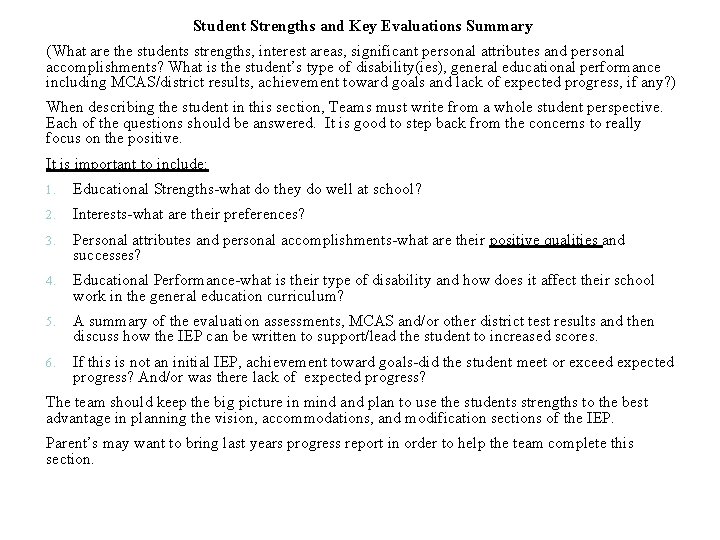
Student Strengths and Key Evaluations Summary (What are the students strengths, interest areas, significant personal attributes and personal accomplishments? What is the student’s type of disability(ies), general educational performance including MCAS/district results, achievement toward goals and lack of expected progress, if any? ) When describing the student in this section, Teams must write from a whole student perspective. Each of the questions should be answered. It is good to step back from the concerns to really focus on the positive. It is important to include: 1. Educational Strengths-what do they do well at school? 2. Interests-what are their preferences? 3. Personal attributes and personal accomplishments-what are their positive qualities and successes? 4. Educational Performance-what is their type of disability and how does it affect their school work in the general education curriculum? 5. A summary of the evaluation assessments, MCAS and/or other district test results and then discuss how the IEP can be written to support/lead the student to increased scores. 6. If this is not an initial IEP, achievement toward goals-did the student meet or exceed expected progress? And/or was there lack of expected progress? The team should keep the big picture in mind and plan to use the students strengths to the best advantage in planning the vision, accommodations, and modification sections of the IEP. Parent’s may want to bring last years progress report in order to help the team complete this section.
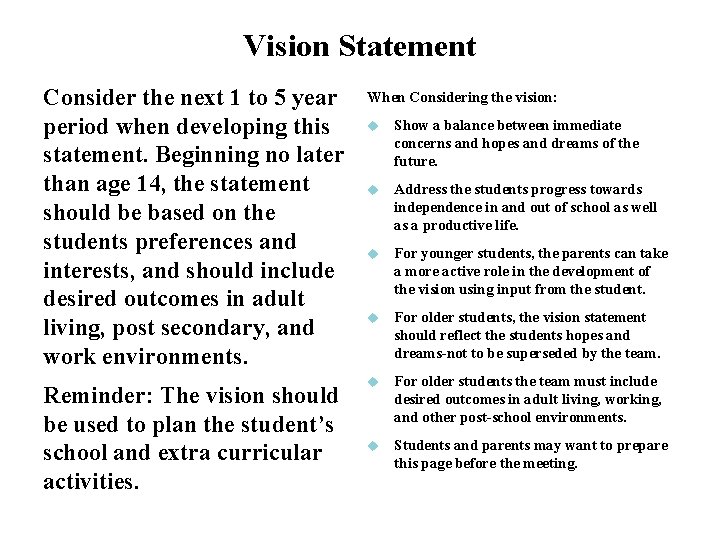
Vision Statement Consider the next 1 to 5 year period when developing this statement. Beginning no later than age 14, the statement should be based on the students preferences and interests, and should include desired outcomes in adult living, post secondary, and work environments. Reminder: The vision should be used to plan the student’s school and extra curricular activities. When Considering the vision: Show a balance between immediate concerns and hopes and dreams of the future. Address the students progress towards independence in and out of school as well as a productive life. For younger students, the parents can take a more active role in the development of the vision using input from the student. For older students, the vision statement should reflect the students hopes and dreams-not to be superseded by the team. For older students the team must include desired outcomes in adult living, working, and other post-school environments. Students and parents may want to prepare this page before the meeting.
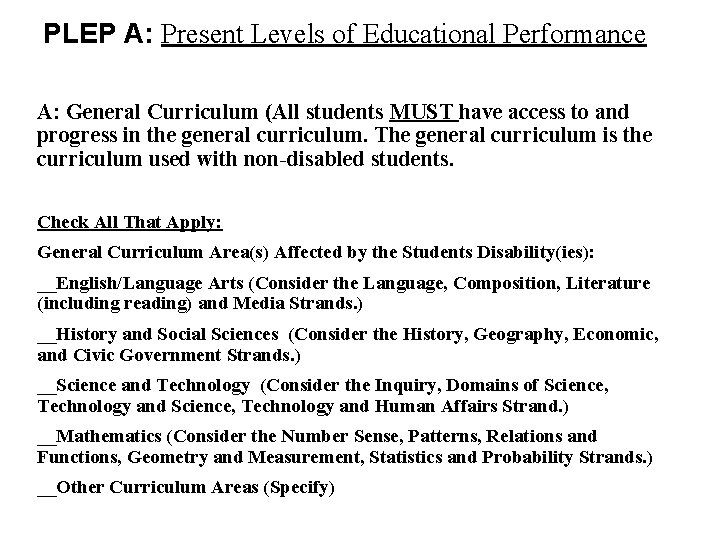
PLEP A: Present Levels of Educational Performance A: General Curriculum (All students MUST have access to and progress in the general curriculum. The general curriculum is the curriculum used with non-disabled students. Check All That Apply: General Curriculum Area(s) Affected by the Students Disability(ies): __English/Language Arts (Consider the Language, Composition, Literature (including reading) and Media Strands. ) __History and Social Sciences (Consider the History, Geography, Economic, and Civic Government Strands. ) __Science and Technology (Consider the Inquiry, Domains of Science, Technology and Human Affairs Strand. ) __Mathematics (Consider the Number Sense, Patterns, Relations and Functions, Geometry and Measurement, Statistics and Probability Strands. ) __Other Curriculum Areas (Specify)
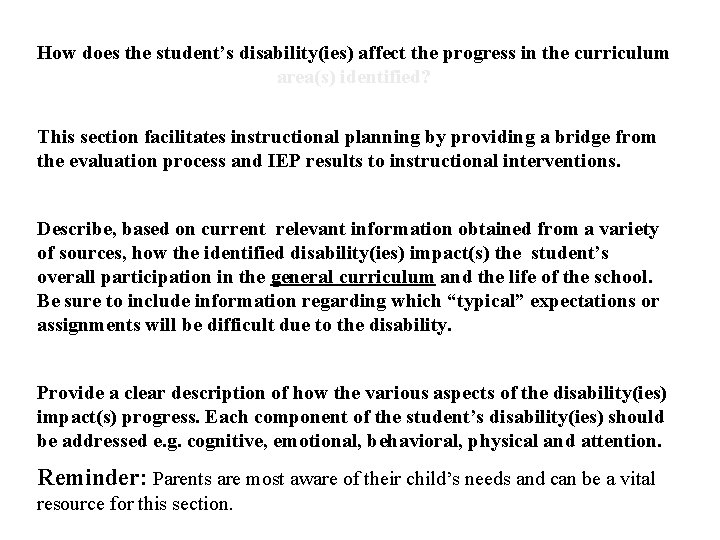
How does the student’s disability(ies) affect the progress in the curriculum area(s) identified? This section facilitates instructional planning by providing a bridge from the evaluation process and IEP results to instructional interventions. Describe, based on current relevant information obtained from a variety of sources, how the identified disability(ies) impact(s) the student’s overall participation in the general curriculum and the life of the school. Be sure to include information regarding which “typical” expectations or assignments will be difficult due to the disability. Provide a clear description of how the various aspects of the disability(ies) impact(s) progress. Each component of the student’s disability(ies) should be addressed e. g. cognitive, emotional, behavioral, physical and attention. Reminder: Parents are most aware of their child’s needs and can be a vital resource for this section.
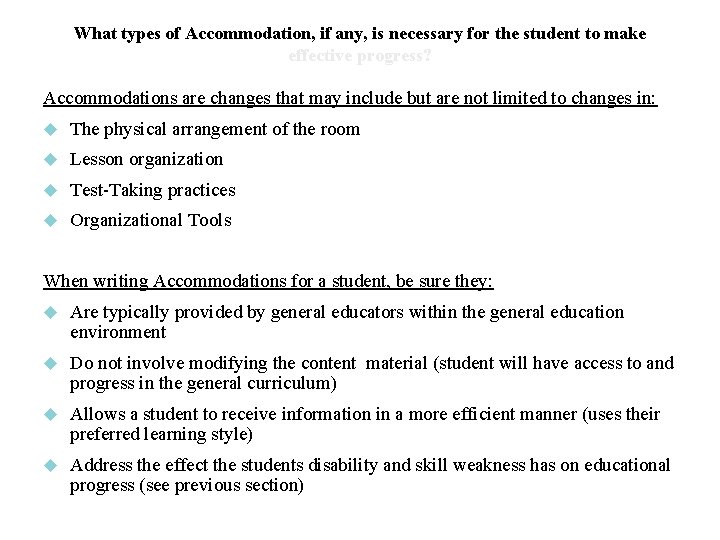
What types of Accommodation, if any, is necessary for the student to make effective progress? Accommodations are changes that may include but are not limited to changes in: The physical arrangement of the room Lesson organization Test-Taking practices Organizational Tools When writing Accommodations for a student, be sure they: Are typically provided by general educators within the general education environment Do not involve modifying the content material (student will have access to and progress in the general curriculum) Allows a student to receive information in a more efficient manner (uses their preferred learning style) Address the effect the students disability and skill weakness has on educational progress (see previous section)
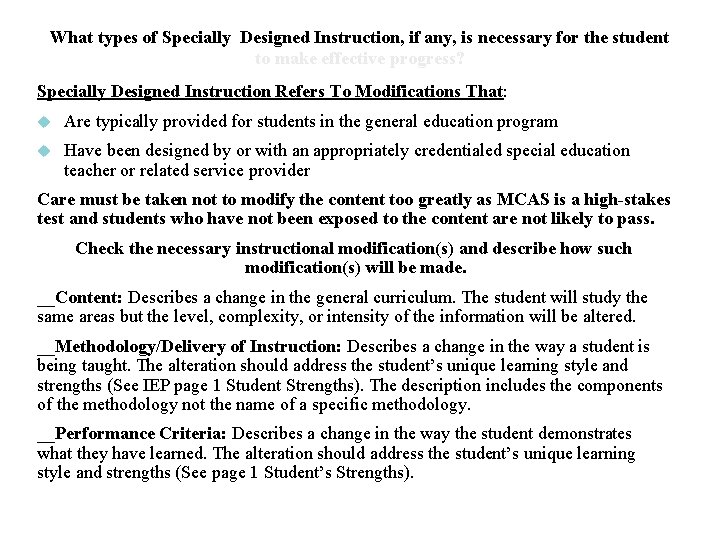
What types of Specially Designed Instruction, if any, is necessary for the student to make effective progress? Specially Designed Instruction Refers To Modifications That: Are typically provided for students in the general education program Have been designed by or with an appropriately credentialed special education teacher or related service provider Care must be taken not to modify the content too greatly as MCAS is a high-stakes test and students who have not been exposed to the content are not likely to pass. Check the necessary instructional modification(s) and describe how such modification(s) will be made. __Content: Describes a change in the general curriculum. The student will study the same areas but the level, complexity, or intensity of the information will be altered. __Methodology/Delivery of Instruction: Describes a change in the way a student is being taught. The alteration should address the student’s unique learning style and strengths (See IEP page 1 Student Strengths). The description includes the components of the methodology not the name of a specific methodology. __Performance Criteria: Describes a change in the way the student demonstrates what they have learned. The alteration should address the student’s unique learning style and strengths (See page 1 Student’s Strengths).
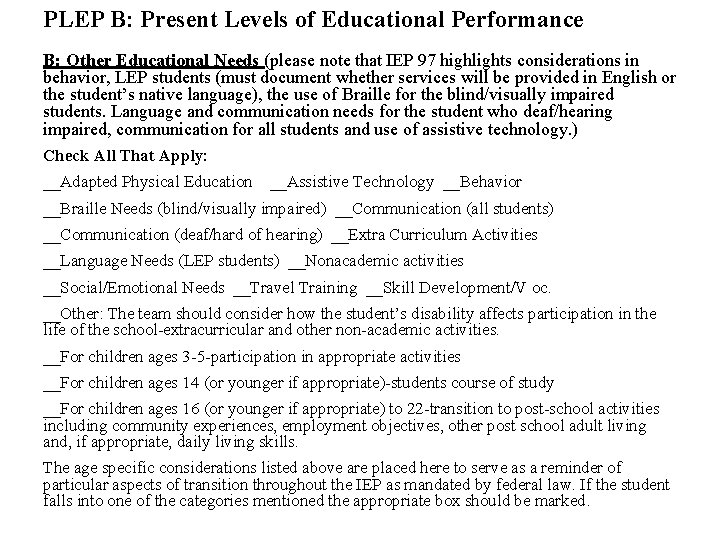
PLEP B: Present Levels of Educational Performance B: Other Educational Needs (please note that IEP 97 highlights considerations in behavior, LEP students (must document whether services will be provided in English or the student’s native language), the use of Braille for the blind/visually impaired students. Language and communication needs for the student who deaf/hearing impaired, communication for all students and use of assistive technology. ) Check All That Apply: __Adapted Physical Education __Assistive Technology __Behavior __Braille Needs (blind/visually impaired) __Communication (all students) __Communication (deaf/hard of hearing) __Extra Curriculum Activities __Language Needs (LEP students) __Nonacademic activities __Social/Emotional Needs __Travel Training __Skill Development/V oc. __Other: The team should consider how the student’s disability affects participation in the life of the school-extracurricular and other non-academic activities. __For children ages 3 -5 -participation in appropriate activities __For children ages 14 (or younger if appropriate)-students course of study __For children ages 16 (or younger if appropriate) to 22 -transition to post-school activities including community experiences, employment objectives, other post school adult living and, if appropriate, daily living skills. The age specific considerations listed above are placed here to serve as a reminder of particular aspects of transition throughout the IEP as mandated by federal law. If the student falls into one of the categories mentioned the appropriate box should be marked.
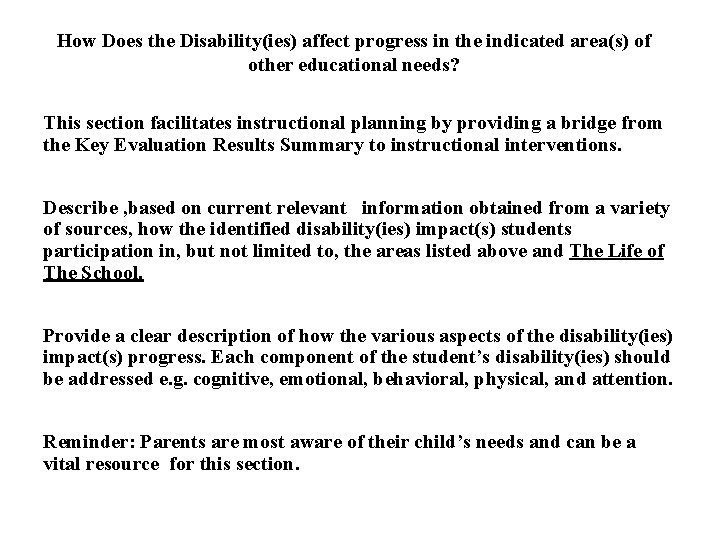
How Does the Disability(ies) affect progress in the indicated area(s) of other educational needs? This section facilitates instructional planning by providing a bridge from the Key Evaluation Results Summary to instructional interventions. Describe , based on current relevant information obtained from a variety of sources, how the identified disability(ies) impact(s) students participation in, but not limited to, the areas listed above and The Life of The School. Provide a clear description of how the various aspects of the disability(ies) impact(s) progress. Each component of the student’s disability(ies) should be addressed e. g. cognitive, emotional, behavioral, physical, and attention. Reminder: Parents are most aware of their child’s needs and can be a vital resource for this section.
What type(s) of accommodation, if any, is necessary for the student to make effective progress? Some students may require accommodations in only one curriculum or program area, others may require extensive accommodations or none at all The “Teams” attention should be on what the school district can do to help the student.
What type(s) of specially designed instruction, if any, is necessary for the student to make effective progress? Specifically designed instruction addresses the unique needs of the student that result from their disability Not all students will need specially designed instruction in all areas of educational need and not all students will require specially designed instruction in the areas of content, methodology/delivery of instruction or performance criteria. Check the necessary instructional modification(s) and describe how such modification(s) will be made. __Content: Describes a change in the general curriculum. The student will study the same areas but the level, complexity, or the intensity of the information will be altered. __Methodology/Delivery of Instruction: describes a change in the way a student is being taught. The alteration should address the student’s unique learning style and strengths. The description includes the components of the methodology not the name of a specific methodology. __Performance Criteria: Describes a change in the way the student demonstrates what they have learned. The alteration should address the student’s unique learning style and strengths.
Current Performance Levels/Measurable Annual Goals Team members will now begin to pay attention to what the school district will expect the student to do and accomplish over the IEP period. The team must ensure that the selected goals are skill building and are the ones that matter most to the parents, to the future of the student, and in making the biggest difference in the student’s life.
Goal# Specific Goal Focus: Using the information found in the Present Levels of Educational Performance (IEP pages 2&3) the Team should identify the focus areas for the goals. Once the focus areas have been determined, the Team then generates specific current performance levels within these focus areas. The current performance levels become the starting point for writing goals and the goals become the end points for student accomplishment for the IEP period. For this reason, current performance levels need to be recorded clearly. This section should be based on examples of student work or test results and not only on anecdotal information. Ask the question, “Within this limited skill area, what can the student do now? ”
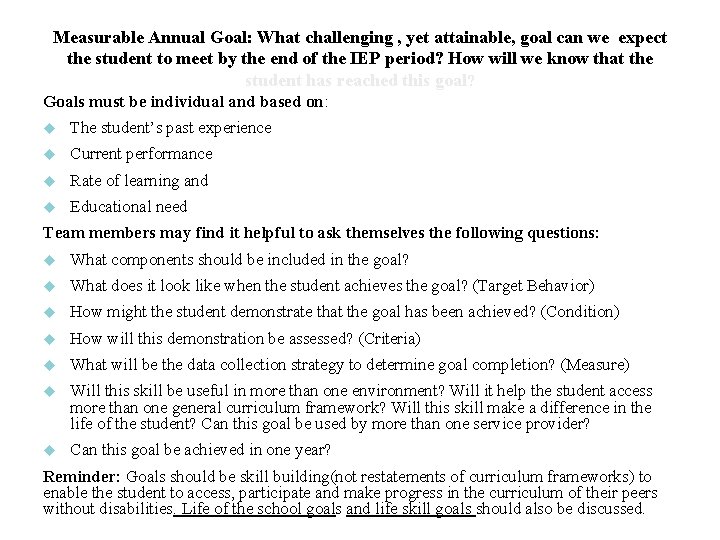
Measurable Annual Goal: What challenging , yet attainable, goal can we expect the student to meet by the end of the IEP period? How will we know that the student has reached this goal? Goals must be individual and based on: The student’s past experience Current performance Rate of learning and Educational need Team members may find it helpful to ask themselves the following questions: What components should be included in the goal? What does it look like when the student achieves the goal? (Target Behavior) How might the student demonstrate that the goal has been achieved? (Condition) How will this demonstration be assessed? (Criteria) What will be the data collection strategy to determine goal completion? (Measure) Will this skill be useful in more than one environment? Will it help the student access more than one general curriculum framework? Will this skill make a difference in the life of the student? Can this goal be used by more than one service provider? Can this goal be achieved in one year? Reminder: Goals should be skill building(not restatements of curriculum frameworks) to enable the student to access, participate and make progress in the curriculum of their peers without disabilities. Life of the school goals and life skill goals should also be discussed.
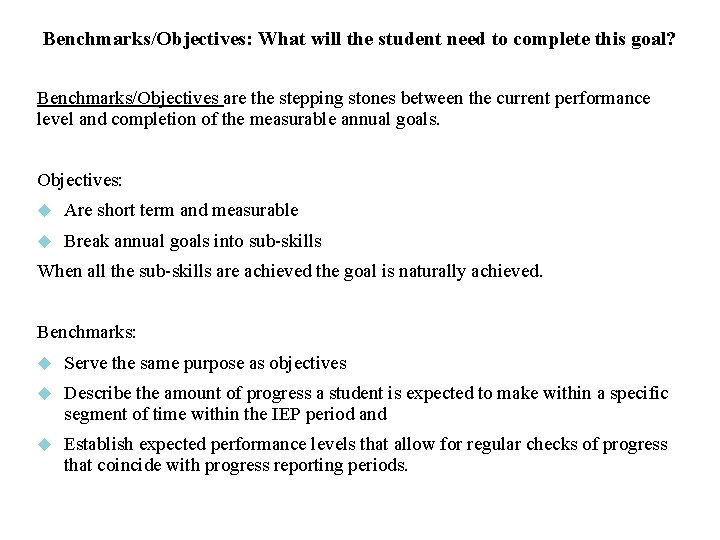
Benchmarks/Objectives: What will the student need to complete this goal? Benchmarks/Objectives are the stepping stones between the current performance level and completion of the measurable annual goals. Objectives: Are short term and measurable Break annual goals into sub-skills When all the sub-skills are achieved the goal is naturally achieved. Benchmarks: Serve the same purpose as objectives Describe the amount of progress a student is expected to make within a specific segment of time within the IEP period and Establish expected performance levels that allow for regular checks of progress that coincide with progress reporting periods.
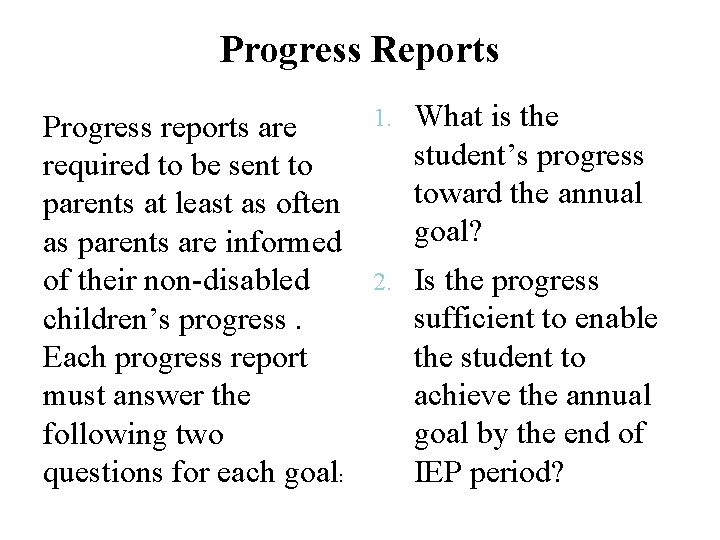
Progress Reports 1. What is the Progress reports are student’s progress required to be sent to toward the annual parents at least as often goal? as parents are informed 2. Is the progress of their non-disabled sufficient to enable children’s progress. the student to Each progress report achieve the annual must answer the goal by the end of following two IEP period? questions for each goal:
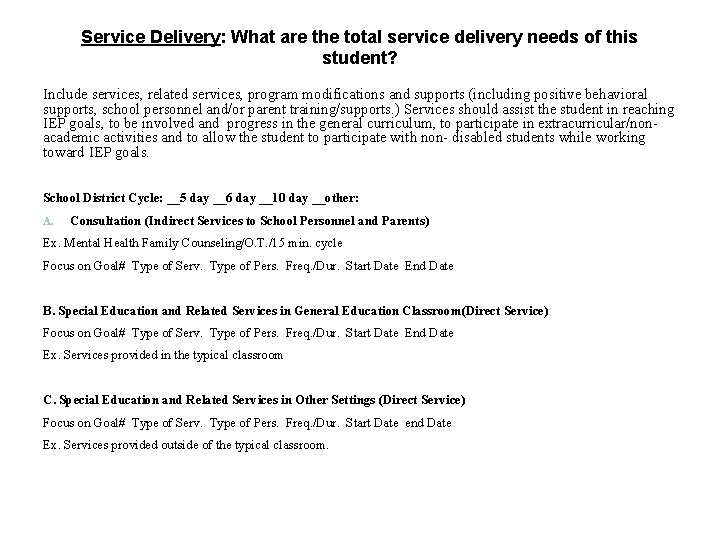
Service Delivery: What are the total service delivery needs of this student? Include services, related services, program modifications and supports (including positive behavioral supports, school personnel and/or parent training/supports. ) Services should assist the student in reaching IEP goals, to be involved and progress in the general curriculum, to participate in extracurricular/nonacademic activities and to allow the student to participate with non- disabled students while working toward IEP goals. School District Cycle: __5 day __6 day __10 day __other: A. Consultation (Indirect Services to School Personnel and Parents) Ex. Mental Health Family Counseling/O. T. /15 min. cycle Focus on Goal# Type of Serv. Type of Pers. Freq. /Dur. Start Date End Date B. Special Education and Related Services in General Education Classroom(Direct Service) Focus on Goal# Type of Serv. Type of Pers. Freq. /Dur. Start Date End Date Ex. Services provided in the typical classroom C. Special Education and Related Services in Other Settings (Direct Service) Focus on Goal# Type of Serv. Type of Pers. Freq. /Dur. Start Date end Date Ex. Services provided outside of the typical classroom.
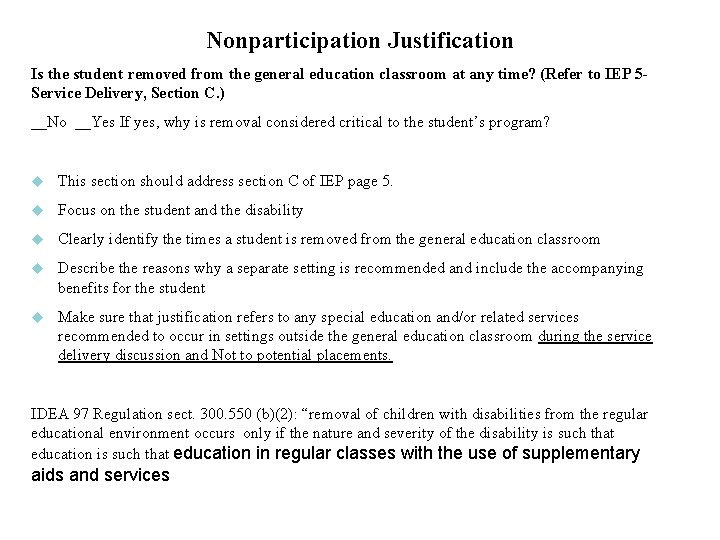
Nonparticipation Justification Is the student removed from the general education classroom at any time? (Refer to IEP 5 Service Delivery, Section C. ) __No __Yes If yes, why is removal considered critical to the student’s program? This section should address section C of IEP page 5. Focus on the student and the disability Clearly identify the times a student is removed from the general education classroom Describe the reasons why a separate setting is recommended and include the accompanying benefits for the student Make sure that justification refers to any special education and/or related services recommended to occur in settings outside the general education classroom during the service delivery discussion and Not to potential placements. IDEA 97 Regulation sect. 300. 550 (b)(2): “removal of children with disabilities from the regular educational environment occurs only if the nature and severity of the disability is such that education in regular classes with the use of supplementary aids and services cannot be achieved satisfactorily. ”
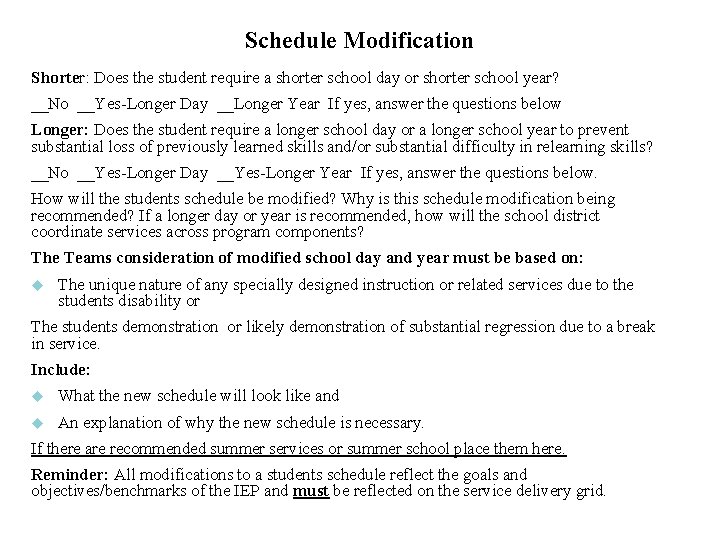
Schedule Modification Shorter: Does the student require a shorter school day or shorter school year? __No __Yes-Longer Day __Longer Year If yes, answer the questions below Longer: Does the student require a longer school day or a longer school year to prevent substantial loss of previously learned skills and/or substantial difficulty in relearning skills? __No __Yes-Longer Day __Yes-Longer Year If yes, answer the questions below. How will the students schedule be modified? Why is this schedule modification being recommended? If a longer day or year is recommended, how will the school district coordinate services across program components? The Teams consideration of modified school day and year must be based on: The unique nature of any specially designed instruction or related services due to the students disability or The students demonstration or likely demonstration of substantial regression due to a break in service. Include: What the new schedule will look like and An explanation of why the new schedule is necessary. If there are recommended summer services or summer school place them here. Reminder: All modifications to a students schedule reflect the goals and objectives/benchmarks of the IEP and must be reflected on the service delivery grid.
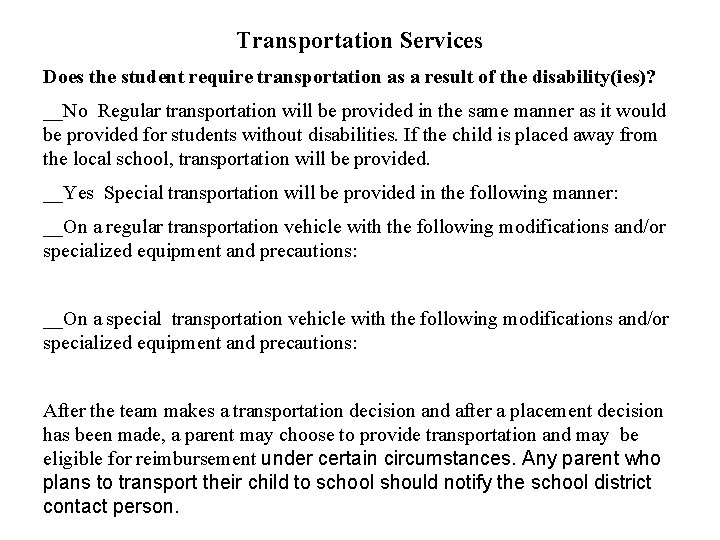
Transportation Services Does the student require transportation as a result of the disability(ies)? __No Regular transportation will be provided in the same manner as it would be provided for students without disabilities. If the child is placed away from the local school, transportation will be provided. __Yes Special transportation will be provided in the following manner: __On a regular transportation vehicle with the following modifications and/or specialized equipment and precautions: __On a special transportation vehicle with the following modifications and/or specialized equipment and precautions: After the team makes a transportation decision and after a placement decision has been made, a parent may choose to provide transportation and may be eligible for reimbursement under certain circumstances. Any parent who plans to transport their child to school should notify the school district contact person.
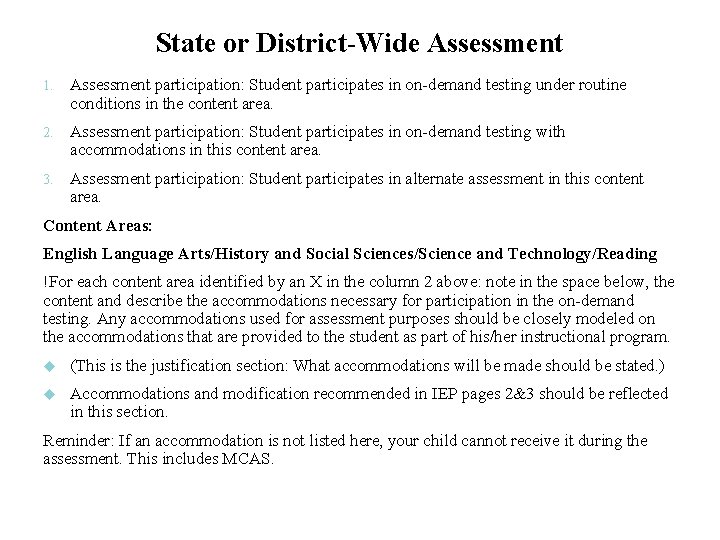
State or District-Wide Assessment 1. Assessment participation: Student participates in on-demand testing under routine conditions in the content area. 2. Assessment participation: Student participates in on-demand testing with accommodations in this content area. 3. Assessment participation: Student participates in alternate assessment in this content area. Content Areas: English Language Arts/History and Social Sciences/Science and Technology/Reading !For each content area identified by an X in the column 2 above: note in the space below, the content and describe the accommodations necessary for participation in the on-demand testing. Any accommodations used for assessment purposes should be closely modeled on the accommodations that are provided to the student as part of his/her instructional program. (This is the justification section: What accommodations will be made should be stated. ) Accommodations and modification recommended in IEP pages 2&3 should be reflected in this section. Reminder: If an accommodation is not listed here, your child cannot receive it during the assessment. This includes MCAS.
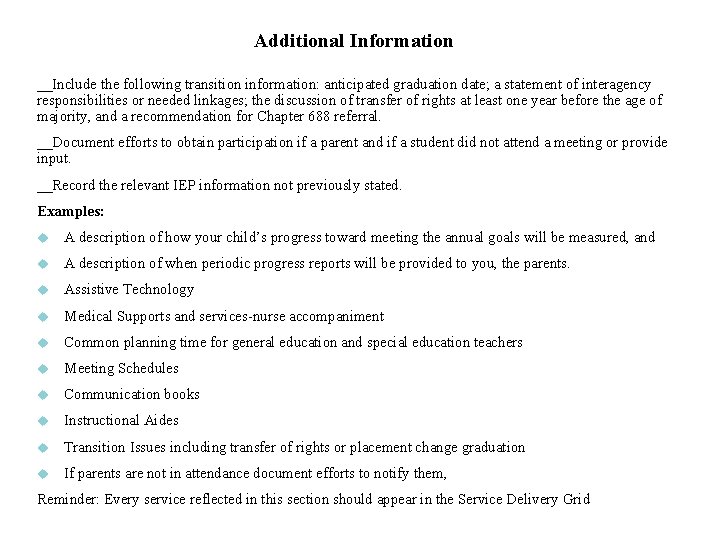
Additional Information __Include the following transition information: anticipated graduation date; a statement of interagency responsibilities or needed linkages; the discussion of transfer of rights at least one year before the age of majority, and a recommendation for Chapter 688 referral. __Document efforts to obtain participation if a parent and if a student did not attend a meeting or provide input. __Record the relevant IEP information not previously stated. Examples: A description of how your child’s progress toward meeting the annual goals will be measured, and A description of when periodic progress reports will be provided to you, the parents. Assistive Technology Medical Supports and services-nurse accompaniment Common planning time for general education and special education teachers Meeting Schedules Communication books Instructional Aides Transition Issues including transfer of rights or placement change graduation If parents are not in attendance document efforts to notify them, Reminder: Every service reflected in this section should appear in the Service Delivery Grid
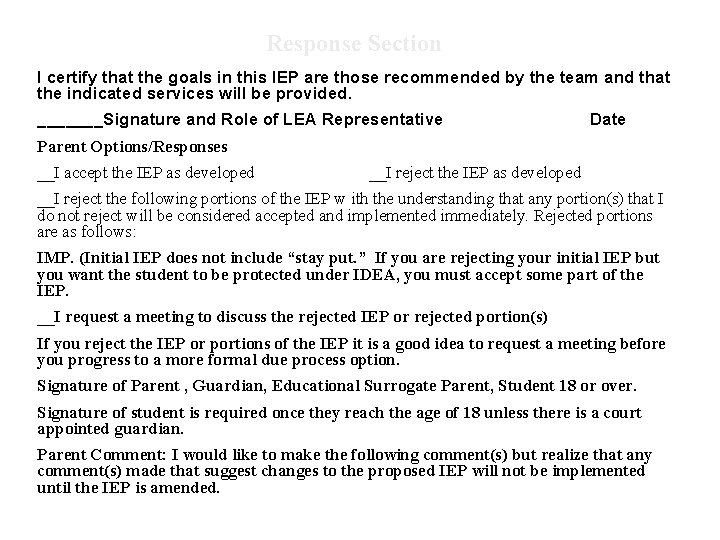
Response Section I certify that the goals in this IEP are those recommended by the team and that the indicated services will be provided. _______Signature and Role of LEA Representative Date Parent Options/Responses __I accept the IEP as developed __I reject the following portions of the IEP w ith the understanding that any portion(s) that I do not reject will be considered accepted and implemented immediately. Rejected portions are as follows: IMP. (Initial IEP does not include “stay put. ” If you are rejecting your initial IEP but you want the student to be protected under IDEA, you must accept some part of the IEP. __I request a meeting to discuss the rejected IEP or rejected portion(s) If you reject the IEP or portions of the IEP it is a good idea to request a meeting before you progress to a more formal due process option. Signature of Parent , Guardian, Educational Surrogate Parent, Student 18 or over. Signature of student is required once they reach the age of 18 unless there is a court appointed guardian. Parent Comment: I would like to make the following comment(s) but realize that any comment(s) made that suggest changes to the proposed IEP will not be implemented until the IEP is amended.
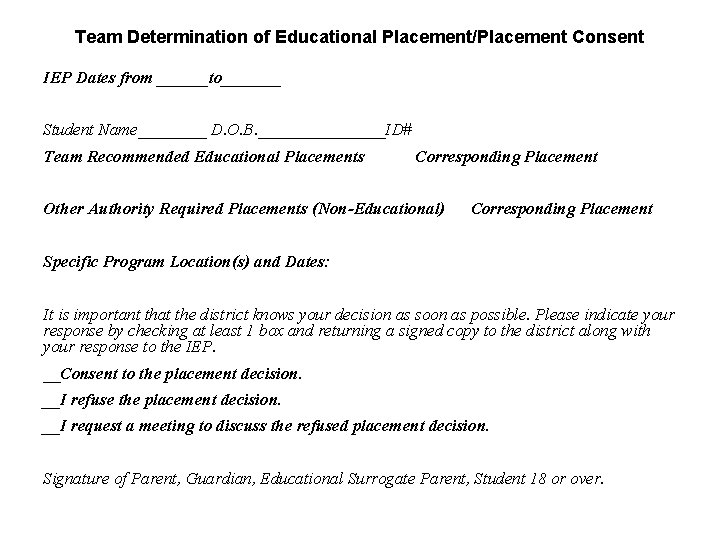
Team Determination of Educational Placement/Placement Consent IEP Dates from ______to_______ Student Name____ D. O. B. ________ID# Team Recommended Educational Placements Corresponding Placement Other Authority Required Placements (Non-Educational) Corresponding Placement Specific Program Location(s) and Dates: It is important that the district knows your decision as soon as possible. Please indicate your response by checking at least 1 box and returning a signed copy to the district along with your response to the IEP. __Consent to the placement decision. __I refuse the placement decision. __I request a meeting to discuss the refused placement decision. Signature of Parent, Guardian, Educational Surrogate Parent, Student 18 or over.
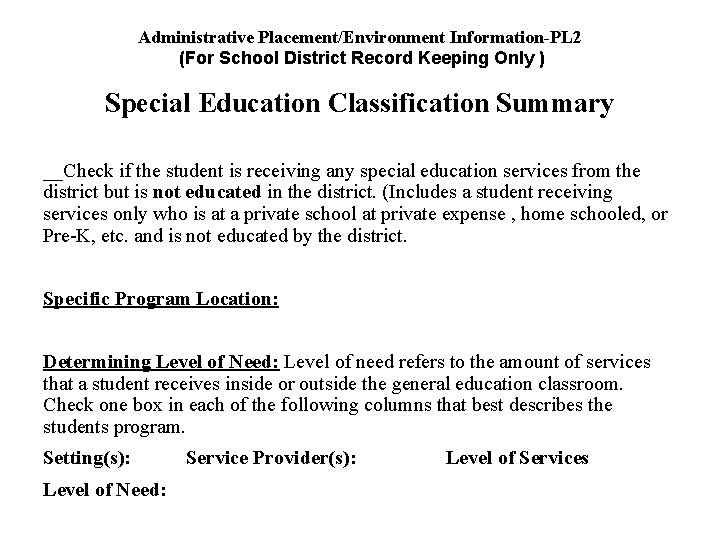
Administrative Placement/Environment Information-PL 2 (For School District Record Keeping Only ) Special Education Classification Summary __Check if the student is receiving any special education services from the district but is not educated in the district. (Includes a student receiving services only who is at a private school at private expense , home schooled, or Pre-K, etc. and is not educated by the district. Specific Program Location: Determining Level of Need: Level of need refers to the amount of services that a student receives inside or outside the general education classroom. Check one box in each of the following columns that best describes the students program. Setting(s): Level of Need: Service Provider(s): Level of Services
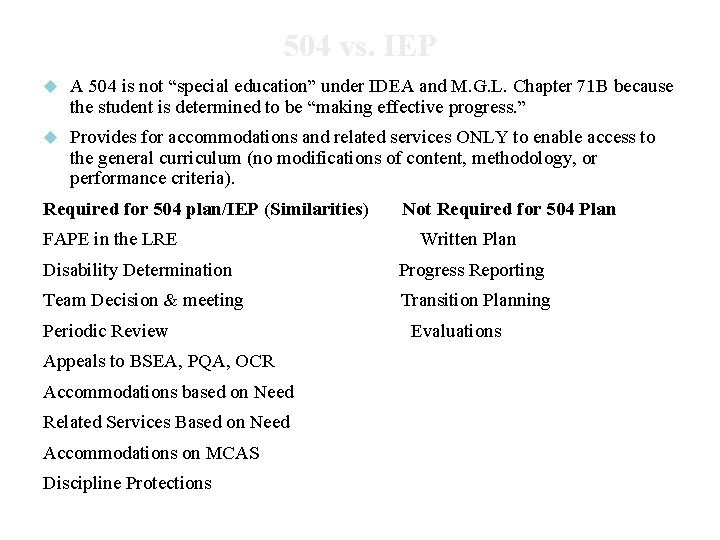
504 vs. IEP A 504 is not “special education” under IDEA and M. G. L. Chapter 71 B because the student is determined to be “making effective progress. ” Provides for accommodations and related services ONLY to enable access to the general curriculum (no modifications of content, methodology, or performance criteria). Required for 504 plan/IEP (Similarities) FAPE in the LRE Not Required for 504 Plan Written Plan Disability Determination Progress Reporting Team Decision & meeting Transition Planning Periodic Review Appeals to BSEA, PQA, OCR Accommodations based on Need Related Services Based on Need Accommodations on MCAS Discipline Protections Evaluations
CONCLUSION Questions? ? Resources for presentation Materials in this presentation: www. fcsn. org www. doe. mass. edu www. wrightslaw. com