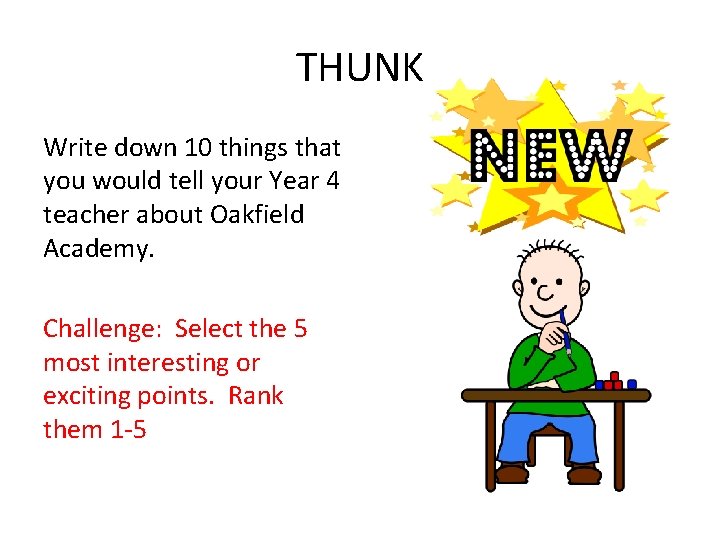
THUNK Write down 10 things that you would
- Slides: 25
THUNK Write down 10 things that you would tell your Year 4 teacher about Oakfield Academy. Challenge: Select the 5 most interesting or exciting points. Rank them 1 -5
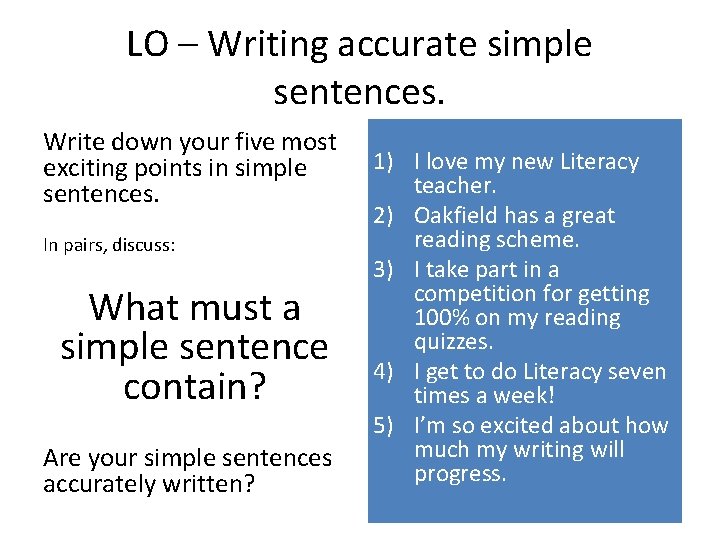
LO – Writing accurate simple sentences. Write down your five most exciting points in simple sentences. In pairs, discuss: What must a simple sentence contain? Are your simple sentences accurately written? 1) I love my new Literacy teacher. 2) Oakfield has a great reading scheme. 3) I take part in a competition for getting 100% on my reading quizzes. 4) I get to do Literacy seven times a week! 5) I’m so excited about how much my writing will progress.
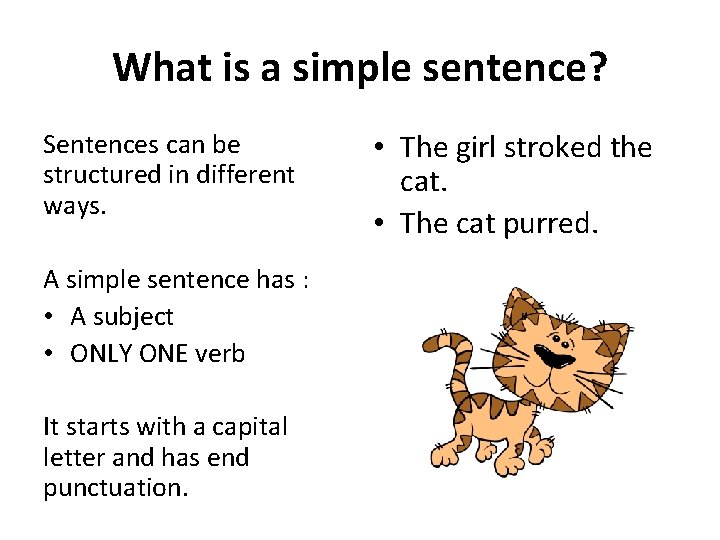
What is a simple sentence? Sentences can be structured in different ways. A simple sentence has : • A subject • ONLY ONE verb It starts with a capital letter and has end punctuation. • The girl stroked the cat. • The cat purred.
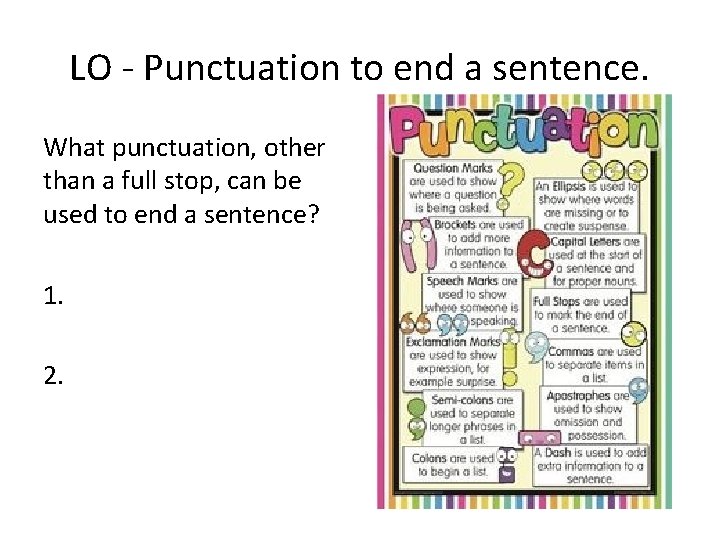
LO - Punctuation to end a sentence. What punctuation, other than a full stop, can be used to end a sentence? 1. 2.
LO – capital letters, full stops, exclamation marks and question marks To achieve 100 you need to use capital letters, full stops, exclamation marks and question marks in the correct places in sentences. Have a go at the exercises! PAGE 44
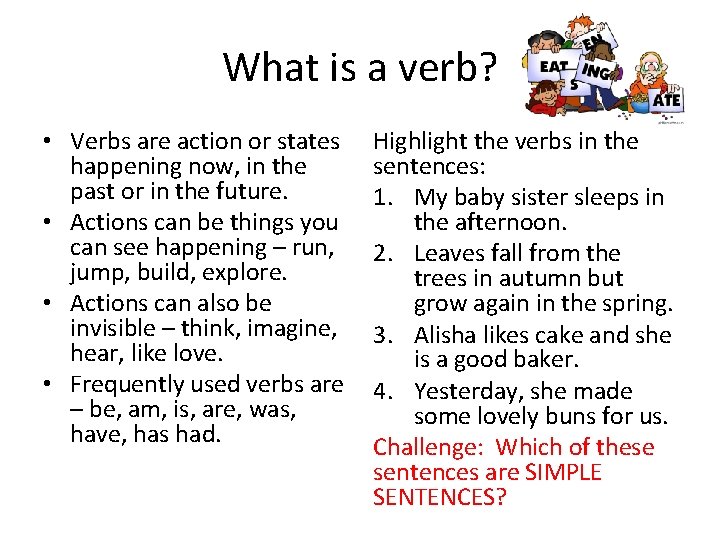
What is a verb? • Verbs are action or states happening now, in the past or in the future. • Actions can be things you can see happening – run, jump, build, explore. • Actions can also be invisible – think, imagine, hear, like love. • Frequently used verbs are – be, am, is, are, was, have, has had. Highlight the verbs in the sentences: 1. My baby sister sleeps in the afternoon. 2. Leaves fall from the trees in autumn but grow again in the spring. 3. Alisha likes cake and she is a good baker. 4. Yesterday, she made some lovely buns for us. Challenge: Which of these sentences are SIMPLE SENTENCES?
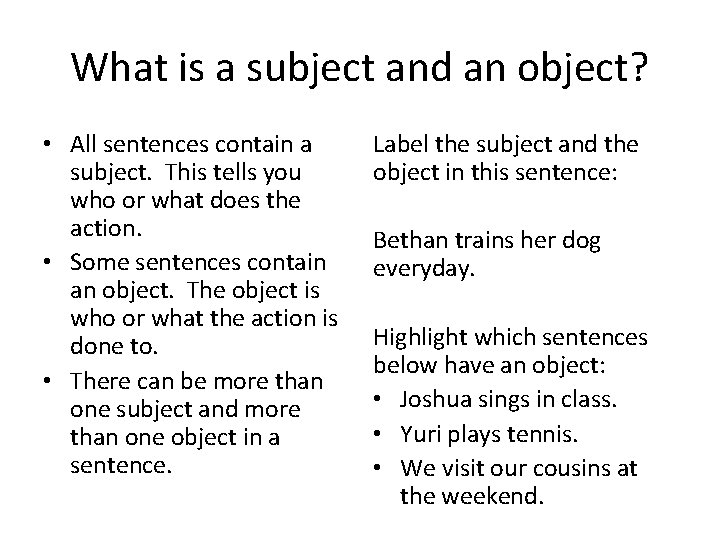
What is a subject and an object? • All sentences contain a subject. This tells you who or what does the action. • Some sentences contain an object. The object is who or what the action is done to. • There can be more than one subject and more than one object in a sentence. Label the subject and the object in this sentence: Bethan trains her dog everyday. Highlight which sentences below have an object: • Joshua sings in class. • Yuri plays tennis. • We visit our cousins at the weekend.
LO – subject and object To achieve 100 you need to find the subject and object in sentences. Have a go at the exercises! PAGE 31
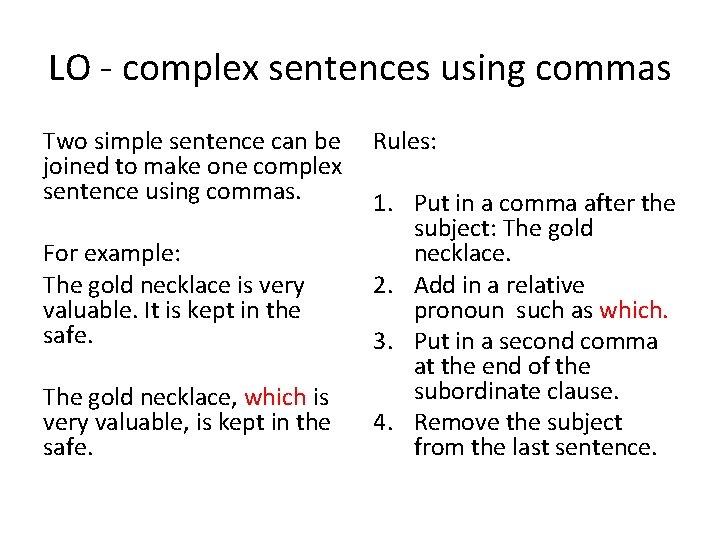
LO - complex sentences using commas Two simple sentence can be joined to make one complex sentence using commas. For example: The gold necklace is very valuable. It is kept in the safe. The gold necklace, which is very valuable, is kept in the safe. Rules: 1. Put in a comma after the subject: The gold necklace. 2. Add in a relative pronoun such as which. 3. Put in a second comma at the end of the subordinate clause. 4. Remove the subject from the last sentence.
LO - complex sentences using commas Complete the worksheet on ‘Complex Sentences’ where you are joining two simple sentences into one complex sentence using commas.
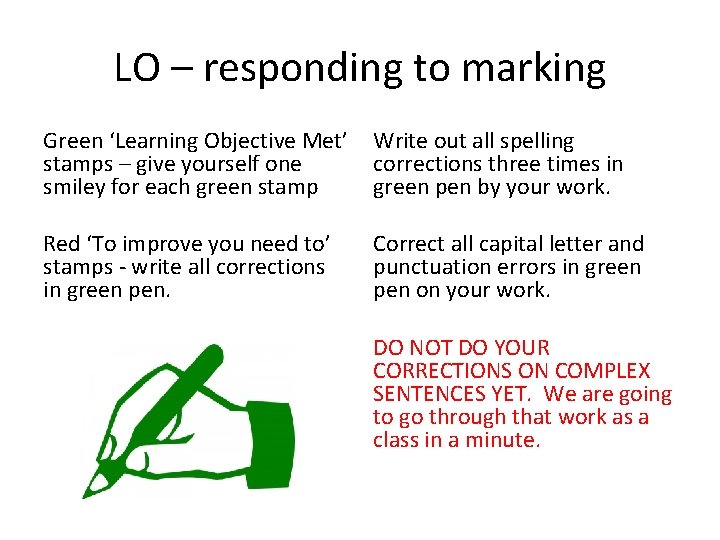
LO – responding to marking Green ‘Learning Objective Met’ stamps – give yourself one smiley for each green stamp Write out all spelling corrections three times in green pen by your work. Red ‘To improve you need to’ stamps - write all corrections in green pen. Correct all capital letter and punctuation errors in green pen on your work. DO NOT DO YOUR CORRECTIONS ON COMPLEX SENTENCES YET. We are going to go through that work as a class in a minute.
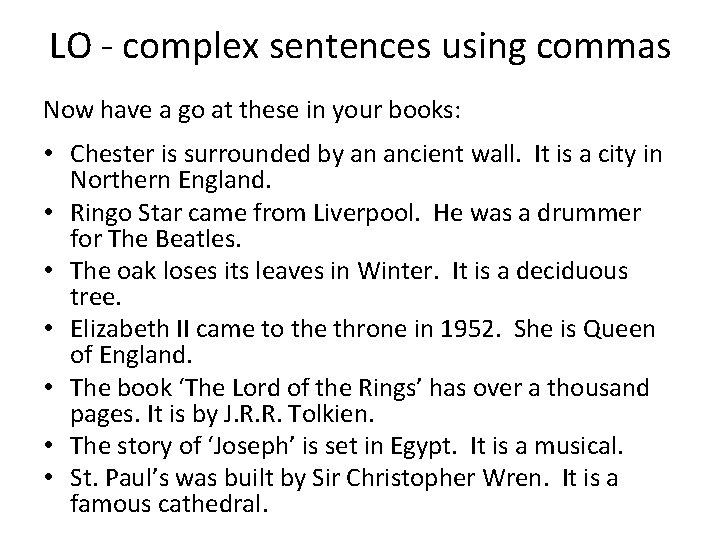
LO - complex sentences using commas Now have a go at these in your books: • Chester is surrounded by an ancient wall. It is a city in Northern England. • Ringo Star came from Liverpool. He was a drummer for The Beatles. • The oak loses its leaves in Winter. It is a deciduous tree. • Elizabeth II came to the throne in 1952. She is Queen of England. • The book ‘The Lord of the Rings’ has over a thousand pages. It is by J. R. R. Tolkien. • The story of ‘Joseph’ is set in Egypt. It is a musical. • St. Paul’s was built by Sir Christopher Wren. It is a famous cathedral.
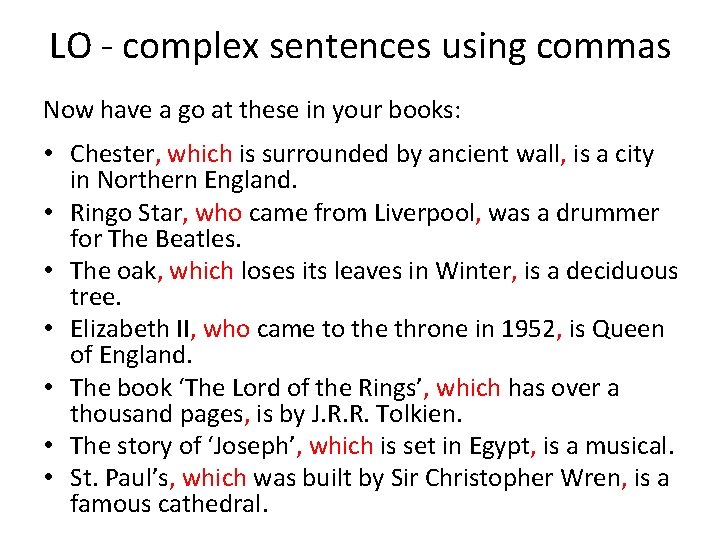
LO - complex sentences using commas Now have a go at these in your books: • Chester, which is surrounded by ancient wall, is a city in Northern England. • Ringo Star, who came from Liverpool, was a drummer for The Beatles. • The oak, which loses its leaves in Winter, is a deciduous tree. • Elizabeth II, who came to the throne in 1952, is Queen of England. • The book ‘The Lord of the Rings’, which has over a thousand pages, is by J. R. R. Tolkien. • The story of ‘Joseph’, which is set in Egypt, is a musical. • St. Paul’s, which was built by Sir Christopher Wren, is a famous cathedral.
LO – commas To achieve 100 you need to find the subject and object in sentences. Have a go at the exercises! PAGE 46
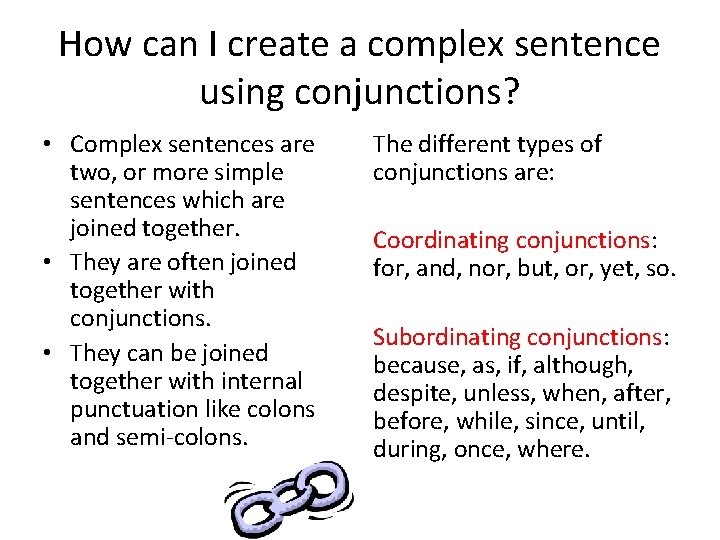
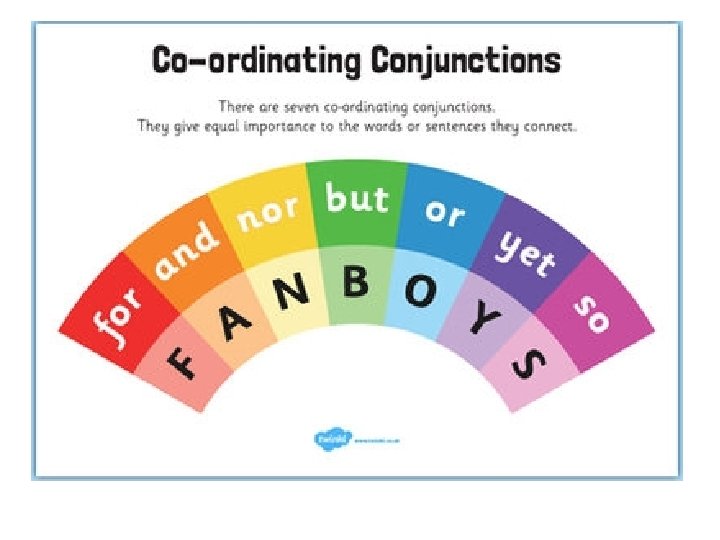
How can I create a complex sentence using conjunctions? • Complex sentences are two, or more simple sentences which are joined together. • They are often joined together with conjunctions. • They can be joined together with internal punctuation like colons and semi-colons. The different types of conjunctions are: Coordinating conjunctions: for, and, nor, but, or, yet, so. Subordinating conjunctions: because, as, if, although, despite, unless, when, after, before, while, since, until, during, once, where.
LO – subordinating and co-ordinating conjunctions To achieve 100 you need to identify and use punctuation correctly. Have a go at the exercises! PAGE 29
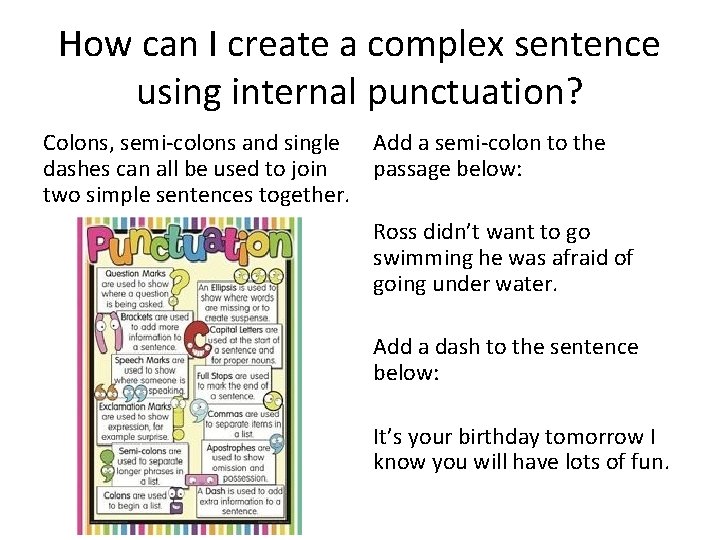
How can I create a complex sentence using internal punctuation? Colons, semi-colons and single Add a semi-colon to the dashes can all be used to join passage below: two simple sentences together. Ross didn’t want to go swimming he was afraid of going under water. Add a dash to the sentence below: It’s your birthday tomorrow I know you will have lots of fun.
LO – Colons, semi-colons, single dashes, hyphens and bullet points. To achieve 100 you need to identify and use punctuation correctly. Have a go at the exercises! PAGE 53
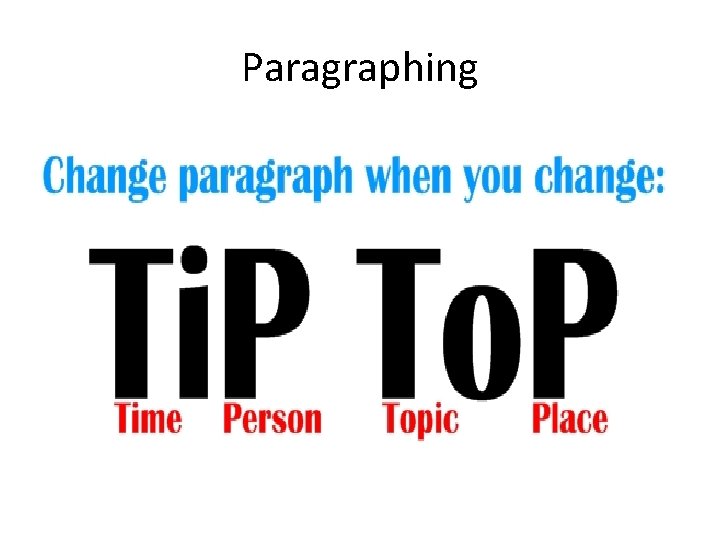
Paragraphing
Remember this? Write down your five most exciting points in simple sentences. In pairs, discuss: What must a simple sentence contain? Are your simple sentences accurately written? 1) I love my new Literacy teacher. 2) Oakfield has a great reading scheme. 3) I take part in a competition for getting 100% on my reading quizzes. 4) I get to do Literacy seven times a week! 5) I’m so excited about how much my writing will progress.
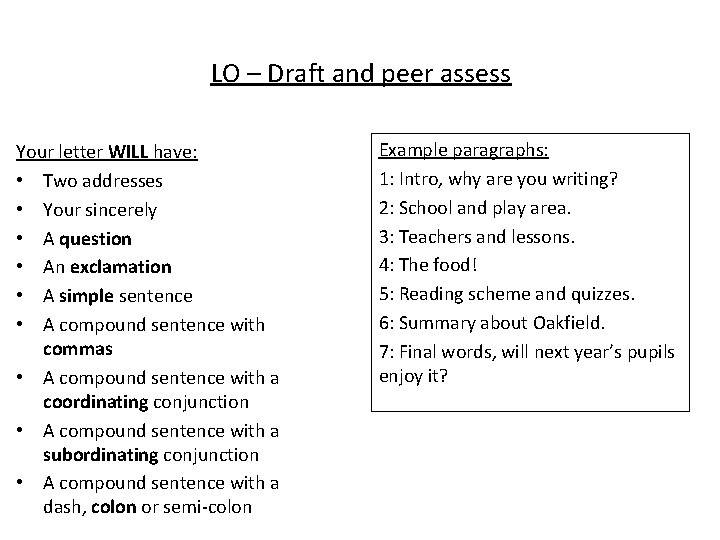
LO – Draft and peer assess Your letter WILL have: • Two addresses • Your sincerely • A question • An exclamation • A simple sentence • A compound sentence with commas • A compound sentence with a coordinating conjunction • A compound sentence with a subordinating conjunction • A compound sentence with a dash, colon or semi-colon Example paragraphs: 1: Intro, why are you writing? 2: School and play area. 3: Teachers and lessons. 4: The food! 5: Reading scheme and quizzes. 6: Summary about Oakfield. 7: Final words, will next year’s pupils enjoy it?
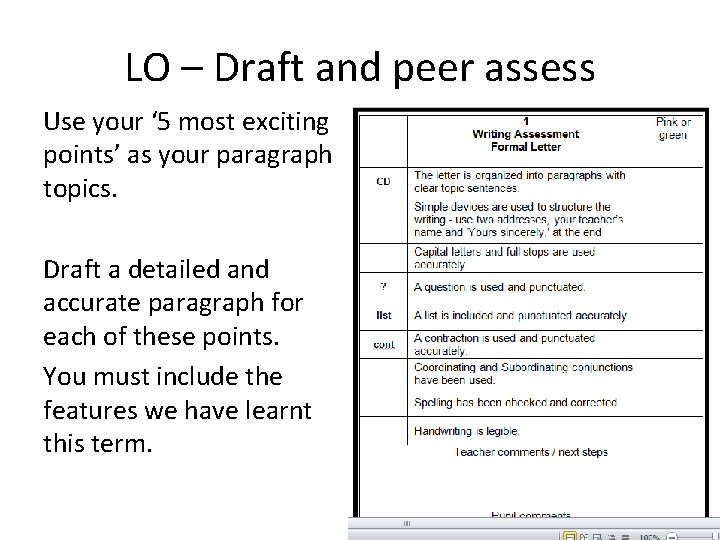
LO – Draft and peer assess Use your ‘ 5 most exciting points’ as your paragraph topics. Draft a detailed and accurate paragraph for each of these points. You must include the features we have learnt this term.
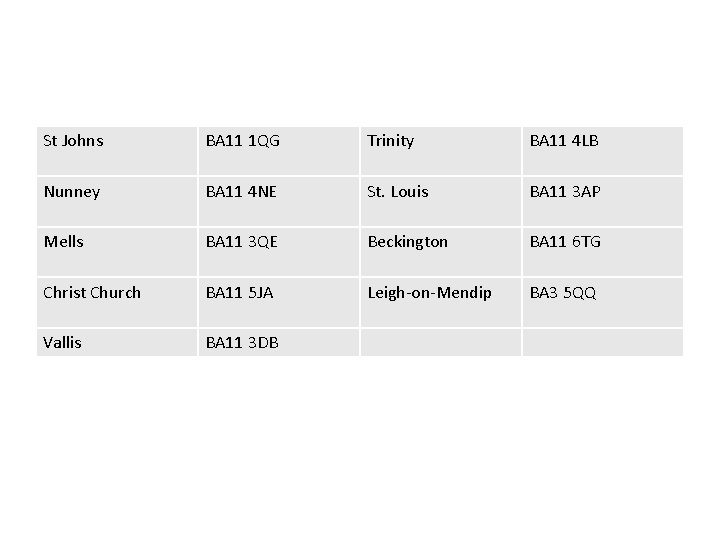
St Johns BA 11 1 QG Trinity BA 11 4 LB Nunney BA 11 4 NE St. Louis BA 11 3 AP Mells BA 11 3 QE Beckington BA 11 6 TG Christ Church BA 11 5 JA Leigh-on-Mendip BA 3 5 QQ Vallis BA 11 3 DB
LO – Write up your letter into your Perfect Piece books Letter to my First School