Threads in Java Jaanus Pial Ph D Tallinn
- Slides: 16
Threads in Java Jaanus Pöial, Ph. D Tallinn, Estonia
Multi-threaded Programs Threads - processes inside one Java program (lightweight processes): • parallel • related to each other (share the same address space) • cooperate using synchronization tools Critical section – part of a program that cannot be interrupted by other thread
In Java • Class Thread (methods start, run, interrupt, join, yield, sleep, is. Alive, set. Priority, get. Priority, set. Daemon, . . . ) • Interface Runnable (method run) • Methods in class Object – wait, . . . , notify. All • synchronized blocks and methods • priority system and timesharing • Class Runtime (method exit) • Class Thread. Group
Thread States NEW - a thread that has not yet started is in this state. RUNNABLE - a thread executing in the Java virtual machine is in this state. BLOCKED - a thread that is blocked waiting for a monitor lock is in this state. WAITING – a thread that is waiting indefinitely for another thread to perform a particular action is in this state. TIMED_WAITING - a thread that is waiting for another thread to perform an action for up to a specified waiting time is in this state. TERMINATED - a thread that has exited is in this state.
Life Cycle of the Thread Create Process executed in thread is given as public void run() method that does not throw exceptions • create a subclass of Thread and override the run() method • use interface Runnable to create a new thread: Thread t = new Thread (runnable. Object); run() method of the runnable. Object is used Start t. start(); // run() is executed
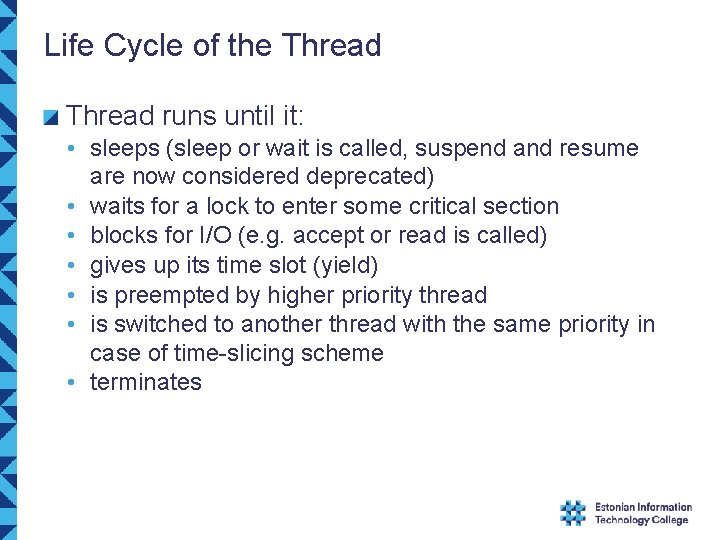
Life Cycle of the Thread runs until it: • sleeps (sleep or wait is called, suspend and resume are now considered deprecated) • waits for a lock to enter some critical section • blocks for I/O (e. g. accept or read is called) • gives up its time slot (yield) • is preempted by higher priority thread • is switched to another thread with the same priority in case of time-slicing scheme • terminates
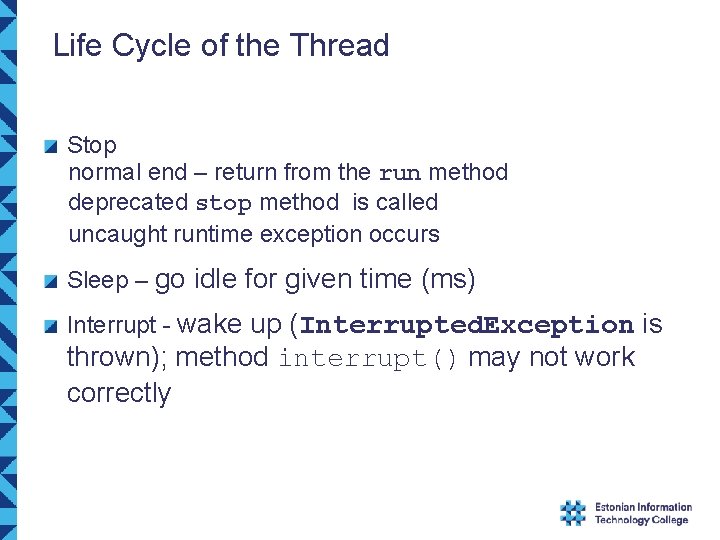
Life Cycle of the Thread Stop normal end – return from the run method deprecated stop method is called uncaught runtime exception occurs Sleep – go idle for given time (ms) Interrupt - wake up (Interrupted. Exception is thrown); method interrupt() may not work correctly
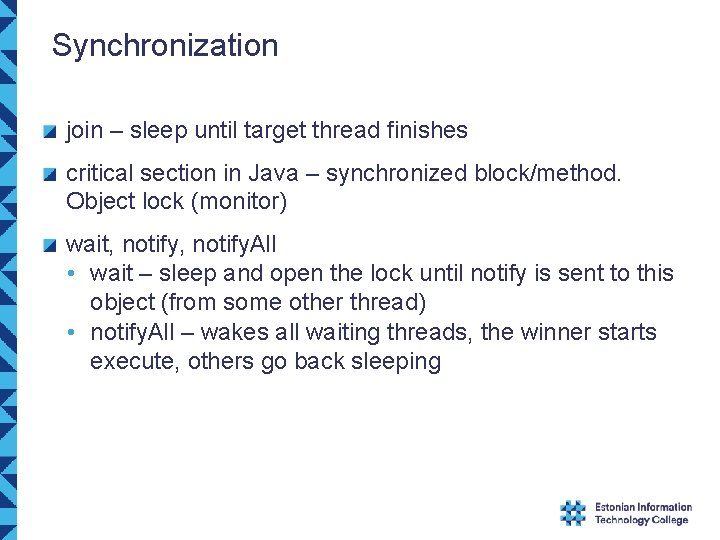
Synchronization join – sleep until target thread finishes critical section in Java – synchronized block/method. Object lock (monitor) wait, notify. All • wait – sleep and open the lock until notify is sent to this object (from some other thread) • notify. All – wakes all waiting threads, the winner starts execute, others go back sleeping
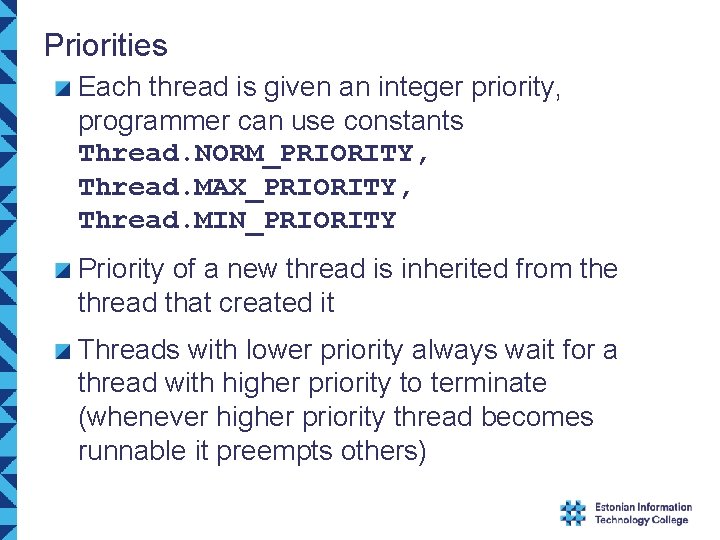
Priorities Each thread is given an integer priority, programmer can use constants Thread. NORM_PRIORITY, Thread. MAX_PRIORITY, Thread. MIN_PRIORITY Priority of a new thread is inherited from the thread that created it Threads with lower priority always wait for a thread with higher priority to terminate (whenever higher priority thread becomes runnable it preempts others)
Priorities Threads with the same priority: • round robin – priority and synchronization rules apply but "parallel" execution caused by time sharing is not guaranteed • time slicing – parallel or pseudo-parallel execution (all threads get chance) Thread might give up its time slot using the yield method
Priorities When a thread terminates: • higher priority thread always takes over • if there are no higher priority threads switch to the "next" runnable thread in this priority class • if there are no runnable threads of current priority switch to the next lower priority class and choose a runnable thread
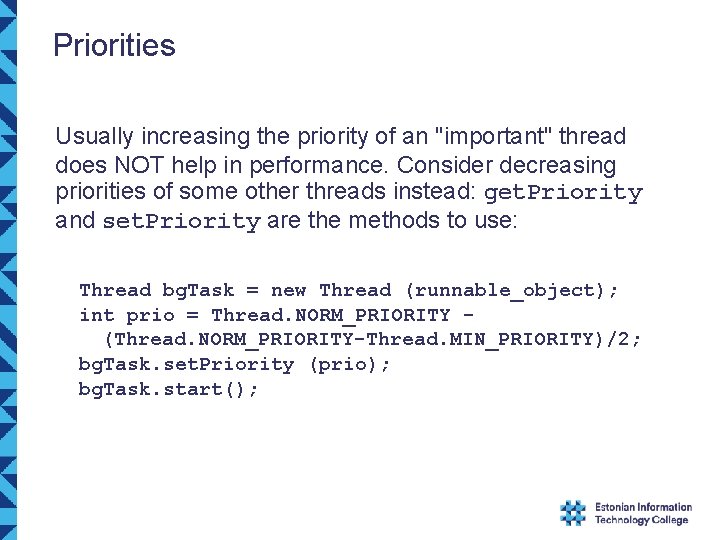
Priorities Usually increasing the priority of an "important" thread does NOT help in performance. Consider decreasing priorities of some other threads instead: get. Priority and set. Priority are the methods to use: Thread bg. Task = new Thread (runnable_object); int prio = Thread. NORM_PRIORITY (Thread. NORM_PRIORITY-Thread. MIN_PRIORITY)/2; bg. Task. set. Priority (prio); bg. Task. start();
Server Threads and Thread Groups Server threads are "weak" – JVM terminates if all remaining threads are daemon threads Methods: set. Daemon, is. Daemon Thread. Group is a set of threads (actually a tree because elements can be groups). Several operations can be applied to the whole group
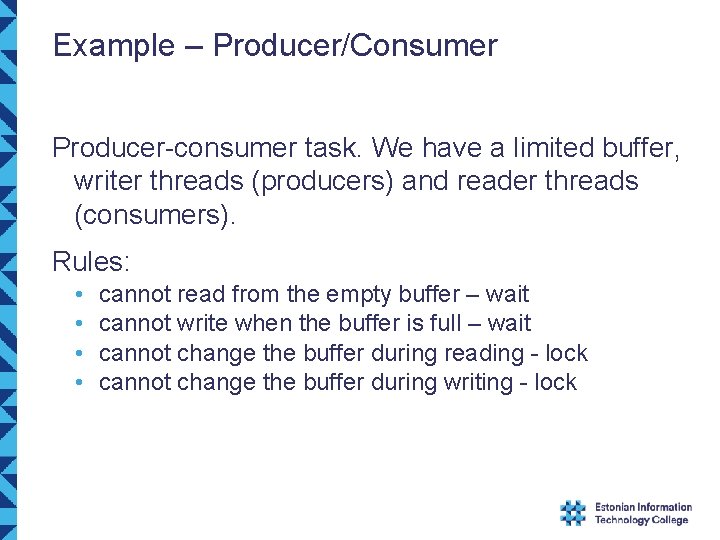
Example – Producer/Consumer Producer-consumer task. We have a limited buffer, writer threads (producers) and reader threads (consumers). Rules: • • cannot read from the empty buffer – wait cannot write when the buffer is full – wait cannot change the buffer during reading - lock cannot change the buffer during writing - lock
Examples Threads. java Deadlock. java Cons. Prod 5. java Runnable. CP 5. java Prod. Con. Selective. java Pipes. java
Example – Runnable Applet clock – Clock. java, clock. html