Third Edition 2 CHAPTER MECHANICS OF MATERIALS Ferdinand


- Slides: 48
Third Edition 2 CHAPTER MECHANICS OF MATERIALS Ferdinand P. Beer E. Russell Johnston, Jr. John T. De. Wolf Stress and Strain – Axial Loading Lecture Notes: J. Walt Oler Texas Tech University © 2002 The Mc. Graw-Hill Companies, Inc. All rights reserved.
Third Edition MECHANICS OF MATERIALS Beer • Johnston • De. Wolf Contents Stress & Strain: Axial Loading Normal Strain Stress-Strain Test Stress-Strain Diagram: Ductile Materials Stress-Strain Diagram: Brittle Materials Hooke’s Law: Modulus of Elasticity Elastic vs. Plastic Behavior Fatigue Deformations Under Axial Loading Example 2. 01 Sample Problem 2. 1 Static Indeterminacy Example 2. 04 Thermal Stresses Poisson’s Ratio © 2002 The Mc. Graw-Hill Companies, Inc. All rights reserved. Generalized Hooke’s Law Dilatation: Bulk Modulus Shearing Strain Example 2. 10 Relation Among E, n, and G Sample Problem 2. 5 Composite Materials Saint-Venant’s Principle Stress Concentration: Hole Stress Concentration: Fillet Example 2. 12 Elastoplastic Materials Plastic Deformations Residual Stresses Example 2. 14, 2. 15, 2. 16 2 -2
Third Edition MECHANICS OF MATERIALS Beer • Johnston • De. Wolf Stress & Strain: Axial Loading • Suitability of a structure or machine may depend on the deformations in the structure as well as the stresses induced under loading. Statics analyses alone are not sufficient. • Considering structures as deformable allows determination of member forces and reactions which are statically indeterminate. • Determination of the stress distribution within a member also requires consideration of deformations in the member. • Chapter 2 is concerned with deformation of a structural member under axial loading. Later chapters will deal with torsional and pure bending loads. © 2002 The Mc. Graw-Hill Companies, Inc. All rights reserved. 2 -3
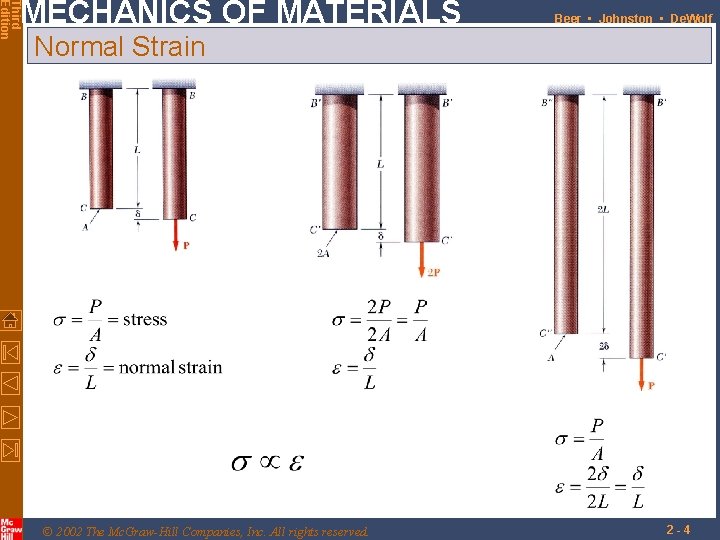
Third Edition MECHANICS OF MATERIALS Beer • Johnston • De. Wolf Normal Strain © 2002 The Mc. Graw-Hill Companies, Inc. All rights reserved. 2 -4
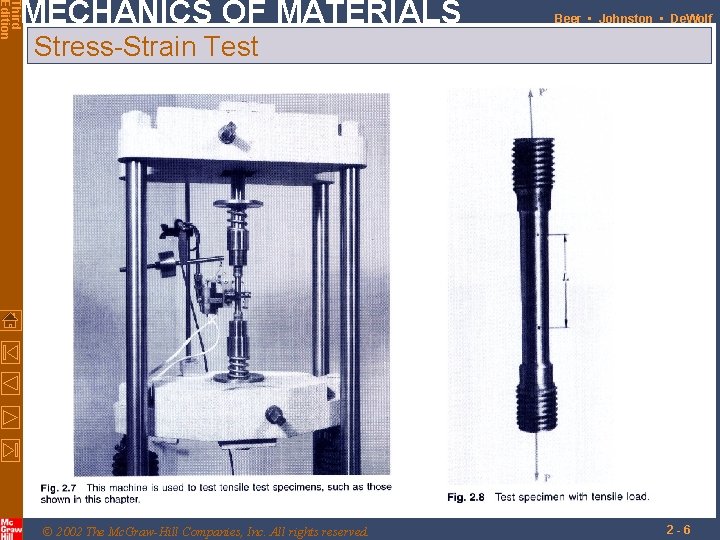
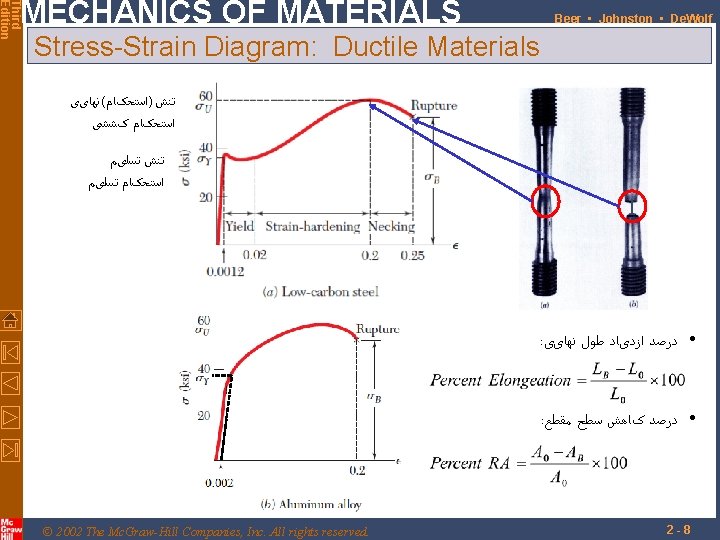
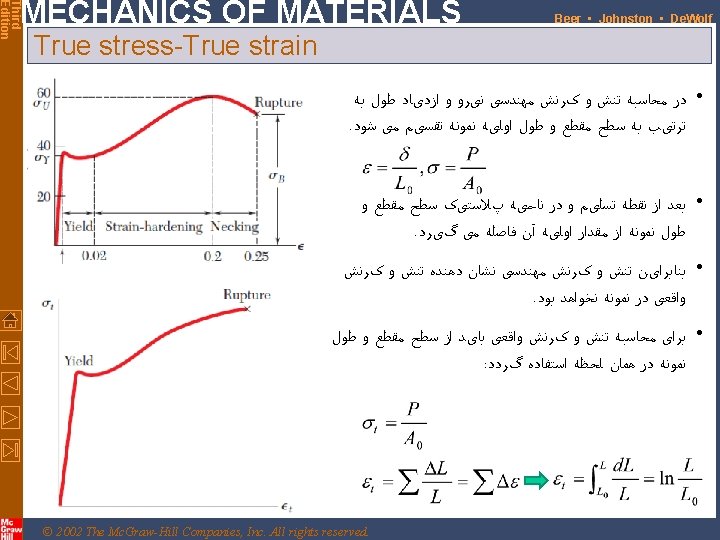
Third Edition MECHANICS OF MATERIALS Beer • Johnston • De. Wolf Stress-Strain Test © 2002 The Mc. Graw-Hill Companies, Inc. All rights reserved. 2 -6
Third Edition MECHANICS OF MATERIALS Tensile test © 2002 The Mc. Graw-Hill Companies, Inc. All rights reserved. Beer • Johnston • De. Wolf
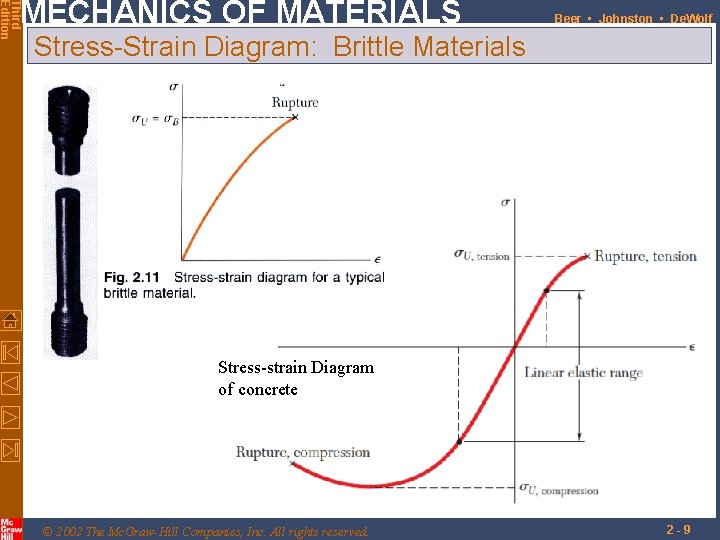
Third Edition MECHANICS OF MATERIALS Beer • Johnston • De. Wolf Stress-Strain Diagram: Brittle Materials Stress-strain Diagram of concrete © 2002 The Mc. Graw-Hill Companies, Inc. All rights reserved. 2 -9
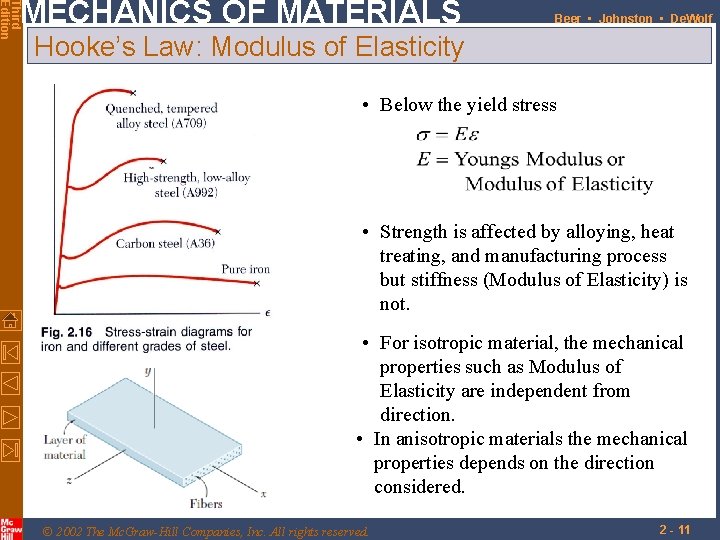
Third Edition MECHANICS OF MATERIALS Beer • Johnston • De. Wolf Hooke’s Law: Modulus of Elasticity • Below the yield stress • Strength is affected by alloying, heat treating, and manufacturing process but stiffness (Modulus of Elasticity) is not. • For isotropic material, the mechanical properties such as Modulus of Elasticity are independent from direction. • In anisotropic materials the mechanical properties depends on the direction considered. © 2002 The Mc. Graw-Hill Companies, Inc. All rights reserved. 2 - 11
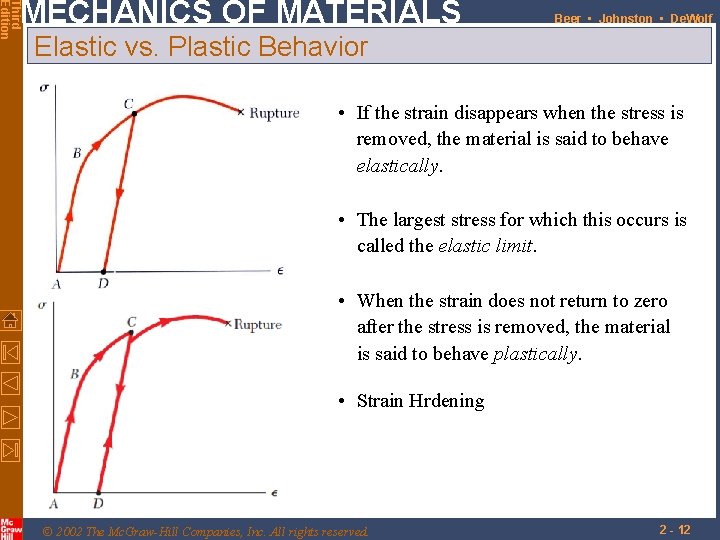
Third Edition MECHANICS OF MATERIALS Beer • Johnston • De. Wolf Elastic vs. Plastic Behavior • If the strain disappears when the stress is removed, the material is said to behave elastically. • The largest stress for which this occurs is called the elastic limit. • When the strain does not return to zero after the stress is removed, the material is said to behave plastically. • Strain Hrdening © 2002 The Mc. Graw-Hill Companies, Inc. All rights reserved. 2 - 12
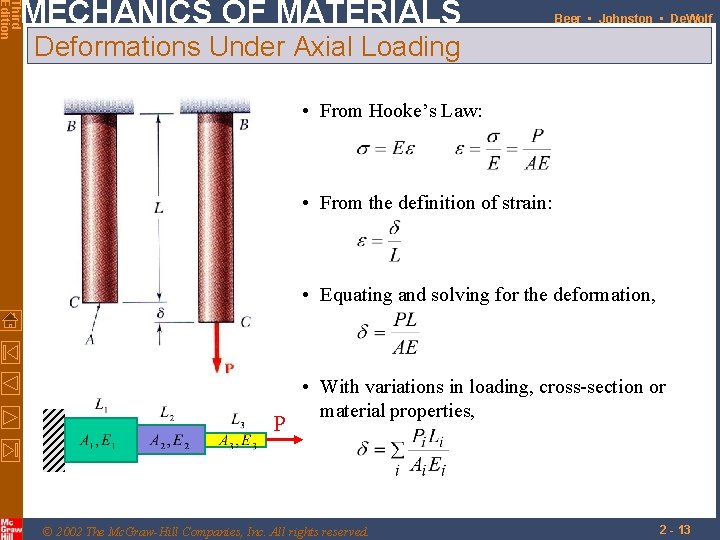
Third Edition MECHANICS OF MATERIALS Beer • Johnston • De. Wolf Deformations Under Axial Loading • From Hooke’s Law: • From the definition of strain: • Equating and solving for the deformation, P • With variations in loading, cross-section or material properties, © 2002 The Mc. Graw-Hill Companies, Inc. All rights reserved. 2 - 13
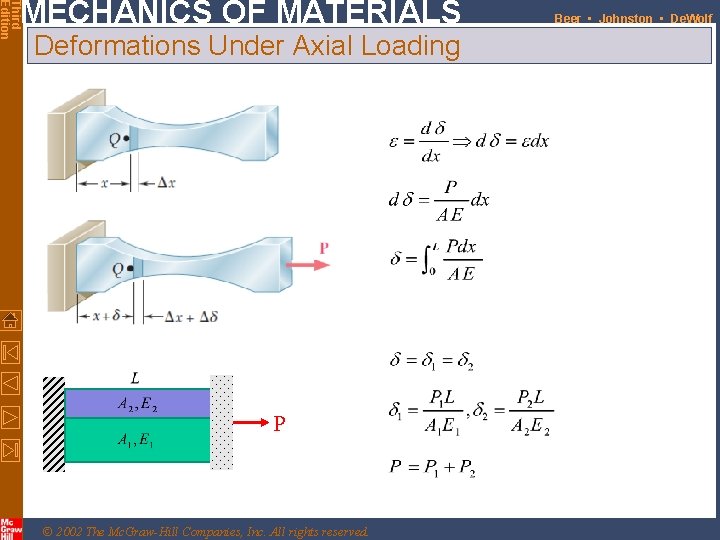
Third Edition MECHANICS OF MATERIALS Deformations Under Axial Loading P © 2002 The Mc. Graw-Hill Companies, Inc. All rights reserved. Beer • Johnston • De. Wolf
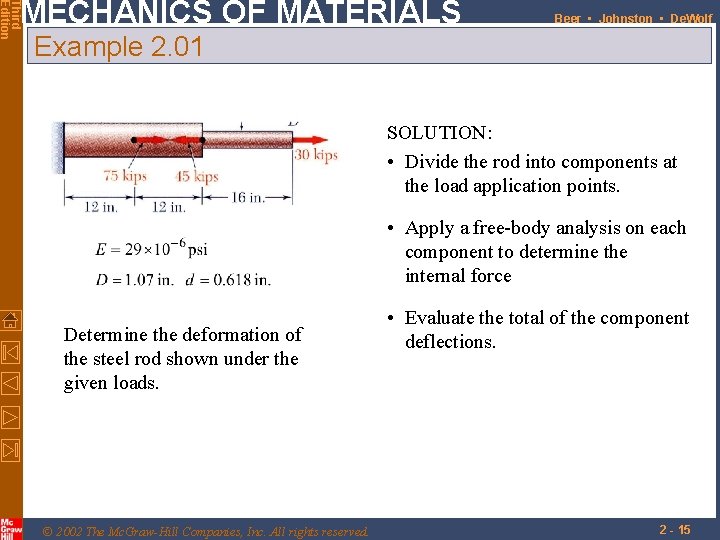
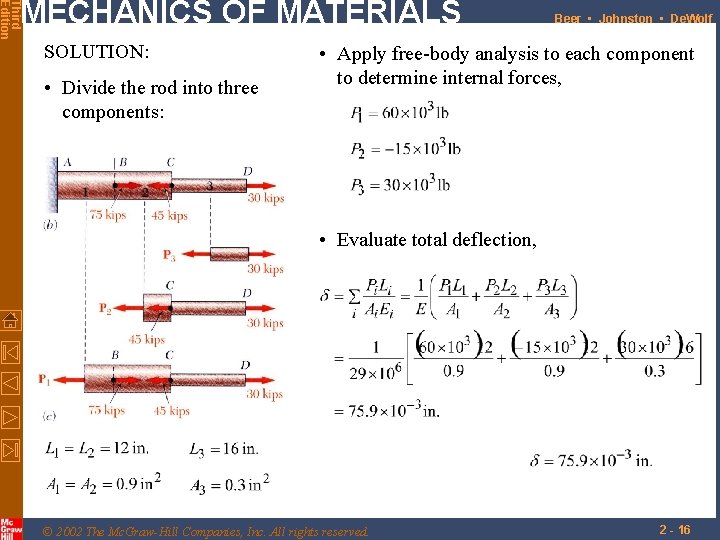
Third Edition MECHANICS OF MATERIALS Beer • Johnston • De. Wolf Example 2. 01 SOLUTION: • Divide the rod into components at the load application points. • Apply a free-body analysis on each component to determine the internal force Determine the deformation of the steel rod shown under the given loads. © 2002 The Mc. Graw-Hill Companies, Inc. All rights reserved. • Evaluate the total of the component deflections. 2 - 15
Third Edition MECHANICS OF MATERIALS SOLUTION: • Divide the rod into three components: Beer • Johnston • De. Wolf • Apply free-body analysis to each component to determine internal forces, • Evaluate total deflection, © 2002 The Mc. Graw-Hill Companies, Inc. All rights reserved. 2 - 16
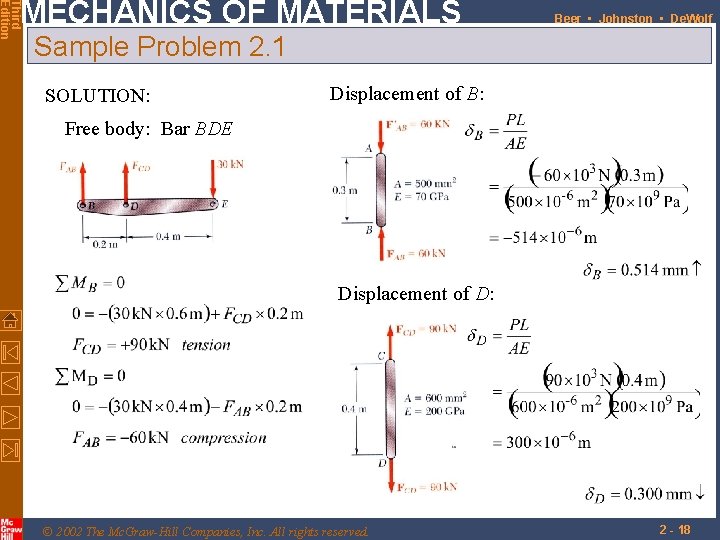
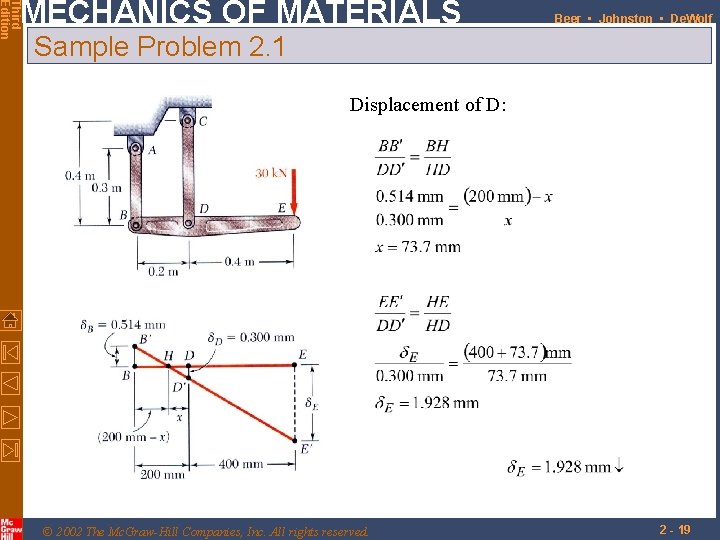
Third Edition MECHANICS OF MATERIALS Beer • Johnston • De. Wolf Sample Problem 2. 1 SOLUTION: The rigid bar BDE is supported by two links AB and CD. • Apply a free-body analysis to the bar BDE to find the forces exerted by links AB and DC. • Evaluate the deformation of links AB and DC or the displacements of B and D. • Work out the geometry to find the Link AB is made of aluminum (E = 70 deflection at E given the deflections GPa) and has a cross-sectional area of 500 at B and D. mm 2. Link CD is made of steel (E = 200 GPa) and has a cross-sectional area of (600 mm 2). For the 30 -k. N force shown, determine the deflection a) of B, b) of D, and c) of E. © 2002 The Mc. Graw-Hill Companies, Inc. All rights reserved. 2 - 17
Third Edition MECHANICS OF MATERIALS Beer • Johnston • De. Wolf Sample Problem 2. 1 SOLUTION: Displacement of B: Free body: Bar BDE Displacement of D: © 2002 The Mc. Graw-Hill Companies, Inc. All rights reserved. 2 - 18
Third Edition MECHANICS OF MATERIALS Beer • Johnston • De. Wolf Sample Problem 2. 1 Displacement of D: © 2002 The Mc. Graw-Hill Companies, Inc. All rights reserved. 2 - 19
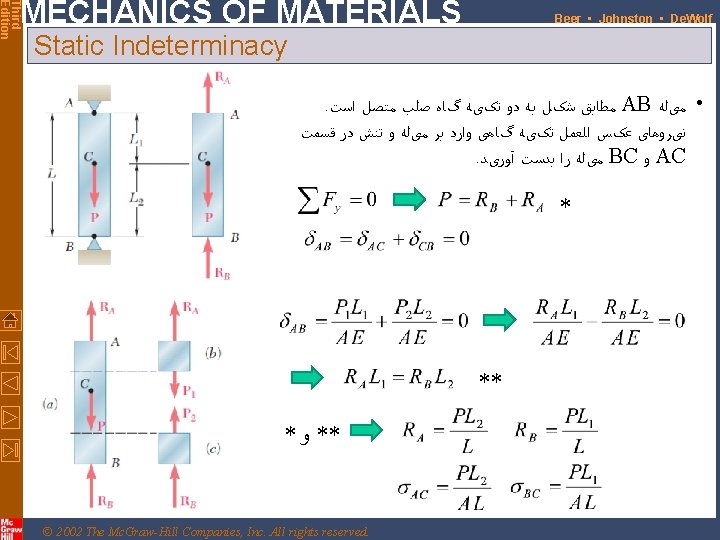
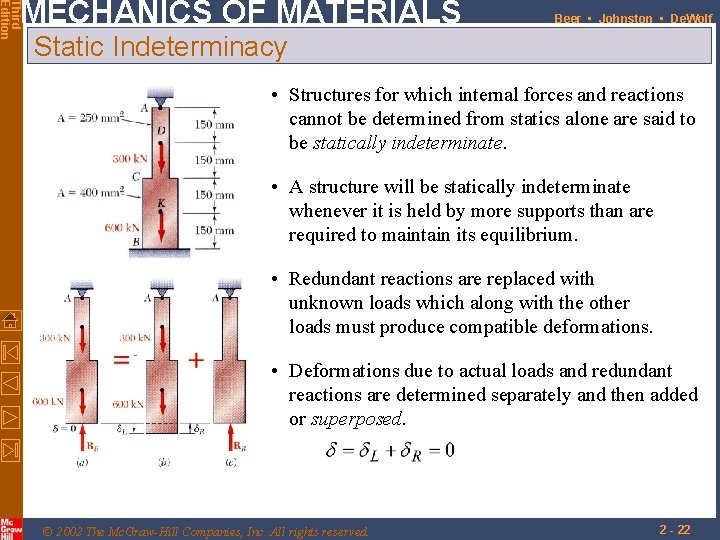
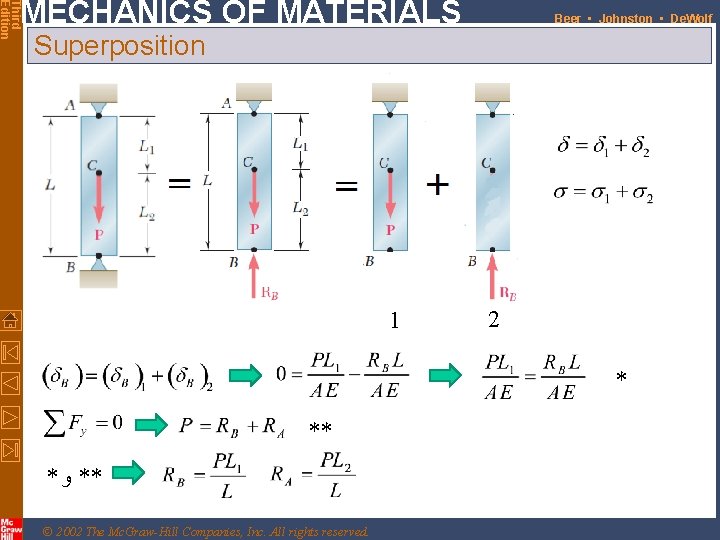
Third Edition MECHANICS OF MATERIALS Beer • Johnston • De. Wolf Static Indeterminacy • Structures for which internal forces and reactions cannot be determined from statics alone are said to be statically indeterminate. • A structure will be statically indeterminate whenever it is held by more supports than are required to maintain its equilibrium. • Redundant reactions are replaced with unknown loads which along with the other loads must produce compatible deformations. • Deformations due to actual loads and redundant reactions are determined separately and then added or superposed. © 2002 The Mc. Graw-Hill Companies, Inc. All rights reserved. 2 - 22
Third Edition MECHANICS OF MATERIALS Beer • Johnston • De. Wolf Superposition 1 2 * ** ﻭ © 2002 The Mc. Graw-Hill Companies, Inc. All rights reserved.
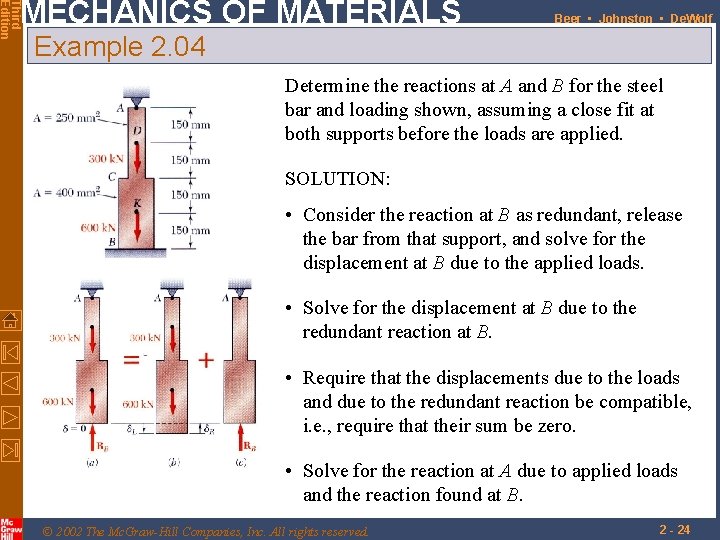
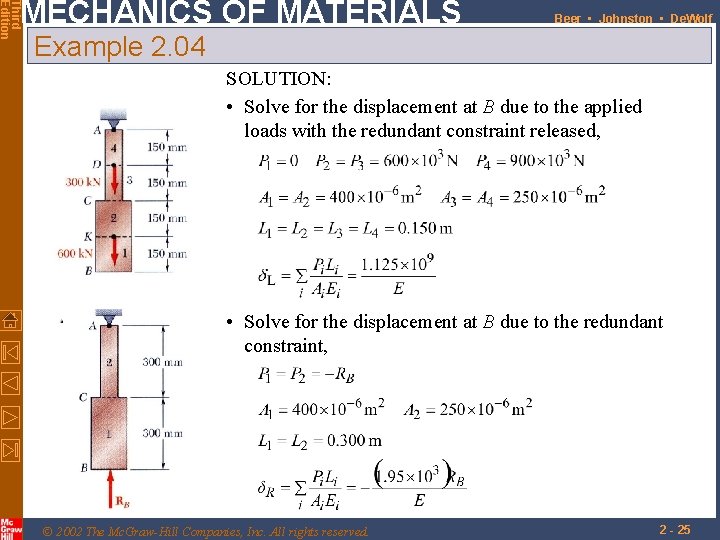
Third Edition MECHANICS OF MATERIALS Beer • Johnston • De. Wolf Example 2. 04 Determine the reactions at A and B for the steel bar and loading shown, assuming a close fit at both supports before the loads are applied. SOLUTION: • Consider the reaction at B as redundant, release the bar from that support, and solve for the displacement at B due to the applied loads. • Solve for the displacement at B due to the redundant reaction at B. • Require that the displacements due to the loads and due to the redundant reaction be compatible, i. e. , require that their sum be zero. • Solve for the reaction at A due to applied loads and the reaction found at B. © 2002 The Mc. Graw-Hill Companies, Inc. All rights reserved. 2 - 24
Third Edition MECHANICS OF MATERIALS Beer • Johnston • De. Wolf Example 2. 04 SOLUTION: • Solve for the displacement at B due to the applied loads with the redundant constraint released, • Solve for the displacement at B due to the redundant constraint, © 2002 The Mc. Graw-Hill Companies, Inc. All rights reserved. 2 - 25
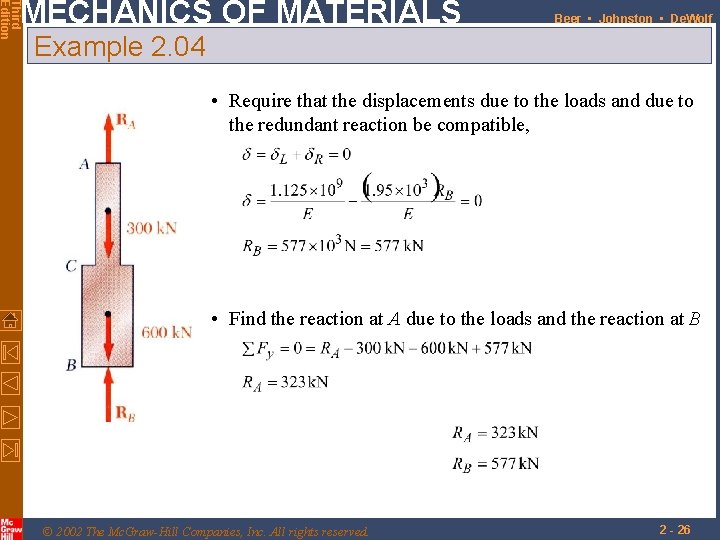
Third Edition MECHANICS OF MATERIALS Beer • Johnston • De. Wolf Example 2. 04 • Require that the displacements due to the loads and due to the redundant reaction be compatible, • Find the reaction at A due to the loads and the reaction at B © 2002 The Mc. Graw-Hill Companies, Inc. All rights reserved. 2 - 26
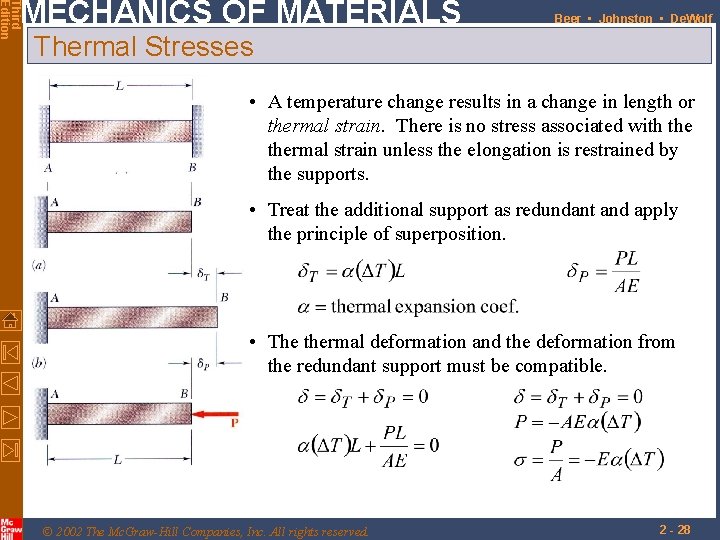
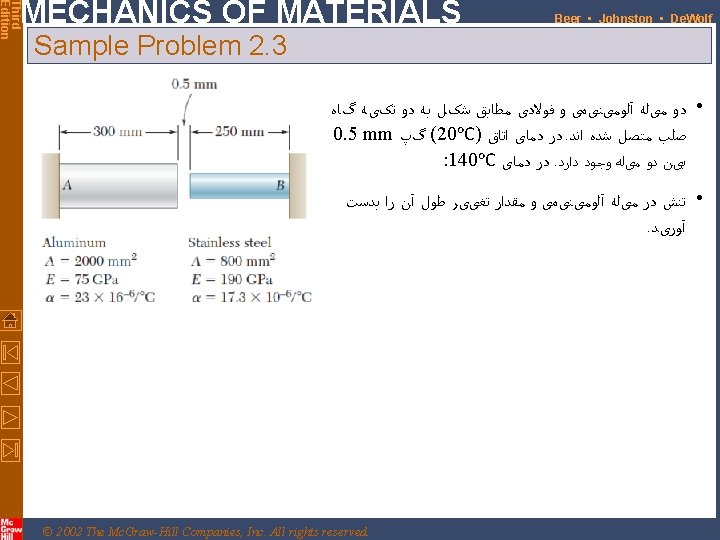
Third Edition MECHANICS OF MATERIALS Beer • Johnston • De. Wolf Thermal Stresses • A temperature change results in a change in length or thermal strain. There is no stress associated with thermal strain unless the elongation is restrained by the supports. • Treat the additional support as redundant and apply the principle of superposition. • The thermal deformation and the deformation from the redundant support must be compatible. © 2002 The Mc. Graw-Hill Companies, Inc. All rights reserved. 2 - 28
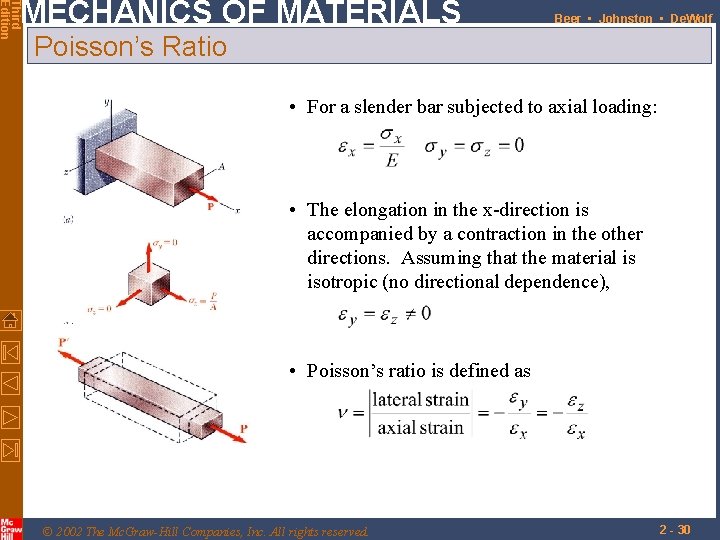
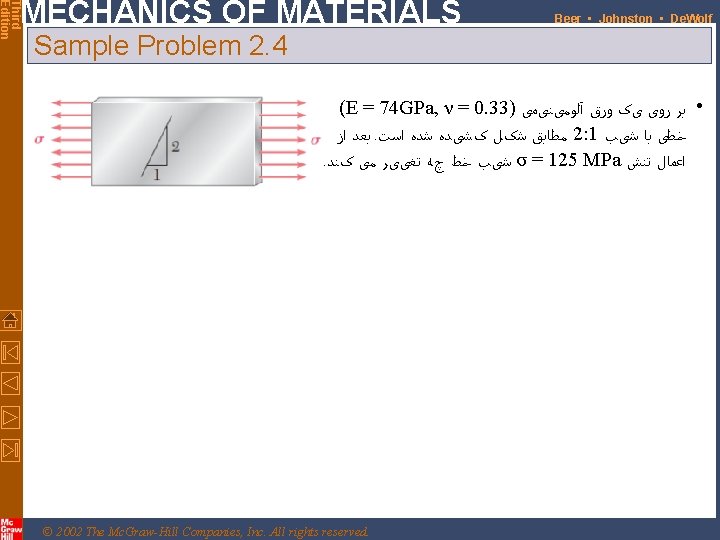
Third Edition MECHANICS OF MATERIALS Beer • Johnston • De. Wolf Poisson’s Ratio • For a slender bar subjected to axial loading: • The elongation in the x-direction is accompanied by a contraction in the other directions. Assuming that the material is isotropic (no directional dependence), • Poisson’s ratio is defined as © 2002 The Mc. Graw-Hill Companies, Inc. All rights reserved. 2 - 30
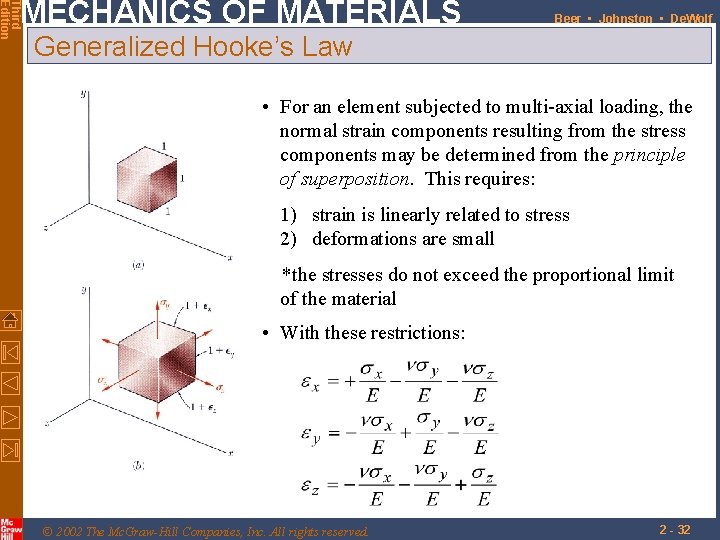
Third Edition MECHANICS OF MATERIALS Beer • Johnston • De. Wolf Generalized Hooke’s Law • For an element subjected to multi-axial loading, the normal strain components resulting from the stress components may be determined from the principle of superposition. This requires: 1) strain is linearly related to stress 2) deformations are small *the stresses do not exceed the proportional limit of the material • With these restrictions: © 2002 The Mc. Graw-Hill Companies, Inc. All rights reserved. 2 - 32
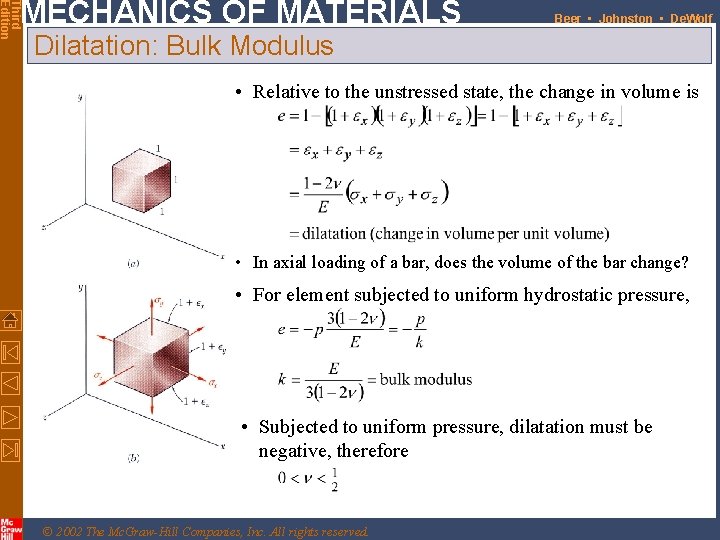
Third Edition MECHANICS OF MATERIALS Beer • Johnston • De. Wolf Dilatation: Bulk Modulus • Relative to the unstressed state, the change in volume is • In axial loading of a bar, does the volume of the bar change? • For element subjected to uniform hydrostatic pressure, • Subjected to uniform pressure, dilatation must be negative, therefore © 2002 The Mc. Graw-Hill Companies, Inc. All rights reserved.
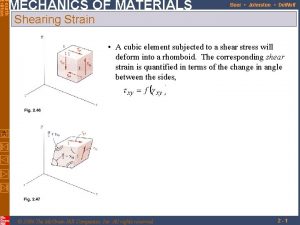
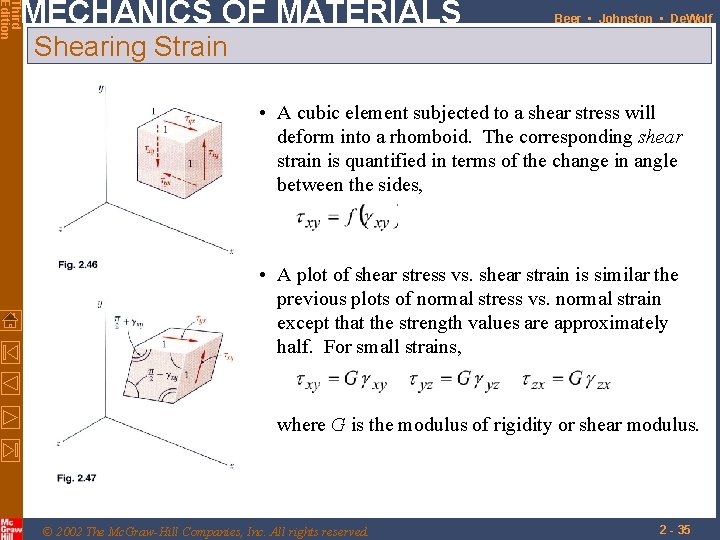
Third Edition MECHANICS OF MATERIALS Beer • Johnston • De. Wolf Shearing Strain • A cubic element subjected to a shear stress will deform into a rhomboid. The corresponding shear strain is quantified in terms of the change in angle between the sides, • A plot of shear stress vs. shear strain is similar the previous plots of normal stress vs. normal strain except that the strength values are approximately half. For small strains, where G is the modulus of rigidity or shear modulus. © 2002 The Mc. Graw-Hill Companies, Inc. All rights reserved. 2 - 35
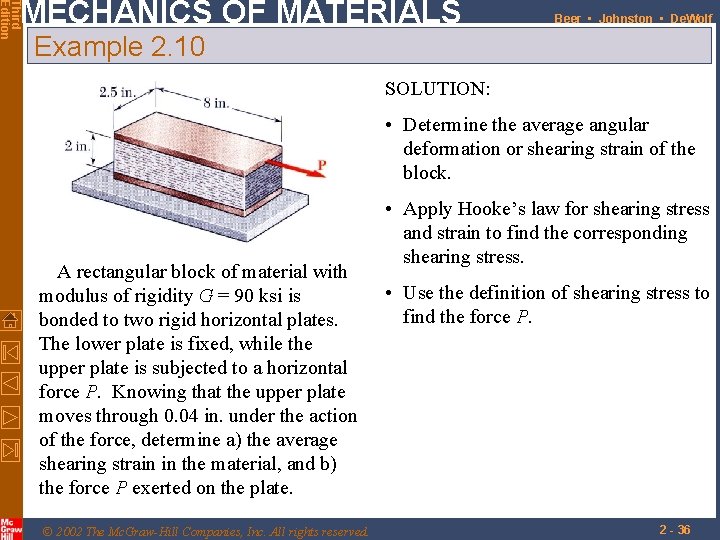
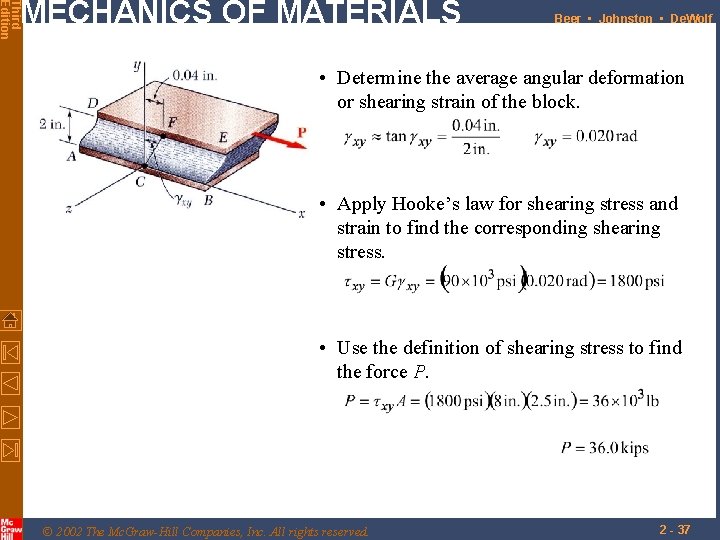
Third Edition MECHANICS OF MATERIALS Beer • Johnston • De. Wolf Example 2. 10 SOLUTION: • Determine the average angular deformation or shearing strain of the block. A rectangular block of material with modulus of rigidity G = 90 ksi is bonded to two rigid horizontal plates. The lower plate is fixed, while the upper plate is subjected to a horizontal force P. Knowing that the upper plate moves through 0. 04 in. under the action of the force, determine a) the average shearing strain in the material, and b) the force P exerted on the plate. © 2002 The Mc. Graw-Hill Companies, Inc. All rights reserved. • Apply Hooke’s law for shearing stress and strain to find the corresponding shearing stress. • Use the definition of shearing stress to find the force P. 2 - 36
Third Edition MECHANICS OF MATERIALS Beer • Johnston • De. Wolf • Determine the average angular deformation or shearing strain of the block. • Apply Hooke’s law for shearing stress and strain to find the corresponding shearing stress. • Use the definition of shearing stress to find the force P. © 2002 The Mc. Graw-Hill Companies, Inc. All rights reserved. 2 - 37
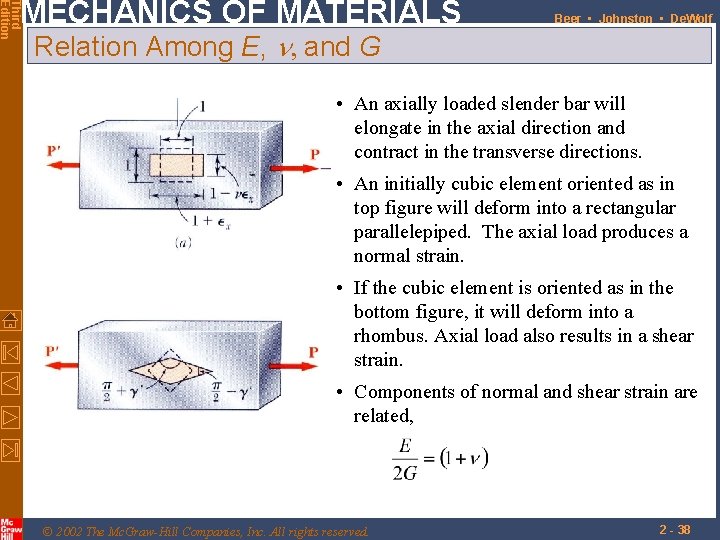
Third Edition MECHANICS OF MATERIALS Beer • Johnston • De. Wolf Relation Among E, n, and G • An axially loaded slender bar will elongate in the axial direction and contract in the transverse directions. • An initially cubic element oriented as in top figure will deform into a rectangular parallelepiped. The axial load produces a normal strain. • If the cubic element is oriented as in the bottom figure, it will deform into a rhombus. Axial load also results in a shear strain. • Components of normal and shear strain are related, © 2002 The Mc. Graw-Hill Companies, Inc. All rights reserved. 2 - 38
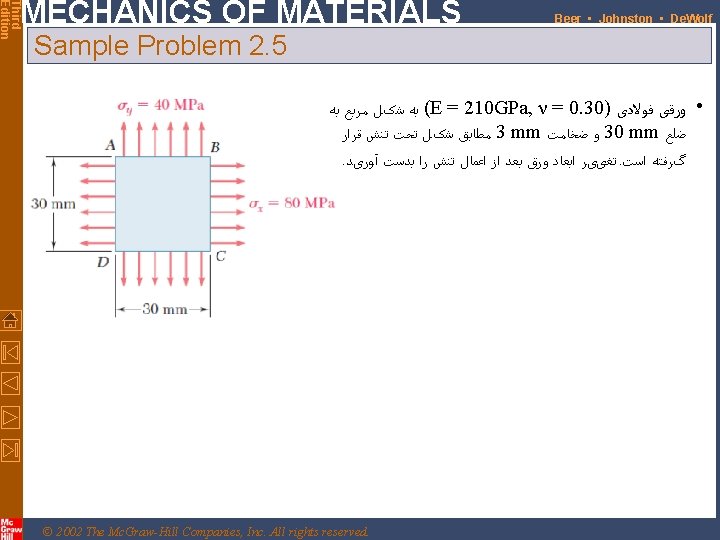
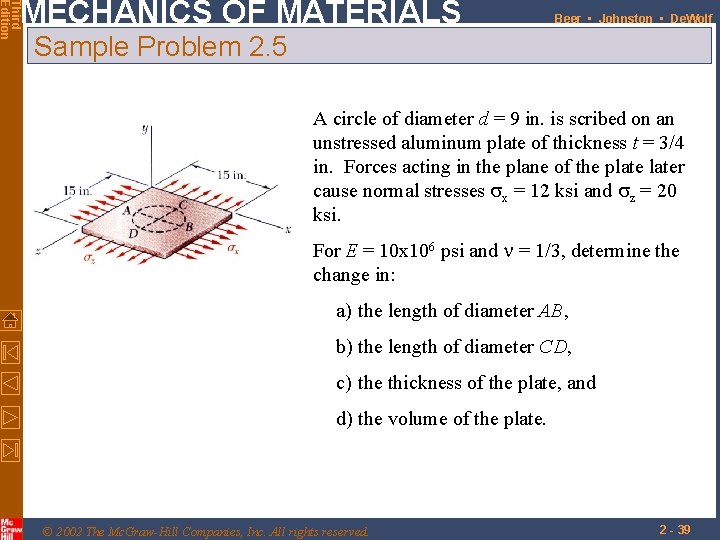
Third Edition MECHANICS OF MATERIALS Beer • Johnston • De. Wolf Sample Problem 2. 5 A circle of diameter d = 9 in. is scribed on an unstressed aluminum plate of thickness t = 3/4 in. Forces acting in the plane of the plater cause normal stresses sx = 12 ksi and sz = 20 ksi. For E = 10 x 106 psi and n = 1/3, determine the change in: a) the length of diameter AB, b) the length of diameter CD, c) the thickness of the plate, and d) the volume of the plate. © 2002 The Mc. Graw-Hill Companies, Inc. All rights reserved. 2 - 39
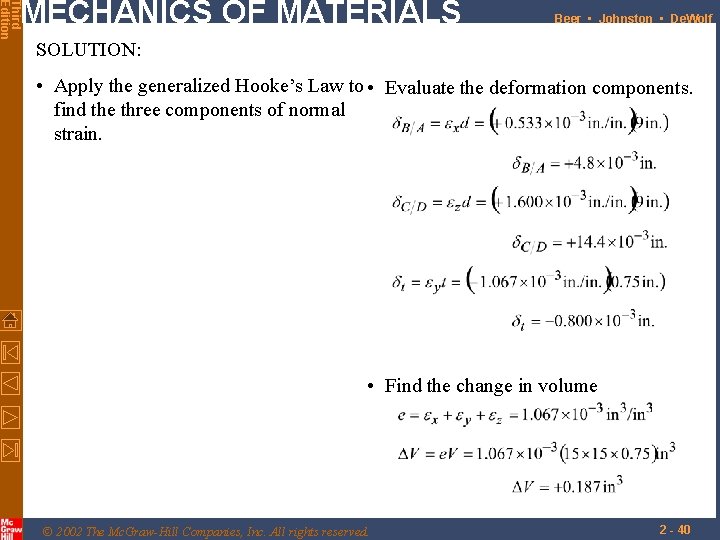
Third Edition MECHANICS OF MATERIALS Beer • Johnston • De. Wolf SOLUTION: • Apply the generalized Hooke’s Law to • Evaluate the deformation components. find the three components of normal strain. • Find the change in volume © 2002 The Mc. Graw-Hill Companies, Inc. All rights reserved. 2 - 40
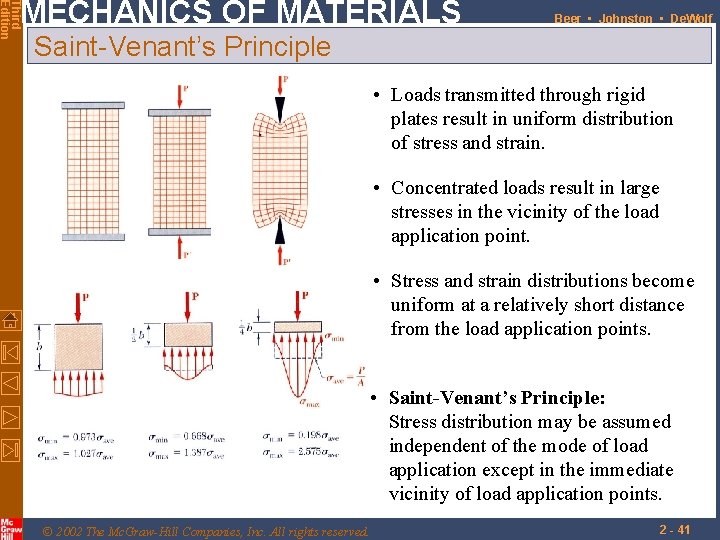
Third Edition MECHANICS OF MATERIALS Beer • Johnston • De. Wolf Saint-Venant’s Principle • Loads transmitted through rigid plates result in uniform distribution of stress and strain. • Concentrated loads result in large stresses in the vicinity of the load application point. • Stress and strain distributions become uniform at a relatively short distance from the load application points. • Saint-Venant’s Principle: Stress distribution may be assumed independent of the mode of load application except in the immediate vicinity of load application points. © 2002 The Mc. Graw-Hill Companies, Inc. All rights reserved. 2 - 41
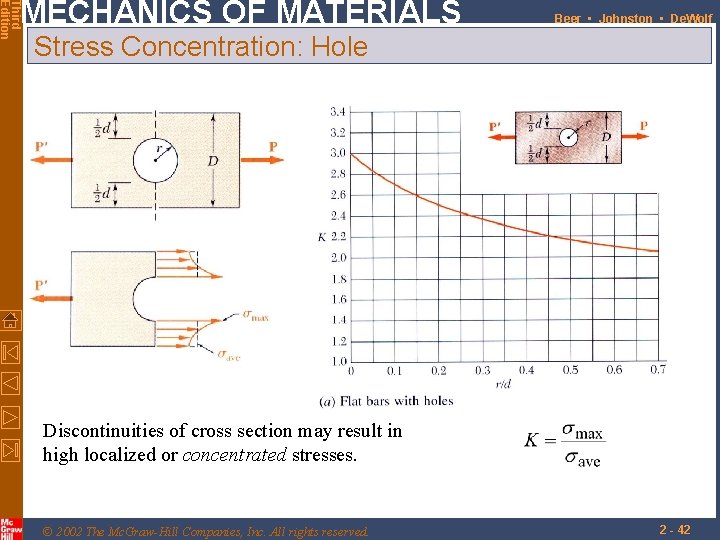
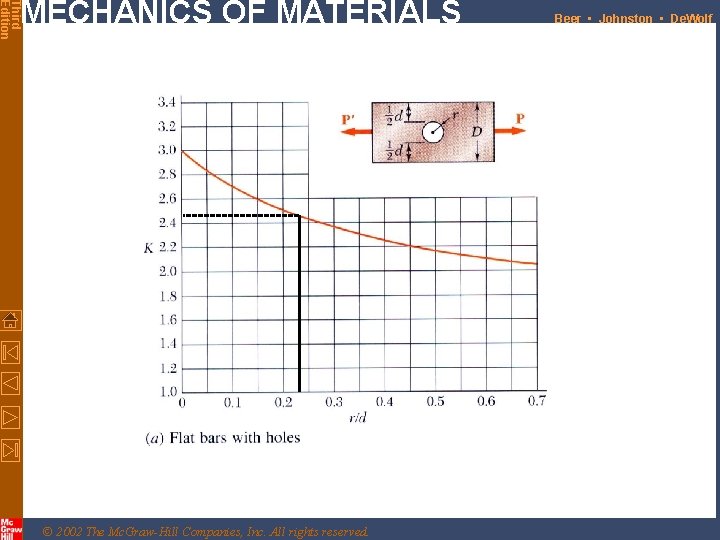
Third Edition MECHANICS OF MATERIALS Beer • Johnston • De. Wolf Stress Concentration: Hole Discontinuities of cross section may result in high localized or concentrated stresses. © 2002 The Mc. Graw-Hill Companies, Inc. All rights reserved. 2 - 42
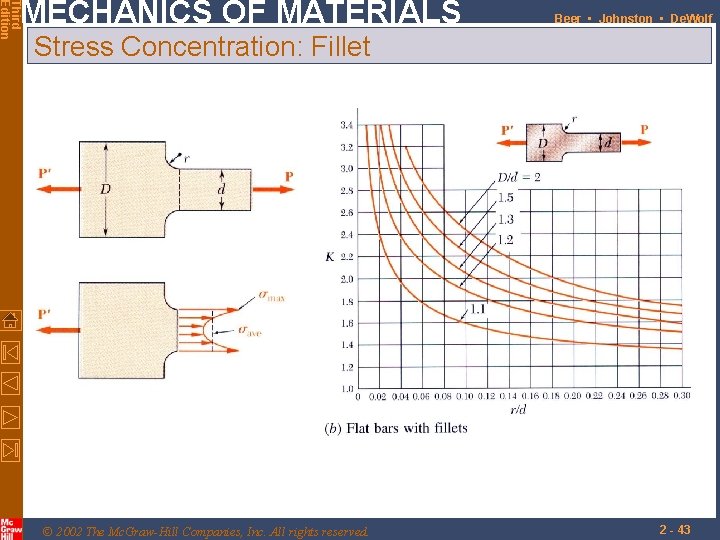
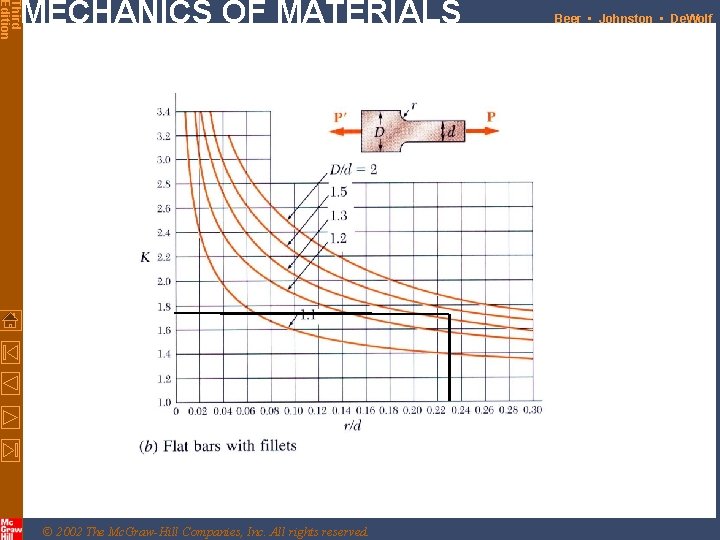
Third Edition MECHANICS OF MATERIALS Beer • Johnston • De. Wolf Stress Concentration: Fillet © 2002 The Mc. Graw-Hill Companies, Inc. All rights reserved. 2 - 43
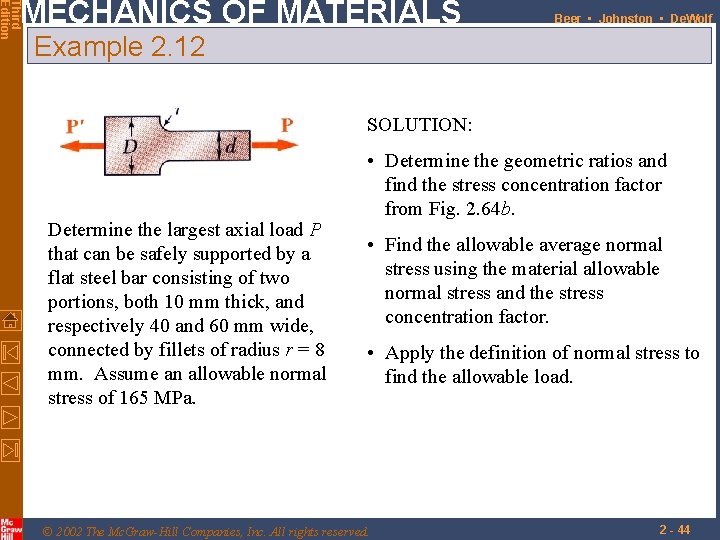
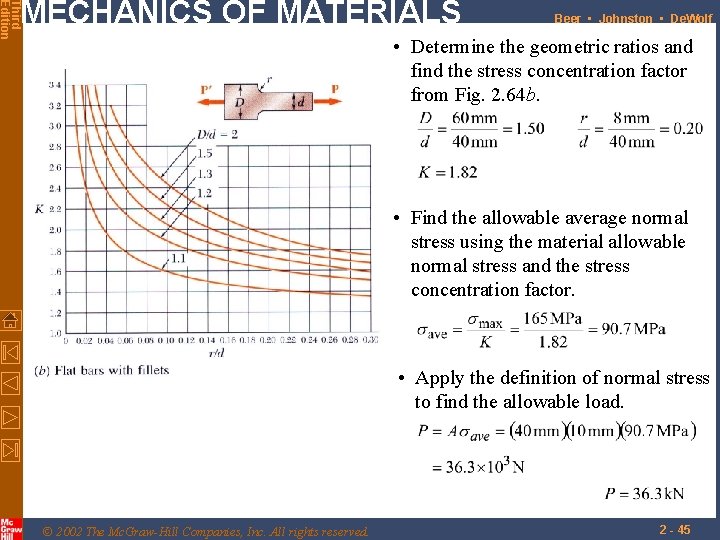
Third Edition MECHANICS OF MATERIALS Beer • Johnston • De. Wolf Example 2. 12 SOLUTION: Determine the largest axial load P that can be safely supported by a flat steel bar consisting of two portions, both 10 mm thick, and respectively 40 and 60 mm wide, connected by fillets of radius r = 8 mm. Assume an allowable normal stress of 165 MPa. • Determine the geometric ratios and find the stress concentration factor from Fig. 2. 64 b. • Find the allowable average normal stress using the material allowable normal stress and the stress concentration factor. • Apply the definition of normal stress to find the allowable load. © 2002 The Mc. Graw-Hill Companies, Inc. All rights reserved. 2 - 44
Third Edition MECHANICS OF MATERIALS Beer • Johnston • De. Wolf • Determine the geometric ratios and find the stress concentration factor from Fig. 2. 64 b. • Find the allowable average normal stress using the material allowable normal stress and the stress concentration factor. • Apply the definition of normal stress to find the allowable load. © 2002 The Mc. Graw-Hill Companies, Inc. All rights reserved. 2 - 45
Third Edition MECHANICS OF MATERIALS © 2002 The Mc. Graw-Hill Companies, Inc. All rights reserved. Beer • Johnston • De. Wolf
Third Edition MECHANICS OF MATERIALS © 2002 The Mc. Graw-Hill Companies, Inc. All rights reserved. Beer • Johnston • De. Wolf