
MECHANICS OF MATERIALS Russell C Hibbeler th 7
MECHANICS OF MATERIALS Russell C. Hibbeler th 7 Edition Chapter 1: Stress
Introduction • Mechanics of materials is a study of the relationship between the external loads on a body and the intensity of the internal loads within the body. • This subject also involves the deformations and stability of a body when subjected to external forces. Chapter 1: Stress © 2008 Pearson Education South Asia Pte Ltd Mechanics of Material 7 th Edition

Equilibrium of a Deformable Body External Forces 1. Surface Forces - caused by direct contact of other body’s surface 2. Body Forces - other body exerts a force without contact Chapter 1: Stress © 2008 Pearson Education South Asia Pte Ltd Mechanics of Material 7 th Edition
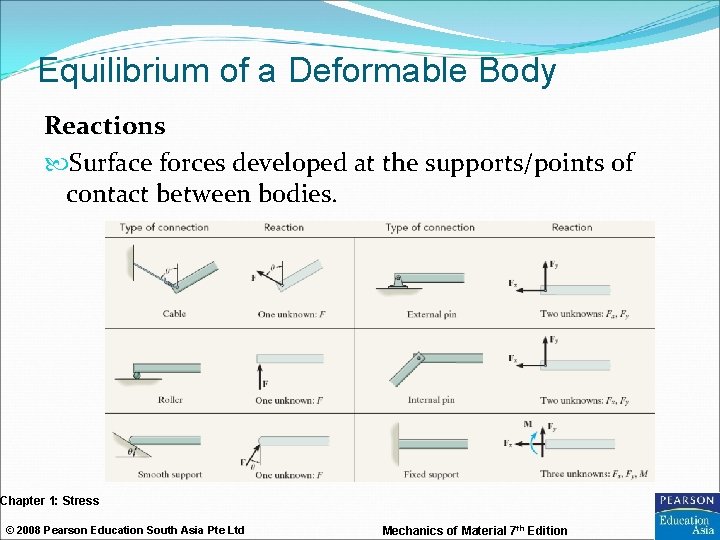
Equilibrium of a Deformable Body Reactions Surface forces developed at the supports/points of contact between bodies. Chapter 1: Stress © 2008 Pearson Education South Asia Pte Ltd Mechanics of Material 7 th Edition
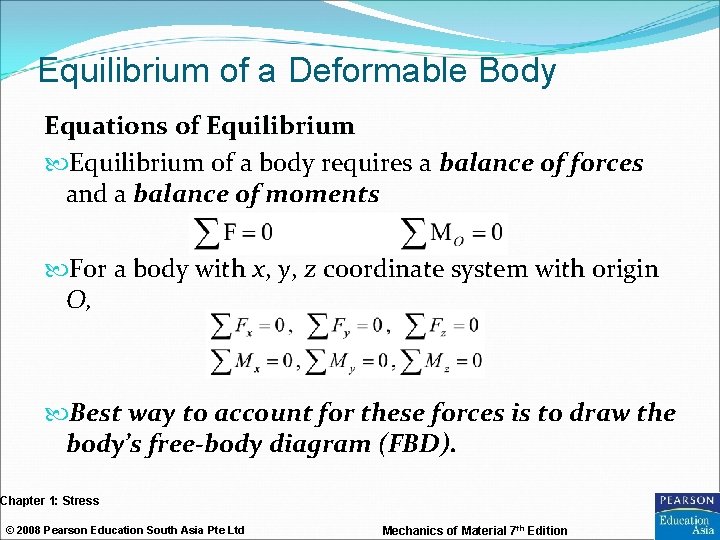
Equilibrium of a Deformable Body Equations of Equilibrium of a body requires a balance of forces and a balance of moments For a body with x, y, z coordinate system with origin O, Best way to account for these forces is to draw the body’s free-body diagram (FBD). Chapter 1: Stress © 2008 Pearson Education South Asia Pte Ltd Mechanics of Material 7 th Edition
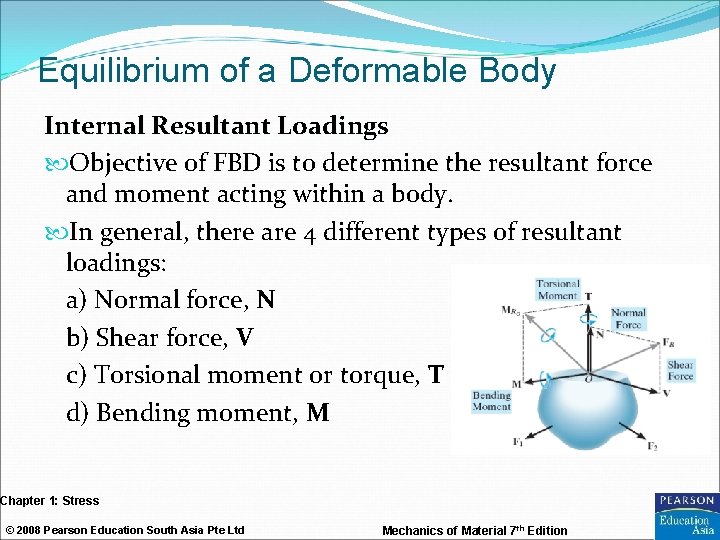
Equilibrium of a Deformable Body Internal Resultant Loadings Objective of FBD is to determine the resultant force and moment acting within a body. In general, there are 4 different types of resultant loadings: a) Normal force, N b) Shear force, V c) Torsional moment or torque, T d) Bending moment, M Chapter 1: Stress © 2008 Pearson Education South Asia Pte Ltd Mechanics of Material 7 th Edition
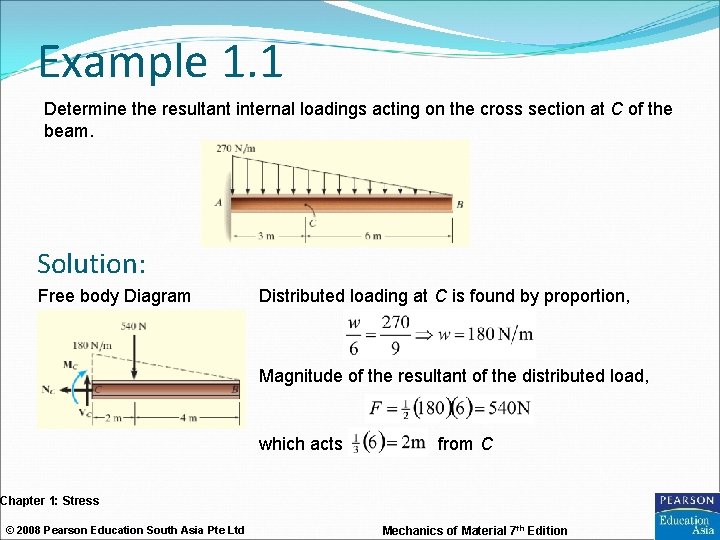
Example 1. 1 Determine the resultant internal loadings acting on the cross section at C of the beam. Solution: Free body Diagram Distributed loading at C is found by proportion, Magnitude of the resultant of the distributed load, which acts from C Chapter 1: Stress © 2008 Pearson Education South Asia Pte Ltd Mechanics of Material 7 th Edition
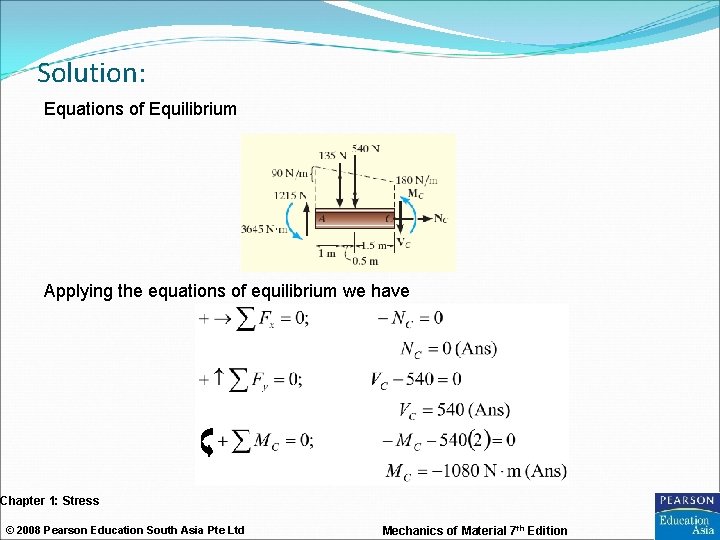
Solution: Equations of Equilibrium Applying the equations of equilibrium we have Chapter 1: Stress © 2008 Pearson Education South Asia Pte Ltd Mechanics of Material 7 th Edition
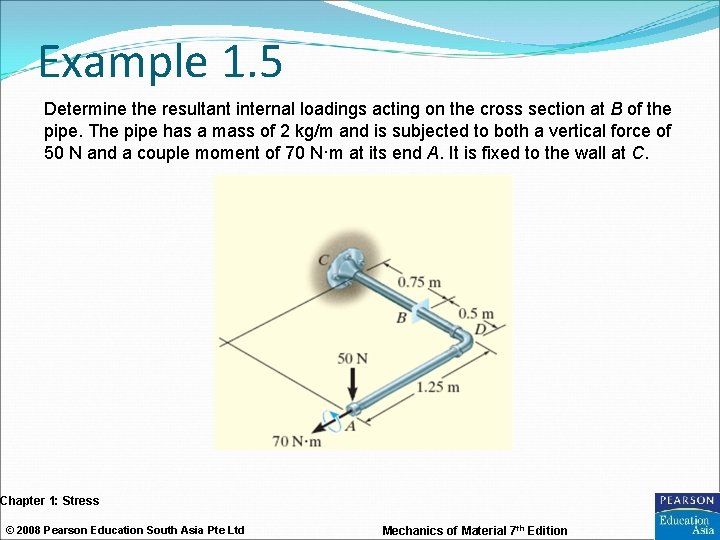
Example 1. 5 Determine the resultant internal loadings acting on the cross section at B of the pipe. The pipe has a mass of 2 kg/m and is subjected to both a vertical force of 50 N and a couple moment of 70 N·m at its end A. It is fixed to the wall at C. Chapter 1: Stress © 2008 Pearson Education South Asia Pte Ltd Mechanics of Material 7 th Edition
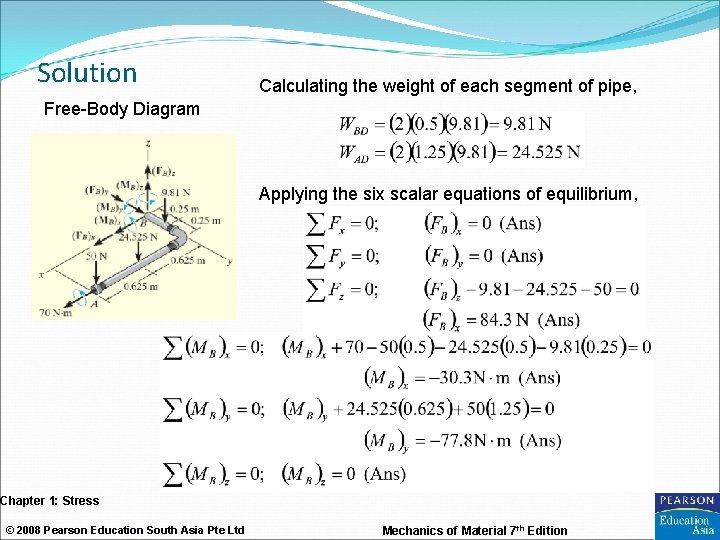
Solution Calculating the weight of each segment of pipe, Free-Body Diagram Applying the six scalar equations of equilibrium, Chapter 1: Stress © 2008 Pearson Education South Asia Pte Ltd Mechanics of Material 7 th Edition
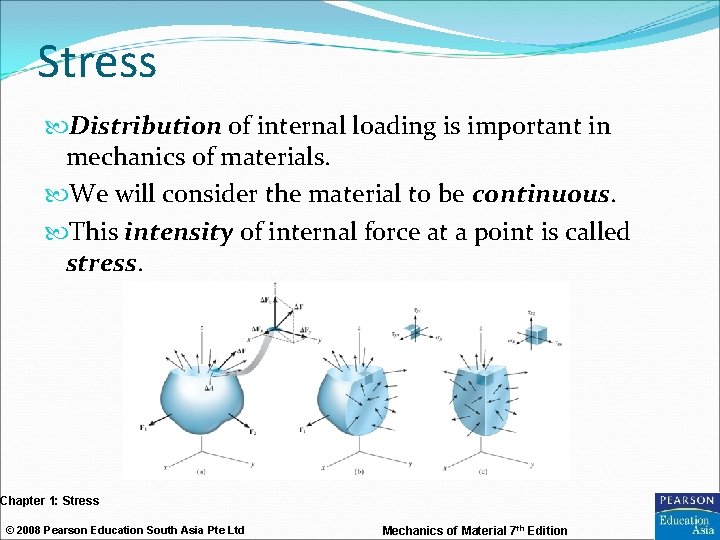
Stress Distribution of internal loading is important in mechanics of materials. We will consider the material to be continuous. This intensity of internal force at a point is called stress. Chapter 1: Stress © 2008 Pearson Education South Asia Pte Ltd Mechanics of Material 7 th Edition

Stress Normal Stress σ Force per unit area acting normal to ΔA Shear Stress τ Force per unit area acting tangent to ΔA Chapter 1: Stress © 2008 Pearson Education South Asia Pte Ltd Mechanics of Material 7 th Edition

Average Normal Stress in an Axially Loaded Bar When a cross-sectional area bar is subjected to axial force through the centroid, it is only subjected to normal stress. Stress is assumed to be averaged over the area. Chapter 1: Stress © 2008 Pearson Education South Asia Pte Ltd Mechanics of Material 7 th Edition

Average Normal Stress in an Axially Loaded Bar Average Normal Stress Distribution When a bar is subjected to a constant deformation, σ = average normal stress P = resultant normal force A = cross sectional area of bar Equilibrium 2 normal stress components that are equal in magnitude but opposite in direction. Chapter 1: Stress © 2008 Pearson Education South Asia Pte Ltd Mechanics of Material 7 th Edition
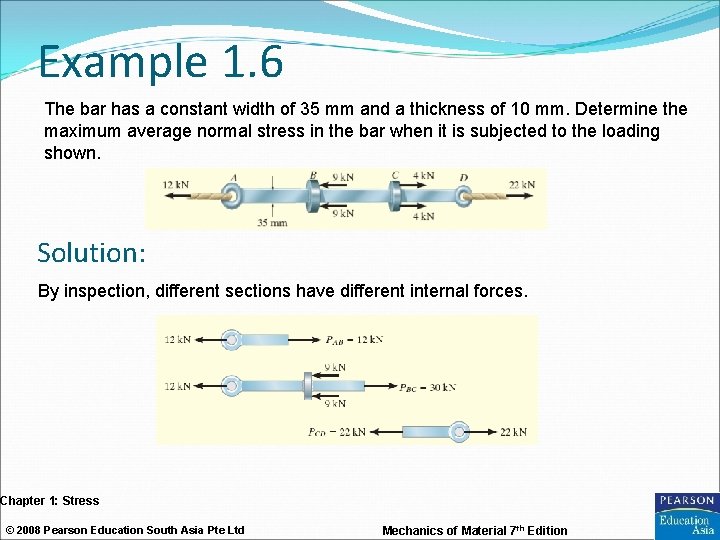
Example 1. 6 The bar has a constant width of 35 mm and a thickness of 10 mm. Determine the maximum average normal stress in the bar when it is subjected to the loading shown. Solution: By inspection, different sections have different internal forces. Chapter 1: Stress © 2008 Pearson Education South Asia Pte Ltd Mechanics of Material 7 th Edition

Solution: Graphically, the normal force diagram is as shown. By inspection, the largest loading is in region BC, Since the cross-sectional area of the bar is constant, the largest average normal stress is Chapter 1: Stress © 2008 Pearson Education South Asia Pte Ltd Mechanics of Material 7 th Edition
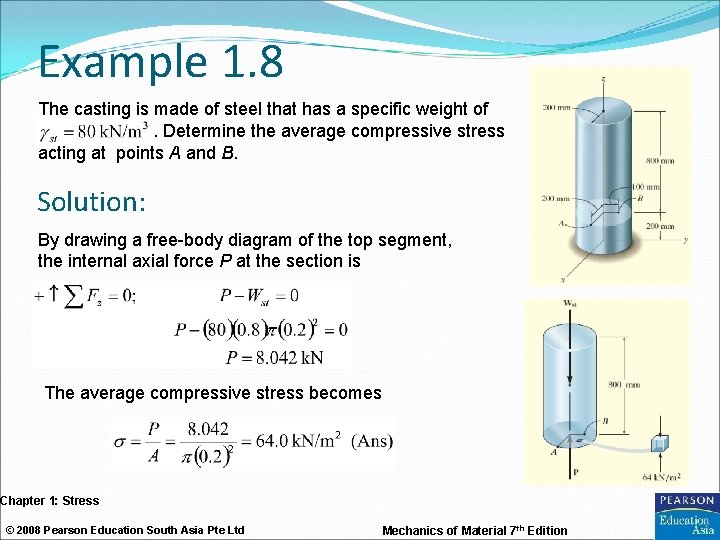
Example 1. 8 The casting is made of steel that has a specific weight of. Determine the average compressive stress acting at points A and B. Solution: By drawing a free-body diagram of the top segment, the internal axial force P at the section is The average compressive stress becomes Chapter 1: Stress © 2008 Pearson Education South Asia Pte Ltd Mechanics of Material 7 th Edition
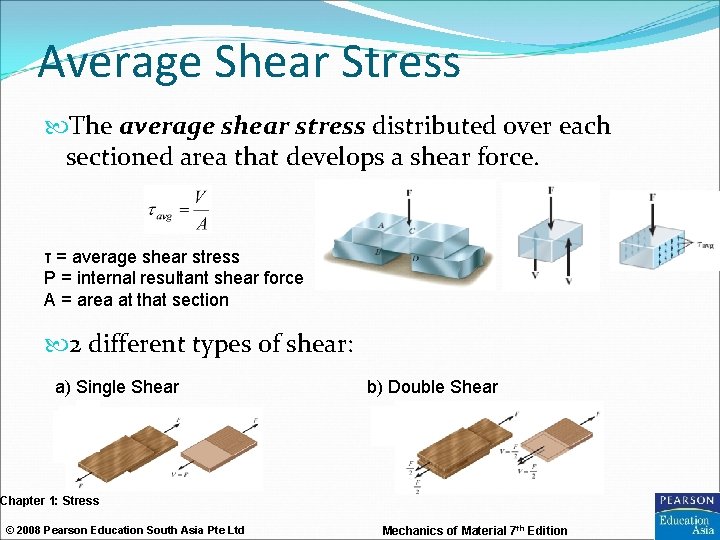
Average Shear Stress The average shear stress distributed over each sectioned area that develops a shear force. τ = average shear stress P = internal resultant shear force A = area at that section 2 different types of shear: a) Single Shear b) Double Shear Chapter 1: Stress © 2008 Pearson Education South Asia Pte Ltd Mechanics of Material 7 th Edition
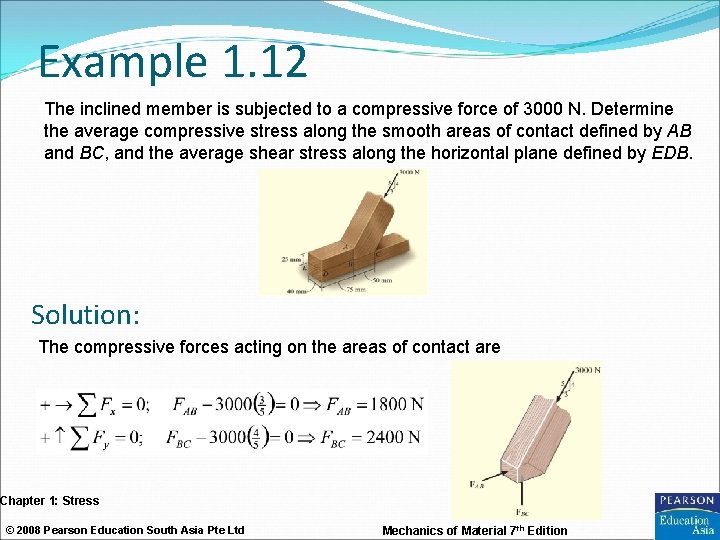
Example 1. 12 The inclined member is subjected to a compressive force of 3000 N. Determine the average compressive stress along the smooth areas of contact defined by AB and BC, and the average shear stress along the horizontal plane defined by EDB. Solution: The compressive forces acting on the areas of contact are Chapter 1: Stress © 2008 Pearson Education South Asia Pte Ltd Mechanics of Material 7 th Edition
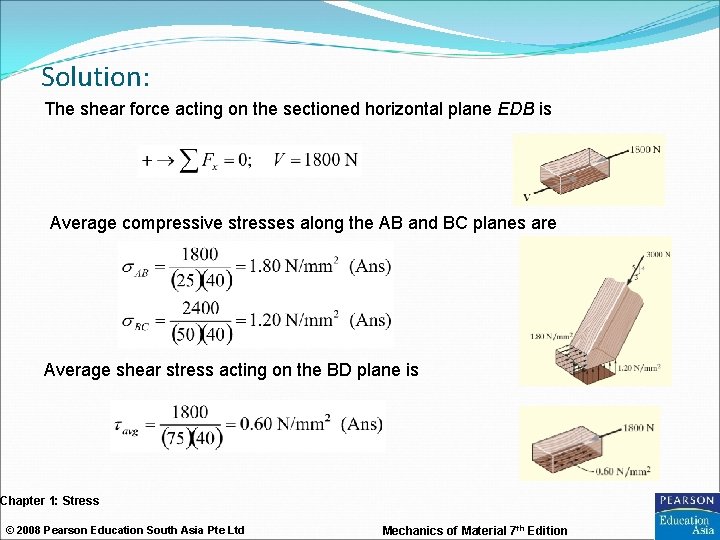
Solution: The shear force acting on the sectioned horizontal plane EDB is Average compressive stresses along the AB and BC planes are Average shear stress acting on the BD plane is Chapter 1: Stress © 2008 Pearson Education South Asia Pte Ltd Mechanics of Material 7 th Edition
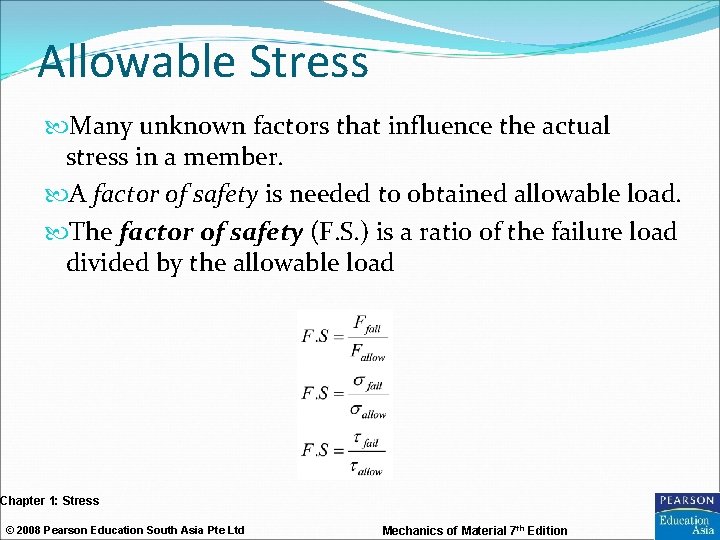
Allowable Stress Many unknown factors that influence the actual stress in a member. A factor of safety is needed to obtained allowable load. The factor of safety (F. S. ) is a ratio of the failure load divided by the allowable load Chapter 1: Stress © 2008 Pearson Education South Asia Pte Ltd Mechanics of Material 7 th Edition
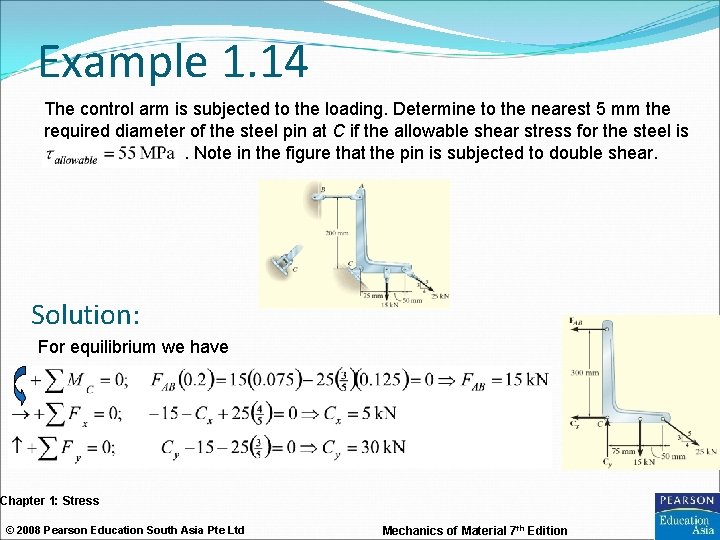
Example 1. 14 The control arm is subjected to the loading. Determine to the nearest 5 mm the required diameter of the steel pin at C if the allowable shear stress for the steel is. Note in the figure that the pin is subjected to double shear. Solution: For equilibrium we have Chapter 1: Stress © 2008 Pearson Education South Asia Pte Ltd Mechanics of Material 7 th Edition
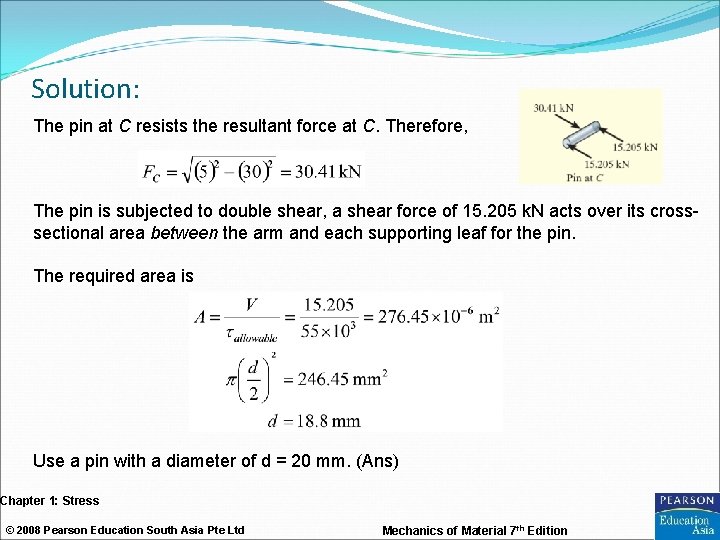
Solution: The pin at C resists the resultant force at C. Therefore, The pin is subjected to double shear, a shear force of 15. 205 k. N acts over its crosssectional area between the arm and each supporting leaf for the pin. The required area is Use a pin with a diameter of d = 20 mm. (Ans) Chapter 1: Stress © 2008 Pearson Education South Asia Pte Ltd Mechanics of Material 7 th Edition
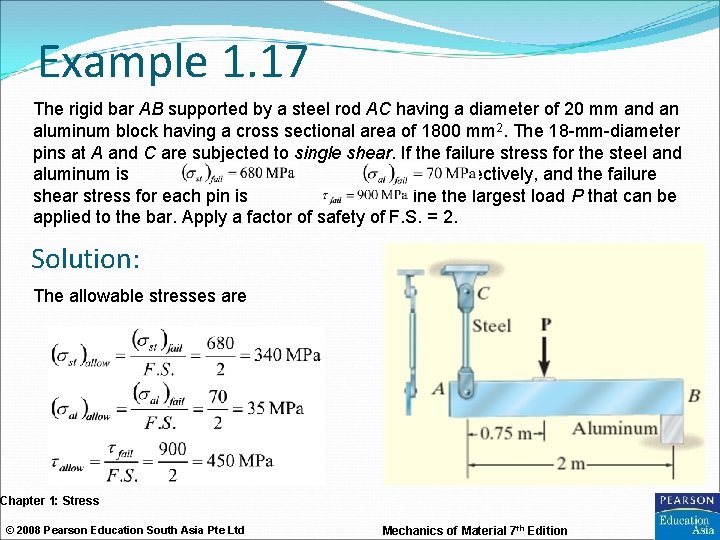
Example 1. 17 The rigid bar AB supported by a steel rod AC having a diameter of 20 mm and an aluminum block having a cross sectional area of 1800 mm 2. The 18 -mm-diameter pins at A and C are subjected to single shear. If the failure stress for the steel and aluminum is and respectively, and the failure shear stress for each pin is , determine the largest load P that can be applied to the bar. Apply a factor of safety of F. S. = 2. Solution: The allowable stresses are Chapter 1: Stress © 2008 Pearson Education South Asia Pte Ltd Mechanics of Material 7 th Edition
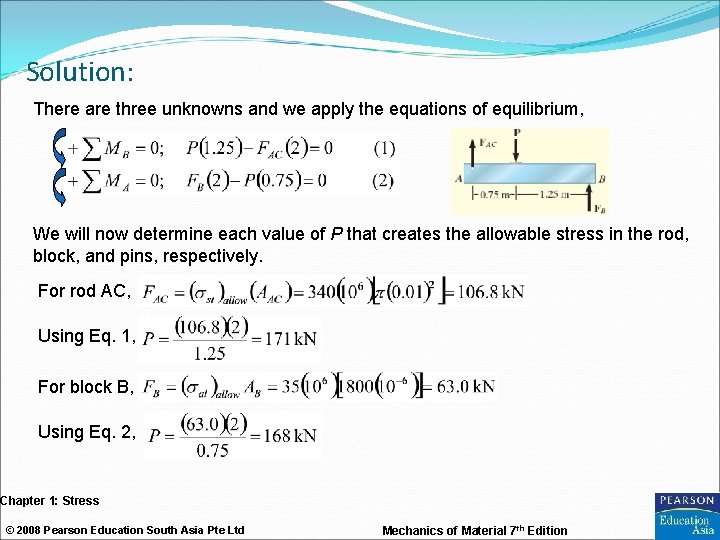
Solution: There are three unknowns and we apply the equations of equilibrium, We will now determine each value of P that creates the allowable stress in the rod, block, and pins, respectively. For rod AC, Using Eq. 1, For block B, Using Eq. 2, Chapter 1: Stress © 2008 Pearson Education South Asia Pte Ltd Mechanics of Material 7 th Edition
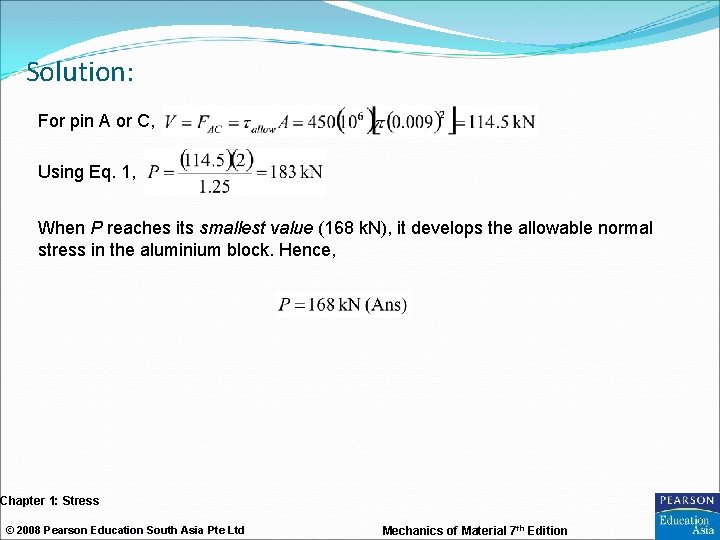
Solution: For pin A or C, Using Eq. 1, When P reaches its smallest value (168 k. N), it develops the allowable normal stress in the aluminium block. Hence, Chapter 1: Stress © 2008 Pearson Education South Asia Pte Ltd Mechanics of Material 7 th Edition
- Slides: 26