First Edition CHAPTER 7 Statics and Mechanics of

- Slides: 19
First Edition CHAPTER 7 Statics and Mechanics of Materials Ferdinand P. Beer E. Russell Johnston, Jr. John T. De. Wolf Distributed Forces: Moments of Inertia David M. Mazurek © 2011 The Mc. Graw-Hill Companies, Inc. All rights reserved.
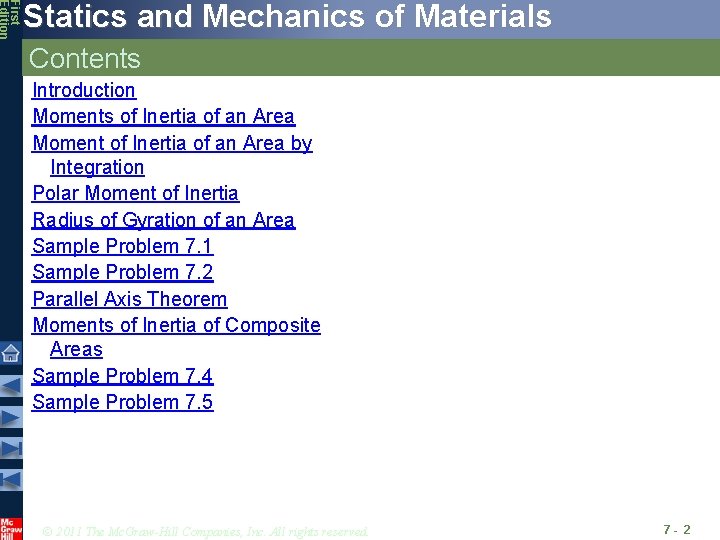
First Edition Statics and Mechanics of Materials Contents Introduction Moments of Inertia of an Area Moment of Inertia of an Area by Integration Polar Moment of Inertia Radius of Gyration of an Area Sample Problem 7. 1 Sample Problem 7. 2 Parallel Axis Theorem Moments of Inertia of Composite Areas Sample Problem 7. 4 Sample Problem 7. 5 © 2011 The Mc. Graw-Hill Companies, Inc. All rights reserved. 7 - 2
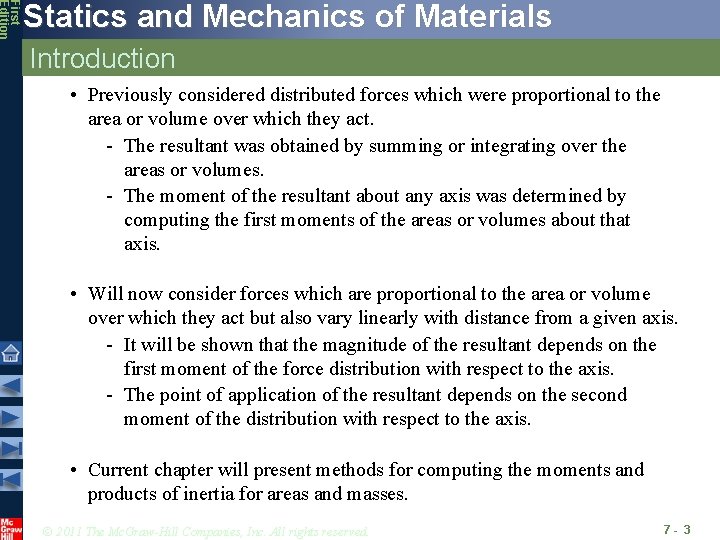
First Edition Statics and Mechanics of Materials Introduction • Previously considered distributed forces which were proportional to the area or volume over which they act. - The resultant was obtained by summing or integrating over the areas or volumes. - The moment of the resultant about any axis was determined by computing the first moments of the areas or volumes about that axis. • Will now consider forces which are proportional to the area or volume over which they act but also vary linearly with distance from a given axis. - It will be shown that the magnitude of the resultant depends on the first moment of the force distribution with respect to the axis. - The point of application of the resultant depends on the second moment of the distribution with respect to the axis. • Current chapter will present methods for computing the moments and products of inertia for areas and masses. © 2011 The Mc. Graw-Hill Companies, Inc. All rights reserved. 7 - 3
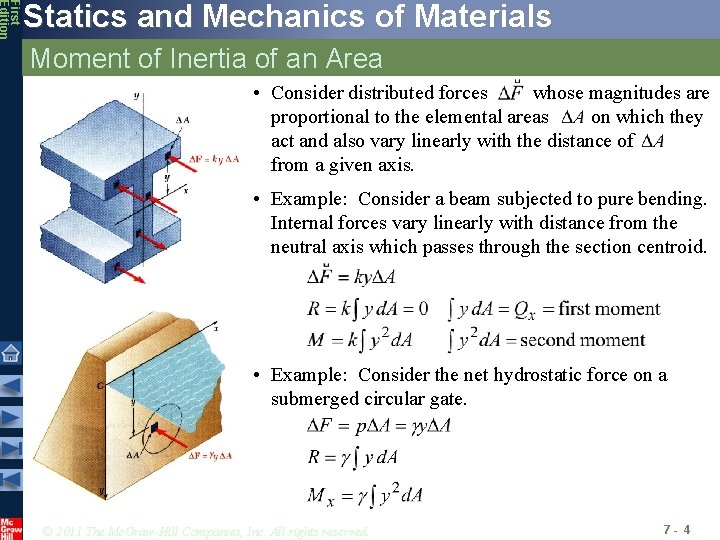
First Edition Statics and Mechanics of Materials Moment of Inertia of an Area • Consider distributed forces whose magnitudes are proportional to the elemental areas on which they act and also vary linearly with the distance of from a given axis. • Example: Consider a beam subjected to pure bending. Internal forces vary linearly with distance from the neutral axis which passes through the section centroid. • Example: Consider the net hydrostatic force on a submerged circular gate. © 2011 The Mc. Graw-Hill Companies, Inc. All rights reserved. 7 - 4
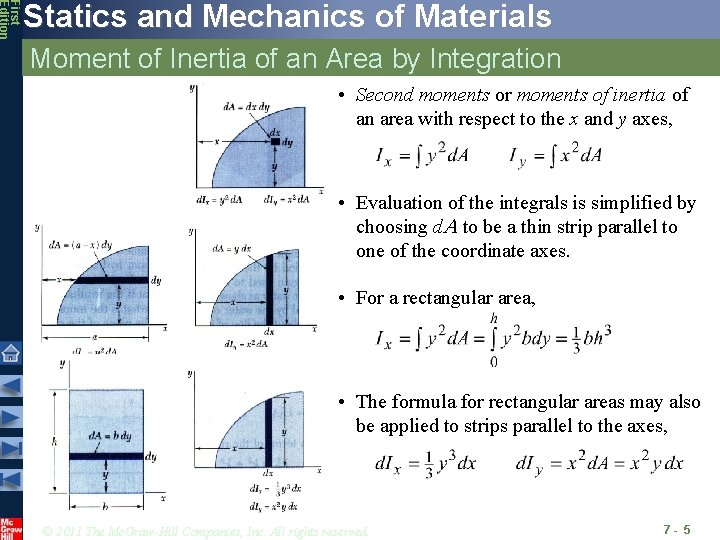
First Edition Statics and Mechanics of Materials Moment of Inertia of an Area by Integration • Second moments or moments of inertia of an area with respect to the x and y axes, • Evaluation of the integrals is simplified by choosing d. A to be a thin strip parallel to one of the coordinate axes. • For a rectangular area, • The formula for rectangular areas may also be applied to strips parallel to the axes, © 2011 The Mc. Graw-Hill Companies, Inc. All rights reserved. 7 - 5
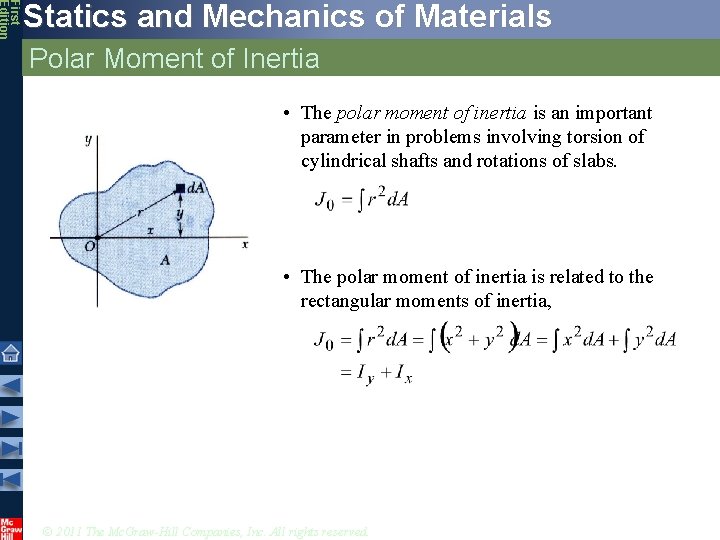
First Edition Statics and Mechanics of Materials Polar Moment of Inertia • The polar moment of inertia is an important parameter in problems involving torsion of cylindrical shafts and rotations of slabs. • The polar moment of inertia is related to the rectangular moments of inertia, © 2011 The Mc. Graw-Hill Companies, Inc. All rights reserved.
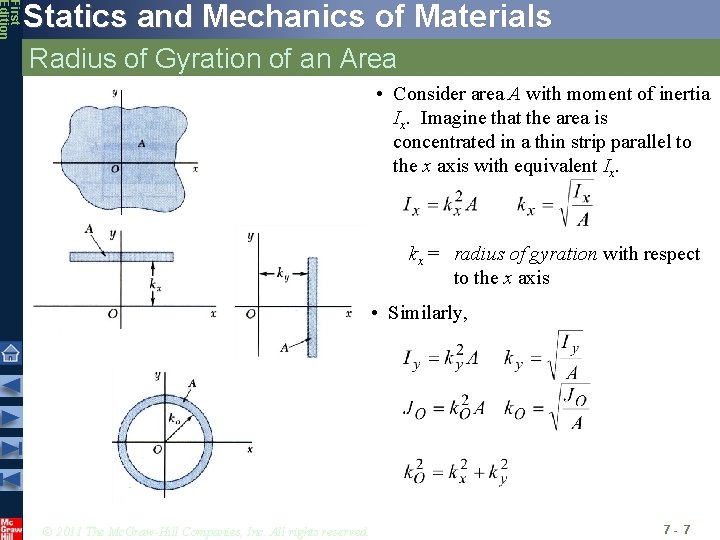
First Edition Statics and Mechanics of Materials Radius of Gyration of an Area • Consider area A with moment of inertia Ix. Imagine that the area is concentrated in a thin strip parallel to the x axis with equivalent Ix. kx = radius of gyration with respect to the x axis • Similarly, © 2011 The Mc. Graw-Hill Companies, Inc. All rights reserved. 7 - 7
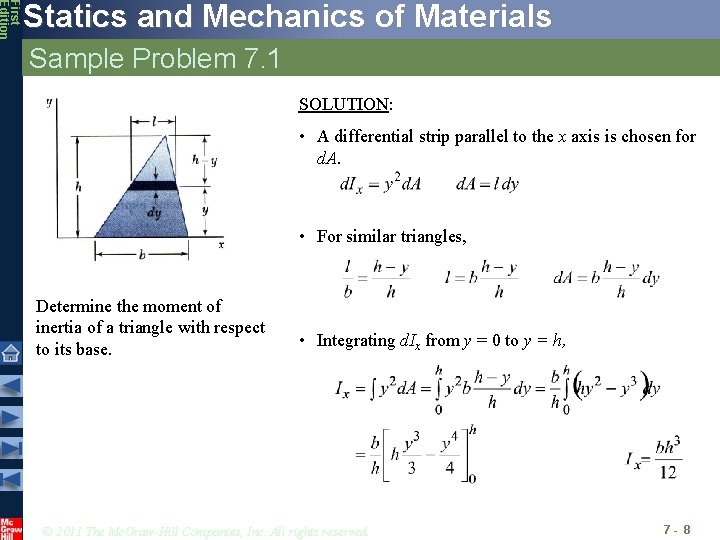
First Edition Statics and Mechanics of Materials Sample Problem 7. 1 SOLUTION: • A differential strip parallel to the x axis is chosen for d. A. • For similar triangles, Determine the moment of inertia of a triangle with respect to its base. • Integrating d. Ix from y = 0 to y = h, © 2011 The Mc. Graw-Hill Companies, Inc. All rights reserved. 7 - 8
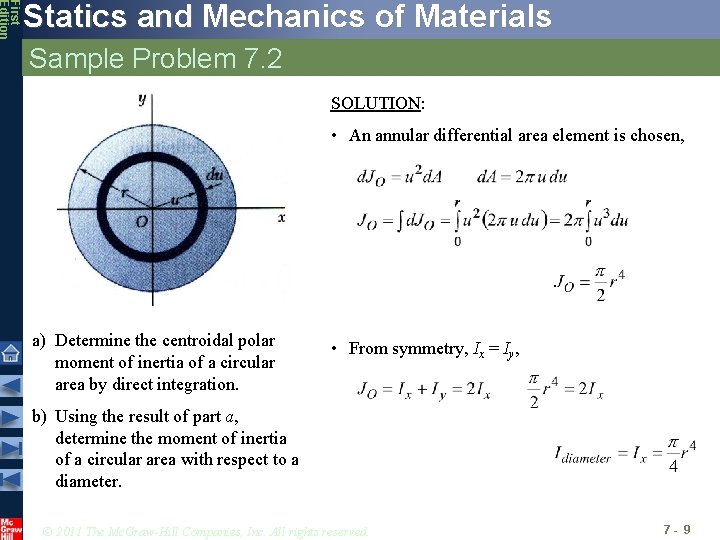
First Edition Statics and Mechanics of Materials Sample Problem 7. 2 SOLUTION: • An annular differential area element is chosen, a) Determine the centroidal polar moment of inertia of a circular area by direct integration. • From symmetry, Ix = Iy, b) Using the result of part a, determine the moment of inertia of a circular area with respect to a diameter. © 2011 The Mc. Graw-Hill Companies, Inc. All rights reserved. 7 - 9
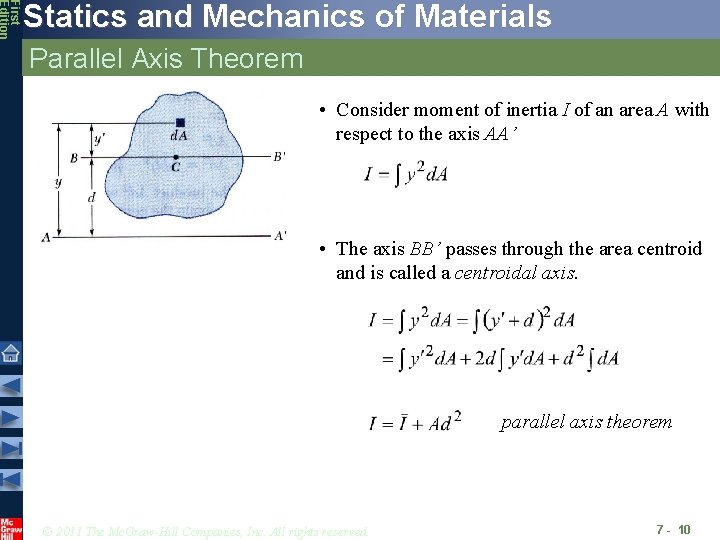
First Edition Statics and Mechanics of Materials Parallel Axis Theorem • Consider moment of inertia I of an area A with respect to the axis AA’ • The axis BB’ passes through the area centroid and is called a centroidal axis. parallel axis theorem © 2011 The Mc. Graw-Hill Companies, Inc. All rights reserved. 7 - 10
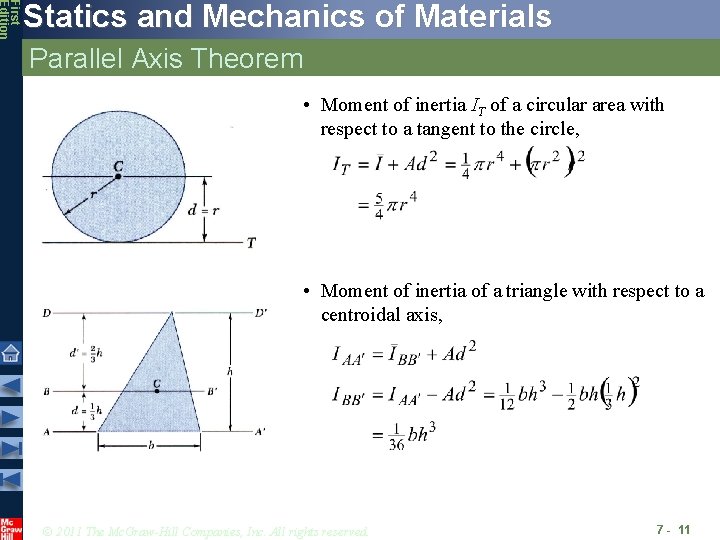
First Edition Statics and Mechanics of Materials Parallel Axis Theorem • Moment of inertia IT of a circular area with respect to a tangent to the circle, • Moment of inertia of a triangle with respect to a centroidal axis, © 2011 The Mc. Graw-Hill Companies, Inc. All rights reserved. 7 - 11
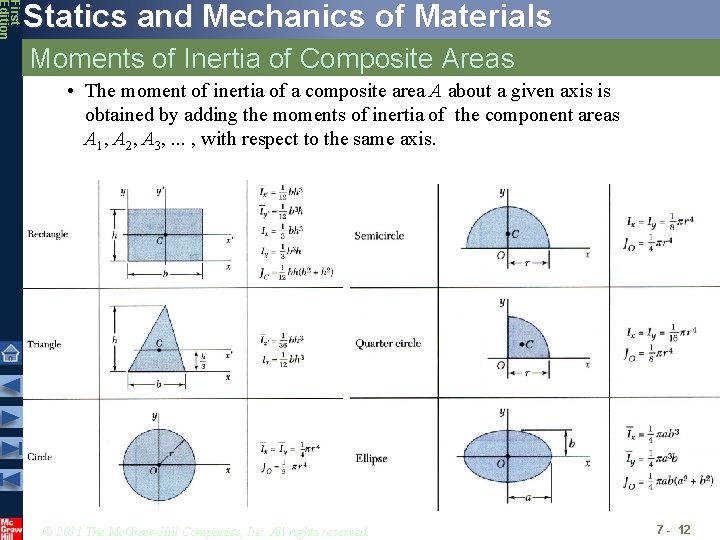
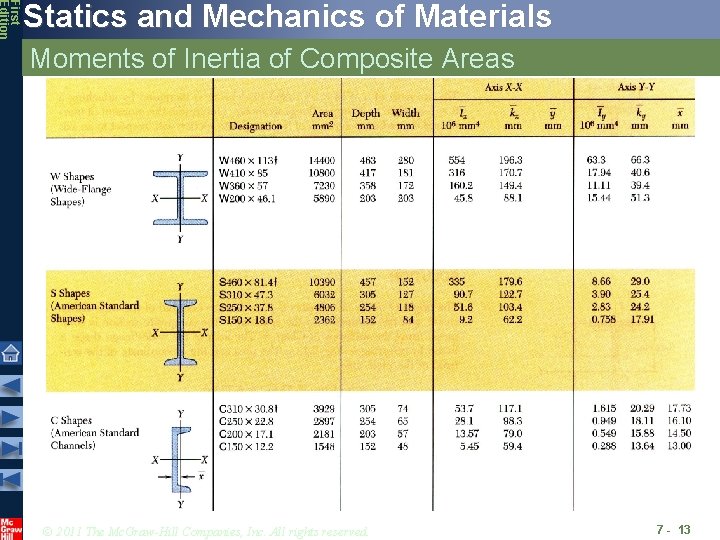
First Edition Statics and Mechanics of Materials Moments of Inertia of Composite Areas • The moment of inertia of a composite area A about a given axis is obtained by adding the moments of inertia of the component areas A 1, A 2, A 3, . . . , with respect to the same axis. © 2011 The Mc. Graw-Hill Companies, Inc. All rights reserved. 7 - 12
First Edition Statics and Mechanics of Materials Moments of Inertia of Composite Areas © 2011 The Mc. Graw-Hill Companies, Inc. All rights reserved. 7 - 13
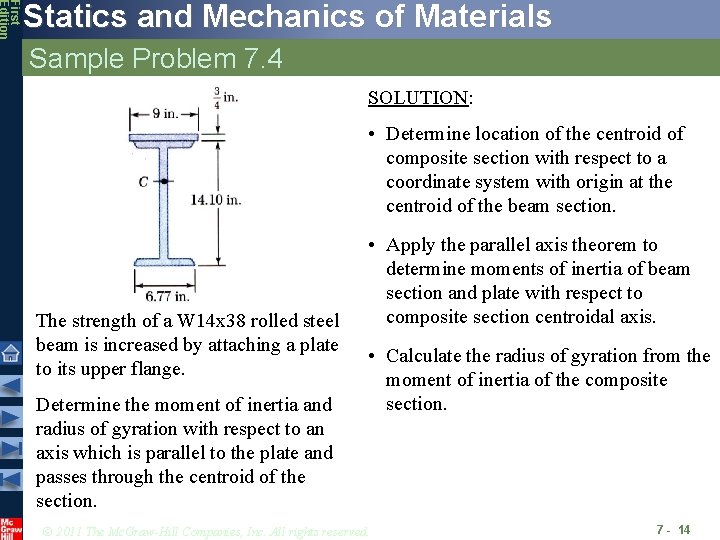
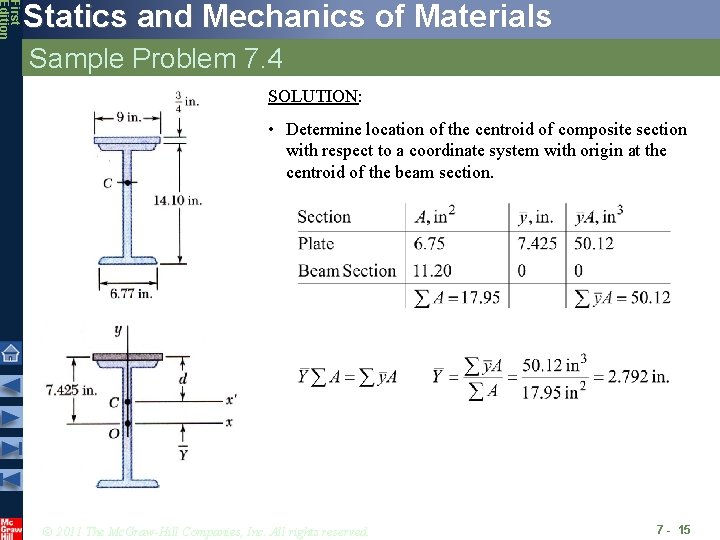
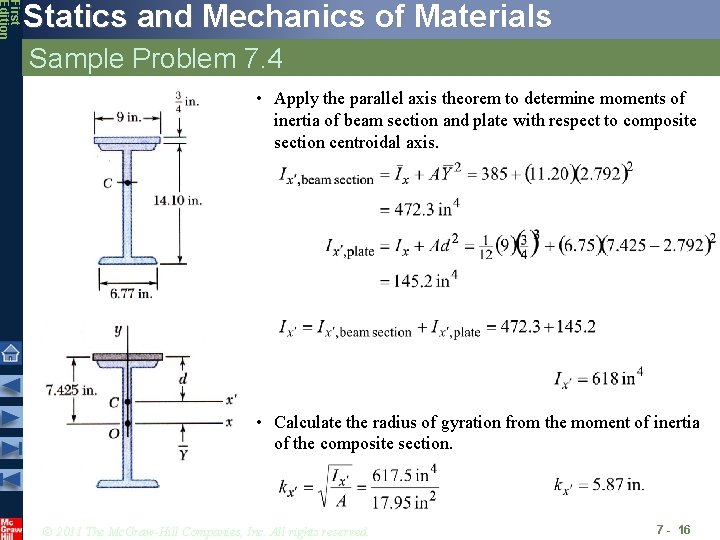
First Edition Statics and Mechanics of Materials Sample Problem 7. 4 SOLUTION: • Determine location of the centroid of composite section with respect to a coordinate system with origin at the centroid of the beam section. The strength of a W 14 x 38 rolled steel beam is increased by attaching a plate to its upper flange. Determine the moment of inertia and radius of gyration with respect to an axis which is parallel to the plate and passes through the centroid of the section. • Apply the parallel axis theorem to determine moments of inertia of beam section and plate with respect to composite section centroidal axis. • Calculate the radius of gyration from the moment of inertia of the composite section. © 2011 The Mc. Graw-Hill Companies, Inc. All rights reserved. 7 - 14
First Edition Statics and Mechanics of Materials Sample Problem 7. 4 SOLUTION: • Determine location of the centroid of composite section with respect to a coordinate system with origin at the centroid of the beam section. © 2011 The Mc. Graw-Hill Companies, Inc. All rights reserved. 7 - 15
First Edition Statics and Mechanics of Materials Sample Problem 7. 4 • Apply the parallel axis theorem to determine moments of inertia of beam section and plate with respect to composite section centroidal axis. • Calculate the radius of gyration from the moment of inertia of the composite section. © 2011 The Mc. Graw-Hill Companies, Inc. All rights reserved. 7 - 16
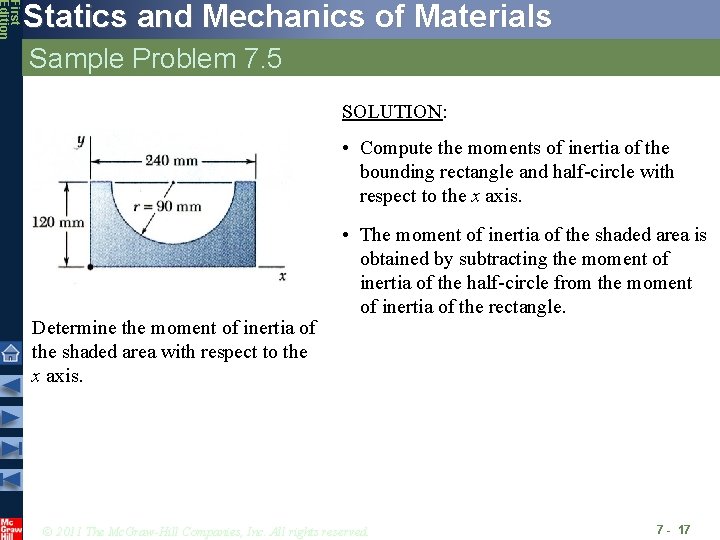
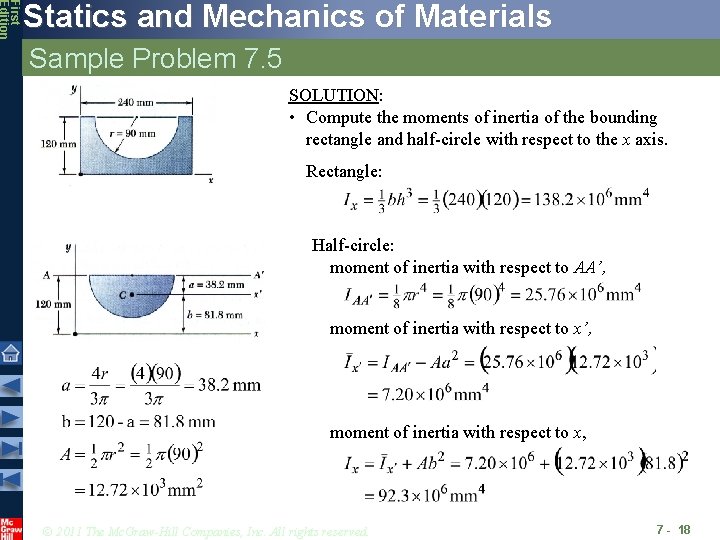
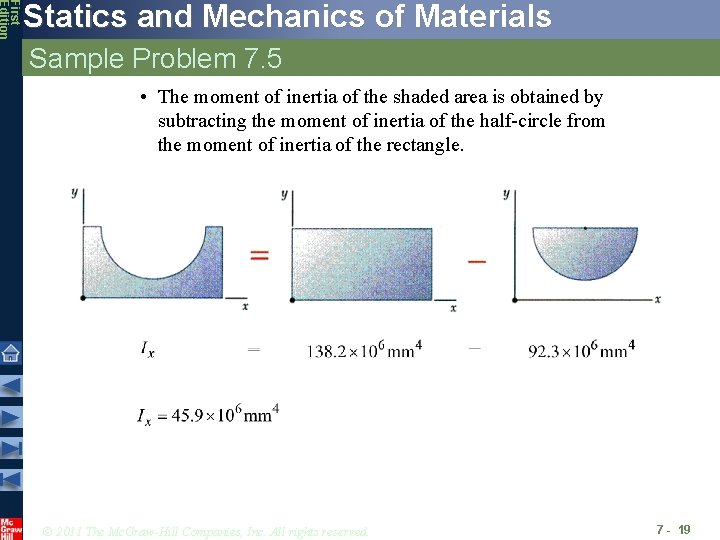
First Edition Statics and Mechanics of Materials Sample Problem 7. 5 SOLUTION: • Compute the moments of inertia of the bounding rectangle and half-circle with respect to the x axis. Determine the moment of inertia of the shaded area with respect to the x axis. • The moment of inertia of the shaded area is obtained by subtracting the moment of inertia of the half-circle from the moment of inertia of the rectangle. © 2011 The Mc. Graw-Hill Companies, Inc. All rights reserved. 7 - 17
First Edition Statics and Mechanics of Materials Sample Problem 7. 5 SOLUTION: • Compute the moments of inertia of the bounding rectangle and half-circle with respect to the x axis. Rectangle: Half-circle: moment of inertia with respect to AA’, moment of inertia with respect to x’, moment of inertia with respect to x, © 2011 The Mc. Graw-Hill Companies, Inc. All rights reserved. 7 - 18
First Edition Statics and Mechanics of Materials Sample Problem 7. 5 • The moment of inertia of the shaded area is obtained by subtracting the moment of inertia of the half-circle from the moment of inertia of the rectangle. © 2011 The Mc. Graw-Hill Companies, Inc. All rights reserved. 7 - 19