
Fifth SI Edition CHAPTER 2 MECHANICS OF MATERIALS
- Slides: 21
Fifth SI Edition CHAPTER 2 MECHANICS OF MATERIALS Ferdinand P. Beer E. Russell Johnston, Jr. John T. De. Wolf David F. Mazurek Stress and Strain – Axial Loading Lecture Notes: J. Walt Oler Texas Tech University © 2009 The Mc. Graw-Hill Companies, Inc. All rights reserved.
Fifth Edition MECHANICS OF MATERIALS Beer • Johnston • De. Wolf • Mazurek Contents Stress & Strain: Axial Loading Normal Strain Stress-Strain Test Stress-Strain Diagram: Ductile Materials Stress-Strain Diagram: Brittle Materials Hooke’s Law: Modulus of Elasticity Elastic vs. Plastic Behavior Fatigue Deformations Under Axial Loading Example 2. 01 Sample Problem 2. 1 Static Indeterminacy Example 2. 04 Thermal Stresses Poisson’s Ratio © 2009 The Mc. Graw-Hill Companies, Inc. All rights reserved. Generalized Hooke’s Law Dilatation: Bulk Modulus Shearing Strain Example 2. 10 Relation Among E, n, and G Sample Problem 2. 5 Composite Materials Saint-Venant’s Principle Stress Concentration: Hole Stress Concentration: Fillet Example 2. 12 Elastoplastic Materials Plastic Deformations Residual Stresses Example 2. 14, 2. 15, 2. 16 2
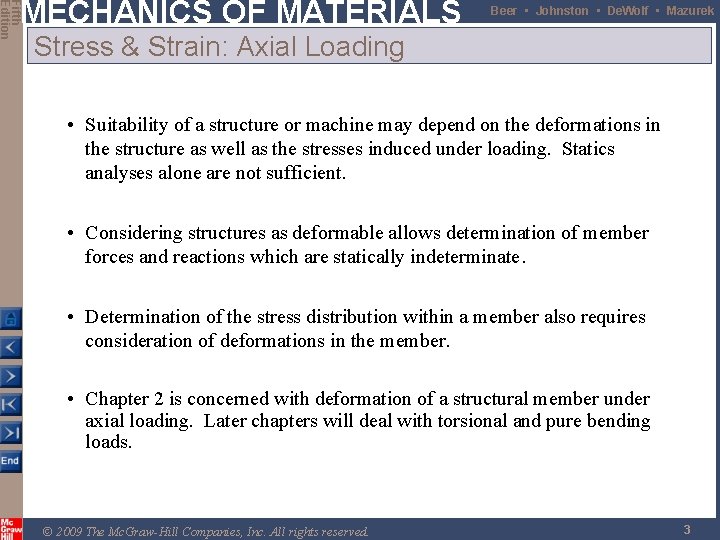
Fifth Edition MECHANICS OF MATERIALS Beer • Johnston • De. Wolf • Mazurek Stress & Strain: Axial Loading • Suitability of a structure or machine may depend on the deformations in the structure as well as the stresses induced under loading. Statics analyses alone are not sufficient. • Considering structures as deformable allows determination of member forces and reactions which are statically indeterminate. • Determination of the stress distribution within a member also requires consideration of deformations in the member. • Chapter 2 is concerned with deformation of a structural member under axial loading. Later chapters will deal with torsional and pure bending loads. © 2009 The Mc. Graw-Hill Companies, Inc. All rights reserved. 3
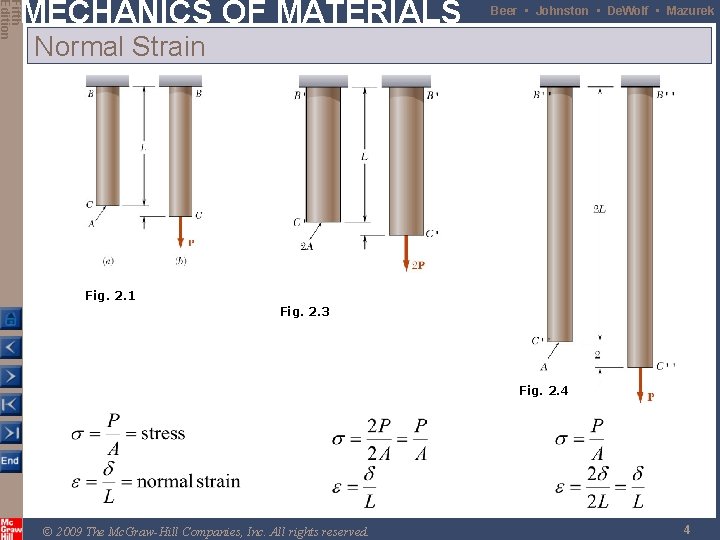
Fifth Edition MECHANICS OF MATERIALS Beer • Johnston • De. Wolf • Mazurek Normal Strain Fig. 2. 1 Fig. 2. 3 Fig. 2. 4 © 2009 The Mc. Graw-Hill Companies, Inc. All rights reserved. 4
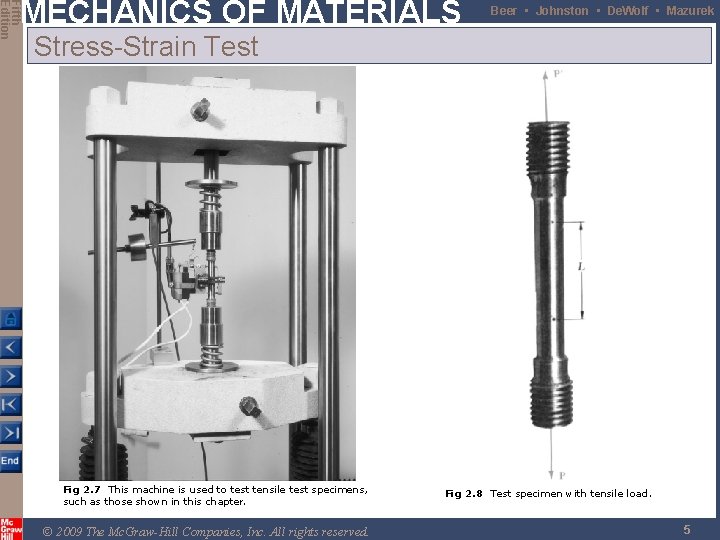
Fifth Edition MECHANICS OF MATERIALS Beer • Johnston • De. Wolf • Mazurek Stress-Strain Test Fig 2. 7 This machine is used to test tensile test specimens, such as those shown in this chapter. © 2009 The Mc. Graw-Hill Companies, Inc. All rights reserved. Fig 2. 8 Test specimen with tensile load. 5
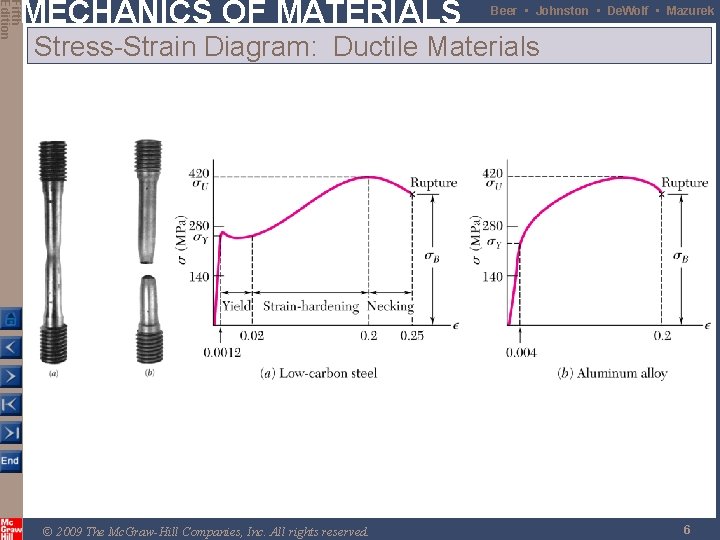
Fifth Edition MECHANICS OF MATERIALS Beer • Johnston • De. Wolf • Mazurek Stress-Strain Diagram: Ductile Materials © 2009 The Mc. Graw-Hill Companies, Inc. All rights reserved. 6
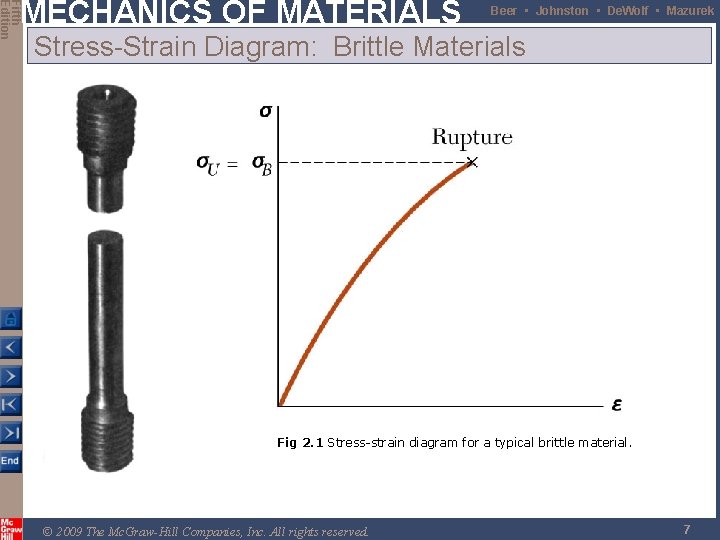
Fifth Edition MECHANICS OF MATERIALS Beer • Johnston • De. Wolf • Mazurek Stress-Strain Diagram: Brittle Materials Fig 2. 1 Stress-strain diagram for a typical brittle material. © 2009 The Mc. Graw-Hill Companies, Inc. All rights reserved. 7
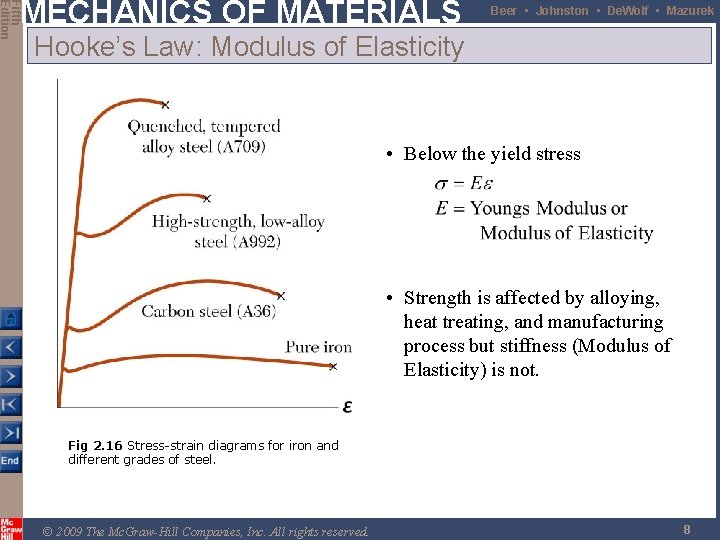
Fifth Edition MECHANICS OF MATERIALS Beer • Johnston • De. Wolf • Mazurek Hooke’s Law: Modulus of Elasticity • Below the yield stress • Strength is affected by alloying, heat treating, and manufacturing process but stiffness (Modulus of Elasticity) is not. Fig 2. 16 Stress-strain diagrams for iron and different grades of steel. © 2009 The Mc. Graw-Hill Companies, Inc. All rights reserved. 8
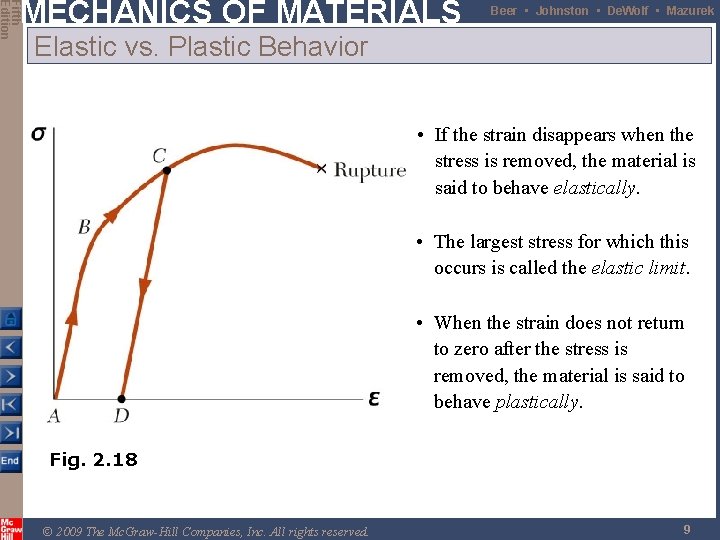
Fifth Edition MECHANICS OF MATERIALS Beer • Johnston • De. Wolf • Mazurek Elastic vs. Plastic Behavior • If the strain disappears when the stress is removed, the material is said to behave elastically. • The largest stress for which this occurs is called the elastic limit. • When the strain does not return to zero after the stress is removed, the material is said to behave plastically. Fig. 2. 18 © 2009 The Mc. Graw-Hill Companies, Inc. All rights reserved. 9
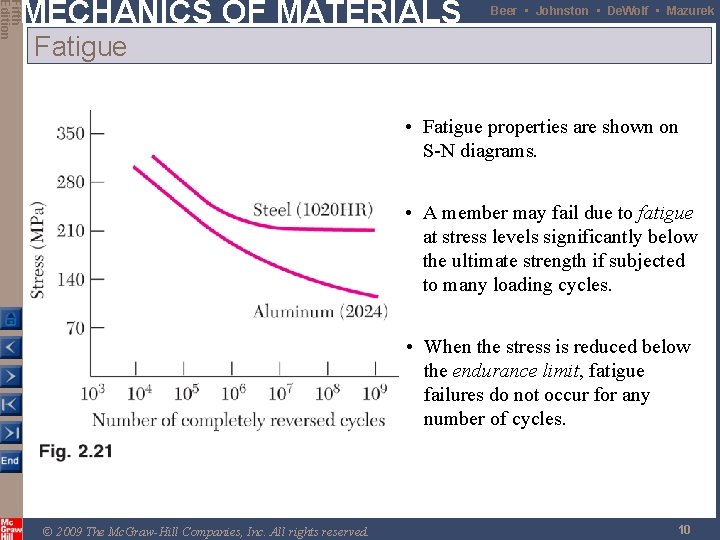
Fifth Edition MECHANICS OF MATERIALS Beer • Johnston • De. Wolf • Mazurek Fatigue • Fatigue properties are shown on S-N diagrams. • A member may fail due to fatigue at stress levels significantly below the ultimate strength if subjected to many loading cycles. • When the stress is reduced below the endurance limit, fatigue failures do not occur for any number of cycles. © 2009 The Mc. Graw-Hill Companies, Inc. All rights reserved. 10
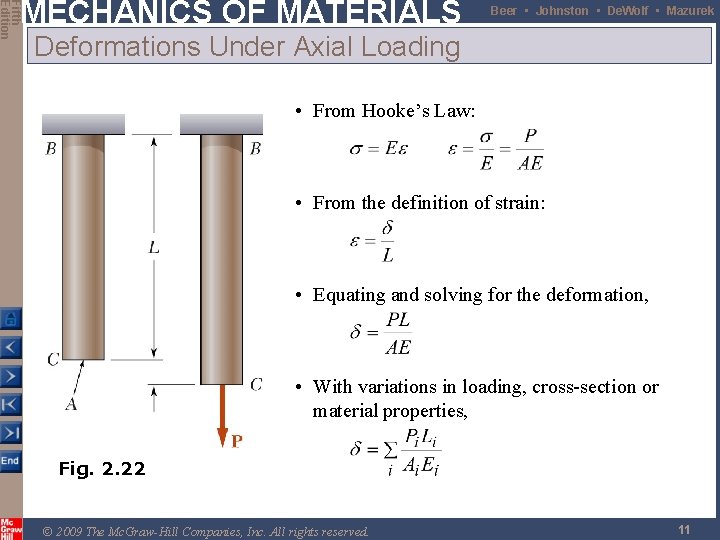
Fifth Edition MECHANICS OF MATERIALS Beer • Johnston • De. Wolf • Mazurek Deformations Under Axial Loading • From Hooke’s Law: • From the definition of strain: • Equating and solving for the deformation, • With variations in loading, cross-section or material properties, Fig. 2. 22 © 2009 The Mc. Graw-Hill Companies, Inc. All rights reserved. 11
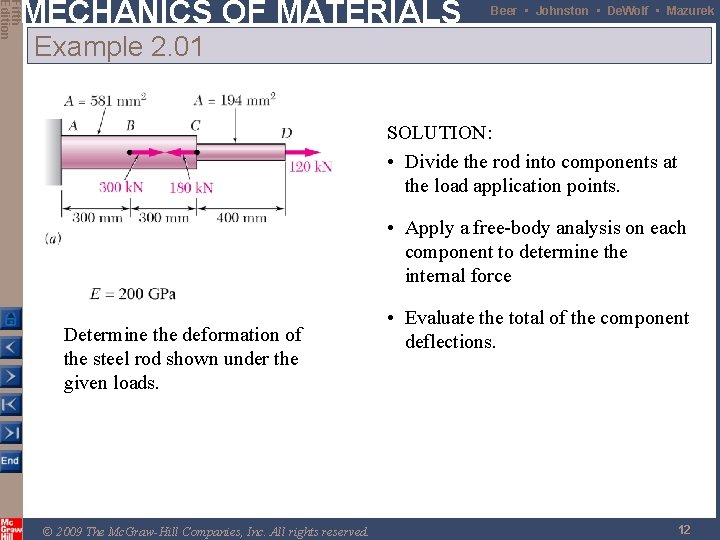
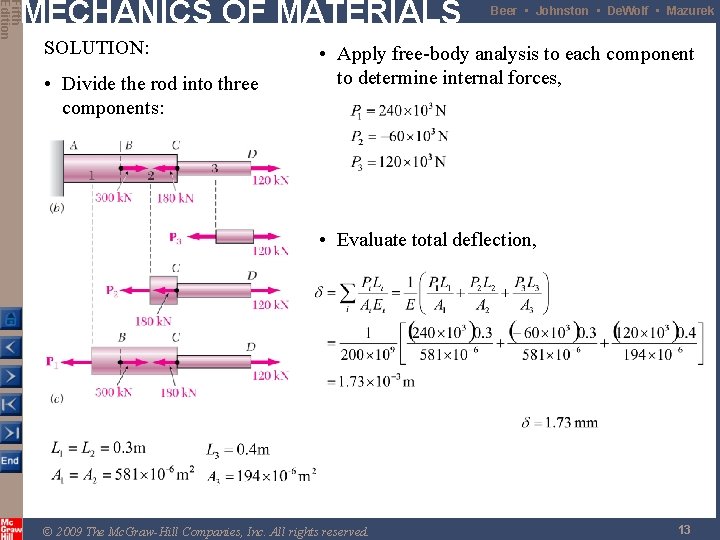
Fifth Edition MECHANICS OF MATERIALS Beer • Johnston • De. Wolf • Mazurek Example 2. 01 SOLUTION: • Divide the rod into components at the load application points. • Apply a free-body analysis on each component to determine the internal force Determine the deformation of the steel rod shown under the given loads. © 2009 The Mc. Graw-Hill Companies, Inc. All rights reserved. • Evaluate the total of the component deflections. 12
Fifth Edition MECHANICS OF MATERIALS SOLUTION: • Divide the rod into three components: Beer • Johnston • De. Wolf • Mazurek • Apply free-body analysis to each component to determine internal forces, • Evaluate total deflection, © 2009 The Mc. Graw-Hill Companies, Inc. All rights reserved. 13
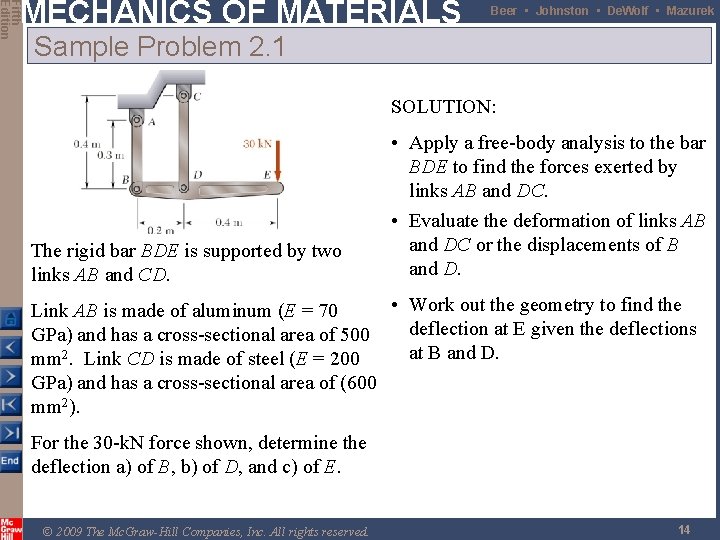
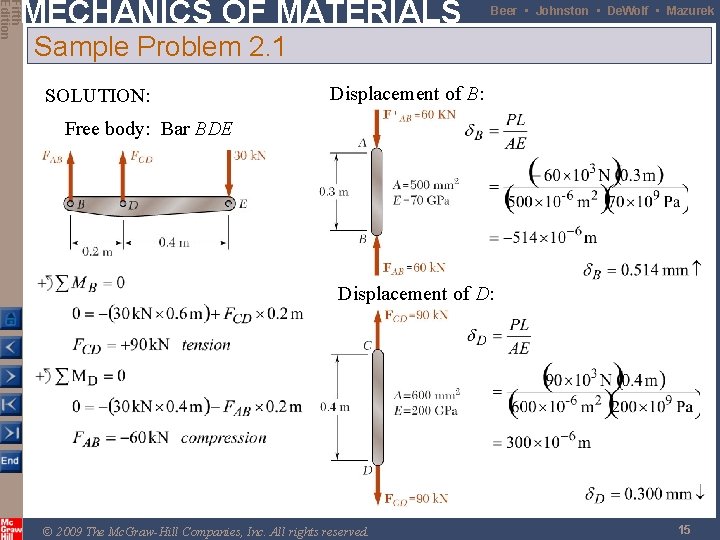
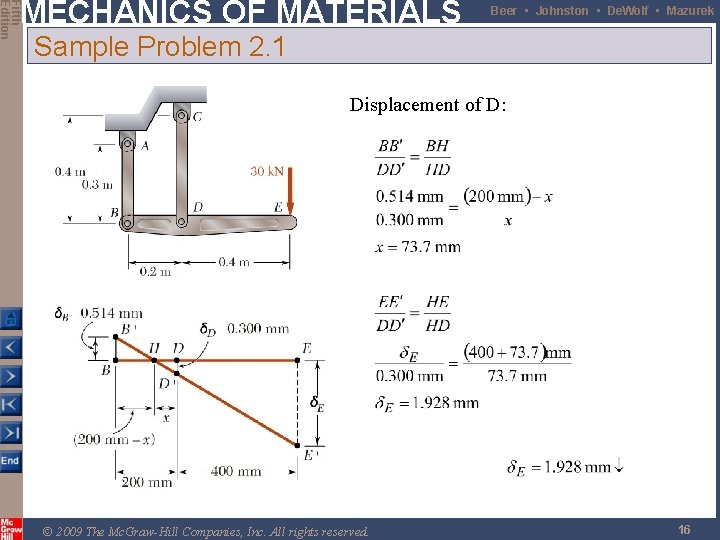
Fifth Edition MECHANICS OF MATERIALS Beer • Johnston • De. Wolf • Mazurek Sample Problem 2. 1 SOLUTION: The rigid bar BDE is supported by two links AB and CD. • Apply a free-body analysis to the bar BDE to find the forces exerted by links AB and DC. • Evaluate the deformation of links AB and DC or the displacements of B and D. • Work out the geometry to find the Link AB is made of aluminum (E = 70 deflection at E given the deflections GPa) and has a cross-sectional area of 500 at B and D. mm 2. Link CD is made of steel (E = 200 GPa) and has a cross-sectional area of (600 mm 2). For the 30 -k. N force shown, determine the deflection a) of B, b) of D, and c) of E. © 2009 The Mc. Graw-Hill Companies, Inc. All rights reserved. 14
Fifth Edition MECHANICS OF MATERIALS Beer • Johnston • De. Wolf • Mazurek Sample Problem 2. 1 SOLUTION: Displacement of B: Free body: Bar BDE Displacement of D: © 2009 The Mc. Graw-Hill Companies, Inc. All rights reserved. 15
Fifth Edition MECHANICS OF MATERIALS Beer • Johnston • De. Wolf • Mazurek Sample Problem 2. 1 Displacement of D: © 2009 The Mc. Graw-Hill Companies, Inc. All rights reserved. 16
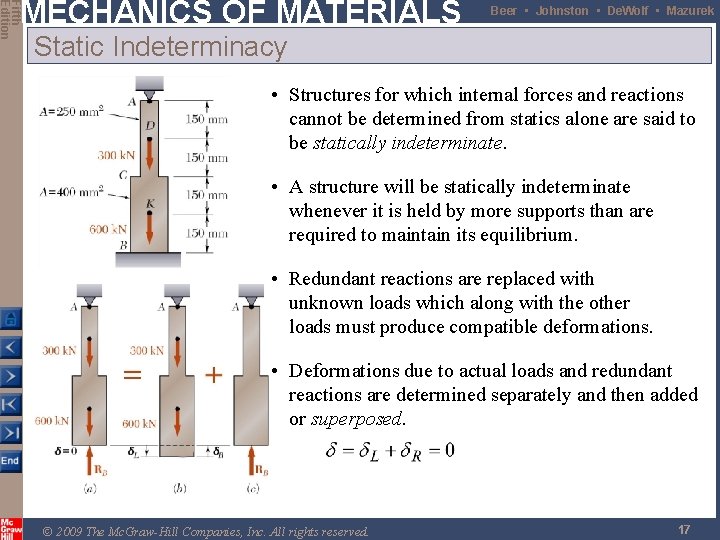
Fifth Edition MECHANICS OF MATERIALS Beer • Johnston • De. Wolf • Mazurek Static Indeterminacy • Structures for which internal forces and reactions cannot be determined from statics alone are said to be statically indeterminate. • A structure will be statically indeterminate whenever it is held by more supports than are required to maintain its equilibrium. • Redundant reactions are replaced with unknown loads which along with the other loads must produce compatible deformations. • Deformations due to actual loads and redundant reactions are determined separately and then added or superposed. © 2009 The Mc. Graw-Hill Companies, Inc. All rights reserved. 17
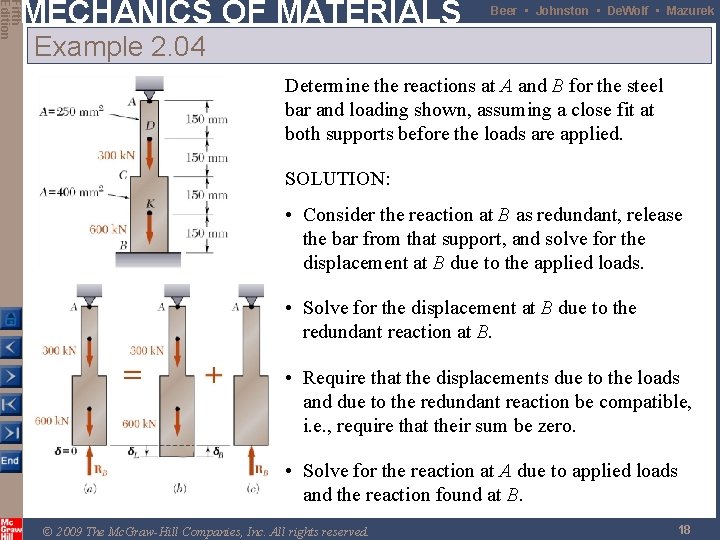
Fifth Edition MECHANICS OF MATERIALS Beer • Johnston • De. Wolf • Mazurek Example 2. 04 Determine the reactions at A and B for the steel bar and loading shown, assuming a close fit at both supports before the loads are applied. SOLUTION: • Consider the reaction at B as redundant, release the bar from that support, and solve for the displacement at B due to the applied loads. • Solve for the displacement at B due to the redundant reaction at B. • Require that the displacements due to the loads and due to the redundant reaction be compatible, i. e. , require that their sum be zero. • Solve for the reaction at A due to applied loads and the reaction found at B. © 2009 The Mc. Graw-Hill Companies, Inc. All rights reserved. 18
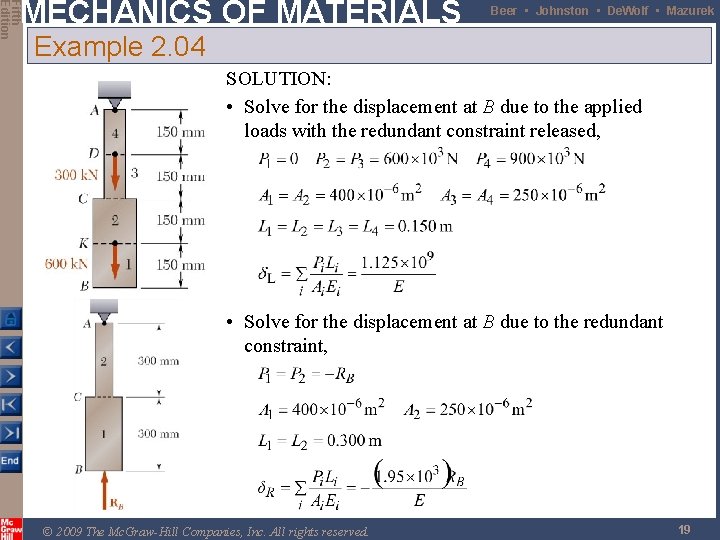
Fifth Edition MECHANICS OF MATERIALS Beer • Johnston • De. Wolf • Mazurek Example 2. 04 SOLUTION: • Solve for the displacement at B due to the applied loads with the redundant constraint released, • Solve for the displacement at B due to the redundant constraint, © 2009 The Mc. Graw-Hill Companies, Inc. All rights reserved. 19
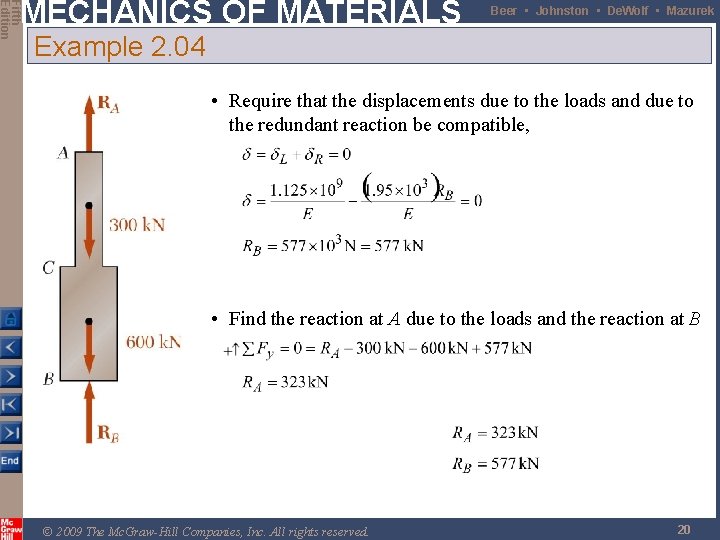
Fifth Edition MECHANICS OF MATERIALS Beer • Johnston • De. Wolf • Mazurek Example 2. 04 • Require that the displacements due to the loads and due to the redundant reaction be compatible, • Find the reaction at A due to the loads and the reaction at B © 2009 The Mc. Graw-Hill Companies, Inc. All rights reserved. 20
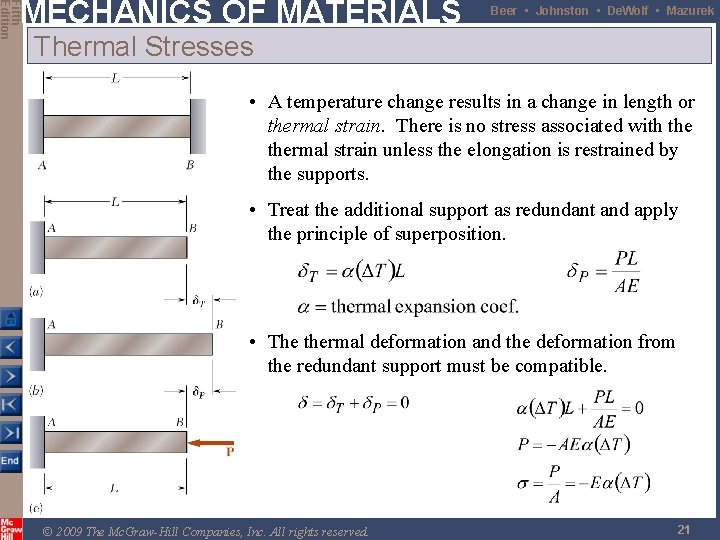
Fifth Edition MECHANICS OF MATERIALS Beer • Johnston • De. Wolf • Mazurek Thermal Stresses • A temperature change results in a change in length or thermal strain. There is no stress associated with thermal strain unless the elongation is restrained by the supports. • Treat the additional support as redundant and apply the principle of superposition. • The thermal deformation and the deformation from the redundant support must be compatible. © 2009 The Mc. Graw-Hill Companies, Inc. All rights reserved. 21