The Role and Challenges of IQ Testing in






- Slides: 30
The Role and Challenges of IQ Testing in Understanding and Supporting Individuals with Autism Workshop for Center for Creative Initiatives in Health and Population (CCIHP) 24 January 2018 When is a Kit. Kat not a Kit. Kat? Dr. John Worthington MAPS MSPS Educational Consultant and Psychologist E-mail: info@jweducation. com Web address: www. jweducation. com
Overview • • • • Introduction Initial Questions Ethics before Effort The Place of Cognitive Assessments The Limitations of IQ Testing in ASD A Brief overview of the history of IQ testing What do IQ tests Look Like What do IQ tests Measure What do the Results Look Like A Cognitive Assessment Can Reveal Far More than Numbers Lets have a break IQ testing in the ASD Environment Case Study The Kit-Kat Phenomena Reporting Multiple Result Types Questions and Discussion
Do you have any Questions? Staying flexible Your questions Limitations From my perspective
Ethics before Effort • The ethical issues in assessing ASD individuals with instruments developed for the general population, limitations of (any) testing. Assessing any individual with cognitive instruments should only occur after considering the benefit to the child any possible negative impact. This consideration for children (and adults) with ASD needs particular attention as a ‘failed’ assessment will give no useful information and may also prevent or delay any future attempts. • Just because you can do an IQ test doesn’t mean you should.
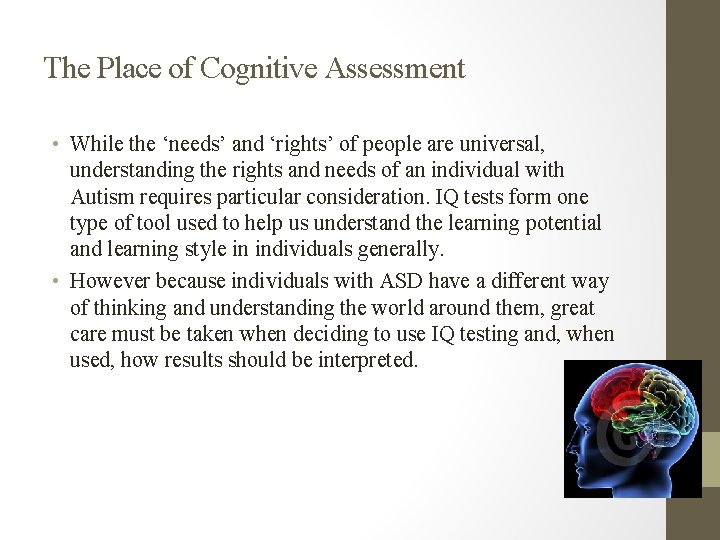
The Place of Cognitive Assessment • While the ‘needs’ and ‘rights’ of people are universal, understanding the rights and needs of an individual with Autism requires particular consideration. IQ tests form one type of tool used to help us understand the learning potential and learning style in individuals generally. • However because individuals with ASD have a different way of thinking and understanding the world around them, great care must be taken when deciding to use IQ testing and, when used, how results should be interpreted.
Alternative Diagnosis and IQ • Individuals who present with atypical behaviours which suggest ASD may be responding to other issues. • They may not have any significant disorder and their behaviours have been perceived by parents or others incorrectly. • They mat have ‘learned’ ASD type behaviours from siblings or peers. • They may be intellectually gifted and their strong interests and or repetitive behaviours are reflection of their exceptional ability and ability to focus.
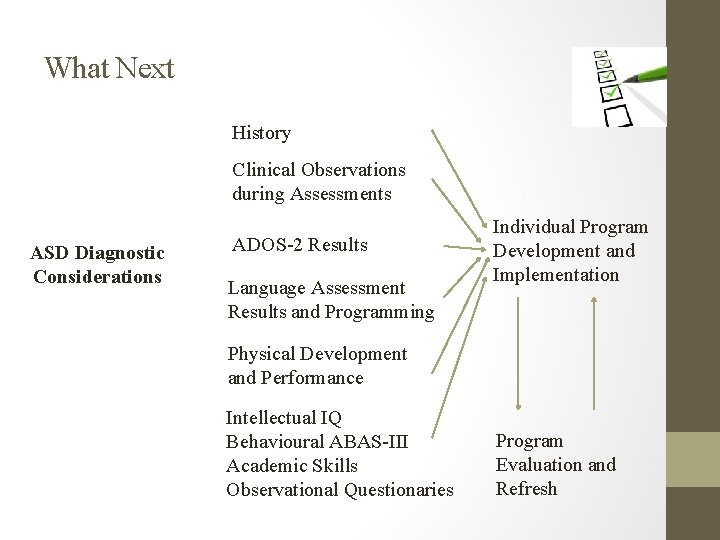
Input for Diagnosis and Support Clinical Observations during Assessments History Prior to Presentation Reports and Records (Parents Teachers and Carers) ASD Diagnostic Considerations Other Assessment Findings Intellectual IQ Behavioural ABAS-III Academic Skills (Psychologist) ADOS-2 Direct diagnostic tool Language (SLP) Physical Health, Development and Performance (GP Paediatrician OT Physio)
What Next History Clinical Observations during Assessments ASD Diagnostic Considerations ADOS-2 Results Language Assessment Results and Programming Individual Program Development and Implementation Physical Development and Performance Intellectual IQ Behavioural ABAS-III Academic Skills Observational Questionaries Program Evaluation and Refresh
The Limitations of IQ Testing in ASD ADOS-2 Vs IQ Assessment • It is important to remember IQ testing is not designed of use with individuals with ASD as a definitive part of diagnosis but an Iq assessment can provide a valuable addition to other assessments such as the ADOS-2.
The Autism Diagnostic Observation Schedule - Second Edition (ADOS-2) • The Autism Diagnostic Observation Schedule - Second Edition (ADOS-2) is a semi structured, standardised assessment of communication, social interaction, play, and restricted and repetitive behaviours. • By observing and coding these behaviours, clinicians can obtain information that informs diagnosis, intervention, treatment planning, and educational placement.
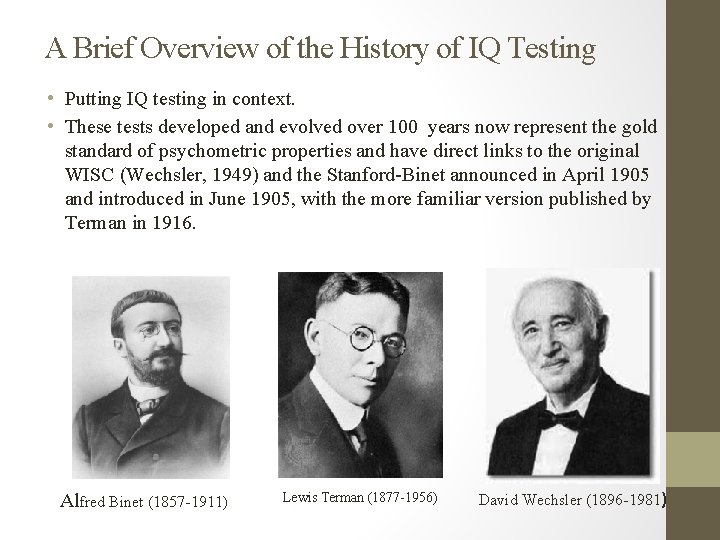
A Brief Overview of the History of IQ Testing • Putting IQ testing in context. • These tests developed and evolved over 100 years now represent the gold standard of psychometric properties and have direct links to the original WISC (Wechsler, 1949) and the Stanford-Binet announced in April 1905 and introduced in June 1905, with the more familiar version published by Terman in 1916. Alfred Binet (1857 -1911) Lewis Terman (1877 -1956) David Wechsler (1896 -1981)
What do IQ tests Measure? • The long history of research and ongoing review, I believe brings us to a point where testing an individuals cognitive ability (IQ) is accepted by most people. • Good IQ tests measure aspects of visual-spatial processing and auditory processing, as well as short-term memory, and processing speed. • More over the results as reflected in the scales and distribution of scores are one way to help understand an individuals general cognitive problem-solving skills typically reflected in academic learning and potential.
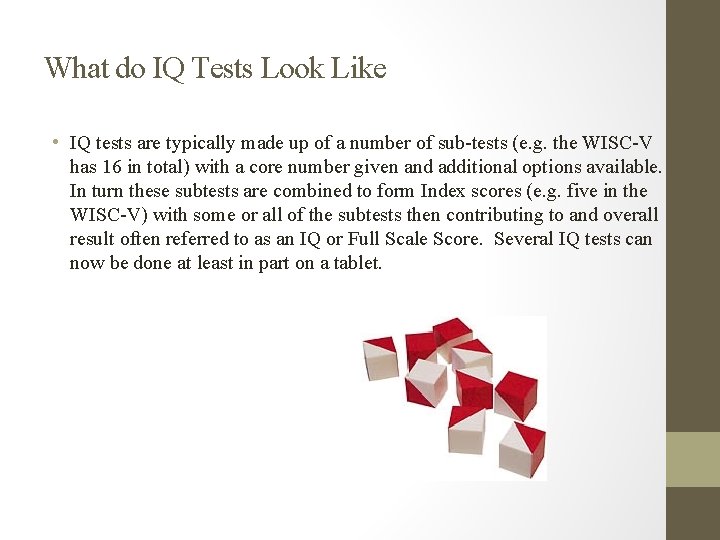
What do IQ Tests Look Like • IQ tests are typically made up of a number of sub-tests (e. g. the WISC-V has 16 in total) with a core number given and additional options available. In turn these subtests are combined to form Index scores (e. g. five in the WISC-V) with some or all of the subtests then contributing to and overall result often referred to as an IQ or Full Scale Score. Several IQ tests can now be done at least in part on a tablet.
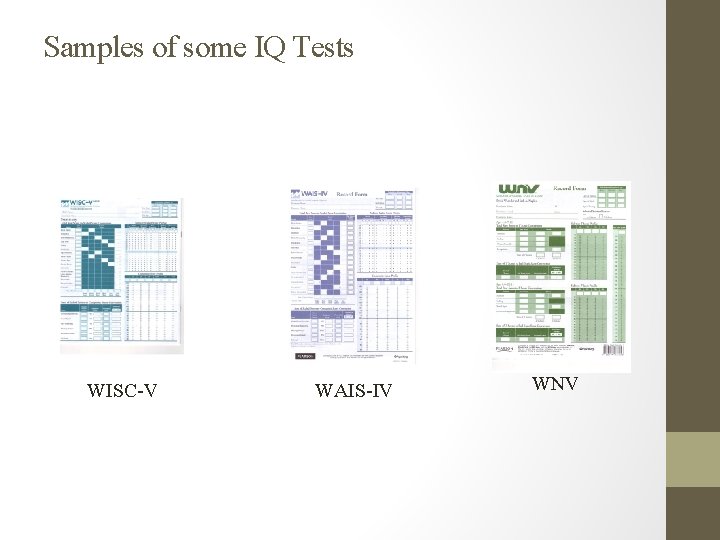
Samples of some IQ Tests WISC-V WAIS-IV WNV
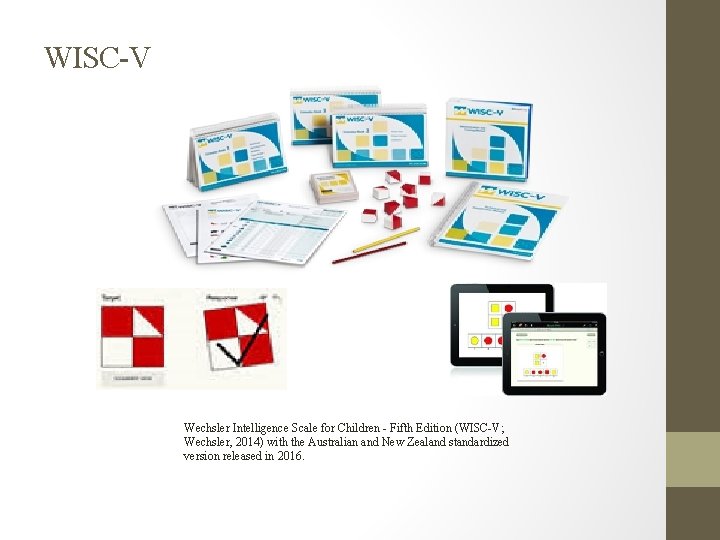
WISC-V Wechsler Intelligence Scale for Children - Fifth Edition (WISC-V; Wechsler, 2014) with the Australian and New Zealand standardized version released in 2016.
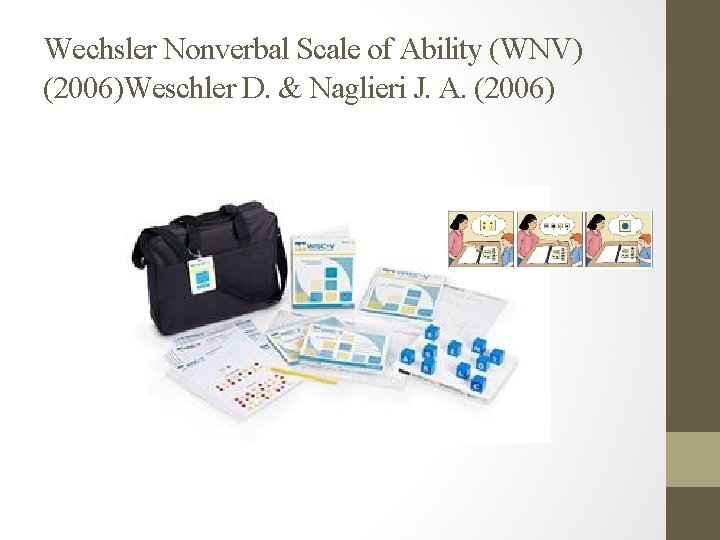
Wechsler Nonverbal Scale of Ability (WNV) (2006)Weschler D. & Naglieri J. A. (2006)
What do the Results Look Like • Index scores and the Full Scale IQ Score which include "Extremely High” 130 and above, “Very High” 120 -129, “High Average” 110 -119; “Average” 90 -109 and “Low Average” 80 -89, “Very Low” 70 -79 and "Extremely Low" 69 and below. • The standard deviation is a measure of spread, in this case of IQ scores. A standard deviation of 15 means 68% of the norm group has scored between 85 (100 – 15) and 115 (100 + 15). In other words, 68% of the norm group has a score within one standard deviation of the average (100). • The results of subtests can also be shown as age equivalents, i. e. the age at which a typical individual would perform at that level.
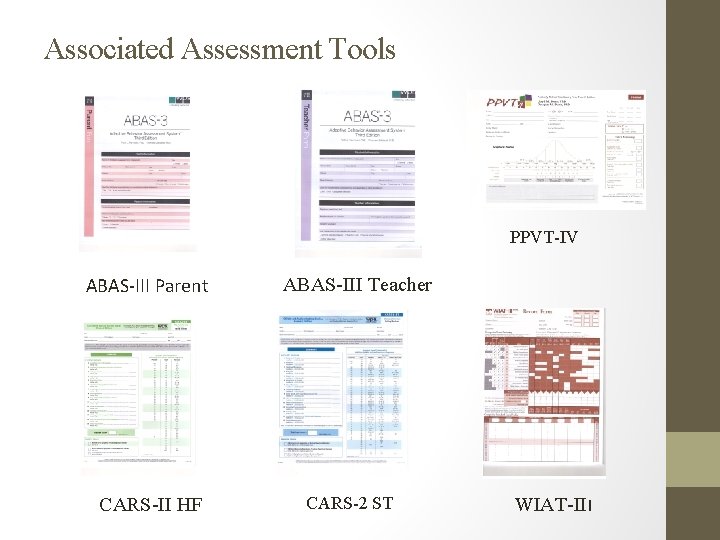
Associated Assessment Tools PPVT-IV ABAS-III Parent CARS-II HF ABAS-III Teacher CARS-2 ST WIAT-III
A Cognitive Assessment Reveal Far More than Numbers • The ‘standardized’ nature of IQ testing does present challenges when working with individuals with ASD however the process of assessment also provides a basis for a wide range of clinical information to be gathered about the child’s affect, attention, interests and sensitivities, task persistence, expressive and receptive language, fine motor functioning etc.
Time for a Break
IQ testing in the ASD Environment • Provide an overview of the place of IQ testing in the ASD population as one tool in understanding abilities and thinking styles. • Individuals thought to have ASD or who have been formally diagnosed may not have had their IQ assessed. While there are individuals whose behaviours are so intrusive that formal (i. e. standardized) assessment is not possible it is my view that the cognitive capacity most individuals can be assessed in whole or part using a range of tools including IQ tests. • While the effort may be great an appropriate assessment of cognitive and other skills can provide a window onto the individual’s strengths and weaknesses, inform programming and a further way to monitor development.
Case Study • Dan a four year old child born in Australia whose family moved to Singapore for the father’s work when he was 18 months old. • Dan’s early development was relatively typical except for language delays, however as he got a little older a range of concerns grew about his very limited expressive language, receptive language, limited social interaction skills, changeable behaviours frequent tantrums, hitting, running away, repetitive play and high levels of physical energy and activity
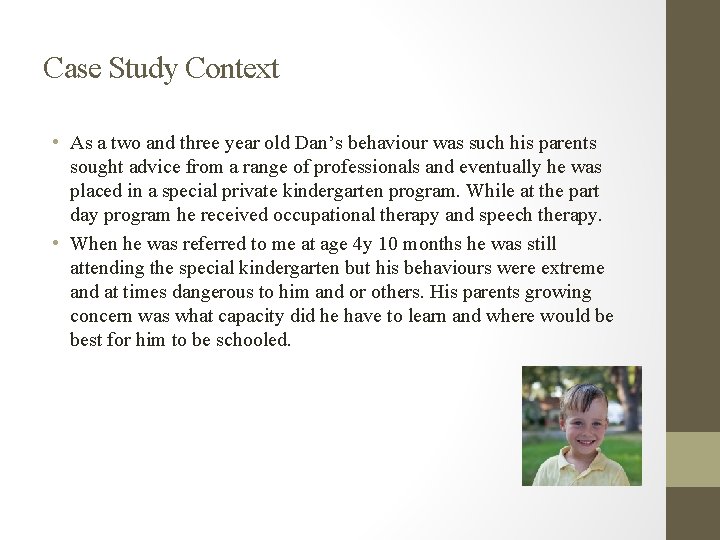
Case Study Context • As a two and three year old Dan’s behaviour was such his parents sought advice from a range of professionals and eventually he was placed in a special private kindergarten program. While at the part day program he received occupational therapy and speech therapy. • When he was referred to me at age 4 y 10 months he was still attending the special kindergarten but his behaviours were extreme and at times dangerous to him and or others. His parents growing concern was what capacity did he have to learn and where would be best for him to be schooled.
Preparing Dan for an IQ Assessment • Prior to visiting Singapore to do the assessment I had several detailed conversations with Dan’s mother. In addition to collecting a history I sought to try to understand the nature of his behaviour outbursts and under what circumstances was he more settled. • This preparation proved to be essential as Dan was prone to throwing toys and ornaments out of the seventh story apartment window. When outside he was happiest but deliberate rode his scooter into the ornamental fish pond. • By arrangement with the mother and over a few weeks she built up his ability to sit at a table and do table top tasks. We also considered his sleeping patterns, the temperature, noise levels and visual and other distractions.
Aim of the Assessment • The general aim of the assessment was to establish base lines for Dan’s capacity and behaviours in a wide range of relevant skills. The information was gathered by observing Dan interacting with his parents and siblings in a range of settings (indoors & outdoors) as well as observing him doing a range of cognitive, and other tasks. • While adhering to the guidelines and consistency is at the heart of IQ testing this is often an issue when assessing ASD children. Sometimes during testing certain allowances need to be made in order to achieve a result. When reporting the results where changes were necessary those changes need to be detailed both for accuracy and for the information of future assessors.
The Kit-Kat Phenomena (A lesson for us all) • As an example of modification (not in the IQ part of the testing) following a consultation with Dan’s mother she provided Kit-Kay chocolate sticks as reward for doing certain amounts of work. This proved highly motivating for Dan until I thought it would be a good idea to break each Kit-Kat up into several small pieces. The moment Dan saw me do this he lost the plot and it took some time to retrieve the situation of ‘not Kit-Kat’.
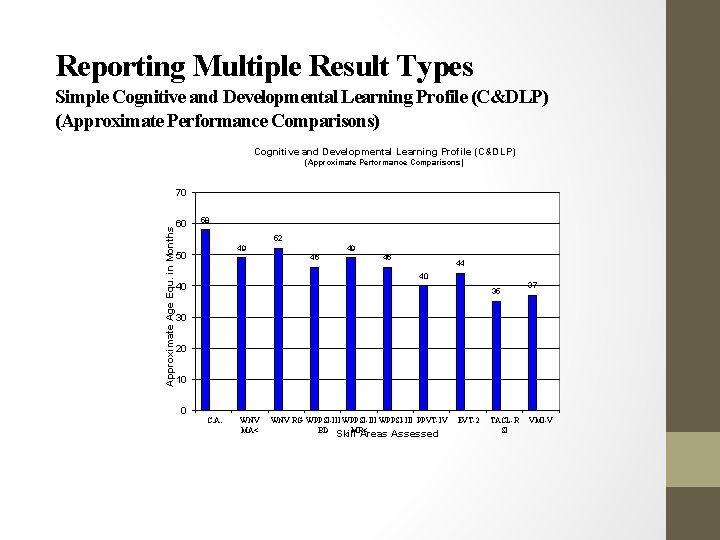
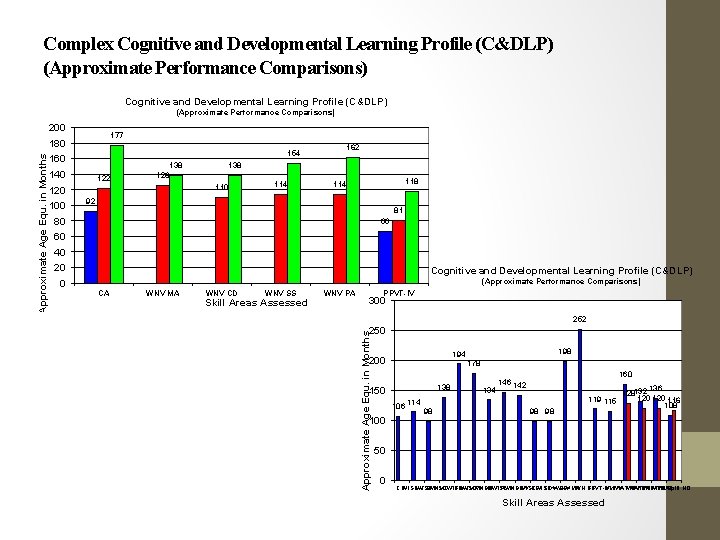
Reporting Multiple Result Types • Because testing ASD children is likely to result in some reliable results in certain skill areas and some less or unreliable results final scores such as a reliable IQ may not be possible. In these situations in addition to the standard scores discussed in the text I use a Cognitive and Developmental Learning Profile (C&DLP) approach. This is simply a way of reporting on a wide range of results relative to an individual’s Chronological Age (C. A. ). • The C&DLP allows for reassessments and different assessments to be added progressive to form a ‘picture’ of the child’s development over time.
Reporting Multiple Result Types Simple Cognitive and Developmental Learning Profile (C&DLP) (Approximate Performance Comparisons) Approximate Age Equ. in Months 70 60 58 52 49 50 49 46 46 44 40 40 35 37 30 20 10 0 C. A. WNV MA< WNV RG WPPSI-III PPVT-IV BD Skill MR< Areas Assessed EVT-2 TACL-R SI VMI-V
Complex Cognitive and Developmental Learning Profile (C&DLP) (Approximate Performance Comparisons) 200 177 154 160 140 122 138 126 100 138 110 120 162 114 118 114 92 81 80 66 60 40 20 0 Cognitive and Developmental Learning Profile (C&DLP) (Approximate Performance Comparisons) CA WNV MA WNV CD WNV SS Skill Areas Assessed WNV PA PPVT-IV 300 252 250 Approximate Age Equ. in Months 180 178 138 150 106 100 198 194 200 134 160 146 142 119 115 114 98 98 98 136 128132 120 116 108 50 0 C. A. WISC-V SIWISC-V VCWISC-V BDWISC-V VPWISC-V MRWISC-V FWWISC-V DS WISC-V PS WISC-V CD<WNV SS< MA WVN PPVT-IV SS VMI-V WIAT-III PDWIAT-III WR WIAT-III Sp NO Skill Areas Assessed
Conclusion • Questions • Answers