The Panama Papers Tax Havens and the Men





- Slides: 57
The Panama Papers, Tax Havens, and the Men Who Pay No Taxes CA Dr. Tejinder Singh Rawal tsrawal@tsrawal. com 1 (C) Dr. Tejinder Singh Rawal tsrawal@tsrawal. com
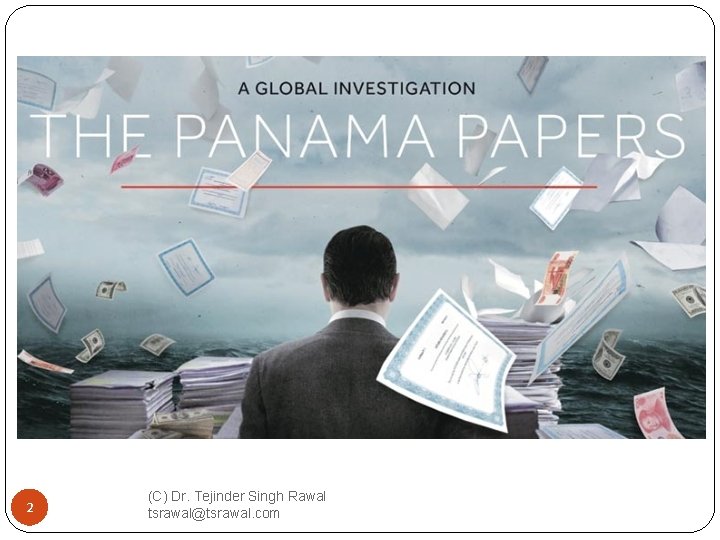
2 (C) Dr. Tejinder Singh Rawal tsrawal@tsrawal. com
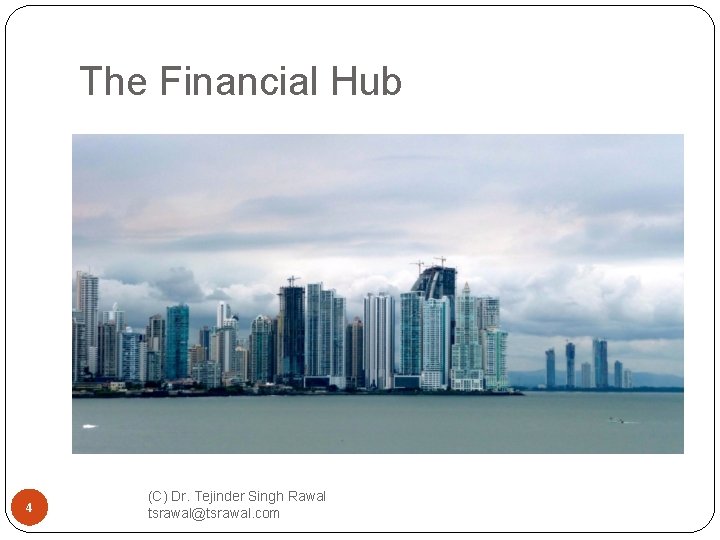
This is the place we are talking about 3 (C) Dr. Tejinder Singh Rawal tsrawal@tsrawal. com
The Financial Hub 4 (C) Dr. Tejinder Singh Rawal tsrawal@tsrawal. com
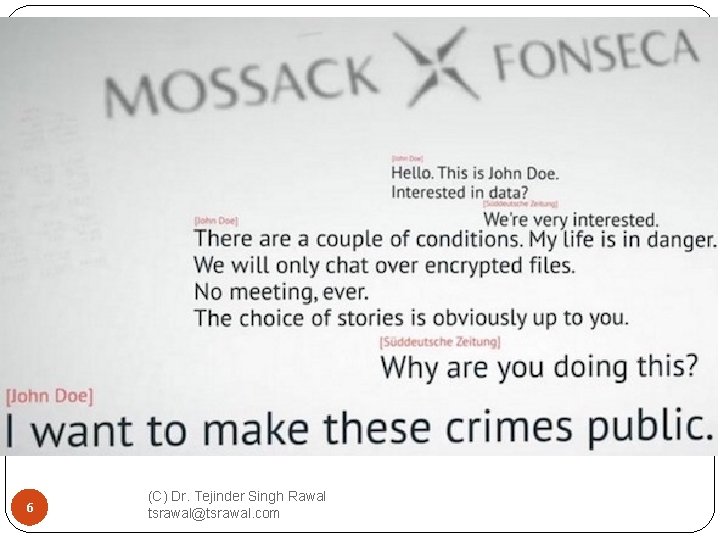
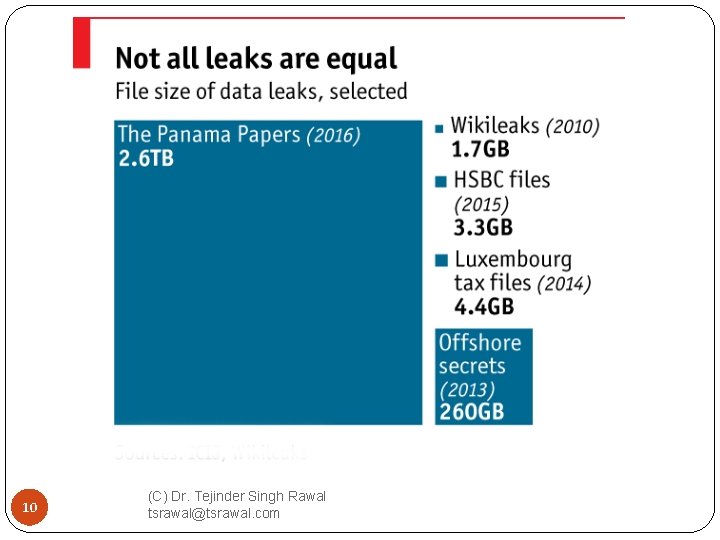
Who opened the Pandora’s Box � An anonymous source using the pseudonym "John 5 Doe" made the documents available in batches to German newspaper Süddeutsche Zeitung beginning in early 2015. � The information from this unremunerated whistleblower documents transactions as far back as the 1970 s and eventually totalled 2. 6 terabytes of data. The newspaper enlisted the help of the USbased International Consortium of Investigative Journalists (ICIJ), which distributed documents for investigation and analysis to some 400 journalists at 107 media organizations in 76 countries. Indian Express is the Indian partner. � The first news reports based on the papers, and 149 of the documents themselves, were published on April 3, 2016. The ICIJ promises to publish a full list of (C) Dr. Tejinder Singh Rawal companies involved in early May 2016 tsrawal@tsrawal. com
6 (C) Dr. Tejinder Singh Rawal tsrawal@tsrawal. com
7 (C) Dr. Tejinder Singh Rawal tsrawal@tsrawal. com
8 (C) Dr. Tejinder Singh Rawal tsrawal@tsrawal. com
9 (C) Dr. Tejinder Singh Rawal tsrawal@tsrawal. com
10 (C) Dr. Tejinder Singh Rawal tsrawal@tsrawal. com
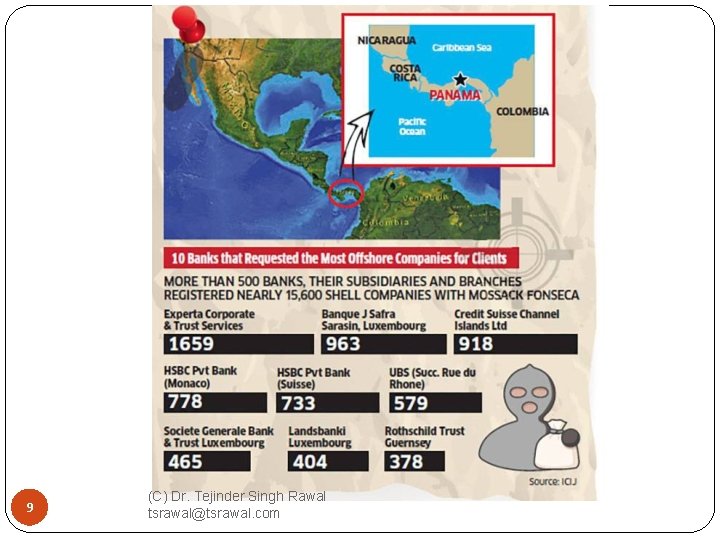
Why Panama? � A tax haven has one of these three characteristics: �It has no income tax or a very low-rate income tax; �it has bank secrecy laws; �and it has a history of non-cooperation with other countries on exchanging information about tax matters. Panama has all three. � Fonseca incorporated more than 113, 000 British Virgin Island (BVI) companies, but also branched out to the tiny Pacific island nation Niue where, by 2001, they were contributing 80% to Niue's budget. � There are no reporting requirements for non-resident Panamanian corporations. Panama does not allow 'piercing the corporate veil'. Panamanian corporation's share certificates can be bearer in form. 11 (C) Dr. Tejinder Singh Rawal tsrawal@tsrawal. com
Tip of the Iceberg �The Panama Papers are merely the tip of the iceberg, with 11. 5 million files from the database of the world's fourth-largest offshore law firm, Mossack Fonseca, tumbling out last weekend. But to provide some perspective, 400, 000 corporations and foundations are domiciled in Panama. And then again, this is also only one of the many financial centres used by the rich and famous to offshore their wealth. 12 (C) Dr. Tejinder Singh Rawal tsrawal@tsrawal. com
13 (C) Dr. Tejinder Singh Rawal tsrawal@tsrawal. com
Which laws does it violate? � The Black Money (Undisclosed Foreign Income and Assets) and 14 Imposition of Tax Act 2015 with effect from July 1, 2015, the Foreign Exchange Management Act 1999, the Prevention of Money Laundering Act 2012, the Prevention of Corruption Act 1988, the Income Tax Act 1961, the Sebi Act 1992, and the Companies Act 2013. � All remittances made before 2004 would raise a red flag since this was before the RBI's Liberalised Remittance Scheme. � From the financial year 2011 -2012 onwards, all resident taxpayers were required to disclose their foreign assets and income earned outside India, even if they were not liable to file their returns. If they have not disclosed details of income earned outside India, of foreign bank accounts and peak balance of that account, of foreign interest in any entity with total investment in rupees, of immovable property with total investment, of concerns in which the person has signing authority of any other overseas asset, of trust in which individual is a trustee, in their returns of income, it shall be deemed to be un-disclosed income with penal (C) Dr. Tejinder Singh Rawal consequences as per the Income Tax Act 1961. tsrawal@tsrawal. com
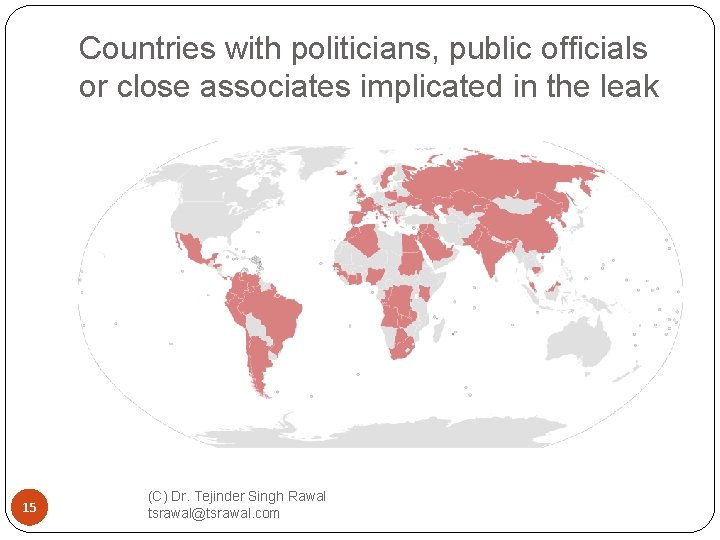
Countries with politicians, public officials or close associates implicated in the leak 15 (C) Dr. Tejinder Singh Rawal tsrawal@tsrawal. com
The Bigwigs �Leaders in Moscow (Vladimir Putin) and Beijing (Xi Jin-Ping) among major powers, Pakistan (Nawaz Sharif) and Iceland (Sigmundur Gunnlaugsson) among lesser powers, and familiar suspects such as Egypt's Hosni Mubarak and Libya's Moammar Gaddafi. 16 Nawaz Sharif 's daughter Maryam Nawaz, Li Xiaolin, daughter of former Chinese PM Li Peng, Mohd Nazifuddin Najib, son of Malaysian PM Najib Razak, Clive Khulubuse Zuma, nephew of South Africa President Jacob Zuma, and Kojo (C) Dr. Tejinder Singh Rawal Annan, son of former UN secretary-general Kofi tsrawal@tsrawal. com
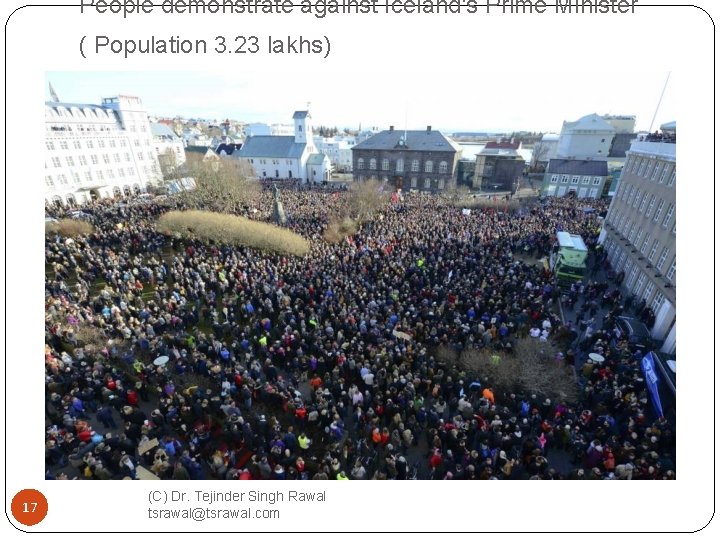
People demonstrate against Iceland's Prime Minister ( Population 3. 23 lakhs) 17 (C) Dr. Tejinder Singh Rawal tsrawal@tsrawal. com
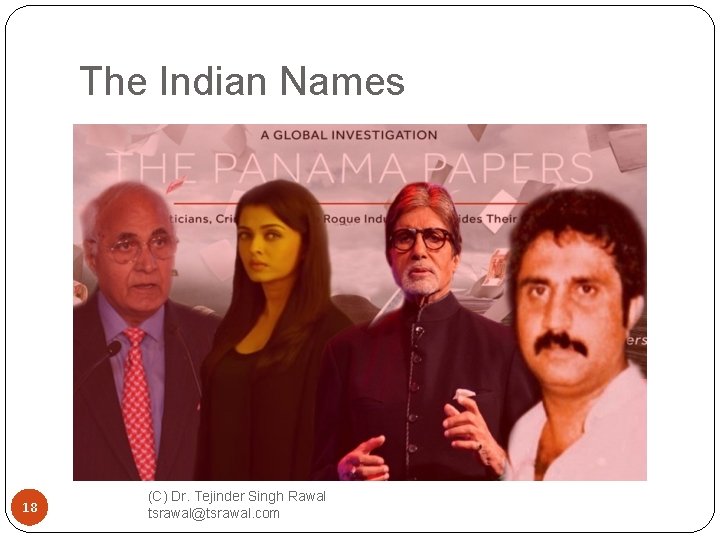
The Indian Names 18 (C) Dr. Tejinder Singh Rawal tsrawal@tsrawal. com
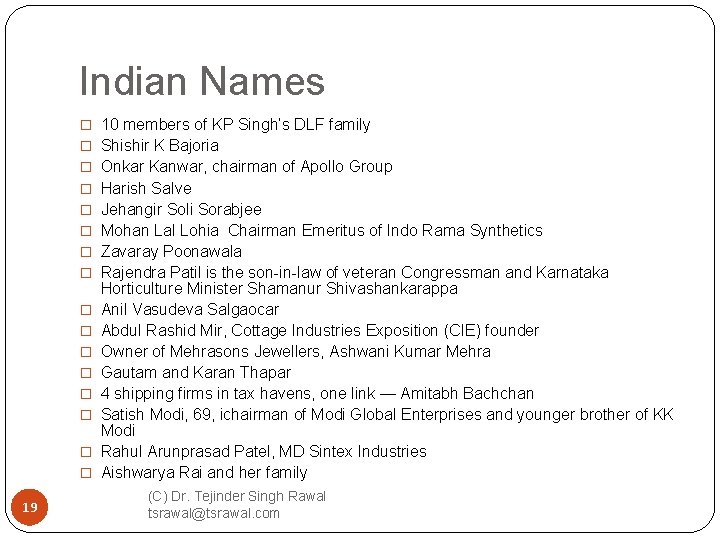
Indian Names � 10 members of KP Singh’s DLF family � Shishir K Bajoria � Onkar Kanwar, chairman of Apollo Group � Harish Salve � Jehangir Soli Sorabjee � Mohan Lal Lohia Chairman Emeritus of Indo Rama Synthetics � Zavaray Poonawala � Rajendra Patil is the son-in-law of veteran Congressman and Karnataka � � � � 19 Horticulture Minister Shamanur Shivashankarappa Anil Vasudeva Salgaocar Abdul Rashid Mir, Cottage Industries Exposition (CIE) founder Owner of Mehrasons Jewellers, Ashwani Kumar Mehra Gautam and Karan Thapar 4 shipping firms in tax havens, one link — Amitabh Bachchan Satish Modi, 69, ichairman of Modi Global Enterprises and younger brother of KK Modi Rahul Arunprasad Patel, MD Sintex Industries Aishwarya Rai and her family (C) Dr. Tejinder Singh Rawal tsrawal@tsrawal. com
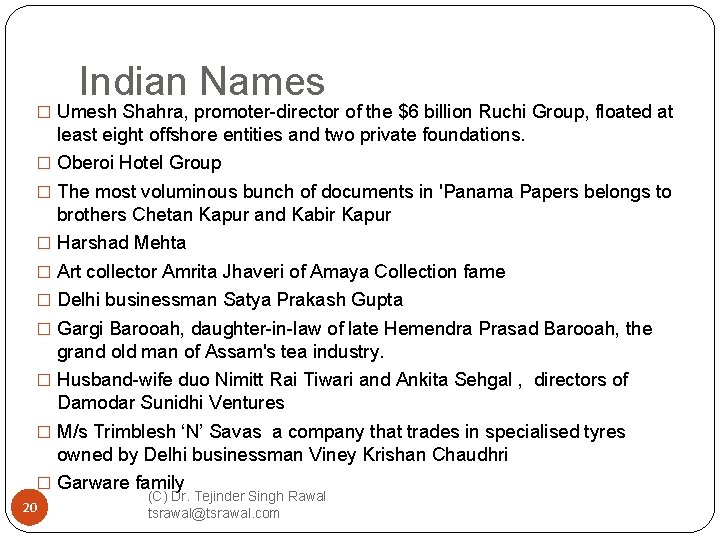
Indian Names � Umesh Shahra, promoter-director of the $6 billion Ruchi Group, floated at least eight offshore entities and two private foundations. � Oberoi Hotel Group � The most voluminous bunch of documents in 'Panama Papers belongs to brothers Chetan Kapur and Kabir Kapur � Harshad Mehta � Art collector Amrita Jhaveri of Amaya Collection fame � Delhi businessman Satya Prakash Gupta � Gargi Barooah, daughter-in-law of late Hemendra Prasad Barooah, the grand old man of Assam's tea industry. � Husband-wife duo Nimitt Rai Tiwari and Ankita Sehgal , directors of Damodar Sunidhi Ventures � M/s Trimblesh ‘N’ Savas a company that trades in specialised tyres owned by Delhi businessman Viney Krishan Chaudhri � Garware family 20 (C) Dr. Tejinder Singh Rawal tsrawal@tsrawal. com
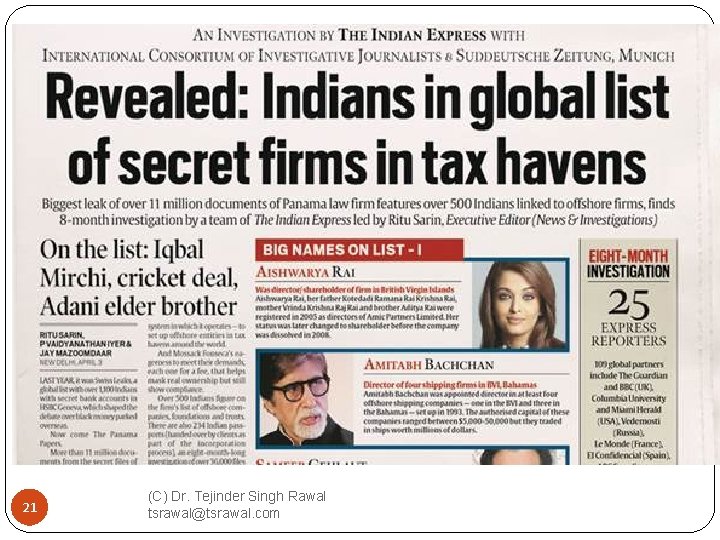
21 (C) Dr. Tejinder Singh Rawal tsrawal@tsrawal. com
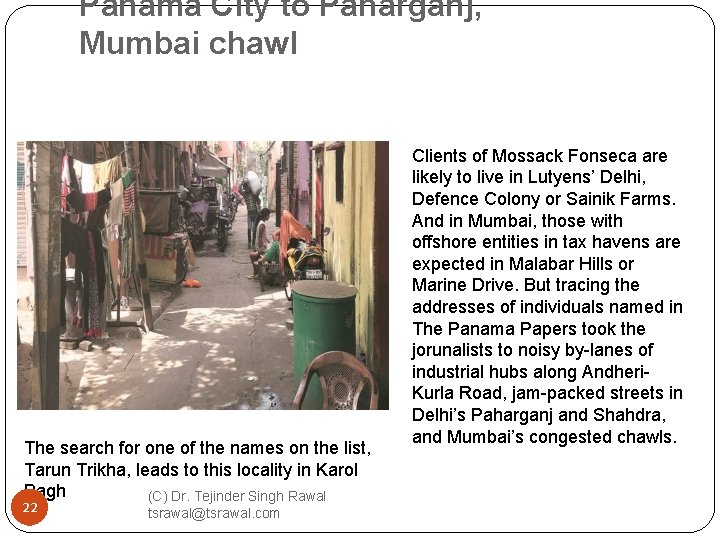
Panama City to Paharganj, Mumbai chawl The search for one of the names on the list, Tarun Trikha, leads to this locality in Karol Bagh (C) Dr. Tejinder Singh Rawal 22 tsrawal@tsrawal. com Clients of Mossack Fonseca are likely to live in Lutyens’ Delhi, Defence Colony or Sainik Farms. And in Mumbai, those with offshore entities in tax havens are expected in Malabar Hills or Marine Drive. But tracing the addresses of individuals named in The Panama Papers took the jorunalists to noisy by-lanes of industrial hubs along Andheri. Kurla Road, jam-packed streets in Delhi’s Paharganj and Shahdra, and Mumbai’s congested chawls.
Every multinational co uses it �THE OFFSHORE WORLD IS ALL AROUND US. Over half of world trade passes, at least on paper, through tax havens. �Over half of all bank assets, and a third of foreign direct investment by multinational corporations, are routed offshore. �Some 85 percent of international banking and bond issuance takes place in the so-called Euromarkets, a stateless offshore zone. �Nearly every multinational corporation uses tax havens. 23 (C) Dr. Tejinder Singh Rawal tsrawal@tsrawal. com
Some people are above law �Tax havens don’t just offer an escape from tax. 24 They also provide wealthy and powerful elites with secrecy and all manner of ways to shrug off the laws and duties that come along with living in and obtaining benefits from society—taxes, prudent financial regulation, criminal laws, inheritance rules, and many others. Offering these escape routes is the tax havens’ core line of business. It is what they do. �Tax haven seeks to attract money by offering politically stable facilities to help people or entities get around the rules, laws, and regulations of (C) Dr. Tejinder Singh Rawal tsrawal@tsrawal. com jurisdictions elsewhere.
“We are not a tax haven” �Tax havens usually deny what they are and strenuously assert that they are clean. �Search for “We are not a tax haven” on the Internet or “We are a transparent, well regulated, and cooperative jurisdiction, ” and see what comes up. �Each has its own way of addressing the critics: In the Cayman Islands, for example, accusations of lax regulation after scandals are routinely dismissed as media stereotypes that do not correspond to objective reality. 25 (C) Dr. Tejinder Singh Rawal tsrawal@tsrawal. com
“Political Stability” � There is one feature of a secrecy jurisdiction that stands 26 out above all: that local politics is captured by financial interests from elsewhere (sometimes these financial interests are criminal interests). � Meaningful opposition to the offshore business model will have been neutered in a serious tax haven, so that such irritants as local politics cannot interrupt the business of making money. � And here lies one of the great offshore paradoxes: These zones of ultra-freedom for financial interests are so often repressive places, viciously intolerant of criticism. The offshore world is steeped in a pervasive inverted morality: Turning a blind eye to crime and corruption has become good business practice: a way of attracting money; while alerting forces of law and order to wrong-doing has become the punishable offense. Here in the tax havens, rugged individualism has morphed into a disregard, even a (C) Dr. Tejinder Singh Rawal contempt, for democracy and for societies at large. tsrawal@tsrawal. com
You are also part of it! � YOU are a prolific and casual user of offshore tax 27 havens. Before I explain what they are, and why powerful governments don’t just close them down, I want you to consider something. � Do you buy from Amazon? If not, have you used Google Play to buy Apps. Or i. Tunes? � Or AIG, Aviva, Barclays, Black & Decker, British American Tobacco, Burberry, Citigroup, Deutsche Bank, Facebook, Fed. Ex, Glaxo. Smith. Kline, Ikea, HSBC, JP Morgan, Microsoft, Pepsi, Skype, Starbucks, Vodafone or Walt Disney? This is just my quirky personal selection from a list of more than 350 multinationals whose convoluted tax schemes were revealed last November by a whistleblower, working (C) Dr. Tejinder Singh Rawal for Pricewaterhouse. Coopers (Pw. C), in one European tsrawal@tsrawal. com tax haven, Luxembourg.
The trick of transfer pricing �The general idea is that by adjusting its internal prices a multinational can shift profits offshore, where they pay little or no tax, and shift the costs onshore, where they are deducted against tax. �The money is funnelled through to the wealthy owners of a multinational corporation. Transfer pricing (or mispricing), U. S. Senator Carl Levin calls is “the corporate equivalent of the secret offshore accounts of individual tax dodgers. ” 28 (C) Dr. Tejinder Singh Rawal tsrawal@tsrawal. com
Funny mispricing � Sometimes these prices are adjusted so aggressively that they lose all sense of reality: A kilo of toilet paper from China has been sold for $4, 121. 81, a litre of apple juice has been sold out of Israel at $2, 052, and a ballpoint pen has been recorded leaving Trinidad valued at $8, 500. � Though most examples are far less blatant than this, the cumulative total of these shenanigans is vast. About two-thirds of global cross-border world trade happens inside multinational corporations. � And it is poor countries in particular, with their underpaid tax officials, that always lose out to multinationals’ aggressive, highly paid accountants. 29 (C) Dr. Tejinder Singh Rawal tsrawal@tsrawal. com
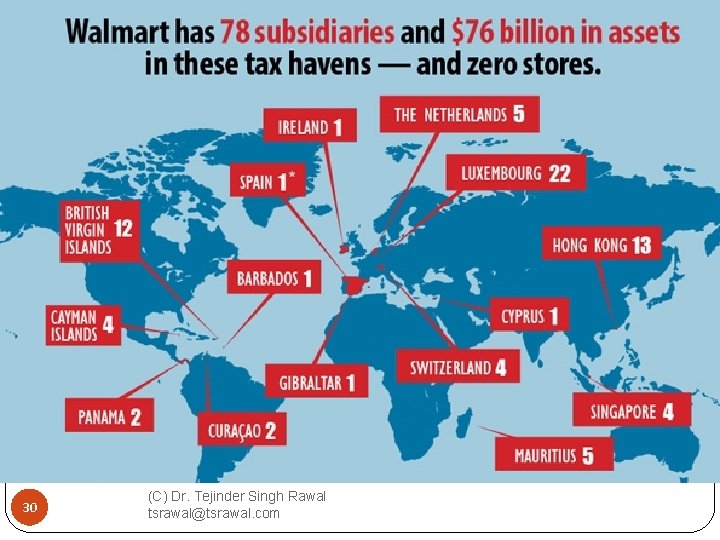
30 (C) Dr. Tejinder Singh Rawal tsrawal@tsrawal. com
Small Businesses Suffer � This may be quite legal—but when it happens, small 31 businesses and ordinary people must step in to pay the taxes that multinationals have escaped. Small businesses are the lifeblood of local economies. “We pay our fair share of taxes, shop locally, support our schools, and actually generate most of the new jobs. So why do we have to subsidize multinationals that use offshore tax havens to avoid paying taxes? ” � Transfer mispricing is one of the most important reasons that multinationals are multinationals and why they usually grow faster than smaller competitors. Anyone worried about the power of global multinationals should pay attention to tax havens. (C) Dr. Tejinder Singh Rawal tsrawal@tsrawal. com
Making Markets Inefficient � All these offshore games make markets profoundly 32 inefficient. Wealth has been transferred from poor taxpayers to rich shareholders—but nobody has produced a better or cheaper product here. � These are untargeted government subsidies for multinationals, courtesy of the tax havens, and they don’t make multinationals more productive. When corporate managers focus on tax dodging they take their eyes off what they do best—making better goods and delivering them more cheaply to market. � Add to that the time and billions wasted paying expensive accountants and lawyers to conjure up these schemes. And then there is the secrecy. A fundamental building block of modern economic theory is transparency: Markets work best when two sides to a contract have access to equal information. (C) Dr. Tejinder Singh Rawal tsrawal@tsrawal. com
How rich Indians exploited the system • Situation before 2004 • LRS in 2004 • 2010 guidelines • 2013 Overseas Direct Investment 33 (C) Dr. Tejinder Singh Rawal tsrawal@tsrawal. com
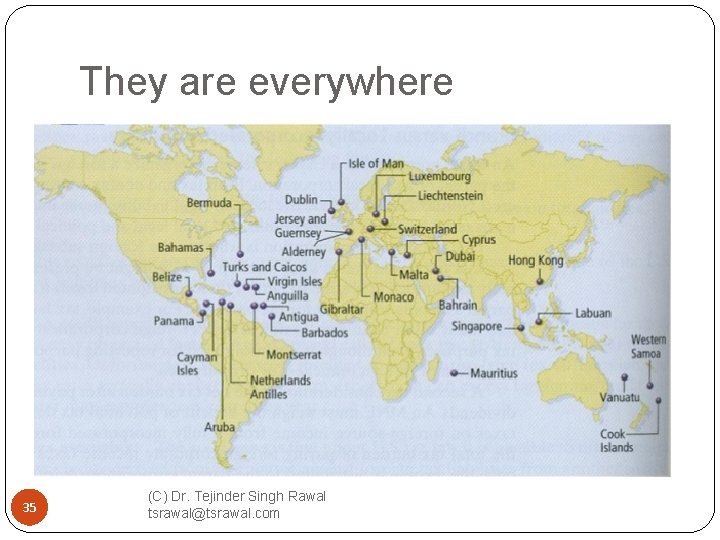
Where are the tax havens located? The world contains about 60 secrecy jurisdictions, or tax havens, which can be divided roughly into four groups: 1. a set of continental European havens, 2. a British zone of influence connected to the City of London and loosely shaped around parts of Britain’s former empire, 3. a zone of influence focused on the United States, 4. unclassified oddities like Somalia and Uruguay. 34 (C) Dr. Tejinder Singh Rawal tsrawal@tsrawal. com
They are everywhere 35 (C) Dr. Tejinder Singh Rawal tsrawal@tsrawal. com
First Group �Switzerland �Picturesque, little-known Luxembourg, specializing since 1929 in certain kinds of offshore corporations, is among the world’s biggest tax havens today: Well over $2. 5 trillion is parked offshore in Luxembourg (In 2013 the GDP was $60. 54 billion of which services, including the financial sector, produced 86%. Population: 5, 43, 202) �Netherlands 36 (C) Dr. Tejinder Singh Rawal tsrawal@tsrawal. com
The Second Group � The second offshore group, accounting for about half 37 the world’s secrecy jurisdictions, is the biggest. This is a layered hub-and-spoke array of tax havens, cantered on the City of London, which mostly emerged from the ashes of the British empire � The City’s offshore network has three main layers. Its inner ring consists of Britain’s three Crown Dependencies: the nearby islands of Jersey, Guernsey, and the Isle of Man. It was estimated conservatively in 2007 that just these three havens hosted about $1 trillion of potentially tax- evading assets. � The next, intermediate ring involves Britain’s 14 overseas territories, the last surviving outposts of (C) Dr. Tejinder Singh Rawal Britain’s formal empire. (he Cayman Islands, tsrawal@tsrawal. com Bermuda, the British Virgin Islands, Turks and Caicos,
The Second Group � The Cayman Islands is the world’s fifth largest financial centre, hosting 80, 000 , over three-quarters of the world’s hedge funds, and $1. 9 trillion on deposit—four times as much as in all the banks in New York City. And it has, at the time of writing, one cinema. � To indicate how murky things are here, the Cayman Islands reported in 2008 that institutions based there had $2. 2 trillion in borrowings but had only lent out a third of that amount—even though these figures should match each other, more or less. The UK and Caymans authorities have not explained this $1. 5 trillion discrepancy. � The third, outer ring is a more diverse array of havens like Hong Kong and the Bahamas, which are outside Britain’s direct control but nevertheless have strong historical links to the empire and deep current links to the City of London 38 (C) Dr. Tejinder Singh Rawal tsrawal@tsrawal. com
The big and powerful �A U. S. Government Accountability Office (GAO) 39 report from December 2008 shows that Citigroup had 427 tax haven subsidiaries, of which 290 were in the British spiderweb. The next biggest user was Morgan Stanley with 273 offshore subsidiaries (of which 220 were in the British zone), then News Corporation with 152, of which 140 were in the British zone. �People have traditionally seen tax havens as marginal players used by Mafiosi, drug smugglers, spies, petty criminals, and celebrity tax-dodgers. Plenty of these can be found offshore, it is true. But the big users of the (C) Dr. Tejinder Singh Rawal secrecy jurisdictions are the banks and other tsrawal@tsrawal. com financial institutions
Vested Interest? �The leak is being managed by "The 40 International Consortium of Investigative Journalists" is funded as it it by entities like the Ford Foundation, the Carnegie Endowment, the Rockefeller Family Fund, the W K Kellogg Foundation, The Sigrid Rausing Trust (the Tetrapak empire) and the Addesium Foundation (George Soros). � It's clear that an organisation that is heavily funded by foundations belonging to US based corporate billionaires have been cherry-picking the data and selectively releasing what they (C) Dr. Tejinder Singh Rawal tsrawal@tsrawal. com choose to. It doesn’t list a single US leader,
The Third Group �Like the British offshore system, the U. S. -based offshore system operates on three tiers. �At the federal level, on the top tier, the United States dangles a range of special tax exemptions, secrecy provisions, and laws designed to attract foreigners’ money into the United States in true offshore style. �The second offshore tier involves individual U. S. States like Wyoming, Delaware, and Nevada �The third U. S. offshore rung is an overseas satellite network, far smaller than the British zone- Marshall Islands, Panama, Liberia 41 (C) Dr. Tejinder Singh Rawal tsrawal@tsrawal. com
Not a bunch of independent nations but an organised system � It should be clear by now that the offshore world is not 42 a bunch of independent states exercising their sovereign rights to set their laws and tax systems as they see fit. It is a set of networks of influence controlled by the world’s major powers, notably Britain, the United States, and some jurisdictions in Europe. Each network is deeply interconnected with, and warmly welcomes offshore business from, the others. � Wealthy U. S. individuals and corporations use the British spiderweb extensively: Enron, for example, had 881 offshore subsidiaries before it went bust, of which 692 were in the Cayman Islands, 119 in the Turks and Caicos, 43 in Mauritius, and 8 in Bermuda, all in the British spiderweb. The United States returns the favour to wealthy British interests investing tax-free, in (C) Dr. Tejinder Singh Rawal secrecy, via Wall Street. tsrawal@tsrawal. com
Secrecy �Tax haven secrecy is not like Swiss banking 43 secrecy, where discreet men in plush offices promised to take their clients’ names to the grave. This is a more insidious form of secrecy, in which authorities and bankers do not bother to ask for name. �For shady clients, this is a far better proposition: what their bankers do not know, they can never be forced to reveal. And their method is disarmingly simple. Instead of opening bank accounts in their own names, fraudsters and money launderers form anonymous companies, (C) Dr. Tejinder Singh Rawal tsrawal@tsrawal. com with which they can then open bank accounts and
Endlessly shifting ecosystem �The offshore world is an endlessly shifting 44 ecosystem, and each jurisdiction offers one or more offshore specialties. Each attracts particular kinds of financial capital, and each develops a particular infrastructure of skilled lawyers, accountants, bankers, and corporate officers to cater to their specific needs. �Yet few people are even aware that such businesses exist. You may well have heard of the Big Four accounting firms KPMG, Deloitte, Ernst & Young, and Pricewaterhouse. Coopers. But have you heard of the Offshore Magic Circle? (C) Dr. Tejinder Singh Rawal tsrawal@tsrawal. com
How they do it? � Offshore services range from the legal to the illegal, with a 45 huge gray area in between. In terms of tax, the illegal stuff is called tax evasion, while tax avoidance is technically legal, though, by definition, it also involves getting around the intent of elected legislatures. The difference between tax avoidance and tax evasion is the thickness of a prison wall. � Even when offshore is not technically illegal, it is often a problem. Secrecy jurisdictions routinely convert what is technically legal, but abusive, into what is seen as legitimate. � Illegal offshore services and structures include tax-evading private banking or asset management, sham trusts, corporate secrecy, illegal re-invoicing, regulatory evasion, fraud concealment, and many, many other nefarious possibilities. These are often hidden behind soothing bromides like “tax optimization” or “asset protection” or (C) Dr. Tejinder Singh Rawal “efficient corporate structure. ” tsrawal@tsrawal. com
Conduit Havens �Some jurisdictions specialize as conduit havens: 46 way stations offering services that transform the identity or character of assets in specific ways, en route to somewhere else. �The Netherlands is a big conduit haven: About € 4. 5 trillion (US $6. 6 trillion) flowed through Dutch Special Financial Institutions in 2008—equivalent to over nine times the Dutch GDP. �Mauritius is a new and fast-growing conduit haven that is the source of over 40 percent of foreign investment into India. It also specializes in channeling Chinese investments into Africa’s mineral sectors. (C) Dr. Tejinder Singh Rawal tsrawal@tsrawal. com
When the door is finally closed, the horse has been stolen and the barn has burned down � Offshore financial structures typically involve a trick sometimes known as laddering. When you slice a structure among several jurisdictions, each provides a new legal or accounting “wrapper” around the assets that can deepen the secrecy and the complexity protecting the assets. � A Mexican drug dealer may have $20 million, say, in a Panama bank account. The account is not in his name but is instead under a trust set up in the Bahamas. The trustees may live in BVI, and the trust beneficiary could be a Wyoming corporation. Even if you can find the names of that company’s directors, and even get photocopies of their passports—that gets you no closer: These directors will be professional nominees who direct hundreds of similar companies. � They are linked to the next rung of the ladder through a company lawyer, who is prevented by attorney-client privilege from giving out any details. Even if you break through that barrier you may find that the corporation is held by a Turks and Caicos trust with a flee clause: � The moment an inquiry is detected, the structure flits to another secrecy jurisdiction. Even if a jurisdiction cooperates with inquiries, it can drag its feet for months or years. 47 (C) Dr. Tejinder Singh Rawal tsrawal@tsrawal. com
Elsewhere becomes nowhere �Even if you can see parts of the structure, the laddering stops you from seeing it all—and if you can’t see the whole, you cannot understand it. �The activity doesn’t happen in any jurisdiction—it happens between jurisdictions. “Elsewhere” becomes “nowhere”: a world without rules. 48 (C) Dr. Tejinder Singh Rawal tsrawal@tsrawal. com
Men who pay no taxes �The Tax Justice Network recently estimated that 49 wealthy individuals hold perhaps $11. 5 trillion worth of wealth offshore. That is about a quarter of all global wealth and equivalent to the entire GDP of the United States. �That much money in hundred-dollar bills, placed end to end, would stretch twenty-three times to the moon and back. The estimated $250 billion in taxes lost each year on the income that money earns is two to three times the size of the entire global aid budget to tackle poverty in developing countries. (C) Dr. Tejinder Singh Rawal tsrawal@tsrawal. com
Men who pay no taxes � But that sum just represents the taxes lost on money 50 wealthy individuals hold offshore. A much bigger transfer of wealth is occurring through illicit financial flows across borders from developing countries into secrecy jurisdictions and rich countries. � Developing countries, Global Financial Integrity, estimated in January 2011, lost a staggering $1. 2 trillion in illicit financial flows in 2008—losses that had been growing at 18 percent per year. Compare this to the $100 billion in total annual foreign aid, and it is easy to see why GFI concluded that “for every dollar that we have been generously handing out across the top of the table, we in the West have been taking back (C) Dr. Tejinder Singh Rawal tsrawal@tsrawal. com some $10 of illicit money under the table.
Same channel for corporations and Mafiosi � In a study subsequently endorsed by the World Bank it 51 was estimated that only about a third of total illicit crossborder flows represent criminal money—from drug smuggling, counterfeit goods, racketeering, and so on. � Corrupt money—local bribes remitted abroad or bribes paid abroad —added up to just 3 percent of the total. � The third component, making up two-thirds, is cross-border commercial transactions, about half from transfer pricing through corporations. � And out of this emerges another profoundly important point. The drug smugglers, terrorists, and other criminals use exactly the same offshore mechanisms and subterfuges— shell banks, trusts, dummy corporations, and so on—that corporations use. � It is hardly surprising success rate in catching criminal money was 0. 1 percent—meaning a 99. 9 percent failure rate. (C) Dr. Tejinder Singh Rawal tsrawal@tsrawal. com
It is there, but nobody notices it! �And that is only the illegal stuff. The legal offshore tax avoidance by individuals and corporations, which further gouges honest hardworking folks, adds hundreds of billions of dollars to these figures. �There has been an astonishing blindness on the part of the world’s most powerful institutions to this system that has effected the greatest transfer of wealth from poor to rich in the history of the planet. 52 (C) Dr. Tejinder Singh Rawal tsrawal@tsrawal. com
Is tax not a part of CSR? �Tax is the missing element in the corporate social responsibility debate. Modern company directors face a dilemma. To whom are they answerable— to shareholders only or to a wider set of stakeholders? There are no useful guidelines. �The corporate world has lost its way. In order to escape taxes and other duties that come with living in democratic nations, they have grown to become steeped in an inverted morality that holds tax, democracy, and society to be bad and tax havens, tax dodging, and secrecy to be good. 53 (C) Dr. Tejinder Singh Rawal tsrawal@tsrawal. com
War against off-shoring will have to be fought �The fight against the offshore system will differ 54 from other campaigns to fix the global economy. Like the fight against corruption, this struggle does not fit neatly into the old political categories of left and right. It does not involve rejecting cross -border trade or seeking solace in purely local solutions. �This fight needs an international perspective, where countries try not to engage in economic warfare against each other. And it will provide a rubric for taxpaying citizens in both rich countries and poor to fight for a common cause. Wherever you live, whoever you are, or what you think, this (C) Dr. Tejinder Singh Rawal affects you. tsrawal@tsrawal. com
The Road Ahead for India �Panama papers are just the tip of the 55 iceberg. �The Panama Papers reveal that countries with much simpler tax laws, lower costs of compliance and a stronger administrative capacity to enforce laws than India have not been able to prevent the use of tax havens. �In India, tax rates are higher, the system is complicated and capital controls restrict foreign financial transactions. Tax havens are more likely to be used not just for illegal (C) Dr. Tejinder Singh Rawal tsrawal@tsrawal. com activity but even for legitimate businesses.
The Road Ahead for India � We rank 157 in the ease of paying taxes. Further, the 56 effective tax on profit is higher: The corporate tax rate and the dividend distribution tax put together make the tax rate on profits nearly 50 per cent. The capital gains tax makes financial transactions even more unattractive. This regime is made more tortuous by an onerous set of capital controls. As a consequence, companies operating globally have every incentive to set up companies in such jurisdictions. � Looking forward, first, rationalisation of capital controls should be a top priority. Many government reports have laid out the path forward. Second, India must (C) Dr. Tejinder Singh Rawal tsrawal@tsrawal. com move to a simple tax regime with lower compliance
Thanks 57 (C) Dr. Tejinder Singh Rawal tsrawal@tsrawal. com