The Age of Imperialism 1800 1914 Lesson 7







- Slides: 24
The Age of Imperialism (1800– 1914) Lesson 7 Southeast Asia and the Pacific
The Age of Imperialism (1800– 1914) Lesson 7 Southeast Asia and the Pacific Learning Objectives • • • Describe how Europe and the United States built colonies in Southeast Asia. Explain how imperialism spread to the islands of the Pacific. Analyze how Australia and New Zealand achieved self-rule.
The Age of Imperialism (1800– 1914) Lesson 7 Southeast Asia and the Pacific Key Terms • • French Indochina. Mongkut Spanish-American War, Liliuokalani indigenous, penal colony, Maori
European Imperialism in Southeast Asia By the mid-1800 s, leaders throughout Southeast Asia faced the growing threat of Western imperialism. Before long, Western industrial powers divided up the region in their race for raw materials, new markets, and Christian converts.
European Imperialism in Southeast Asia • • • The Dutch East Indies The British in Burma and Malaya The French in Indochina Siam Stays Independent Characteristics of Colonial Southeast Asia
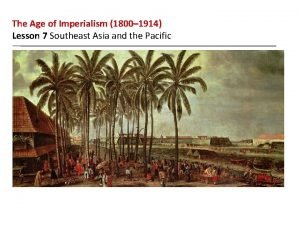
European Imperialism in Southeast Asia The headquarters of the Dutch East India Company was called Batavia Castle. It was located in presentday Jakarta. The East India Company built trading and military bases throughout the Spice Islands.
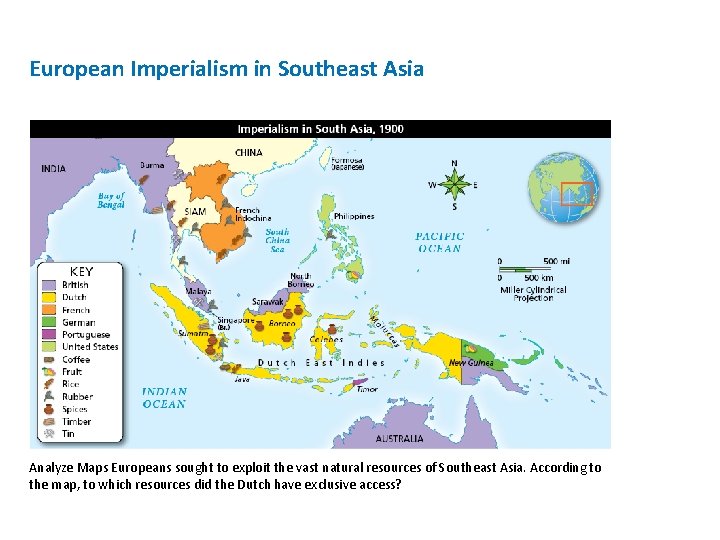
European Imperialism in Southeast Asia Analyze Maps Europeans sought to exploit the vast natural resources of Southeast Asia. According to the map, to which resources did the Dutch have exclusive access?
Military Might and the Philippines In the 1500 s, Spain had seized the Philippines and extended its rule over the islands. Catholic missionaries spread Christianity among the Filipinos and the Catholic Church gained enormous power and wealth. Many Filipinos accused the Church of abusing its position. By the late 1800 s, their anger fueled strong resistance to Spanish rule.
Military Might and the Philippines • Battles in the Philippines
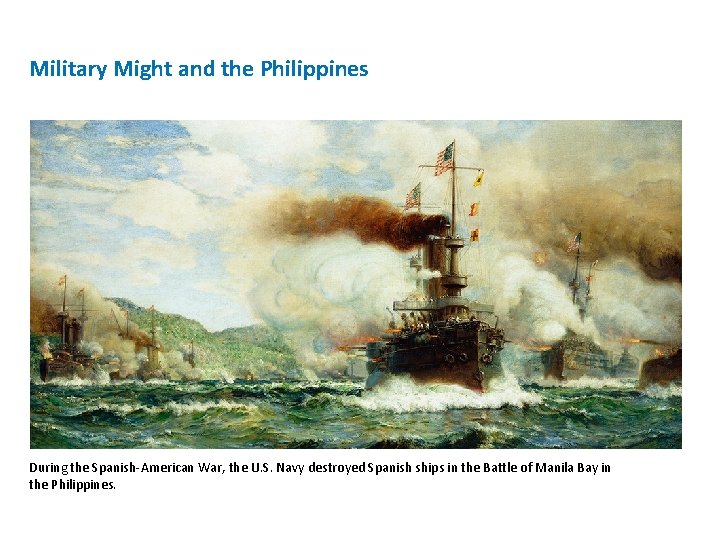
Military Might and the Philippines During the Spanish-American War, the U. S. Navy destroyed Spanish ships in the Battle of Manila Bay in the Philippines.
Strategic Holdings in the Pacific Islands In the 1800 s, the industrialized powers began to take an interest in the islands of the Pacific. The thousands of islands splashed across the Pacific include three regions of Melanesia, Micronesia, and Polynesia.
Strategic Holdings in the Pacific Islands • • From Ports of Call to Colonies Imperialist Rivalry
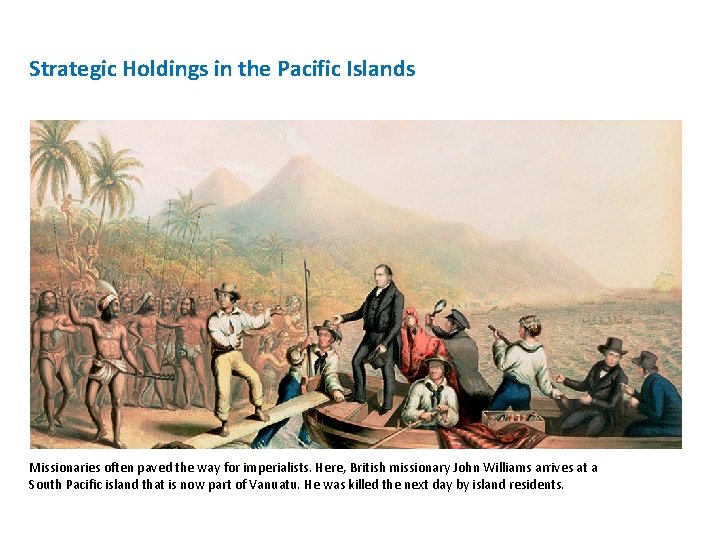
Strategic Holdings in the Pacific Islands Missionaries often paved the way for imperialists. Here, British missionary John Williams arrives at a South Pacific island that is now part of Vanuatu. He was killed the next day by island residents.
Europeans in Australia The Dutch in the 1600 s were the first Europeans to reach Australia—the world's largest island smallest continent. In 1770, Captain James Cook claimed Australia for Britain. For a time, however, Australia remained too distant to attract European settlers.
Europeans in Australia • • Australia’s Indigenous People A Penal Colony Emigration to Australia Self-Rule in Australia
Europeans in Australia This Aboriginal art, showing a mythical woman and child with a fish, was found in northern Australia. Aboriginal art often depicts “Dreamtime, ” the world’s origin according to Aboriginal traditions.
New Zealand’s Story About 1, 000 miles southeast of Australia lies New Zealand. It consists of several islands. New Zealand was the last landmass in the world to be settled. Like Australia, New Zealand had its own indigenous people, the Maori (MAH oh ree).
New Zealand’s Story • • Arrival of the Maori Arrival of Europeans Maori Struggles The Nation of New Zealand
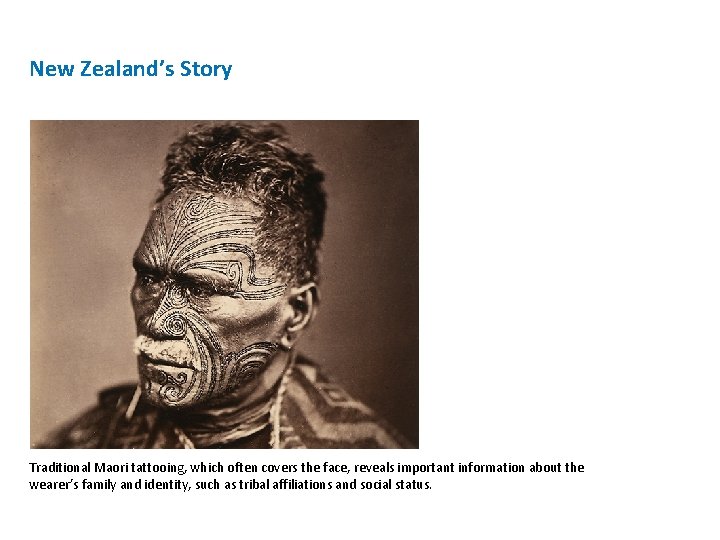
New Zealand’s Story Traditional Maori tattooing, which often covers the face, reveals important information about the wearer’s family and identity, such as tribal affiliations and social status.
Quiz: European Imperialism in Southeast Asia Contrast Siam’s fate to that of Burma and Vietnam. A. Siam remained independent, while Western countries colonized Burma and Vietnam. B. Siam battled against Western countries, while Burma and Vietnam surrendered peacefully. C. Siam joined forces with Western powers to colonize Burma and Vietnam. D. Siam retained traditional ways, while Burma and Vietnam modernized.
Quiz: Military Might and the Philippines How did Filipino rebels get involved in the Spanish-American War? A. B. C. D. They produced supplies for the Spanish army. They took advantage of the turmoil to stage a revolution. They supported the United States, hoping to gain independence. They destroyed the Spanish fleet stationed in the Philippines.
Quiz: Strategic Holdings in the Pacific Islands Identify one major reason for the United States' annexation of Hawaii. A. B. C. D. the arrival of many American settlers the desire to modernize the islands its location on shipping routes pressure from sugar growers
Quiz: Europeans in Australia What group made up the majority of Australia’s first European settlers? A. B. C. D. gold hunters missionaries shepherds convicts
Quiz: New Zealand’s Story Why did the Maori fight colonists in New Zealand? A. B. C. D. to gain power in the Pacific economy to take over New Zealand ports to defend their land to control resources