
The Age of Imperialism 1850 1914 What is

- Slides: 40
The Age of Imperialism 1850 - 1914
What is? o o o Imperialism Social Darwinism Racism
The Scramble for Africa o Africa Before European Dominion n n Divided into hundreds of ethnic and linguistic groups. Followed traditional beliefs, others converted to Islam or Christianity. Politically groups were very different, ranged from large empires to independent villages. Travel to interior by Europeans near impossible. Africans controlled their own trade networks.
The Scramble for Africa (cont. ) o Nations compete for overseas empires. n Europeans who penetrated Africa were: o o o Explorers Missionaries Humanitarians
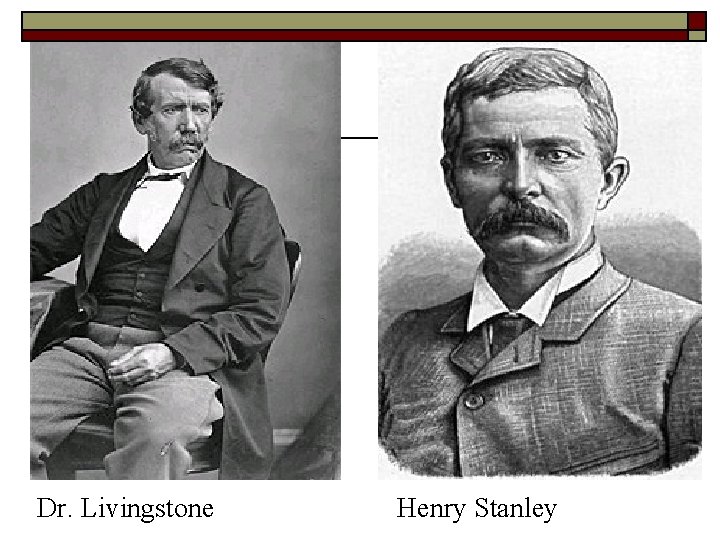
The Scramble for Africa (cont. ) o The Congo Sparks Interest n Dr. Livingstone o o n Livingstone went on expedition into Africa. Lost contact with him. Henry Stanley o o Journalist sent to find Dr. Livingstone After near eight months of search he was found on November 10, 1871. n “Dr. Livingstone I presume? ”
Dr. Livingstone Henry Stanley
Scramble for Africa (cont. ) o Forces Driving Imperialism n Belief in European Superiority. o o n Racism Social Darwinism Factors Promoting Imperialism in Africa. o o o European Technological Superiority. Europeans had means to control. New medicines prevent diseases.
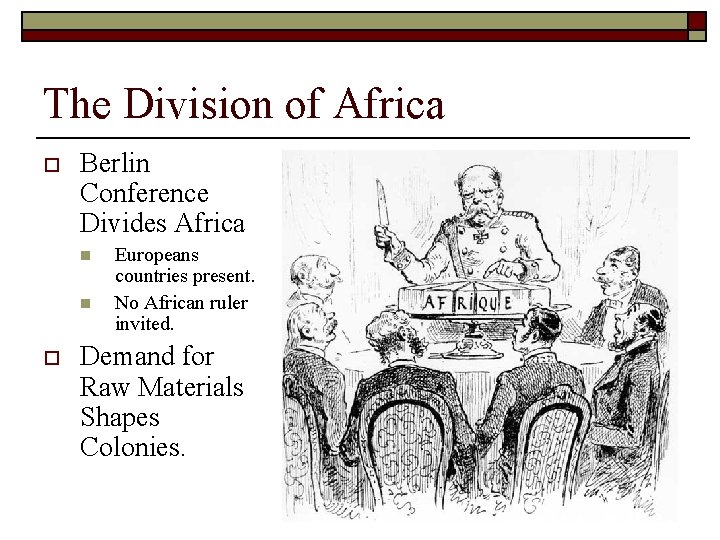
The Division of Africa o Berlin Conference Divides Africa n n o Europeans countries present. No African ruler invited. Demand for Raw Materials Shapes Colonies.
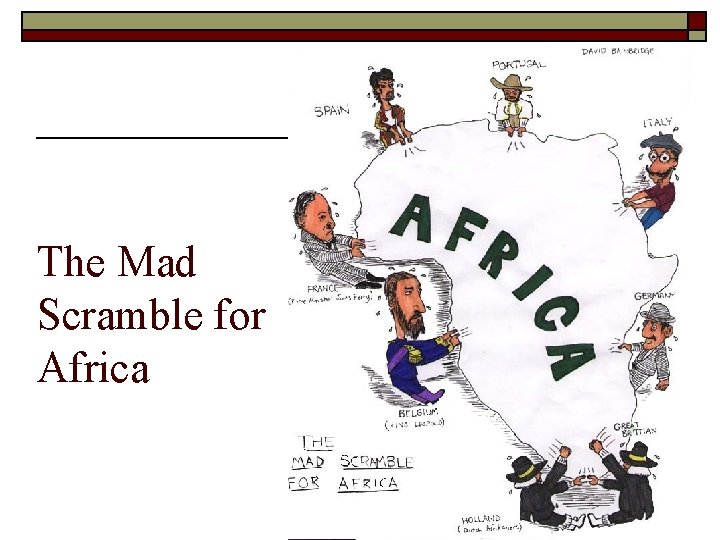
The Mad Scramble for Africa
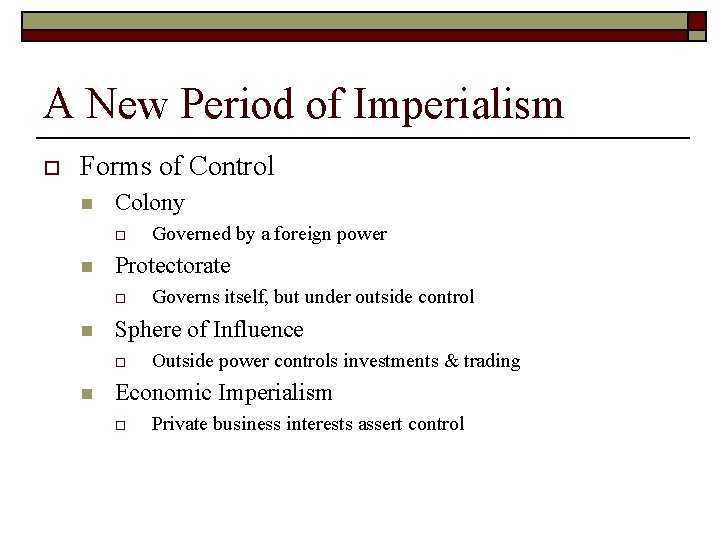
A New Period of Imperialism o Forms of Control n Colony o n Protectorate o n Governs itself, but under outside control Sphere of Influence o n Governed by a foreign power Outside power controls investments & trading Economic Imperialism o Private business interests assert control
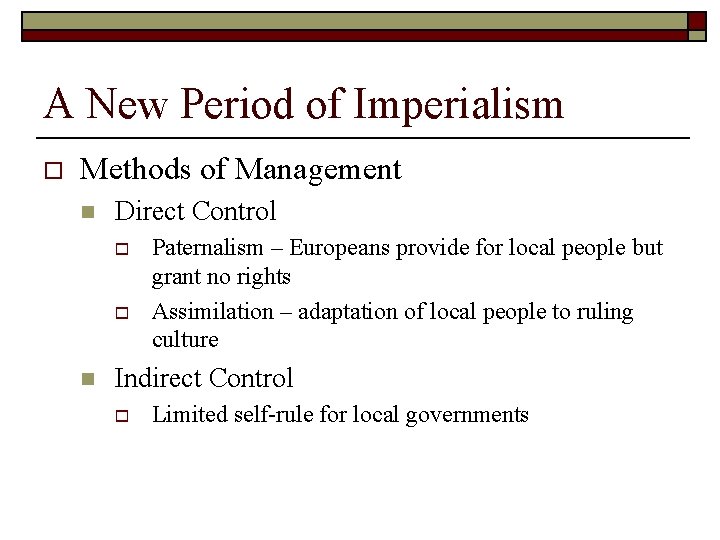
A New Period of Imperialism o Methods of Management n Direct Control o o n Paternalism – Europeans provide for local people but grant no rights Assimilation – adaptation of local people to ruling culture Indirect Control o Limited self-rule for local governments
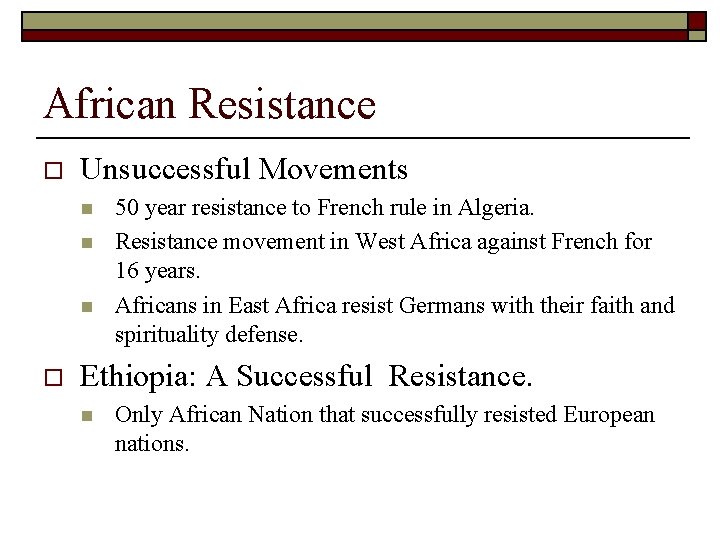
African Resistance o Unsuccessful Movements n n n o 50 year resistance to French rule in Algeria. Resistance movement in West Africa against French for 16 years. Africans in East Africa resist Germans with their faith and spirituality defense. Ethiopia: A Successful Resistance. n Only African Nation that successfully resisted European nations.
Ethiopia: A Successful Resistance. o o Ethiopia under Emperor Menelik II Plays Europeans against each other Stockpiles modern weapons Defeats Italy and remains independent
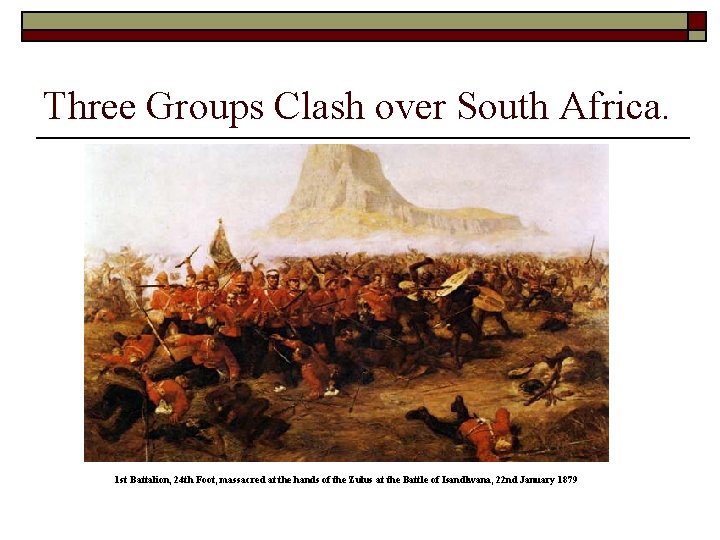
Three Groups Clash over South Africa. 1 st Battalion, 24 th Foot, massacred at the hands of the Zulus at the Battle of Isandlwana, 22 nd January 1879
The Three Groups o Africans o o o Boers n n o Zulu nation, led by Shaka, fought the British Zulu nation lost to British in 1887 Dutch settlers that had controlled South Africa since the mid 1600 s Also known as Afrikaners British n Gained control of South Africa after the Berlin Conference
Boer War o Fought between the Boers and the British n n n Many Africans fought with the Boers First example of “total war” British win in 1910 o Established the Union of South Africa (British Rule)
Results of European Imperialism in Africa
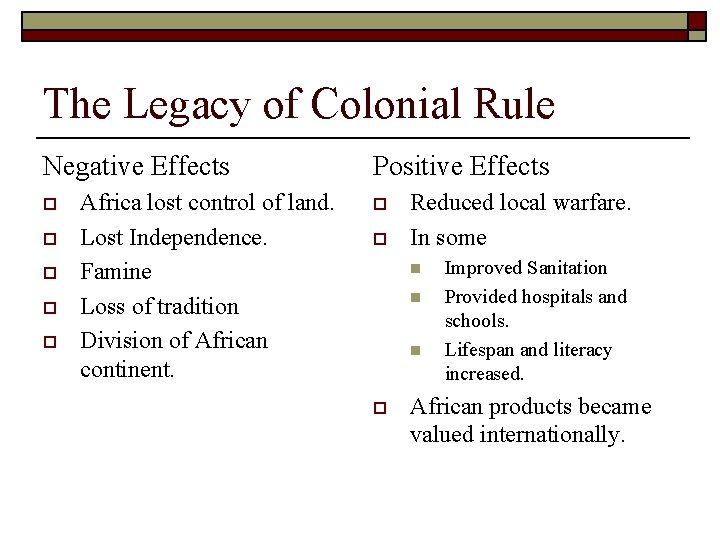
The Legacy of Colonial Rule Negative Effects o o o Africa lost control of land. Lost Independence. Famine Loss of tradition Division of African continent. Positive Effects o o Reduced local warfare. In some n n n o Improved Sanitation Provided hospitals and schools. Lifespan and literacy increased. African products became valued internationally.
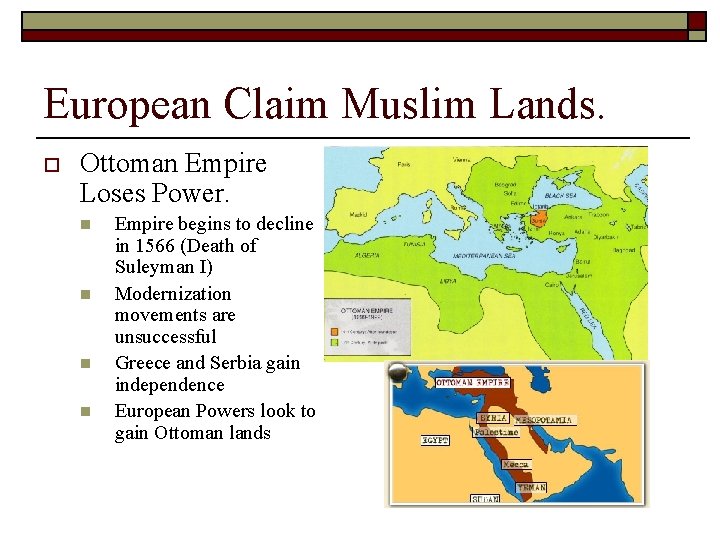
European Claim Muslim Lands. o Ottoman Empire Loses Power. n n Empire begins to decline in 1566 (Death of Suleyman I) Modernization movements are unsuccessful Greece and Serbia gain independence European Powers look to gain Ottoman lands
Crimean War (1853) o Crimean War – Russia vs. Ottoman Empire n Russia seeks Ottoman land o n Access to a warm-water port Russia loses war o o Ottomans are shown to be weak Russia still is able to take land
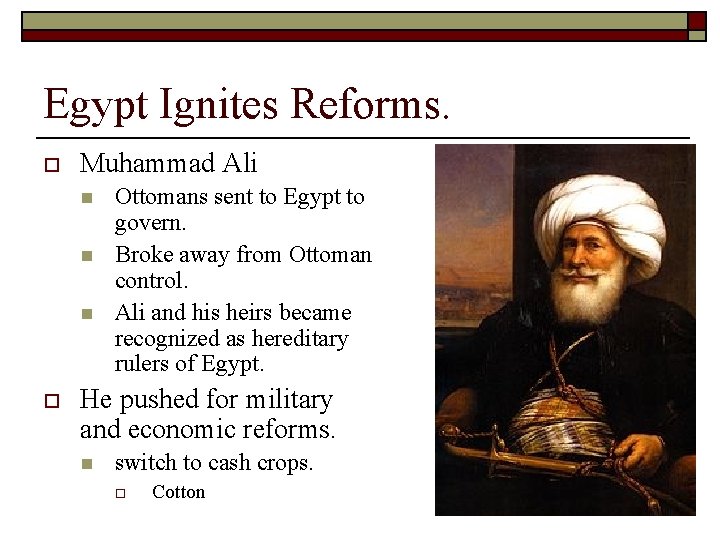
Egypt Ignites Reforms. o Muhammad Ali n n n o Ottomans sent to Egypt to govern. Broke away from Ottoman control. Ali and his heirs became recognized as hereditary rulers of Egypt. He pushed for military and economic reforms. n switch to cash crops. o Cotton
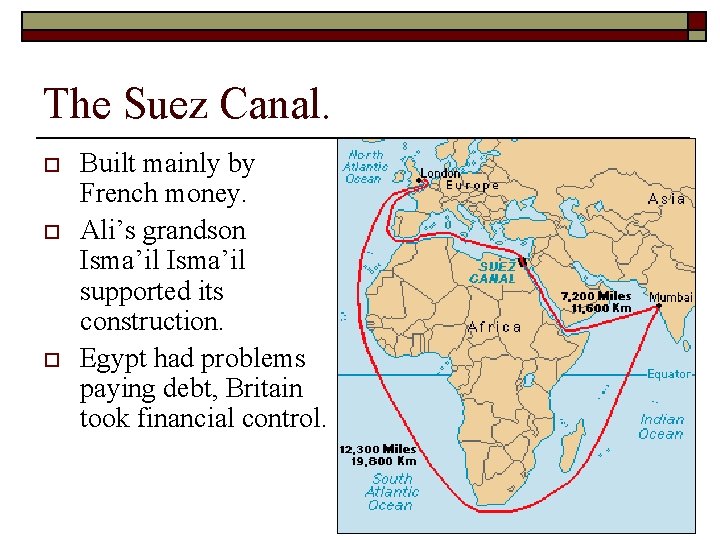
The Suez Canal. o o o Built mainly by French money. Ali’s grandson Isma’il supported its construction. Egypt had problems paying debt, Britain took financial control.
Persia Pressured to Change o o Southwest Asia, Russia and Britain competed to exploit Persia gave up territories to Russia after military defeats in 1813 and 1828. In 1857 Britain made Persia relinquish all claims to Afghanistan. European interest in Persia was due to oil which was discovered in 1908.
Persian Battle Over Tobacco o Tensions arose between citizens and corrupt rulers. n o o o Ex. Persian ruler Nasir al-Din. Final straw British company was given rights to export tobacco. Tobacco boycott organized by Jamal al-Din-al-Afghani. Boycott successful. 1906 constitution established thanks to revolutionaries. Russia and Britain took over in 1907 dividing it into spheres of influence.
British Imperialism in India o British Expand Control over India n East India Company o o n Controls India thru economic imperialism Company uses an army including Indian soldiers known as “sepoys” India was seen as the most important colony o o Due to its production of raw materials Known as the “Jewel in the Crown”
Effects of British Rule o Impact of Colonialism n n n Railroads move cash crops and goods faster British control political and economic power Cash crops resulted in loss of self-sufficiency and caused famine Indian culture is disrupted due to racism and missionaries Britain sought to “modernize” India
Lets do an Activity!!! o o o British entrepreneur (businessman) with a variety of investments in India. An upper-class Indian. An Indian who resents British domination.
The Sepoy Mutiny o Indians Rebel. n A year of fighting sparked by misunderstanding. o Sepoys refuse to use cartridges due to religious reasons n n n o o o They had to bite them open – greased with pork fat or beef fat Pork considered unclean by Muslims Cow sacred to Hindus Many sepoys were jailed, others rebelled British put down the rebellion Turning Point. n n Marked a turning point in Indian history. Britain took direct control of India. Fueled racist attitudes of British towards Indians. Increased distrust between Indians and British.
Nationalism Surfaces in India. o Call for reforms n n o India adopts modernization movements Many Indians adopt western ways Religious Issues Remain n Formation of the Indian National Congress (1885) o n Called for independence from Britain Formation of the Muslim League (1906) o Many Muslims did not trust Hindus within India
Imperialism In Southeast Asia. o European Powers Invade the “Pacific Rim” n Lands of Southeast Asia that border the Pacific Ocean o o Why? n n o Britain – Malaysia, Burma, and Singapore Netherlands – Indonesia France – Indochina (Vietnam, Laos, Cambodia) Land perfect for establishing trading and military posts Excellent for plantation agriculture Siam remains Independent.
US Imperialism in Pacific Islands. o The Philippines Change Hands. n n n Thanks to Spanish American War, US gains Philippines, Guam and Puerto Rico from Spain. Philippines not happy fought US in 1899. US finally won in 1902.
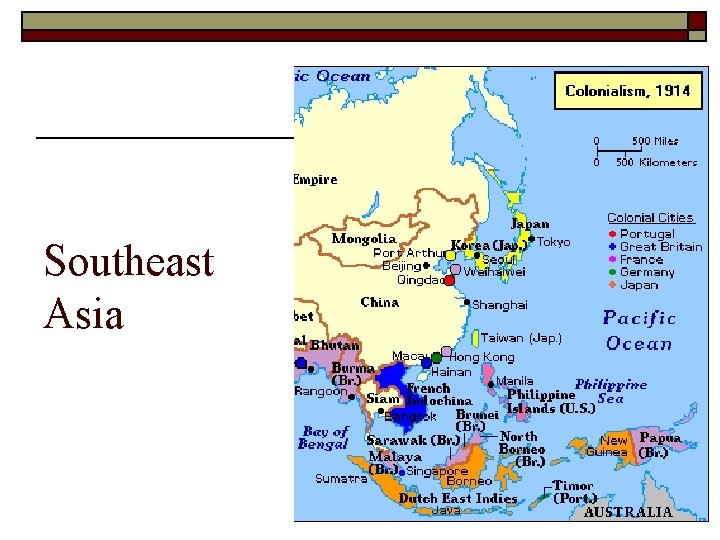
Southeast Asia
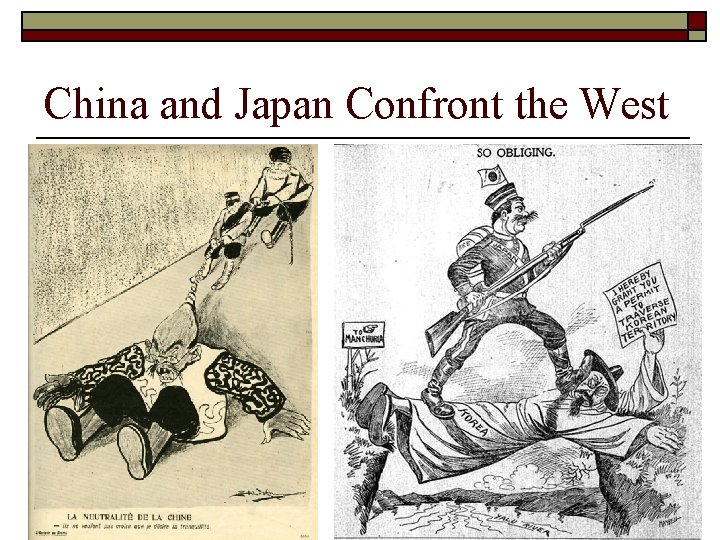
China and Japan Confront the West
China o China vs. The West n n o China was self-sufficient – no need for trade China kept a favorable balance of trade Europeans were able to shift the balance Sale of Opium – addictive drug from poppy plant Opium War – China vs. Britain n n China loses – signs Treaty of Nanjing Chinese power over the West ends
China (cont. ) o Foreign Influence Grows n o Growing Spheres of Influence A Surge in Chinese Nationalism n Boxer Rebellion o n Poor peasants and workers who resented foreign privilege Beginnings of Reform o o China tried to become more western Further added to internal problems
Japan o Japan remained isolated from western world for centuries – only traded mainly with China n n n Treaty of Kanagawa – ends Japan’s isolation Meiji Reform – Japan begins to modernize beginning in 1867 Japan was competitive with the west in many modern industries
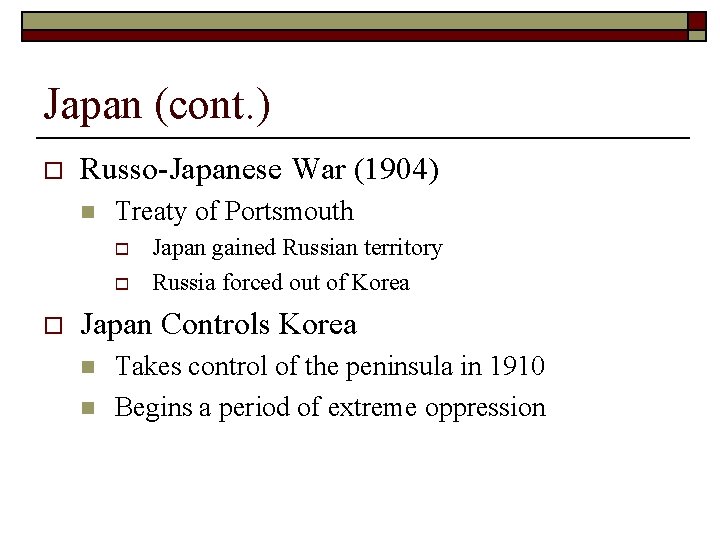
Japan (cont. ) o Russo-Japanese War (1904) n Treaty of Portsmouth o o o Japan gained Russian territory Russia forced out of Korea Japan Controls Korea n n Takes control of the peninsula in 1910 Begins a period of extreme oppression
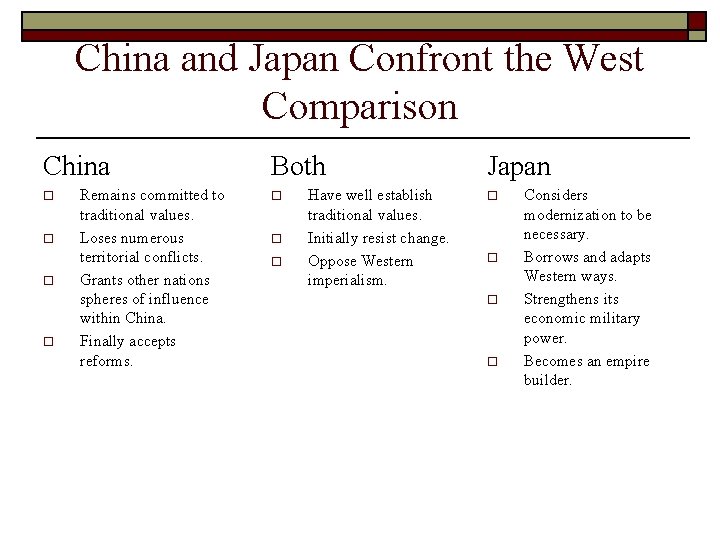
China and Japan Confront the West Comparison China o o Remains committed to traditional values. Loses numerous territorial conflicts. Grants other nations spheres of influence within China. Finally accepts reforms. Both o o o Have well establish traditional values. Initially resist change. Oppose Western imperialism. Japan o o Considers modernization to be necessary. Borrows and adapts Western ways. Strengthens its economic military power. Becomes an empire builder.
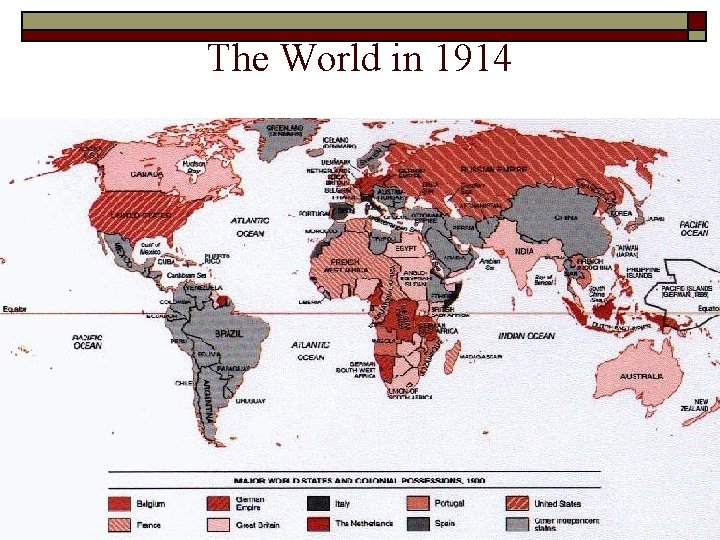
The World in 1914