THE AGE OF IMPERIALISM Chapter 27 SECTION 1
- Slides: 30
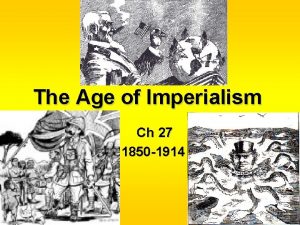
THE AGE OF IMPERIALISM Chapter 27
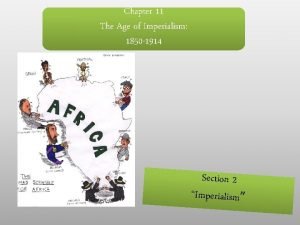
SECTION 1: THE SCRAMBLE FOR AFRICA • Ignoring the claims of African ethnic groups, kingdoms, and citystates, Europeans establish colonies.
AFRICA BEFORE EUROPEAN DOMINATION • Problems Discourage Exploration • • Armies, rivers, disease discourage exploration Nations Compete for Overseas Empires Imperialism—seizure of a country or territory by a stronger country • Missionaries, explorers, humanitarians reach interior of Africa • • The Congo Sparks Interest Henry Stanley helps King Leopold II of Belgium acquire land in Congo • Leopold brutally exploits Africans; millions die • Belgian government takes colony away from Leopold • Much of Europe begins to claim parts of Africa •
FORCES DRIVING IMPERIALISM • Belief in European Superiority Race for colonies grows out of national pride • Racism—belief that one race is better than others • Social Darwinism—survival of the fittest applied to human society • • Factors Promoting Imperialism in Africa Technological inventions like steam engine, Maxim gun help conquest • Perfection of quinine protects Europeans from malaria • Within Africa, Africans are divided by language and culture •
THE DIVISION OF AFRICA • The Lure of Wealth • • Discovery of gold and diamonds increases interest in colonization Berlin Conference Divides Africa Berlin Conference— 14 nations agree on rules for division (1884– 85): -countries must claim land prove ability to control it • By 1914, only Liberia and Ethiopia are free of European control • • Demand for Raw Materials Shapes Colonies Raw materials are greatest source of wealth in Africa • Businesses develop cash-crop plantations •
THREE GROUPS CLASH OVER SOUTH AFRICA • Zulus Fight the British Shaka—Zulu chief—creates centralized state around 1816 • British defeat Zulus and gain control of Zulu nation in 1887 • • Boers and British Settle in the Cape Boers, or Dutch farmers, take Africans’ land, establish large farms • Boers clash with British over land, slaves -move north to escape British • • The Boer War between British, Boers begins in 1899 • British win; Boer republics united in Union of South Africa (1910) •
SECTION 2: IMPERIALISM – CASE STUDY: NIGERIA • Europeans embark on a new phase of empire building that affects both Africa and the rest of the world.
A NEW PERIOD OF IMPERIALISM • Factory Work • • Factories pay more than farms, spur demand for more expensive goods Extending Influence • Europeans want to control all aspects of their colonies: -influence political, social lives of people -shape economies to benefit Europe -want people to adopt European customs
A NEW PERIOD OF IMPERIALISM • Forms of Control • Europeans develop four forms of control of territory: -colony—governed by a foreign power -protectorate—governs itself, but under outside control -sphere of influence—outside power controls investment, trading -economic imperialism—private business interests assert control
A NEW PERIOD OF IMPERIALISM • Methods of Management • Europeans use two methods to manage colonies: -direct control -indirect control • Indirect Control Limited self-rule for local governments • Legislative body includes colonial, local officials • • Direct Control Paternalism—Europeans provide for local people, but grant no rights • Assimilation—adaptation of local people to ruling culture •
A BRITISH COLONY • Gaining Control Britain conquers southern Nigeria using both diplomacy and force • Conquest of northern Nigeria through Royal Niger Company • In 1914, Britain claims all of Nigeria as a colony • • Managing the Colony Nigeria is culturally diverse area, with about 250 ethnic groups • British use indirect rule successfully with Hausa-Fulani • Yoruba and Igbo chiefs resent limits on their power •
AFRICAN RESISTANCE • Africans Confront Imperialism • • Broad resistance to imperialism, but Europeans have superior weapons Unsuccessful Movements Algeria actively resists French for almost 50 years • Samori Touré fights French in West Africa for 16 years • In German East Africa, people put faith in spiritual defense • Results in about 75, 000 deaths; famine kills twice as many • • Ethiopia: A Successful Resistance • Menelik II, emperor of Ethiopia in 1889, resists Europeans -plays Europeans against each other -stockpiles arsenal of modern weapons -defeats Italy, remains independent
THE LEGACY OF COLONIAL RULE • Negative Effects Africans lose land independence, many lose lives • Traditional cultures break down • Division of Africa creates problems that continue today • • Positive Effects Colonialism reduces local fighting • Sanitation improves; hospitals and schools created • Technology brings economic growth •
SECTION 3: EUROPEANS CLAIM MUSLIM LANDS • European nations expand their empires by seizing territories from Muslim states.
OTTOMAN EMPIRE LOSES POWER • Problems Discourage Exploration • • Armies, rivers, disease discourage exploration Reforms Fail • • • After Suleyman I dies in 1566, empire starts to decline Ottoman Empire falls behind Europe in technology Selim III attempts to modernize army and is overthrown Subject peoples in Greece and Serbia gain independence European powers look for ways to take Ottoman lands
EUROPEANS GRAB TERRITORY • Geopolitics—taking land for its strategic location or products • Access to sea trade routes focuses attention on Ottoman lands • • Russia and the Crimean War—Russia attacks Ottomans in 1853 to gain warm-water port • Russia loses, but Ottomans are shown to be weak; still lose land • • The Great Game—war waged between Russia and Britain over India • Battles fought in Afghanistan until British withdrawal in 1881 •
EGYPT INITIATES REFORMS • Military and Economic Reforms Muhammad Ali breaks away from Ottoman control and rules Egypt • Begins series of reforms in military and economy • Shifts Egyptian agriculture from food crops to cash crops • • The Suez Canal Egypt builds Suez Canal—human-made waterway connects Red Sea to Mediterranean • Modernization efforts create huge debt • British oversee financial control of canal, occupy Egypt in 1882 •
PERSIA PRESSURED TO CHANGE • The Exploitation of Persia Russia wants access to Persian Gulf and Indian Ocean • Britain wants Persian oil and Afghanistan • Persia concedes to Western businesses • • Battle over Tobacco Persian ruler sells concession to Britain to export tobacco • Persians boycott tobacco, leads to riots • In 1907, Russia and Britain seize and divide Persia between them •
SECTION 4: BRITISH IMPERIALISM IN INDIA • As the Mughal Empire declined, Britain seizes Indian territory and soon it controls almost the whole subcontinent.
BRITISH EXPAND CONTROL OVER INDIA • Problems Discourage Exploration • • Armies, rivers, disease discourage exploration East India Company Dominates British East India Company rules India until 1850 s • Company has its own army led by British officers • Army is staffed by sepoys—Indian soldiers • • Britain’s “Jewel in the Crown” India is Britain’s most valuable colony, or “jewel in the crown” • Forced to produce raw materials for British manufacturing • Also forced to buy British goods •
BRITISH EXPAND CONTROL OVER INDIA • British Transport Trade Goods Railroads move cash crops and goods faster • Trade in specific crops is tied to international events • • Impact of Colonialism British hold much of political and economic power • Cash crops result in loss of self-sufficiency, famine • Indian life disrupted by missionaries and racist attitudes • British modernize India’s economy, improve public health •
THE SEPOY MUTINY • Indians Rebel Sepoys refuse to use cartridges of new rifles for religious reasons • Many Sepoys are jailed; others start Sepoy Mutiny against British • Many Indians, especially Sikhs, remain loyal to British • • Turning Point British put down rebellion, take direct command of India • Raj—term for British rule over India, lasts from 1757 to 1947 • Uprising increases distrust between British and Indians •
NATIONALISM SURFACES IN INDIA • Call for Reforms In 1800 s, Ram Mohun Roy leads modernization movement • Many Indians adopt western ways and call for social reforms • Indians resent being second-class citizens in own country • • Nationalist Groups Form Indian National Congress and Muslim League form • Nationalists angered by partition of Bengal • -pressure forces Britain to divide it differently
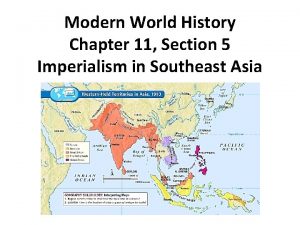
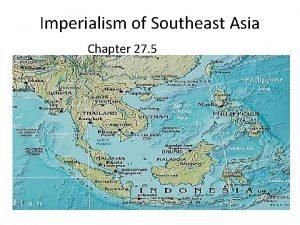
SECTION 5: IMPERIALISM IN SOUTHEAST ASIA • Demand for Asian products drive Western imperialists to seek possession of Southeast Asian lands.
EUROPEAN POWERS INVADE THE PACIFIC RIM • Problems Discourage Exploration • • Armies, rivers, disease discourage exploration Europeans Race to Claim Pacific Rim Lands of Southeast Asia that border Pacific Ocean form Pacific Rim • Dutch, British, French, Germans claim parts of Pacific Rim • -establish trading ports -land perfect for plantation agriculture • Dutch Expand Control Dutch colonies, called Dutch East Indies, include Indonesia • Settle Indonesia, establish rigid social class system •
EUROPEAN POWERS INVADE THE PACIFIC RIM • The Exploitation of Persia Russia wants access to Persian Gulf and Indian Ocean • Britain wants Persian oil and Afghanistan • Persia concedes to Western businesses • • British Take the Malayan Peninsula Britain seizes Singapore as a port and trading base • Also gets colonies in Malaysia, Burma • Chinese immigration to Malaysia creates problems • • French Control Indochina French come to control Vietnam, Laos, Cambodia • Directly control French Indochina • Export rice, angering Vietnamese •
EUROPEAN POWERS INVADE THE PACIFIC RIM • Colonial Impact Modernization mainly helps European businesses • Education, health, sanitation improve • Millions migrate to Southeast Asia to work in mines, plantations • Colonialism leads to racial and religious clashes •
SIAM REMAINS INDEPENDENT • Modernization in Siam remains independent, neutral zone between French, British • King Mongkut modernizes country: • -starts schools -reforms legal system -reorganizes government -builds transportation and telegraph systems -ends slavery
U. S. IMPERIALISM IN THE PACIFIC ISLANDS • The Philippines Change Hands • • • U. S. gains Philippines after Spanish-American War Emilio Aguinaldo, leads Filipino nationalists against U. S. rule U. S. defeats three-year nationalist revolt (1902) U. S. promises to prepare Filipinos for self-rule Focus on cash crops leads to food shortages
U. S. IMPERIALISM IN THE PACIFIC ISLANDS • Hawaii Becomes a Republic • • • Americans establish sugar-cane plantations on Hawaii By mid-1800 s, sugar accounts for 75 percent of Hawaii’s wealth U. S. business leaders want annexation—adding territory to country Queen Liliuokalani tries to restore Hawaiian control American businessmen have her removed from power U. S. annexes Republic of Hawaii (1898)