Technician License Course Chapter 7 Lesson Module 15

- Slides: 18
Technician License Course Chapter 7 Lesson Module 15 – License Regulations and Privileges
Section 1 – License Rules • Licensing authority for Amateur Radio • Federal Communications Commission • FCC rules published in Part 97 of Title 47 – Code of Federal Regulations. • Usually referred to as “Part 97” 2014 Technician License Course
Why Is There Ham Radio? (Part 97. 1) • • • Providing emergency communication capability. Advancement of the art and science of radio. Advance communication and technical skills of radio. Provide a trained reservoir of operators, technicians and electronics experts. Promote and enhance international goodwill. 2014 Technician License Course
Some Definitions • Amateur Service – no pecuniary interest (private and personal, non commercial). • Amateur Operator – the person holding authorization (license) to operate an Amateur Radio station. • Amateur Station – equipment capable of transmitting on frequencies authorized for Amateur Service. 2014 Technician License Course
The Amateur License • No age limit or citizenship restrictions. – One exception – foreign representatives • License actually contains two parts. – Operator license – Station license (the call sign) • Three levels of operator privileges: Technician, General, Amateur Extra. 2014 Technician License Course
Licensing Examinations • Volunteer Examiners (VEs) • Volunteer Examiner Coordinators (VECs) • Preparation – Study the content – Question Pool • Taking the exam – Proctored exam – Multiple choice – What the fee pays for 2014 Technician License Course
License Term and Renewal • The license is free and good for 10 years. – Renewable within 90 days of the expiration date. • Some personal identification information is required. – Tax ID (Social Security Number). – Current Mailing Address. – Federal Registration Number (FRN). 2014 Technician License Course
Responsibilities of Licensure • Prevent unauthorized operation of your station. • Provide personal information as required – keep a current mailing address on file. • Make your station available for FCC inspection upon request. 2014 Technician License Course
FCC ULS Web Site www. wireless. fcc. gov/uls – Register for on-line access to your license information. – Make changes to your address and other information. – Renew your license. – Search for other station information. 2014 Technician License Course
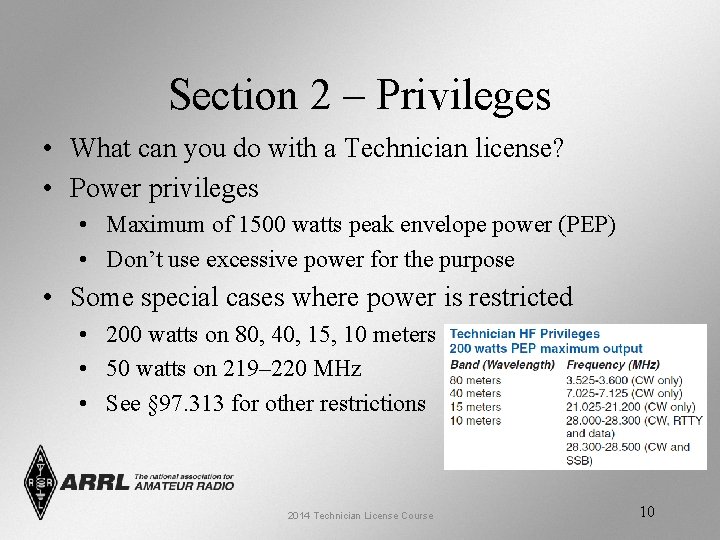
Section 2 – Privileges • What can you do with a Technician license? • Power privileges • Maximum of 1500 watts peak envelope power (PEP) • Don’t use excessive power for the purpose • Some special cases where power is restricted • 200 watts on 80, 40, 15, 10 meters • 50 watts on 219– 220 MHz • See § 97. 313 for other restrictions 2014 Technician License Course 10
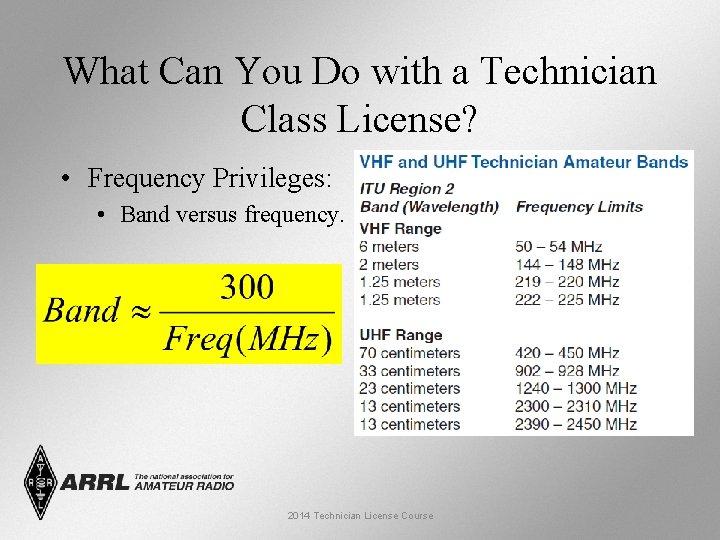
What Can You Do with a Technician Class License? • Frequency Privileges: • Band versus frequency. 2014 Technician License Course
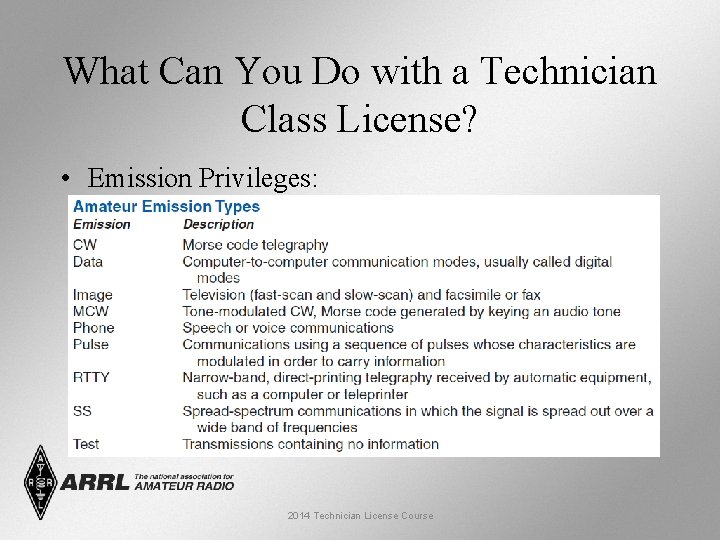
What Can You Do with a Technician Class License? • Emission Privileges: 2014 Technician License Course
Primary and Secondary Allocations • Some authorized amateur frequencies are shared. • Primary Users • Secondary Users – must avoid interfering with users of the primary service 2014 Technician License Course
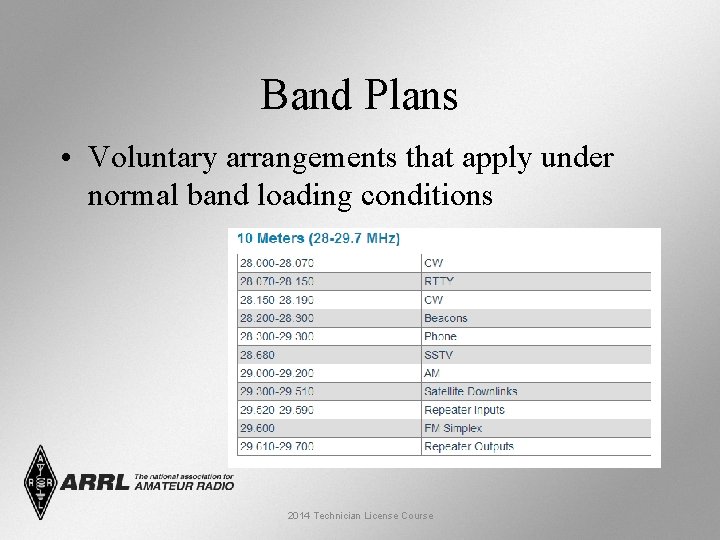
Band Plans • Voluntary arrangements that apply under normal band loading conditions 2014 Technician License Course
Frequency Coordinators • Groups that help allocate repeater channels to minimize interference • Elected by local or regional amateurs • Repeaters approved by the coordinators are coordinated • FCC considers frequency coordination “good amateur practice. ” 2014 Technician License Course
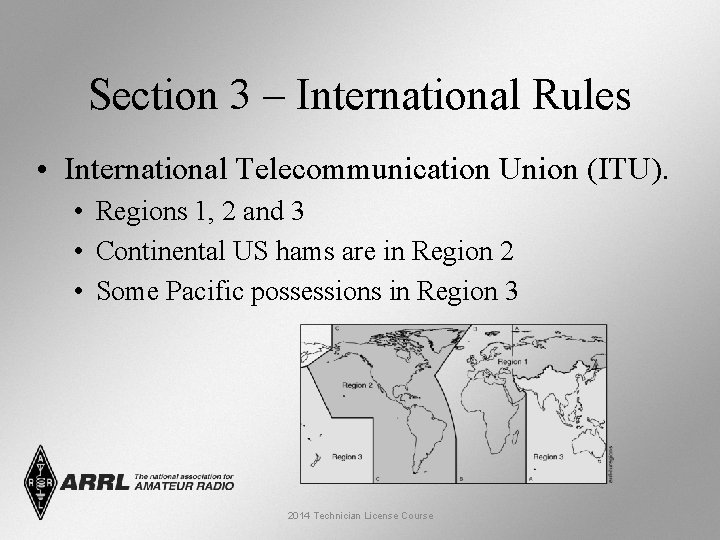
Section 3 – International Rules • International Telecommunication Union (ITU). • Regions 1, 2 and 3 • Continental US hams are in Region 2 • Some Pacific possessions in Region 3 2014 Technician License Course
International Operating Authorization • • Reciprocal operating authority International Amateur Radio Permit (IARP) CEPT licensing ARRL website on international operating • www. arrl. org/international-operating 2014 Technician License Course
International Operating Authorization • Must comply with host country regulations • May operate from US-flagged vessels • Host country’s rules apply in territorial waters • Contacts with other countries must be allowed by that country and by the US • Very rare for contacts to be prohibited! 2014 Technician License Course