Targeting NSP Funds Todd Richardson HUD Office of

- Slides: 15
Targeting NSP Funds Todd Richardson HUD Office of Policy Development and Research
Overview l l Targeting Requirements in NSP HUD’s NSP Allocation Formula l l Statewide allocation Within-state allocations Local NSP Targeting Other Resources
Overview (2) l l All of what I am about to say is on the web: WWW. HUD. GOV/NSP l l l HUD’s Formula Methodology NSP Grantee Data Resources http: //www. huduser. org/publications/commde vl/nsp. html
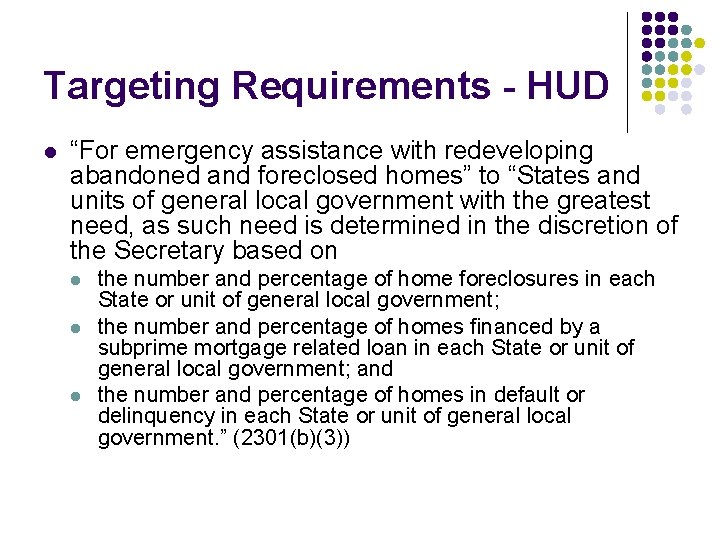
Targeting Requirements - HUD l “For emergency assistance with redeveloping abandoned and foreclosed homes” to “States and units of general local government with the greatest need, as such need is determined in the discretion of the Secretary based on l l l the number and percentage of home foreclosures in each State or unit of general local government; the number and percentage of homes financed by a subprime mortgage related loan in each State or unit of general local government; and the number and percentage of homes in default or delinquency in each State or unit of general local government. ” (2301(b)(3))
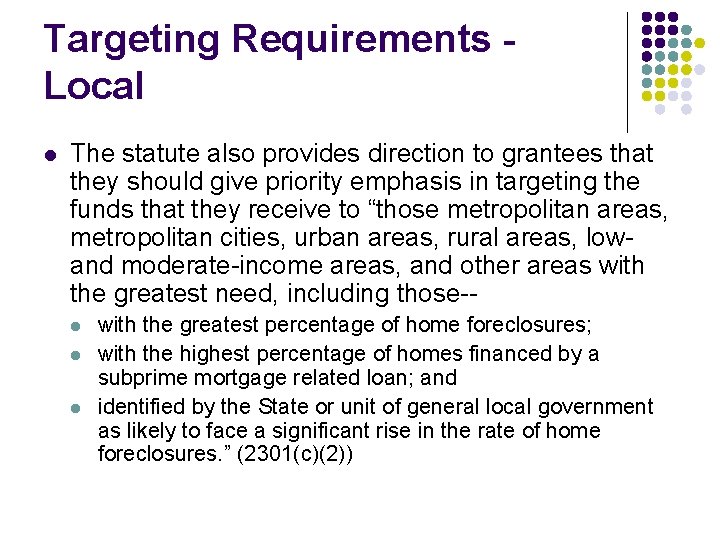
Targeting Requirements Local l The statute also provides direction to grantees that they should give priority emphasis in targeting the funds that they receive to “those metropolitan areas, metropolitan cities, urban areas, rural areas, lowand moderate-income areas, and other areas with the greatest need, including those-l l l with the greatest percentage of home foreclosures; with the highest percentage of homes financed by a subprime mortgage related loan; and identified by the State or unit of general local government as likely to face a significant rise in the rate of home foreclosures. ” (2301(c)(2))
Statewide Allocation l Evaluated multiple data sets for information on foreclosures, subprime loans, defaults/delinquencies l l l Good news – generally, high rate of foreclosure related problems in one data set equaled similarly high rate of foreclosures in other data sets. Bad news – the data sets were not a perfect match; none had 100% coverage, with varying levels of state and regional coverage. Most complete data set for all variables required by statute was Mortgage Bankers Association National Delinquency Survey
Statewide Allocation (2) l MBA National Delinquency Survey Data l l l Statewide data only Only reflects 70% of active mortgages in US, so HUD adjusts its mortgage counts to prevent potential bias due to coverage problems by adjusting counts of mortgages with Census American Community Survey (ACS) and Federal Reserve Home Mortgage Disclosure Act (HMDA) data. USPS Vacancy Data in HMDA High Cost Census Tracts l Calculate a measure of “abandonment risk”
Statewide Allocation (3)
Statewide Allocation (4)
Statewide Allocation (5)
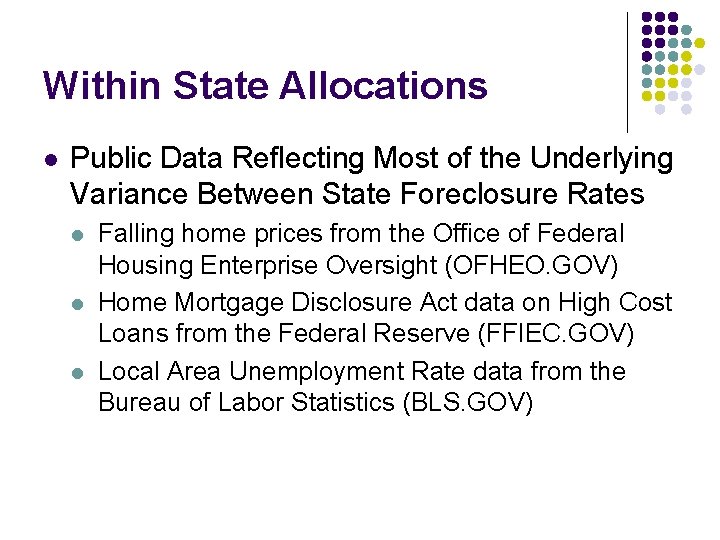
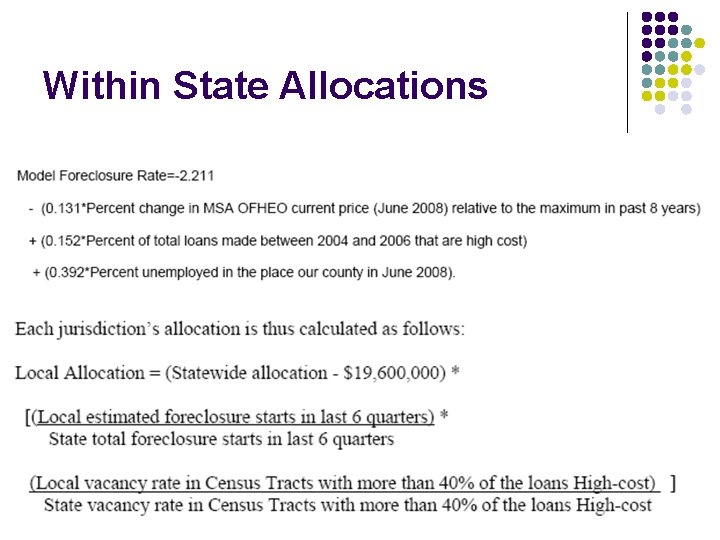
Within State Allocations l Public Data Reflecting Most of the Underlying Variance Between State Foreclosure Rates l l l Falling home prices from the Office of Federal Housing Enterprise Oversight (OFHEO. GOV) Home Mortgage Disclosure Act data on High Cost Loans from the Federal Reserve (FFIEC. GOV) Local Area Unemployment Rate data from the Bureau of Labor Statistics (BLS. GOV)
Within State Allocations
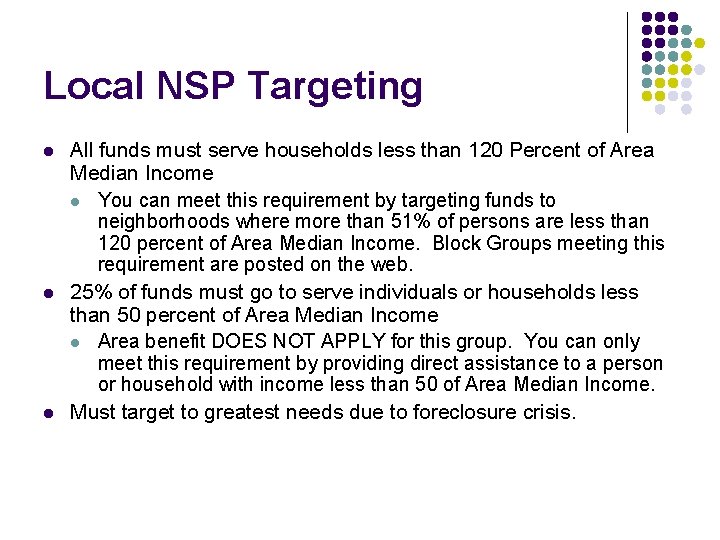
Local NSP Targeting l l l All funds must serve households less than 120 Percent of Area Median Income l You can meet this requirement by targeting funds to neighborhoods where more than 51% of persons are less than 120 percent of Area Median Income. Block Groups meeting this requirement are posted on the web. 25% of funds must go to serve individuals or households less than 50 percent of Area Median Income l Area benefit DOES NOT APPLY for this group. You can only meet this requirement by providing direct assistance to a person or household with income less than 50 of Area Median Income. Must target to greatest needs due to foreclosure crisis.
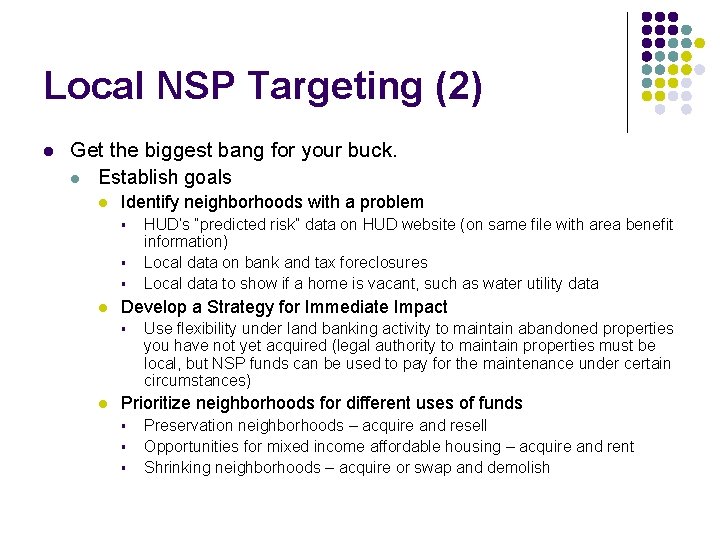
Local NSP Targeting (2) l Get the biggest bang for your buck. l Establish goals l Identify neighborhoods with a problem § § § l Develop a Strategy for Immediate Impact § l HUD’s “predicted risk” data on HUD website (on same file with area benefit information) Local data on bank and tax foreclosures Local data to show if a home is vacant, such as water utility data Use flexibility under land banking activity to maintain abandoned properties you have not yet acquired (legal authority to maintain properties must be local, but NSP funds can be used to pay for the maintenance under certain circumstances) Prioritize neighborhoods for different uses of funds § § § Preservation neighborhoods – acquire and resell Opportunities for mixed income affordable housing – acquire and rent Shrinking neighborhoods – acquire or swap and demolish
Other Resources l l l HUD. GOV HUDUSER. ORG LISC. ORG Enterprise Community Partners (enterprisecommunity. org) National Vacant Properties Campaign (vacantproperties. org) Knowledge. Plex. org / Data. Place. org