Synonyms in modern discourse marking communicative choices Irina
- Slides: 27
Synonyms in modern discourse: marking communicative choices Irina Khoutyz, Kuban State University, (Krasnodar) Re-thinking Synonymy, Helsinki 2010
Presentation Outline p Approaches to the synonymy studies; n Pragmatic synonym; Approach and definition of a The status of new (borrowed) lexis: are these words synonyms, variants, codes? p Characteristics of synonyms borrowed from English (Anglicisms); p Anglicisms as markers of contemporary discourses. p Re-thinking Synonymy, Helsinki 2010
Approaches to the Study of the Synonymy (1) p p General Linguistics: the semantic range of a word can be defined with the assistance of another word that means the same thing, a synonym (Poole 1999: 27); Semantics: part of the semantic fields which serve an important purpose of vocabulary description. Synonymy is described as one of the representations of paradigmatic relations in discourse. The main characteristics of synonyms are: belonging to the same part of speech and the ability to substitute each other without changing the content of the information (Кронгауз 2001: 170). Re-thinking Synonymy, Helsinki 2010
Approaches to the Study of the Synonymy (2) p Discourse analysis: Synonymy enhances one of the most essential qualities of discourse – lexical cohesion (Cutting 2002): n When we arrived in the New World, there was no instruction manual teaching us how to deal with the conditions. …Learning from our mistakes not only allowed us to survive, but also helped us to grow into a powerful and hugely successful country. …Trying, failing, learning from our mistakes, and coming back stronger than ever is an essential part of the American archetype (Rapaille 2006: 134 -135). Re-thinking Synonymy, Helsinki 2010
Coherence in Discourse p A semantic field is built on our associations. This allows those who produce the discourse to represent their ideas using language variety and at the same time making it understandable to other readers (addressees). Re-thinking Synonymy, Helsinki 2010
Approaches to the Study of the Synonymy (3) Theory and Practice of Translation: when producing a high quality translation, it is important to remember that synonymy, as a rule, ‘is not complete equivalence’ (Jacobson 2002: 114). p when translating it is not always easy to find the right synonym, as we deal with ‘difficult synonymy’ and should pay a special attention to semantic space in order to successfully find a corresponding equivalent (Eco 2005). p Re-thinking Synonymy, Helsinki 2010
Approaches to the Study of the Synonymy (4) p p Sociolinguistic Approach: the variants existing in our heterogeneous languages typically correlate with communities within a society, but most speakers use multiple variants, albeit in different proportions. Nevertheless, there appears to be a natural human tendency for a community to select one alternative as the conventional signal for a recurrent coordination problem: a natural human tendency to increase the conventionality of one variant in a community at the expense of another (the First Law of Propagation) (Croft 2000: 176). Re-thinking Synonymy, Helsinki 2010
It is not that simple, is it? p p p the use of content words changes as society changes (Poole 1999). stylistic differences is one of the reasons which may not allow successful substitution of one synonym by another; there are even synonyms which are not interchangeable at all (Кронгауз 2001). synonymy is an example of the many paradigmatic relations between words, however, it is related to the mental organization of vocabularies (Murphy 2003). Re-thinking Synonymy, Helsinki 2010
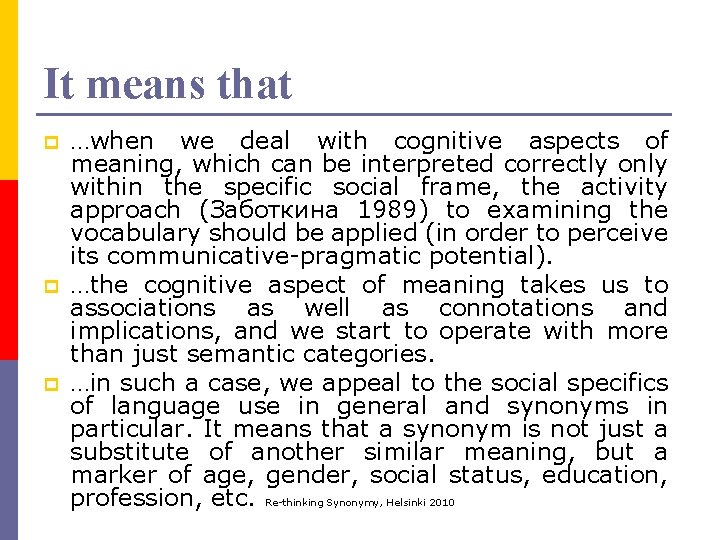
It means that p p p …when we deal with cognitive aspects of meaning, which can be interpreted correctly only within the specific social frame, the activity approach (Заботкина 1989) to examining the vocabulary should be applied (in order to perceive its communicative-pragmatic potential). …the cognitive aspect of meaning takes us to associations as well as connotations and implications, and we start to operate with more than just semantic categories. …in such a case, we appeal to the social specifics of language use in general and synonyms in particular. It means that a synonym is not just a substitute of another similar meaning, but a marker of age, gender, social status, education, profession, etc. Re-thinking Synonymy, Helsinki 2010
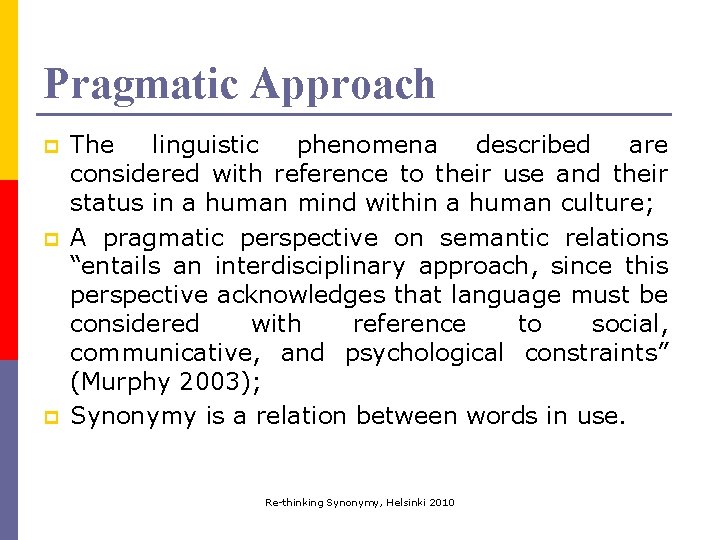
Pragmatic Approach p p p The linguistic phenomena described are considered with reference to their use and their status in a human mind within a human culture; A pragmatic perspective on semantic relations “entails an interdisciplinary approach, since this perspective acknowledges that language must be considered with reference to social, communicative, and psychological constraints” (Murphy 2003); Synonymy is a relation between words in use. Re-thinking Synonymy, Helsinki 2010
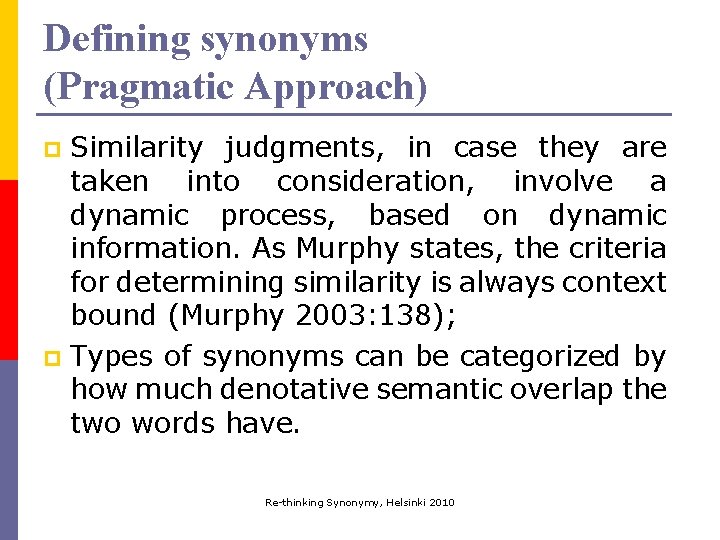
Defining synonyms (Pragmatic Approach) Similarity judgments, in case they are taken into consideration, involve a dynamic process, based on dynamic information. As Murphy states, the criteria for determining similarity is always context bound (Murphy 2003: 138); p Types of synonyms can be categorized by how much denotative semantic overlap the two words have. p Re-thinking Synonymy, Helsinki 2010
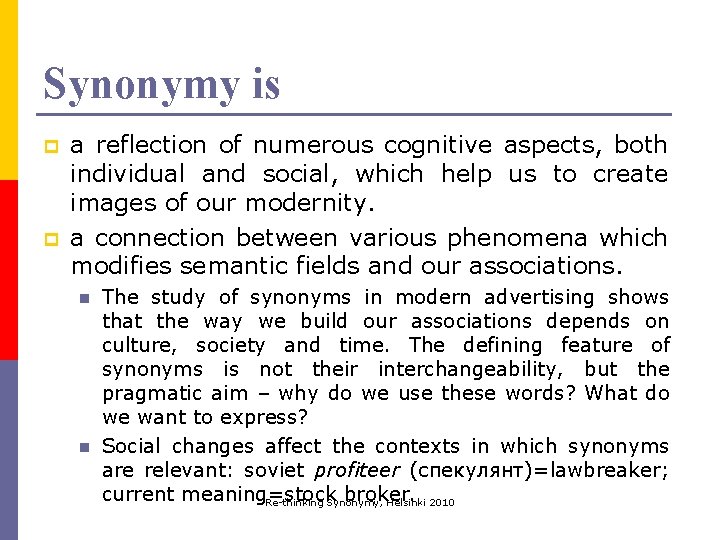
Synonymy is p p a reflection of numerous cognitive aspects, both individual and social, which help us to create images of our modernity. a connection between various phenomena which modifies semantic fields and our associations. n n The study of synonyms in modern advertising shows that the way we build our associations depends on culture, society and time. The defining feature of synonyms is not their interchangeability, but the pragmatic aim – why do we use these words? What do we want to express? Social changes affect the contexts in which synonyms are relevant: soviet profiteer (спекулянт)=lawbreaker; current meaning=stock broker. Re-thinking Synonymy, Helsinki 2010
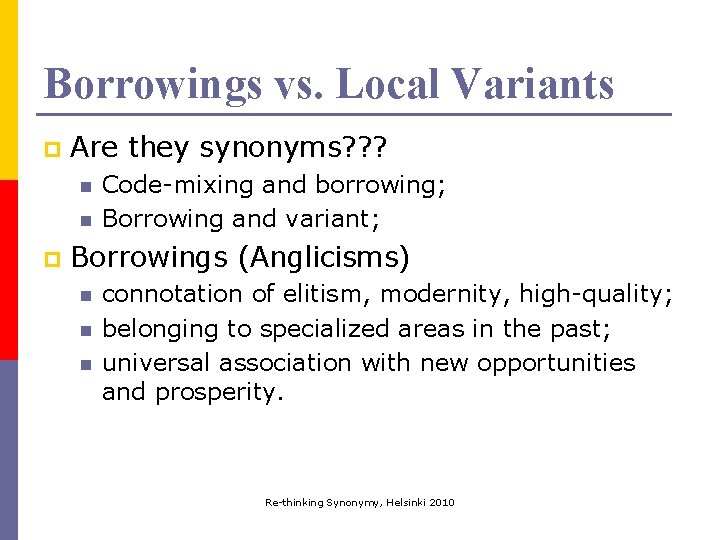
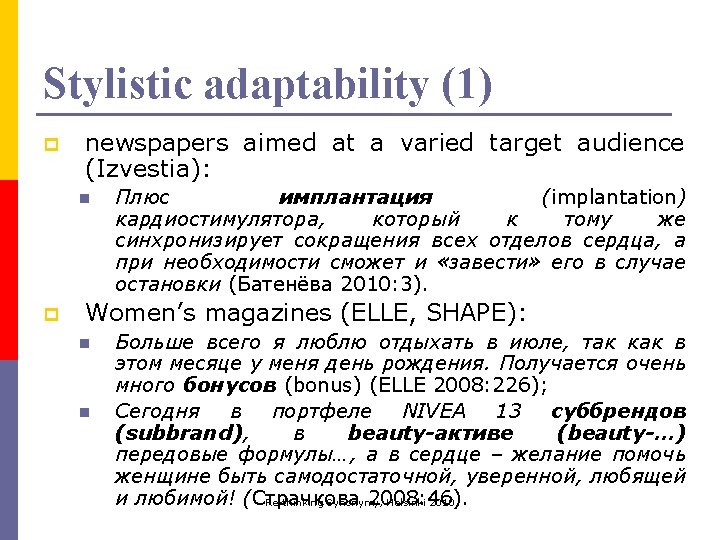
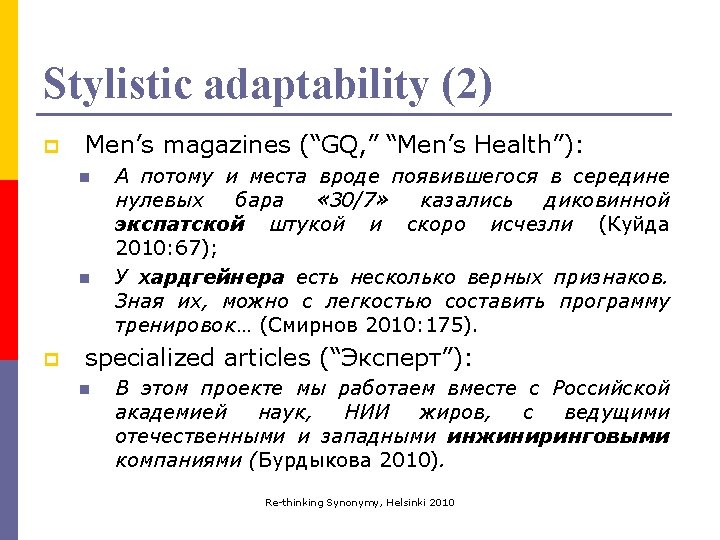
Borrowings vs. Local Variants p Are they synonyms? ? ? n n p Code-mixing and borrowing; Borrowing and variant; Borrowings (Anglicisms) n n n connotation of elitism, modernity, high-quality; belonging to specialized areas in the past; universal association with new opportunities and prosperity. Re-thinking Synonymy, Helsinki 2010
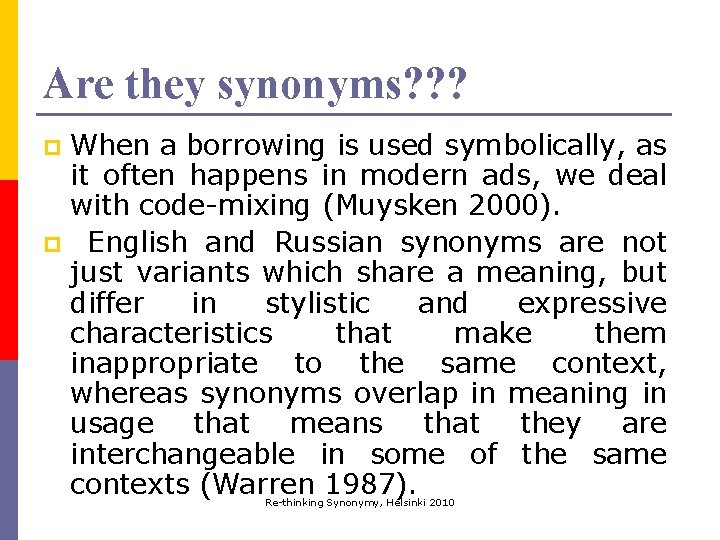
Are they synonyms? ? ? When a borrowing is used symbolically, as it often happens in modern ads, we deal with code-mixing (Muysken 2000). p English and Russian synonyms are not just variants which share a meaning, but differ in stylistic and expressive characteristics that make them inappropriate to the same context, whereas synonyms overlap in meaning in usage that means that they are interchangeable in some of the same contexts (Warren 1987). p Re-thinking Synonymy, Helsinki 2010
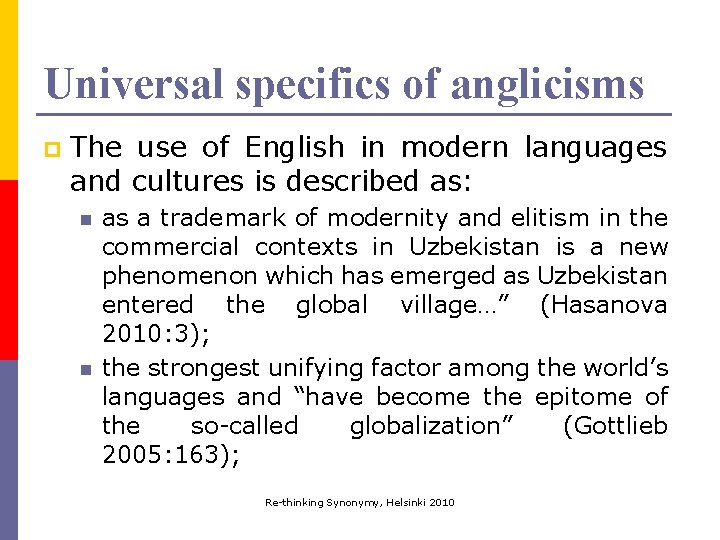
Universal specifics of anglicisms p The use of English in modern languages and cultures is described as: n n as a trademark of modernity and elitism in the commercial contexts in Uzbekistan is a new phenomenon which has emerged as Uzbekistan entered the global village…” (Hasanova 2010: 3); the strongest unifying factor among the world’s languages and “have become the epitome of the so-called globalization” (Gottlieb 2005: 163); Re-thinking Synonymy, Helsinki 2010
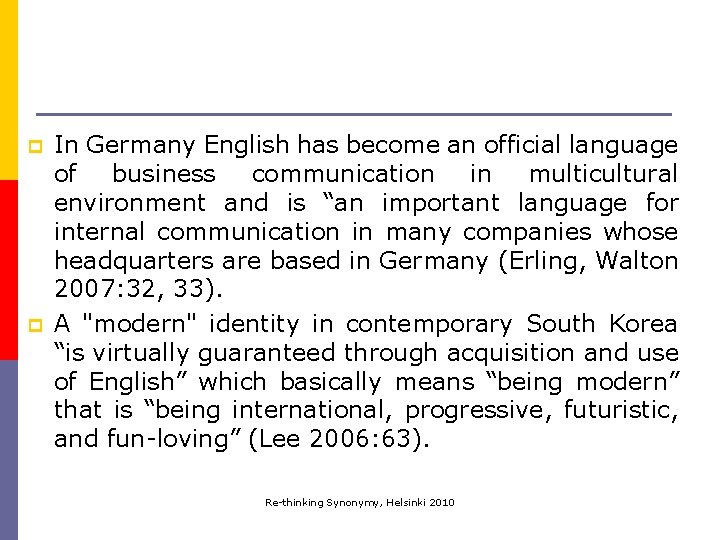
p p In Germany English has become an official language of business communication in multicultural environment and is “an important language for internal communication in many companies whose headquarters are based in Germany (Erling, Walton 2007: 32, 33). A "modern" identity in contemporary South Korea “is virtually guaranteed through acquisition and use of English” which basically means “being modern” that is “being international, progressive, futuristic, and fun-loving” (Lee 2006: 63). Re-thinking Synonymy, Helsinki 2010
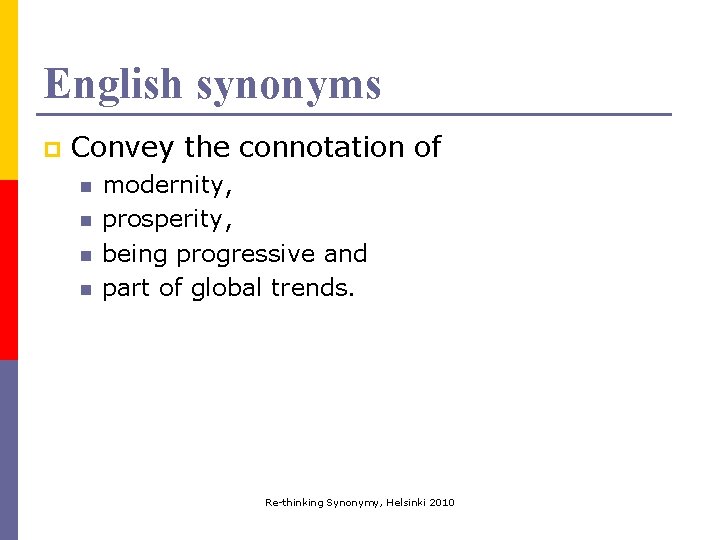
English synonyms p Convey the connotation of n n modernity, prosperity, being progressive and part of global trends. Re-thinking Synonymy, Helsinki 2010
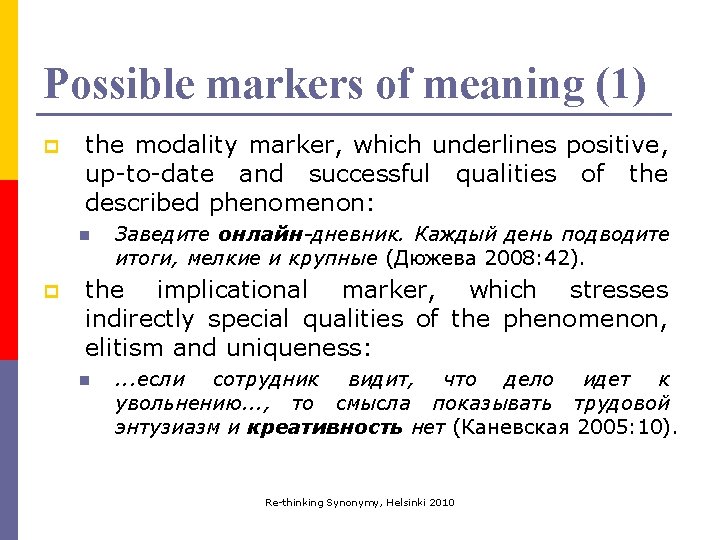
Possible markers of meaning (1) p the modality marker, which underlines positive, up-to-date and successful qualities of the described phenomenon: n p Заведите онлайн-дневник. Каждый день подводите итоги, мелкие и крупные (Дюжева 2008: 42). the implicational marker, which stresses indirectly special qualities of the phenomenon, elitism and uniqueness: n . . . если сотрудник видит, что дело идет к увольнению. . . , то смысла показывать трудовой энтузиазм и креативность нет (Каневская 2005: 10). Re-thinking Synonymy, Helsinki 2010
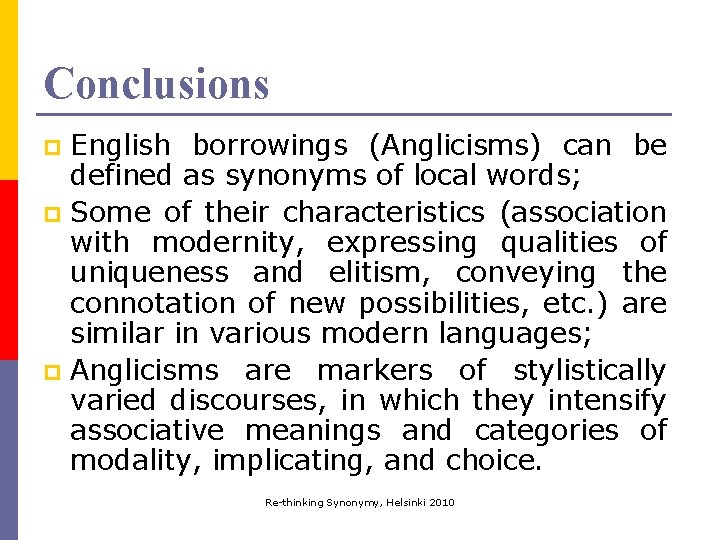
Conclusions English borrowings (Anglicisms) can be defined as synonyms of local words; p Some of their characteristics (association with modernity, expressing qualities of uniqueness and elitism, conveying the connotation of new possibilities, etc. ) are similar in various modern languages; p Anglicisms are markers of stylistically varied discourses, in which they intensify associative meanings and categories of modality, implicating, and choice. p Re-thinking Synonymy, Helsinki 2010
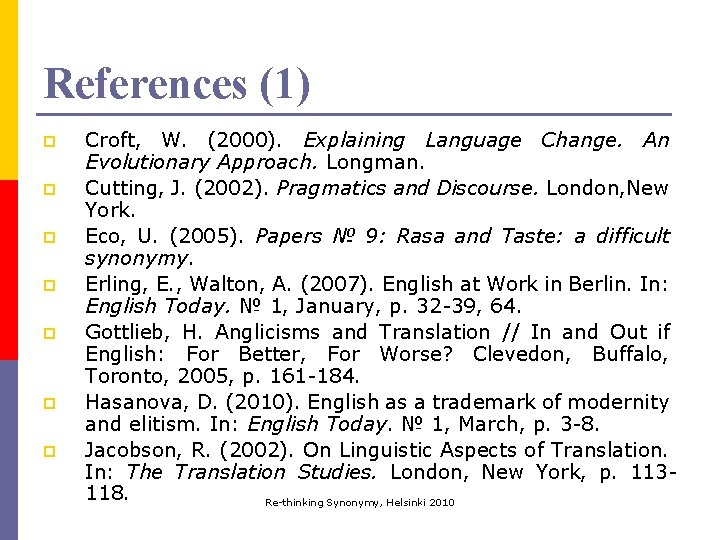
References (1) p p p p Croft, W. (2000). Explaining Language Change. An Evolutionary Approach. Longman. Cutting, J. (2002). Pragmatics and Discourse. London, New York. Eco, U. (2005). Papers № 9: Rasa and Taste: a difficult synonymy. Erling, E. , Walton, A. (2007). English at Work in Berlin. In: English Today. № 1, January, p. 32 -39, 64. Gottlieb, H. Anglicisms and Translation // In and Out if English: For Better, For Worse? Clevedon, Buffalo, Toronto, 2005, p. 161 -184. Hasanova, D. (2010). English as a trademark of modernity and elitism. In: English Today. № 1, March, p. 3 -8. Jacobson, R. (2002). On Linguistic Aspects of Translation. In: The Translation Studies. London, New York, p. 113118. Re-thinking Synonymy, Helsinki 2010
References (2) p p p p Lee, J. (2006). Linguistic constructions of modernity: English mixing in Korean television commercials. In: Language in Society. № 35, p. 59 -91. Murphy, M. Lynne. (2003). Semantic Relations and the Lexicon. Cambridge. Muysken, P. (2000). Bilingual Speech. A Typology of Code -Mixing. Cambridge. Poole, S. (1999). An Introduction to Linguistics. New York. Warren, B. (1987). The dress of thought: Aspects of the study of language. In: Semantics: word meaning. Lund. Rapaille, C. (2006). The Culture Code. New York. Заботкина, В. И. (1989). Новая лексика современного английского языка. Москва. Кронгауз, М. А. (2001). Семантика. Москва. Re-thinking Synonymy, Helsinki 2010
Thank you for your attention! Re-thinking Synonymy, Helsinki 2010