Suspected Spinal Injury New York State Department of
- Slides: 60
Suspected Spinal Injury New York State Department of Health Bureau of Emergency Medical Services
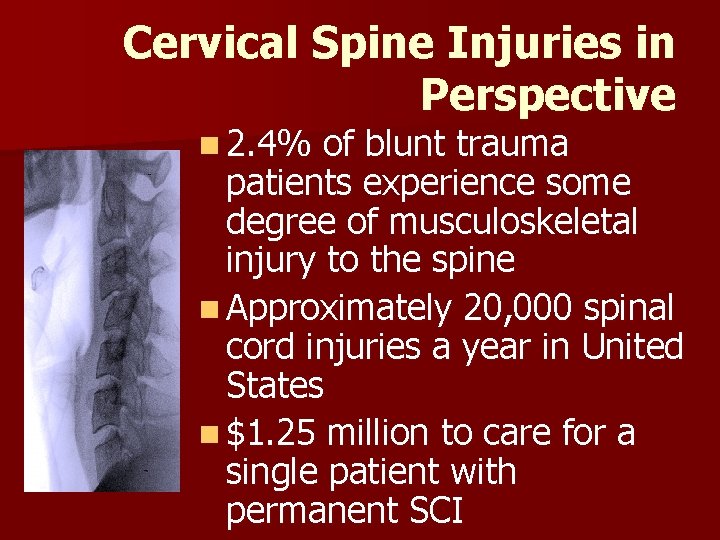
Cervical Spine Injuries in Perspective n 2. 4% of blunt trauma patients experience some degree of musculoskeletal injury to the spine n Approximately 20, 000 spinal cord injuries a year in United States n $1. 25 million to care for a single patient with permanent SCI
n 15, 000 – 20, 000 SCI per year n Higher in men between ages of 16 – 30 n Common causes: § Motor vehicle crashes – 2. 1 million per year (48%) § Falls (21%) § Penetrating injuries (15%) § Sports injuries (14%) n Education in proper handling and transportation can decrease SCI
Historically n Immobilization based on MOI – even if there were no signs and symptoms n Lack of clear clinical guidelines n EMS providers did poorly with full spinal immobilization n Motor vehicles had fewer safety features n Patients spent extended amounts of time in immobilization devices at E. D.
Why not board/collar and Xray everybody? n Immobilization is uncomfortable: increased time immobilized = increased pain, risk of aspiration, vulnerable position, etc. . . n >800, 000 U. S. Patients receive cervical radiography each year n Patient exposure to radiation n >97% of x-rays are negative n Cost exceeds $175, 000 each year
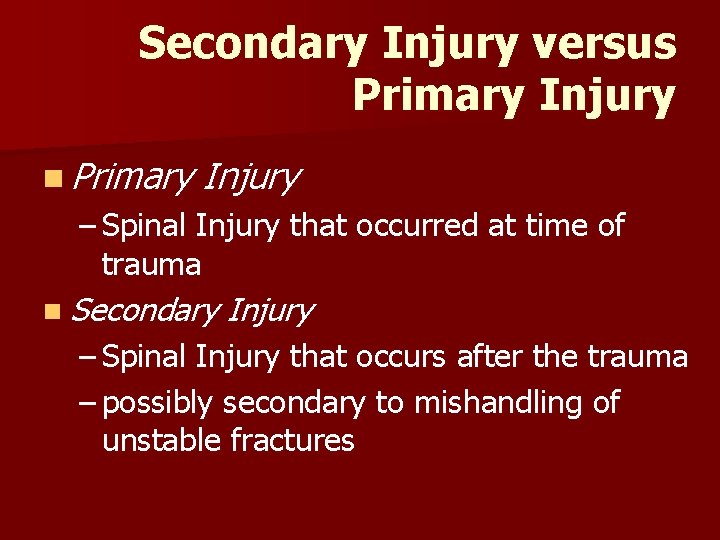
Secondary Injury versus Primary Injury n Primary Injury – Spinal Injury that occurred at time of trauma n Secondary Injury – Spinal Injury that occurs after the trauma – possibly secondary to mishandling of unstable fractures
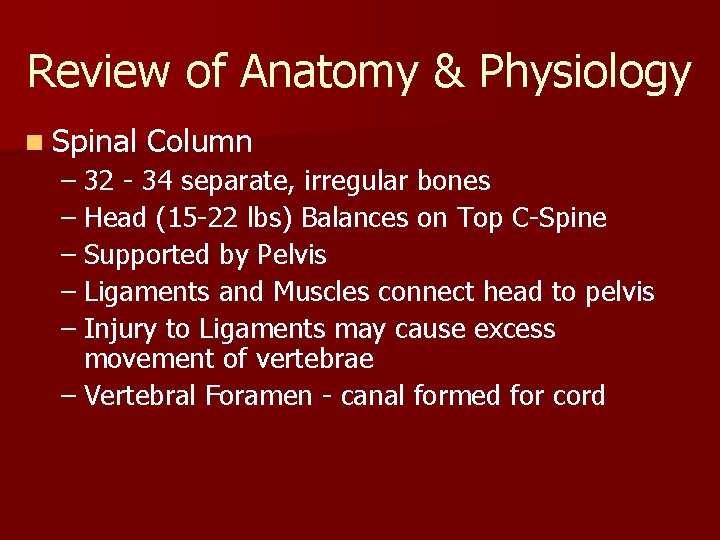
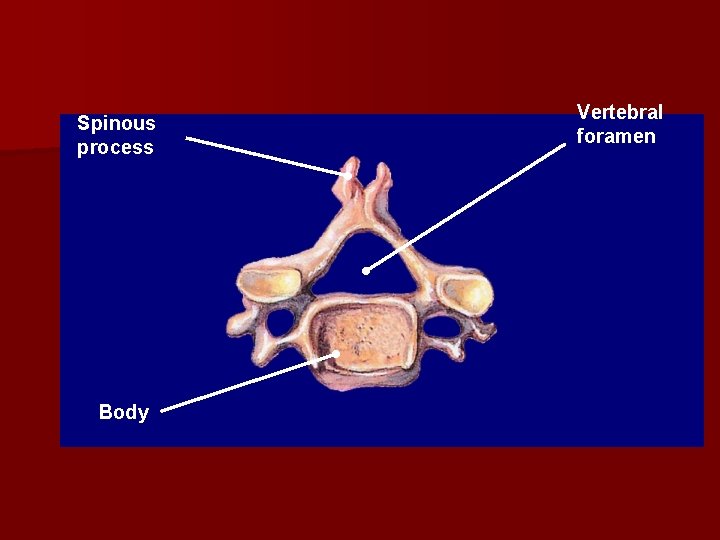
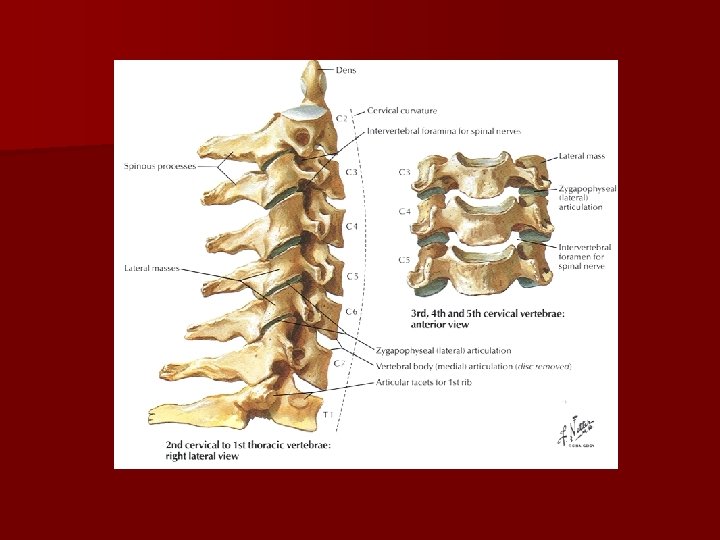
Review of Anatomy & Physiology n Spinal Column – 32 - 34 separate, irregular bones – Head (15 -22 lbs) Balances on Top C-Spine – Supported by Pelvis – Ligaments and Muscles connect head to pelvis – Injury to Ligaments may cause excess movement of vertebrae – Vertebral Foramen - canal formed for cord
Spinous process Body Vertebral foramen
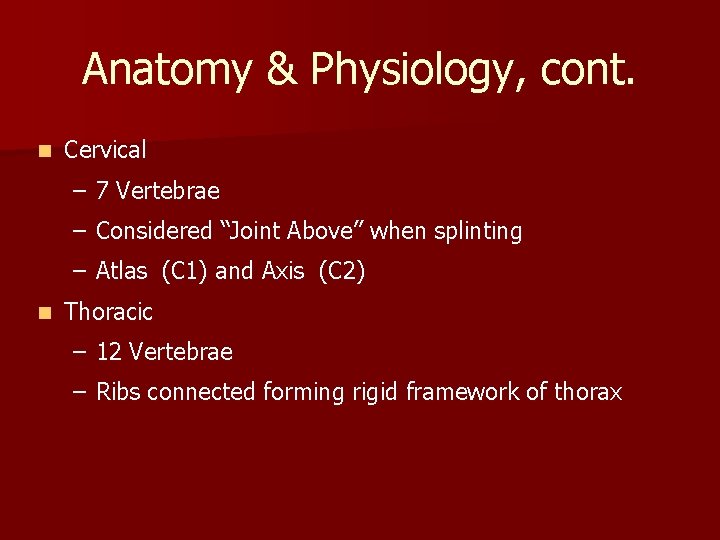
Anatomy & Physiology, cont. n Cervical – 7 Vertebrae – Considered “Joint Above” when splinting – Atlas (C 1) and Axis (C 2) n Thoracic – 12 Vertebrae – Ribs connected forming rigid framework of thorax
Anatomy & Physiology, cont. n Lumbar – 5 Vertebrae (largest vertebral bodies) – Flexible and Carries majority of body weight n Sacrum – 5 fused bones – Considered “Joint Below” with pelvis when splinting
Anatomy & Physiology, cont. n Coccyx – 2 -4 fused bones – “Tailbone” n Vertebral Structures – – Body Transverse Process Spinous Process Intervertebral Disks - fibrocartilage “shock absorber”
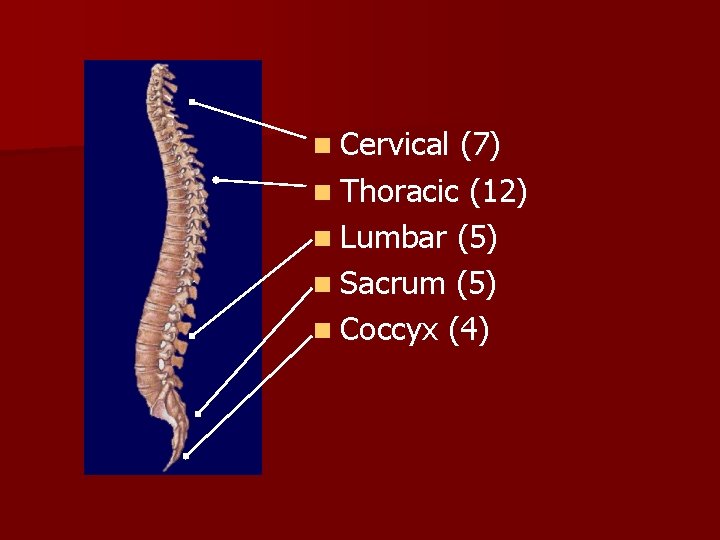
n Cervical (7) n Thoracic (12) n Lumbar (5) n Sacrum (5) n Coccyx (4)
Anatomy & Physiology, cont. n Central Nervous System (CNS) – Brain § § § Largest most complicated portion of CNS Continuous with spinal cord Responsible for all sensory and motor functions – Spinal Cord § Within the Vertebral Column § Begins at Foramen Magnum and ends near L 2 (cauda equina) § Dural Sheath
Anatomy & Physiology, cont. n CNS Cont. – Ascending Nerve Tracts § Carries impulses and sensory information from the body to the brain (I. e. touch, pressure, pain, tenderness, body movements, etc. ) – Descending Nerve Tracts § Carries motor impulses from brain to body (e. g. muscle tone, sweat glands, muscle contraction, control of posture)
Anatomy & Physiology, cont. n CNS Cont. – Spinal Nerves § 31 pairs originating from spinal cord § Mixed Nerves - carry both sensory and motor functions – Dermatones § Topographical region of body surface innervated by one spinal nerve § Example: C-7/T-1 motor = finger abduction and adduction, sensory = little finger
Pathophysiology of Spinal Injuries n Mechanisms and Associated Injuries – Hyperextension – Cervical & Lumbar Spine – Disk disruption – Compression of ligaments – Fx with potential instability and bone displacement – Hyperflexion – – – Cervical & Lumbar Spine Wedge Fx Stretching of ligaments Compression Injury of cord Disk disruption with potential vertebrae dislocation
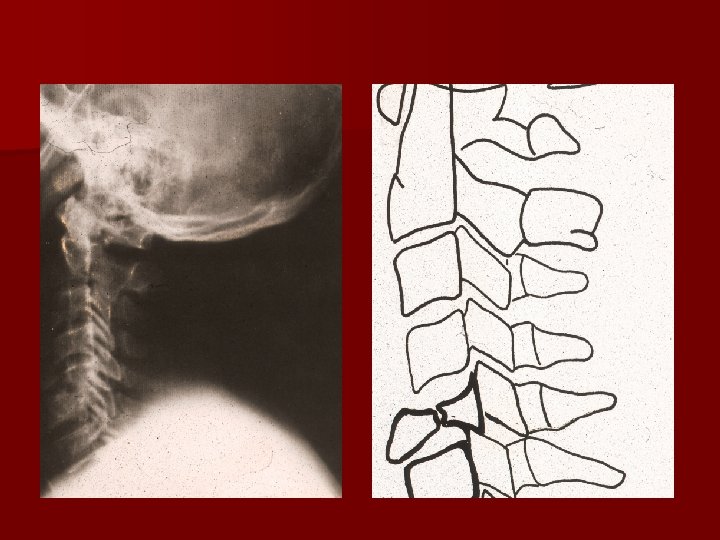
Pathophysiology, cont. (Mechanisms and Common Injuries) – Rotational – – Most commonly Cervical Spine but potentially in Lumbar Spine Stretching and tearing of ligaments Rotational subluxation and dislocation Fx – Compression – – – Most likely between T 12 and L 2 Compression fx Ruptured disk
Pathophysiology, cont. (Mechanisms and Common Injuries) – Distraction – Most common in upper Cervical Spine – Stretching of cord without damage to spinal column – Penetrating – Forces directly to spinal column – Disruption of ligaments – Fx – Direct damage to cord
Pathophysiology, cont. n Specific Injuries – Fractures to vertebrae – Tearing of Ligaments, Tendons and/or Muscles – Dislocation or Subluxation of vertebrae – Disk herniation / rupture
Pathophysiology, cont. (Specific Injuries) – Cord Injuries – Concussion - temporary or transient disruption of cord function – Contusion - Bruising of the cord with associated tissue damage, swelling and vascular leaking – Compression - Pressure on cord secondary to vertebrae displacement, disk herniation and/or associated swelling
Pathophysiology, cont. (Specific Injuries) – Cord Injuries cont. § Laceration - Direct damage to cord with associated bleeding, swelling and potential disruption of cord § Hemorrhage - Often associated with a contusion, laceration or stretching injury that disrupts blood flow, applies pressure secondary to blood accumulation, and/or irritation due to blood crossing blood-brain barrier. § Transection - Partial or complete severing of cord
Pathophysiology, cont. (Specific Injuries) – Spinal Shock § Temporary insult affecting body below level of the injury – Flaccidity and decreased sensation – Hypotension – Loss of bladder and/or bowel control – Priapism – Loss of temperature control – Often transient if no significant damage to cord
Pathophysiology, cont. (Specific Injuries) – Neurogenic Shock § Injury disrupts brain’s control over body – lack of sympathetic tone – Arterial and vein dilation causing relative hypovolemia – Decreased cardiac output – Decrease release of epinephrine § Decreased BP § Decreased HR § Decreased Vasoconstriction
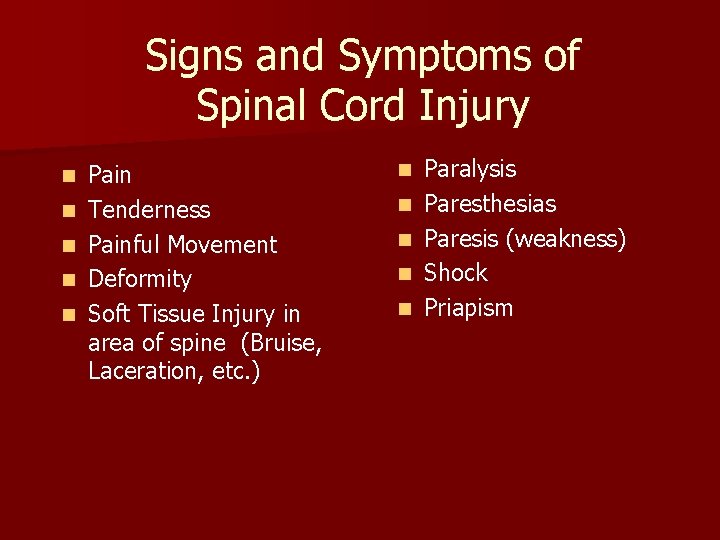
Signs and Symptoms of Spinal Cord Injury n n n Pain Tenderness Painful Movement Deformity Soft Tissue Injury in area of spine (Bruise, Laceration, etc. ) n n n Paralysis Paresthesias Paresis (weakness) Shock Priapism
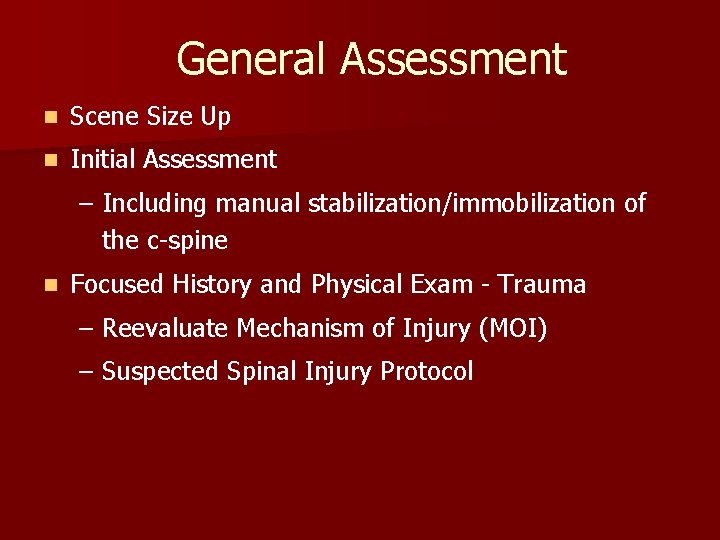
General Assessment n Scene Size Up n Initial Assessment – Including manual stabilization/immobilization of the c-spine n Focused History and Physical Exam - Trauma – Reevaluate Mechanism of Injury (MOI) – Suspected Spinal Injury Protocol
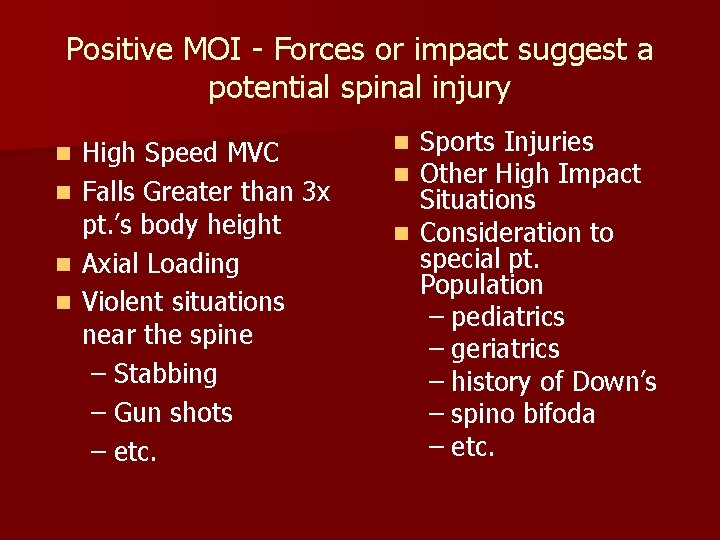
Positive MOI - Forces or impact suggest a potential spinal injury n n High Speed MVC Falls Greater than 3 x pt. ’s body height Axial Loading Violent situations near the spine – Stabbing – Gun shots – etc. Sports Injuries Other High Impact Situations n Consideration to special pt. Population – pediatrics – geriatrics – history of Down’s – spino bifoda – etc. n n
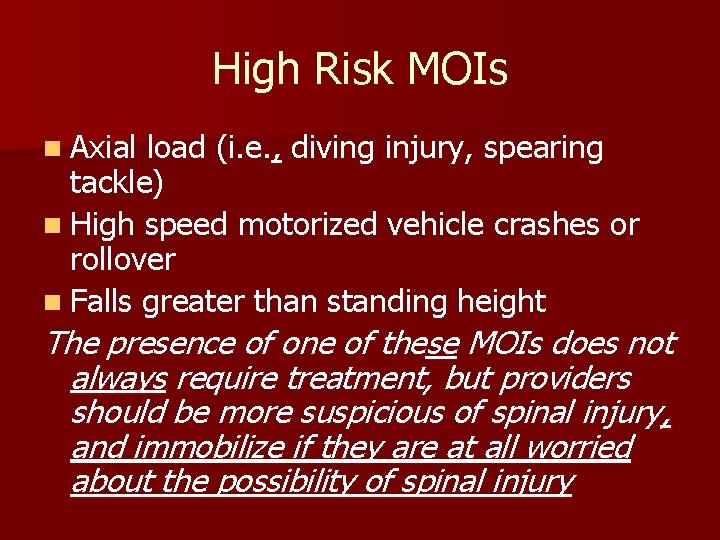
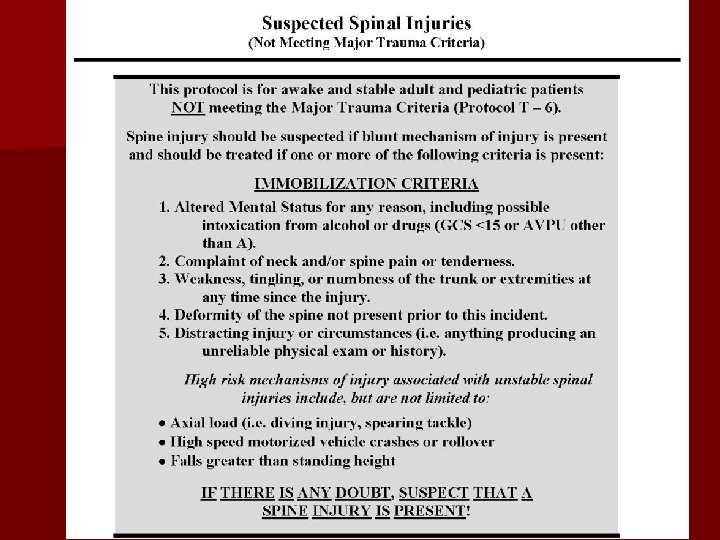
High Risk MOIs n Axial load (i. e. , diving injury, spearing tackle) n High speed motorized vehicle crashes or rollover n Falls greater than standing height The presence of one of these MOIs does not always require treatment, but providers should be more suspicious of spinal injury, and immobilize if they are at all worried about the possibility of spinal injury
Other High Risk Factors Associated with Spinal Injury n Trisomy 21 (Down Syndrome, mongolism) – Risk of Atlanto-Axial Instability (AAI) n Age Greater than 55 – Risk of degenerative arthritis of cervical spine n Degenerative Bone Disease (including ostegenesis imperfecta, or “fragile bones”) – Risk of “pathological” (disease-related) fractures n Spinal Tumors – Risk of “pathological” (disease-related) fractures
Negative MOI n Forces or impact involved does not suggest a potential spinal injury – Dropping rock on foot – Twisting ankle while running – Isolated soft tissue injury
Uncertain MOI n Unclear or uncertainty regarding the impact or forces – Trip and fall hitting head – Fall from 2 -4 feet – Low speed MVC with minor damage
MOI, cont. When using the Suspected Spinal Injury protocol, a positive mechanism of injury is not considered means to necessitate full immobilization … BUT… should be used as a historical component that may heighten a provider’s suspicion for a spinal cord injury.
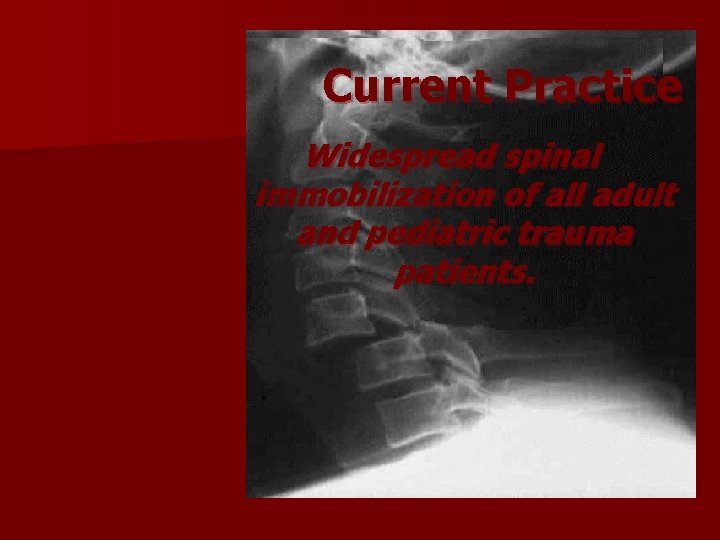
Current Practice Widespread spinal immobilization of all adult and pediatric trauma patients.
Spinal Immobilization Education – Identify All Patients at Risk for Spinal Injury based on Mechanism of Injury and Patient Assessment – Shift from current thinking of immobilization based on mechanism of injury alone.
History of Spinal Immobilization n Maine Selective Spinal Immobilization – Early Leaders in Out – of – Hospital Selective Spinal Immobilization n National Emergency X-Radiography Utilization Study (NEXUS)
Spinal Immobilization Protocols in New York State The following groups of patient should be immobilized!
Major Trauma Protocol n All Adult and Pediatric Trauma Patients who meet the Major Trauma Protocols (T 6– 7) n Certain Adult and Pediatric Patients with Blunt Head and Neck Trauma i. e. Based on Mechanism of Injury (T 8)
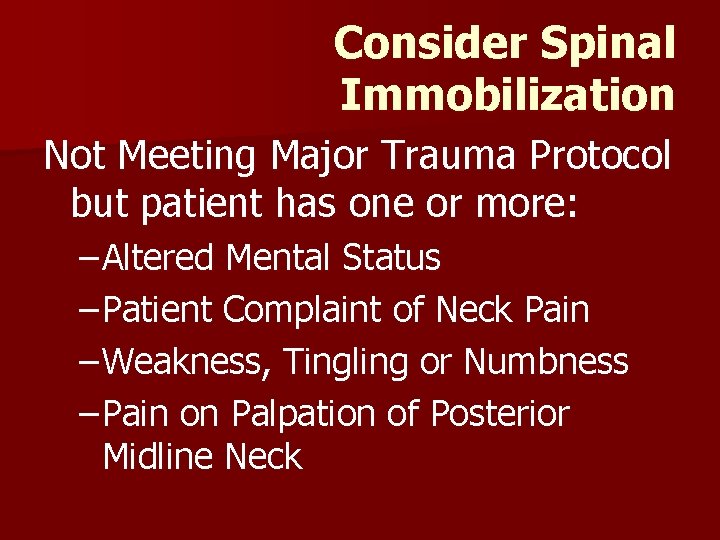
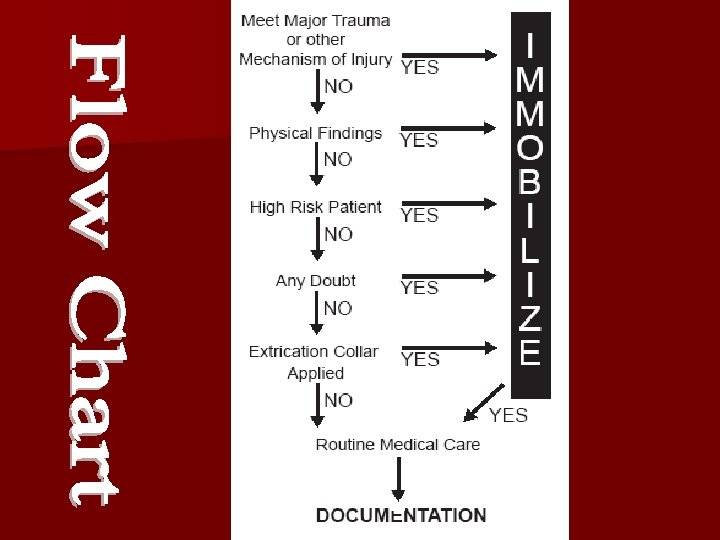
Consider Spinal Immobilization Not Meeting Major Trauma Protocol but patient has one or more: – Altered Mental Status – Patient Complaint of Neck Pain – Weakness, Tingling or Numbness – Pain on Palpation of Posterior Midline Neck
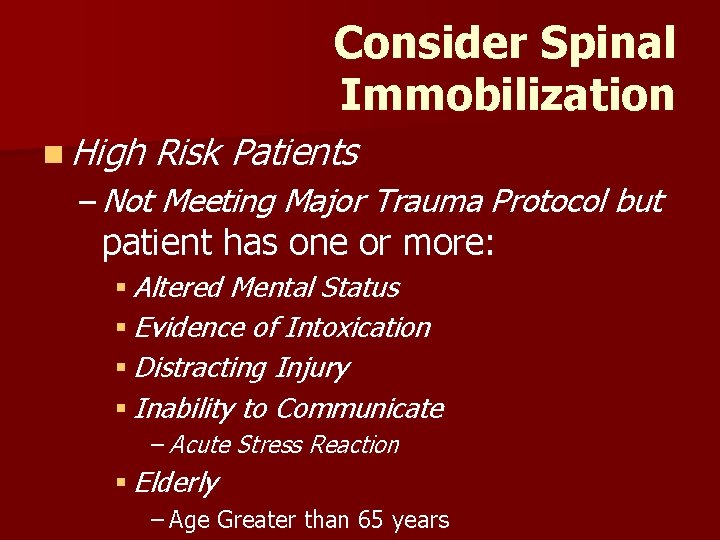
Consider Spinal Immobilization n High Risk Patients – Not Meeting Major Trauma Protocol but patient has one or more: § Altered Mental Status § Evidence of Intoxication § Distracting Injury § Inability to Communicate – Acute Stress Reaction § Elderly – Age Greater than 65 years
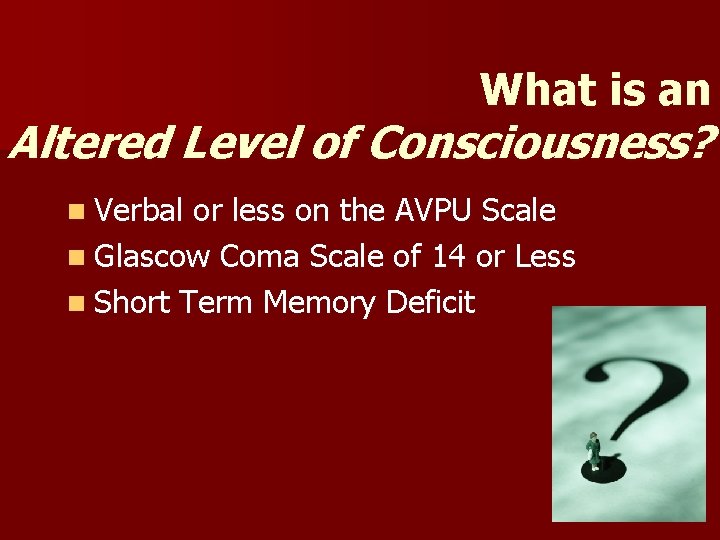
What is an Altered Level of Consciousness? n Verbal or less on the AVPU Scale n Glascow Coma Scale of 14 or Less n Short Term Memory Deficit
What is n Patients Intoxication? who have either – A History of Recent Alcohol Ingestion or Ingestion of Other Intoxicants – Evidence of Intoxication on Physical Examination
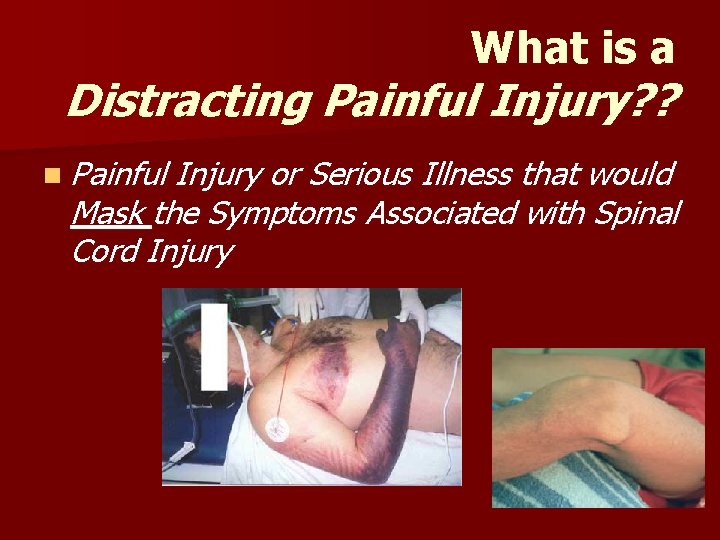
What is a Distracting Painful Injury? ? n Painful Injury or Serious Illness that would Mask the Symptoms Associated with Spinal Cord Injury
Distracting Injury or Circumstances n Painful Injury – – Obvious Deformity Significant Bleeding Impaled Object Any painful injury that may distract the patient’s attention from another, potentially more serious (cervical spine) injury Inability to Communicate Clearly (small child, confused or intoxicated adult) n Emotional Distress n Presence or Exacerbation of Existing Medical Conditions n
Fundamental Principle n Patient Communication – Patients with Communication Difficulties – Acute Stress Reaction
What is Acute Stress Reaction? n. A “fight or flight” response that can override any pain from an injury
Key Point n If there is ANY DOUBT, then SUSPECT that a SPINE INJURY is Present and Treat Accordingly
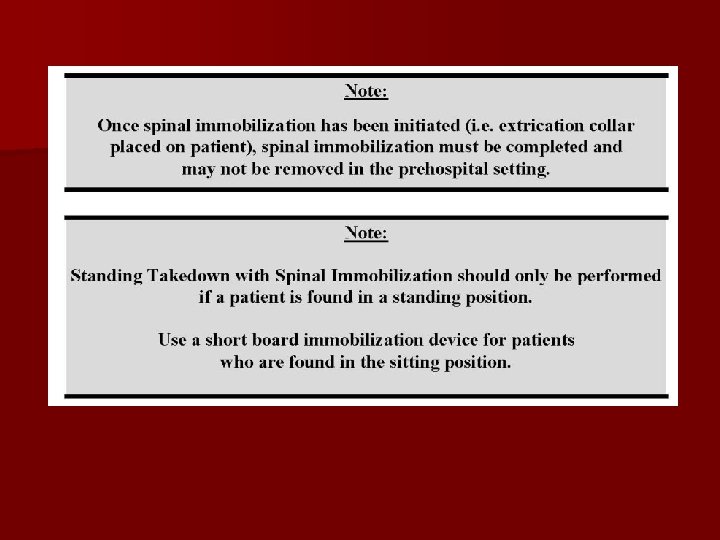
Termination of Immobilization Once spinal immobilization has been initiated, it must be completed. An extrication or cervical collar starts the immobilization process Manual Stabilization does NOT start the immobilization process
Documentation n Negligence –Either an omission or a commission of an act § Documentation of rationale to –Immobilize –Not Immobilize
Routine Prehospital Care Documentation n Mechanism Of Injury n Patient Chief Complaint n Physical Examination Finding – Initial Assessment – Rapid Trauma Examination – Detailed Trauma Examination
Documentation of Rationale to Not Immobilize n Mechanism Of Injury is Minor – Physical Examination (Positives) – Physical Examination (Negatives) § Absence of signs of spine injury § Absence of distracting injury – Patient was not one of the identified high risk patients
New NYS BLS Protocol Suspected Spinal Injury (not meeting major trauma criteria)
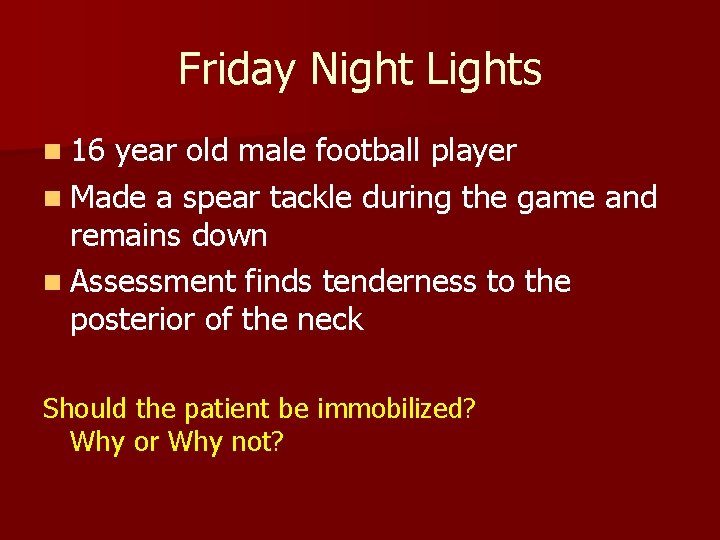
Friday Night Lights n 16 year old male football player n Made a spear tackle during the game and remains down n Assessment finds tenderness to the posterior of the neck Should the patient be immobilized? Why or Why not?
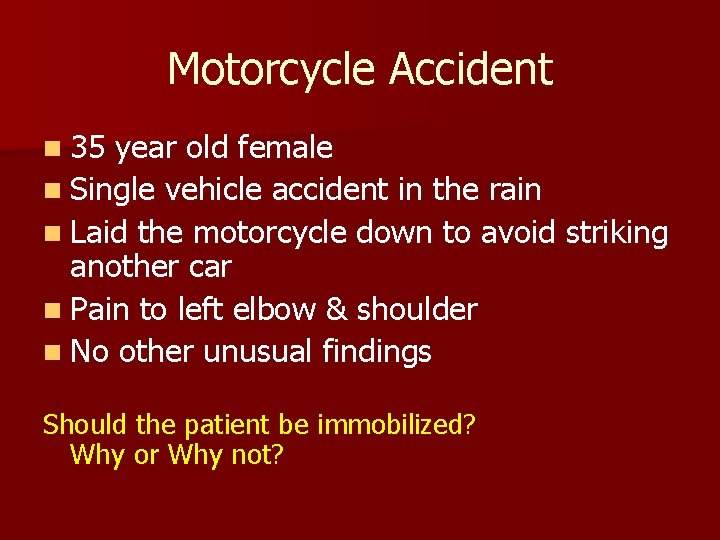
Motorcycle Accident n 35 year old female n Single vehicle accident in the rain n Laid the motorcycle down to avoid striking another car n Pain to left elbow & shoulder n No other unusual findings Should the patient be immobilized? Why or Why not?
Two Cars, Two Drivers n Driver #1 – Ambulatory, Agitated, 50 year old male – Rear ended by driver # 2 at a stoplight n Driver #2 – Belted and still in vehicle 19 year old female – Couldn’t stop in time, struck other vehicle Should either patient be immobilized? Why or Why not?
QA/QI n Regional review of PCRs. n Agency increased review of all PCRs where spinal immobilization was not used. n On-going education of providers
First, do no harm n Good Medical Care requires good clinical judgment; this can not be defined or legislated, but must be employed. n When in doubt, decide in favor of the patient and immobilize the spine.