Survey of Eye Tracking Techniques PSYC 736 Spring

- Slides: 33
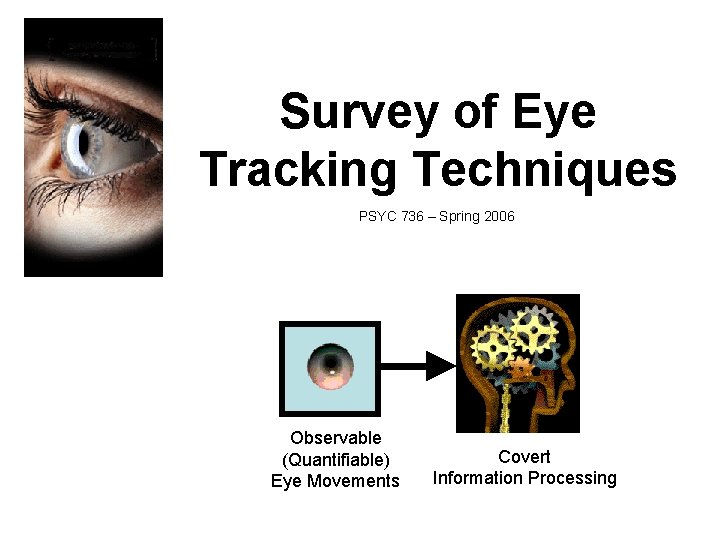
Survey of Eye Tracking Techniques PSYC 736 – Spring 2006 Observable (Quantifiable) Eye Movements Covert Information Processing
Introduction
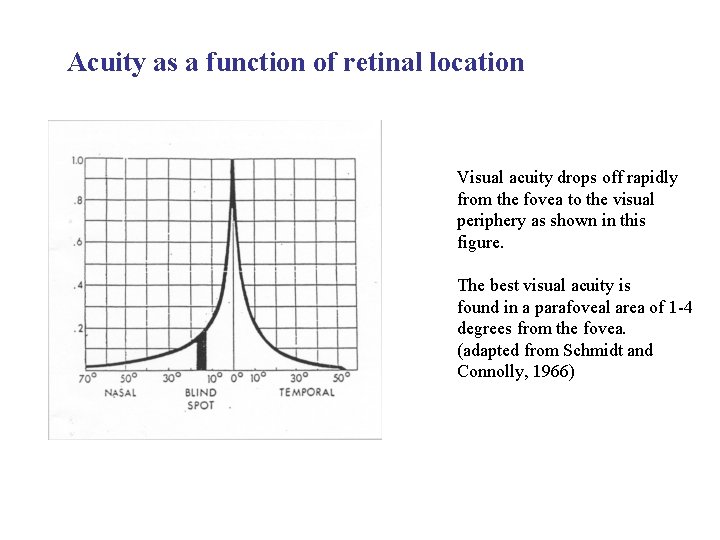
Acuity as a function of retinal location Visual acuity drops off rapidly from the fovea to the visual periphery as shown in this figure. The best visual acuity is found in a parafoveal area of 1 -4 degrees from the fovea. (adapted from Schmidt and Connolly, 1966)
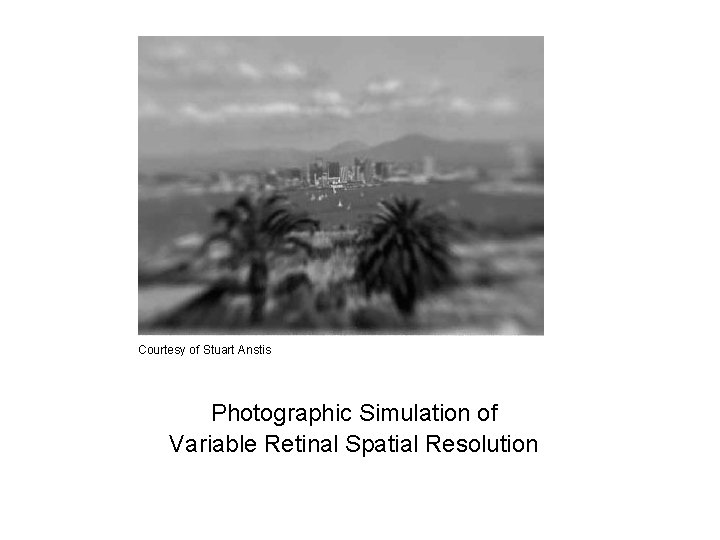
Courtesy of Stuart Anstis Photographic Simulation of Variable Retinal Spatial Resolution
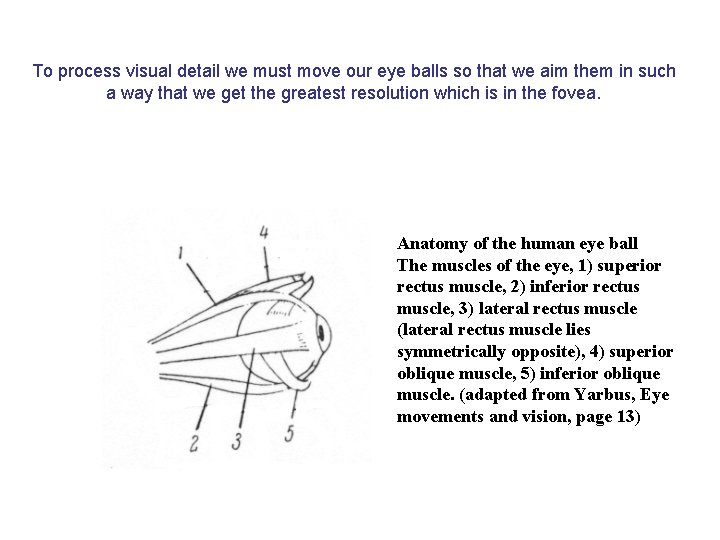
To process visual detail we must move our eye balls so that we aim them in such a way that we get the greatest resolution which is in the fovea. Anatomy of the human eye ball The muscles of the eye, 1) superior rectus muscle, 2) inferior rectus muscle, 3) lateral rectus muscle (lateral rectus muscle lies symmetrically opposite), 4) superior oblique muscle, 5) inferior oblique muscle. (adapted from Yarbus, Eye movements and vision, page 13)
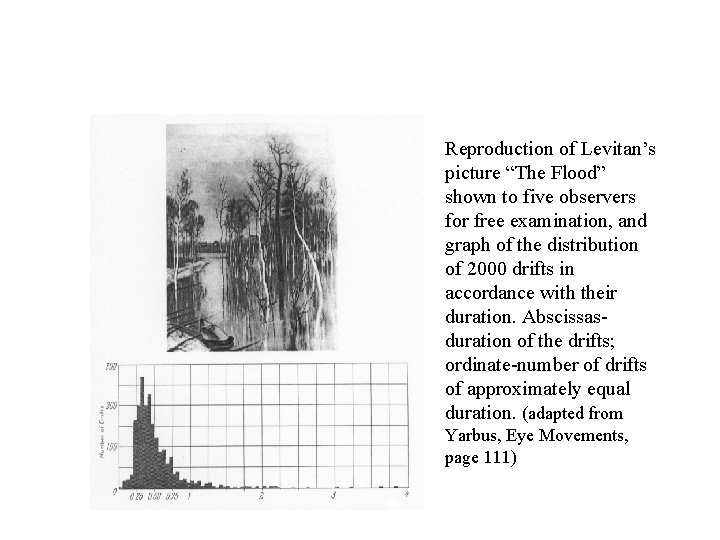
Reproduction of Levitan’s picture “The Flood” shown to five observers for free examination, and graph of the distribution of 2000 drifts in accordance with their duration. Abscissasduration of the drifts; ordinate-number of drifts of approximately equal duration. (adapted from Yarbus, Eye Movements, page 111)
Usually an eye fixation takes about 0. 4 seconds (2. 5 fixations/second) 60*2. 5=150 eye fixations/minute 60*150=9000 eye fixations/hour 16*9000=144000 eye fixations/day 144000 is an average number of eye fixations per day or a number of visual details processed per day Usually the brain processes all visual information taken during a fixation and initiates the execution of the any action, if any execution is required. If too much information or uncertainty is present, then another fixation is necessary.
Eye Tracking Techniques • Electrooculography (EOG) • Contact Lens Techniques a. Scleral coil b. Mirror reflector • Limbus Tracker • Video-based Pupil/Corneal Reflection • Dual Purkinje Image • Subjective Video Analysis
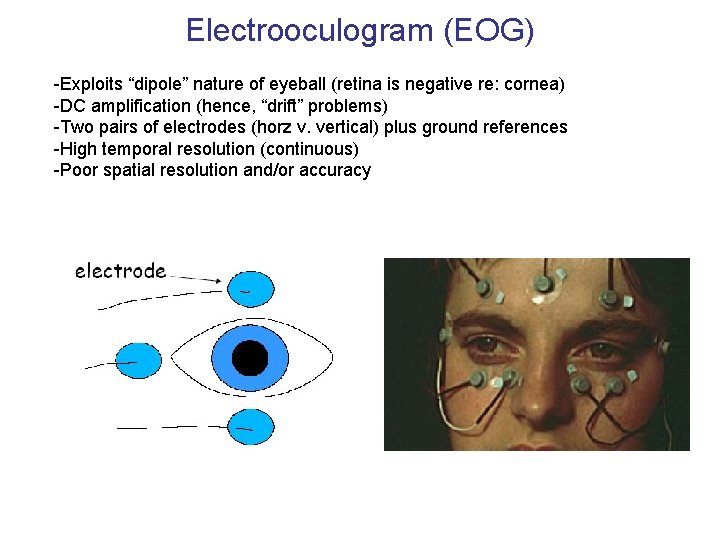
Electrooculogram (EOG) -Exploits “dipole” nature of eyeball (retina is negative re: cornea) -DC amplification (hence, “drift” problems) -Two pairs of electrodes (horz v. vertical) plus ground references -High temporal resolution (continuous) -Poor spatial resolution and/or accuracy
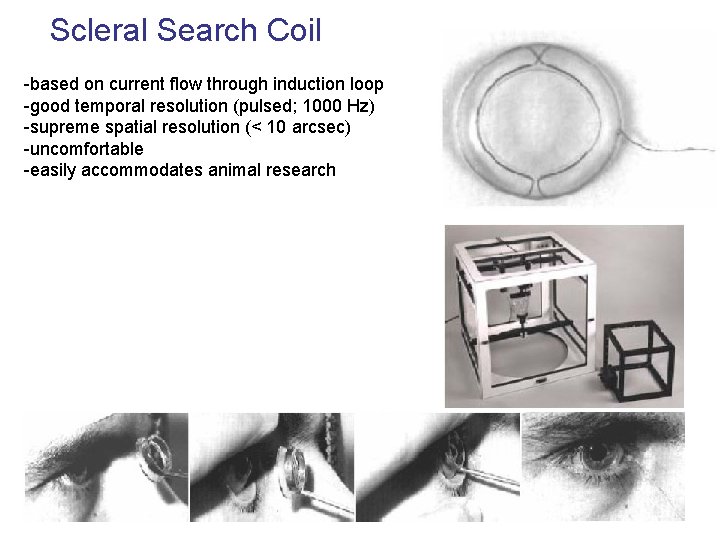
Scleral Search Coil -based on current flow through induction loop -good temporal resolution (pulsed; 1000 Hz) -supreme spatial resolution (< 10 arcsec) -uncomfortable -easily accommodates animal research
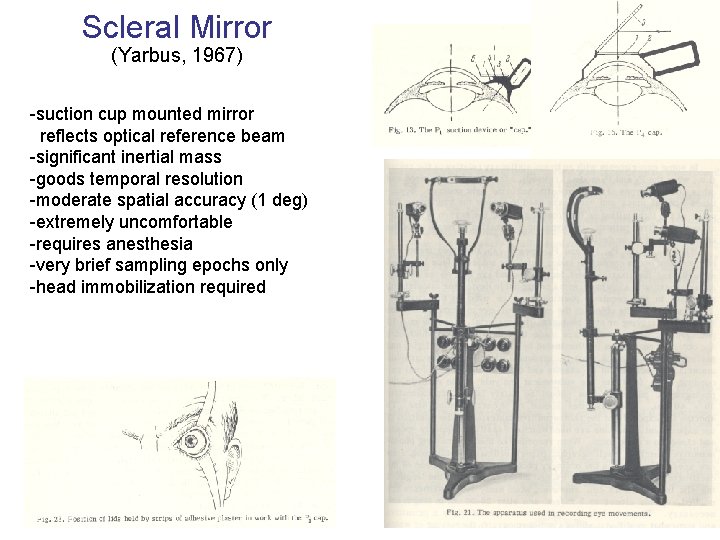
Scleral Mirror (Yarbus, 1967) -suction cup mounted mirror reflects optical reference beam -significant inertial mass -goods temporal resolution -moderate spatial accuracy (1 deg) -extremely uncomfortable -requires anesthesia -very brief sampling epochs only -head immobilization required
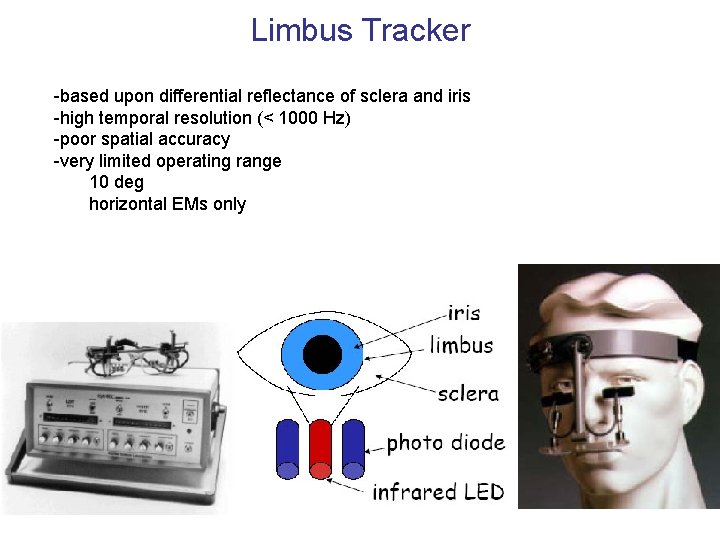
Limbus Tracker -based upon differential reflectance of sclera and iris -high temporal resolution (< 1000 Hz) -poor spatial accuracy -very limited operating range 10 deg horizontal EMs only
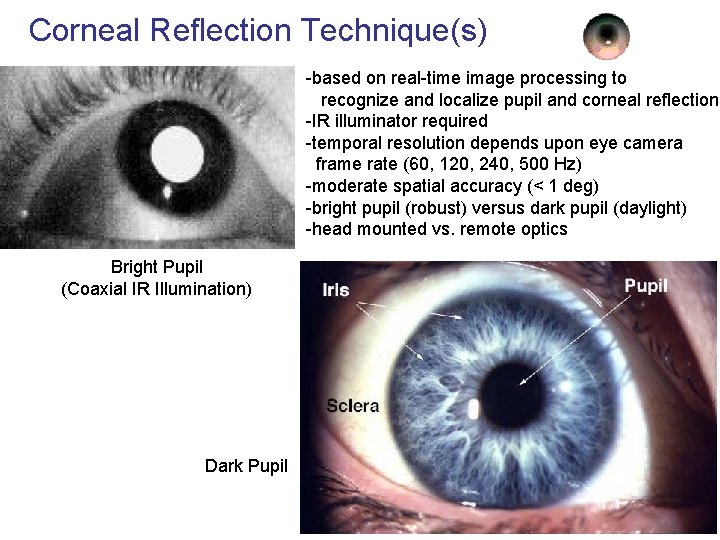
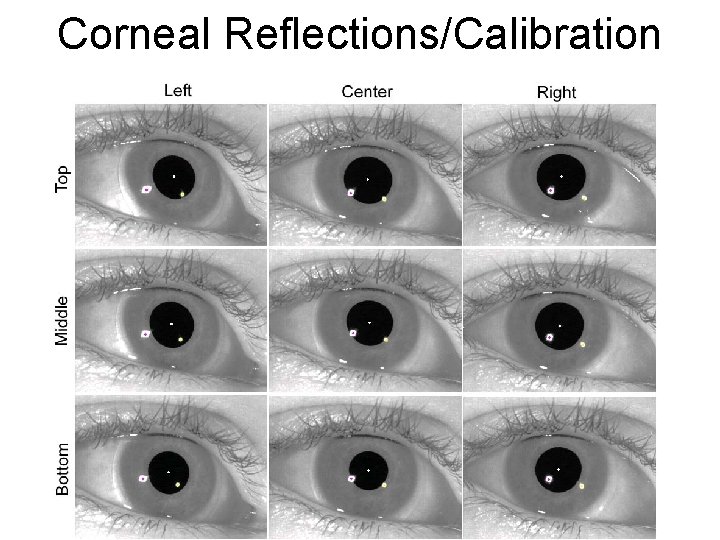
Corneal Reflection Technique(s) -based on real-time image processing to recognize and localize pupil and corneal reflection -IR illuminator required -temporal resolution depends upon eye camera frame rate (60, 120, 240, 500 Hz) -moderate spatial accuracy (< 1 deg) -bright pupil (robust) versus dark pupil (daylight) -head mounted vs. remote optics Bright Pupil (Coaxial IR Illumination) Dark Pupil
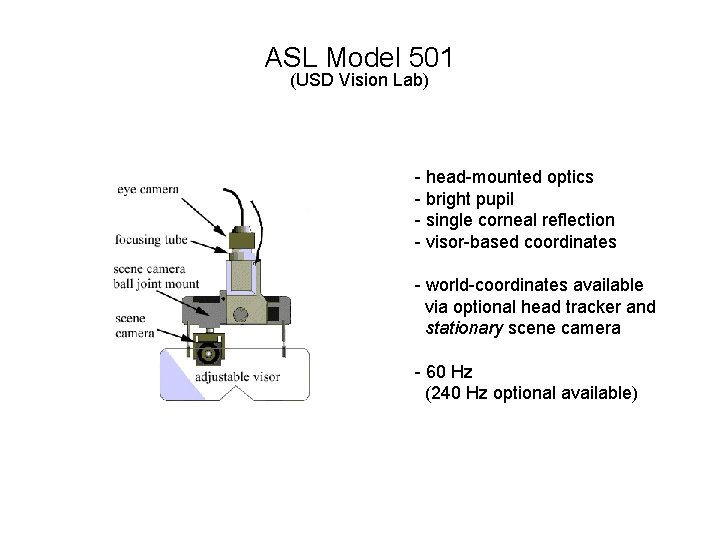
ASL Model 501 (USD Vision Lab) - head-mounted optics - bright pupil - single corneal reflection - visor-based coordinates - world-coordinates available via optional head tracker and stationary scene camera - 60 Hz (240 Hz optional available)
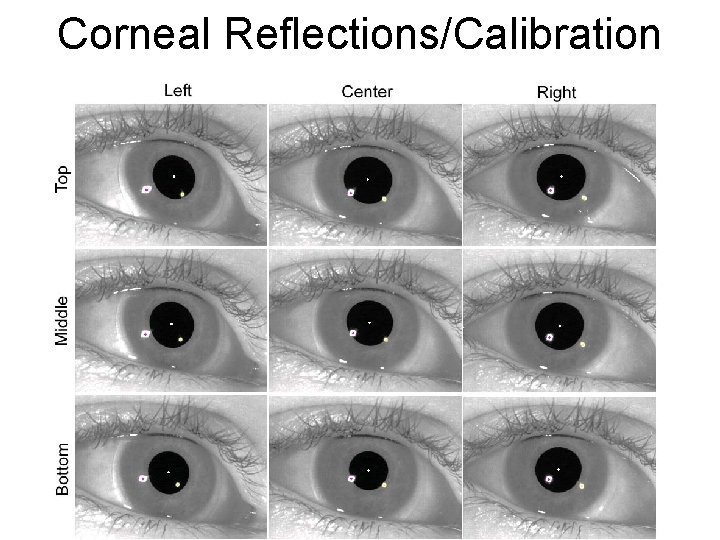
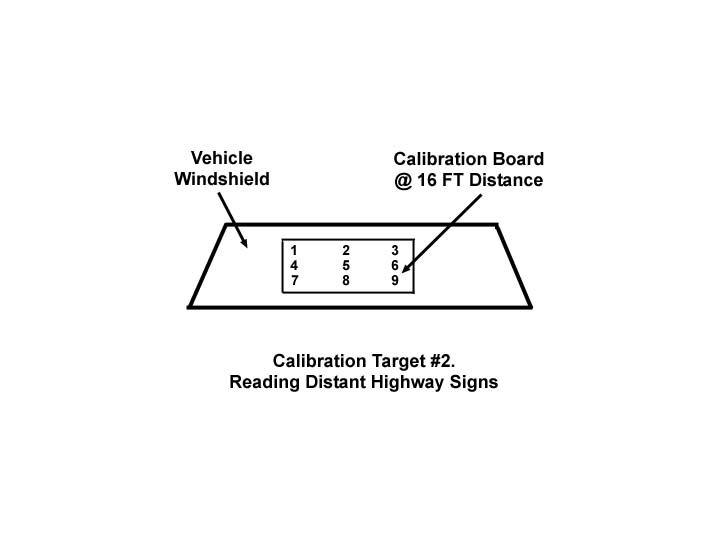
Corneal Reflections/Calibration
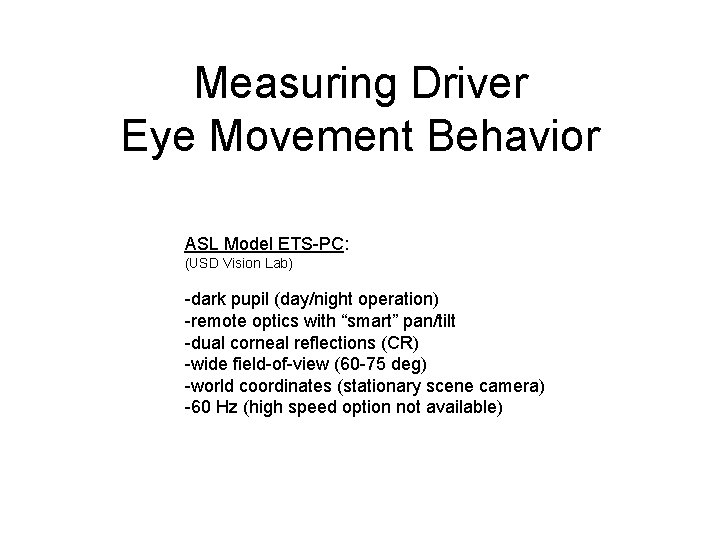
Measuring Driver Eye Movement Behavior ASL Model ETS-PC: (USD Vision Lab) -dark pupil (day/night operation) -remote optics with “smart” pan/tilt -dual corneal reflections (CR) -wide field-of-view (60 -75 deg) -world coordinates (stationary scene camera) -60 Hz (high speed option not available)
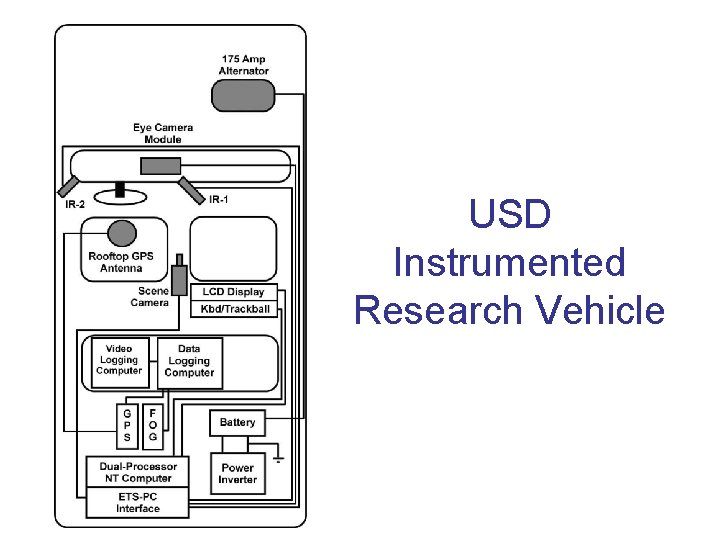
USD Instrumented Research Vehicle
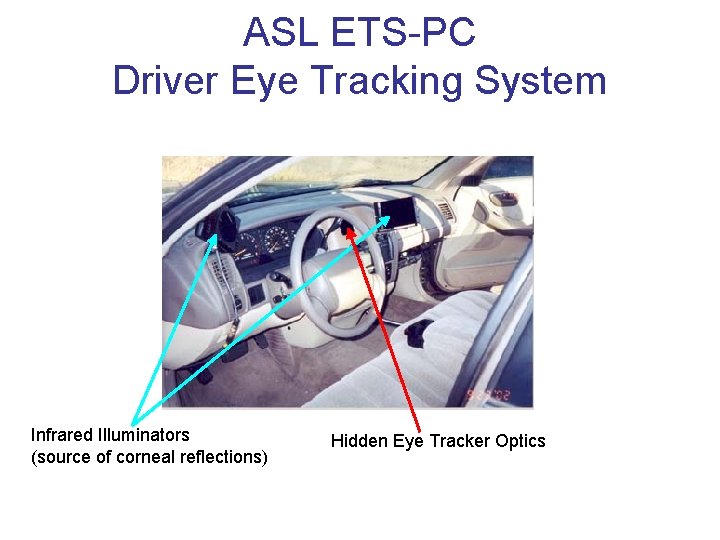
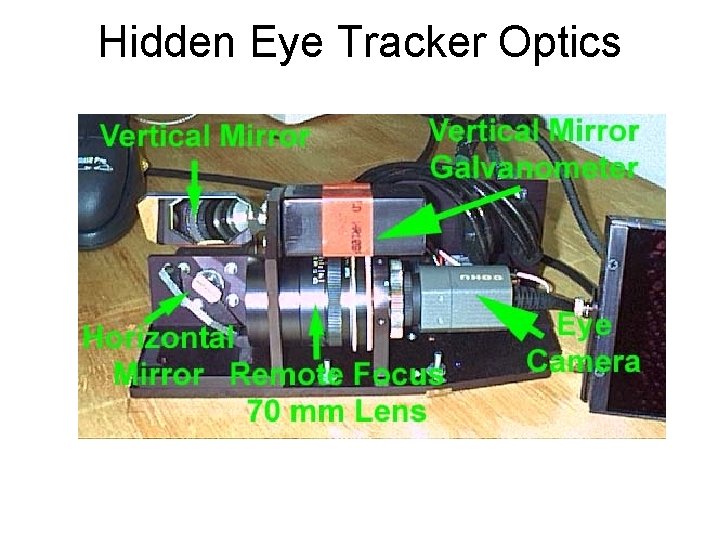
ASL ETS-PC Driver Eye Tracking System Infrared Illuminators (source of corneal reflections) Hidden Eye Tracker Optics
Hidden Eye Tracker Optics
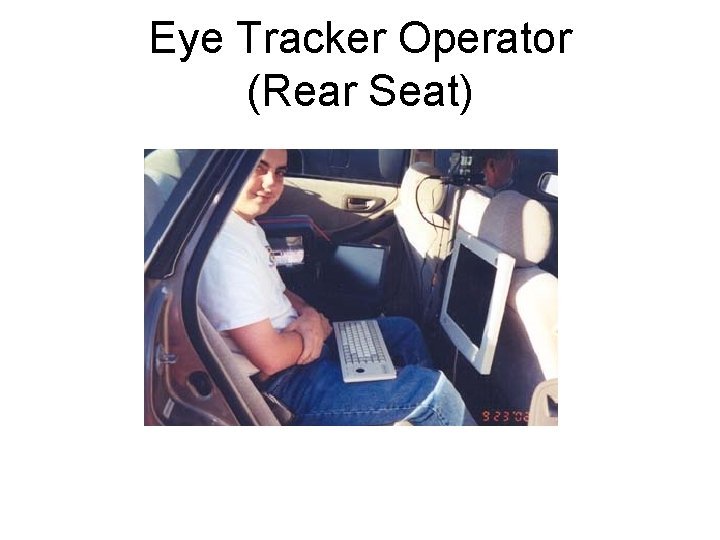
Eye Tracker Operator (Rear Seat)
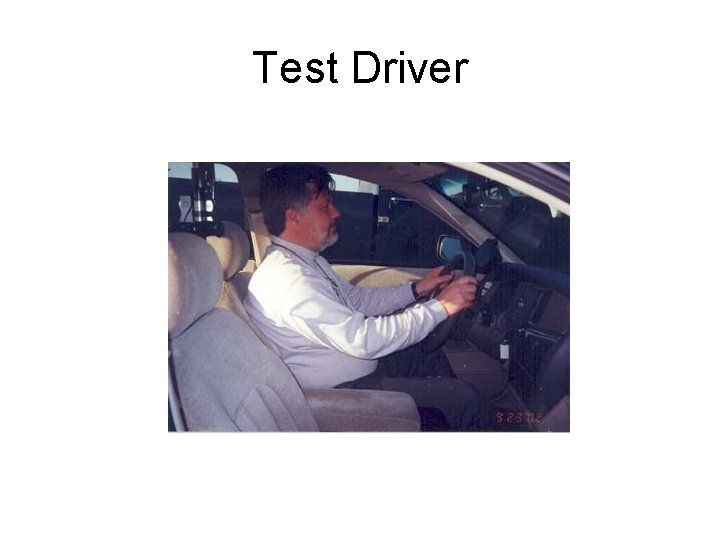
Test Driver
Corneal Reflections/Calibration
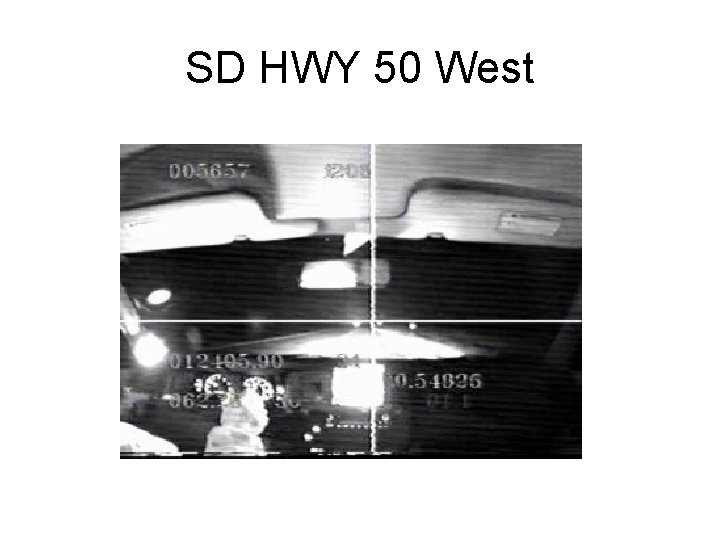
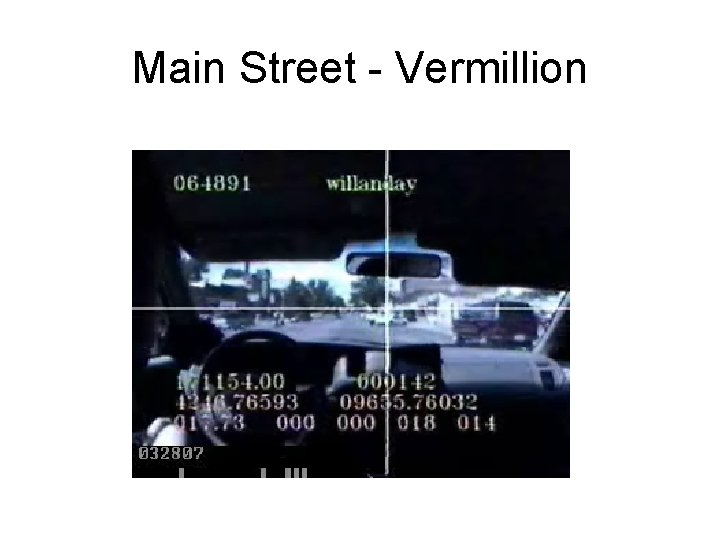
Some Examples of Driver Eye Movement Records
SD HWY 50 West
Main Street - Vermillion
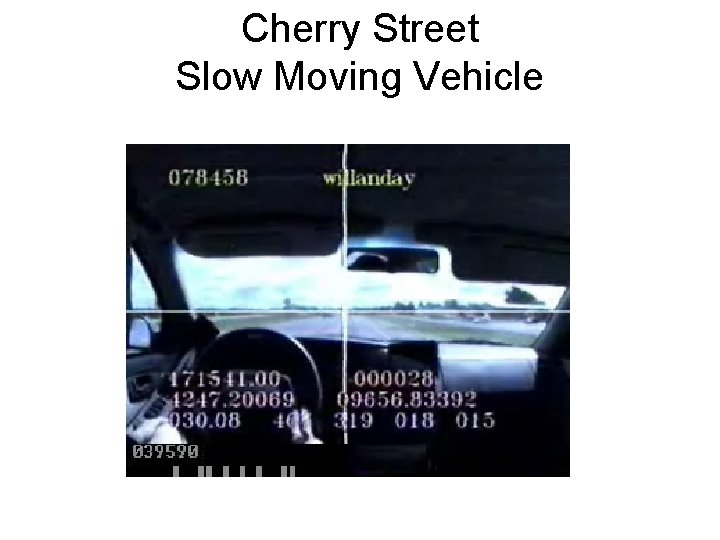
Cherry Street Slow Moving Vehicle
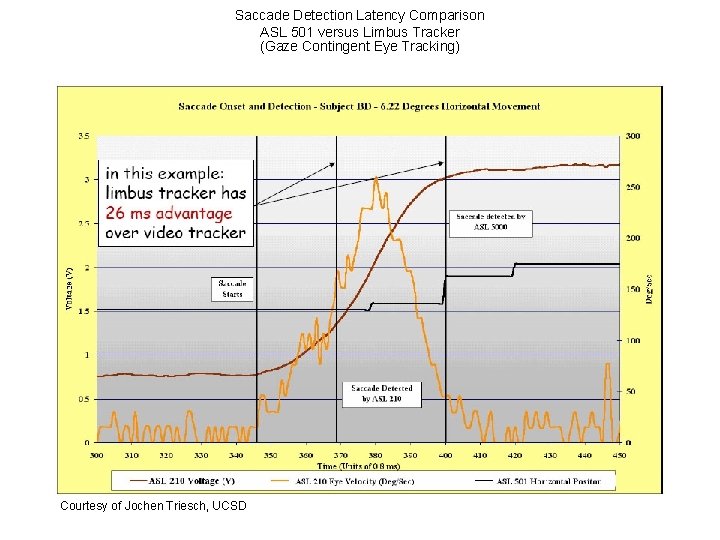
Saccade Detection Latency Comparison ASL 501 versus Limbus Tracker (Gaze Contingent Eye Tracking) Courtesy of Jochen Triesch, UCSD
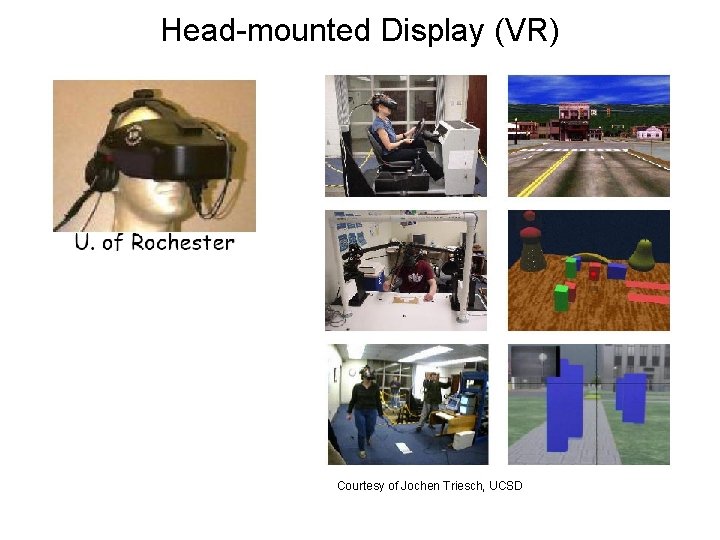
Head-mounted Display (VR) Courtesy of Jochen Triesch, UCSD
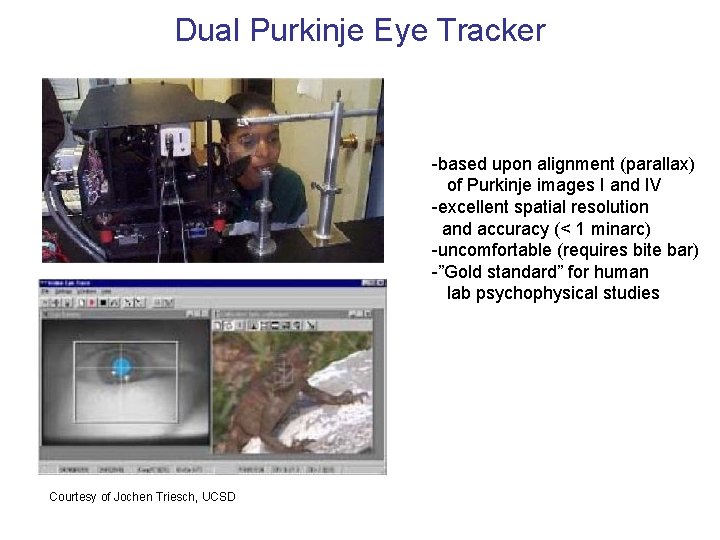
Dual Purkinje Eye Tracker -based upon alignment (parallax) of Purkinje images I and IV -excellent spatial resolution and accuracy (< 1 minarc) -uncomfortable (requires bite bar) -”Gold standard” for human lab psychophysical studies Courtesy of Jochen Triesch, UCSD
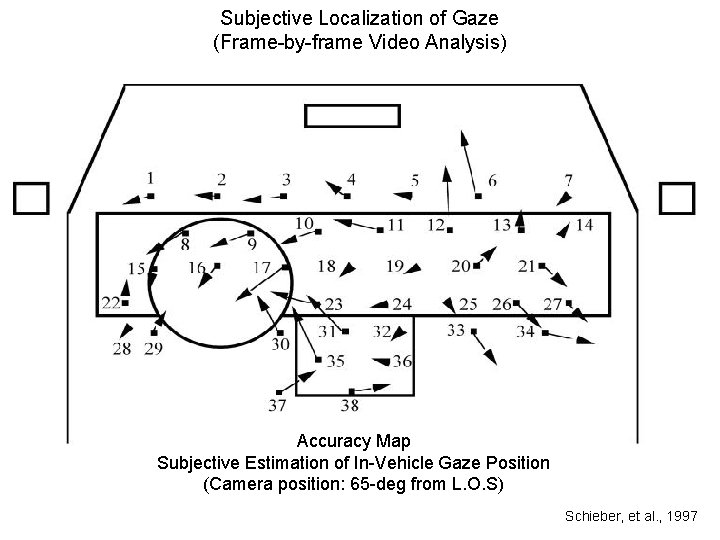
Subjective Localization of Gaze (Frame-by-frame Video Analysis) Accuracy Map Subjective Estimation of In-Vehicle Gaze Position (Camera position: 65 -deg from L. O. S) Schieber, et al. , 1997
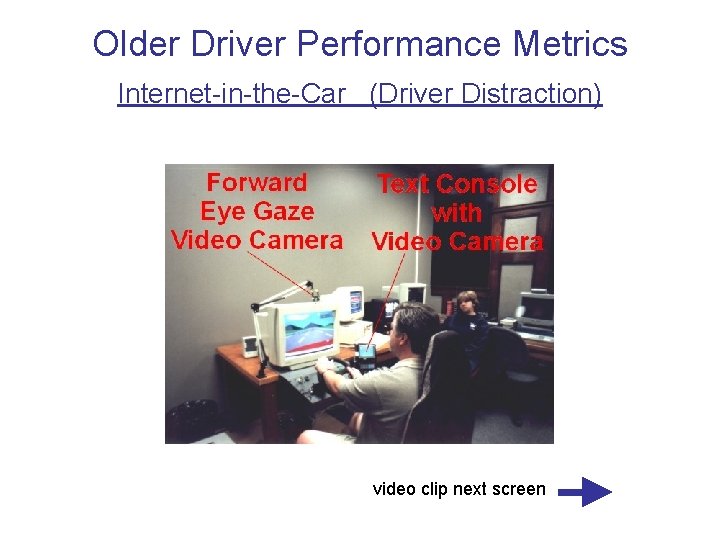
Older Driver Performance Metrics Internet-in-the-Car (Driver Distraction) video clip next screen
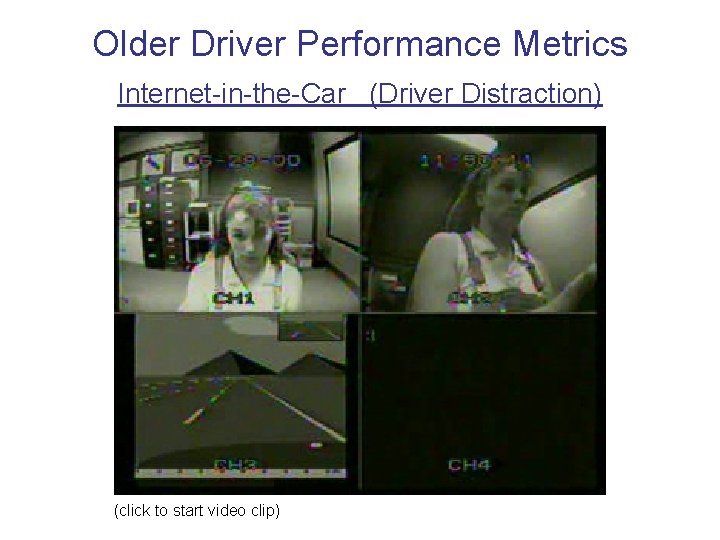
Older Driver Performance Metrics Internet-in-the-Car (Driver Distraction) (click to start video clip)