
736 Roadmap 736b Payments in liquidation of partners

736 Roadmap 736(b): Payments in liquidation of partners interest, to extent in exchange for partners interest in partnership property, considered at distributions of property. Thus, - Go to 731 for gain or loss treatment - Go to 732 for basis treatment 736(a): Kicks in if (1) premium payment is made in excess of partner’s interest in partnership property and (2) capital not material factor (service partnership) and there are unrealized receivables or goodwill not subject to an agreement on payments for good will. Then, - If payments based on income, deemed distributed share of income to partner and income allocated to other partners reduced. - If payment not based on income, deemed guaranteed payment under 707(c), with income to liquidating partner and deduction to partnership. Corporate & Partner Tax Instructor: Dwight Drake

731 & 732 via 736(b) liquidation 731: No gain or loss recognized to partner unless: - Gain to extent money distributed exceeds partner’s basis in partnership interest. - Loss recognized if only money and unrealized receivables and inventory distributed to extent basis in partner’s interest exceeds amount of money distributed and partnership’s basis in receivables and inventory. - Any recognized gain or loss is from sale or exchange of partnership interest. 732(b): If property distributed to partner in liquidation of partnership interest, basis in property shall equal partner’s interest in partnership less money receives in distribution. Corporate & Partner Tax Instructor: Dwight Drake
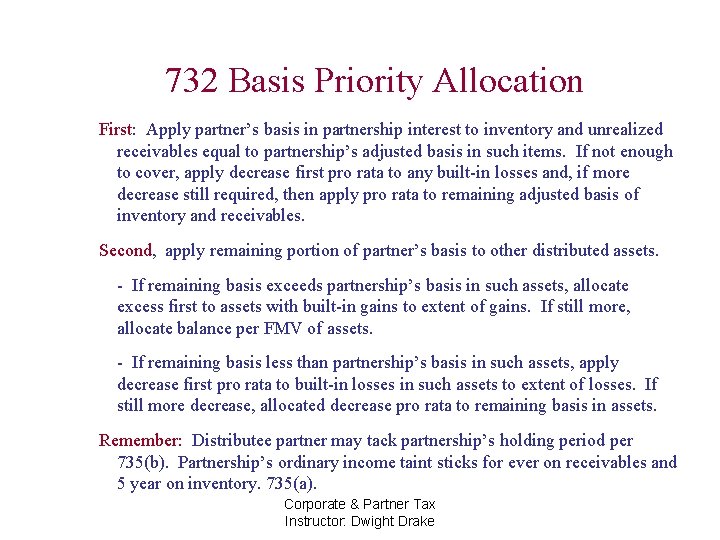
732 Basis Priority Allocation First: Apply partner’s basis in partnership interest to inventory and unrealized receivables equal to partnership’s adjusted basis in such items. If not enough to cover, apply decrease first pro rata to any built-in losses and, if more decrease still required, then apply pro rata to remaining adjusted basis of inventory and receivables. Second, apply remaining portion of partner’s basis to other distributed assets. - If remaining basis exceeds partnership’s basis in such assets, allocate excess first to assets with built-in gains to extent of gains. If still more, allocate balance per FMV of assets. - If remaining basis less than partnership’s basis in such assets, apply decrease first pro rata to built-in losses in such assets to extent of losses. If still more decrease, allocated decrease pro rata to remaining basis in assets. Remember: Distributee partner may tack partnership’s holding period per 735(b). Partnership’s ordinary income taint sticks for ever on receivables and 5 year on inventory. 735(a). Corporate & Partner Tax Instructor: Dwight Drake
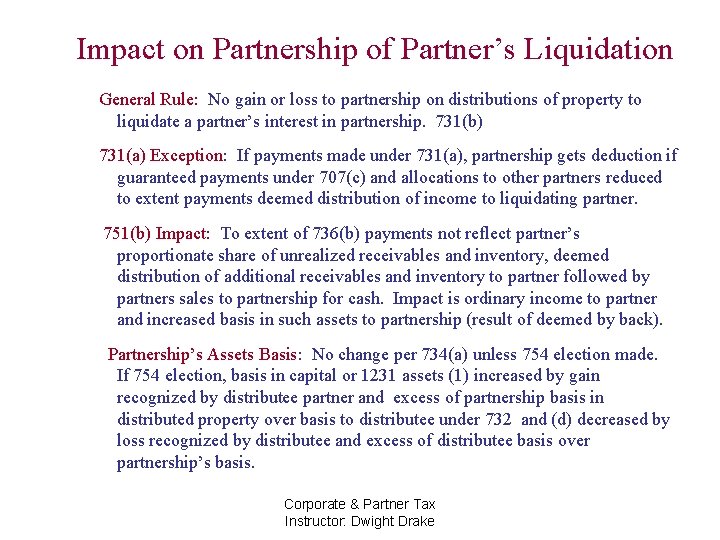
Impact on Partnership of Partner’s Liquidation General Rule: No gain or loss to partnership on distributions of property to liquidate a partner’s interest in partnership. 731(b) 731(a) Exception: If payments made under 731(a), partnership gets deduction if guaranteed payments under 707(c) and allocations to other partners reduced to extent payments deemed distribution of income to liquidating partner. 751(b) Impact: To extent of 736(b) payments not reflect partner’s proportionate share of unrealized receivables and inventory, deemed distribution of additional receivables and inventory to partner followed by partners sales to partnership for cash. Impact is ordinary income to partner and increased basis in such assets to partnership (result of deemed by back). Partnership’s Assets Basis: No change per 734(a) unless 754 election made. If 754 election, basis in capital or 1231 assets (1) increased by gain recognized by distributee partner and excess of partnership basis in distributed property over basis to distributee under 732 and (d) decreased by loss recognized by distributee and excess of distributee basis over partnership’s basis. Corporate & Partner Tax Instructor: Dwight Drake
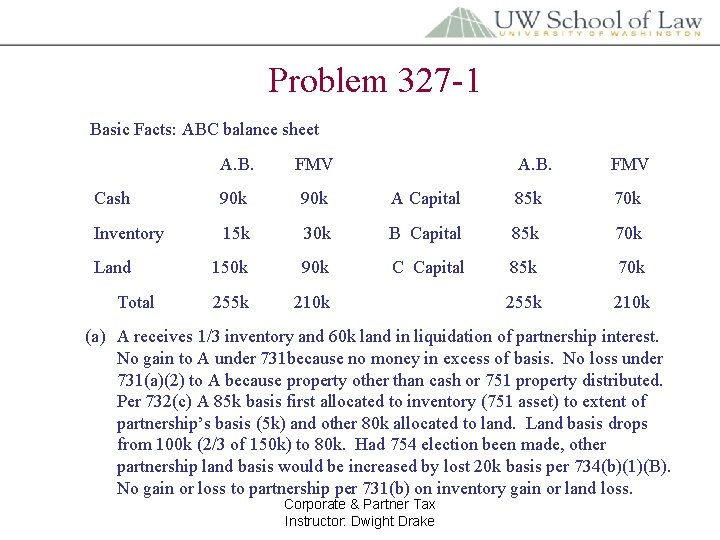
Problem 327 -1 Basic Facts: ABC balance sheet A. B. FMV Cash 90 k Inventory 15 k Land Total A. B. FMV A Capital 85 k 70 k 30 k B Capital 85 k 70 k 150 k 90 k C Capital 85 k 70 k 255 k 210 k (a) A receives 1/3 inventory and 60 k land in liquidation of partnership interest. No gain to A under 731 because no money in excess of basis. No loss under 731(a)(2) to A because property other than cash or 751 property distributed. Per 732(c) A 85 k basis first allocated to inventory (751 asset) to extent of partnership’s basis (5 k) and other 80 k allocated to land. Land basis drops from 100 k (2/3 of 150 k) to 80 k. Had 754 election been made, other partnership land basis would be increased by lost 20 k basis per 734(b)(1)(B). No gain or loss to partnership per 731(b) on inventory gain or land loss. Corporate & Partner Tax Instructor: Dwight Drake
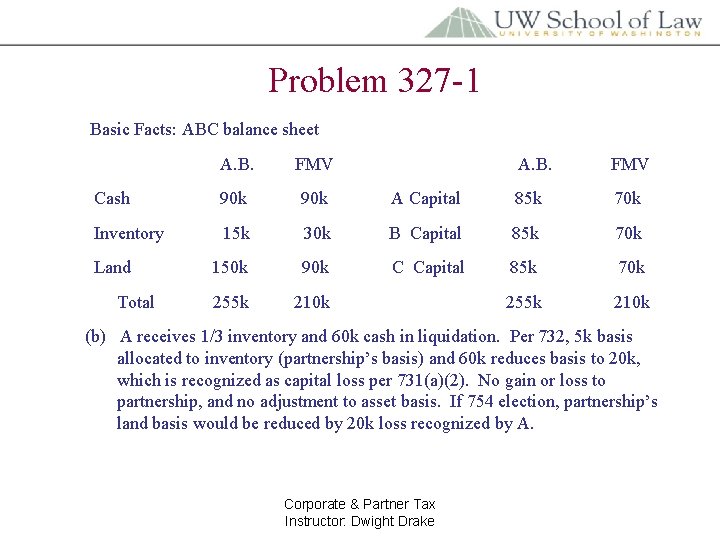
Problem 327 -1 Basic Facts: ABC balance sheet A. B. FMV Cash 90 k Inventory 15 k Land Total A. B. FMV A Capital 85 k 70 k 30 k B Capital 85 k 70 k 150 k 90 k C Capital 85 k 70 k 255 k 210 k (b) A receives 1/3 inventory and 60 k cash in liquidation. Per 732, 5 k basis allocated to inventory (partnership’s basis) and 60 k reduces basis to 20 k, which is recognized as capital loss per 731(a)(2). No gain or loss to partnership, and no adjustment to asset basis. If 754 election, partnership’s land basis would be reduced by 20 k loss recognized by A. Corporate & Partner Tax Instructor: Dwight Drake
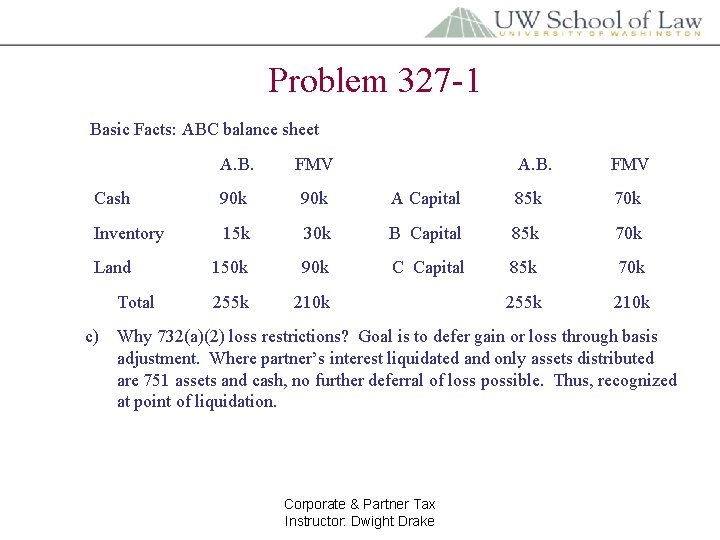
Problem 327 -1 Basic Facts: ABC balance sheet A. B. FMV Cash 90 k Inventory 15 k Land Total c) A. B. FMV A Capital 85 k 70 k 30 k B Capital 85 k 70 k 150 k 90 k C Capital 85 k 70 k 255 k 210 k Why 732(a)(2) loss restrictions? Goal is to defer gain or loss through basis adjustment. Where partner’s interest liquidated and only assets distributed are 751 assets and cash, no further deferral of loss possible. Thus, recognized at point of liquidation. Corporate & Partner Tax Instructor: Dwight Drake
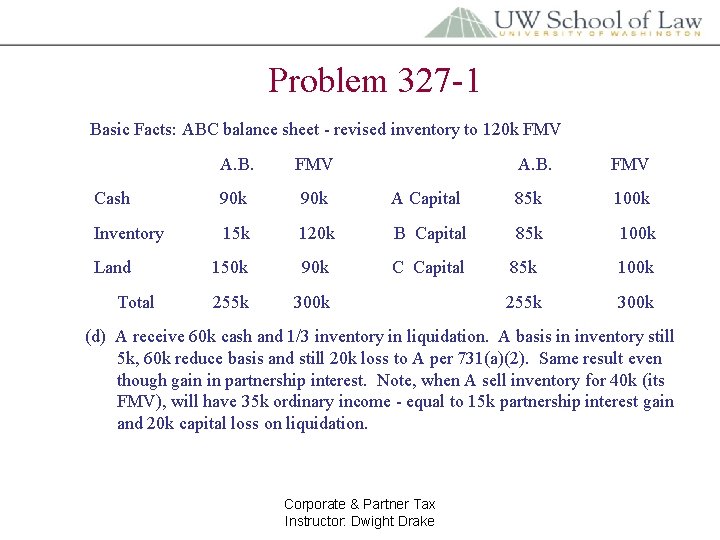
Problem 327 -1 Basic Facts: ABC balance sheet - revised inventory to 120 k FMV A. B. FMV Cash 90 k Inventory 15 k Land Total A. B. FMV A Capital 85 k 100 k 120 k B Capital 85 k 150 k 90 k C Capital 255 k 300 k 100 k 85 k 100 k 255 k 300 k (d) A receive 60 k cash and 1/3 inventory in liquidation. A basis in inventory still 5 k, 60 k reduce basis and still 20 k loss to A per 731(a)(2). Same result even though gain in partnership interest. Note, when A sell inventory for 40 k (its FMV), will have 35 k ordinary income - equal to 15 k partnership interest gain and 20 k capital loss on liquidation. Corporate & Partner Tax Instructor: Dwight Drake

Problem 327 - 2 If 754 election: - Downward adjustment in partnership’s other assets only for loss on liquidation or if 732(b) applies on liquidation. - But upward adjustment to partnership’s other assets for both operating and liquidating distributions because 731(a)(1) and 732(a)(2) and (b) apply to both types of distributions. Corporate & Partner Tax Instructor: Dwight Drake
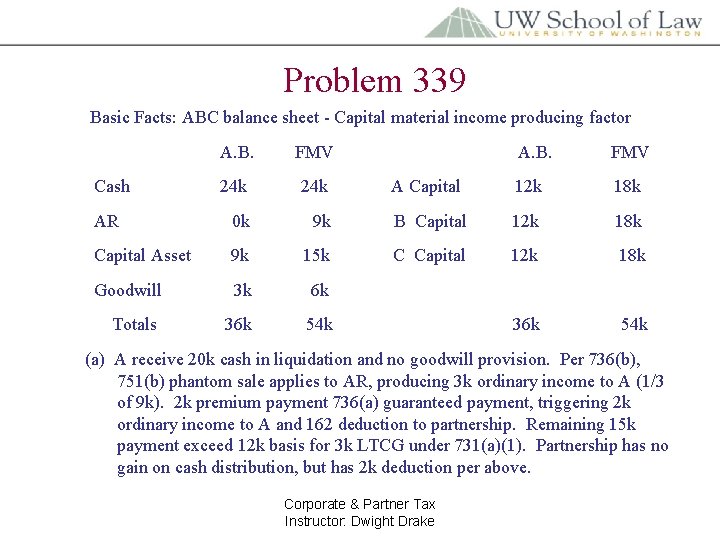
Problem 339 Basic Facts: ABC balance sheet - Capital material income producing factor A. B. FMV 24 k A Capital 12 k 18 k AR 0 k 9 k B Capital 12 k 18 k Capital Asset 9 k 15 k C Capital 12 k 18 k Goodwill 3 k 6 k Totals 36 k 54 k Cash (a) A receive 20 k cash in liquidation and no goodwill provision. Per 736(b), 751(b) phantom sale applies to AR, producing 3 k ordinary income to A (1/3 of 9 k). 2 k premium payment 736(a) guaranteed payment, triggering 2 k ordinary income to A and 162 deduction to partnership. Remaining 15 k payment exceed 12 k basis for 3 k LTCG under 731(a)(1). Partnership has no gain on cash distribution, but has 2 k deduction per above. Corporate & Partner Tax Instructor: Dwight Drake
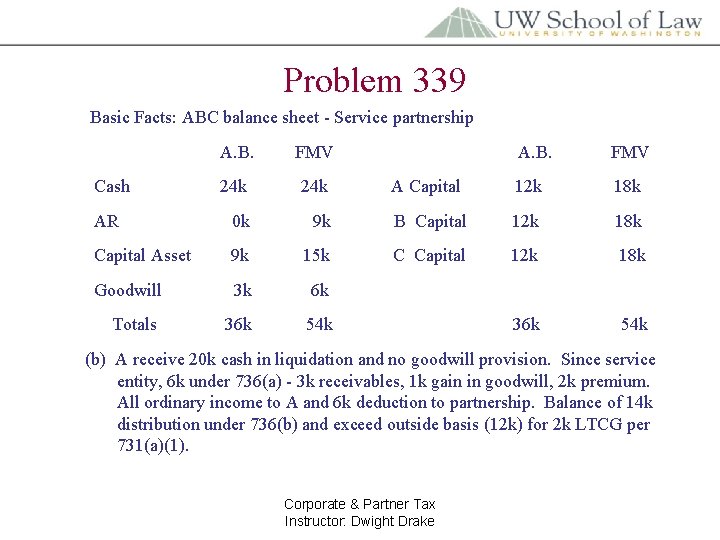
Problem 339 Basic Facts: ABC balance sheet - Service partnership A. B. FMV 24 k A Capital 12 k 18 k AR 0 k 9 k B Capital 12 k 18 k Capital Asset 9 k 15 k C Capital 12 k 18 k Goodwill 3 k 6 k Totals 36 k 54 k Cash (b) A receive 20 k cash in liquidation and no goodwill provision. Since service entity, 6 k under 736(a) - 3 k receivables, 1 k gain in goodwill, 2 k premium. All ordinary income to A and 6 k deduction to partnership. Balance of 14 k distribution under 736(b) and exceed outside basis (12 k) for 2 k LTCG per 731(a)(1). Corporate & Partner Tax Instructor: Dwight Drake
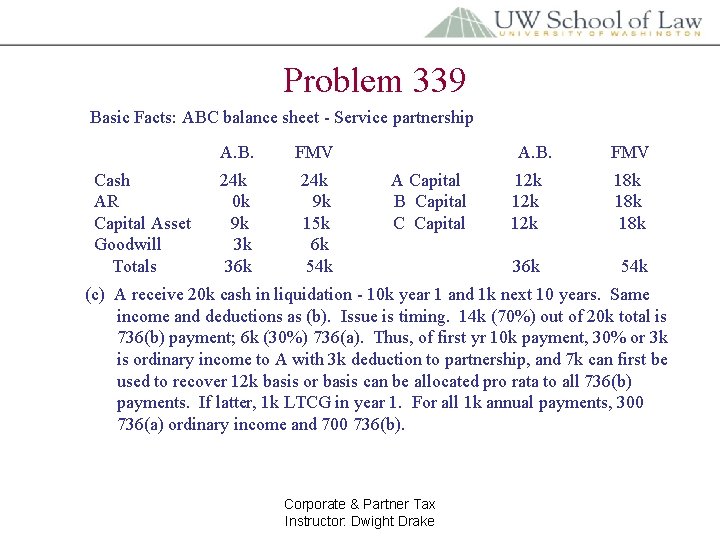
Problem 339 Basic Facts: ABC balance sheet - Service partnership Cash AR Capital Asset Goodwill Totals A. B. FMV 24 k 0 k 9 k 3 k 36 k 24 k 9 k 15 k 6 k 54 k A. B. A Capital B Capital C Capital FMV 12 k 12 k 18 k 18 k 36 k 54 k (c) A receive 20 k cash in liquidation - 10 k year 1 and 1 k next 10 years. Same income and deductions as (b). Issue is timing. 14 k (70%) out of 20 k total is 736(b) payment; 6 k (30%) 736(a). Thus, of first yr 10 k payment, 30% or 3 k is ordinary income to A with 3 k deduction to partnership, and 7 k can first be used to recover 12 k basis or basis can be allocated pro rata to all 736(b) payments. If latter, 1 k LTCG in year 1. For all 1 k annual payments, 300 736(a) ordinary income and 700 736(b). Corporate & Partner Tax Instructor: Dwight Drake
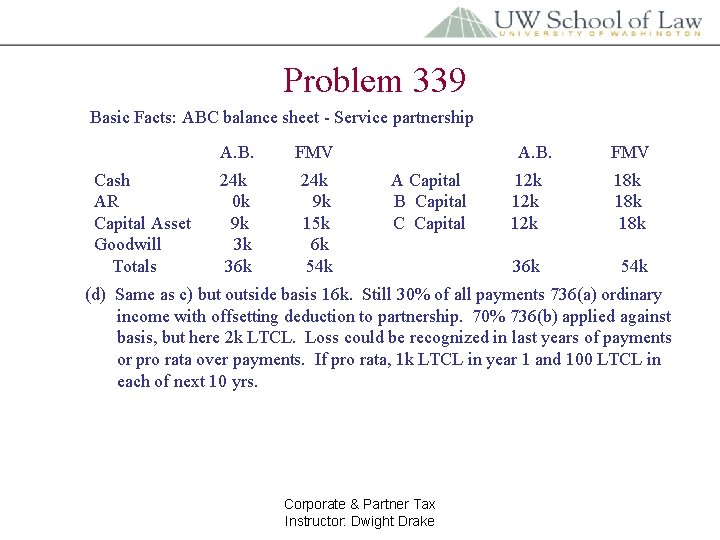
Problem 339 Basic Facts: ABC balance sheet - Service partnership Cash AR Capital Asset Goodwill Totals A. B. FMV 24 k 0 k 9 k 3 k 36 k 24 k 9 k 15 k 6 k 54 k A. B. A Capital B Capital C Capital FMV 12 k 12 k 18 k 18 k 36 k 54 k (d) Same as c) but outside basis 16 k. Still 30% of all payments 736(a) ordinary income with offsetting deduction to partnership. 70% 736(b) applied against basis, but here 2 k LTCL. Loss could be recognized in last years of payments or pro rata over payments. If pro rata, 1 k LTCL in year 1 and 100 LTCL in each of next 10 yrs. Corporate & Partner Tax Instructor: Dwight Drake
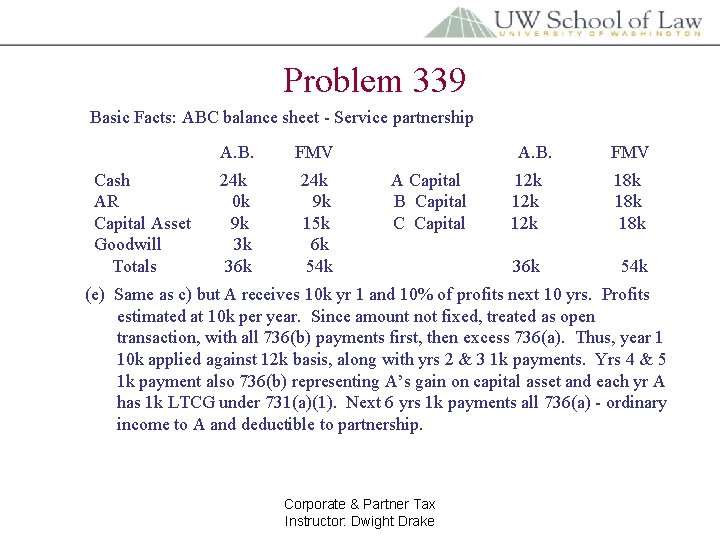
Problem 339 Basic Facts: ABC balance sheet - Service partnership Cash AR Capital Asset Goodwill Totals A. B. FMV 24 k 0 k 9 k 3 k 36 k 24 k 9 k 15 k 6 k 54 k A. B. A Capital B Capital C Capital FMV 12 k 12 k 18 k 18 k 36 k 54 k (e) Same as c) but A receives 10 k yr 1 and 10% of profits next 10 yrs. Profits estimated at 10 k per year. Since amount not fixed, treated as open transaction, with all 736(b) payments first, then excess 736(a). Thus, year 1 10 k applied against 12 k basis, along with yrs 2 & 3 1 k payments. Yrs 4 & 5 1 k payment also 736(b) representing A’s gain on capital asset and each yr A has 1 k LTCG under 731(a)(1). Next 6 yrs 1 k payments all 736(a) - ordinary income to A and deductible to partnership. Corporate & Partner Tax Instructor: Dwight Drake
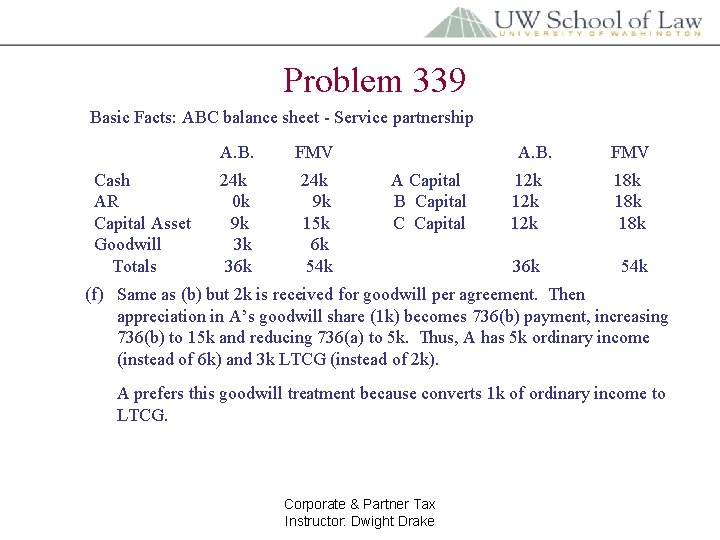
Problem 339 Basic Facts: ABC balance sheet - Service partnership Cash AR Capital Asset Goodwill Totals A. B. FMV 24 k 0 k 9 k 3 k 36 k 24 k 9 k 15 k 6 k 54 k A. B. A Capital B Capital C Capital FMV 12 k 12 k 18 k 18 k 36 k 54 k (f) Same as (b) but 2 k is received for goodwill per agreement. Then appreciation in A’s goodwill share (1 k) becomes 736(b) payment, increasing 736(b) to 15 k and reducing 736(a) to 5 k. Thus, A has 5 k ordinary income (instead of 6 k) and 3 k LTCG (instead of 2 k). A prefers this goodwill treatment because converts 1 k of ordinary income to LTCG. Corporate & Partner Tax Instructor: Dwight Drake
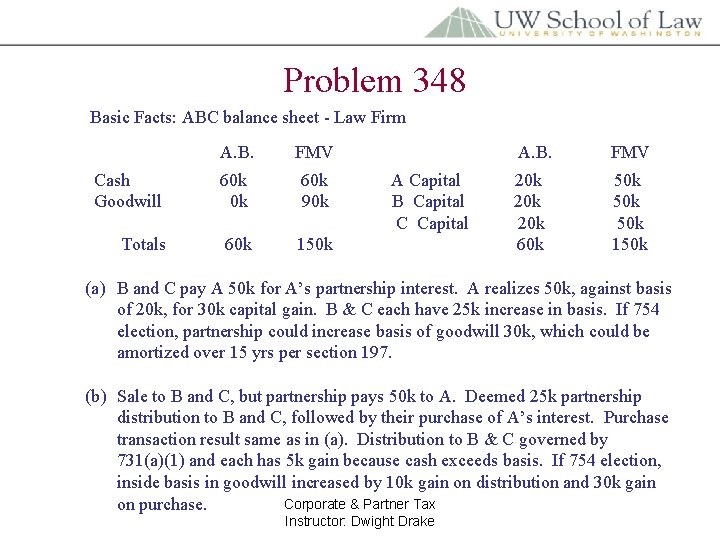
Problem 348 Basic Facts: ABC balance sheet - Law Firm A. B. FMV Cash Goodwill 60 k 0 k 60 k 90 k Totals 60 k 150 k A Capital B Capital C Capital A. B. FMV 20 k 20 k 60 k 50 k 50 k 150 k (a) B and C pay A 50 k for A’s partnership interest. A realizes 50 k, against basis of 20 k, for 30 k capital gain. B & C each have 25 k increase in basis. If 754 election, partnership could increase basis of goodwill 30 k, which could be amortized over 15 yrs per section 197. (b) Sale to B and C, but partnership pays 50 k to A. Deemed 25 k partnership distribution to B and C, followed by their purchase of A’s interest. Purchase transaction result same as in (a). Distribution to B & C governed by 731(a)(1) and each has 5 k gain because cash exceeds basis. If 754 election, inside basis in goodwill increased by 10 k gain on distribution and 30 k gain Corporate & Partner Tax on purchase. Instructor: Dwight Drake
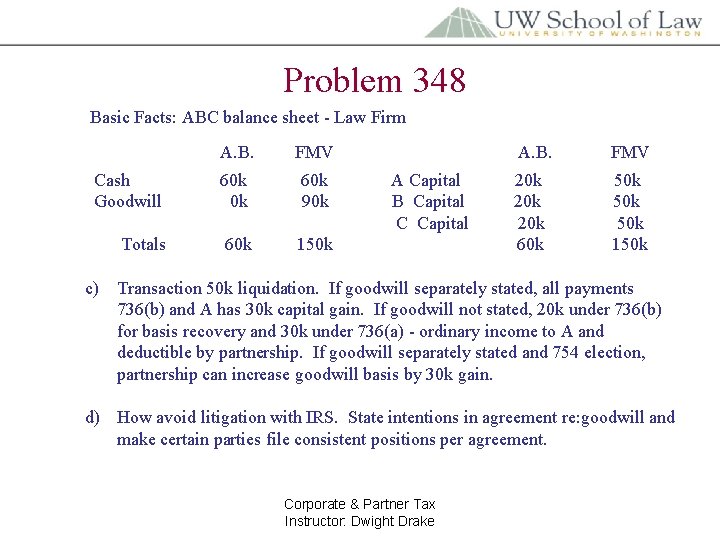
Problem 348 Basic Facts: ABC balance sheet - Law Firm A. B. FMV Cash Goodwill 60 k 0 k 60 k 90 k Totals 60 k 150 k A Capital B Capital C Capital A. B. FMV 20 k 20 k 60 k 50 k 50 k 150 k c) Transaction 50 k liquidation. If goodwill separately stated, all payments 736(b) and A has 30 k capital gain. If goodwill not stated, 20 k under 736(b) for basis recovery and 30 k under 736(a) - ordinary income to A and deductible by partnership. If goodwill separately stated and 754 election, partnership can increase goodwill basis by 30 k gain. d) How avoid litigation with IRS. State intentions in agreement re: goodwill and make certain parties file consistent positions per agreement. Corporate & Partner Tax Instructor: Dwight Drake
- Slides: 17