Successes Failures and Uncertainties in Jet Physics in
- Slides: 41
Successes, Failures, and Uncertainties in Jet Physics in Heavy Ion Collisions W. A. Horowitz The Ohio State University March 12, 2010 With many thanks to Brian Cole, Miklos Gyulassy, Ulrich Heinz, and Yuri Kovchegov 12/4/2020 Wayne State University Seminar 1
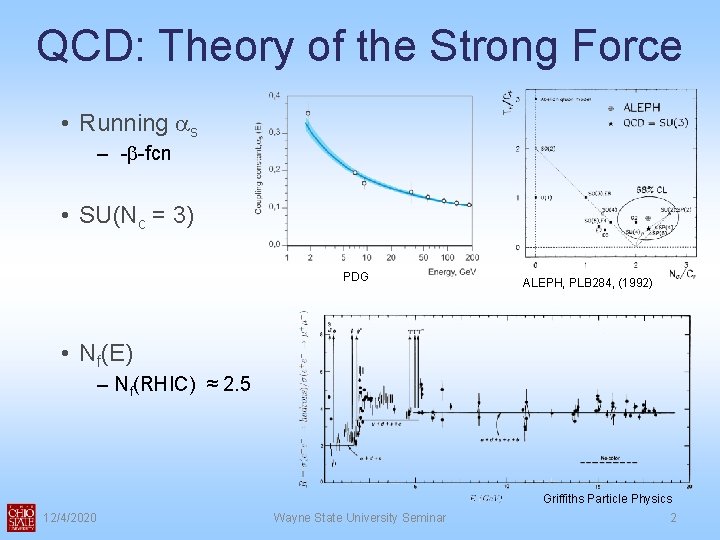
QCD: Theory of the Strong Force • Running as – -b-fcn • SU(Nc = 3) PDG ALEPH, PLB 284, (1992) • Nf(E) – Nf(RHIC) ≈ 2. 5 Griffiths Particle Physics 12/4/2020 Wayne State University Seminar 2
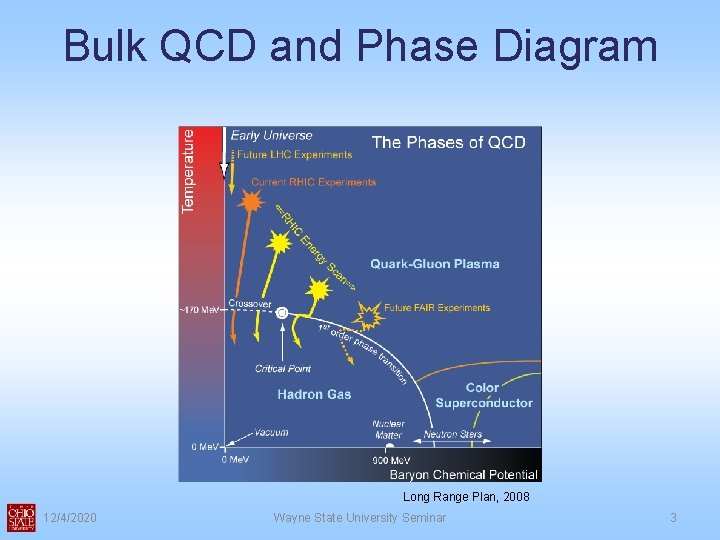
Bulk QCD and Phase Diagram Long Range Plan, 2008 12/4/2020 Wayne State University Seminar 3
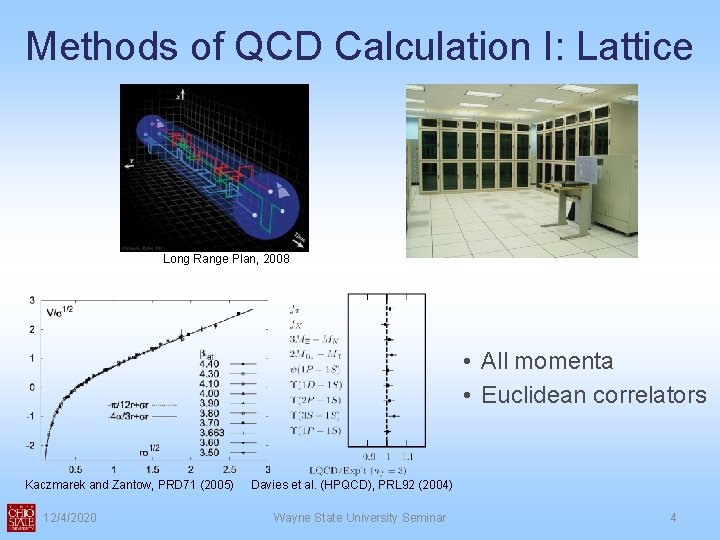
Methods of QCD Calculation I: Lattice Long Range Plan, 2008 • All momenta • Euclidean correlators Kaczmarek and Zantow, PRD 71 (2005) 12/4/2020 Davies et al. (HPQCD), PRL 92 (2004) Wayne State University Seminar 4
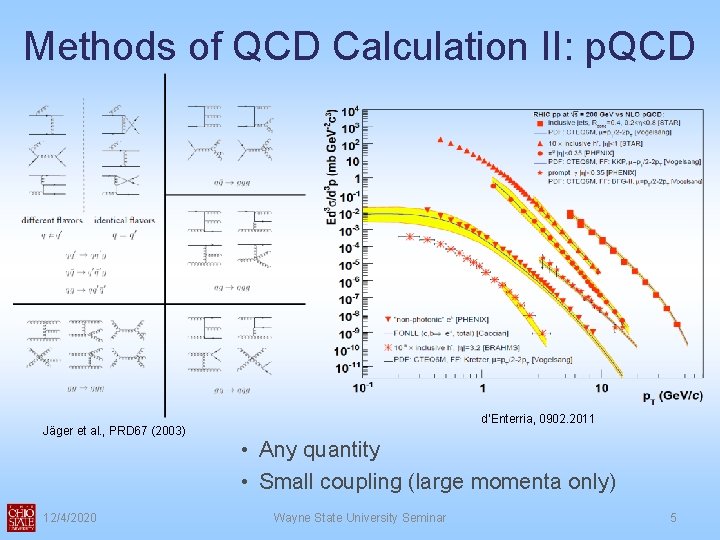
Methods of QCD Calculation II: p. QCD Jäger et al. , PRD 67 (2003) 12/4/2020 d’Enterria, 0902. 2011 • Any quantity • Small coupling (large momenta only) Wayne State University Seminar 5
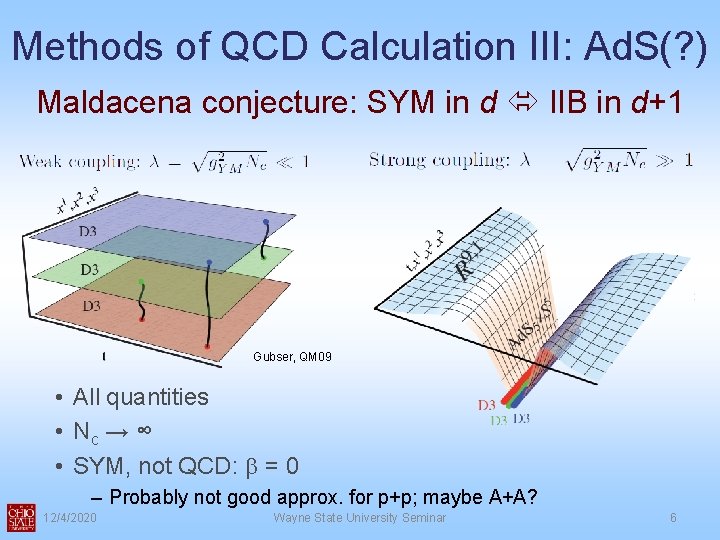
Methods of QCD Calculation III: Ad. S(? ) Maldacena conjecture: SYM in d IIB in d+1 Gubser, QM 09 • All quantities • Nc → ∞ • SYM, not QCD: b = 0 – Probably not good approx. for p+p; maybe A+A? 12/4/2020 Wayne State University Seminar 6
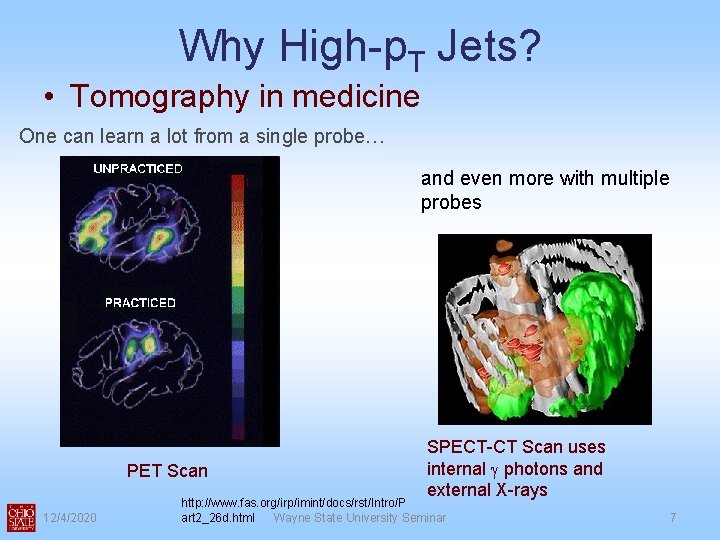
Why High-p. T Jets? • Tomography in medicine One can learn a lot from a single probe… and even more with multiple probes PET Scan 12/4/2020 SPECT-CT Scan uses internal g photons and external X-rays http: //www. fas. org/irp/imint/docs/rst/Intro/P art 2_26 d. html Wayne State University Seminar 7
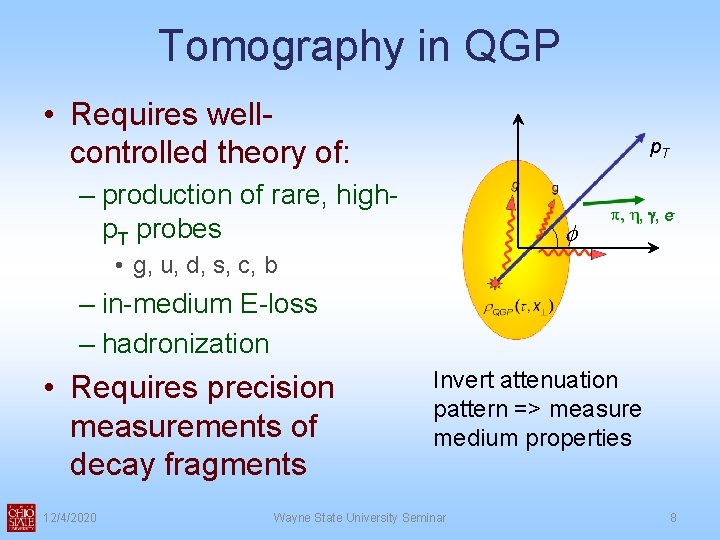
Tomography in QGP • Requires wellcontrolled theory of: p. T – production of rare, highp. T probes f , g, e- • g, u, d, s, c, b – in-medium E-loss – hadronization • Requires precision measurements of decay fragments 12/4/2020 Invert attenuation pattern => measure medium properties Wayne State University Seminar 8
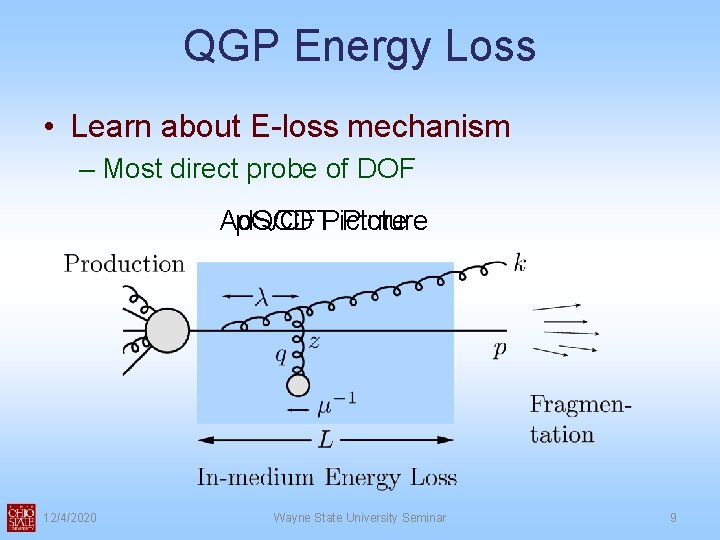
QGP Energy Loss • Learn about E-loss mechanism – Most direct probe of DOF p. QCD Picture Ad. S/CFT Picture 12/4/2020 Wayne State University Seminar 9
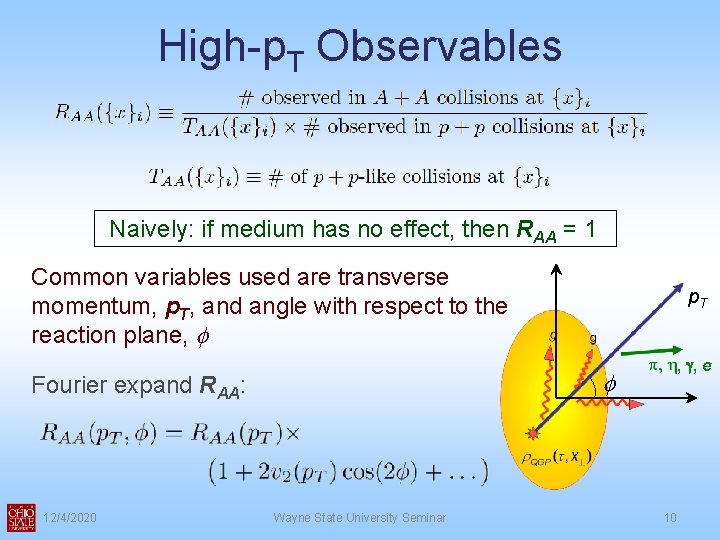
High-p. T Observables Naively: if medium has no effect, then RAA = 1 Common variables used are transverse momentum, p. T, and angle with respect to the reaction plane, f , g, e- f Fourier expand RAA: 12/4/2020 p. T Wayne State University Seminar 10
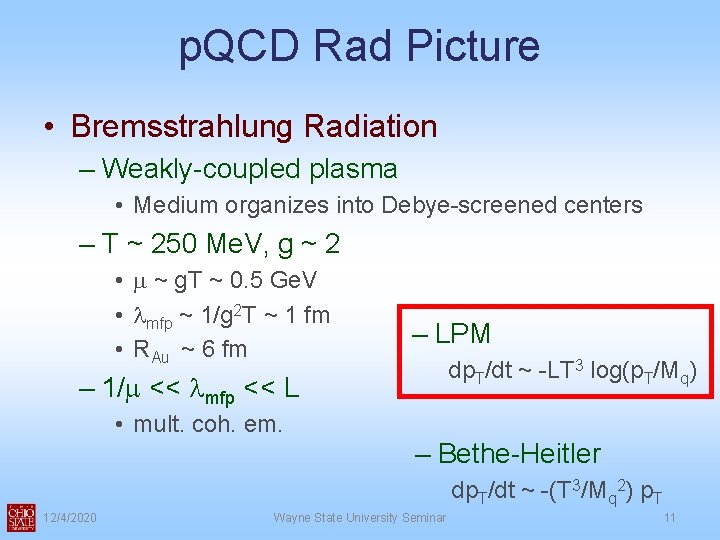
p. QCD Rad Picture • Bremsstrahlung Radiation – Weakly-coupled plasma • Medium organizes into Debye-screened centers – T ~ 250 Me. V, g ~ 2 • m ~ g. T ~ 0. 5 Ge. V • lmfp ~ 1/g 2 T ~ 1 fm • RAu ~ 6 fm – LPM dp. T/dt ~ -LT 3 log(p. T/Mq) – 1/m << lmfp << L • mult. coh. em. – Bethe-Heitler dp. T/dt ~ -(T 3/Mq 2) p. T 12/4/2020 Wayne State University Seminar 11
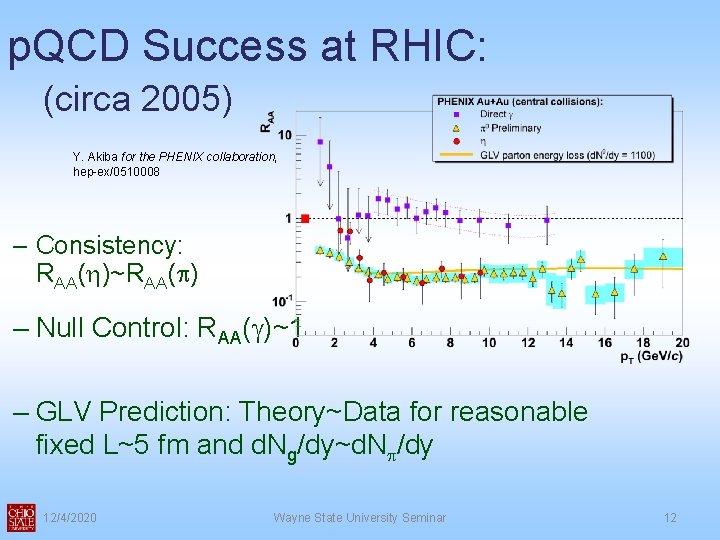
p. QCD Success at RHIC: (circa 2005) Y. Akiba for the PHENIX collaboration, hep-ex/0510008 – Consistency: RAA(h)~RAA(p) – Null Control: RAA(g)~1 – GLV Prediction: Theory~Data for reasonable fixed L~5 fm and d. Ng/dy~d. Np/dy 12/4/2020 Wayne State University Seminar 12
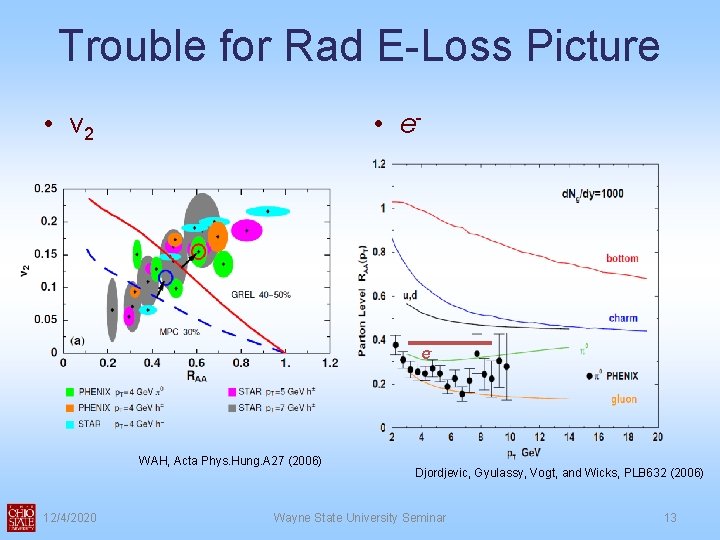
Trouble for Rad E-Loss Picture • v 2 • e- e- WAH, Acta Phys. Hung. A 27 (2006) 12/4/2020 Djordjevic, Gyulassy, Vogt, and Wicks, PLB 632 (2006) Wayne State University Seminar 13
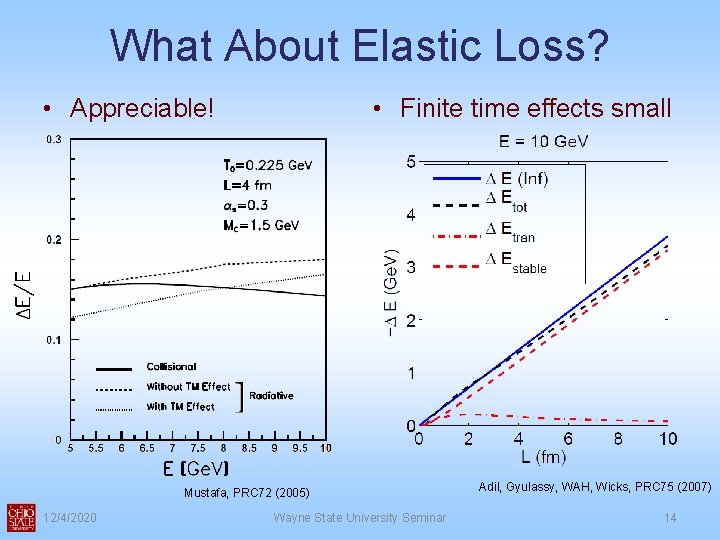
What About Elastic Loss? • Appreciable! • Finite time effects small Mustafa, PRC 72 (2005) 12/4/2020 Wayne State University Seminar Adil, Gyulassy, WAH, Wicks, PRC 75 (2007) 14
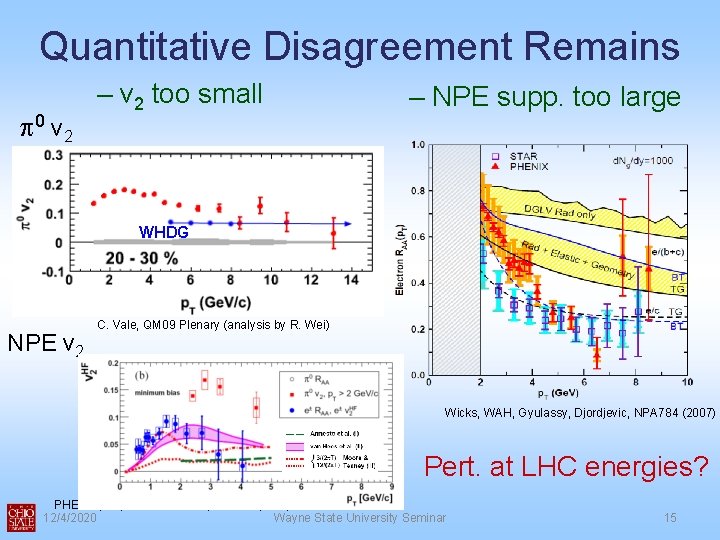
Quantitative Disagreement Remains p 0 v 2 – v 2 too small – NPE supp. too large WHDG NPE v 2 C. Vale, QM 09 Plenary (analysis by R. Wei) Wicks, WAH, Gyulassy, Djordjevic, NPA 784 (2007) Pert. at LHC energies? PHENIX, Phys. Rev. Lett. 98, 172301 (2007) 12/4/2020 Wayne State University Seminar 15
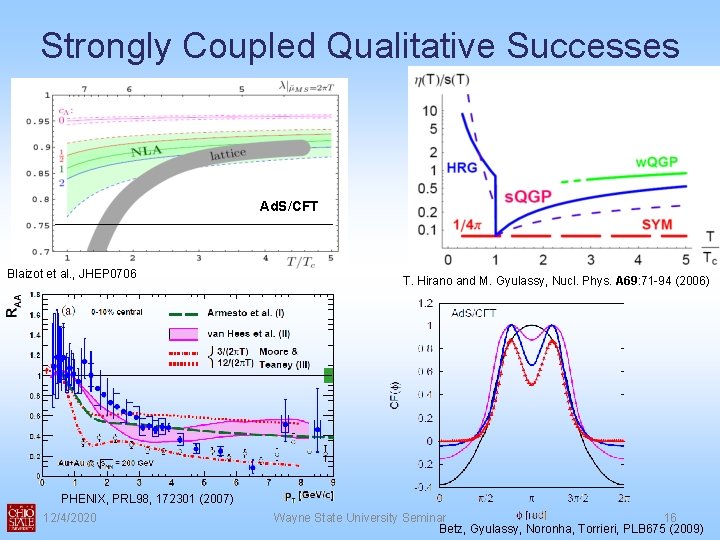
Strongly Coupled Qualitative Successes Ad. S/CFT Blaizot et al. , JHEP 0706 T. Hirano and M. Gyulassy, Nucl. Phys. A 69: 71 -94 (2006) PHENIX, PRL 98, 172301 (2007) 12/4/2020 Wayne State University Seminar 16 Betz, Gyulassy, Noronha, Torrieri, PLB 675 (2009)
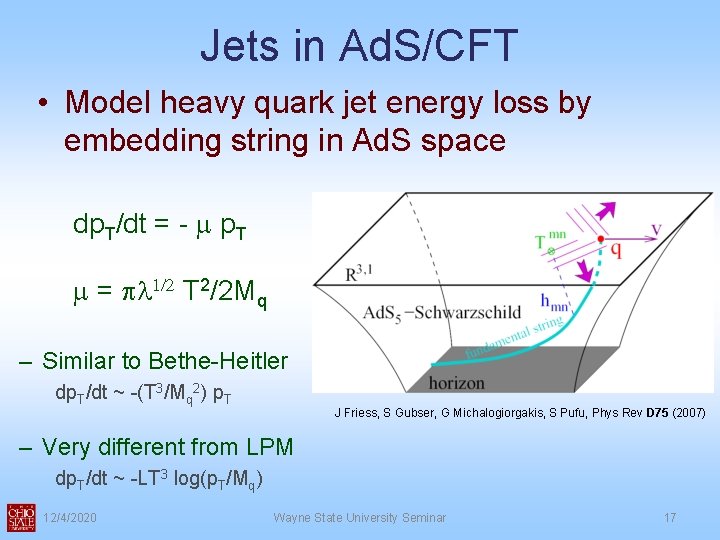
Jets in Ad. S/CFT • Model heavy quark jet energy loss by embedding string in Ad. S space dp. T/dt = - m p. T m = pl 1/2 T 2/2 Mq – Similar to Bethe-Heitler dp. T/dt ~ -(T 3/Mq 2) p. T J Friess, S Gubser, G Michalogiorgakis, S Pufu, Phys Rev D 75 (2007) – Very different from LPM dp. T/dt ~ -LT 3 log(p. T/Mq) 12/4/2020 Wayne State University Seminar 17
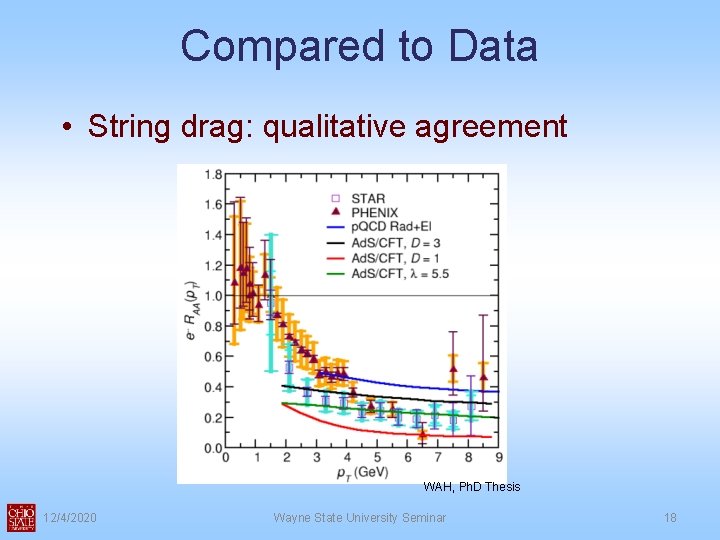
Compared to Data • String drag: qualitative agreement WAH, Ph. D Thesis 12/4/2020 Wayne State University Seminar 18
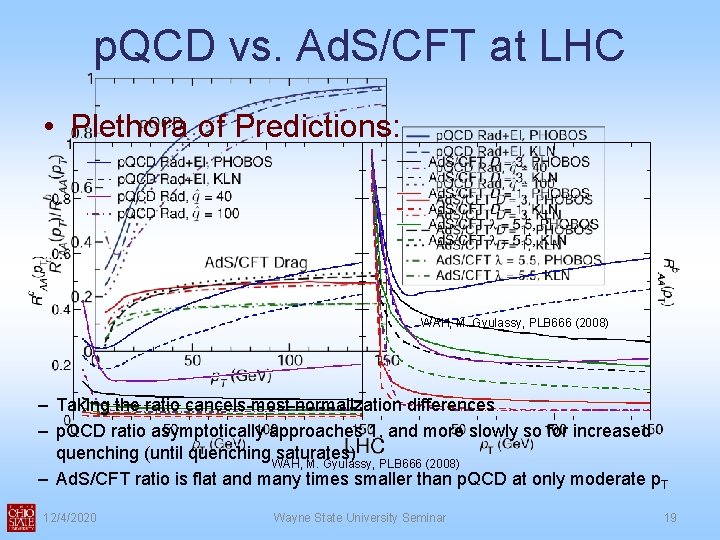
p. QCD vs. Ad. S/CFT at LHC • Plethora of Predictions: WAH, M. Gyulassy, PLB 666 (2008) – Taking the ratio cancels most normalization differences – p. QCD ratio asymptotically approaches 1, and more slowly so for increased quenching (until quenching saturates) WAH, M. Gyulassy, PLB 666 (2008) – Ad. S/CFT ratio is flat and many times smaller than p. QCD at only moderate p. T 12/4/2020 Wayne State University Seminar 19
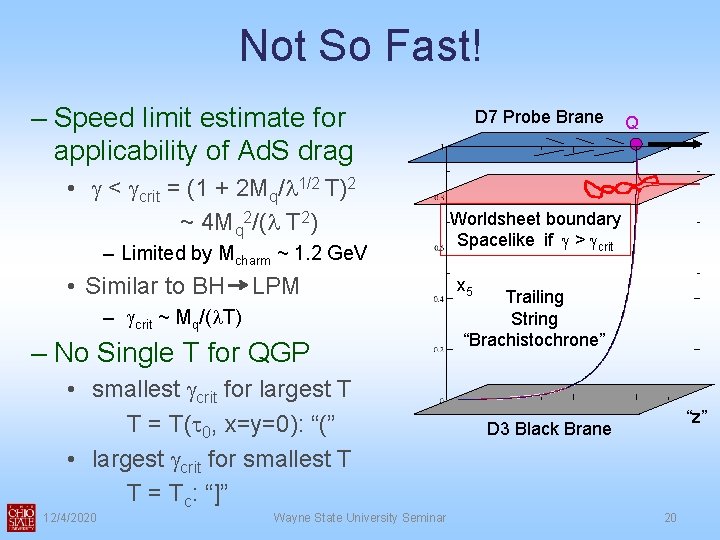
Not So Fast! – Speed limit estimate for applicability of Ad. S drag • g < gcrit = (1 + 2 Mq/l 1/2 T)2 ~ 4 Mq 2/(l T 2) – Limited by Mcharm ~ 1. 2 Ge. V • Similar to BH LPM – gcrit ~ Mq/(l. T) – No Single T for QGP • smallest gcrit for largest T T = T(t 0, x=y=0): “(” • largest gcrit for smallest T T = Tc: “]” 12/4/2020 Wayne State University Seminar D 7 Probe Brane Q Worldsheet boundary Spacelike if g > gcrit x 5 Trailing String “Brachistochrone” “z” D 3 Black Brane 20
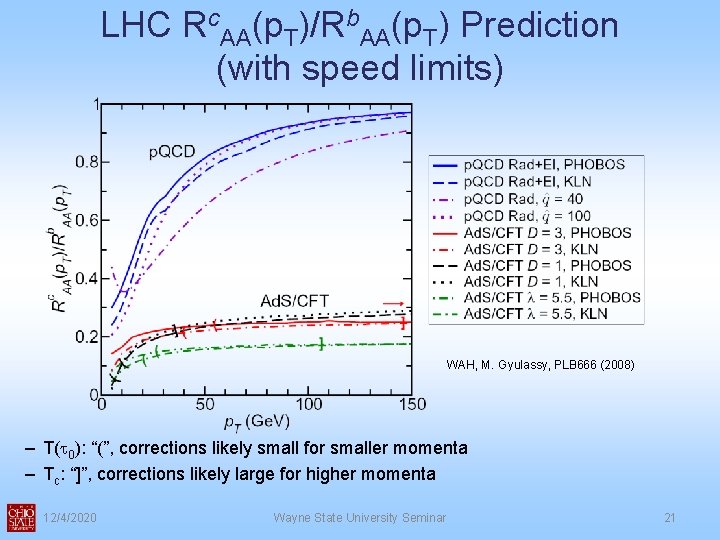
LHC Rc. AA(p. T)/Rb. AA(p. T) Prediction (with speed limits) WAH, M. Gyulassy, PLB 666 (2008) – T(t 0): “(”, corrections likely small for smaller momenta – Tc: “]”, corrections likely large for higher momenta 12/4/2020 Wayne State University Seminar 21
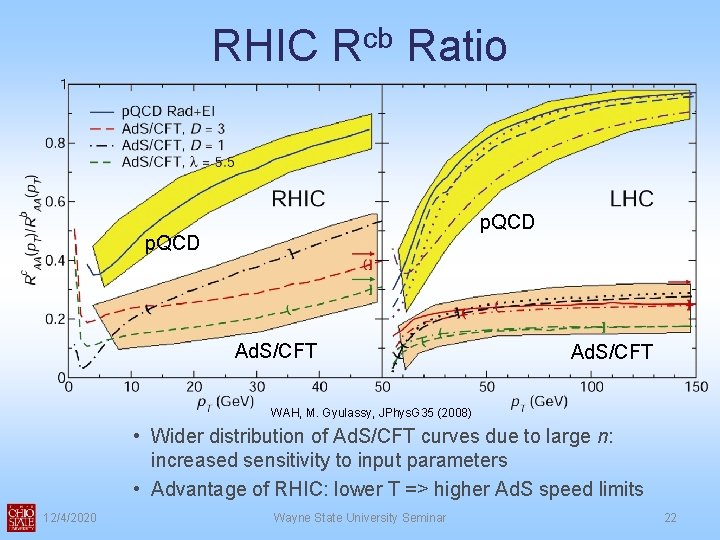
RHIC Rcb Ratio p. QCD Ad. S/CFT WAH, M. Gyulassy, JPhys. G 35 (2008) • Wider distribution of Ad. S/CFT curves due to large n: increased sensitivity to input parameters • Advantage of RHIC: lower T => higher Ad. S speed limits 12/4/2020 Wayne State University Seminar 22
Universality and Applicability • How universal are th. HQ drag results? – Examine different theories – Investigate alternate geometries • Other Ad. S geometries – Bjorken expanding hydro – Shock metric • Warm-up to Bj. hydro • Can represent both hot and cold nuclear matter 12/4/2020 Wayne State University Seminar 23
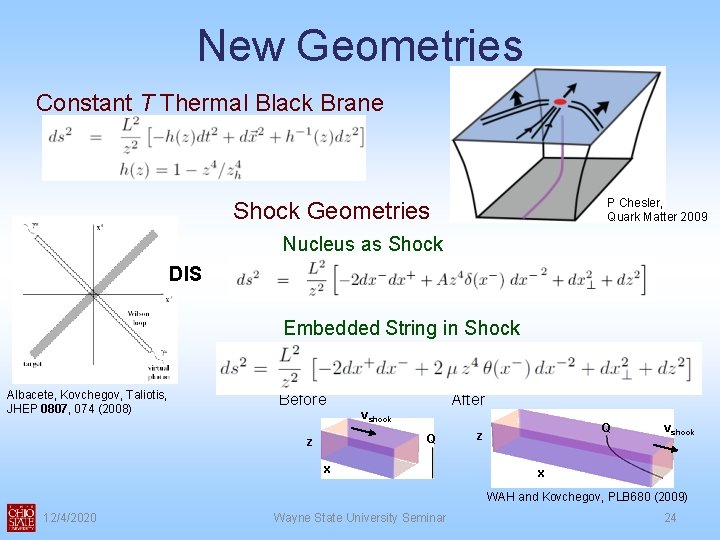
New Geometries Constant T Thermal Black Brane P Chesler, Quark Matter 2009 Shock Geometries Nucleus as Shock DIS Embedded String in Shock Albacete, Kovchegov, Taliotis, JHEP 0807, 074 (2008) Before After vshock Q z x Q z vshock x WAH and Kovchegov, PLB 680 (2009) 12/4/2020 Wayne State University Seminar 24
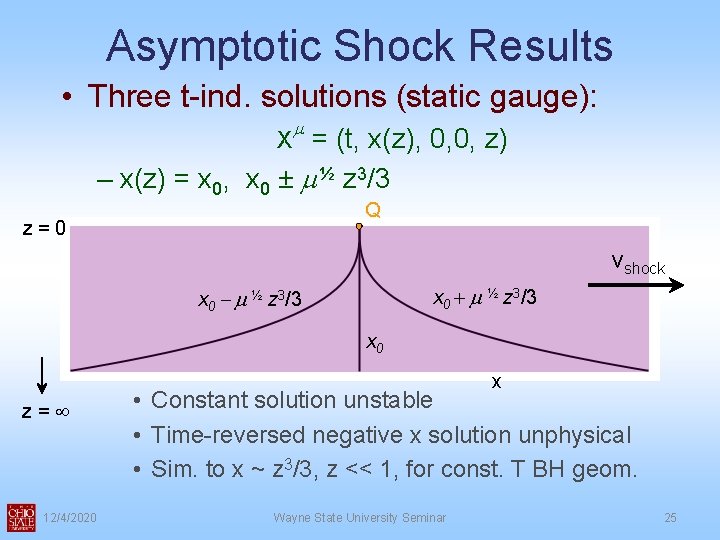
Asymptotic Shock Results • Three t-ind. solutions (static gauge): m X = (t, x(z), 0, 0, z) – x(z) = x 0, x 0 ± m ½ z 3/3 Q z=0 vshock x 0 + m ½ z 3/3 x 0 - m ½ z 3/3 x 0 x z=¥ 12/4/2020 • Constant solution unstable • Time-reversed negative x solution unphysical • Sim. to x ~ z 3/3, z << 1, for const. T BH geom. Wayne State University Seminar 25
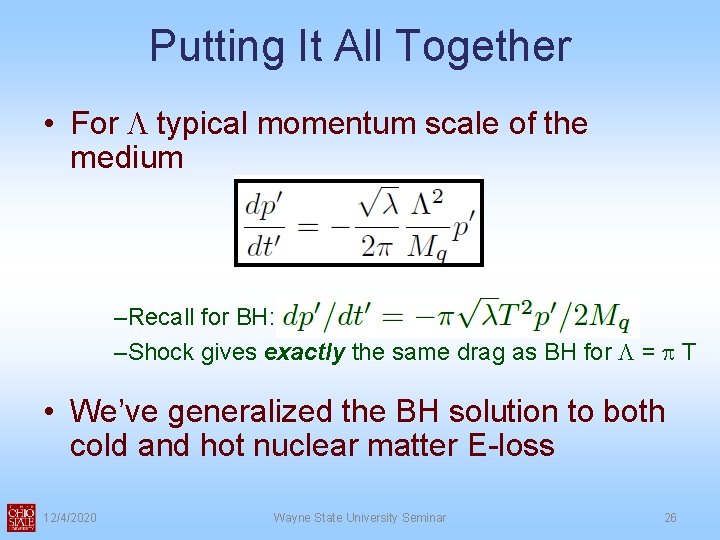
Putting It All Together • For L typical momentum scale of the medium –Recall for BH: –Shock gives exactly the same drag as BH for L = p T • We’ve generalized the BH solution to both cold and hot nuclear matter E-loss 12/4/2020 Wayne State University Seminar 26
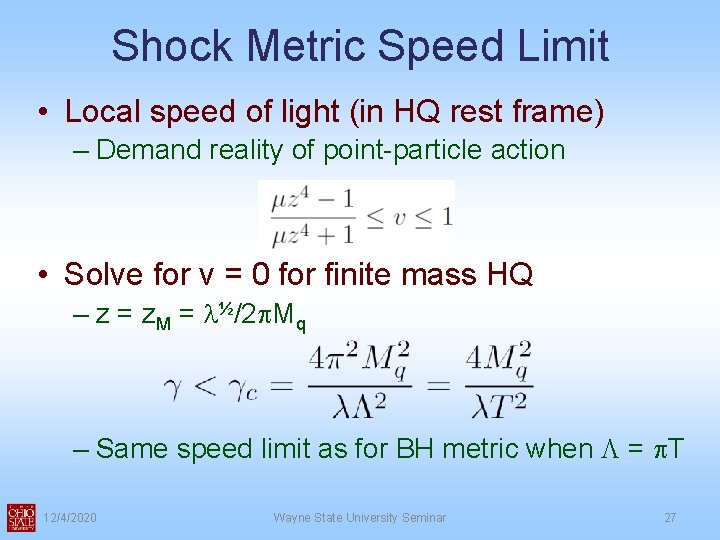
Shock Metric Speed Limit • Local speed of light (in HQ rest frame) – Demand reality of point-particle action • Solve for v = 0 for finite mass HQ – z = z. M = l½/2 p. Mq – Same speed limit as for BH metric when L = p. T 12/4/2020 Wayne State University Seminar 27
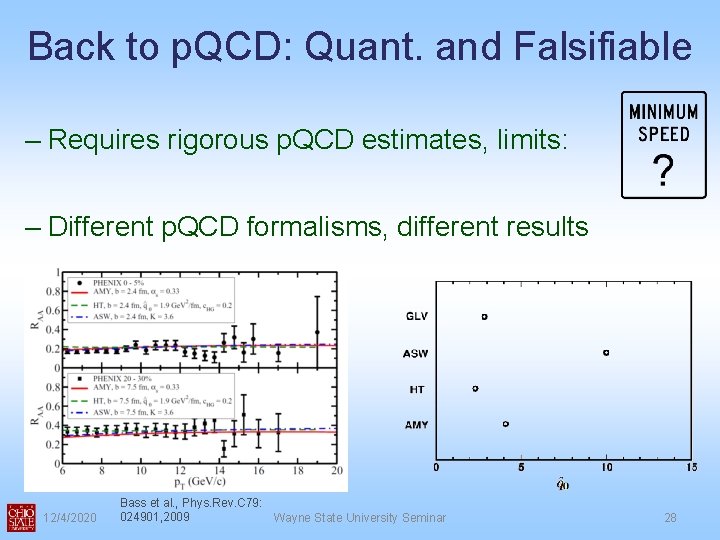
Back to p. QCD: Quant. and Falsifiable – Requires rigorous p. QCD estimates, limits: – Different p. QCD formalisms, different results 12/4/2020 Bass et al. , Phys. Rev. C 79: 024901, 2009 Wayne State University Seminar 28
Need for Theoretical Uncertainty • Want to rigorously: – falsify theories – quantify medium • Therefore need: – Precise observables – Precise theory • Distinguish between systematic uncertainties: – between formalisms • Due to diff. physics assumptions – within formalisms • Due to simplifying approximations • Focus specifically on opacity expansion – GLV; ASW-SH 12/4/2020 Wayne State University Seminar 29
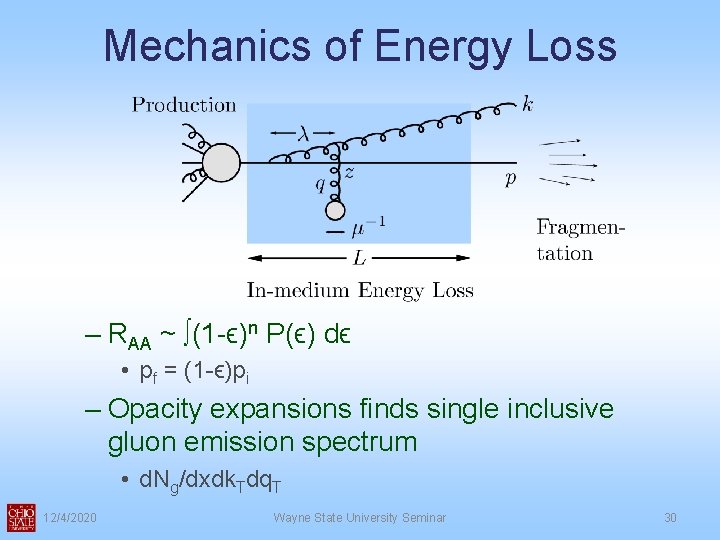
Mechanics of Energy Loss – RAA ~ ∫(1 -ϵ)n P(ϵ) dϵ • pf = (1 -ϵ)pi – Opacity expansions finds single inclusive gluon emission spectrum • d. Ng/dxdk. Tdq. T 12/4/2020 Wayne State University Seminar 30
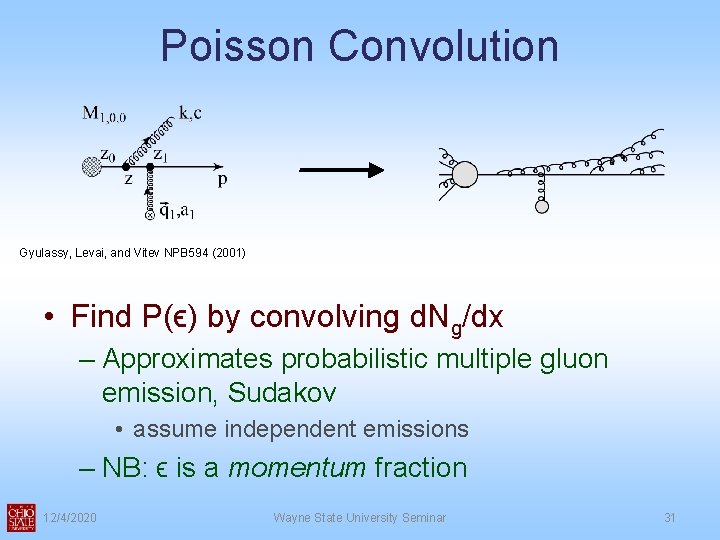
Poisson Convolution Gyulassy, Levai, and Vitev NPB 594 (2001) • Find P(ϵ) by convolving d. Ng/dx – Approximates probabilistic multiple gluon emission, Sudakov • assume independent emissions – NB: ϵ is a momentum fraction 12/4/2020 Wayne State University Seminar 31
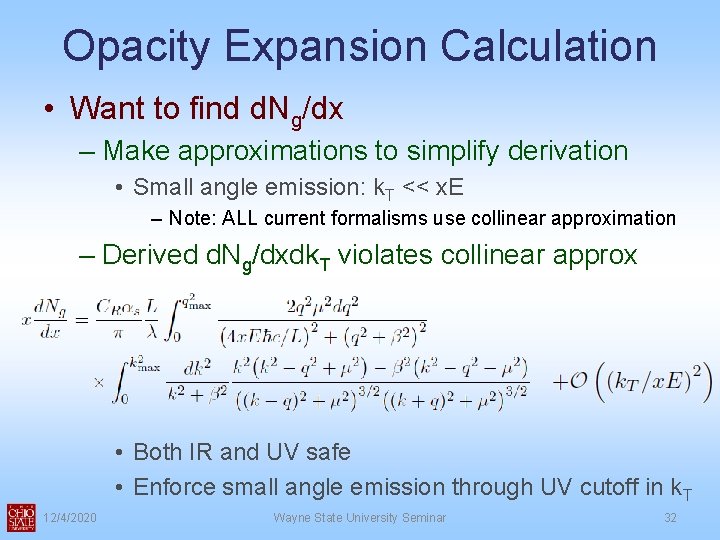
Opacity Expansion Calculation • Want to find d. Ng/dx – Make approximations to simplify derivation • Small angle emission: k. T << x. E – Note: ALL current formalisms use collinear approximation – Derived d. Ng/dxdk. T violates collinear approx • Both IR and UV safe • Enforce small angle emission through UV cutoff in k. T 12/4/2020 Wayne State University Seminar 32
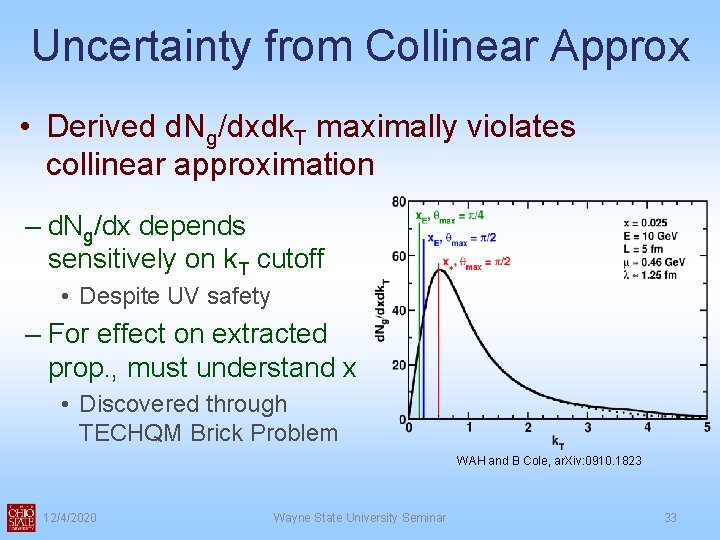
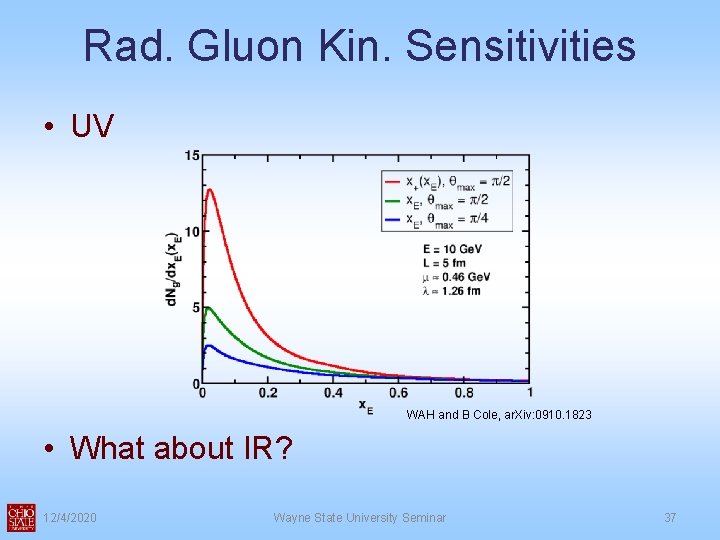
Uncertainty from Collinear Approx • Derived d. Ng/dxdk. T maximally violates collinear approximation – d. Ng/dx depends sensitively on k. T cutoff • Despite UV safety – For effect on extracted prop. , must understand x • Discovered through TECHQM Brick Problem WAH and B Cole, ar. Xiv: 0910. 1823 12/4/2020 Wayne State University Seminar 33
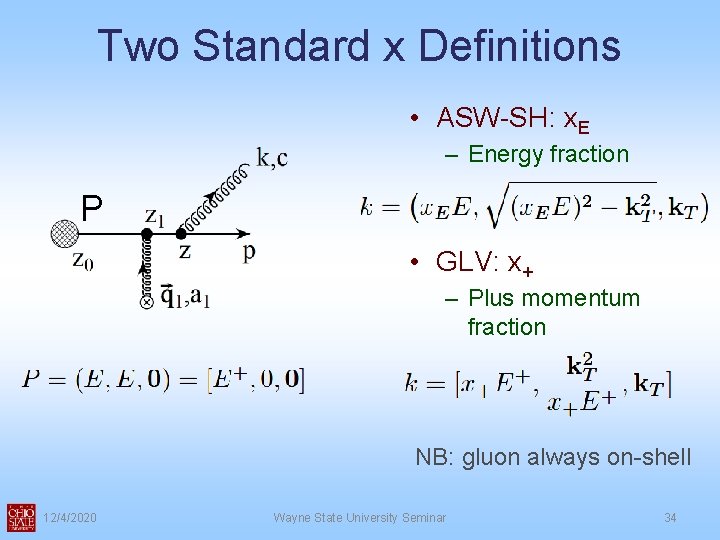
Two Standard x Definitions • ASW-SH: x. E – Energy fraction P • GLV: x+ – Plus momentum fraction NB: gluon always on-shell 12/4/2020 Wayne State University Seminar 34
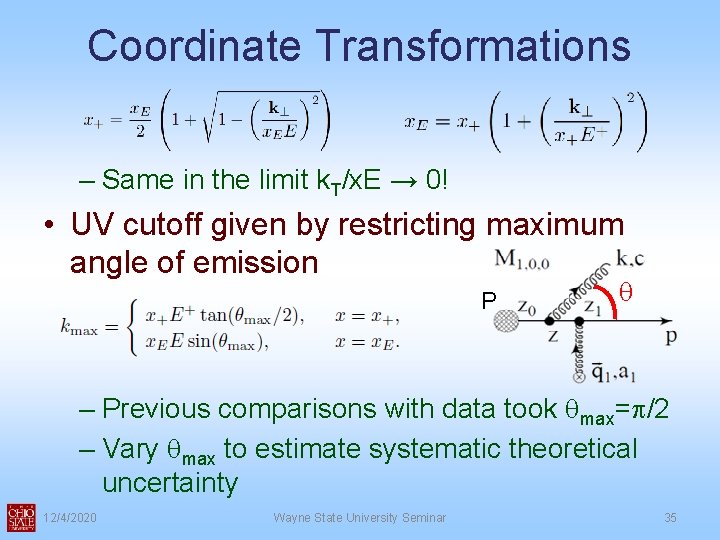
Coordinate Transformations – Same in the limit k. T/x. E → 0! • UV cutoff given by restricting maximum angle of emission P q – Previous comparisons with data took qmax=p/2 – Vary qmax to estimate systematic theoretical uncertainty 12/4/2020 Wayne State University Seminar 35
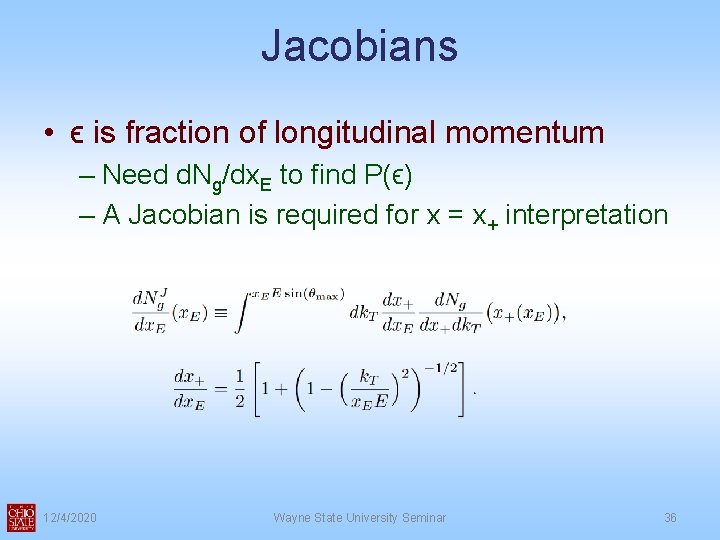
Jacobians • ϵ is fraction of longitudinal momentum – Need d. Ng/dx. E to find P(ϵ) – A Jacobian is required for x = x+ interpretation 12/4/2020 Wayne State University Seminar 36
Rad. Gluon Kin. Sensitivities • UV WAH and B Cole, ar. Xiv: 0910. 1823 • What about IR? 12/4/2020 Wayne State University Seminar 37
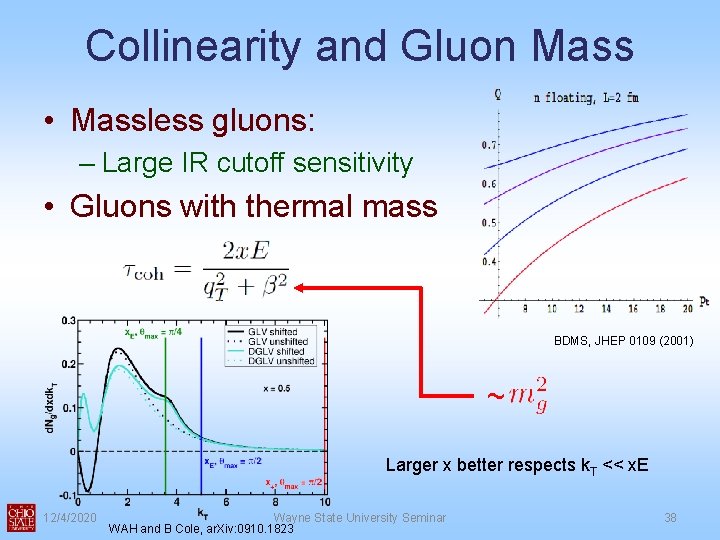
Collinearity and Gluon Mass • Massless gluons: – Large IR cutoff sensitivity • Gluons with thermal mass BDMS, JHEP 0109 (2001) ~ Larger x better respects k. T << x. E 12/4/2020 Wayne State University Seminar WAH and B Cole, ar. Xiv: 0910. 1823 38
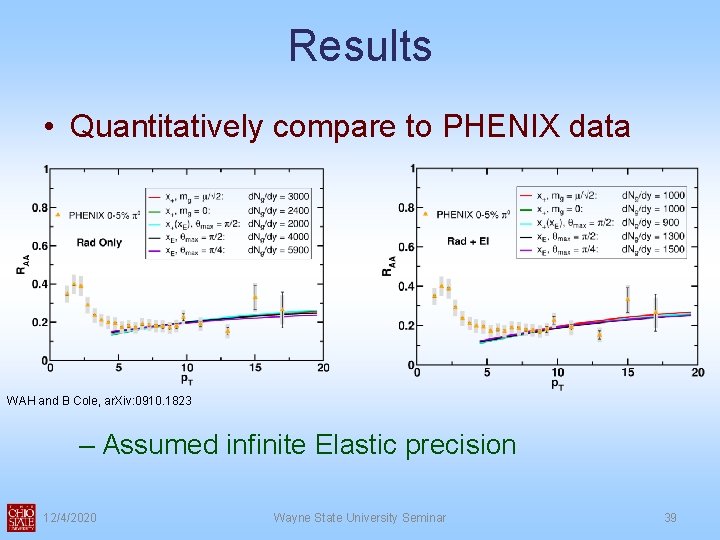
Results • Quantitatively compare to PHENIX data WAH and B Cole, ar. Xiv: 0910. 1823 – Assumed infinite Elastic precision 12/4/2020 Wayne State University Seminar 39
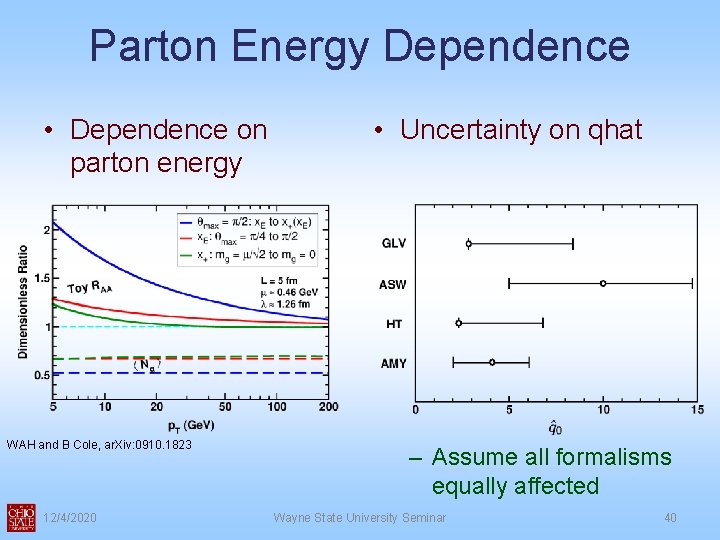
Parton Energy Dependence • Dependence on parton energy WAH and B Cole, ar. Xiv: 0910. 1823 12/4/2020 • Uncertainty on qhat – Assume all formalisms equally affected Wayne State University Seminar 40
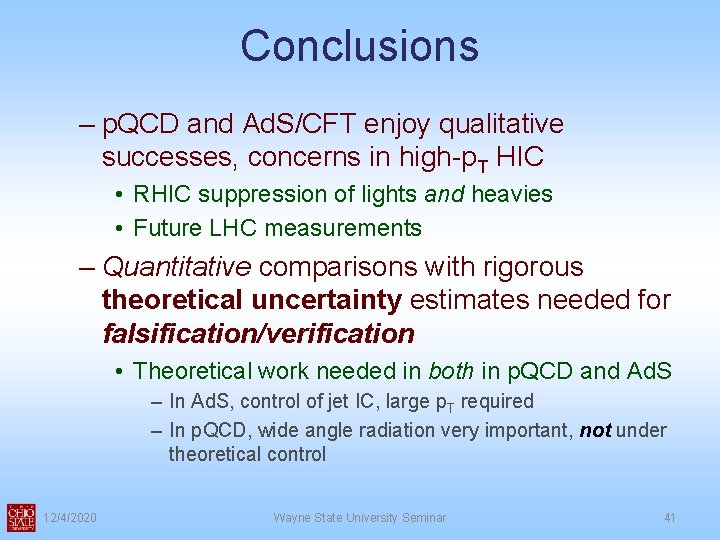
Conclusions – p. QCD and Ad. S/CFT enjoy qualitative successes, concerns in high-p. T HIC • RHIC suppression of lights and heavies • Future LHC measurements – Quantitative comparisons with rigorous theoretical uncertainty estimates needed for falsification/verification • Theoretical work needed in both in p. QCD and Ad. S – In Ad. S, control of jet IC, large p. T required – In p. QCD, wide angle radiation very important, not under theoretical control 12/4/2020 Wayne State University Seminar 41