Student Launch Initiative AIAA OC Rocketeers STUDENT LAUNCH




- Slides: 59
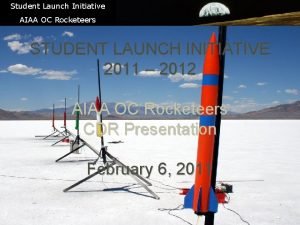
Student Launch Initiative AIAA OC Rocketeers STUDENT LAUNCH INITIATIVE 2011 – 2012 AIAA OC Rocketeers CDR Presentation February 6, 2011 1
Student Launch Initiative AIAA OC Rocketeers Agenda u u u u Introduction of team members (representing 4 high schools in Orange County California) Scale model testing and results Full Scale Design • Vehicle • UAV Payload – Description, Safety, and Testing • Recovery System and Events • GPS • Integration Feedback form checklist Risks and Safety Educational Outreach Budget and Timeline Corrected 3 slides, added scale launches 2&3 & RC plane testing 2
Student Launch Initiative AIAA OC Rocketeers Scale Model Testing How it affected the final design 3
Student Launch Initiative AIAA OC Rocketeers Black Powder Calculations Scale rocket is 3” diameter (surface area on a bulkhead is π r 2 or 7. 07 in 2). . We need at least 100 lbs of force + another 105 lbs for the three #2 Nylon screws. The amount of black powder then is C D 2 L where C is psi *. 0004. D is the diameter in inches (3), and L is the length in inches (12). Pounds PSI (lbs/in 2) Black Powder (g) 175 24. 8 (175 lbs / 7. 07 in 2) 1. 08 200 28. 3 (200 lbs / 7. 07 in 2) 1. 22 225 31. 8 (225 lbs / 7. 07 in 2) 1. 37 250 35. 4 (250 lbs / 7. 07 in 2) 1. 53 4
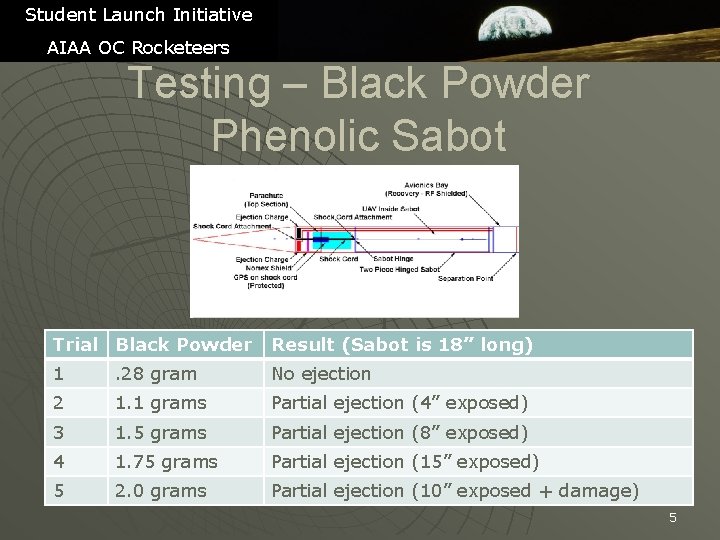
Student Launch Initiative AIAA OC Rocketeers Testing – Black Powder Phenolic Sabot Trial Black Powder Result (Sabot is 18” long) 1 . 28 gram No ejection 2 1. 1 grams Partial ejection (4” exposed) 3 1. 5 grams Partial ejection (8” exposed) 4 1. 75 grams Partial ejection (15” exposed) 5 2. 0 grams Partial ejection (10” exposed + damage) 5
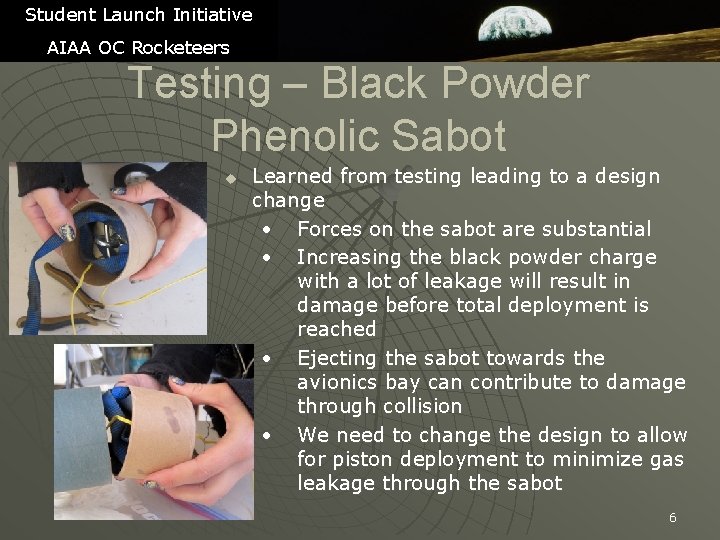
Student Launch Initiative AIAA OC Rocketeers Testing – Black Powder Phenolic Sabot u Learned from testing leading to a design change • Forces on the sabot are substantial • Increasing the black powder charge with a lot of leakage will result in damage before total deployment is reached • Ejecting the sabot towards the avionics bay can contribute to damage through collision • We need to change the design to allow for piston deployment to minimize gas leakage through the sabot 6
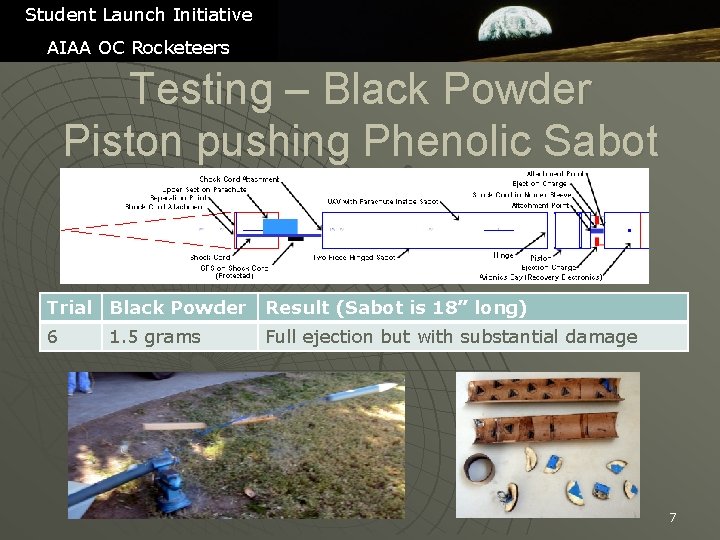
Student Launch Initiative AIAA OC Rocketeers Testing – Black Powder Piston pushing Phenolic Sabot Trial Black Powder Result (Sabot is 18” long) 6 Full ejection but with substantial damage 1. 5 grams 7
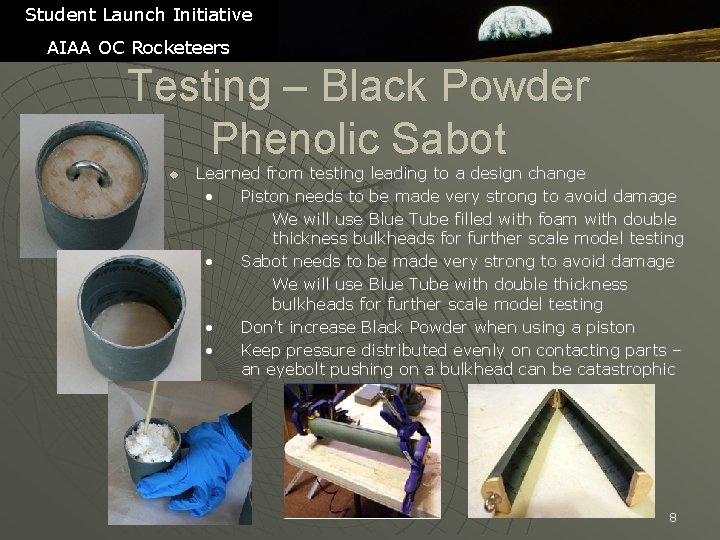
Student Launch Initiative AIAA OC Rocketeers Testing – Black Powder Phenolic Sabot u Learned from testing leading to a design change • Piston needs to be made very strong to avoid damage • We will use Blue Tube filled with foam with double thickness bulkheads for further scale model testing • Sabot needs to be made very strong to avoid damage • We will use Blue Tube with double thickness bulkheads for further scale model testing • Don’t increase Black Powder when using a piston • Keep pressure distributed evenly on contacting parts – an eyebolt pushing on a bulkhead can be catastrophic 8
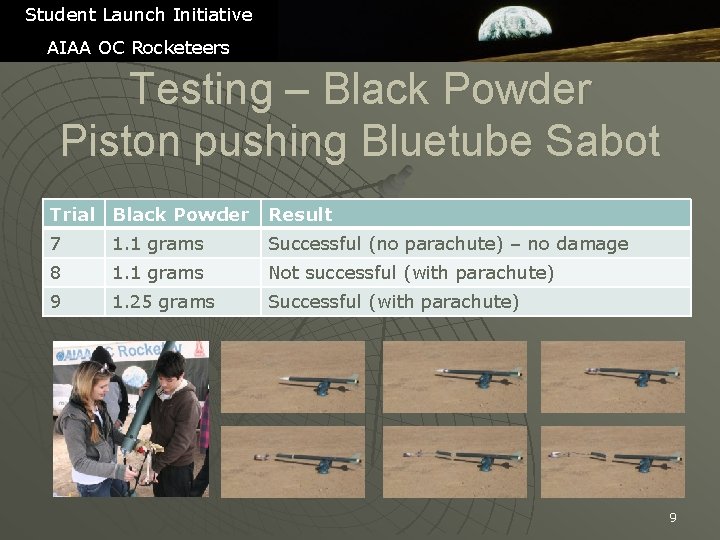
Student Launch Initiative AIAA OC Rocketeers Testing – Black Powder Piston pushing Bluetube Sabot Trial Black Powder Result 7 1. 1 grams Successful (no parachute) – no damage 8 1. 1 grams Not successful (with parachute) 9 1. 25 grams Successful (with parachute) 9
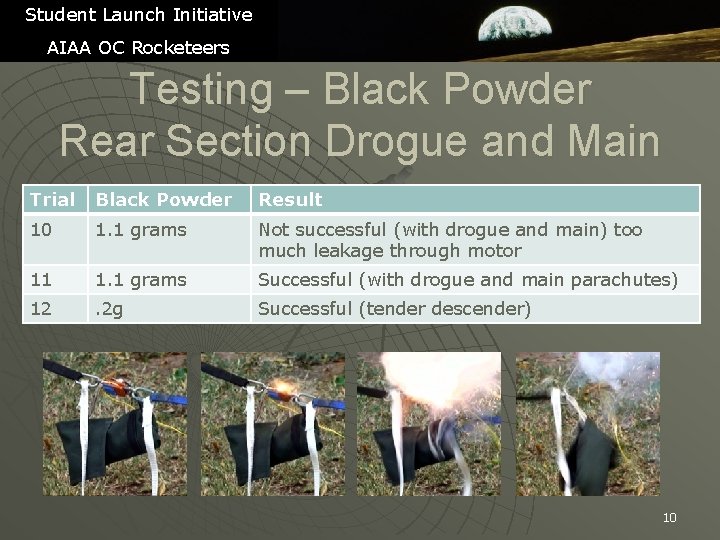
Student Launch Initiative AIAA OC Rocketeers Testing – Black Powder Rear Section Drogue and Main Trial Black Powder Result 10 1. 1 grams Not successful (with drogue and main) too much leakage through motor 11 1. 1 grams Successful (with drogue and main parachutes) 12 . 2 g Successful (tender descender) 10
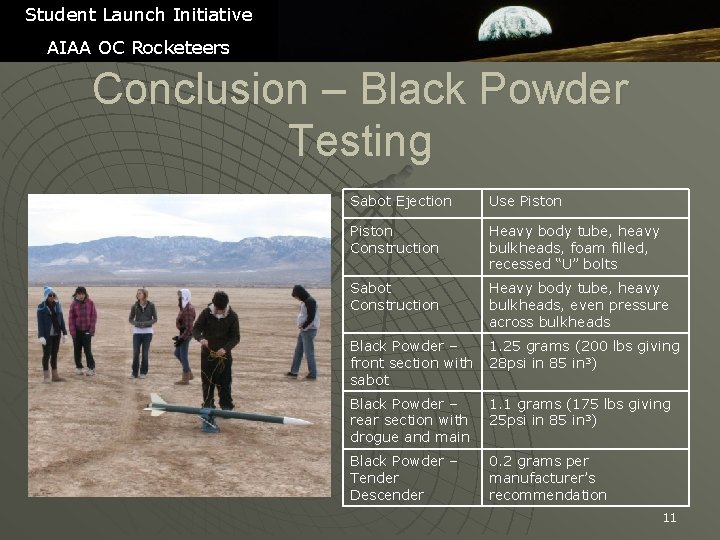
Student Launch Initiative AIAA OC Rocketeers Conclusion – Black Powder Testing Sabot Ejection Use Piston Construction Heavy body tube, heavy bulkheads, foam filled, recessed “U” bolts Sabot Construction Heavy body tube, heavy bulkheads, even pressure across bulkheads Black Powder – 1. 25 grams (200 lbs giving front section with 28 psi in 85 in 3) sabot Black Powder – rear section with drogue and main 1. 1 grams (175 lbs giving 25 psi in 85 in 3) Black Powder – Tender Descender 0. 2 grams per manufacturer’s recommendation 11
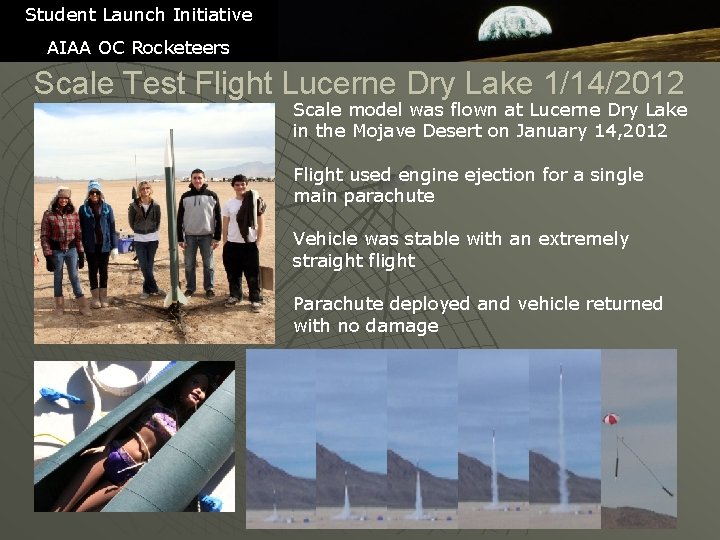
Student Launch Initiative AIAA OC Rocketeers Scale Test Flight Lucerne Dry Lake 1/14/2012 Scale model was flown at Lucerne Dry Lake in the Mojave Desert on January 14, 2012 Flight used engine ejection for a single main parachute Vehicle was stable with an extremely straight flight Parachute deployed and vehicle returned with no damage 12
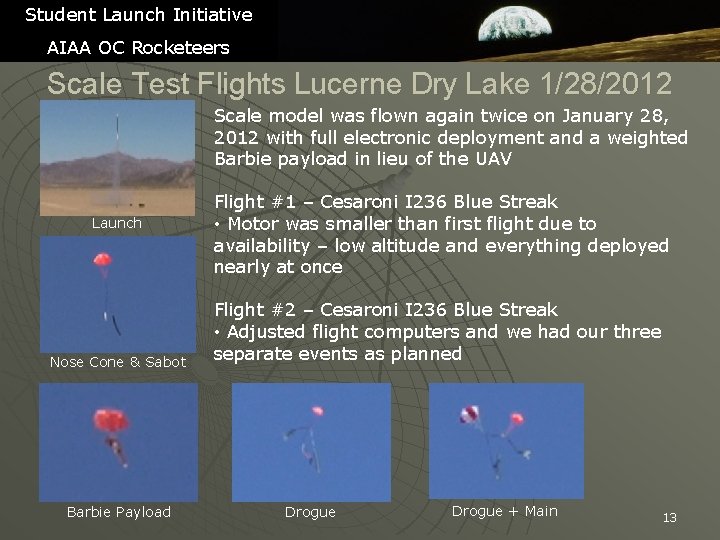
Student Launch Initiative AIAA OC Rocketeers Scale Test Flights Lucerne Dry Lake 1/28/2012 Scale model was flown again twice on January 28, 2012 with full electronic deployment and a weighted Barbie payload in lieu of the UAV Launch Nose Cone & Sabot Barbie Payload Flight #1 – Cesaroni I 236 Blue Streak • Motor was smaller than first flight due to availability – low altitude and everything deployed nearly at once Flight #2 – Cesaroni I 236 Blue Streak • Adjusted flight computers and we had our three separate events as planned Drogue + Main 13
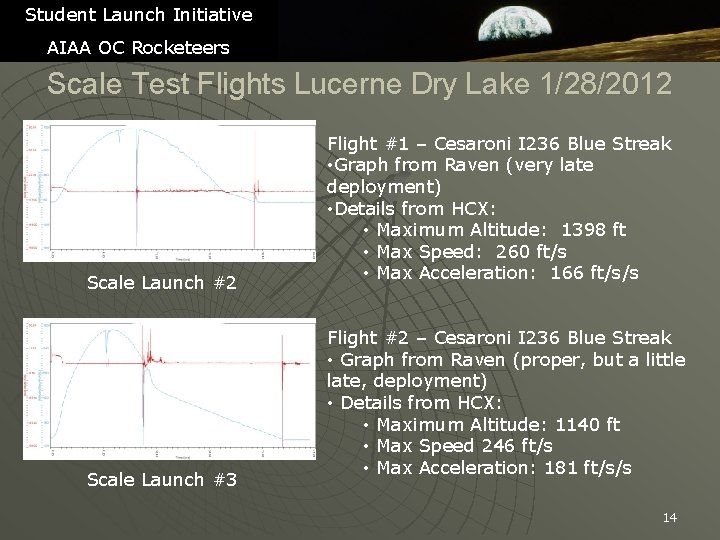
Student Launch Initiative AIAA OC Rocketeers Scale Test Flights Lucerne Dry Lake 1/28/2012 Scale Launch #3 Flight #1 – Cesaroni I 236 Blue Streak • Graph from Raven (very late deployment) • Details from HCX: • Maximum Altitude: 1398 ft • Max Speed: 260 ft/s • Max Acceleration: 166 ft/s/s Flight #2 – Cesaroni I 236 Blue Streak • Graph from Raven (proper, but a little late, deployment) • Details from HCX: • Maximum Altitude: 1140 ft • Max Speed 246 ft/s • Max Acceleration: 181 ft/s/s 14
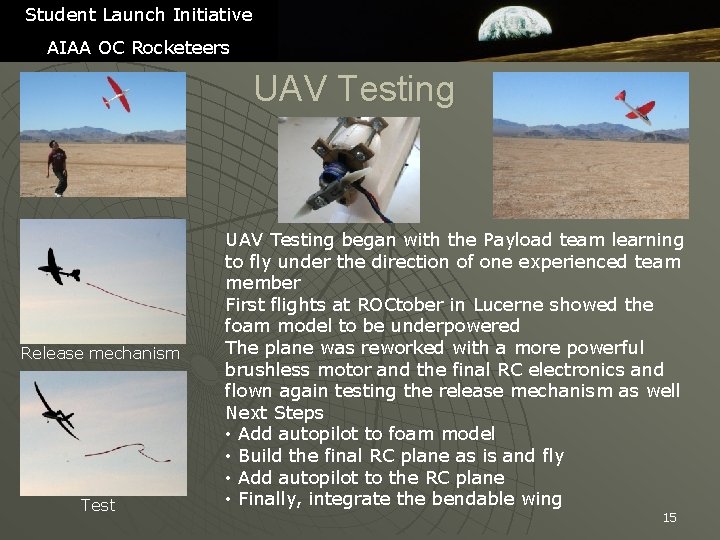
Student Launch Initiative AIAA OC Rocketeers UAV Testing Release mechanism Test UAV Testing began with the Payload team learning to fly under the direction of one experienced team member First flights at ROCtober in Lucerne showed the foam model to be underpowered The plane was reworked with a more powerful brushless motor and the final RC electronics and flown again testing the release mechanism as well Next Steps • Add autopilot to foam model • Build the final RC plane as is and fly • Add autopilot to the RC plane • Finally, integrate the bendable wing 15
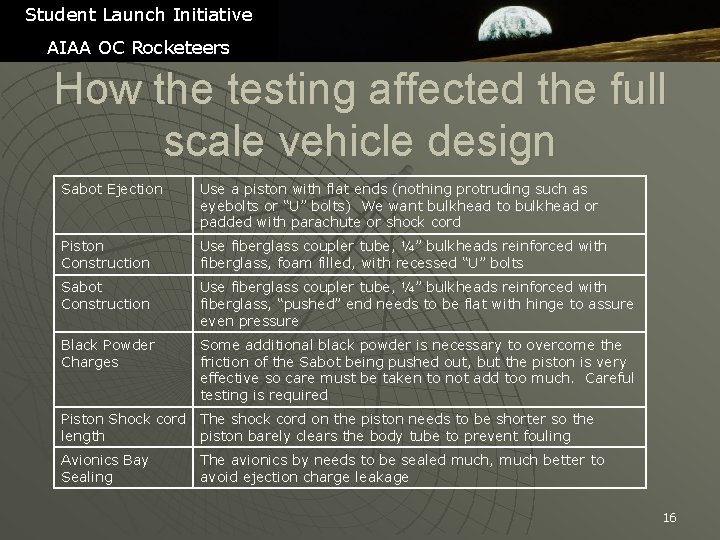
Student Launch Initiative AIAA OC Rocketeers How the testing affected the full scale vehicle design Sabot Ejection Use a piston with flat ends (nothing protruding such as eyebolts or “U” bolts) We want bulkhead to bulkhead or padded with parachute or shock cord Piston Construction Use fiberglass coupler tube, ¼” bulkheads reinforced with fiberglass, foam filled, with recessed “U” bolts Sabot Construction Use fiberglass coupler tube, ¼” bulkheads reinforced with fiberglass, “pushed” end needs to be flat with hinge to assure even pressure Black Powder Charges Some additional black powder is necessary to overcome the friction of the Sabot being pushed out, but the piston is very effective so care must be taken to not add too much. Careful testing is required Piston Shock cord The shock cord on the piston needs to be shorter so the length piston barely clears the body tube to prevent fouling Avionics Bay Sealing The avionics by needs to be sealed much, much better to avoid ejection charge leakage 16
Student Launch Initiative AIAA OC Rocketeers Full Scale Design 17
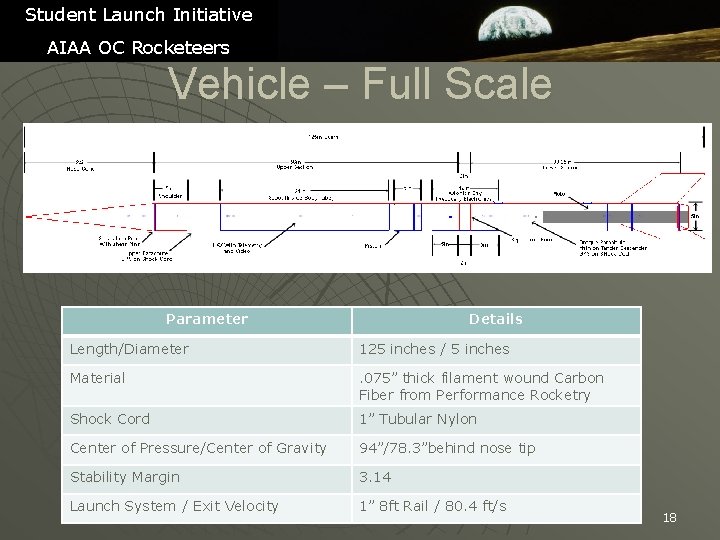
Student Launch Initiative AIAA OC Rocketeers Vehicle – Full Scale Parameter Details Length/Diameter 125 inches / 5 inches Material . 075” thick filament wound Carbon Fiber from Performance Rocketry Shock Cord 1” Tubular Nylon Center of Pressure/Center of Gravity 94”/78. 3”behind nose tip Stability Margin 3. 14 Launch System / Exit Velocity 1” 8 ft Rail / 80. 4 ft/s 18
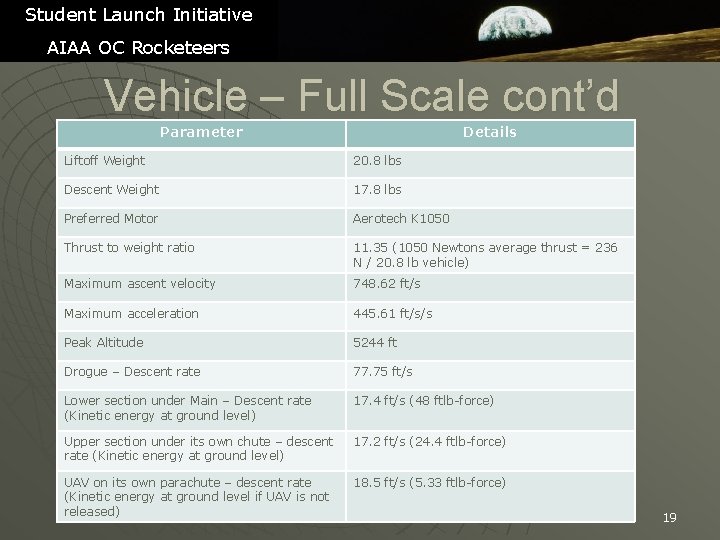
Student Launch Initiative AIAA OC Rocketeers Vehicle – Full Scale cont’d Parameter Details Liftoff Weight 20. 8 lbs Descent Weight 17. 8 lbs Preferred Motor Aerotech K 1050 Thrust to weight ratio 11. 35 (1050 Newtons average thrust = 236 N / 20. 8 lb vehicle) Maximum ascent velocity 748. 62 ft/s Maximum acceleration 445. 61 ft/s/s Peak Altitude 5244 ft Drogue – Descent rate 77. 75 ft/s Lower section under Main – Descent rate (Kinetic energy at ground level) 17. 4 ft/s (48 ftlb-force) Upper section under its own chute – descent rate (Kinetic energy at ground level) 17. 2 ft/s (24. 4 ftlb-force) UAV on its own parachute – descent rate (Kinetic energy at ground level if UAV is not released) 18. 5 ft/s (5. 33 ftlb-force) 19
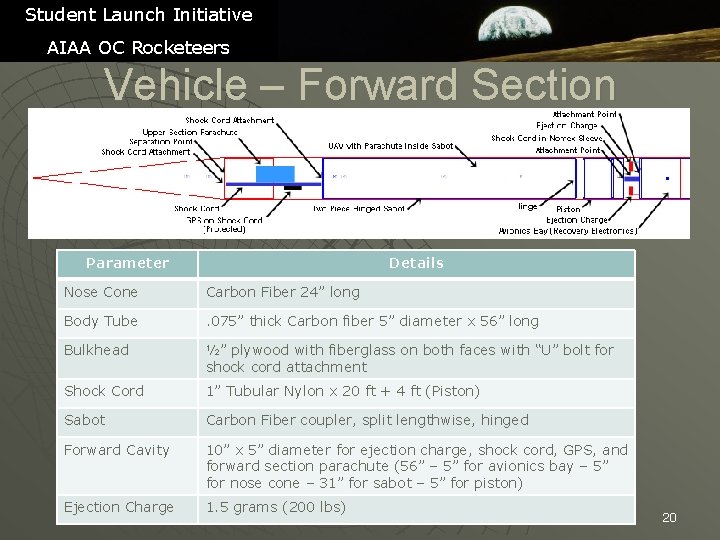
Student Launch Initiative AIAA OC Rocketeers Vehicle – Forward Section Parameter Details Nose Cone Carbon Fiber 24” long Body Tube . 075” thick Carbon fiber 5” diameter x 56” long Bulkhead ½” plywood with fiberglass on both faces with “U” bolt for shock cord attachment Shock Cord 1” Tubular Nylon x 20 ft + 4 ft (Piston) Sabot Carbon Fiber coupler, split lengthwise, hinged Forward Cavity 10” x 5” diameter for ejection charge, shock cord, GPS, and forward section parachute (56” – 5” for avionics bay – 5” for nose cone – 31” for sabot – 5” for piston) Ejection Charge 1. 5 grams (200 lbs) 20
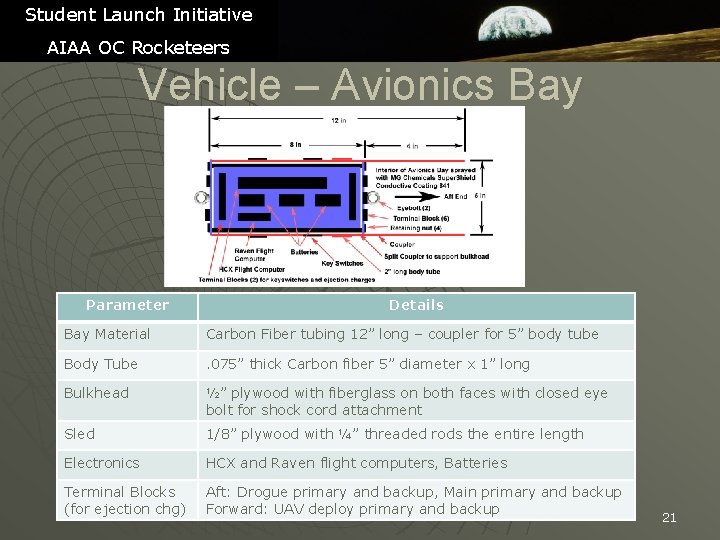
Student Launch Initiative AIAA OC Rocketeers Vehicle – Avionics Bay Parameter Details Bay Material Carbon Fiber tubing 12” long – coupler for 5” body tube Body Tube . 075” thick Carbon fiber 5” diameter x 1” long Bulkhead ½” plywood with fiberglass on both faces with closed eye bolt for shock cord attachment Sled 1/8” plywood with ¼” threaded rods the entire length Electronics HCX and Raven flight computers, Batteries Terminal Blocks (for ejection chg) Aft: Drogue primary and backup, Main primary and backup Forward: UAV deploy primary and backup 21
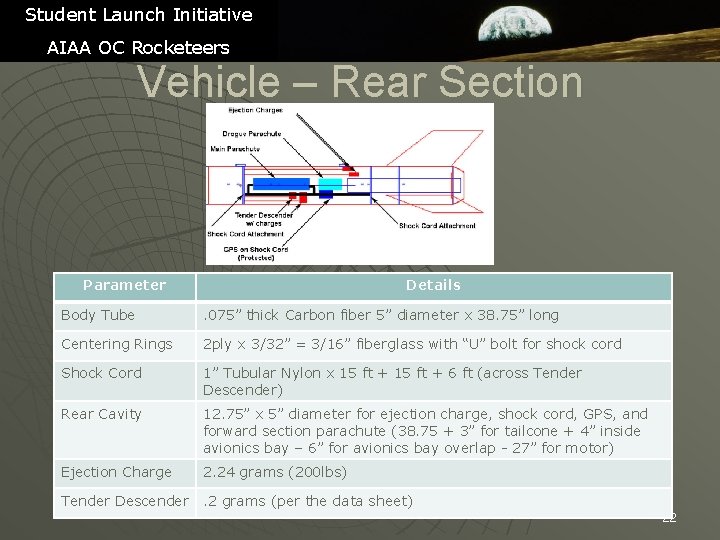
Student Launch Initiative AIAA OC Rocketeers Vehicle – Rear Section Parameter Details Body Tube . 075” thick Carbon fiber 5” diameter x 38. 75” long Centering Rings 2 ply x 3/32” = 3/16” fiberglass with “U” bolt for shock cord Shock Cord 1” Tubular Nylon x 15 ft + 6 ft (across Tender Descender) Rear Cavity 12. 75” x 5” diameter for ejection charge, shock cord, GPS, and forward section parachute (38. 75 + 3” for tailcone + 4” inside avionics bay – 6” for avionics bay overlap - 27” for motor) Ejection Charge 2. 24 grams (200 lbs) Tender Descender . 2 grams (per the data sheet) 22
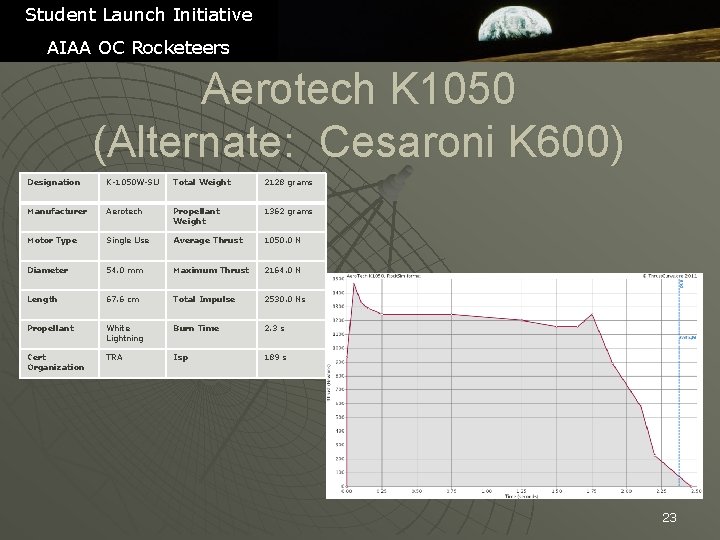
Student Launch Initiative AIAA OC Rocketeers Aerotech K 1050 (Alternate: Cesaroni K 600) Designation K-1050 W-SU Total Weight 2128 grams Manufacturer Aerotech Propellant Weight 1362 grams Motor Type Single Use Average Thrust 1050. 0 N Diameter 54. 0 mm Maximum Thrust 2164. 0 N Length 67. 6 cm Total Impulse 2530. 0 Ns Propellant White Lightning Burn Time 2. 3 s Cert Organization TRA Isp 189 s 23
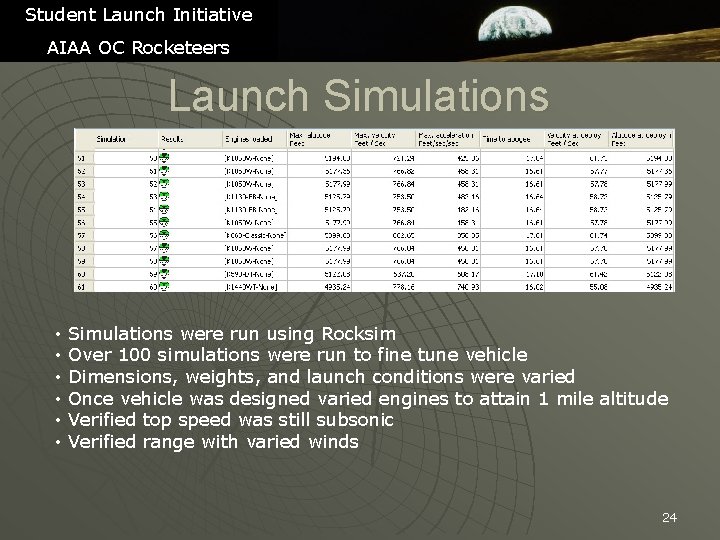
Student Launch Initiative AIAA OC Rocketeers Launch Simulations • Simulations were run using Rocksim • Over 100 simulations were run to fine tune vehicle • Dimensions, weights, and launch conditions were varied • Once vehicle was designed varied engines to attain 1 mile altitude • Verified top speed was still subsonic • Verified range with varied winds 24
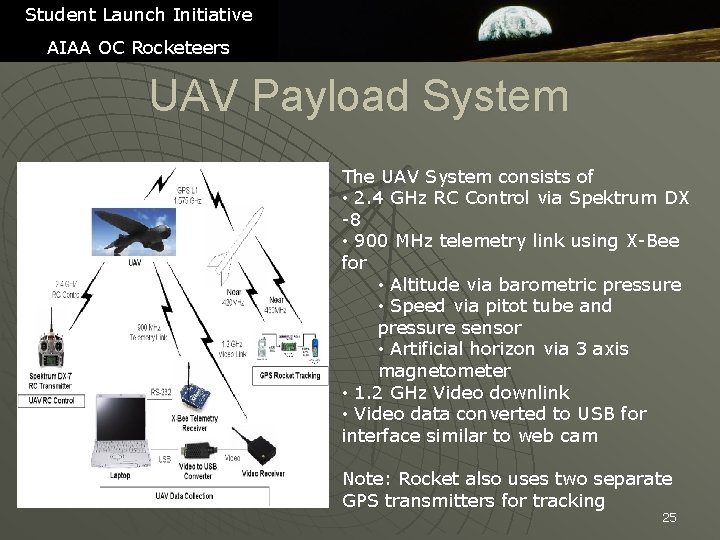
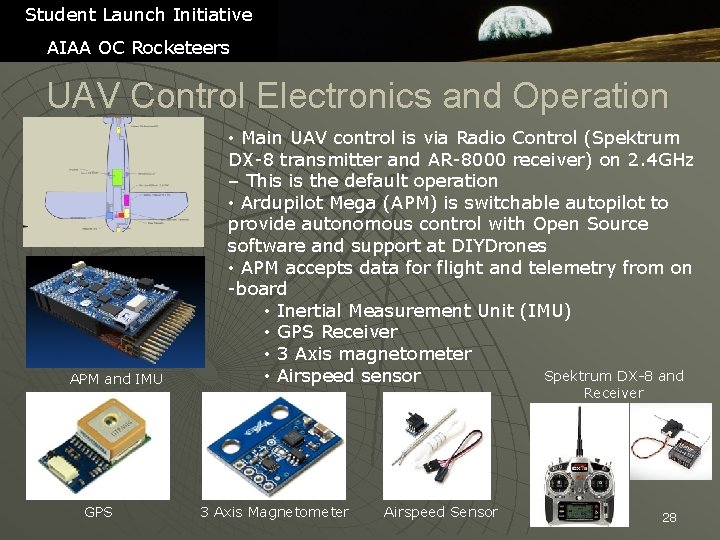
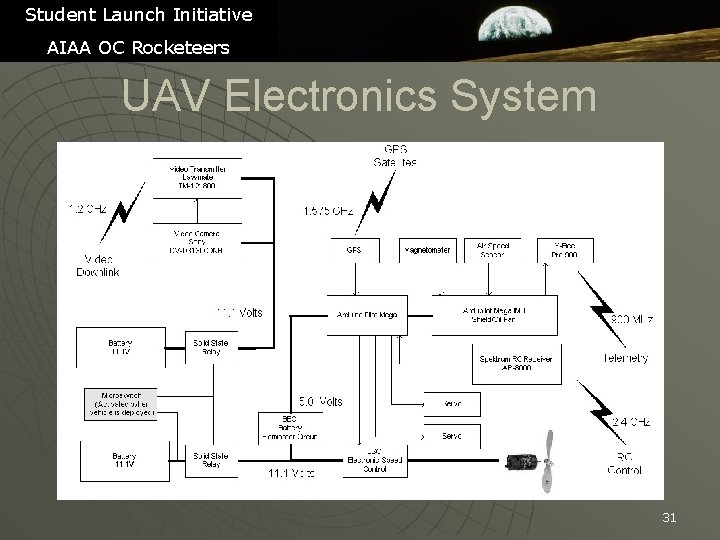
Student Launch Initiative AIAA OC Rocketeers UAV Payload System The UAV System consists of • 2. 4 GHz RC Control via Spektrum DX -8 • 900 MHz telemetry link using X-Bee for • Altitude via barometric pressure • Speed via pitot tube and pressure sensor • Artificial horizon via 3 axis magnetometer • 1. 2 GHz Video downlink • Video data converted to USB for interface similar to web cam Note: Rocket also uses two separate GPS transmitters for tracking 25
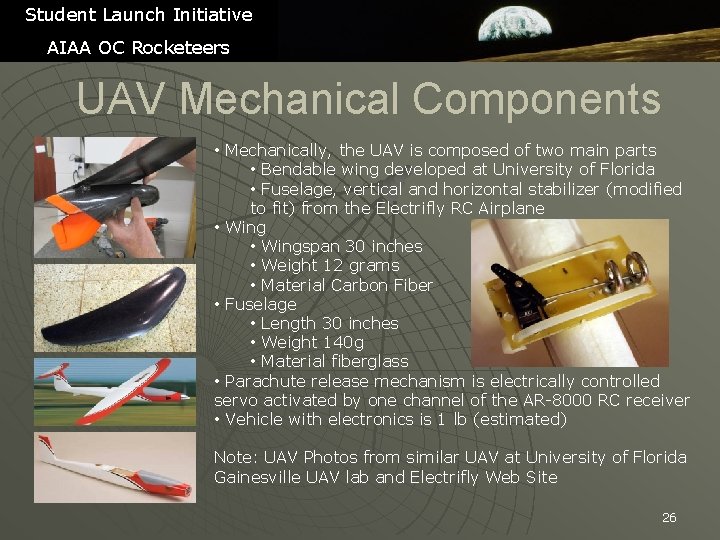
Student Launch Initiative AIAA OC Rocketeers UAV Mechanical Components • Mechanically, the UAV is composed of two main parts • Bendable wing developed at University of Florida • Fuselage, vertical and horizontal stabilizer (modified to fit) from the Electrifly RC Airplane • Wingspan 30 inches • Weight 12 grams • Material Carbon Fiber • Fuselage • Length 30 inches • Weight 140 g • Material fiberglass • Parachute release mechanism is electrically controlled servo activated by one channel of the AR-8000 RC receiver • Vehicle with electronics is 1 lb (estimated) Note: UAV Photos from similar UAV at University of Florida Gainesville UAV lab and Electrifly Web Site 26
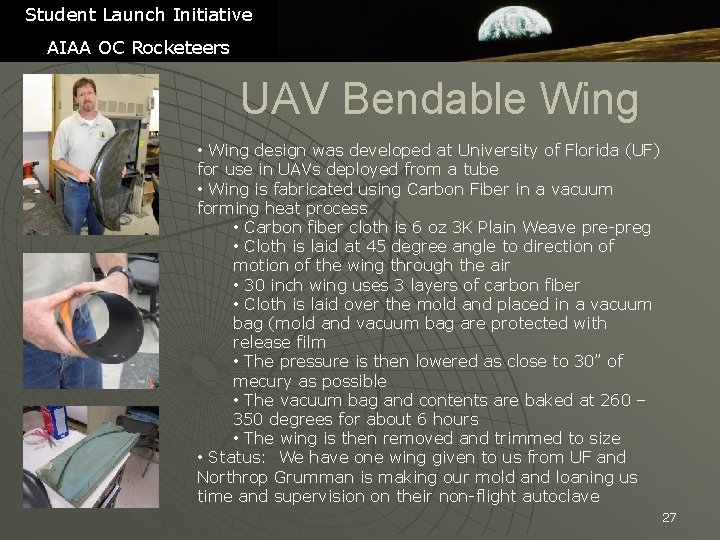
Student Launch Initiative AIAA OC Rocketeers UAV Bendable Wing • Wing design was developed at University of Florida (UF) for use in UAVs deployed from a tube • Wing is fabricated using Carbon Fiber in a vacuum forming heat process • Carbon fiber cloth is 6 oz 3 K Plain Weave pre-preg • Cloth is laid at 45 degree angle to direction of motion of the wing through the air • 30 inch wing uses 3 layers of carbon fiber • Cloth is laid over the mold and placed in a vacuum bag (mold and vacuum bag are protected with release film • The pressure is then lowered as close to 30” of mecury as possible • The vacuum bag and contents are baked at 260 – 350 degrees for about 6 hours • The wing is then removed and trimmed to size • Status: We have one wing given to us from UF and Northrop Grumman is making our mold and loaning us time and supervision on their non-flight autoclave 27
Student Launch Initiative AIAA OC Rocketeers UAV Control Electronics and Operation APM and IMU GPS • Main UAV control is via Radio Control (Spektrum DX-8 transmitter and AR-8000 receiver) on 2. 4 GHz – This is the default operation • Ardupilot Mega (APM) is switchable autopilot to provide autonomous control with Open Source software and support at DIYDrones • APM accepts data for flight and telemetry from on -board • Inertial Measurement Unit (IMU) • GPS Receiver • 3 Axis magnetometer Spektrum DX-8 and • Airspeed sensor Receiver 3 Axis Magnetometer Airspeed Sensor 28
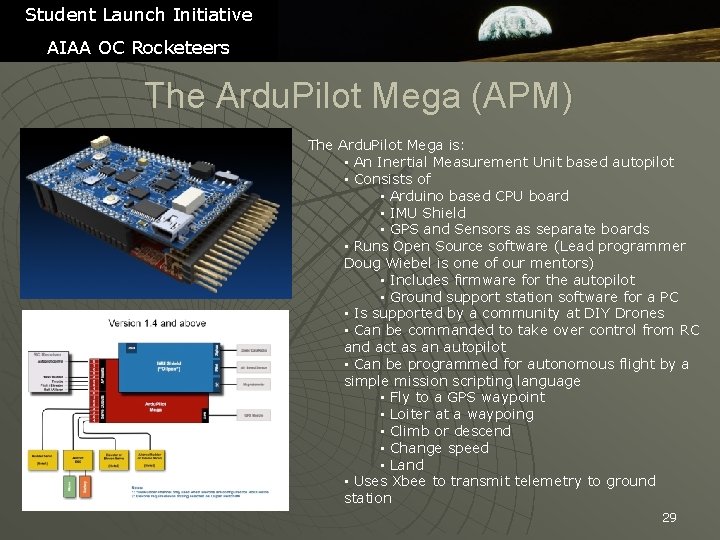
Student Launch Initiative AIAA OC Rocketeers The Ardu. Pilot Mega (APM) The Ardu. Pilot Mega is: • An Inertial Measurement Unit based autopilot • Consists of • Arduino based CPU board • IMU Shield • GPS and Sensors as separate boards • Runs Open Source software (Lead programmer Doug Wiebel is one of our mentors) • Includes firmware for the autopilot • Ground support station software for a PC • Is supported by a community at DIY Drones • Can be commanded to take over control from RC and act as an autopilot • Can be programmed for autonomous flight by a simple mission scripting language • Fly to a GPS waypoint • Loiter at a waypoing • Climb or descend • Change speed • Land • Uses Xbee to transmit telemetry to ground station 29
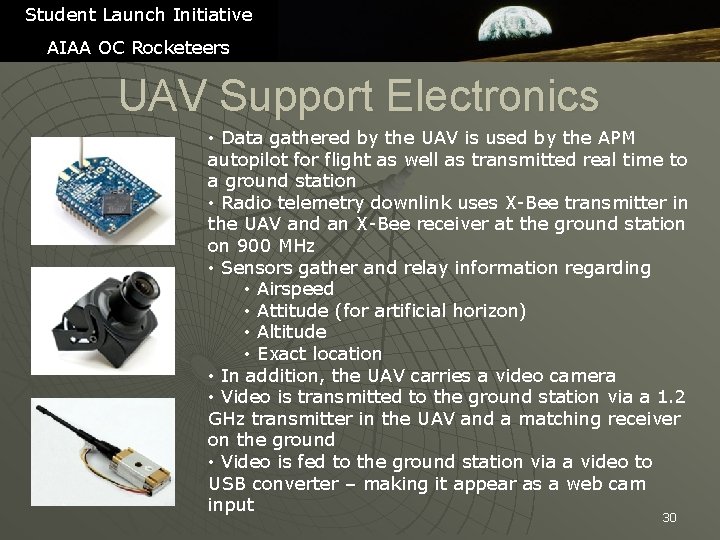
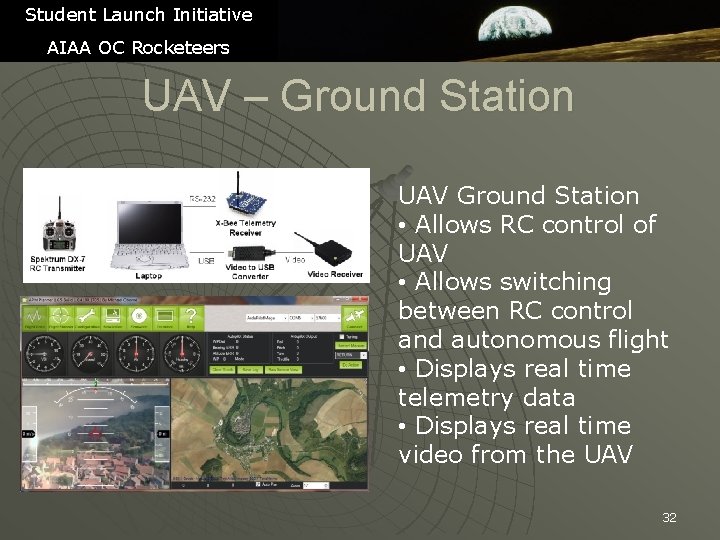
Student Launch Initiative AIAA OC Rocketeers UAV Support Electronics • Data gathered by the UAV is used by the APM autopilot for flight as well as transmitted real time to a ground station • Radio telemetry downlink uses X-Bee transmitter in the UAV and an X-Bee receiver at the ground station on 900 MHz • Sensors gather and relay information regarding • Airspeed • Attitude (for artificial horizon) • Altitude • Exact location • In addition, the UAV carries a video camera • Video is transmitted to the ground station via a 1. 2 GHz transmitter in the UAV and a matching receiver on the ground • Video is fed to the ground station via a video to USB converter – making it appear as a web cam input 30
Student Launch Initiative AIAA OC Rocketeers UAV Electronics System 31
Student Launch Initiative AIAA OC Rocketeers UAV – Ground Station UAV Ground Station • Allows RC control of UAV • Allows switching between RC control and autonomous flight • Displays real time telemetry data • Displays real time video from the UAV 32
Student Launch Initiative AIAA OC Rocketeers UAV Safety 1. The UAV will descend on parachute until it can be verified it is flightworthy and not fouled on shock cords or shroud lines 2. The UAV detachment from the parachute is manual allowing a human to make the final decision 3. The UAV can be manually switched back to RC control at any time during the flight 4. If RC communications is lost the AR-8000 receiver sends a signal to the APM autopilot to switch to RC control and the AR 8000 sets servos and throttles to a preset (low throttle and circle) – needs testing 5. Alternatively, the APM autopilot can be programmed to return to home (needs testing) 6. If power is lost to the APM autopilot it automatically returns to RC control 7. If power is restored to the APM autopilot in flight, it will reload a backup program and restart where it left off 33
Student Launch Initiative AIAA OC Rocketeers UAV Test Plan Note: UAV will be built from a commercial “Rifle” almost ready to fly RC plane from Electrifly with the University of Florida bendable wing. We are also using a foam Wild Hawk as a rugged trainer. Integration is at the guidance of Dr. Robert Davey, an aeronautical engineer and retired professor from Cal Poly Pomona 1. Install only RC control with batteries, servos, and power components into the foam Wild Hawk and verify the plane is flightworthy and can be controlled 2. Install the APM autopilot into the foam Wild Hawk and integrate with the ground station and X-Planes for a full “Hardware-in-the-loop” PC simulation on the ground 1. Validate the scripting performs as it is intended 2. Validate the scripting can be changed in the air 3. Validate that control can be switched between RC and APM autopilot 4. Validate the UAV reaction to loss of RC signal 5. Validate the APM autopilot reaction to loss of power and return of power 3. Go to Lucerne Dry Lake and repeat the testing in step 1 (RC only control) and 2 (APM autopilot control with the plane actually in the air 4. Build the Rifle kit as-is with no modifications (i. e. use the wing that came with the Rifle) 5. Repeat steps 1 through 3 with the Rifle 6. Replace the Rifle wing with the bendable carbon fiber wing 7. Go to Lucerne Dry Lake and repeat steps 2 and 3 flying on RC and autopilot 8. Include the vehicle and validate in test flight of full scale vehicle launch 34
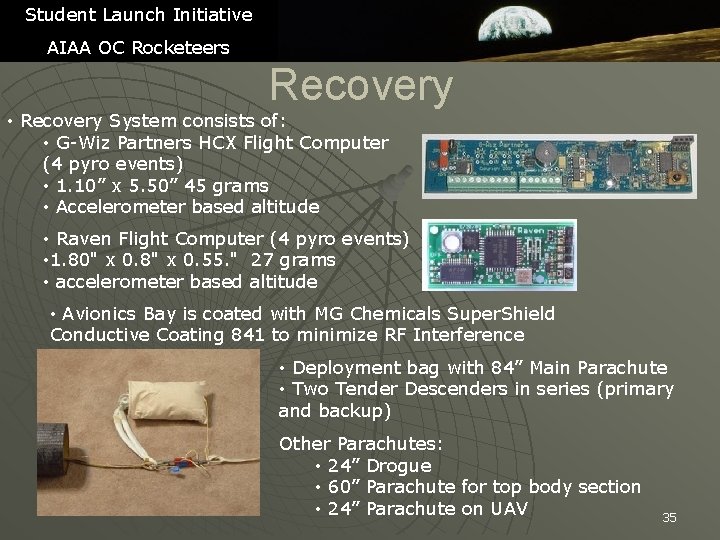
Student Launch Initiative AIAA OC Rocketeers Recovery • Recovery System consists of: • G-Wiz Partners HCX Flight Computer (4 pyro events) • 1. 10” x 5. 50” 45 grams • Accelerometer based altitude • Raven Flight Computer (4 pyro events) • 1. 80" x 0. 8" x 0. 55. " 27 grams • accelerometer based altitude • Avionics Bay is coated with MG Chemicals Super. Shield Conductive Coating 841 to minimize RF Interference • Deployment bag with 84” Main Parachute • Two Tender Descenders in series (primary and backup) Other Parachutes: • 24” Drogue • 60” Parachute for top body section • 24” Parachute on UAV 35
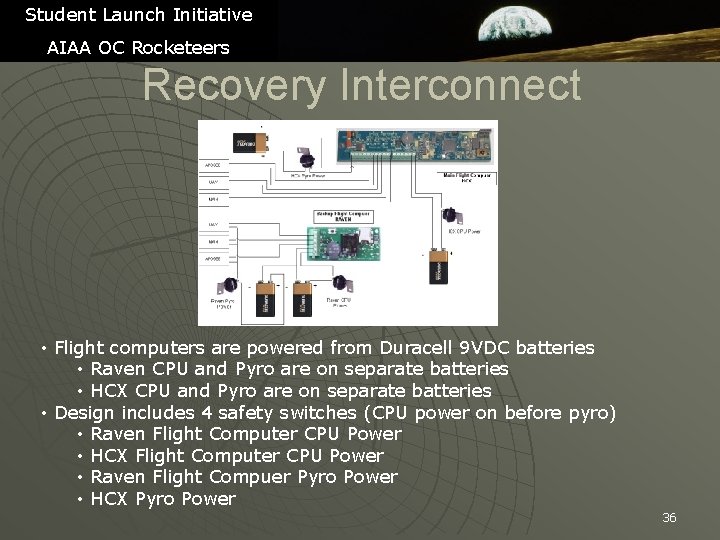
Student Launch Initiative AIAA OC Rocketeers Recovery Interconnect • Flight computers are powered from Duracell 9 VDC batteries • Raven CPU and Pyro are on separate batteries • HCX CPU and Pyro are on separate batteries • Design includes 4 safety switches (CPU power on before pyro) • Raven Flight Computer CPU Power • HCX Flight Computer CPU Power • Raven Flight Compuer Pyro Power • HCX Pyro Power 36
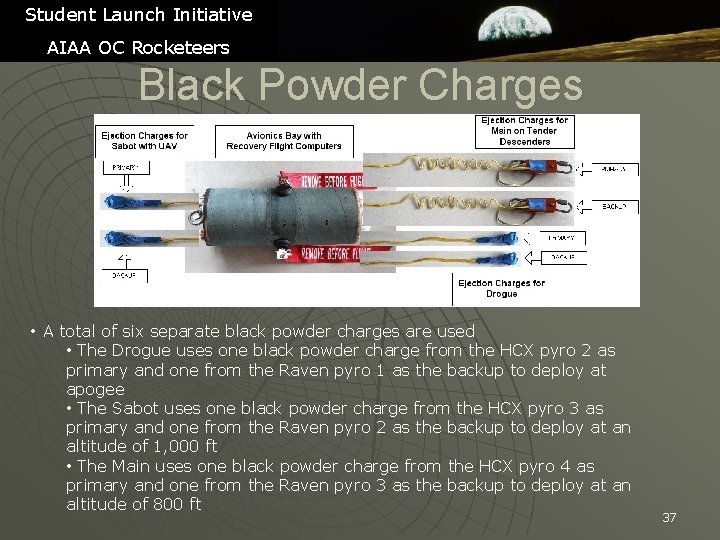
Student Launch Initiative AIAA OC Rocketeers Black Powder Charges • A total of six separate black powder charges are used • The Drogue uses one black powder charge from the HCX pyro 2 as primary and one from the Raven pyro 1 as the backup to deploy at apogee • The Sabot uses one black powder charge from the HCX pyro 3 as primary and one from the Raven pyro 2 as the backup to deploy at an altitude of 1, 000 ft • The Main uses one black powder charge from the HCX pyro 4 as primary and one from the Raven pyro 3 as the backup to deploy at an altitude of 800 ft 37
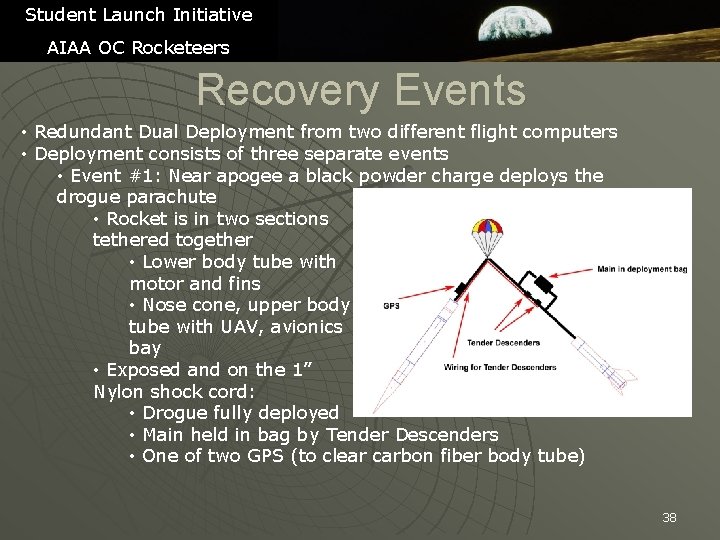
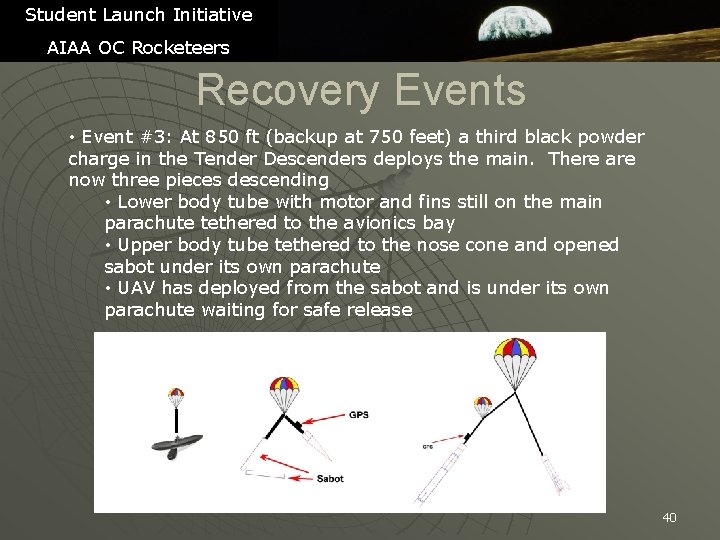
Student Launch Initiative AIAA OC Rocketeers Recovery Events • Redundant Dual Deployment from two different flight computers • Deployment consists of three separate events • Event #1: Near apogee a black powder charge deploys the drogue parachute • Rocket is in two sections tethered together • Lower body tube with motor and fins • Nose cone, upper body tube with UAV, avionics bay • Exposed and on the 1” Nylon shock cord: • Drogue fully deployed • Main held in bag by Tender Descenders • One of two GPS (to clear carbon fiber body tube) 38
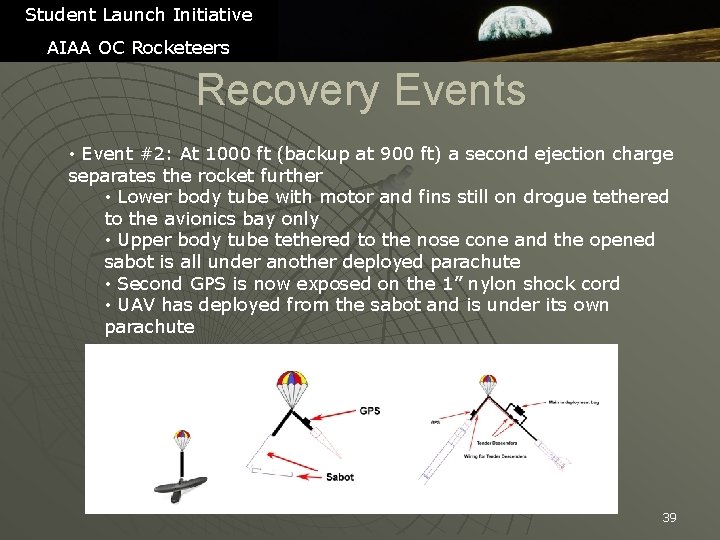
Student Launch Initiative AIAA OC Rocketeers Recovery Events • Event #2: At 1000 ft (backup at 900 ft) a second ejection charge separates the rocket further • Lower body tube with motor and fins still on drogue tethered to the avionics bay only • Upper body tube tethered to the nose cone and the opened sabot is all under another deployed parachute • Second GPS is now exposed on the 1” nylon shock cord • UAV has deployed from the sabot and is under its own parachute 39
Student Launch Initiative AIAA OC Rocketeers Recovery Events • Event #3: At 850 ft (backup at 750 feet) a third black powder charge in the Tender Descenders deploys the main. There are now three pieces descending • Lower body tube with motor and fins still on the main parachute tethered to the avionics bay • Upper body tube tethered to the nose cone and opened sabot under its own parachute • UAV has deployed from the sabot and is under its own parachute waiting for safe release 40
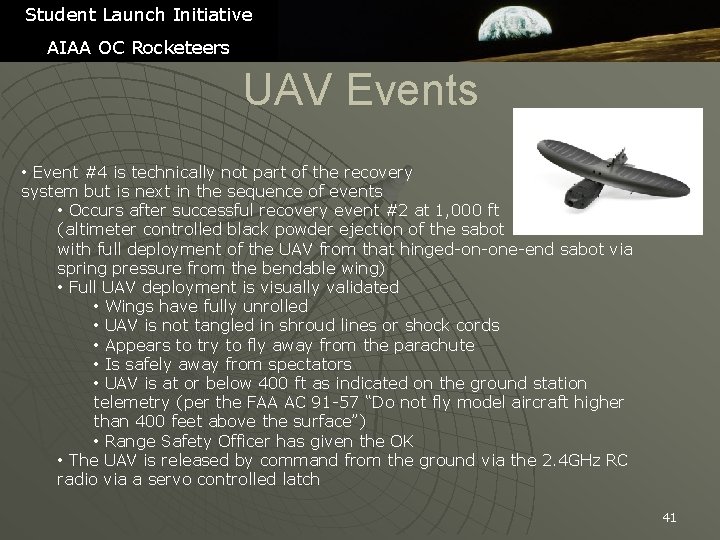
Student Launch Initiative AIAA OC Rocketeers UAV Events • Event #4 is technically not part of the recovery system but is next in the sequence of events • Occurs after successful recovery event #2 at 1, 000 ft (altimeter controlled black powder ejection of the sabot with full deployment of the UAV from that hinged-on-one-end sabot via spring pressure from the bendable wing) • Full UAV deployment is visually validated • Wings have fully unrolled • UAV is not tangled in shroud lines or shock cords • Appears to try to fly away from the parachute • Is safely away from spectators • UAV is at or below 400 ft as indicated on the ground station telemetry (per the FAA AC 91 -57 “Do not fly model aircraft higher than 400 feet above the surface”) • Range Safety Officer has given the OK • The UAV is released by command from the ground via the 2. 4 GHz RC radio via a servo controlled latch 41
Student Launch Initiative AIAA OC Rocketeers UAV Events • After the UAV is flying without the parachute • First the UAV is flown as an RC plane until it is validated that we have full control and the plane is functioning properly • The RC transmitter on the ground sends a signal to the UAV electronics to fly autonomously (via the APM autopilot) • The UAV will fly to pre-programmed waypoints (these waypoints can also be changed from the ground station) • After the autonomous flight, the RC transmitter will send a signal to the UAV electronics to fly under RC control again • The UAV will be landed under RC control 42
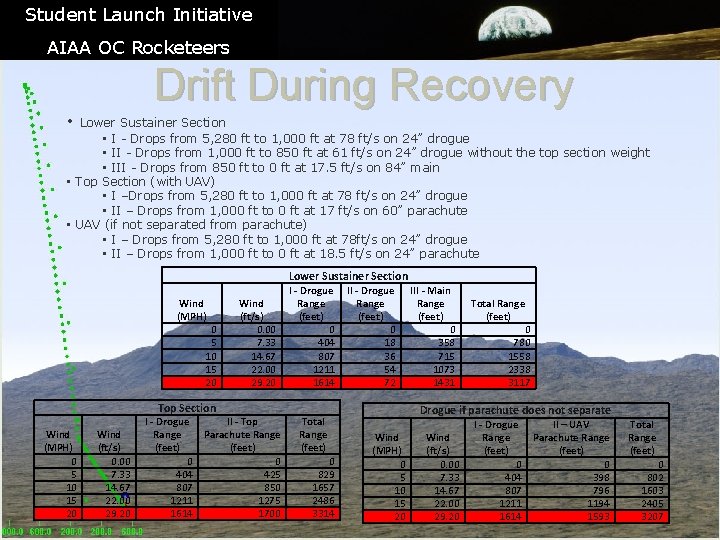
Student Launch Initiative AIAA OC Rocketeers Drift During Recovery • Lower Sustainer Section • I - Drops from 5, 280 ft to 1, 000 ft at 78 ft/s on 24” drogue • II - Drops from 1, 000 ft to 850 ft at 61 ft/s on 24” drogue without the top section weight • III - Drops from 850 ft to 0 ft at 17. 5 ft/s on 84” main • Top Section (with UAV) • I –Drops from 5, 280 ft to 1, 000 ft at 78 ft/s on 24” drogue • II – Drops from 1, 000 ft to 0 ft at 17 ft/s on 60” parachute • UAV (if not separated from parachute) • I – Drops from 5, 280 ft to 1, 000 ft at 78 ft/s on 24” drogue • II – Drops from 1, 000 ft to 0 ft at 18. 5 ft/s on 24” parachute Lower Sustainer Section Wind (MPH) 0 5 10 15 20 Top Section Wind (MPH) 0 5 10 15 20 Wind (ft/s) 0. 00 7. 33 14. 67 22. 00 29. 20 I - Drogue II - Top Range Parachute Range (feet) 0 0 404 425 807 850 1211 1275 1614 1700 I - Drogue Range (feet) 0 404 807 1211 1614 Total Range (feet) 0 829 1657 2486 3314 II - Drogue Range (feet) 0 18 36 54 72 III - Main Range (feet) 0 358 715 1073 1431 Total Range (feet) 0 780 1558 2338 3117 Drogue if parachute does not separate Wind (MPH) 0 5 10 15 20 Wind (ft/s) 0. 00 7. 33 14. 67 22. 00 29. 20 I - Drogue II – UAV Range Parachute Range (feet) 0 0 404 398 807 796 1211 1194 1614 1593 Total Range (feet) 0 802 1603 2405 320743
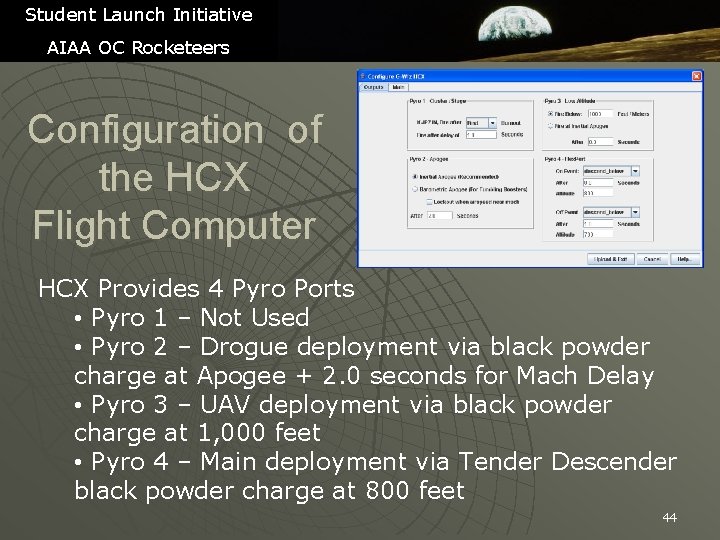
Student Launch Initiative AIAA OC Rocketeers Configuration of the HCX Flight Computer HCX Provides 4 Pyro Ports • Pyro 1 – Not Used • Pyro 2 – Drogue deployment via black powder charge at Apogee + 2. 0 seconds for Mach Delay • Pyro 3 – UAV deployment via black powder charge at 1, 000 feet • Pyro 4 – Main deployment via Tender Descender black powder charge at 800 feet 44
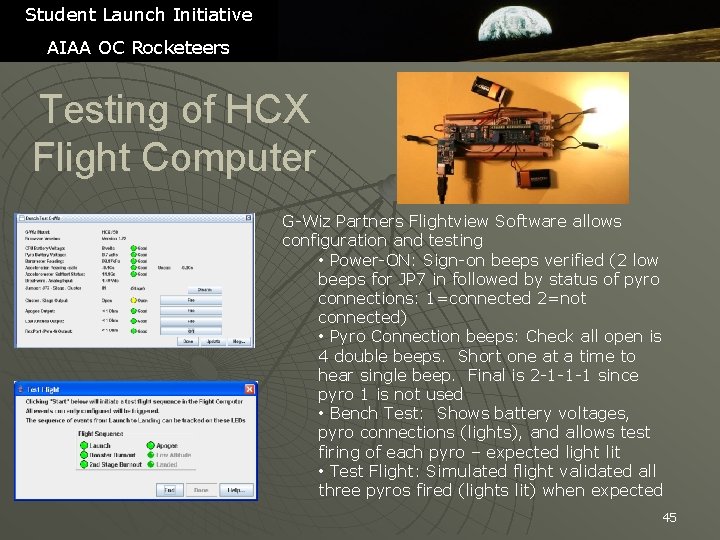
Student Launch Initiative AIAA OC Rocketeers Testing of HCX Flight Computer G-Wiz Partners Flightview Software allows configuration and testing • Power-ON: Sign-on beeps verified (2 low beeps for JP 7 in followed by status of pyro connections: 1=connected 2=not connected) • Pyro Connection beeps: Check all open is 4 double beeps. Short one at a time to hear single beep. Final is 2 -1 -1 -1 since pyro 1 is not used • Bench Test: Shows battery voltages, pyro connections (lights), and allows test firing of each pyro – expected light lit • Test Flight: Simulated flight validated all three pyros fired (lights lit) when expected 45
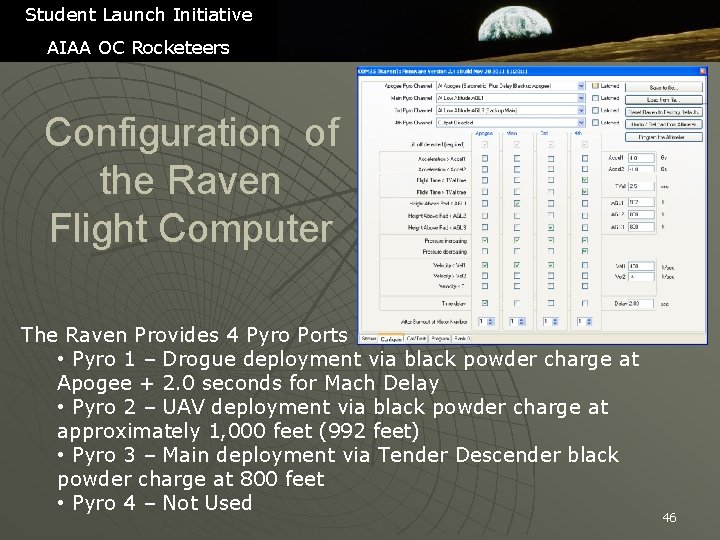
Student Launch Initiative AIAA OC Rocketeers Configuration of the Raven Flight Computer The Raven Provides 4 Pyro Ports • Pyro 1 – Drogue deployment via black powder charge at Apogee + 2. 0 seconds for Mach Delay • Pyro 2 – UAV deployment via black powder charge at approximately 1, 000 feet (992 feet) • Pyro 3 – Main deployment via Tender Descender black powder charge at 800 feet • Pyro 4 – Not Used 46
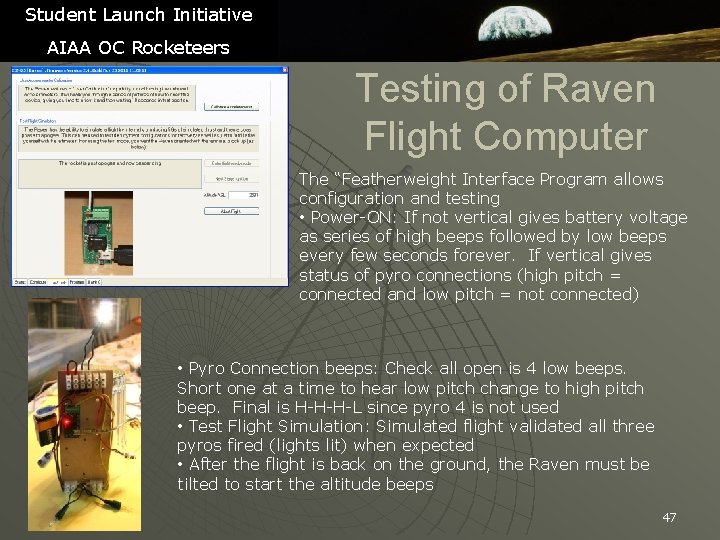
Student Launch Initiative AIAA OC Rocketeers Testing of Raven Flight Computer The “Featherweight Interface Program allows configuration and testing • Power-ON: If not vertical gives battery voltage as series of high beeps followed by low beeps every few seconds forever. If vertical gives status of pyro connections (high pitch = connected and low pitch = not connected) • Pyro Connection beeps: Check all open is 4 low beeps. Short one at a time to hear low pitch change to high pitch beep. Final is H-H-H-L since pyro 4 is not used • Test Flight Simulation: Simulated flight validated all three pyros fired (lights lit) when expected • After the flight is back on the ground, the Raven must be tilted to start the altitude beeps 47
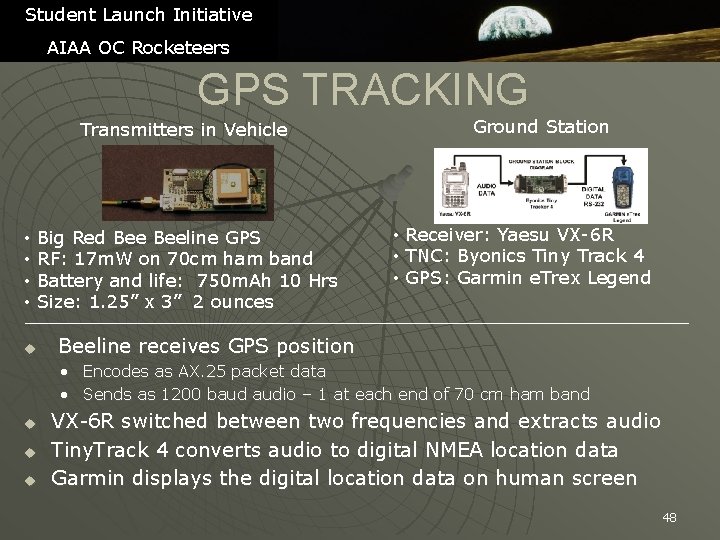
Student Launch Initiative AIAA OC Rocketeers GPS TRACKING Transmitters in Vehicle • Big Red Beeline GPS • RF: 17 m. W on 70 cm ham band • Battery and life: 750 m. Ah 10 Hrs • Size: 1. 25” x 3” 2 ounces u Ground Station • Receiver: Yaesu VX-6 R • TNC: Byonics Tiny Track 4 • GPS: Garmin e. Trex Legend Beeline receives GPS position • Encodes as AX. 25 packet data • Sends as 1200 baud audio – 1 at each end of 70 cm ham band u u u VX-6 R switched between two frequencies and extracts audio Tiny. Track 4 converts audio to digital NMEA location data Garmin displays the digital location data on human screen 48
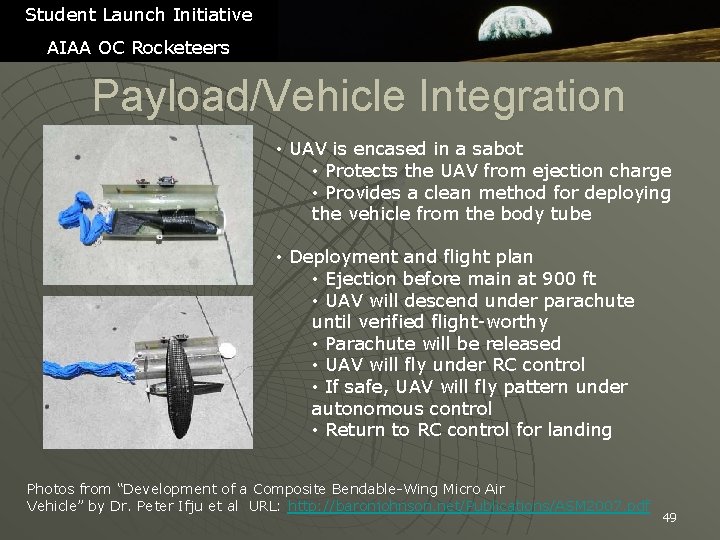
Student Launch Initiative AIAA OC Rocketeers Payload/Vehicle Integration • UAV is encased in a sabot • Protects the UAV from ejection charge • Provides a clean method for deploying the vehicle from the body tube • Deployment and flight plan • Ejection before main at 900 ft • UAV will descend under parachute until verified flight-worthy • Parachute will be released • UAV will fly under RC control • If safe, UAV will fly pattern under autonomous control • Return to RC control for landing Photos from “Development of a Composite Bendable-Wing Micro Air Vehicle” by Dr. Peter Ifju et al URL: http: //baronjohnson. net/Publications/ASM 2007. pdf 49
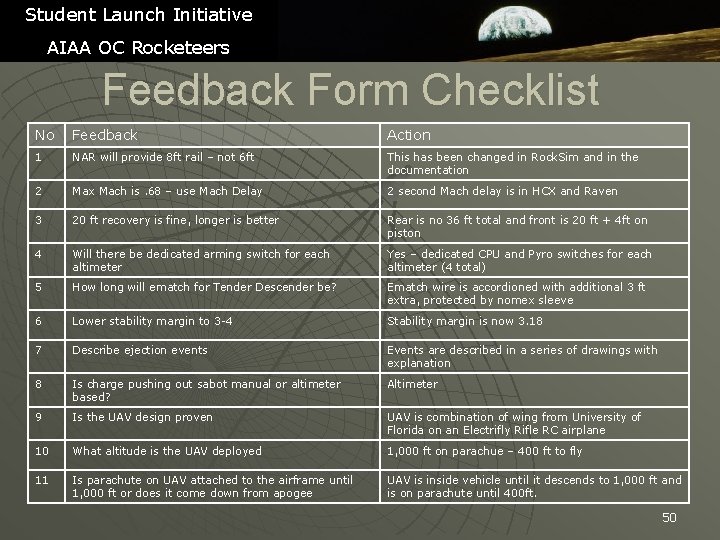
Student Launch Initiative AIAA OC Rocketeers Feedback Form Checklist No Feedback Action 1 NAR will provide 8 ft rail – not 6 ft This has been changed in Rock. Sim and in the documentation 2 Max Mach is. 68 – use Mach Delay 2 second Mach delay is in HCX and Raven 3 20 ft recovery is fine, longer is better Rear is no 36 ft total and front is 20 ft + 4 ft on piston 4 Will there be dedicated arming switch for each altimeter Yes – dedicated CPU and Pyro switches for each altimeter (4 total) 5 How long will ematch for Tender Descender be? Ematch wire is accordioned with additional 3 ft extra, protected by nomex sleeve 6 Lower stability margin to 3 -4 Stability margin is now 3. 18 7 Describe ejection events Events are described in a series of drawings with explanation 8 Is charge pushing out sabot manual or altimeter based? Altimeter 9 Is the UAV design proven UAV is combination of wing from University of Florida on an Electrifly Rifle RC airplane 10 What altitude is the UAV deployed 1, 000 ft on parachue – 400 ft to fly 11 Is parachute on UAV attached to the airframe until 1, 000 ft or does it come down from apogee UAV is inside vehicle until it descends to 1, 000 ft and is on parachute until 400 ft. 50
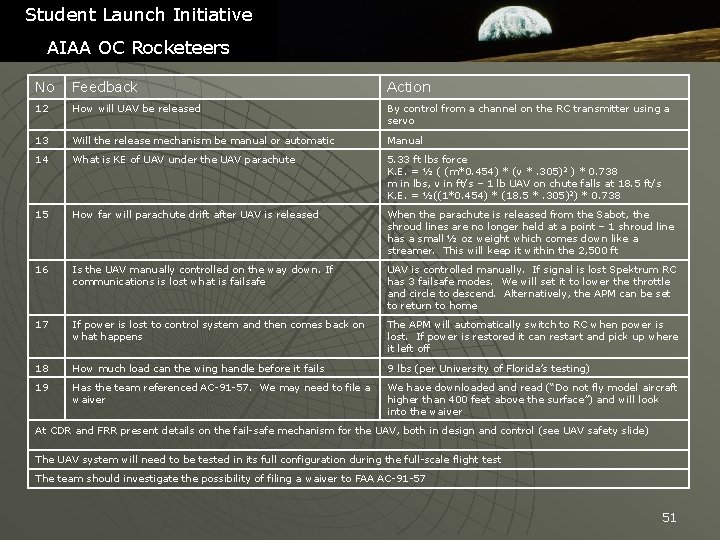
Student Launch Initiative AIAA OC Rocketeers No Feedback Action 12 How will UAV be released By control from a channel on the RC transmitter using a servo 13 Will the release mechanism be manual or automatic Manual 14 What is KE of UAV under the UAV parachute 5. 33 ft lbs force K. E. = ½ ( (m*0. 454) * (v *. 305)2 ) * 0. 738 m in lbs, v in ft/s – 1 lb UAV on chute falls at 18. 5 ft/s K. E. = ½((1*0. 454) * (18. 5 *. 305)2) * 0. 738 15 How far will parachute drift after UAV is released When the parachute is released from the Sabot, the shroud lines are no longer held at a point – 1 shroud line has a small ½ oz weight which comes down like a streamer. This will keep it within the 2, 500 ft 16 Is the UAV manually controlled on the way down. If communications is lost what is failsafe UAV is controlled manually. If signal is lost Spektrum RC has 3 failsafe modes. We will set it to lower the throttle and circle to descend. Alternatively, the APM can be set to return to home 17 If power is lost to control system and then comes back on what happens The APM will automatically switch to RC when power is lost. If power is restored it can restart and pick up where it left off 18 How much load can the wing handle before it fails 9 lbs (per University of Florida’s testing) 19 Has the team referenced AC-91 -57. We may need to file a waiver We have downloaded and read (“Do not fly model aircraft higher than 400 feet above the surface”) and will look into the waiver At CDR and FRR present details on the fail-safe mechanism for the UAV, both in design and control (see UAV safety slide) The UAV system will need to be tested in its full configuration during the full-scale flight test The team should investigate the possibility of filing a waiver to FAA AC-91 -57 51
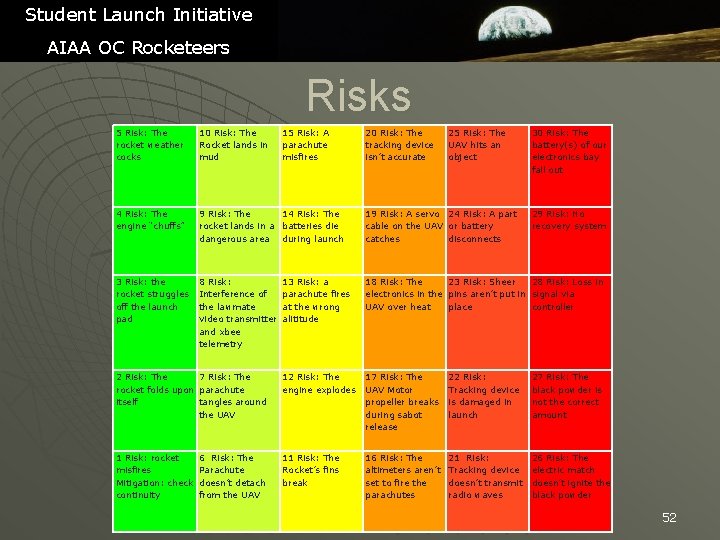
Student Launch Initiative AIAA OC Rocketeers Risks 5 Risk: The rocket weather cocks 10 Risk: The Rocket lands in mud 15 Risk: A parachute misfires 20 Risk: The tracking device isn’t accurate 25 Risk: The UAV hits an object 30 Risk: The battery(s) of our electronics bay fall out 4 Risk: The engine “chuffs” 9 Risk: The 14 Risk: The rocket lands in a batteries die dangerous area during launch 19 Risk: A servo 24 Risk: A part cable on the UAV or battery catches disconnects 3 Risk: the rocket struggles off the launch pad 8 Risk: 13 Risk: a Interference of parachute fires the lawmate at the wrong video transmitter alititude and xbee telemetry 18 Risk: The 23 Risk: Sheer 28 Risk: Loss in electronics in the pins aren’t put in signal via UAV over heat place controller 29 Risk: No recovery system 2 Risk: The 7 Risk: The rocket folds upon parachute itself tangles around the UAV 12 Risk: The engine explodes 17 Risk: The UAV Motor propeller breaks during sabot release 22 Risk: Tracking device is damaged in launch 27 Risk: The black powder is not the correct amount 1 Risk: rocket misfires Mitigation: check continuity 11 Risk: The Rocket’s fins break 16 Risk: The altimeters aren’t set to fire the parachutes 21 Risk: Tracking device doesn’t transmit radio waves 26 Risk: The electric match doesn’t ignite the black powder 6 Risk: The Parachute doesn’t detach from the UAV 52
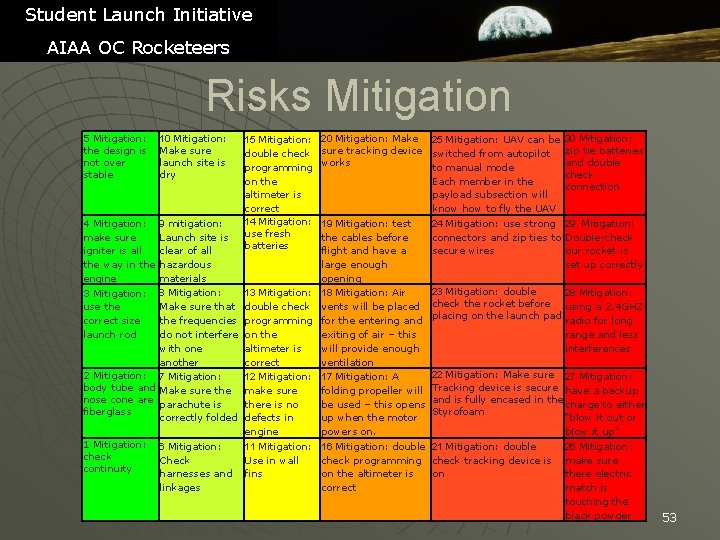
Student Launch Initiative AIAA OC Rocketeers Risks Mitigation 5 Mitigation: the design is not over stable 10 Mitigation: Make sure launch site is dry 4 Mitigation: 9 mitigation: make sure Launch site is igniter is all clear of all the way in the hazardous engine materials 3 Mitigation: 8 Mitigation: use the Make sure that correct size the frequencies launch rod do not interfere with one another 2 Mitigation: 7 Mitigation: body tube and Make sure the nose cone are parachute is fiberglass correctly folded 15 Mitigation: double check programming on the altimeter is correct 14 Mitigation: use fresh batteries 13 Mitigation: double check programming on the altimeter is correct 12 Mitigation: make sure there is no defects in engine 1 Mitigation: 6 Mitigation: 11 Mitigation: check Check Use in wall continuity harnesses and fins linkages 20 Mitigation: Make 25 Mitigation: UAV can be 30 Mitigation: sure tracking device switched from autopilot zip tie batteries works and double to manual mode check Each member in the connection payload subsection will know how to fly the UAV 19 Mitigation: test 24 Mitigation: use strong 29 Mitigation: the cables before connectors and zip ties to Double-check flight and have a secure wires our rocket is large enough set up correctly opening 23 Mitigation: double 18 Mitigation: Air 28 Mitigation: vents will be placed check the rocket before using a 2. 4 GHZ placing on the launch pad for the entering and radio for long exiting of air – this range and less will provide enough interferences ventilation 22 Mitigation: Make sure 27 Mitigation: 17 Mitigation: A folding propeller will Tracking device is secure have a backup and is fully encased in the be used – this opens charge to either Styrofoam up when the motor “blow it out or powers on. blow it up” 16 Mitigation: double 21 Mitigation: double 26 Mitigation: check programming check tracking device is make sure on the altimeter is on there electric correct match is touching the black powder 53
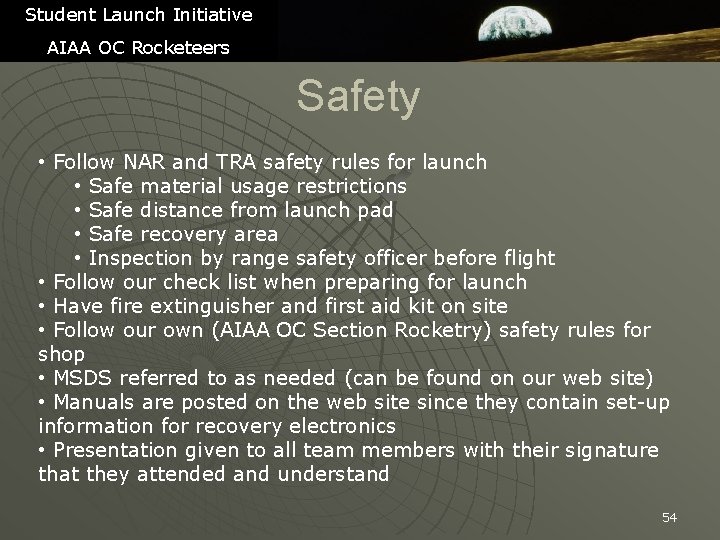
Student Launch Initiative AIAA OC Rocketeers Safety • Follow NAR and TRA safety rules for launch • Safe material usage restrictions • Safe distance from launch pad • Safe recovery area • Inspection by range safety officer before flight • Follow our check list when preparing for launch • Have fire extinguisher and first aid kit on site • Follow our own (AIAA OC Section Rocketry) safety rules for shop • MSDS referred to as needed (can be found on our web site) • Manuals are posted on the web site since they contain set-up information for recovery electronics • Presentation given to all team members with their signature that they attended and understand 54
Student Launch Initiative AIAA OC Rocketeers Educational Outreach • Space 2011 Education Alley (Sept – too early for credit) • Girl scout workshop and launch outing in October/November 2011 • Talk at St Norbert school January 2012 • Talk at Montesorri school in Fullerton January 2012 • Giving presentation to AIAA professional society council meeting with all AIAA members in Orange County invited in 2012 • Newspaper articles • Article in Sunny Hills High School (Fullerton, CA) school paper • Try for article in local paper in Orange, CA – The Foothills Sentry • Presentations at Orange County 4 H clubs • Contact Discovery Science Center for youth booth • Youth Expo at the Orange County Fair Grounds April 2012 55
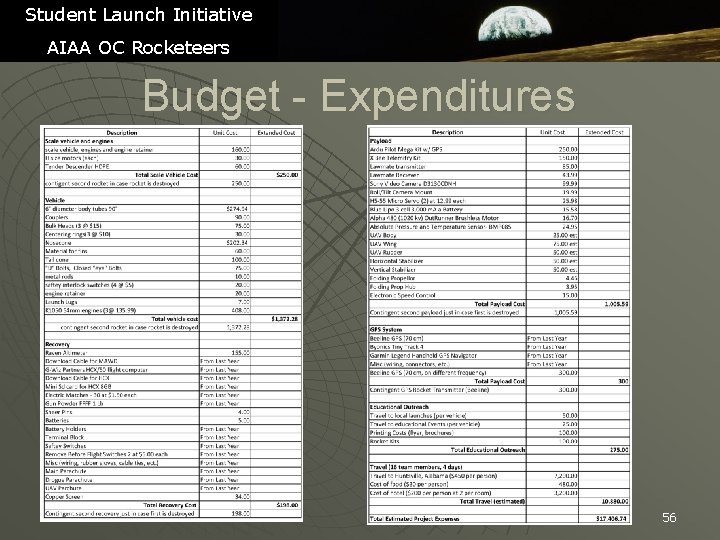
Student Launch Initiative AIAA OC Rocketeers Budget - Expenditures 56
Student Launch Initiative AIAA OC Rocketeers Budget – Income • NASA Grant for SLI teams • Fundraising letters • Boeing • Raytheon • Northrop Grumman • Lockheed Martin • Thirty other aerospace related companies • Sees candy sales • Beg for support from parents 57
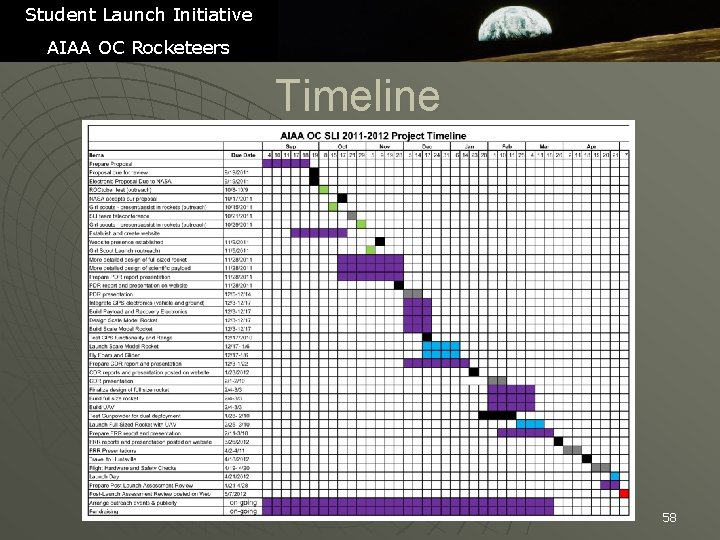
Student Launch Initiative AIAA OC Rocketeers Timeline 58
Student Launch Initiative AIAA OC Rocketeers Thank you for letting us be part of SLI again Questions? 59