
The Cold War The United Nations l l
- Slides: 58
The Cold War
The United Nations l l l Chartered in April 1945 Replaced the League of Nations 50 nations joined initially (today, UN has 193 members) In the General Assembly, which decides general UN policies, each nation gets 1 vote (so all are equal) UN Security Council: US, Soviet Union, France, Great Britain, & China reserved the power to veto any action by the UN For the UN to take any military action requires a unanimous vote of the Security Council
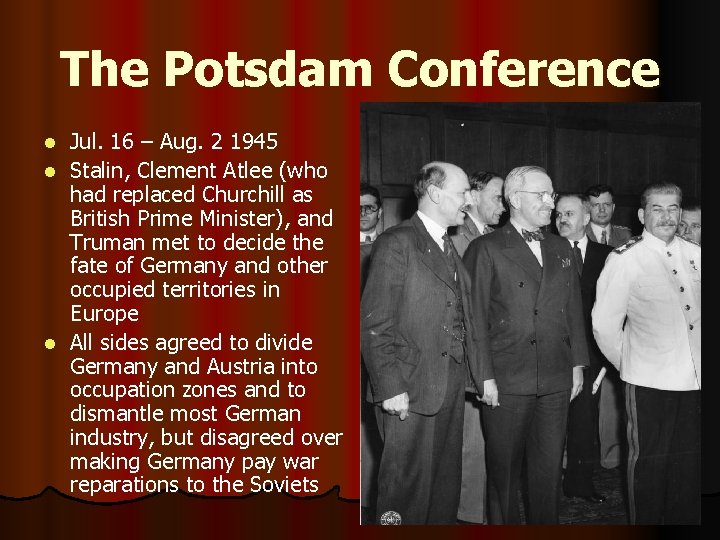
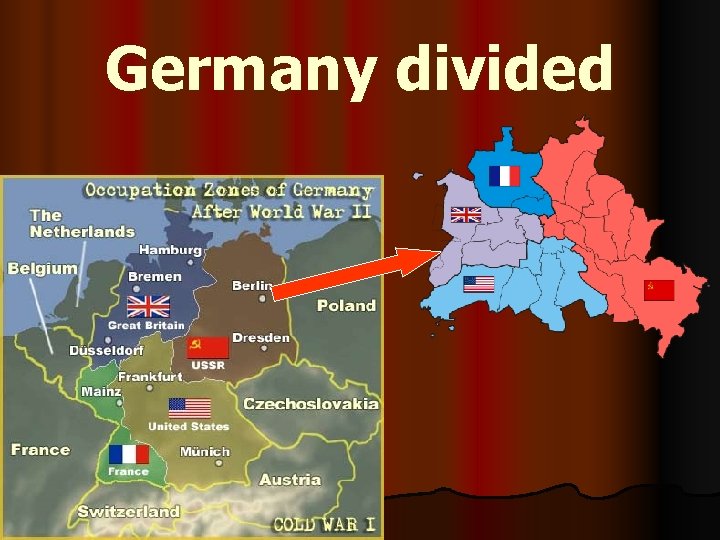
The Potsdam Conference Jul. 16 – Aug. 2 1945 l Stalin, Clement Atlee (who had replaced Churchill as British Prime Minister), and Truman met to decide the fate of Germany and other occupied territories in Europe l All sides agreed to divide Germany and Austria into occupation zones and to dismantle most German industry, but disagreed over making Germany pay war reparations to the Soviets l
Germany divided
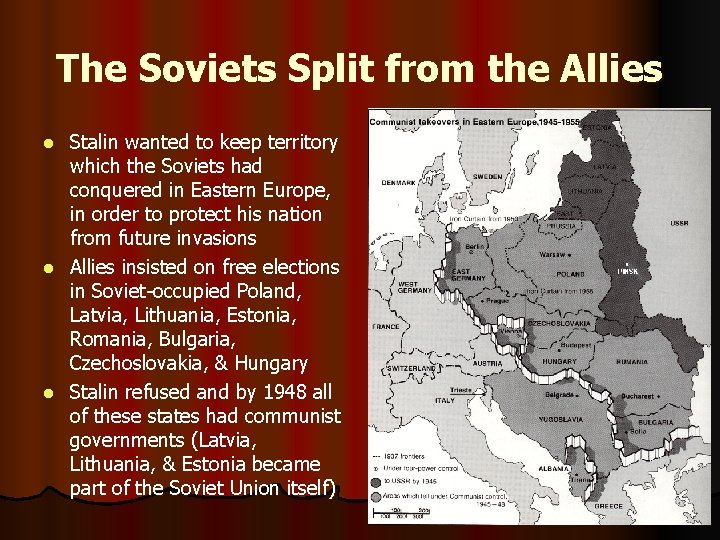
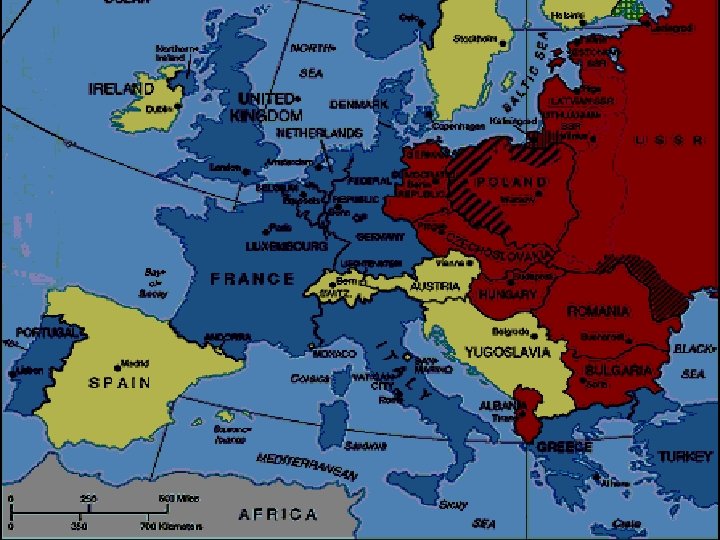
The Soviets Split from the Allies Stalin wanted to keep territory which the Soviets had conquered in Eastern Europe, in order to protect his nation from future invasions l Allies insisted on free elections in Soviet-occupied Poland, Latvia, Lithuania, Estonia, Romania, Bulgaria, Czechoslovakia, & Hungary l Stalin refused and by 1948 all of these states had communist governments (Latvia, Lithuania, & Estonia became part of the Soviet Union itself) l
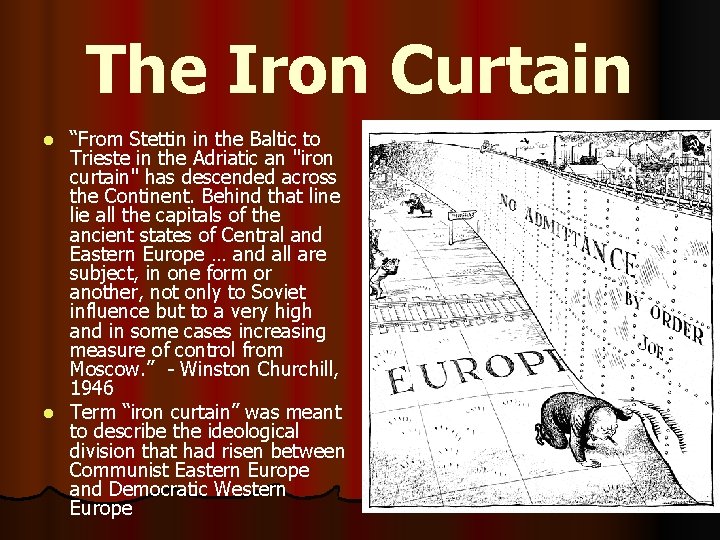
The Iron Curtain “From Stettin in the Baltic to Trieste in the Adriatic an "iron curtain" has descended across the Continent. Behind that line lie all the capitals of the ancient states of Central and Eastern Europe … and all are subject, in one form or another, not only to Soviet influence but to a very high and in some cases increasing measure of control from Moscow. ” - Winston Churchill, 1946 l Term “iron curtain” was meant to describe the ideological division that had risen between Communist Eastern Europe and Democratic Western Europe l
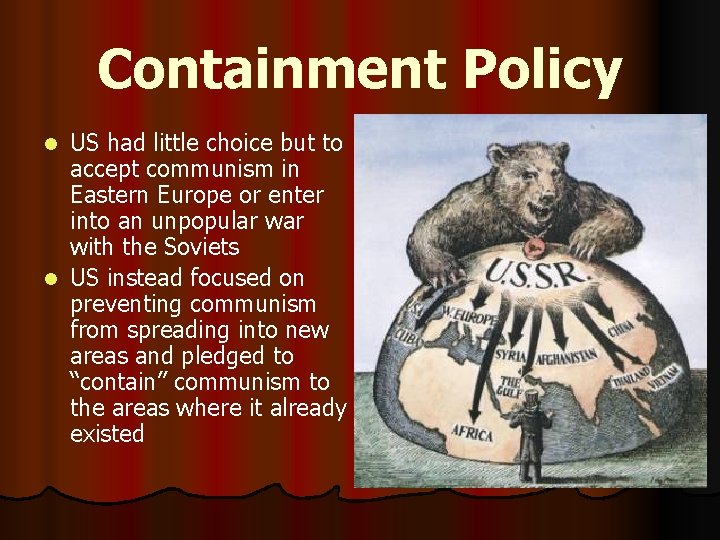
Containment Policy US had little choice but to accept communism in Eastern Europe or enter into an unpopular with the Soviets l US instead focused on preventing communism from spreading into new areas and pledged to “contain” communism to the areas where it already existed l
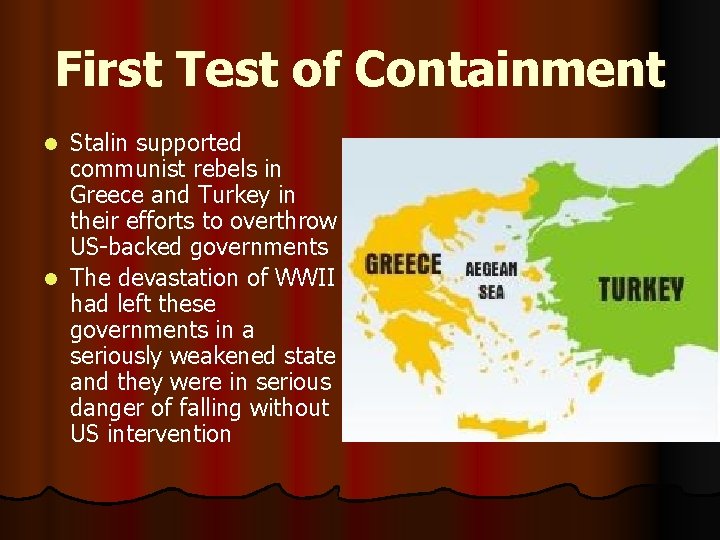
First Test of Containment Stalin supported communist rebels in Greece and Turkey in their efforts to overthrow US-backed governments l The devastation of WWII had left these governments in a seriously weakened state and they were in serious danger of falling without US intervention l
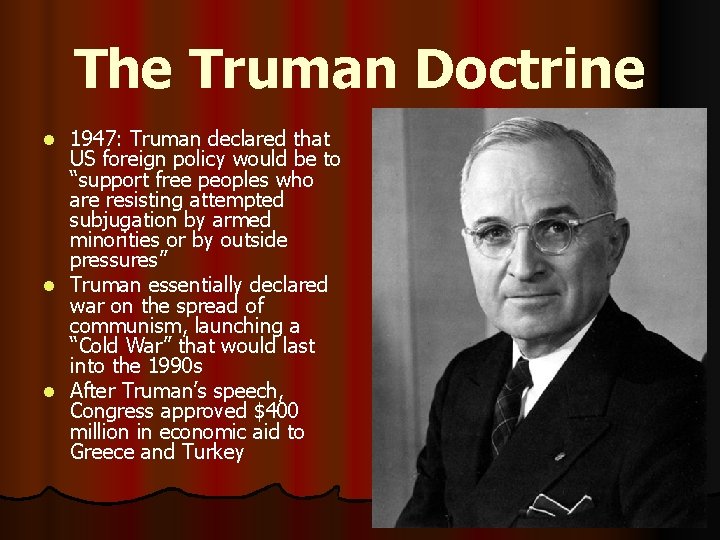
The Truman Doctrine 1947: Truman declared that US foreign policy would be to “support free peoples who are resisting attempted subjugation by armed minorities or by outside pressures” l Truman essentially declared war on the spread of communism, launching a “Cold War” that would last into the 1990 s l After Truman’s speech, Congress approved $400 million in economic aid to Greece and Turkey l
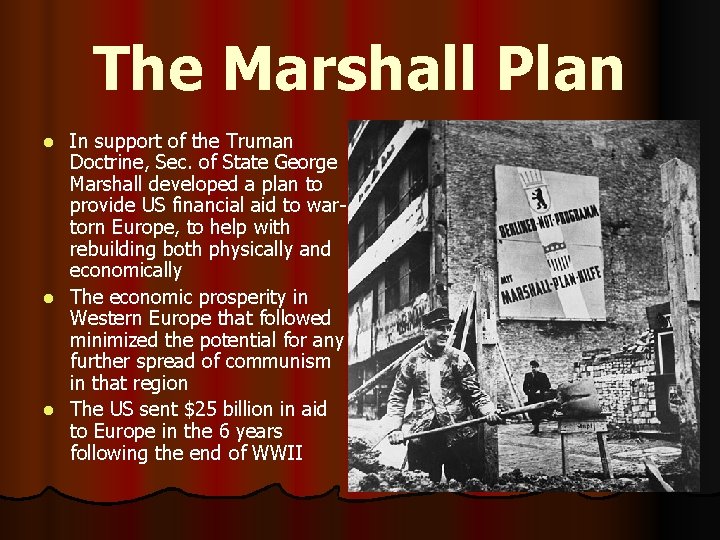
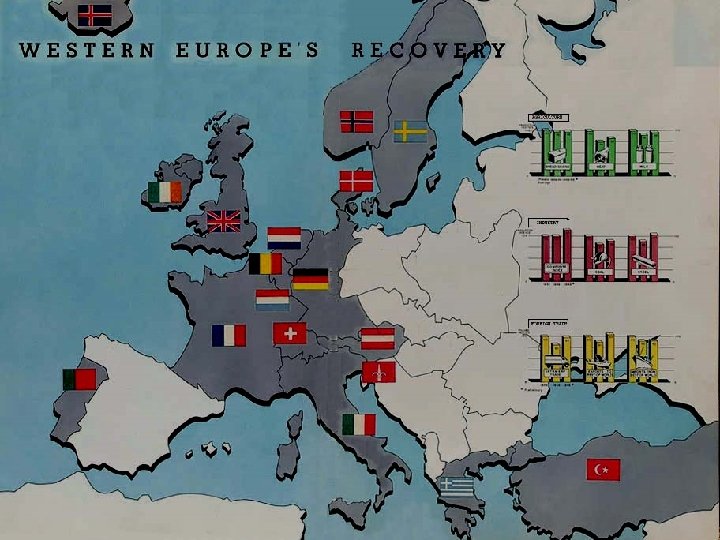
The Marshall Plan In support of the Truman Doctrine, Sec. of State George Marshall developed a plan to provide US financial aid to wartorn Europe, to help with rebuilding both physically and economically l The economic prosperity in Western Europe that followed minimized the potential for any further spread of communism in that region l The US sent $25 billion in aid to Europe in the 6 years following the end of WWII l
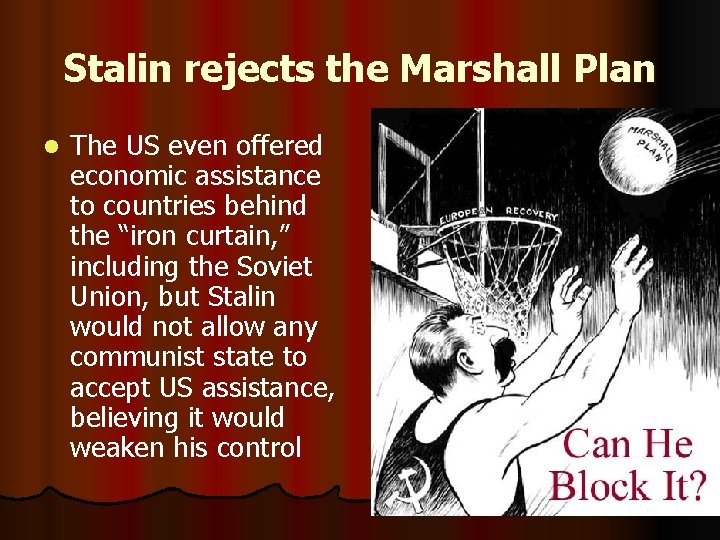
Stalin rejects the Marshall Plan l The US even offered economic assistance to countries behind the “iron curtain, ” including the Soviet Union, but Stalin would not allow any communist state to accept US assistance, believing it would weaken his control
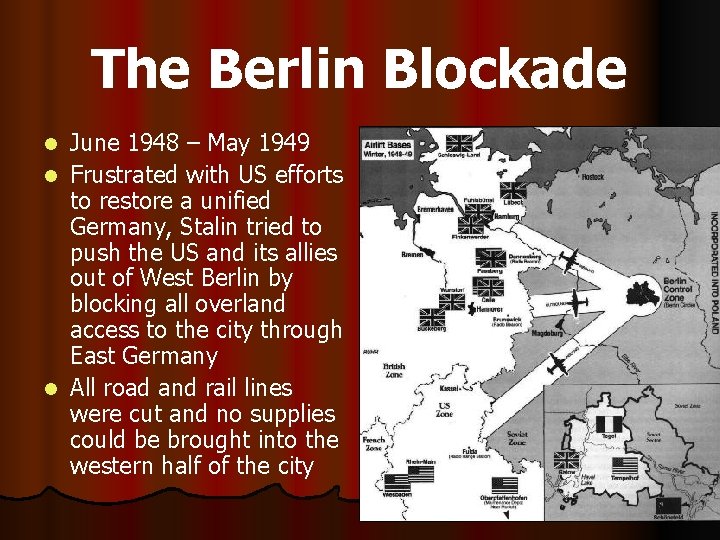
The Berlin Blockade June 1948 – May 1949 l Frustrated with US efforts to restore a unified Germany, Stalin tried to push the US and its allies out of West Berlin by blocking all overland access to the city through East Germany l All road and rail lines were cut and no supplies could be brought into the western half of the city l
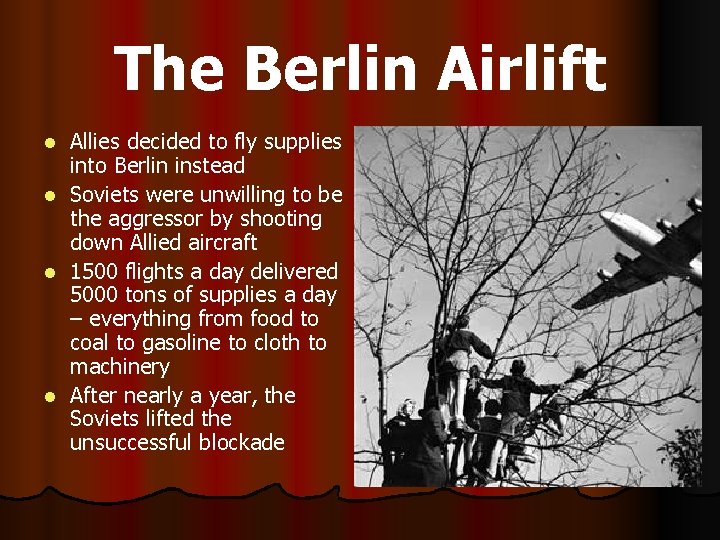
The Berlin Airlift Allies decided to fly supplies into Berlin instead l Soviets were unwilling to be the aggressor by shooting down Allied aircraft l 1500 flights a day delivered 5000 tons of supplies a day – everything from food to coal to gasoline to cloth to machinery l After nearly a year, the Soviets lifted the unsuccessful blockade l
North Atlantic Treaty Organization (NATO) Founded April 4, 1949 l Mutual defense treaty against the Soviets l US, Canada, and most of Western Europe were members l Today, still includes most of Europe + US & Canada l
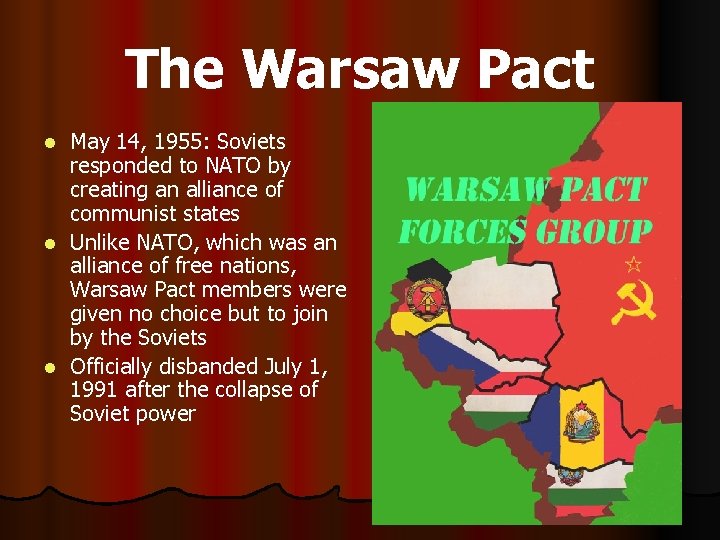
The Warsaw Pact May 14, 1955: Soviets responded to NATO by creating an alliance of communist states l Unlike NATO, which was an alliance of free nations, Warsaw Pact members were given no choice but to join by the Soviets l Officially disbanded July 1, 1991 after the collapse of Soviet power l
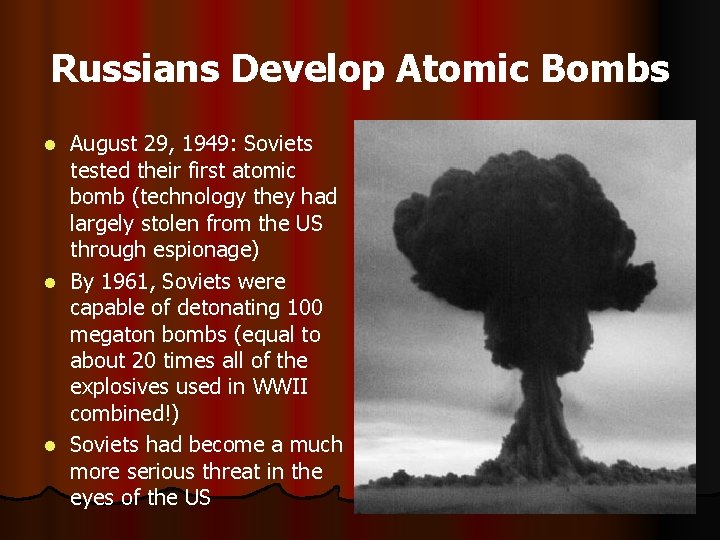
Russians Develop Atomic Bombs August 29, 1949: Soviets tested their first atomic bomb (technology they had largely stolen from the US through espionage) l By 1961, Soviets were capable of detonating 100 megaton bombs (equal to about 20 times all of the explosives used in WWII combined!) l Soviets had become a much more serious threat in the eyes of the US l
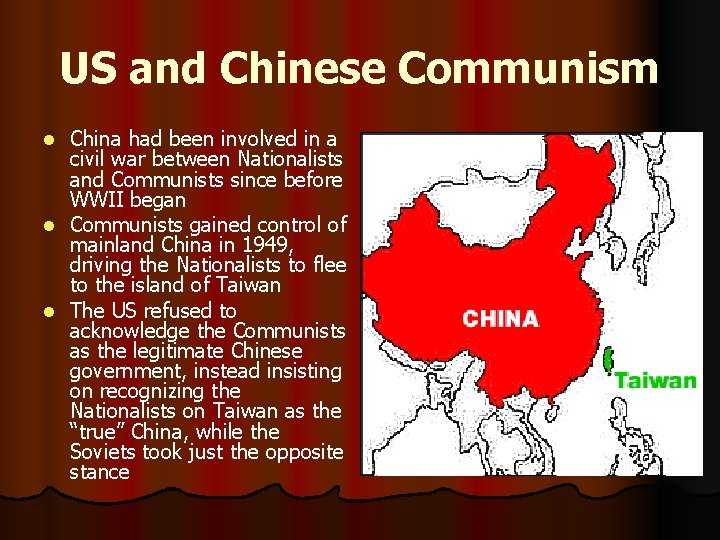
US and Chinese Communism China had been involved in a civil war between Nationalists and Communists since before WWII began l Communists gained control of mainland China in 1949, driving the Nationalists to flee to the island of Taiwan l The US refused to acknowledge the Communists as the legitimate Chinese government, instead insisting on recognizing the Nationalists on Taiwan as the “true” China, while the Soviets took just the opposite stance l
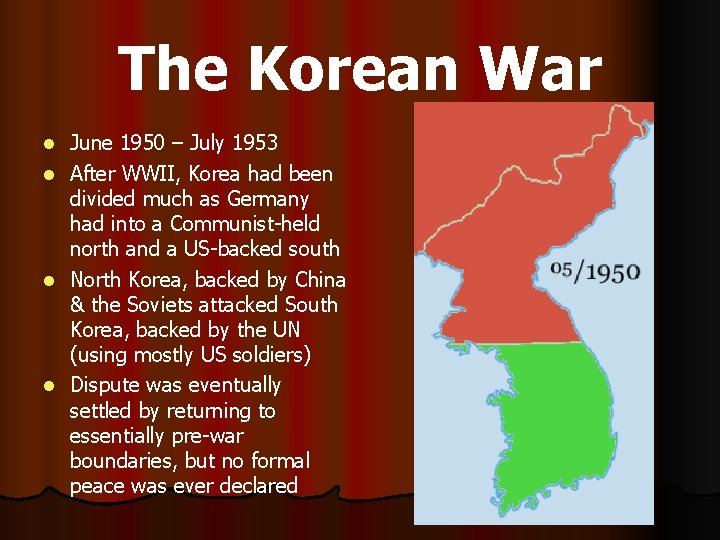
The Korean War June 1950 – July 1953 l After WWII, Korea had been divided much as Germany had into a Communist-held north and a US-backed south l North Korea, backed by China & the Soviets attacked South Korea, backed by the UN (using mostly US soldiers) l Dispute was eventually settled by returning to essentially pre-war boundaries, but no formal peace was ever declared l
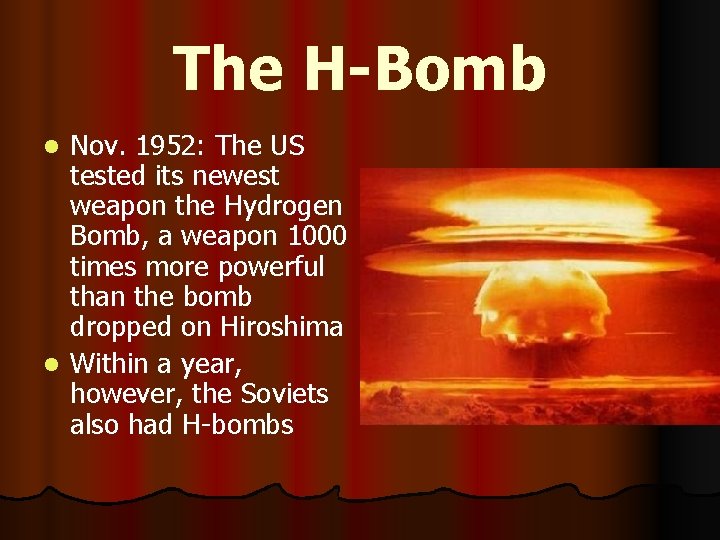
The H-Bomb Nov. 1952: The US tested its newest weapon the Hydrogen Bomb, a weapon 1000 times more powerful than the bomb dropped on Hiroshima l Within a year, however, the Soviets also had H-bombs l
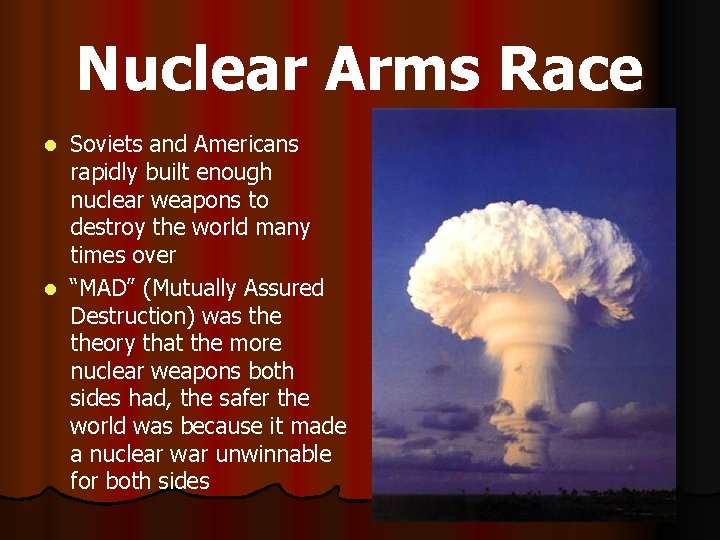
Nuclear Arms Race Soviets and Americans rapidly built enough nuclear weapons to destroy the world many times over l “MAD” (Mutually Assured Destruction) was theory that the more nuclear weapons both sides had, the safer the world was because it made a nuclear war unwinnable for both sides l
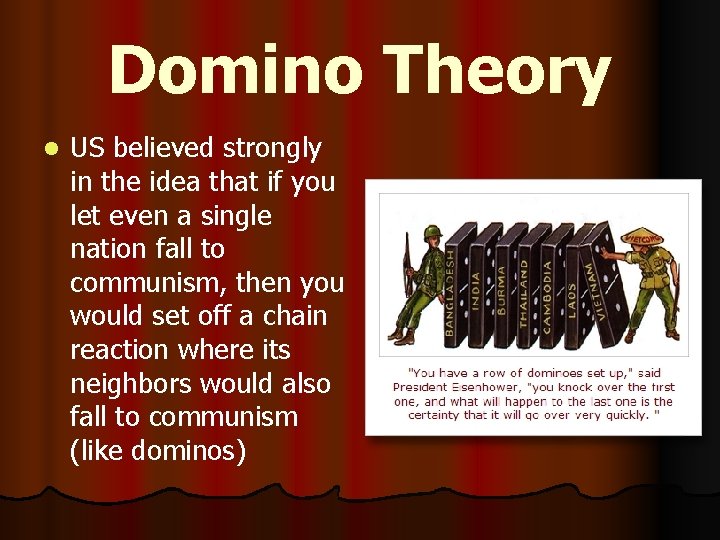
Domino Theory l US believed strongly in the idea that if you let even a single nation fall to communism, then you would set off a chain reaction where its neighbors would also fall to communism (like dominos)
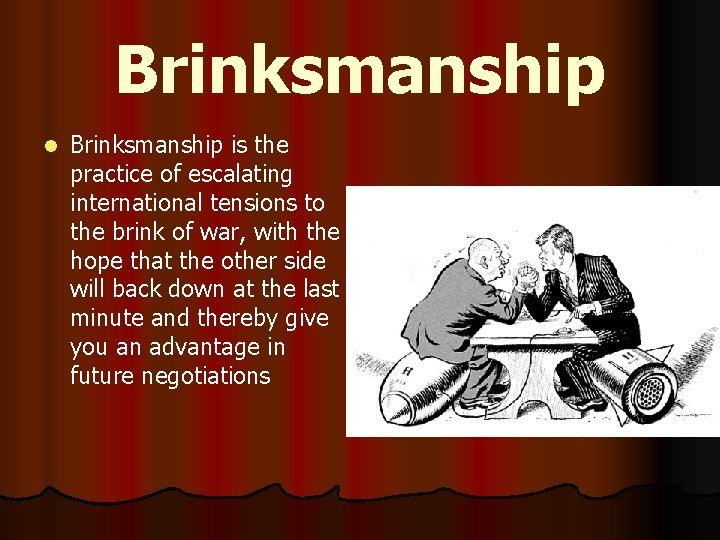
Brinksmanship l Brinksmanship is the practice of escalating international tensions to the brink of war, with the hope that the other side will back down at the last minute and thereby give you an advantage in future negotiations
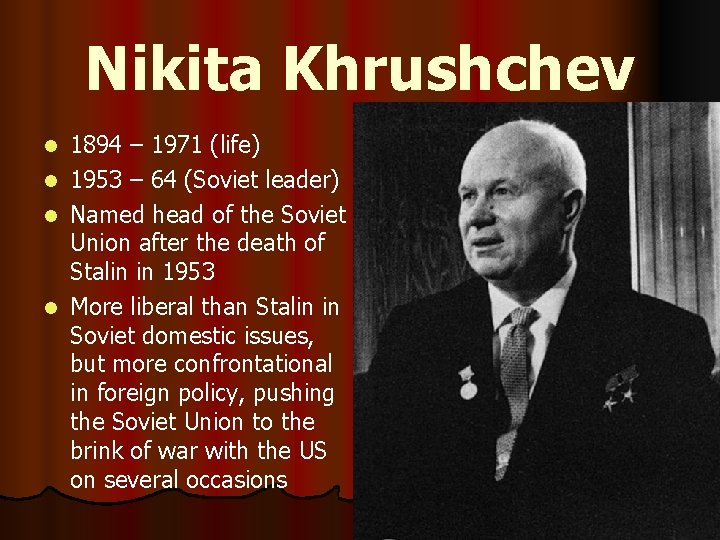
Nikita Khrushchev 1894 – 1971 (life) l 1953 – 64 (Soviet leader) l Named head of the Soviet Union after the death of Stalin in 1953 l More liberal than Stalin in Soviet domestic issues, but more confrontational in foreign policy, pushing the Soviet Union to the brink of war with the US on several occasions l
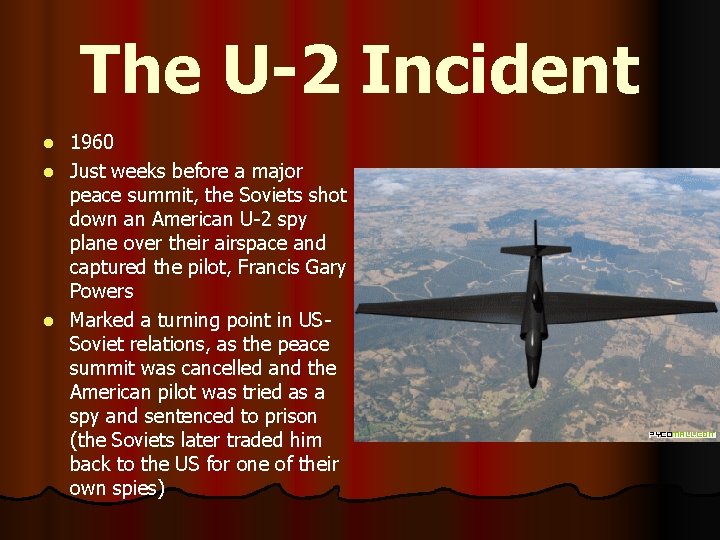
The U-2 Incident 1960 l Just weeks before a major peace summit, the Soviets shot down an American U-2 spy plane over their airspace and captured the pilot, Francis Gary Powers l Marked a turning point in USSoviet relations, as the peace summit was cancelled and the American pilot was tried as a spy and sentenced to prison (the Soviets later traded him back to the US for one of their own spies) l
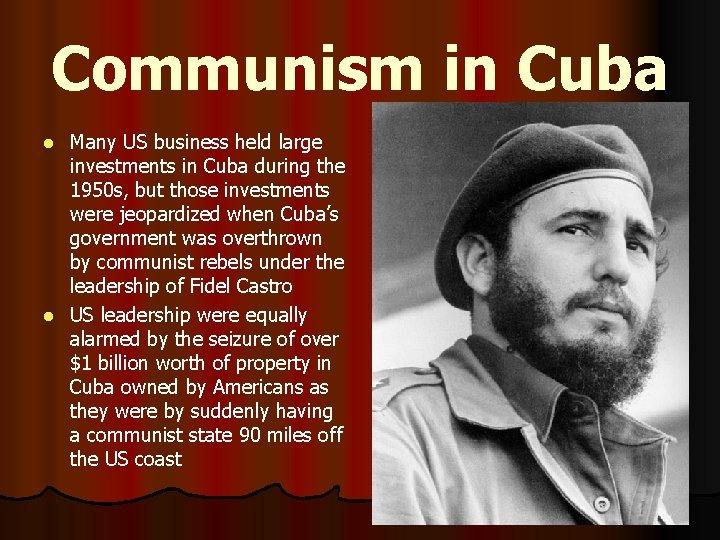
Communism in Cuba Many US business held large investments in Cuba during the 1950 s, but those investments were jeopardized when Cuba’s government was overthrown by communist rebels under the leadership of Fidel Castro l US leadership were equally alarmed by the seizure of over $1 billion worth of property in Cuba owned by Americans as they were by suddenly having a communist state 90 miles off the US coast l
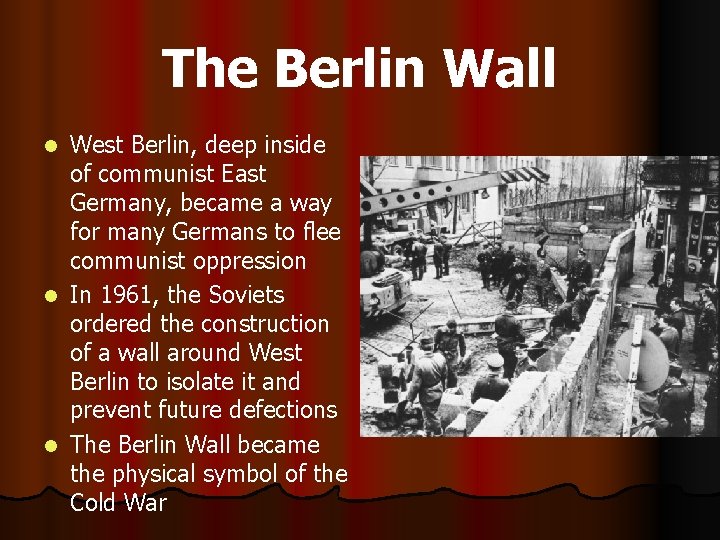
The Berlin Wall West Berlin, deep inside of communist East Germany, became a way for many Germans to flee communist oppression l In 1961, the Soviets ordered the construction of a wall around West Berlin to isolate it and prevent future defections l The Berlin Wall became the physical symbol of the Cold War l
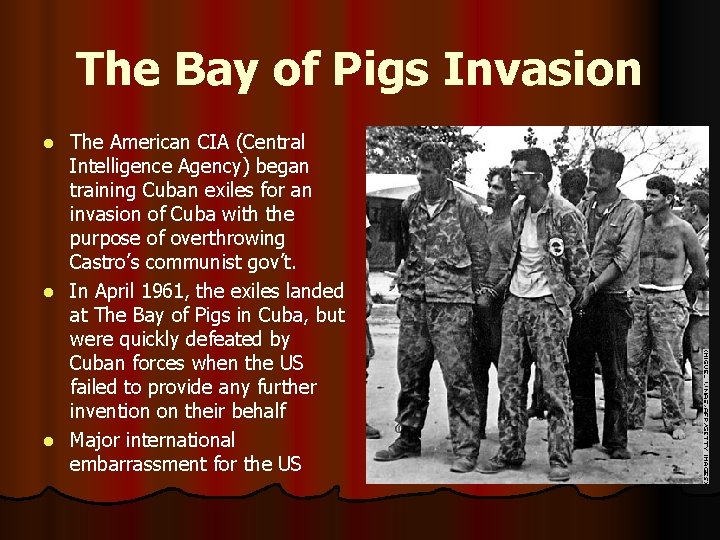
The Bay of Pigs Invasion The American CIA (Central Intelligence Agency) began training Cuban exiles for an invasion of Cuba with the purpose of overthrowing Castro’s communist gov’t. l In April 1961, the exiles landed at The Bay of Pigs in Cuba, but were quickly defeated by Cuban forces when the US failed to provide any further invention on their behalf l Major international embarrassment for the US l
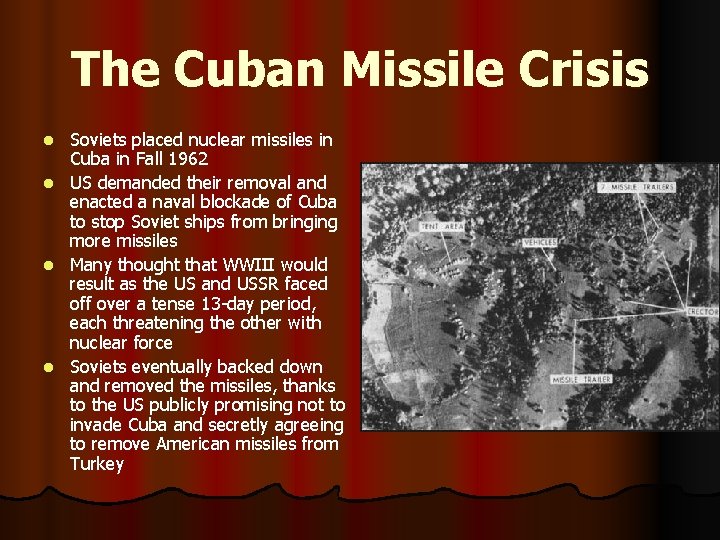
The Cuban Missile Crisis Soviets placed nuclear missiles in Cuba in Fall 1962 l US demanded their removal and enacted a naval blockade of Cuba to stop Soviet ships from bringing more missiles l Many thought that WWIII would result as the US and USSR faced off over a tense 13 -day period, each threatening the other with nuclear force l Soviets eventually backed down and removed the missiles, thanks to the US publicly promising not to invade Cuba and secretly agreeing to remove American missiles from Turkey l
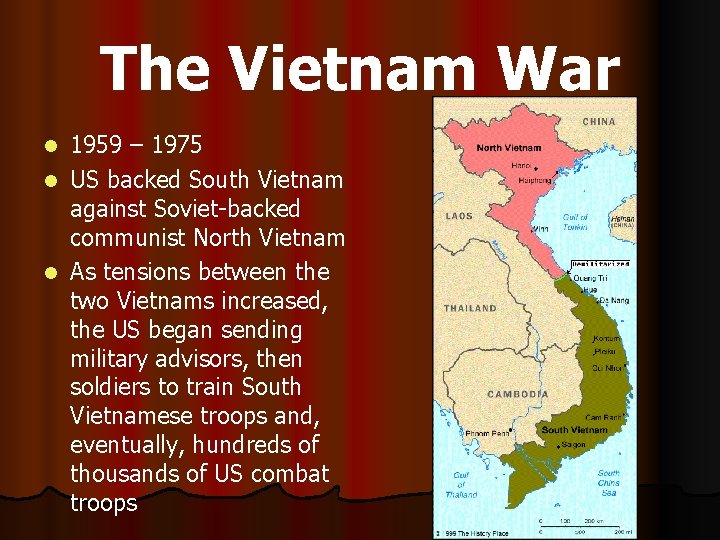
The Vietnam War 1959 – 1975 l US backed South Vietnam against Soviet-backed communist North Vietnam l As tensions between the two Vietnams increased, the US began sending military advisors, then soldiers to train South Vietnamese troops and, eventually, hundreds of thousands of US combat troops l
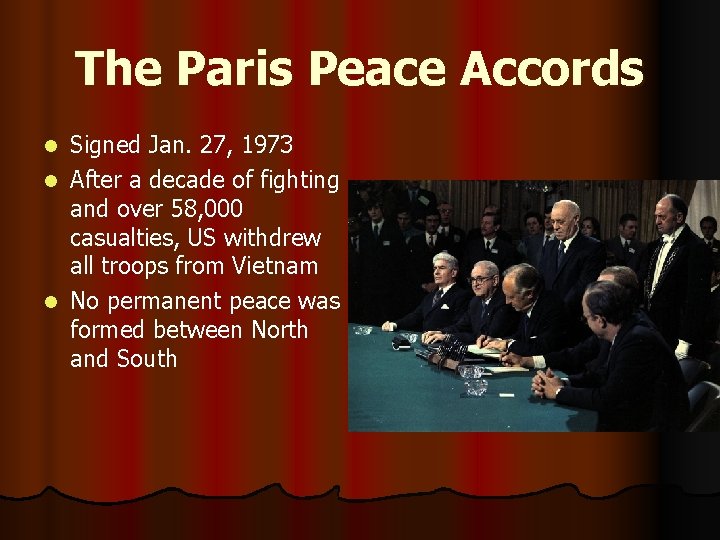
The Paris Peace Accords Signed Jan. 27, 1973 l After a decade of fighting and over 58, 000 casualties, US withdrew all troops from Vietnam l No permanent peace was formed between North and South l
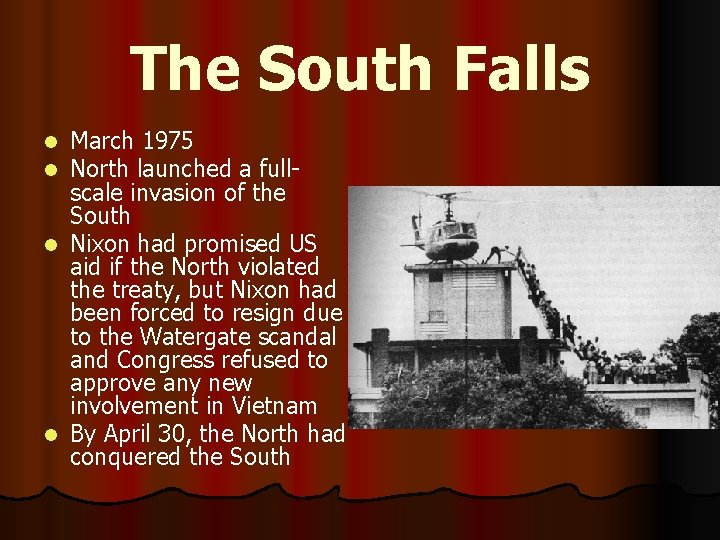
The South Falls March 1975 North launched a fullscale invasion of the South l Nixon had promised US aid if the North violated the treaty, but Nixon had been forced to resign due to the Watergate scandal and Congress refused to approve any new involvement in Vietnam l By April 30, the North had conquered the South l l
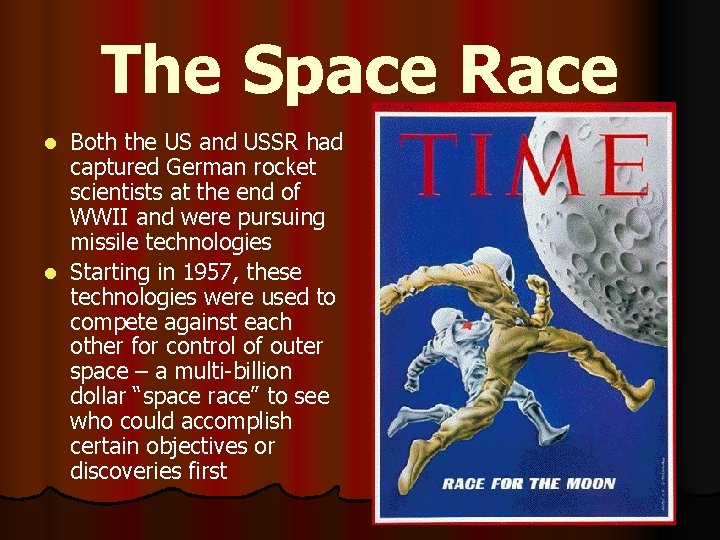
The Space Race Both the US and USSR had captured German rocket scientists at the end of WWII and were pursuing missile technologies l Starting in 1957, these technologies were used to compete against each other for control of outer space – a multi-billion dollar “space race” to see who could accomplish certain objectives or discoveries first l
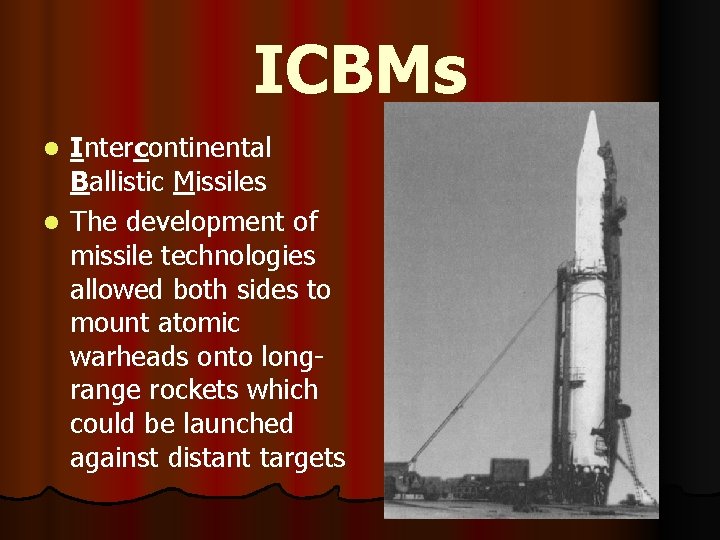
ICBMs Intercontinental Ballistic Missiles l The development of missile technologies allowed both sides to mount atomic warheads onto longrange rockets which could be launched against distant targets l
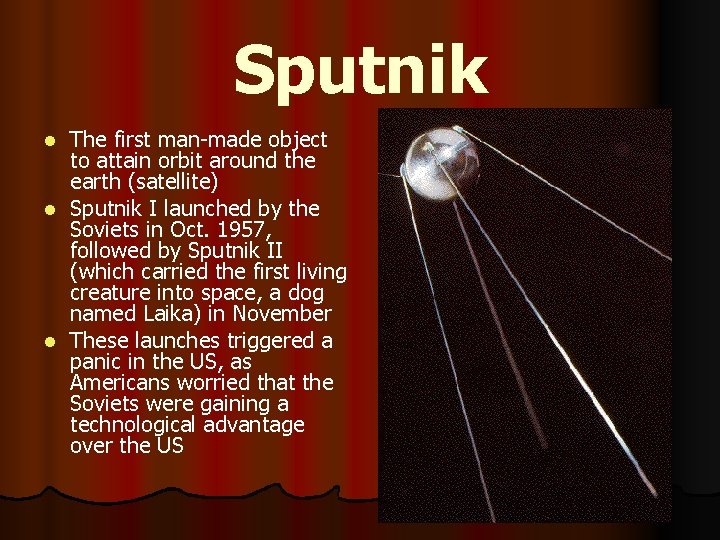
Sputnik l l l The first man-made object to attain orbit around the earth (satellite) Sputnik I launched by the Soviets in Oct. 1957, followed by Sputnik II (which carried the first living creature into space, a dog named Laika) in November These launches triggered a panic in the US, as Americans worried that the Soviets were gaining a technological advantage over the US
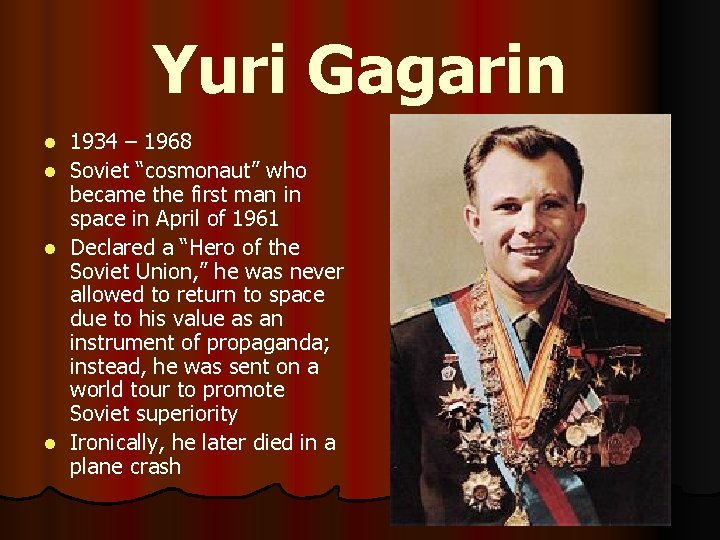
Yuri Gagarin 1934 – 1968 l Soviet “cosmonaut” who became the first man in space in April of 1961 l Declared a “Hero of the Soviet Union, ” he was never allowed to return to space due to his value as an instrument of propaganda; instead, he was sent on a world tour to promote Soviet superiority l Ironically, he later died in a plane crash l
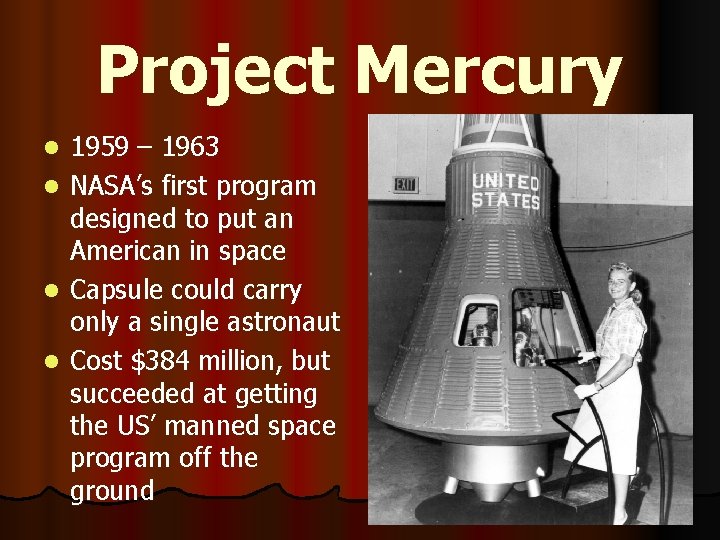
Project Mercury l l 1959 – 1963 NASA’s first program designed to put an American in space Capsule could carry only a single astronaut Cost $384 million, but succeeded at getting the US’ manned space program off the ground
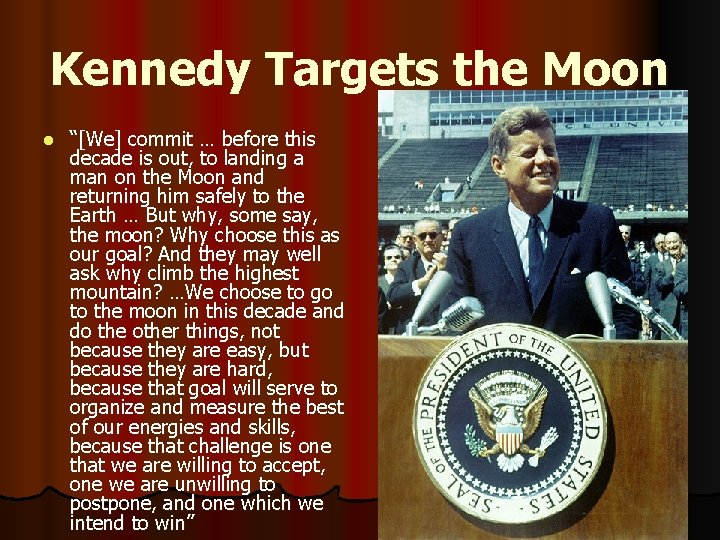
Kennedy Targets the Moon l “[We] commit … before this decade is out, to landing a man on the Moon and returning him safely to the Earth … But why, some say, the moon? Why choose this as our goal? And they may well ask why climb the highest mountain? …We choose to go to the moon in this decade and do the other things, not because they are easy, but because they are hard, because that goal will serve to organize and measure the best of our energies and skills, because that challenge is one that we are willing to accept, one we are unwilling to postpone, and one which we intend to win”
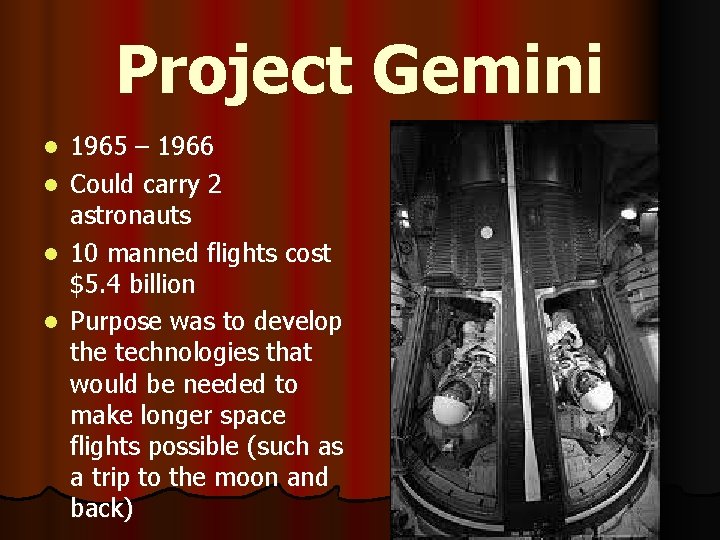
Project Gemini 1965 – 1966 l Could carry 2 astronauts l 10 manned flights cost $5. 4 billion l Purpose was to develop the technologies that would be needed to make longer space flights possible (such as a trip to the moon and back) l
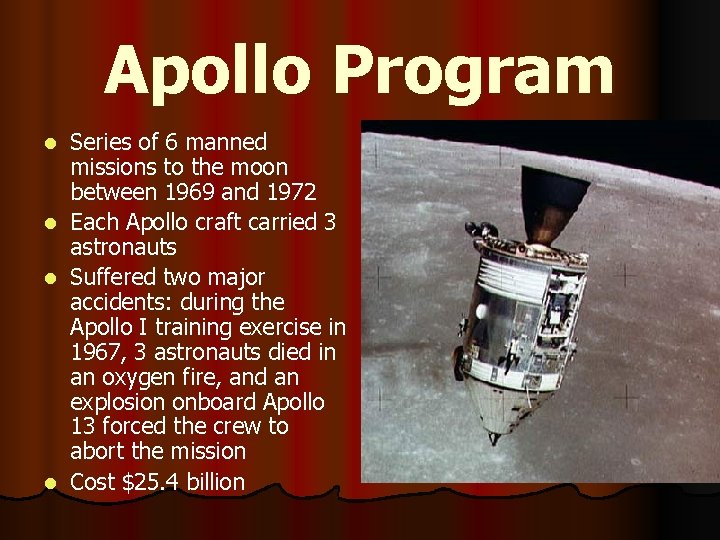
Apollo Program Series of 6 manned missions to the moon between 1969 and 1972 l Each Apollo craft carried 3 astronauts l Suffered two major accidents: during the Apollo I training exercise in 1967, 3 astronauts died in an oxygen fire, and an explosion onboard Apollo 13 forced the crew to abort the mission l Cost $25. 4 billion l
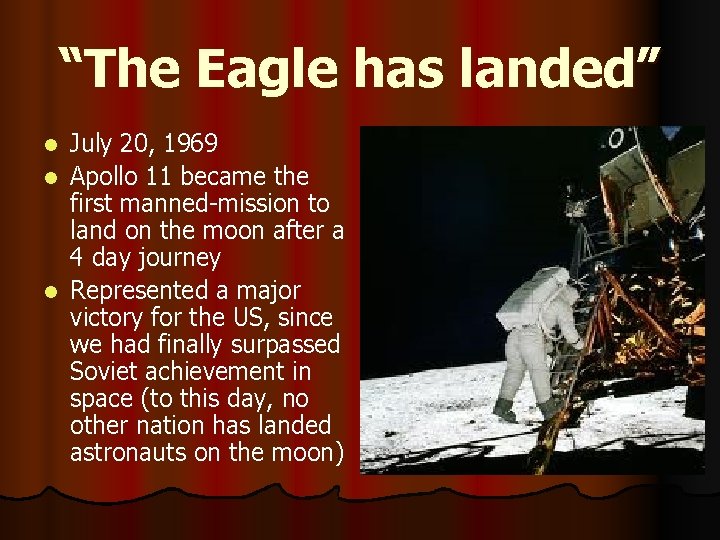
“The Eagle has landed” July 20, 1969 l Apollo 11 became the first manned-mission to land on the moon after a 4 day journey l Represented a major victory for the US, since we had finally surpassed Soviet achievement in space (to this day, no other nation has landed astronauts on the moon) l
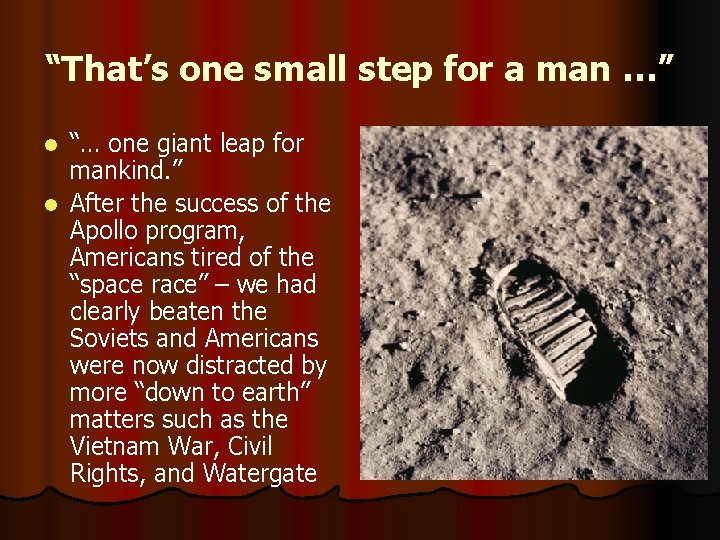
“That’s one small step for a man …” “… one giant leap for mankind. ” l After the success of the Apollo program, Americans tired of the “space race” – we had clearly beaten the Soviets and Americans were now distracted by more “down to earth” matters such as the Vietnam War, Civil Rights, and Watergate l
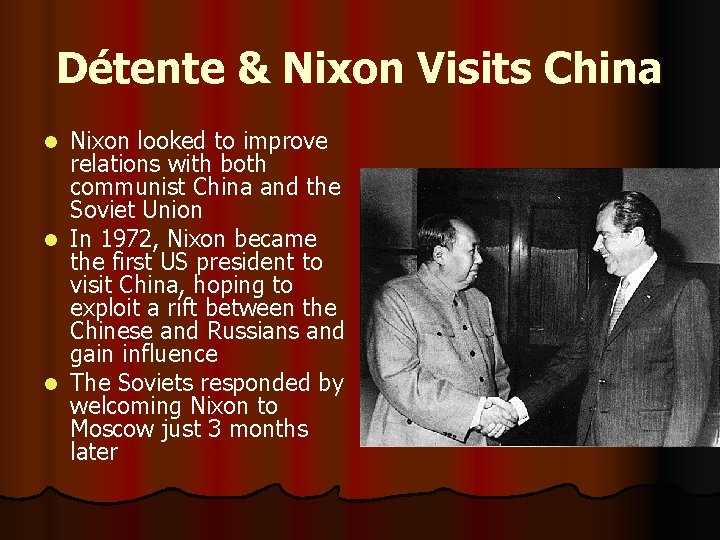
Détente & Nixon Visits China Nixon looked to improve relations with both communist China and the Soviet Union l In 1972, Nixon became the first US president to visit China, hoping to exploit a rift between the Chinese and Russians and gain influence l The Soviets responded by welcoming Nixon to Moscow just 3 months later l
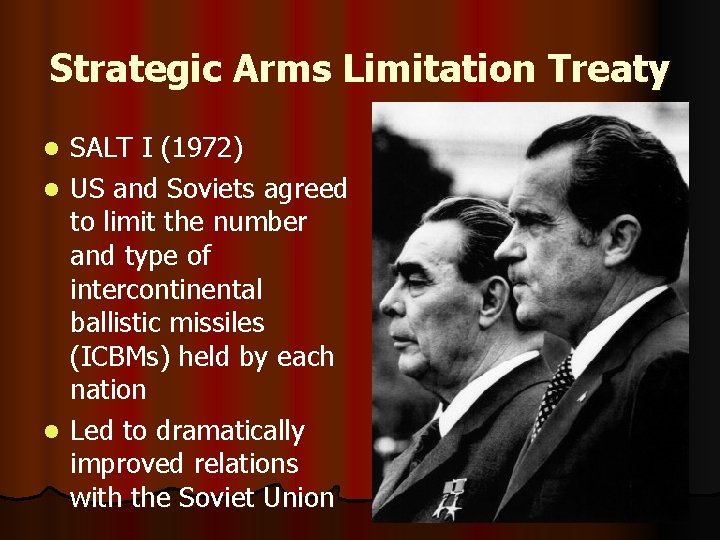
Strategic Arms Limitation Treaty SALT I (1972) l US and Soviets agreed to limit the number and type of intercontinental ballistic missiles (ICBMs) held by each nation l Led to dramatically improved relations with the Soviet Union l
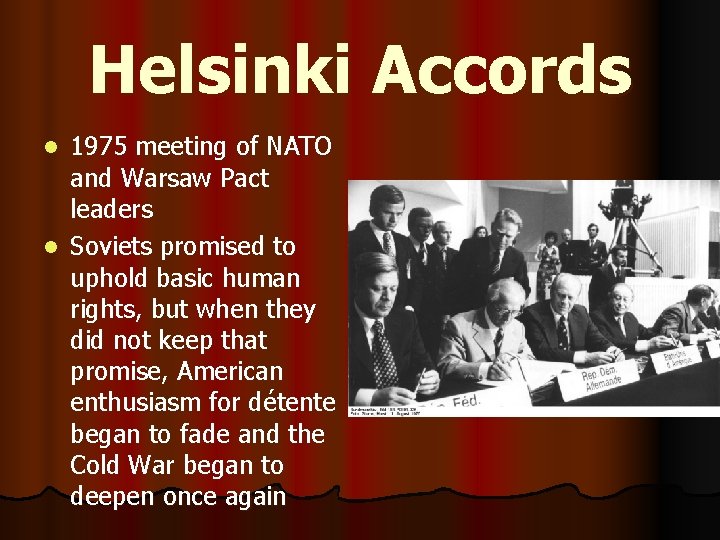
Helsinki Accords 1975 meeting of NATO and Warsaw Pact leaders l Soviets promised to uphold basic human rights, but when they did not keep that promise, American enthusiasm for détente began to fade and the Cold War began to deepen once again l
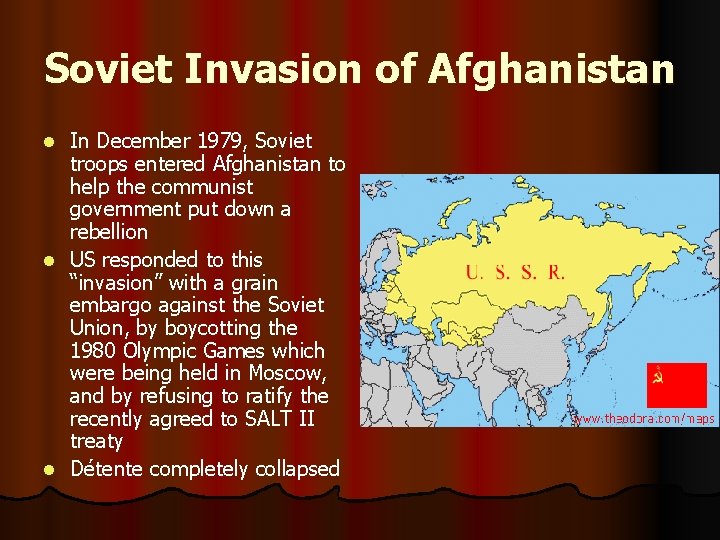
Soviet Invasion of Afghanistan In December 1979, Soviet troops entered Afghanistan to help the communist government put down a rebellion l US responded to this “invasion” with a grain embargo against the Soviet Union, by boycotting the 1980 Olympic Games which were being held in Moscow, and by refusing to ratify the recently agreed to SALT II treaty l Détente completely collapsed l
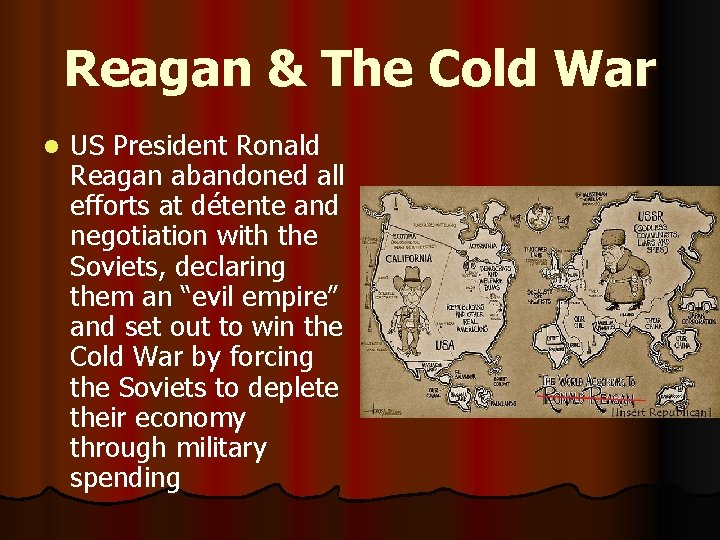
Reagan & The Cold War l US President Ronald Reagan abandoned all efforts at détente and negotiation with the Soviets, declaring them an “evil empire” and set out to win the Cold War by forcing the Soviets to deplete their economy through military spending
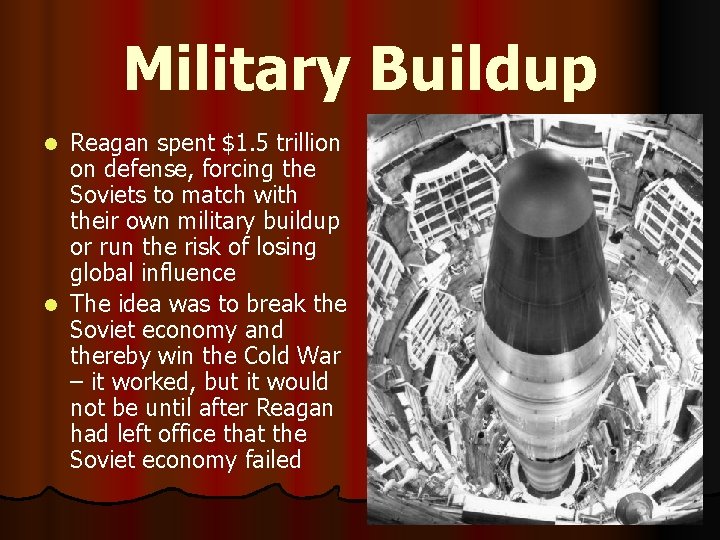
Military Buildup Reagan spent $1. 5 trillion on defense, forcing the Soviets to match with their own military buildup or run the risk of losing global influence l The idea was to break the Soviet economy and thereby win the Cold War – it worked, but it would not be until after Reagan had left office that the Soviet economy failed l
“Star Wars” Strategic Defense Initiative (SDI) l Reagan called for the development of a spacemounted weapons platform which could be used to destroy Soviet nuclear missiles before they could reach the US l The US spent about $100 billion trying to develop such a system (with no success), forcing the Soviets to spend money on how to counter such a system l
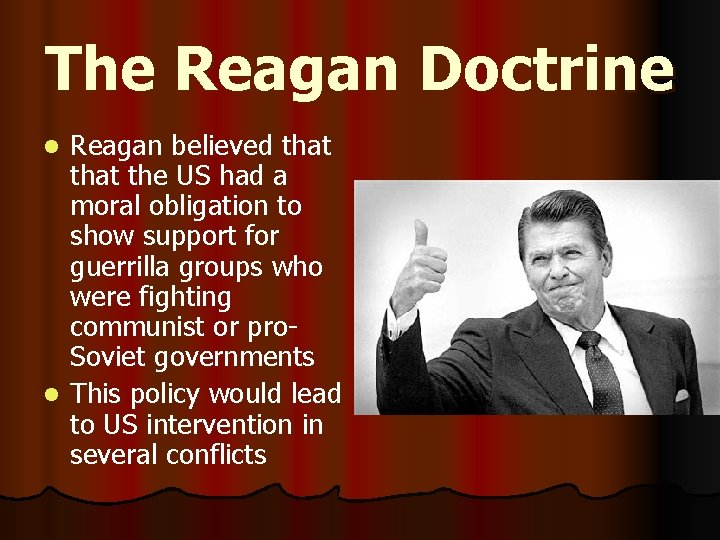
The Reagan Doctrine Reagan believed that the US had a moral obligation to show support for guerrilla groups who were fighting communist or pro. Soviet governments l This policy would lead to US intervention in several conflicts l
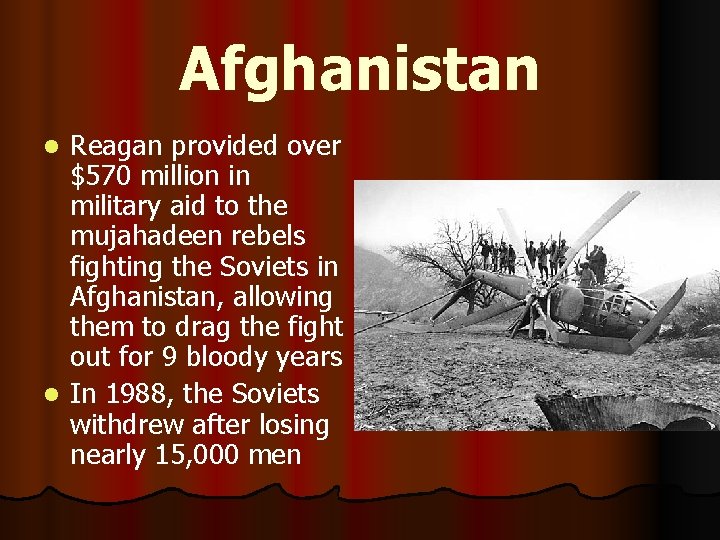
Afghanistan Reagan provided over $570 million in military aid to the mujahadeen rebels fighting the Soviets in Afghanistan, allowing them to drag the fight out for 9 bloody years l In 1988, the Soviets withdrew after losing nearly 15, 000 men l
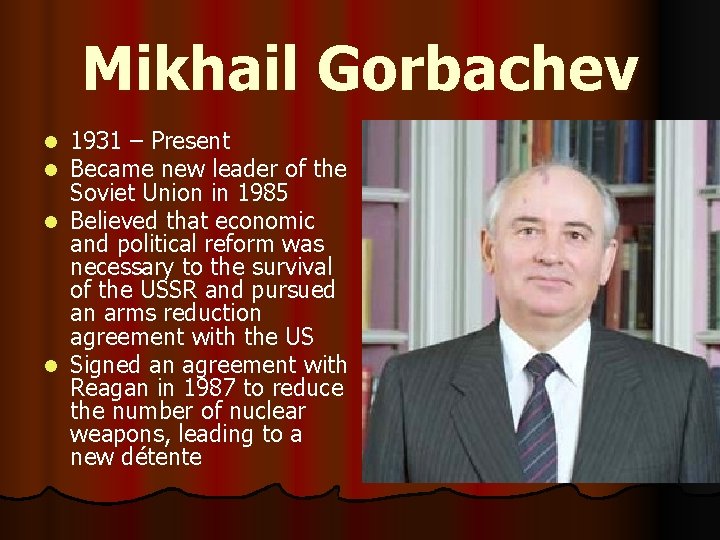
Mikhail Gorbachev 1931 – Present Became new leader of the Soviet Union in 1985 l Believed that economic and political reform was necessary to the survival of the USSR and pursued an arms reduction agreement with the US l Signed an agreement with Reagan in 1987 to reduce the number of nuclear weapons, leading to a new détente l l
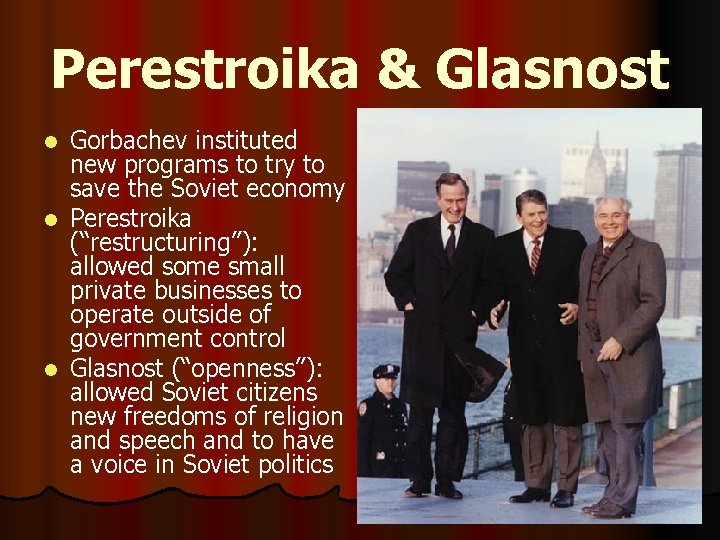
Perestroika & Glasnost Gorbachev instituted new programs to try to save the Soviet economy l Perestroika (“restructuring”): allowed some small private businesses to operate outside of government control l Glasnost (“openness”): allowed Soviet citizens new freedoms of religion and speech and to have a voice in Soviet politics l
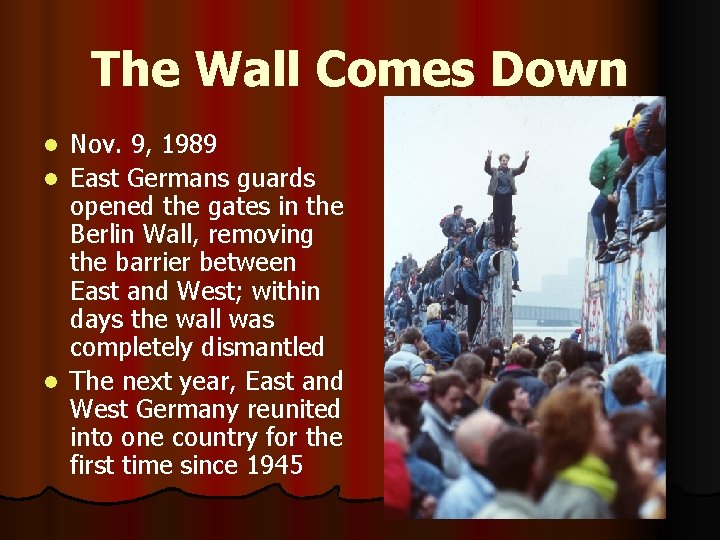
The Wall Comes Down Nov. 9, 1989 l East Germans guards opened the gates in the Berlin Wall, removing the barrier between East and West; within days the wall was completely dismantled l The next year, East and West Germany reunited into one country for the first time since 1945 l
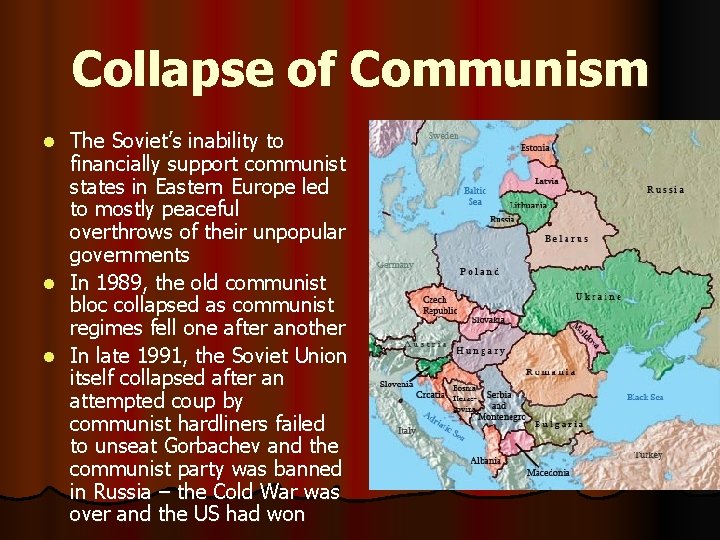
Collapse of Communism The Soviet’s inability to financially support communist states in Eastern Europe led to mostly peaceful overthrows of their unpopular governments l In 1989, the old communist bloc collapsed as communist regimes fell one after another l In late 1991, the Soviet Union itself collapsed after an attempted coup by communist hardliners failed to unseat Gorbachev and the communist party was banned in Russia – the Cold War was over and the US had won l
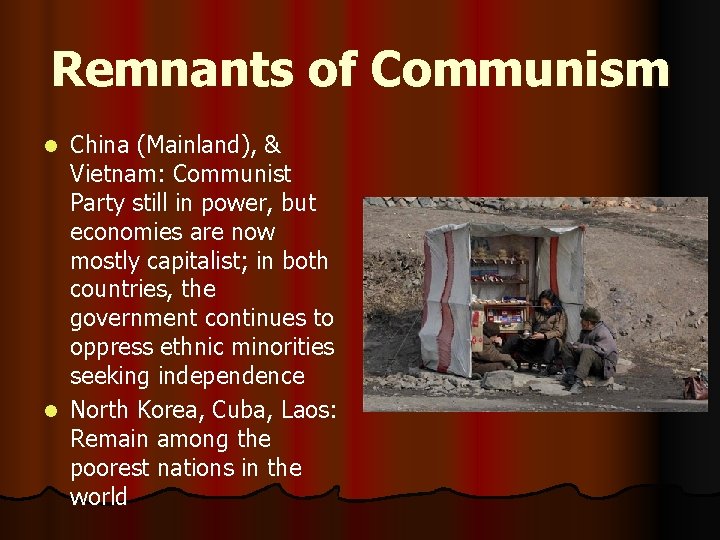
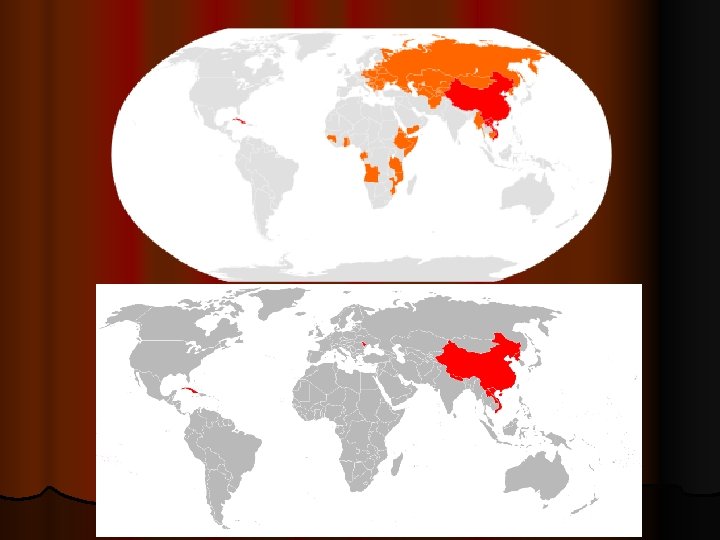
Remnants of Communism China (Mainland), & Vietnam: Communist Party still in power, but economies are now mostly capitalist; in both countries, the government continues to oppress ethnic minorities seeking independence l North Korea, Cuba, Laos: Remain among the poorest nations in the world l