Strategy for Contingency Plan in the Event of

- Slides: 22
Strategy for Contingency Plan in the Event of Aberrant South West Monsoon Department of Agriculture Tamil Nadu 11/25/2020
FORE GROUND u Tamilnadu lies in rain shadow region of western ghats during South West Monsoon u Most rain fall occurs due to convectional activity. u No perennial rivers originates and flows through State & depends on other state for irrigation which depends on SWM u 49% of net sown area under rainfed u Crux of the problem – Aberrant SWM u Results in, less area under crops, low production productivity of crops and under employment 11/25/2020 2
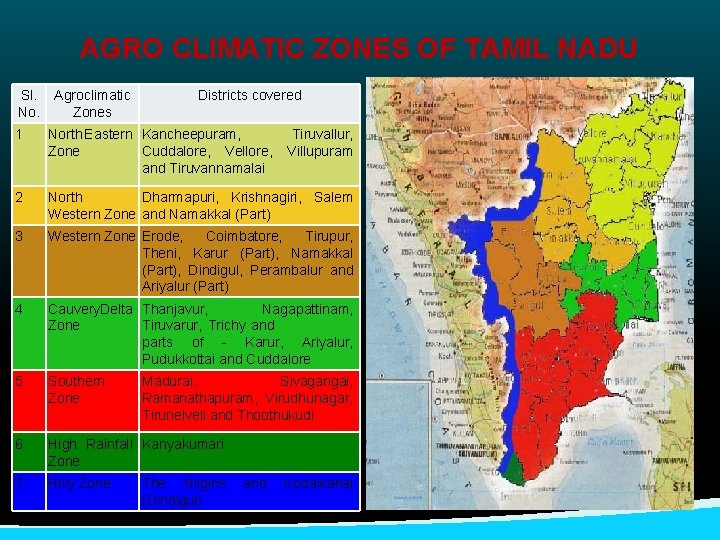
AGRO CLIMATIC ZONES OF TAMIL NADU Sl. Agroclimatic No. Zones Districts covered 1 North Eastern Kancheepuram, Tiruvallur, Zone Cuddalore, Vellore, Villupuram and Tiruvannamalai 2 North Dharmapuri, Krishnagiri, Salem Western Zone and Namakkal (Part) 3 Western Zone Erode, Coimbatore, Tirupur, Theni, Karur (Part), Namakkal (Part), Dindigul, Perambalur and Ariyalur (Part) 4 Cauvery Delta Thanjavur, Nagapattinam, Zone Tiruvarur, Trichy and parts of - Karur, Ariyalur, Pudukkottai and Cuddalore 5 Southern Zone 6 High Rainfall Kanyakumari Zone 7 Hilly Zone Madurai, Sivagangai, Ramanathapuram, Virudhunagar, Tirunelveli and Thoothukudi The Nilgiris and Kodaikanal (Dindigul)
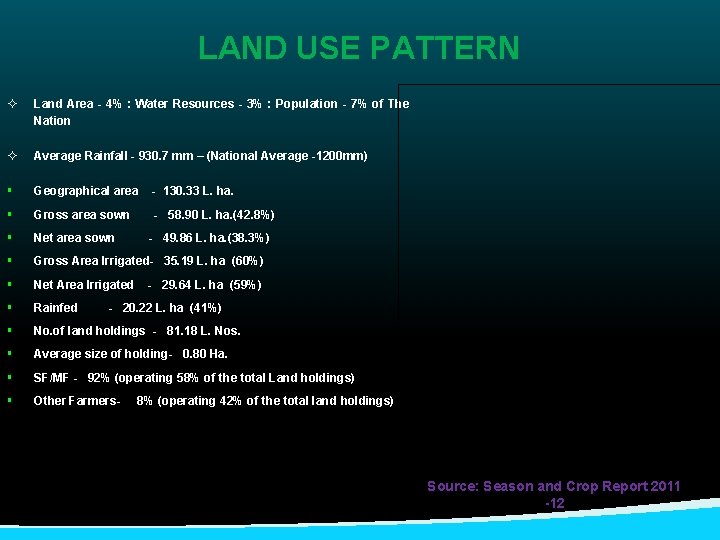
LAND USE PATTERN ² Land Area - 4% : Water Resources - 3% : Population - 7% of The Nation ² Average Rainfall - 930. 7 mm – (National Average -1200 mm) § Geographical area - 130. 33 L. ha. § Gross area sown - 58. 90 L. ha. (42. 8%) § Net area sown - 49. 86 L. ha. (38. 3%) § Gross Area Irrigated- 35. 19 L. ha (60%) § Net Area Irrigated - 29. 64 L. ha (59%) § Rainfed - 20. 22 L. ha (41%) § No. of land holdings - 81. 18 L. Nos. § Average size of holding- 0. 80 Ha. § SF/MF - 92% (operating 58% of the total Land holdings) § Other Farmers- 8% (operating 42% of the total land holdings) Source: Season and Crop Report 2011 -12
SOURCES OF IRRIGATION Net Area irrigated : 29. 64 L. Ha. ( 59%) Net Area sown : 49. 54 L. Ha.
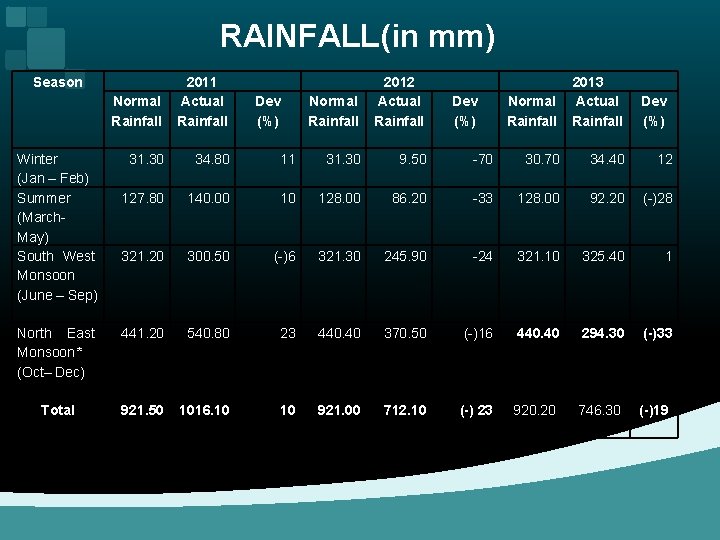
RAINFALL(in mm) Season Winter (Jan – Feb) Summer (March- May) South West Monsoon (June – Sep) 2011 Normal Actual Rainfall Dev (%) 2012 Normal Actual Rainfall Dev (%) 2013 Normal Actual Rainfall Dev (%) 31. 30 34. 80 11 31. 30 9. 50 -70 30. 70 34. 40 12 127. 80 140. 00 10 128. 00 86. 20 -33 128. 00 92. 20 (-)28 321. 20 300. 50 (-)6 321. 30 245. 90 -24 321. 10 325. 40 1 North East Monsoon * (Oct– Dec) 441. 20 540. 80 23 440. 40 370. 50 (-)16 440. 40 294. 30 (-)33 Total 921. 50 1016. 10 10 921. 00 712. 10 (-) 23 920. 20 746. 30 (-)19
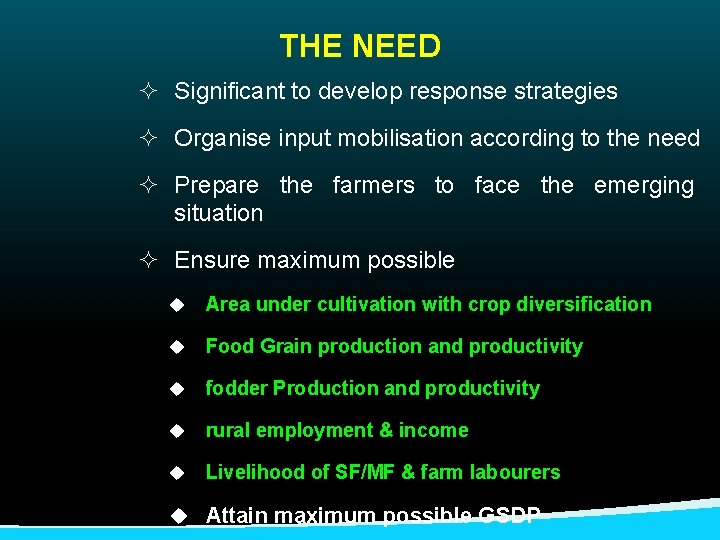
THE NEED ² Significant to develop response strategies ² Organise input mobilisation according to the need ² Prepare the farmers to face the emerging situation ² Ensure maximum possible u Area under cultivation with crop diversification u Food Grain production and productivity u fodder Production and productivity u rural employment & income u Livelihood of SF/MF & farm labourers u Attain maximum possible GSDP
Current Status… Ø Contingency plan prepared for all the districts Ø Plans discussed at district level with TNAU scientist and accepted Ø Plans were developed for …. Ø Delay in onset of rains during the season Ø Slow progression during the season Ø Mid Season drought Ø End season drought Ø Deficit rainfall situation Ø Focus on mitigation measures Viz. , Ø Creation of water harvesting Structures like Farm ponds Ø Stabilisation of existing farm ponds/ percolation ponds Ø Erecting recharge shafts/ Sub- surface dykes to revitalise aquifers
Crop Contingent Plan ² Integral Part of Agriculture ² Objective u Minimise reduction in overall agricultural Production caused due to adverse Climatic Condition by u selecting appropriate Crop varieties or alternative crops u Production technologies in accordance to the temporal and spatial outbreak of Monsoon ² Four major Components u Crop & Varietal use management u Technologies for increasing production u Technologies for mitigating water stress/ drought situation u Input supply management system
Crop & Varietal use Management ² 7 Agro climatic zones ² Crop Plan suggested for u Normal season u Delay in monsoon (2 to 12 weeks) u Drought spell u Early withdrawal of Monsoon ² Zonewise Crops and varieties suggested 11/25/2020
Technologies for increasing production/mitigating water stress/drought situations ² Package of practices for each crop ² Transfer of technologies to the farmers u Demonstration u Training u Distribution of key inputs 7 Agro climatic zones ² Technologies for mitigating water stress/drought situations 11/25/2020
Technologies for increasing production/mitigating water stress/drought situations ² Technologies for mitigating water stress/drought situations u Early maturing varieties u Addition of organic matter to improve the water holding capacity u Selection of short duration, drought resistant and high yielding varieties u Using higher seed rate u Use of Bio-Fertilisers u Potash application for inducing drought resistant u Potash spray(2%) for drought tolerance
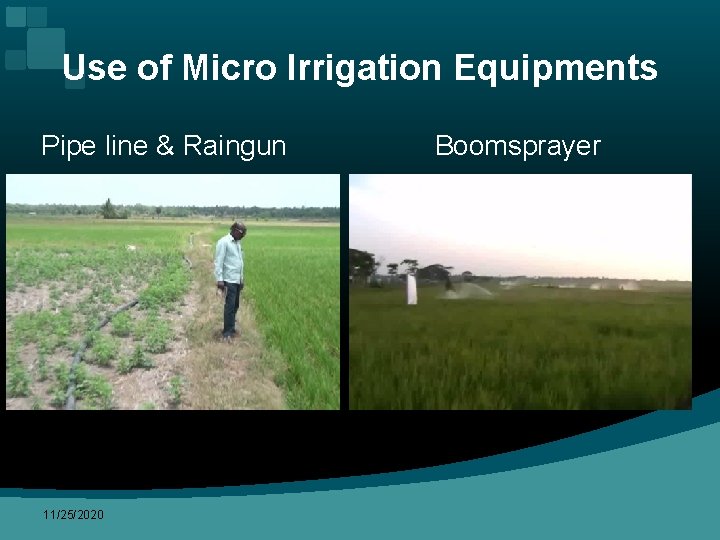
Action Plan ² Plan afoot for mass production and distribution of early maturing varieties. u Anna 4, a short duration Paddy variety of 90 to 95 days duration. u Plan for distribution in drought prone districts u Potential yield - 5 tonnes/Ha. ² Management practices u Use of Portable pumps for irrigation u Distribution of Pipes u Encourage the use of Micro-irrigation equipments u Popularisation of PPFM, KCL spray u Promotion of SRI Technology u Precision Farming for Sugarcane, Horticulture and garden land crops
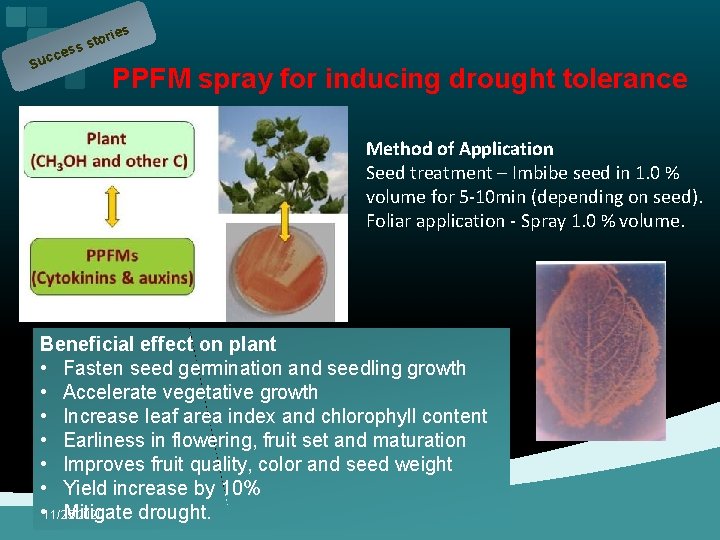
ce ries o t ss s Suc PPFM spray for inducing drought tolerance Method of Application Seed treatment – Imbibe seed in 1. 0 % volume for 5 -10 min (depending on seed). Foliar application - Spray 1. 0 % volume. Beneficial effect on plant • Fasten seed germination and seedling growth • Accelerate vegetative growth • Increase leaf area index and chlorophyll content • Earliness in flowering, fruit set and maturation • Improves fruit quality, color and seed weight • Yield increase by 10% • 11/25/2020 Mitigate drought.
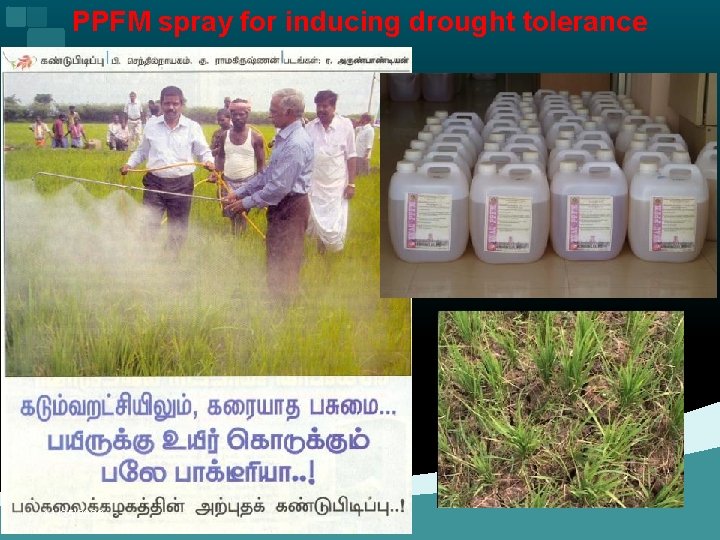
PPFM spray for inducing drought tolerance 11/25/2020
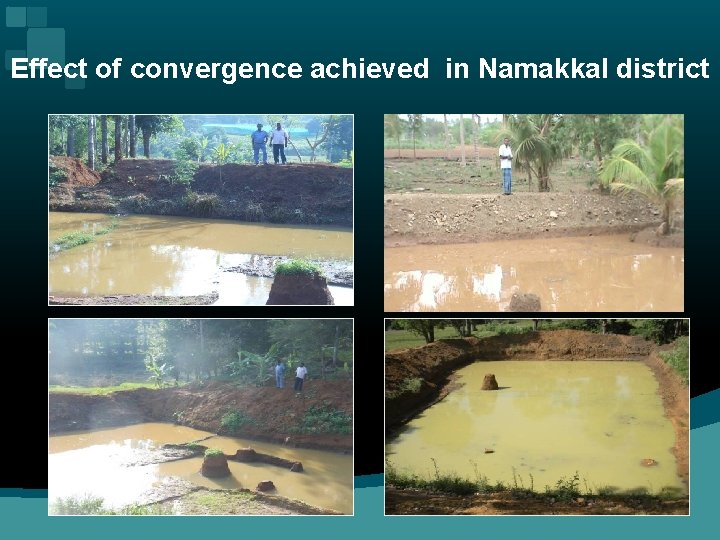
Effect of convergence achieved in Namakkal district
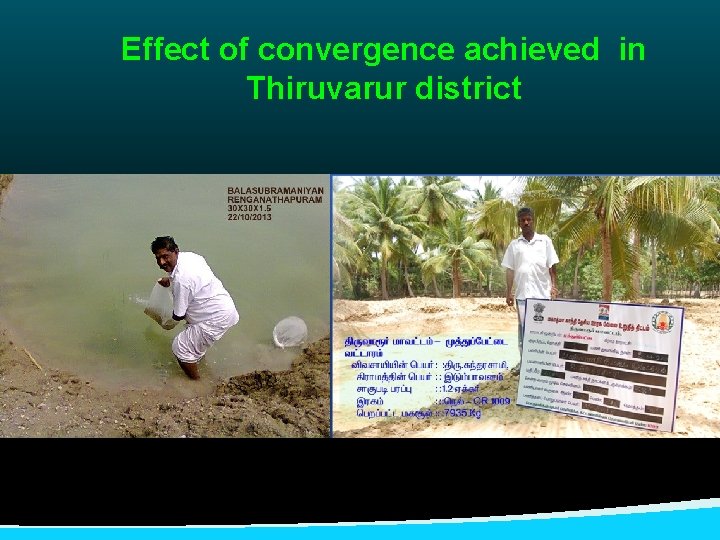
Effect of convergence achieved in Thiruvarur district
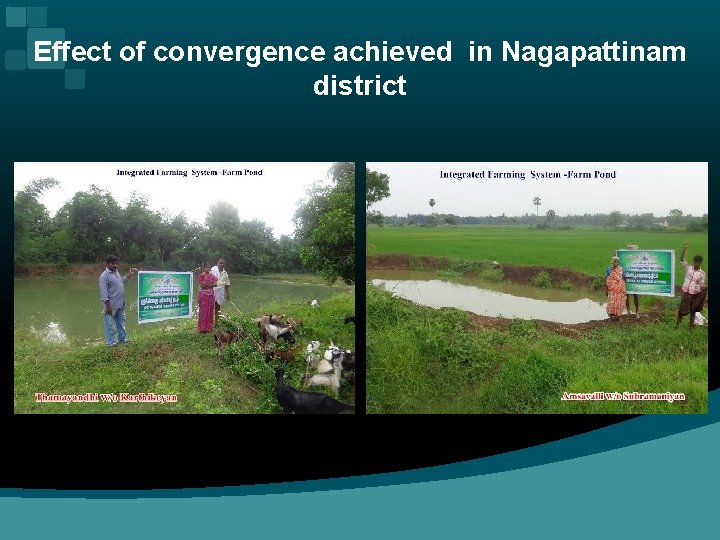
Effect of convergence achieved in Nagapattinam district
Use of Micro Irrigation Equipments Pipe line & Raingun 11/25/2020 Boomsprayer
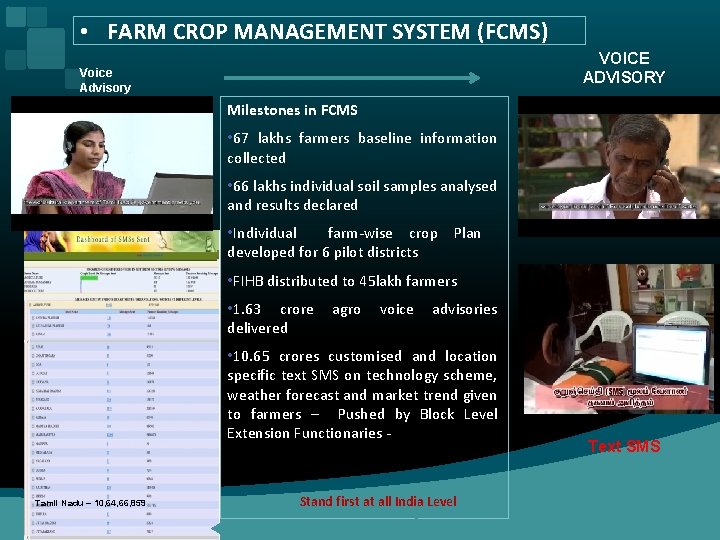
• FARM CROP MANAGEMENT SYSTEM (FCMS) VOICE ADVISORY Voice Advisory Milestones in FCMS • 67 lakhs farmers baseline information collected • 66 lakhs individual soil samples analysed and results declared • Individual farm-wise crop Plan developed for 6 pilot districts • FIHB distributed to 45 lakh farmers • 1. 63 crore delivered agro voice advisories • 10. 65 crores customised and location specific text SMS on technology scheme, weather forecast and market trend given to farmers – Pushed by Block Level Extension Functionaries - Tamil Nadu – 10, 64, 66, 859 Stand first at all India Level Text SMS
EXPECTED BENEFITS ² Ensure maximum cropped area ² Increase in ground water table and quality of irrigation water ² Irrigation opportunities after post monsoon ² Stabilise production and productivity ² Ensure Rural employment ² Stablise income of SC/ST farmers and Small and Marginal farmers
THANKS