Stop Consonant Voicing and 2 nd language learning





- Slides: 43
Stop Consonant Voicing (and 2 nd language learning)
The English phonemic inventory of stops includes 6 sounds: /b/ /d/ /g/ (voiced, V+) /p/ /t/ /k/ (unvoiced, V-, also called voiceless) Voiced: Vocal folds buzz Unvoiced: Vocal folds don’t buzz It should be simple to specify the articulatory and acoustic features that distinguish V+ from V-. It isn’t. Why? (a) There are quite a few phonological rules that apply to voicing distinctions. (b) The details vary with context, especially initial vs. final stops. We’re going to keep it simple and stick with initial stops.
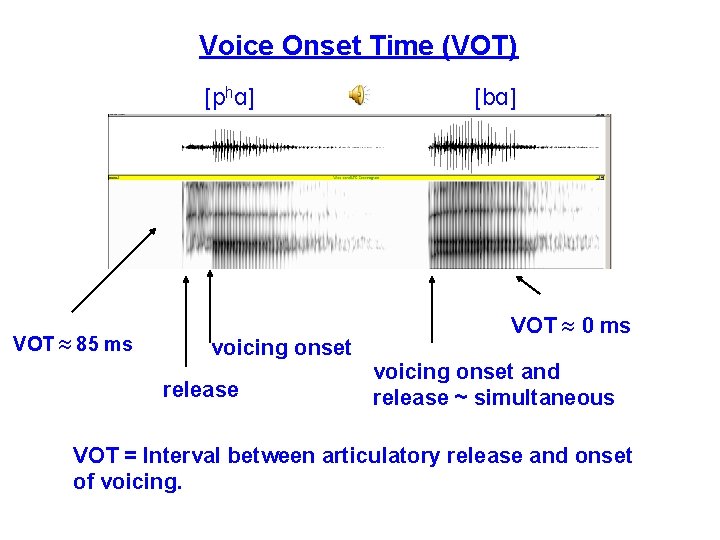
Main feature (for initial stops): Voice-onset time: Articulatory definition: Interval between articulatory release and the onset of voicing; e. g. , if the vocal folds start vibrating 20 ms after release, VOT=20 ms. That’s it. Acoustic definition: “Burst-to-buzz interval” – interval between the burst of noise signaling articulatory release and the onset of periodic vibration. e. g. , if periodic vibration follows the release burst by 20 ms, VOT=20 ms. The articulatory & acoustic definitions are two different ways of saying the same thing.
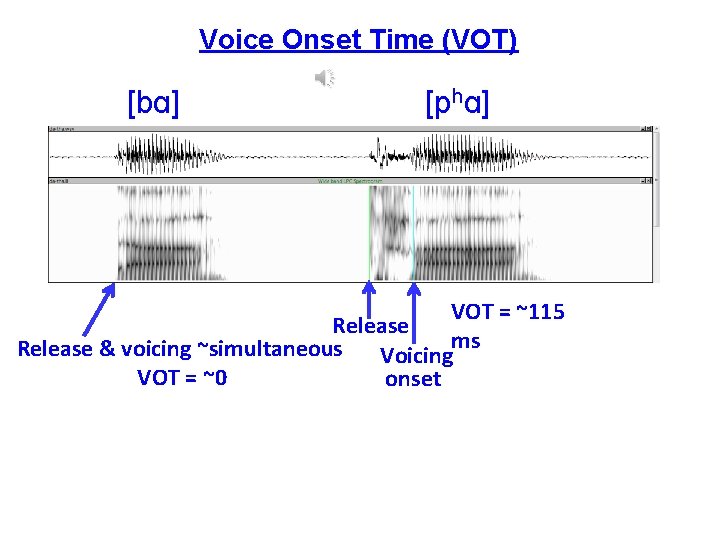
Voice Onset Time (VOT) [bɑ] [phɑ] VOT = ~115 Release & voicing ~simultaneous Voicingms VOT = ~0 onset
Voice Onset Time (VOT) [phɑ] VOT » 85 ms voicing onset release [bɑ] VOT » 0 ms voicing onset and release ~ simultaneous VOT = Interval between articulatory release and onset of voicing.
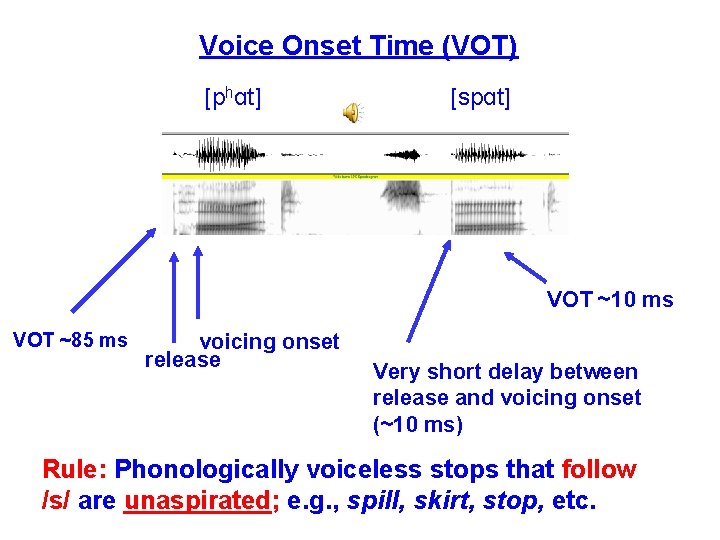
Voice Onset Time (VOT) [phɑt] [spɑt] VOT ~10 ms VOT ~85 ms voicing onset release Very short delay between release and voicing onset (~10 ms) Rule: Phonologically voiceless stops that follow /s/ are unaspirated; e. g. , spill, skirt, stop, etc.
[spɑt] (unaspirated [p]) With [s] edited out
pack [phæk] (aspirated [p]) /p/ precedes stressed vowel (aspirated) capping [khæpɪŋ] (lightly aspirated [p]) /p/ precedes unstressed vowel (unasiprated or lightly aspirated)
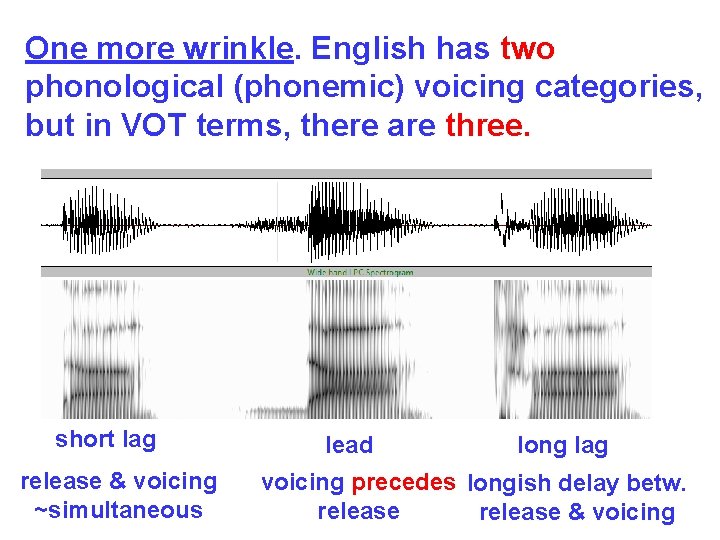
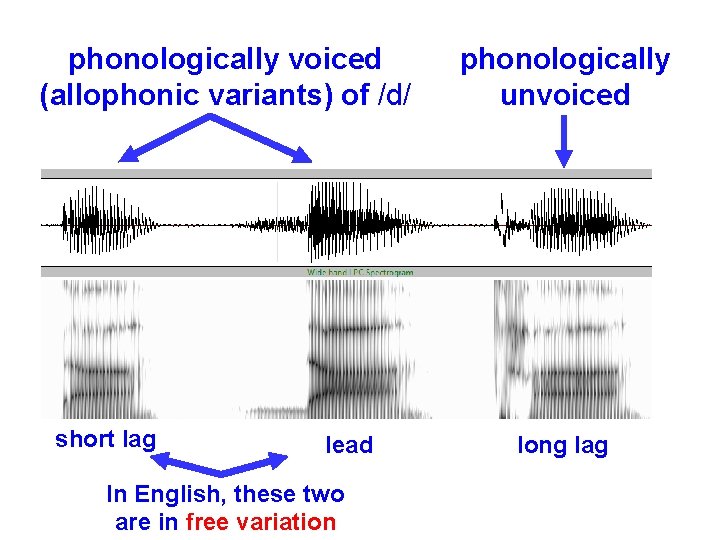
One more wrinkle. English has two phonological (phonemic) voicing categories, but in VOT terms, there are three. short lag release & voicing ~simultaneous lead long lag voicing precedes longish delay betw. release & voicing
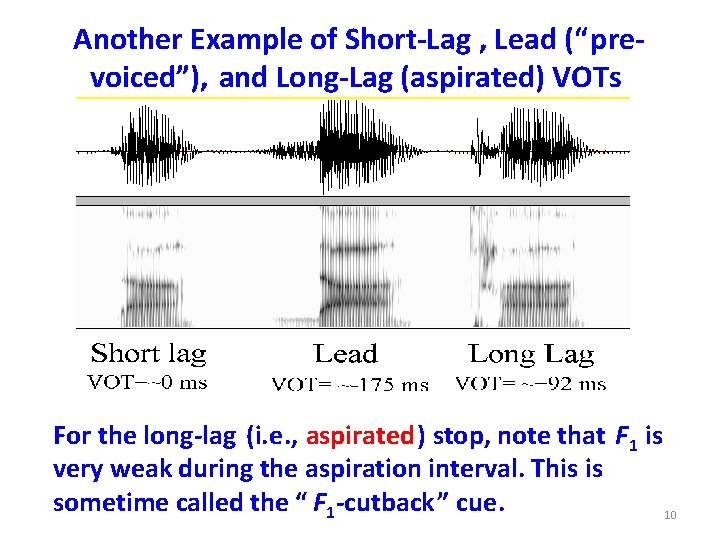
Another Example of Short-Lag , Lead (“prevoiced”), and Long-Lag (aspirated) VOTs For the long-lag (i. e. , aspirated) stop, note that F 1 is very weak during the aspiration interval. This is sometime called the “ F 1 -cutback” cue. 10
phonologically voiced (allophonic variants) of /d/ short lag release & voicing ~simultaneous lead phonologically unvoiced long lag voicing precedes longish delay betw. release & voicing
phonologically voiced (allophonic variants) of /d/ short lag lead In English, these two are in free variation phonologically unvoiced long lag
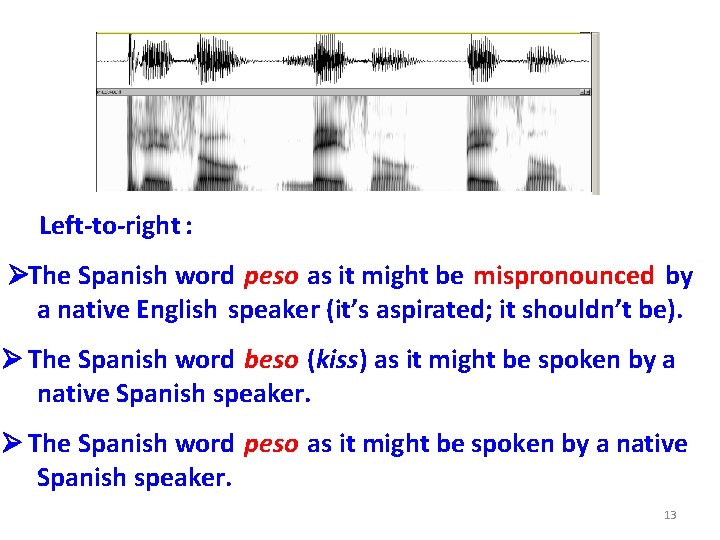
Left-to-right : Ø The Spanish word peso as it might be mispronounced by a native English speaker (it’s aspirated; it shouldn’t be). Ø The Spanish word beso (kiss) as it might be spoken by a native Spanish speaker. Ø The Spanish word peso as it might be spoken by a native Spanish speaker. 13
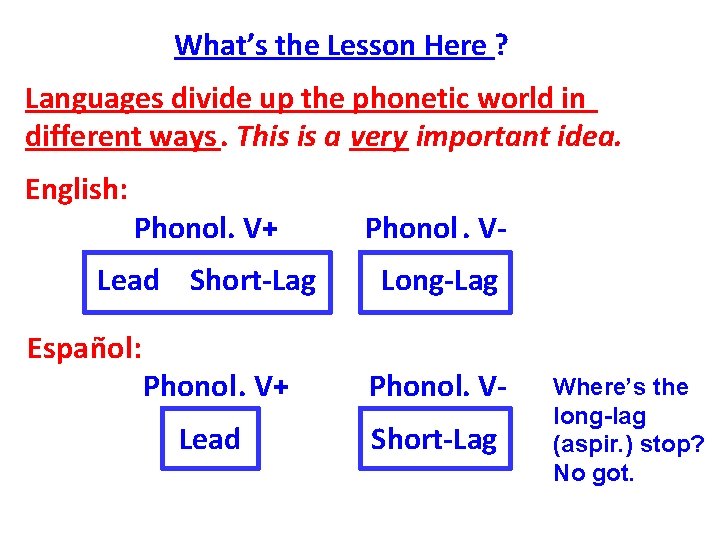
What’s the Lesson Here ? Languages divide up the phonetic world in different ways. This is a very important idea. English: Phonol. V+ Phonol. VLead Short-Lag Long-Lag Español: Phonol. V+ Phonol. V Lead Short-Lag Where’s the long-lag (aspir. ) stop? No got.
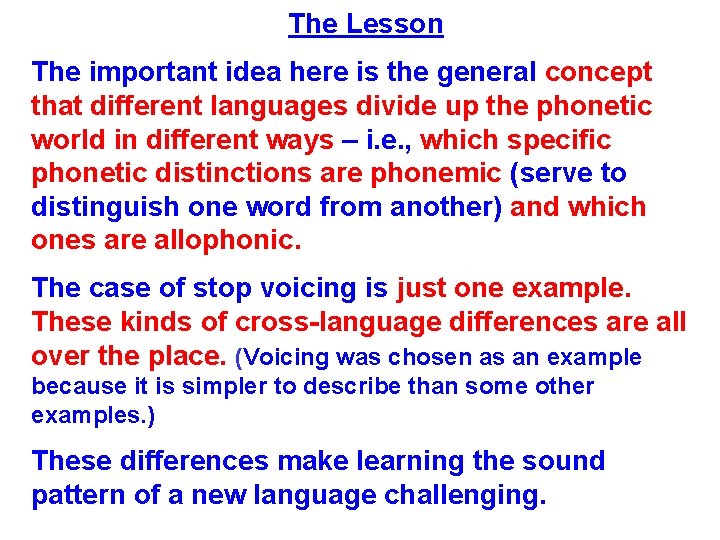
The Lesson The important idea here is the general concept that different languages divide up the phonetic world in different ways – i. e. , which specific phonetic distinctions are phonemic (serve to distinguish one word from another) and which ones are allophonic. The case of stop voicing is just one example. These kinds of cross-language differences are all over the place. (Voicing was chosen as an example because it is simpler to describe than some other examples. ) These differences make learning the sound pattern of a new language challenging.
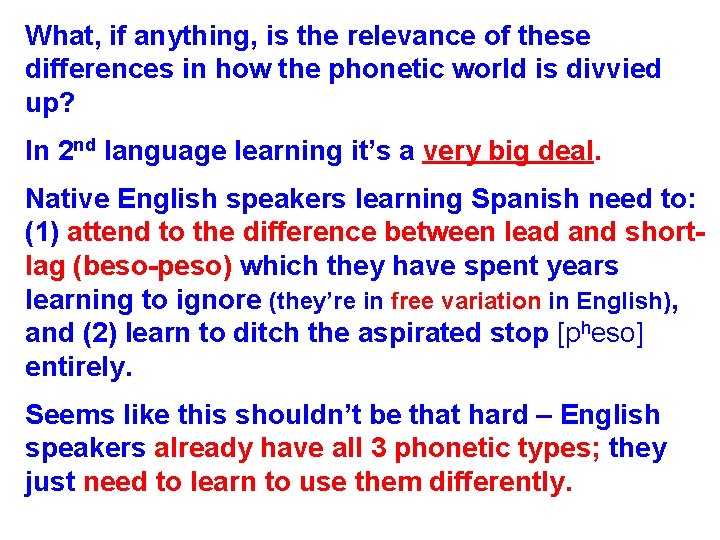
What, if anything, is the relevance of these differences in how the phonetic world is divvied up? In 2 nd language learning it’s a very big deal. Native English speakers learning Spanish need to: (1) attend to the difference between lead and shortlag (beso-peso) which they have spent years learning to ignore (they’re in free variation in English), and (2) learn to ditch the aspirated stop [pheso] entirely. Seems like this shouldn’t be that hard – English speakers already have all 3 phonetic types; they just need to learn to use them differently.
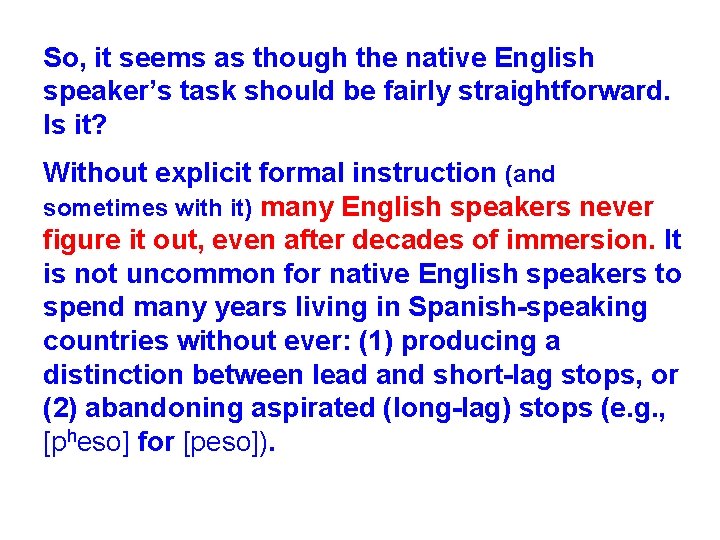
So, it seems as though the native English speaker’s task should be fairly straightforward. Is it? Without explicit formal instruction (and sometimes with it) many English speakers never figure it out, even after decades of immersion. It is not uncommon for native English speakers to spend many years living in Spanish-speaking countries without ever: (1) producing a distinction between lead and short-lag stops, or (2) abandoning aspirated (long-lag) stops (e. g. , [pheso] for [peso]).
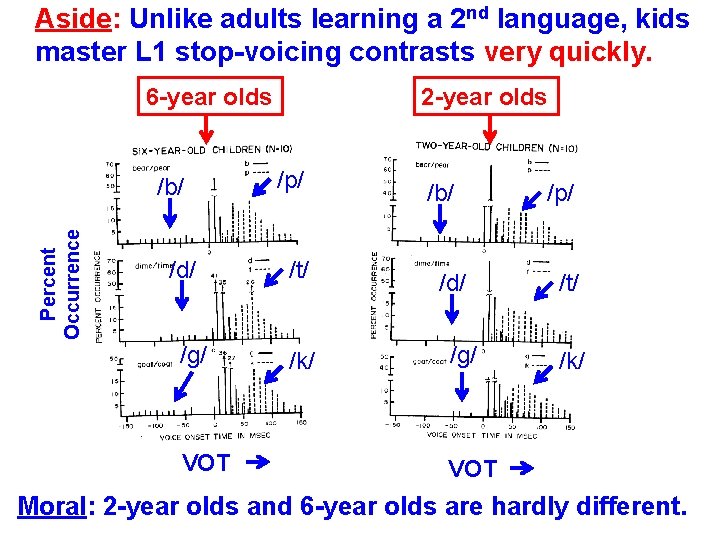
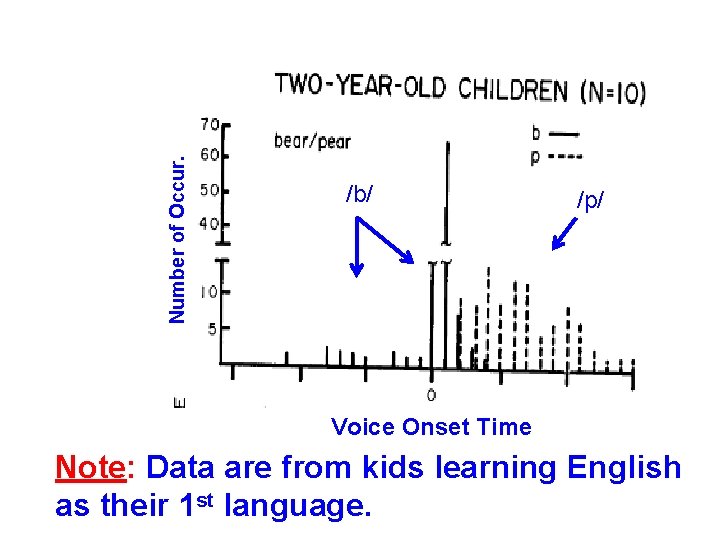
Aside: Unlike adults learning a 2 nd language, kids master L 1 stop-voicing contrasts very quickly. 6 -year olds Percent Occurrence /b/ /d/ /g/ VOT 2 -year olds /p/ /t/ /k/ /b/ /d/ /g/ /p/ /t/ /k/ VOT Moral: 2 -year olds and 6 -year olds are hardly different.
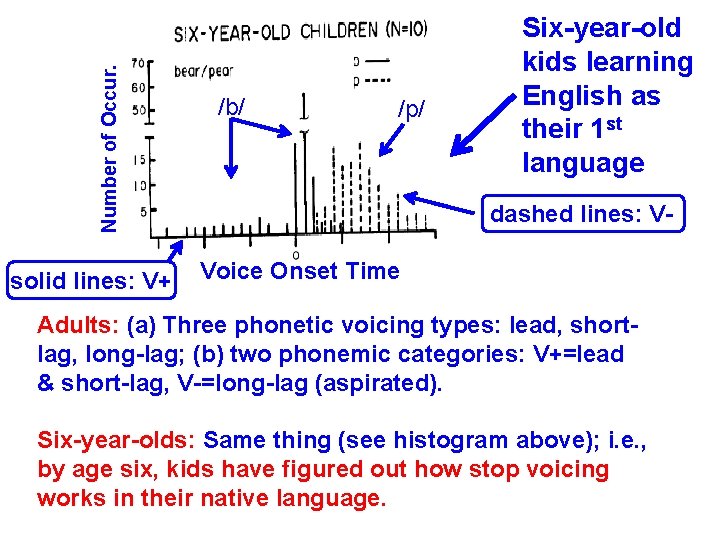
Number of Occur. solid lines: V+ /b/ /p/ Six-year-old kids learning English as their 1 st language dashed lines: V- Voice Onset Time Adults: (a) Three phonetic voicing types: lead, shortlag, long-lag; (b) two phonemic categories: V+=lead & short-lag, V-=long-lag (aspirated). Six-year-olds: Same thing (see histogram above); i. e. , by age six, kids have figured out how stop voicing works in their native language.
Number of Occur. /b/ /p/ Voice Onset Time Note: Data are from kids learning English as their 1 st language.
What problem does the Spanish speaker face in learning English? (1) Learn to ignore the now irrelevant lead/short -lag difference (once again, these are allophonic variants in English, not distinct phonemes as they are in Spanish). (2) Develop the brand-new long-lag sound type. How easy are these things? Not. Many Spanish speakers (and Dutch and French and Arabic and …) spend very long periods of time immersed in English-speaking environments without ever abandoning their Spanish voicing system: V+ = lead, V- = shortlag, no aspirated stops.
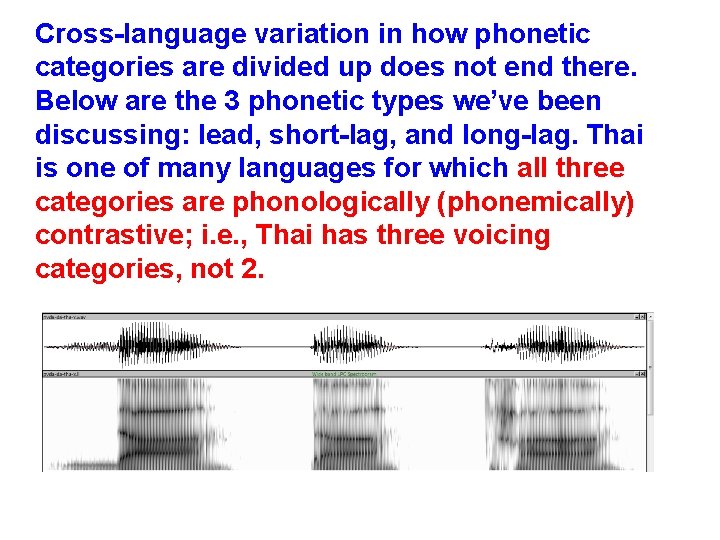
Cross-language variation in how phonetic categories are divided up does not end there. Below are the 3 phonetic types we’ve been discussing: lead, short-lag, and long-lag. Thai is one of many languages for which all three categories are phonologically (phonemically) contrastive; i. e. , Thai has three voicing categories, not 2.
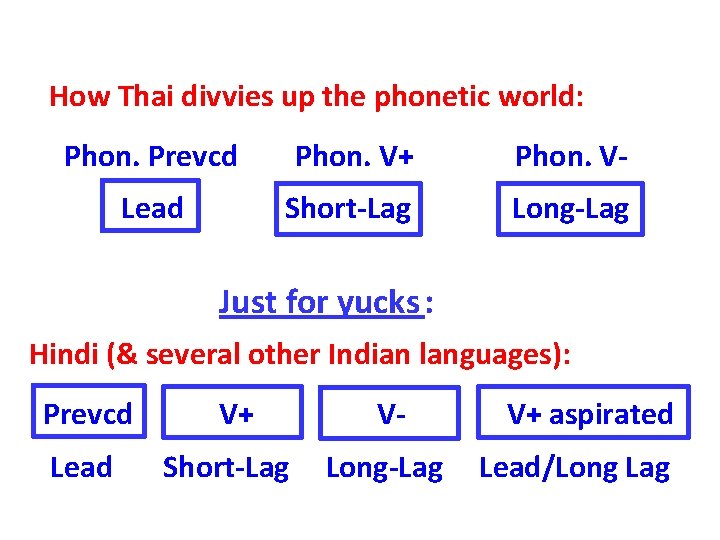
How Thai divvies up the phonetic world: Phon. Prevcd Phon. V+ Phon. V Lead Short-Lag Long-Lag Just for yucks : Hindi (& several other Indian languages): Prevcd V+ V- V+ aspirated Lead Short-Lag Long-Lag Lead/Long Lag
Why am I bothering to tell you all this? This VOT stuff is just one example (part of one e. g. – initial stops only) of the kind of problem faced by: 1. Children learning their native language – they have to learn how to divide up the phonetic world; i. e. , figure out what phonetic types are grouped together and which ones are contrastive (phonemically/phonologically distinctive). 2. Adults learning a 2 nd language: it’s the same problem – what distinctions matter linguistically (phonemically/phonologically) and which ones are allophonic.
Kids solve these problems (with their native tongue and with a new language) gracefully and with astonishing speed. Adults usually don’t fare so well. Why? As a general thing, the more you know about something the easier it is to learn new things in that same area; e. g. , learning algebra makes it easier (not harder) to learn trigonometry and calculus. Speech & language don’t work this way – hard-won knowledge about L 1 gets in the way of learning L 2. Once a native English speaker learns to ignore the difference between lead and short-lag stops, it’s extremely difficult to unlearn it. (This is not unique to language. )
VERY IMPORTANT: I pick the initial stop voicing example because there’s a single cue (VOT) that allows you to see what’s going on. But examples are everywhere. One more quick one: English has lots of vowels (~15), partly because English distinguishes tense and lax vowels (/i-ɪ/, /e-ɛ/, /u-ʊ/. Spanish (and other Romance languages – Italian, Portuguese, French, …) has many fewer vowels (~5 -7 usually).
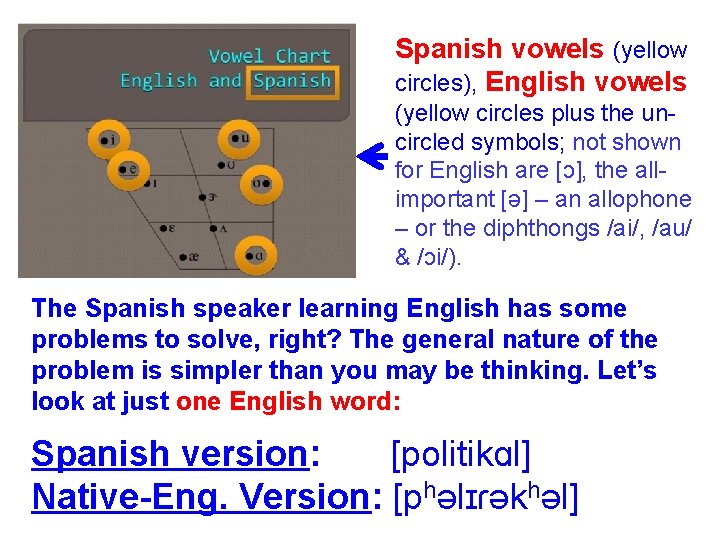
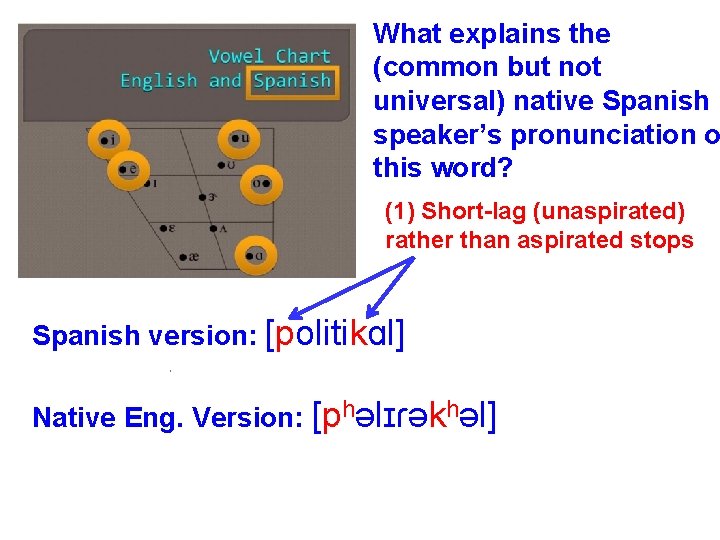
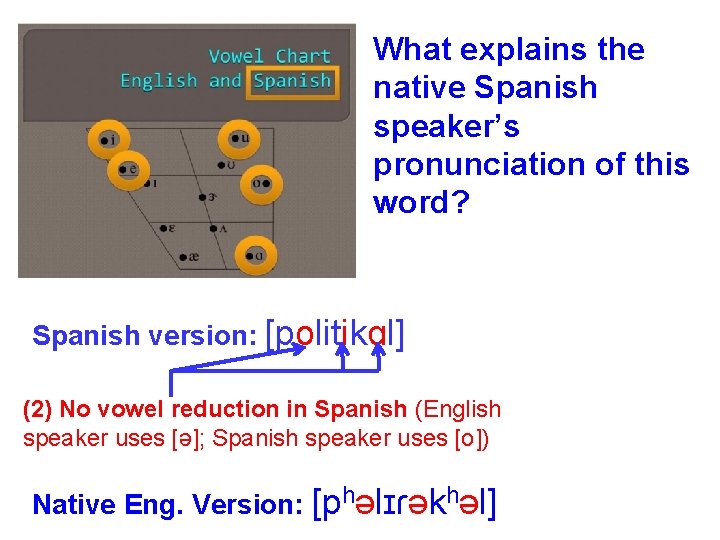
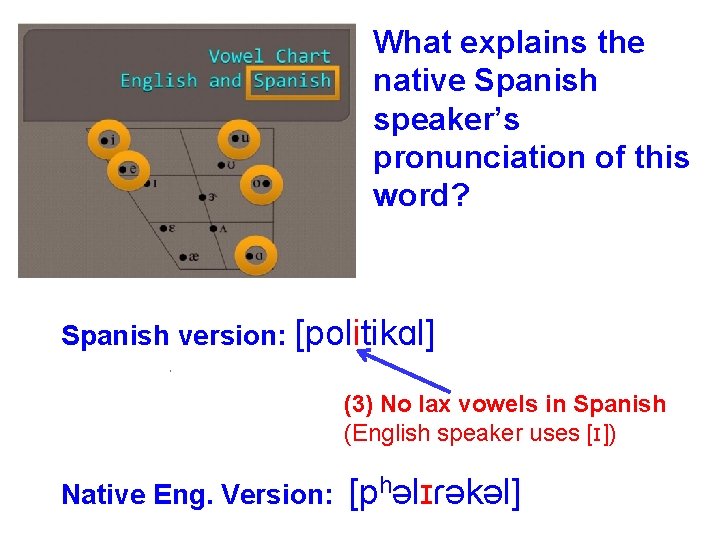
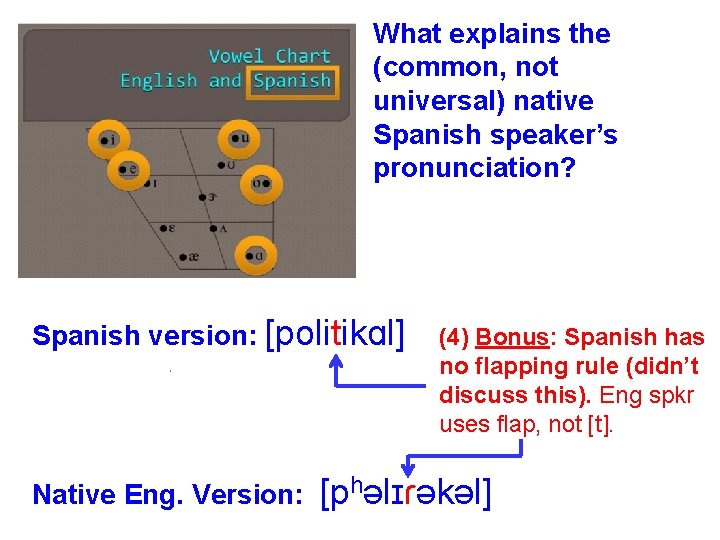
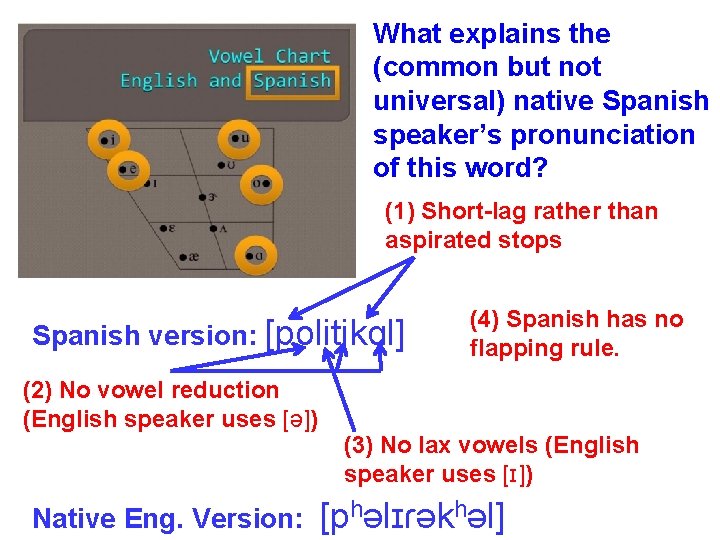
Spanish vowels (yellow circles), English vowels (yellow circles plus the uncircled symbols; not shown for English are [ɔ], the allimportant [ə] – an allophone – or the diphthongs /ai/, /au/ & /ɔi/). The Spanish speaker learning English has some problems to solve, right? The general nature of the problem is simpler than you may be thinking. Let’s look at just one English word: Spanish version: [politikɑl] Native-Eng. Version: [phəlɪɾəkhəl]
What explains the (common but not universal) native Spanish speaker’s pronunciation o this word? (1) Short-lag (unaspirated) rather than aspirated stops Spanish version: [politikɑl] Native Eng. Version: [phəlɪɾəkhəl]
What explains the native Spanish speaker’s pronunciation of this word? Spanish version: [politikɑl] (2) No vowel reduction in Spanish (English speaker uses [ə]; Spanish speaker uses [o]) Native Eng. Version: [phəlɪɾəkhəl]
What explains the native Spanish speaker’s pronunciation of this word? Spanish version: [politikɑl] (3) No lax vowels in Spanish (English speaker uses [ɪ]) Native Eng. Version: [phəlɪɾəkəl]
What explains the (common, not universal) native Spanish speaker’s pronunciation? Spanish version: [politikɑl] (4) Bonus: Spanish has no flapping rule (didn’t discuss this). Eng spkr uses flap, not [t]. Native Eng. Version: [phəlɪɾəkəl]
What explains the (common but not universal) native Spanish speaker’s pronunciation of this word? (1) Short-lag rather than aspirated stops Spanish version: [politikɑl] (2) No vowel reduction (English speaker uses [ə]) (4) Spanish has no flapping rule. (3) No lax vowels (English speaker uses [ɪ]) Native Eng. Version: [phəlɪɾəkhəl]
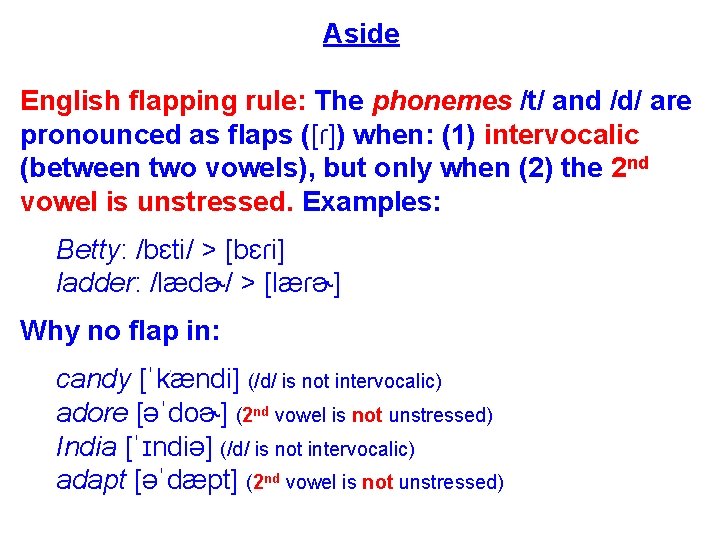
Aside English flapping rule: The phonemes /t/ and /d/ are pronounced as flaps ([ɾ]) when: (1) intervocalic (between two vowels), but only when (2) the 2 nd vowel is unstressed. Examples: Betty: /bɛti/ > [bɛɾi] ladder: /lædɚ/ > [læɾɚ] Why no flap in: candy [ˈkændi] (/d/ is not intervocalic) adore [əˈdoɚ] (2 nd vowel is not unstressed) India [ˈɪndiə] (/d/ is not intervocalic) adapt [əˈdæpt] (2 nd vowel is not unstressed)
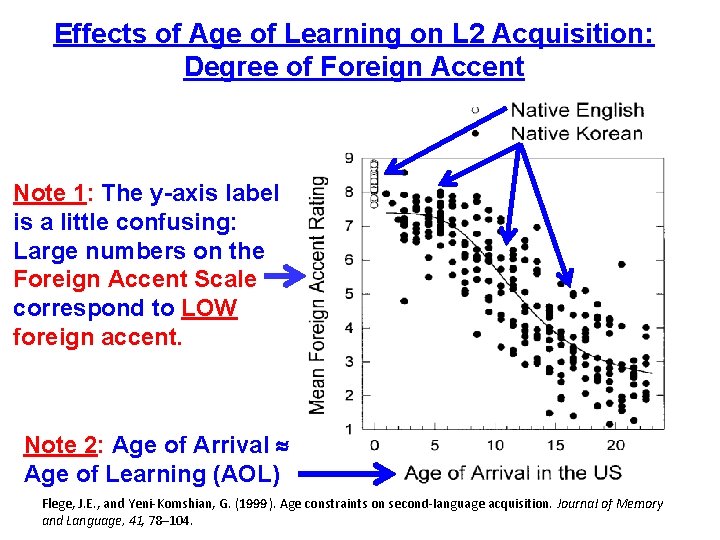
Effects of Age of Learning on L 2 Acquisition: Degree of Foreign Accent Note 1: The y-axis label is a little confusing: Large numbers on the Foreign Accent Scale correspond to LOW foreign accent. Note 2: Age of Arrival » Age of Learning (AOL) Flege, J. E. , and Yeni-Komshian, G. (1999). Age constraints on second-language acquisition. Journal of Memory and Language, 41, 78– 104.
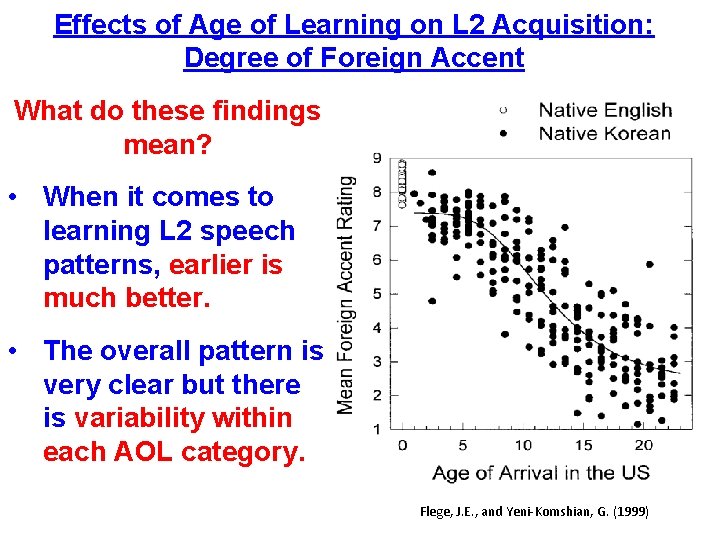
Effects of Age of Learning on L 2 Acquisition: Degree of Foreign Accent What do these findings mean? • When it comes to learning L 2 speech patterns, earlier is much better. • The overall pattern is very clear but there is variability within each AOL category. Flege, J. E. , and Yeni-Komshian, G. (1999)
The Critical Period: Duck Imprinting https: //www. youtube. com/watch? v=Mxxr. DEbtuag
In all of these examples, the same thing is going on: The speaker’s knowledge of their native language is interfering with their ability to learn the new language – it’s called inter-language interference. Do adults learning a 2 nd language end up solving these problems? There is no single answer to this, but: age of learning plays a HUGE role (though it is not the only factor that matters). The most striking thing is that many (not all) speakers never end up solving some of these clashes between L 1 and L 2.
Ok, we’ve looked at the pronunciation of just one English word as it might be pronounced by a native speaker of just one language – Spanish. Further, except for the flap, we examined just two features – initial stop voicing and vowel quality. How much have we learned from this one example? Answer: Plenty. With more time we could have looked at many other examples, but the nature of most of these problems looks the same.
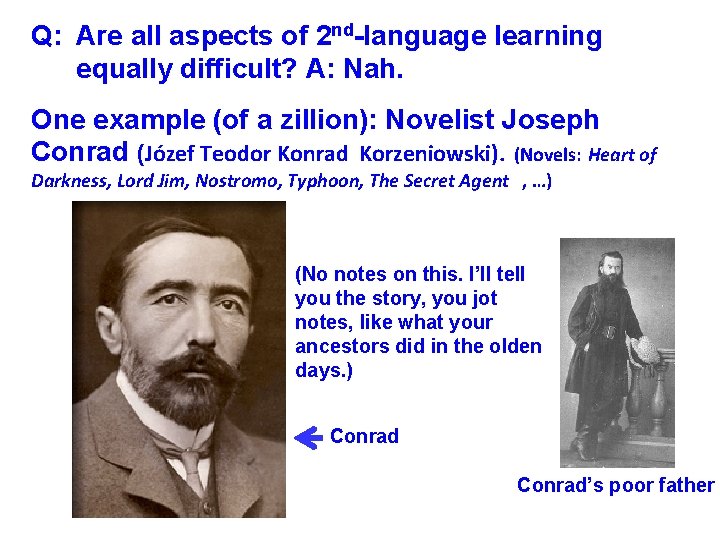
Q: Are all aspects of 2 nd-language learning equally difficult? A: Nah. One example (of a zillion): Novelist Joseph Conrad (Józef Teodor Konrad Korzeniowski). (Novels: Heart of Darkness, Lord Jim, Nostromo, Typhoon, The Secret Agent , …) (No notes on this. I’ll tell you the story, you jot notes, like what your ancestors did in the olden days. ) Conrad’s poor father
Sample of Conrad’s writing: She stood looking at us without a stir, and like the wilderness itself, with an air of brooding over an inscrutable purpose. A whole minute passed, and then she made a step forward. There was a low jingle, a glint of yellow metal, a sway of fringed draperies, and she stopped as if her heart had failed her. -Joseph Conrad, Heart of Darkness Note the syntax and word choice: (a) Is there anything awkward or clumsy about either? (b) Is there anything simple about either? (c) How does this compare with what I’ve told you about Conrad’s mastery (or non- mastery) of the sound pattern of English?
The lesson of this is that the sound pattern often causes special problems for a 2 nd language learner. This does not mean that aspects of language such as syntax and word choice cause no difficulties for 2 nd language learners. Examples: My father was best hairy in family. [‘best hairy’ = least bald] Bag garbage no good, ski good. [Skiing is more fun that sliding down a hill on a plastic garbage bag. ]
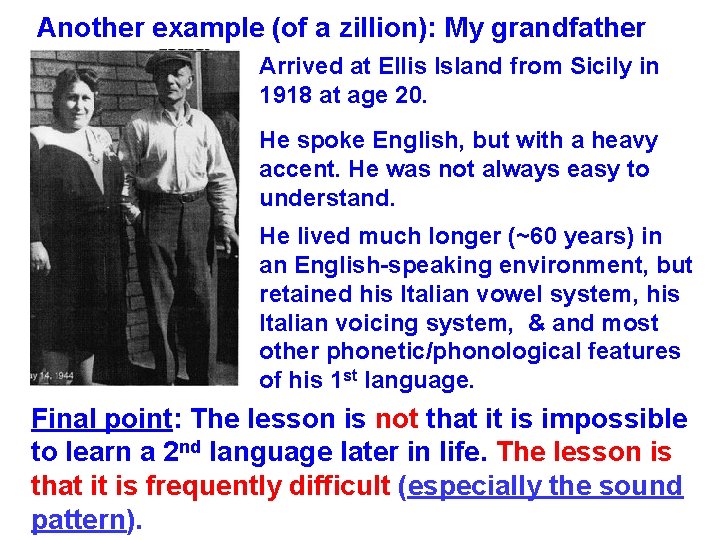
Another example (of a zillion): My grandfather Arrived at Ellis Island from Sicily in 1918 at age 20. He spoke English, but with a heavy accent. He was not always easy to understand. He lived much longer (~60 years) in an English-speaking environment, but retained his Italian vowel system, his Italian voicing system, & and most other phonetic/phonological features of his 1 st language. Final point: The lesson is not that it is impossible to learn a 2 nd language later in life. The lesson is that it is frequently difficult (especially the sound pattern).
One more very last final point: The effects of age of learning are well known and have been for many years: On average, the older you are the harder it is to learn a new language. In the U. S. , at what age do we typically start teaching 2 nd languages? Early childhood? Late childhood? Adolescence? Does this make any sense at all? ?