
CONSONANT SEQUENCES INTRODUCTION We have learned how single


- Slides: 15
CONSONANT SEQUENCES
INTRODUCTION We have learned how single consonants are made, and sometimes how a sequence of two consonants should be said (e. g. /pr, kr, tr/) but there are many other cases where two or three or four or even more consonants follow one after the other. Some examples are: scheme /ski: m/, cream /kri: m/, necks /neks/, next /nekst/, and text /teksts/.
INTRODUCTION Some languages have many consonant sequences, and speakers of these languages will not have any difficulty in pronouncing most of the English ones. But other languages do not have sequences of consonants at all may have difficulty in stringin toghether two, three or four consonants with no vowel between them.
INITIAL SEQUENCES At the beginning of English words there may be either two or three consonants in sequence. Sequences of two consonants initially: 1. /s/ followed by one of /p, t, k, f, m, n, l, w, j/, e. g. in spy, stay, sky, sphere, small, snow, sleep, swear, suit. 2. One of /p, t, k, b, d, g, f, θ, ʃ, v, m, n, h/ followed by one of /l, r, w, j/. Not all of these sequences are found (/pw, dl/ do not occcur).
INITIAL SEQUENCES SINGLE SOUND FOLLOWED BY EXAMPLES /p/ /j, r/ Play, pray, pure /t/ /r, w, j/ Try, twice, tune /k/ /r, w, j/ Climb, cry, quiet, cure /b/ /l, r, j/ Blow, bread, beauty /d/ /r, w, j/ Dress, dwell, duty /Θ/ /r, w/ Throw, thwart /ʃ/ /r/ Shriek /v/ /j/ View /m/ /j/ Music /n/ /j/ New /h/ /j/ huge
INITIAL SEQUENCES Sequences of three consonants initially These are /spr, str, skr, spj, spl, skw/ and are a combination of the /sp/ type of sequence and the /pr/ type. The /s/ at the beginning is cut off by the following stop, and during the stop the following consonant is fully prepared. Try the following examples very slowly at first; cut off the /s/ by the tongue or lips and, whilst holding this stop, get the third consonant ready, then release the stop straight into the third consonant: spread /spred/, straight /streɪt/, screw /skru: /, spurious /spjƱərɪəs/, stupid /stju: pɪd/, skewer /skjƱə/, splendid /splendɪd/, square /skweə/.
PRACTICE Find other examples for each combination: SINGLE SOUND FOLLOWED BY /p/ /j, r/ /t/ /r, w, j/ /k/ /r, w, j/ /b/ /l, r, j/ /d/ /r, w, j/ /Θ/ /r, w/ /ʃ/ /r/ /v/ /j/ /m/ /j/ /n/ /j/ /h/ /j/ EXAMPLES
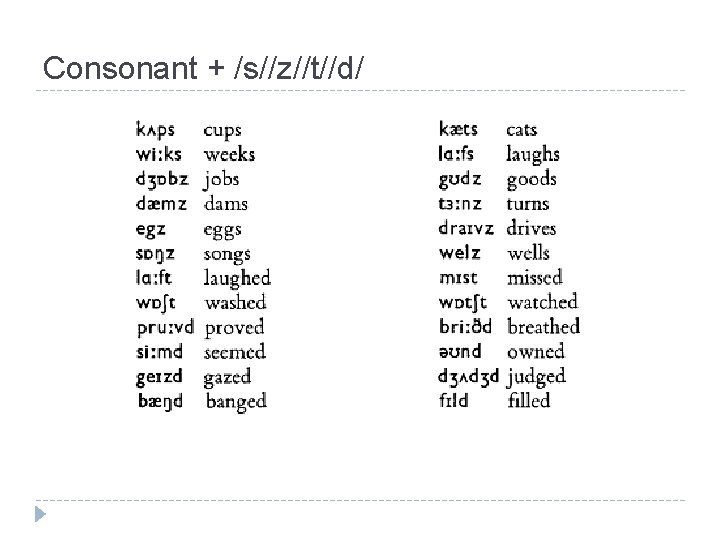
FINAL CONSONANTS � Sequences of consonants at the ends of words are more varied than at the beginning mainly because /s/ or /z/ have to be added to most nouns to give their plural forms, as in cats /kæts/, dogs /dogz/, and /t/ or /d/ have to be added to most verbs to form their past tense, as in wished /wɪʃt/, raised /reɪzd/.
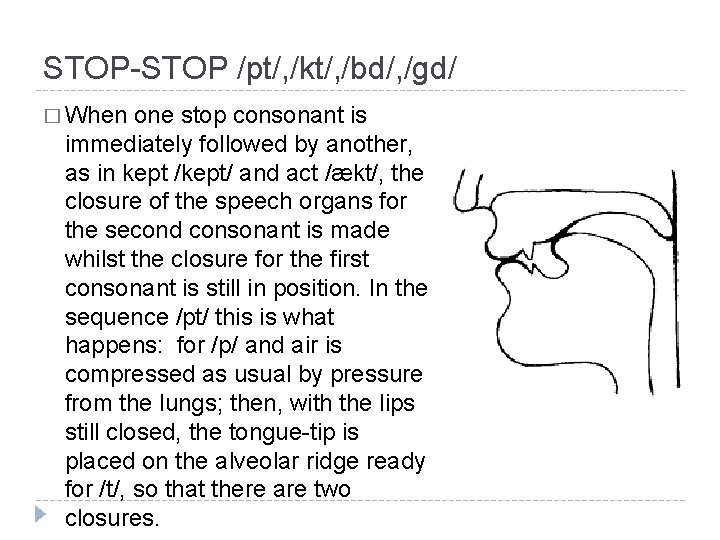
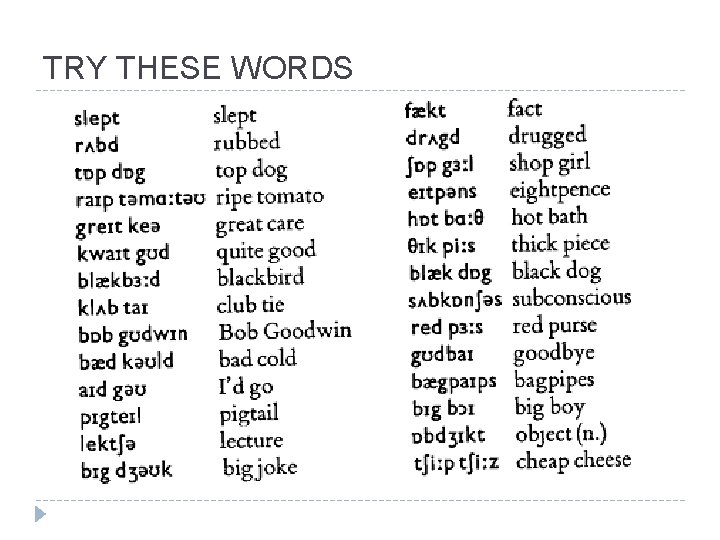
STOP-STOP /pt/, /kt/, /bd/, /gd/ � When one stop consonant is immediately followed by another, as in kept /kept/ and act /ækt/, the closure of the speech organs for the second consonant is made whilst the closure for the first consonant is still in position. In the sequence /pt/ this is what happens: for /p/ and air is compressed as usual by pressure from the lungs; then, with the lips still closed, the tongue-tip is placed on the alveolar ridge ready for /t/, so that there are two closures.
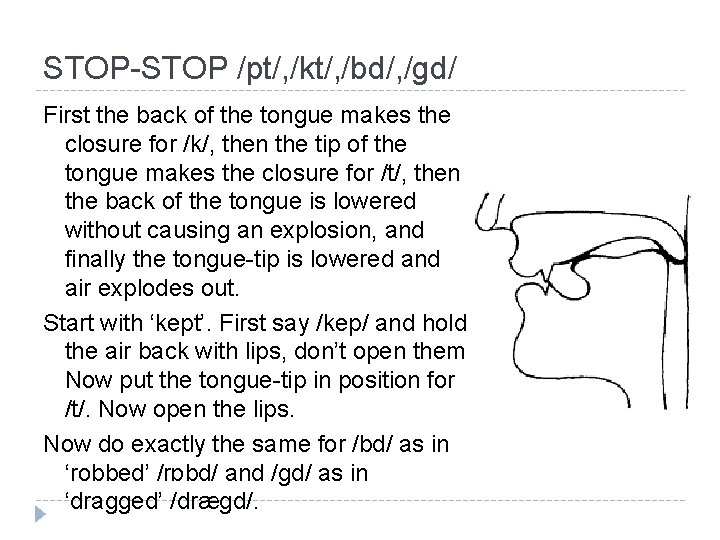
STOP-STOP /pt/, /kt/, /bd/, /gd/ First the back of the tongue makes the closure for /k/, then the tip of the tongue makes the closure for /t/, then the back of the tongue is lowered without causing an explosion, and finally the tongue-tip is lowered and air explodes out. Start with ‘kept’. First say /kep/ and hold the air back with lips, don’t open them. Now put the tongue-tip in position for /t/. Now open the lips. Now do exactly the same for /bd/ as in ‘robbed’ /rɒbd/ and /gd/ as in ‘dragged’ /drægd/.
TRY THESE WORDS
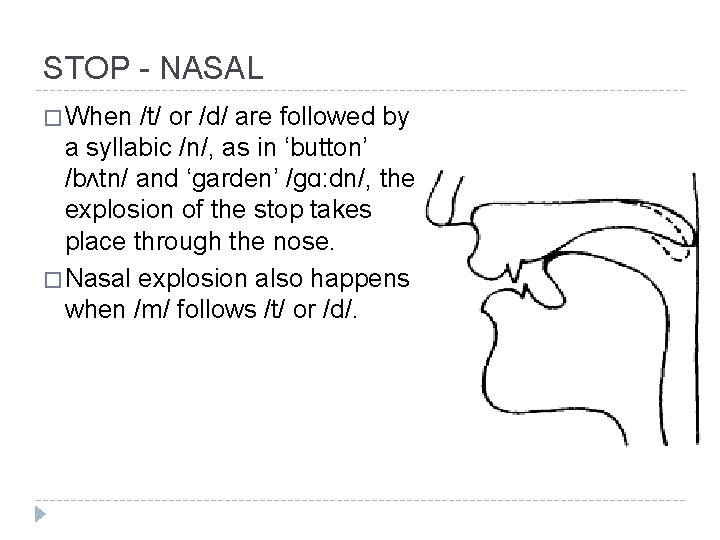
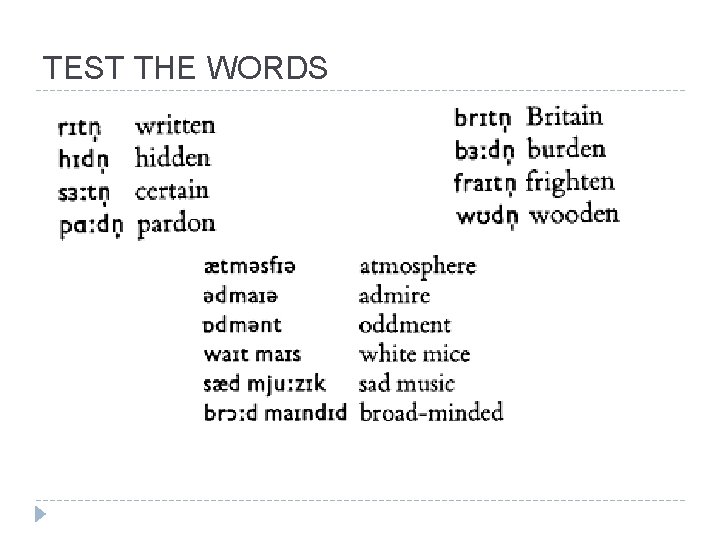
STOP - NASAL � When /t/ or /d/ are followed by a syllabic /n/, as in ‘button’ /bʌtn/ and ‘garden’ /gɑ: dn/, the explosion of the stop takes place through the nose. � Nasal explosion also happens when /m/ follows /t/ or /d/.
TEST THE WORDS
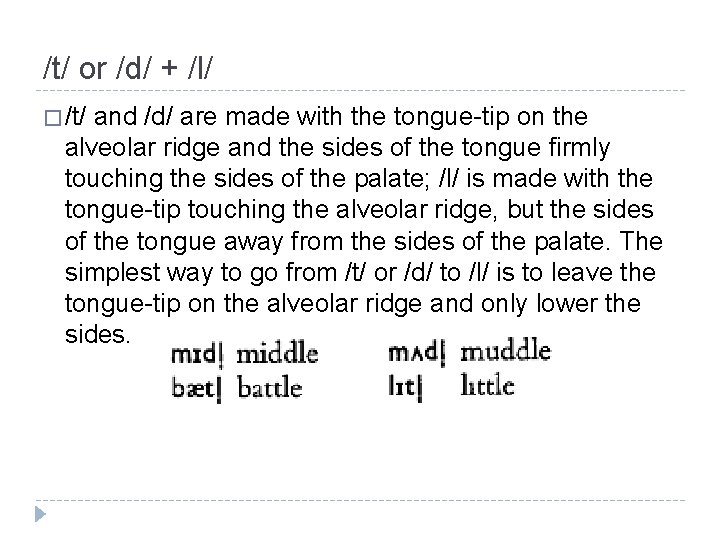
/t/ or /d/ + /l/ � /t/ and /d/ are made with the tongue-tip on the alveolar ridge and the sides of the tongue firmly touching the sides of the palate; /l/ is made with the tongue-tip touching the alveolar ridge, but the sides of the tongue away from the sides of the palate. The simplest way to go from /t/ or /d/ to /l/ is to leave the tongue-tip on the alveolar ridge and only lower the sides.
Consonant + /s//z//t//d/