
CHAPTER SEVEN ASSESSING AND TEACHING READING PHONOLOGICAL AWARENESS

- Slides: 27
CHAPTER SEVEN ASSESSING AND TEACHING READING: PHONOLOGICAL AWARENESS, PHONICS, AND WORD RECOGNITION Strategies for Teaching Students with Learning and Behavior Problems, 8 e Vaughn and Bos ISBN: 0137034695 © 2012, 2009, 2006 Pearson Education, Inc. All rights reserved.
Chapter Overview As you read the next four chapters, think about how reading and writing are reciprocal processes and how they can be taught in such a way that each complements and supports the other. Strategies for Teaching Students with Learning and Behavior Problems, 8 e, Vaughn and Bos ISBN # 0137034695 7 -2 © 2012, 2009, 2006 Pearson Education, Inc.
Two Overarching Concepts that Guide Reading Instruction n n Reading is a skilled and strategic process in which learning to decode and read words accurately and rapidly is essential. Reading entails understanding the text and depends on active engagement and interpretation by the reader. Strategies for Teaching Students with Learning and Behavior Problems, 8 e, Vaughn and Bos ISBN # 0137034695 7 -3 © 2012, 2009, 2006 Pearson Education, Inc.
Definitions n Phonological awareness: Knowing and demonstrating that spoken can be broken down into smaller units (words, syllables, phonemes), which can be manipulated within the alphabetic system or orthography. Strategies for Teaching Students with Learning and Behavior Problems, 8 e, Vaughn and Bos ISBN # 0137034695 7 -4 © 2012, 2009, 2006 Pearson Education, Inc.
Definitions n Phonemic awareness: The ability to recognize the smallest sound units of spoken language and how these units of sound, or phonemes, can be separated (pulled apart or segmented), blended (put back together), and manipulated (added, deleted, and substituted). Strategies for Teaching Students with Learning and Behavior Problems, 8 e, Vaughn and Bos ISBN # 0137034695 7 -5 © 2012, 2009, 2006 Pearson Education, Inc.
Definitions n Phoneme: The smallest sound in spoken language that makes a difference in words. For instructional purposes related to reading, a phoneme is a single sound that maps to print – sometimes to one letter and sometime to more than one letter. Strategies for Teaching Students with Learning and Behavior Problems, 8 e, Vaughn and Bos ISBN # 0137034695 7 -6 © 2012, 2009, 2006 Pearson Education, Inc.
Definitions n Phonics: The way in which sounds of our language (not the letters) map to print. It is knowing how letter names and sounds relate to each other (i. e. , letter-sound correspondence). Strategies for Teaching Students with Learning and Behavior Problems, 8 e, Vaughn and Bos ISBN # 0137034695 7 -7 © 2012, 2009, 2006 Pearson Education, Inc.
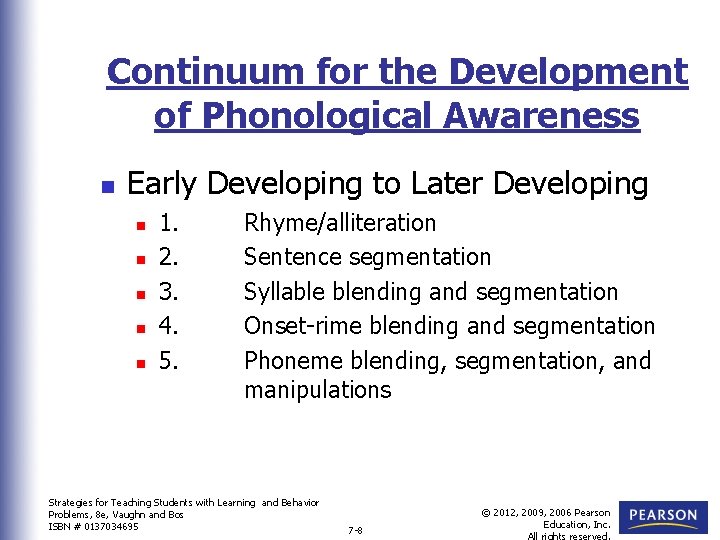
Continuum for the Development of Phonological Awareness n Early Developing to Later Developing n n n 1. 2. 3. 4. 5. Rhyme/alliteration Sentence segmentation Syllable blending and segmentation Onset-rime blending and segmentation Phoneme blending, segmentation, and manipulations Strategies for Teaching Students with Learning and Behavior Problems, 8 e, Vaughn and Bos ISBN # 0137034695 7 -8 © 2012, 2009, 2006 Pearson Education, Inc.
Teaching Phonological Awareness and Phonics n The majority of students at risk for reading difficulties have poor phonological awareness and can profit from explicit instruction in blending, segmenting, and manipulating sounds and mapping these sounds to letters as quickly as possible. Strategies for Teaching Students with Learning and Behavior Problems, 8 e, Vaughn and Bos ISBN # 0137034695 7 -9 © 2012, 2009, 2006 Pearson Education, Inc.
Response to Intervention and Progress Monitoring n Successfully preventing reading difficulties and appropriately serving students with reading disabilities requires an understanding of how response to intervention (RTI) and progress monitoring can be coordinated in the early grades to address phonological awareness and phonics. Strategies for Teaching Students with Learning and Behavior Problems, 8 e, Vaughn and Bos ISBN # 0137034695 7 -10 © 2012, 2009, 2006 Pearson Education, Inc.
How Do We Know if Students are Responding to Instruction in Phonemic Awareness and Phonics? n n n Have students received scientifically based reading instruction in phonemic awareness and phonics from their classroom teacher? Have students received adequate opportunities to respond, obtain feedback, and see modeling to scaffold their learning? How does the performance of students with low response compare to the performance of other students in the class? Have students with low phonemic awareness received instructional opportunities in small groups to acquire phonemic awareness and phonics? Is progress monitoring data available to show the scope of the student’s progress? Strategies for Teaching Students with Learning and Behavior Problems, 8 e, Vaughn and Bos ISBN # 0137034695 7 -11 © 2012, 2009, 2006 Pearson Education, Inc.
How Do We Know When Students are Responding Adequately to Instruction in Phonics and Word Study? n If students are receiving scientifically based reading instruction in phonics and word study, we can determine whether they are low- or high-responders based on two essential criteria: n How do they respond relative to others in their class and others in the same grade in other classes in the school, and n What is the slope of their progress based on progress monitoring measures acquired at least every two weeks? Strategies for Teaching Students with Learning and Behavior Problems, 8 e, Vaughn and Bos ISBN # 0137034695 7 -12 © 2012, 2009, 2006 Pearson Education, Inc.
Progress Monitoring n n Determining students’ performance in each of the building blocks of reading (e. g. , phonemic awareness, phonics, word reading) is an essential first step in designing an effective intervention program. Assessments n n Diagnostic assessments Norm-based assessments Progress monitoring assessment Curriculum-based measures Strategies for Teaching Students with Learning and Behavior Problems, 8 e, Vaughn and Bos ISBN # 0137034695 7 -13 © 2012, 2009, 2006 Pearson Education, Inc.
Teaching Letter-Sound Correspondences n n Expert estimates of the number of speech sounds or phonemes in English vary from 40 to 52. For purposes of teaching students, most estimates are about 44. (Fromkin and Rodman, 1998; Owens, 2010) n In learning to read and write, students learn more than 100 spellings (graphemes) for these phonemes. Strategies for Teaching Students with Learning and Behavior Problems, 8 e, Vaughn and Bos ISBN # 0137034695 7 -14 © 2012, 2009, 2006 Pearson Education, Inc.
Teaching Letter-Sound Correspondences (continued) n n The largest division of phonemes is consonants (C) or vowels (V). The English language also makes use of consonant digraphs and consonant blends. n Consonant digraph – two consonants that represent one sound (ph for /f/) n Consonant blend – combines the sounds of two or more consonants so that they are clustered together. Strategies for Teaching Students with Learning and Behavior Problems, 8 e, Vaughn and Bos ISBN # 0137034695 7 -15 © 2012, 2009, 2006 Pearson Education, Inc.
Guidelines for Teaching Letter. Sound Correspondences n n n Students use letter-sound correspondences to decode words. Struggling readers benefit from learning to blend and segment sounds so that they can decode and spell words. A number of programs have been developed using systematic approaches to introduce the letter-sound relationships and how to blend sounds to read words. Strategies for Teaching Students with Learning and Behavior Problems, 8 e, Vaughn and Bos ISBN # 0137034695 7 -16 © 2012, 2009, 2006 Pearson Education, Inc.
Family Participation in Beginning Reading n Parents/guardians are very interested in having information that will allow them to provide the best support possible to their children as they acquire the important early skills related to reading. Consider demonstrating some of the activities that family members can do at home and encouraging them to engage children in fun and meaningful activities that are associated with improved outcomes in reading. Strategies for Teaching Students with Learning and Behavior Problems, 8 e, Vaughn and Bos ISBN # 0137034695 7 -17 © 2012, 2009, 2006 Pearson Education, Inc.
Decoding Strategies n Decoding strategies for identifying words: n n n n Phonic analysis Onset-rime Synthetic and analytic phonics Structural analysis Syllabication Automatic word recognition Syntax and semantics Strategies for Teaching Students with Learning and Behavior Problems, 8 e, Vaughn and Bos ISBN # 0137034695 7 -18 © 2012, 2009, 2006 Pearson Education, Inc.
Teaching Phonics, Word Recognition, and Word Study n In beginning to work with students who have limited sight words and word identification strategies, it is helpful not only to determine the students’ current strategies, but also to determine what instructional approaches have been used previously, how consistently, for how long, and with what success. Strategies for Teaching Students with Learning and Behavior Problems, 8 e, Vaughn and Bos ISBN # 0137034695 7 -19 © 2012, 2009, 2006 Pearson Education, Inc.
Teaching Phonics, Word Recognition, and Word Study n It is also helpful to use the intervention research to inform the teacher’s decision making. If the school the student is attending is using a response to intervention model, data about previous interventions may be available. Strategies for Teaching Students with Learning and Behavior Problems, 8 e, Vaughn and Bos ISBN # 0137034695 7 -20 © 2012, 2009, 2006 Pearson Education, Inc.
Teaching Phonics, Word Recognition, and Word Study n Beginning reading approaches that emphasize explicit, direct teaching of phonological awareness and word identification strategies that rely on using phonics, onset-rime, and structural analysis result in greater gains in word recognition and comprehension than approaches in which phonological awareness and phonics are more implicitly taught (National Reading Panel, 2000). Consequently, explicit code instruction approaches should be a part of a balanced reading approach for most students with special needs. Strategies for Teaching Students with Learning and Behavior Problems, 8 e, Vaughn and Bos ISBN # 0137034695 7 -21 © 2012, 2009, 2006 Pearson Education, Inc.
Explicit Code Instruction n Explicit code approaches teach phonological awareness, letter-sound correspondences, the alphabetic principle, and the use of phonic analysis, structural analysis, and syllabication to decode unknown words. Strategies for Teaching Students with Learning and Behavior Problems, 8 e, Vaughn and Bos ISBN # 0137034695 7 -22 © 2012, 2009, 2006 Pearson Education, Inc.
Explicit Code Instruction (continued) n 3 instructional features: n n n Systematic instruction of letter–sound correspondences and teaching students to blend the sounds to make words and segment sounds to spell words Scaffolded instruction so that modeling, guidance, and positive and corrective feedback are integral features of instruction Multiple opportunities for practice and review in various contexts (e. g. , games with words cards, constructing sentences, reading texts) Strategies for Teaching Students with Learning and Behavior Problems, 8 e, Vaughn and Bos ISBN # 0137034695 7 -23 © 2012, 2009, 2006 Pearson Education, Inc.
Linguistic Approach: Onset. Rime and Word Families n The linguistic approach uses controlled text and word families (onset-rimes, phonograms, or spelling patterns) such as -at, -ight, and -ent to teach word recognition. This approach is particularly useful for students with reading problems. Strategies for Teaching Students with Learning and Behavior Problems, 8 e, Vaughn and Bos ISBN # 0137034695 7 -24 © 2012, 2009, 2006 Pearson Education, Inc.
English Language Learners and Reading Difficulties n n Good readers—whether they are monolingual English or English language learners—rely primarily on decoding words (understanding the sound to print correspondence or alphabetic principle). They do not rely primarily on context or pictures to identify words. When they use context it is to confirm word reading or to better understand text meaning. Strategies for Teaching Students with Learning and Behavior Problems, 8 e, Vaughn and Bos ISBN # 0137034695 7 -25 © 2012, 2009, 2006 Pearson Education, Inc.
English Language Learners and Reading Difficulties n n Well-developed phonics instruction helps ELLs develop the skills and strategies they need to effectively and efficiently establish a map for making sense of how English language works in print. As with monolingual students, phonics instruction is a piece of the reading instruction, not the entire program. Good phonics instruction is well integrated into language activities, story time, and small group support to create a balanced reading program. Strategies for Teaching Students with Learning and Behavior Problems, 8 e, Vaughn and Bos ISBN # 0137034695 7 -26 © 2012, 2009, 2006 Pearson Education, Inc.
Multisensory Structured Language Instruction n Multisensory structured language programs combine systematic explicit teaching of phonemic awareness, the alphabetic principle, phonics and structural analysis, syllabication, and decoding with activities that incorporate the visual, auditory, tactile (touch), and kinesthetic (movement) (VAKT) modalities. Strategies for Teaching Students with Learning and Behavior Problems, 8 e, Vaughn and Bos ISBN # 0137034695 7 -27 © 2012, 2009, 2006 Pearson Education, Inc.