Stoichiometry Chapters 2 3 4 Significant Figures A


- Slides: 50
Stoichiometry Chapters 2, 3, 4
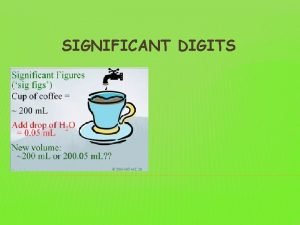
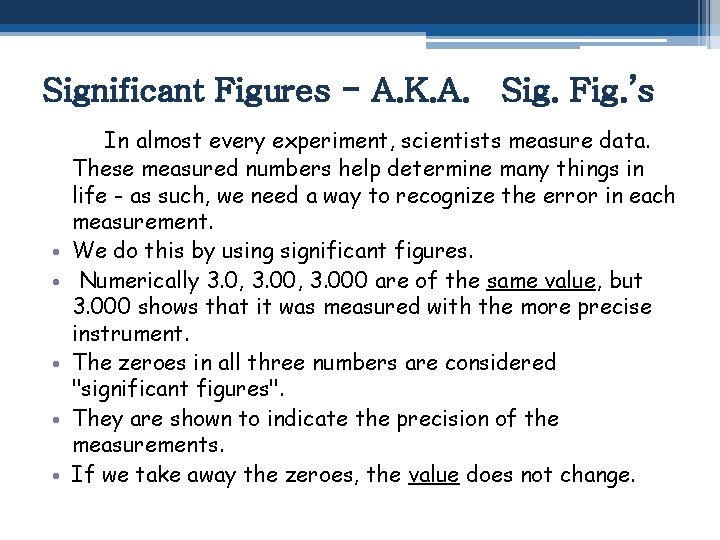
Significant Figures - A. K. A. Sig. Fig. ’s • • • In almost every experiment, scientists measure data. These measured numbers help determine many things in life - as such, we need a way to recognize the error in each measurement. We do this by using significant figures. Numerically 3. 0, 3. 000 are of the same value, but 3. 000 shows that it was measured with the more precise instrument. The zeroes in all three numbers are considered "significant figures". They are shown to indicate the precision of the measurements. If we take away the zeroes, the value does not change.
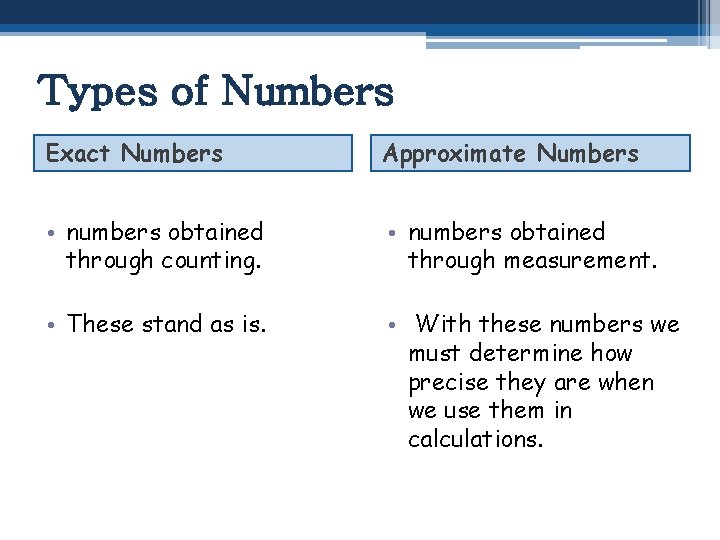
Types of Numbers Exact Numbers Approximate Numbers • numbers obtained through counting. • numbers obtained through measurement. • These stand as is. • With these numbers we must determine how precise they are when we use them in calculations.
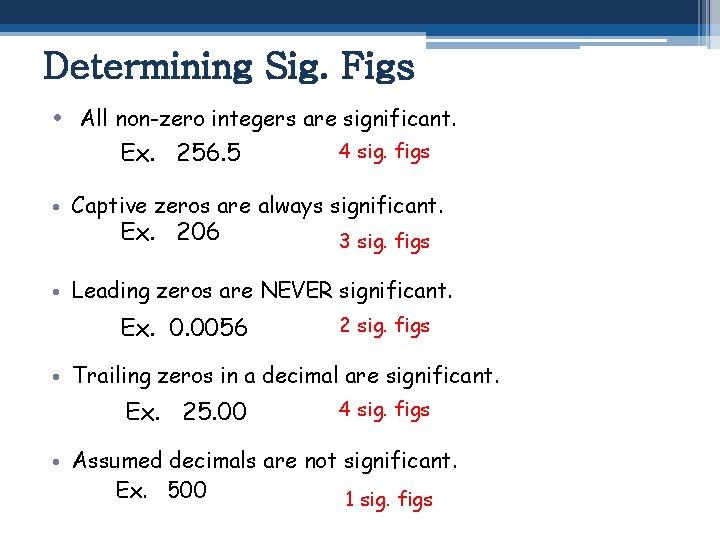
Determining Sig. Figs • All non-zero integers are significant. Ex. 256. 5 4 sig. figs • Captive zeros are always significant. Ex. 206 3 sig. figs • Leading zeros are NEVER significant. Ex. 0. 0056 2 sig. figs • Trailing zeros in a decimal are significant. Ex. 25. 00 4 sig. figs • Assumed decimals are not significant. Ex. 500 1 sig. figs
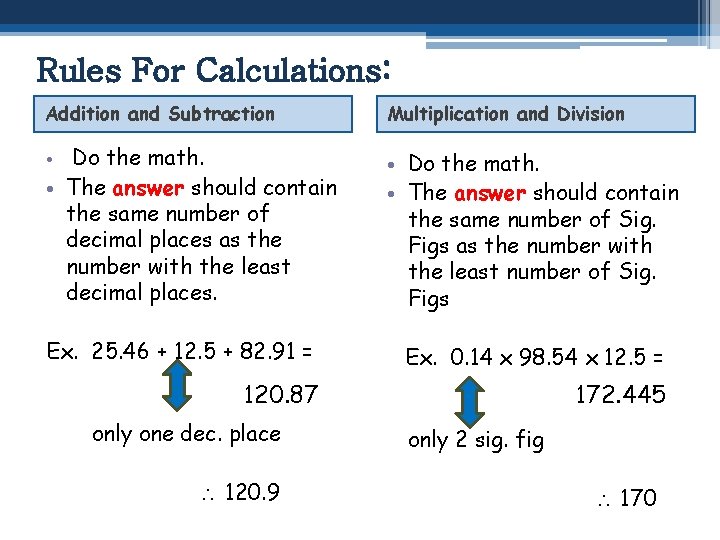
Rules For Calculations: Addition and Subtraction Multiplication and Division • Do the math. • The answer should contain the same number of Sig. Figs as the number with the least number of Sig. Figs • The answer should contain the same number of decimal places as the number with the least decimal places. Ex. 25. 46 + 12. 5 + 82. 91 = Ex. 0. 14 x 98. 54 x 12. 5 = 120. 87 172. 445 only one dec. place 120. 9 only 2 sig. fig 170
Chapter 2. 1 Isotopes and Average Atomic Mass Isotopes Recall that the mass number tells the total number of protons and neutrons. • All neutral atoms have the same number of protons and electrons, however, the number of neutrons may vary. • Isotopes - atoms of an element that have the same number of protons but different number of neutrons. �atoms of the same element do not necessarily have the same mass number.
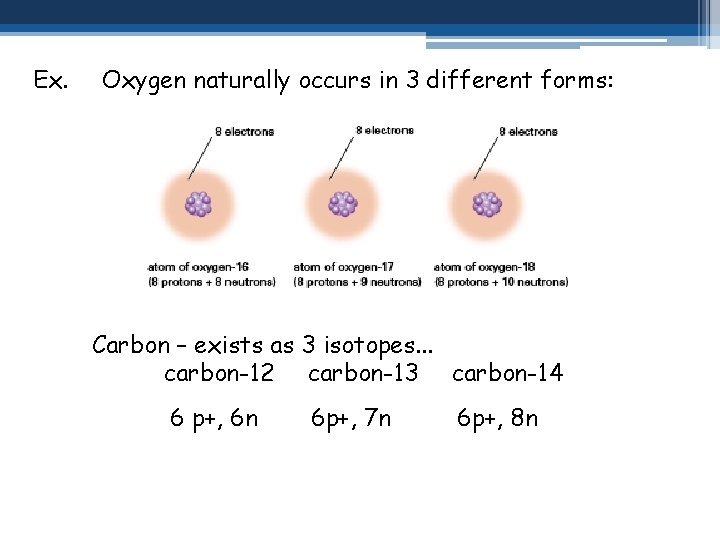
Ex. Oxygen naturally occurs in 3 different forms: Carbon – exists as 3 isotopes. . . carbon-12 carbon-13 carbon-14 6 p+, 6 n 6 p+, 7 n 6 p+, 8 n
The Relative Mass of An Atom • The mass of an atom is expressed in atomic mass units, u. • Atomic masses are relative - all are based on the mass of carbon-12, 12 u. the mass of all other elements are defined in comparison to carbon-12.
Isotopic Abundance • An element may have several naturally occurring isotopes, but not all of its isotopes will exist in the same amount. Ex. Magnesium exists in 3 isotopes – Mg-24, Mg-25, and Mg-26 • All sources of magnesium occur in the following amounts: Mg-24 79%, Mg-25 10%, Mg-26 11% • Isotopic Abundance - the relative amount in which each isotope is present in an element. • Determined with a sophisticated machine called a mass spectrometer. It uses a magnetic field to separate the different masses in a sample. Complete #1 -4 Page 45
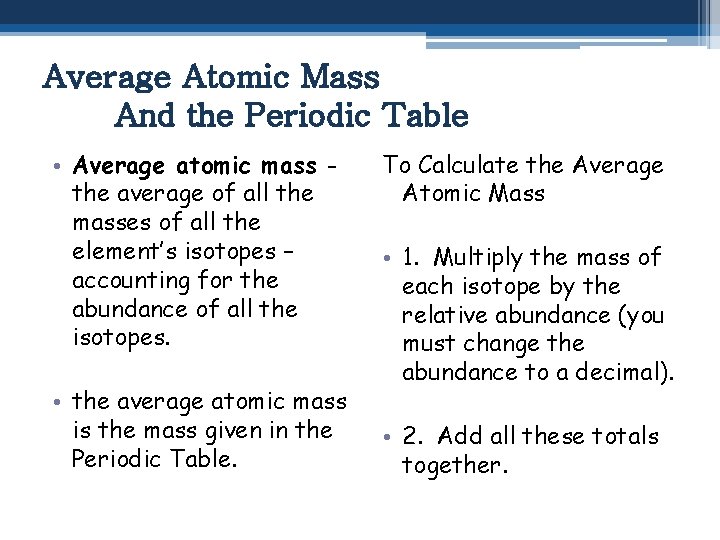
Average Atomic Mass And the Periodic Table • Average atomic mass the average of all the masses of all the element’s isotopes – accounting for the abundance of all the isotopes. • the average atomic mass is the mass given in the Periodic Table. To Calculate the Average Atomic Mass • 1. Multiply the mass of each isotope by the relative abundance (you must change the abundance to a decimal). • 2. Add all these totals together.
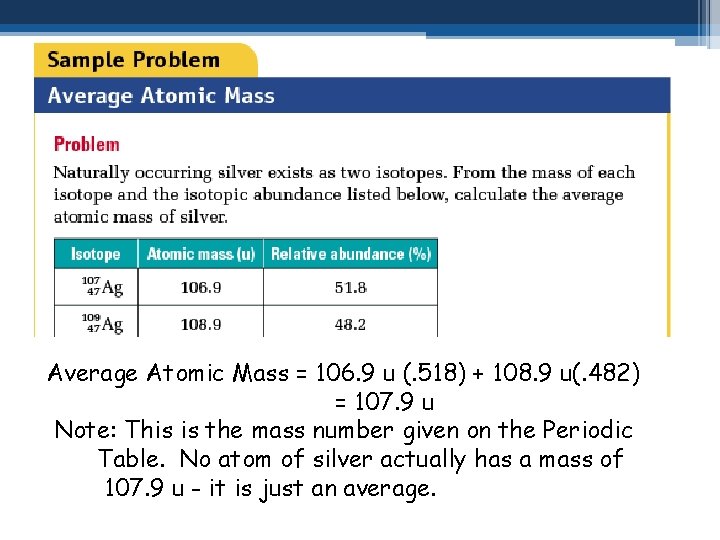
Average Atomic Mass = 106. 9 u (. 518) + 108. 9 u(. 482) = 107. 9 u Note: This is the mass number given on the Periodic Table. No atom of silver actually has a mass of 107. 9 u - it is just an average.
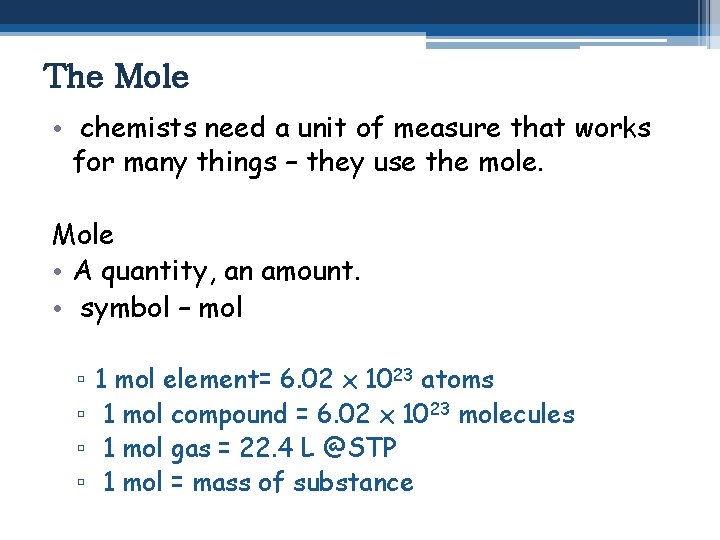
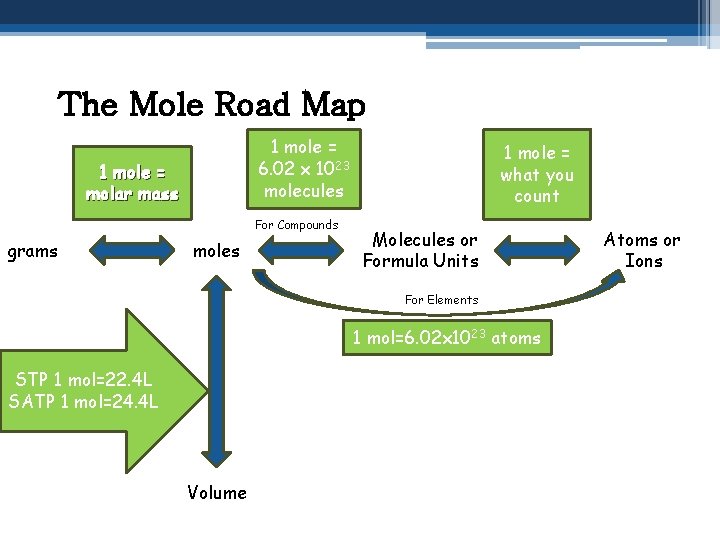
The Mole • chemists need a unit of measure that works for many things – they use the mole. Mole • A quantity, an amount. • symbol – mol ▫ ▫ 1 mol element= 6. 02 x 1023 atoms 1 mol compound = 6. 02 x 1023 molecules 1 mol gas = 22. 4 L @STP 1 mol = mass of substance
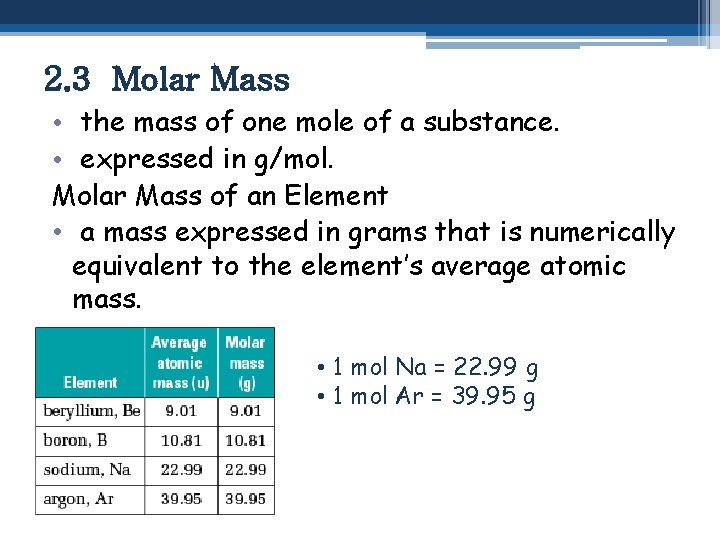
2. 3 Molar Mass • the mass of one mole of a substance. • expressed in g/mol. Molar Mass of an Element • a mass expressed in grams that is numerically equivalent to the element’s average atomic mass. • 1 mol Na = 22. 99 g • 1 mol Ar = 39. 95 g
Molar Mass Of Compounds • the mass of one mole of a compound is equal to the molar mass of all the elements it contains. • 1 mole Mg. O = mass Mg + mass of O = 24. 31 g + 16. 00 g = 40. 31 g • 1 mole Ca 3(PO 4)2 = 3(Ca) + 2(P) + 8(O) = 3(40. 08) + 2(30. 97) + 8(16. 00) = 310. 18 g • 1 mole Ca 3(PO 4)2 = 310. 18 g or molar mass of Ca 3(PO 4)2 = 310. 18 g/mol
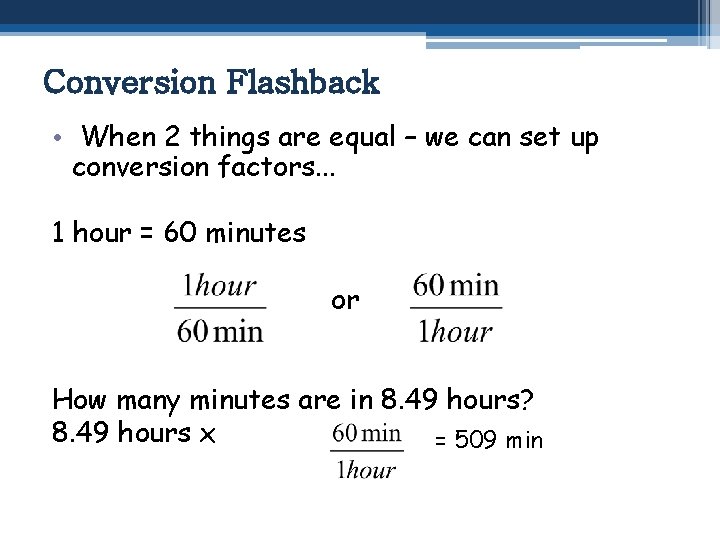
Conversion Flashback • When 2 things are equal – we can set up conversion factors. . . 1 hour = 60 minutes or How many minutes are in 8. 49 hours? 8. 49 hours x = 509 min
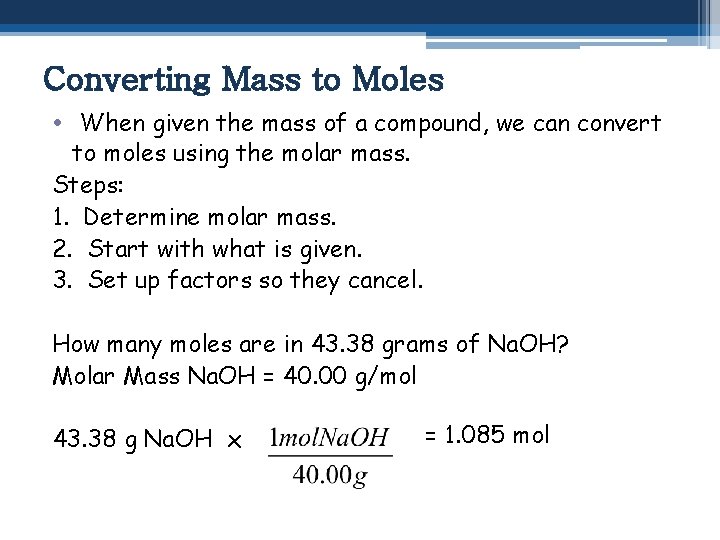
Converting Mass to Moles • When given the mass of a compound, we can convert to moles using the molar mass. Steps: 1. Determine molar mass. 2. Start with what is given. 3. Set up factors so they cancel. How many moles are in 43. 38 grams of Na. OH? Molar Mass Na. OH = 40. 00 g/mol 43. 38 g Na. OH x = 1. 085 mol
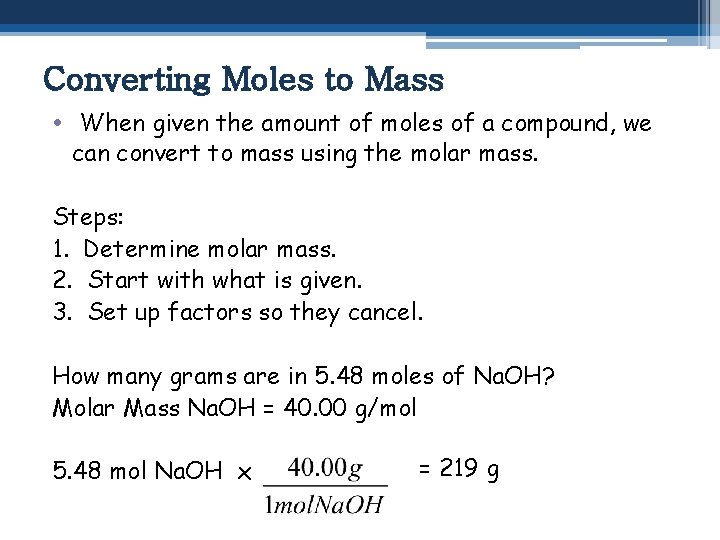
Converting Moles to Mass • When given the amount of moles of a compound, we can convert to mass using the molar mass. Steps: 1. Determine molar mass. 2. Start with what is given. 3. Set up factors so they cancel. How many grams are in 5. 48 moles of Na. OH? Molar Mass Na. OH = 40. 00 g/mol 5. 48 mol Na. OH x = 219 g
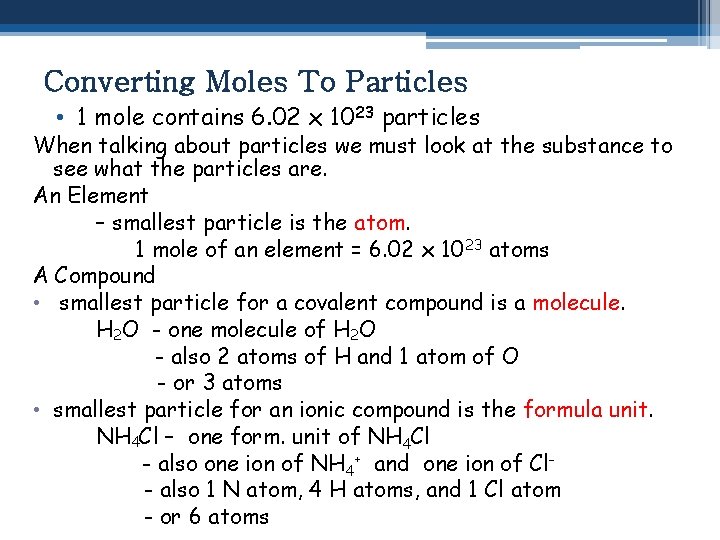
Converting Moles To Particles • 1 mole contains 6. 02 x 1023 particles When talking about particles we must look at the substance to see what the particles are. An Element – smallest particle is the atom. 1 mole of an element = 6. 02 x 1023 atoms A Compound • smallest particle for a covalent compound is a molecule. H 2 O - one molecule of H 2 O - also 2 atoms of H and 1 atom of O - or 3 atoms • smallest particle for an ionic compound is the formula unit. NH 4 Cl – one form. unit of NH 4 Cl - also one ion of NH 4+ and one ion of Cl- also 1 N atom, 4 H atoms, and 1 Cl atom - or 6 atoms
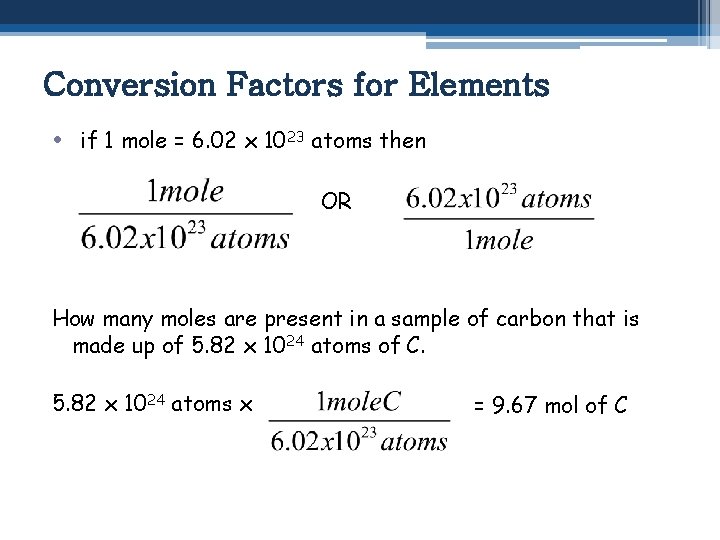
Conversion Factors for Elements • if 1 mole = 6. 02 x 1023 atoms then OR How many moles are present in a sample of carbon that is made up of 5. 82 x 1024 atoms of C. 5. 82 x 1024 atoms x = 9. 67 mol of C
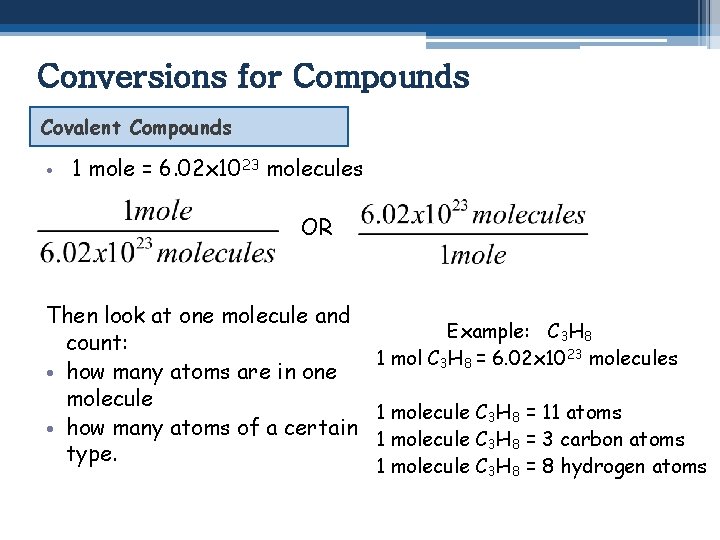
Conversions for Compounds Covalent Compounds • 1 mole = 6. 02 x 1023 molecules OR Then look at one molecule and Example: C 3 H 8 count: 1 mol C 3 H 8 = 6. 02 x 1023 molecules • how many atoms are in one molecule 1 molecule C 3 H 8 = 11 atoms • how many atoms of a certain 1 molecule C H = 3 carbon atoms 3 8 type. 1 molecule C 3 H 8 = 8 hydrogen atoms
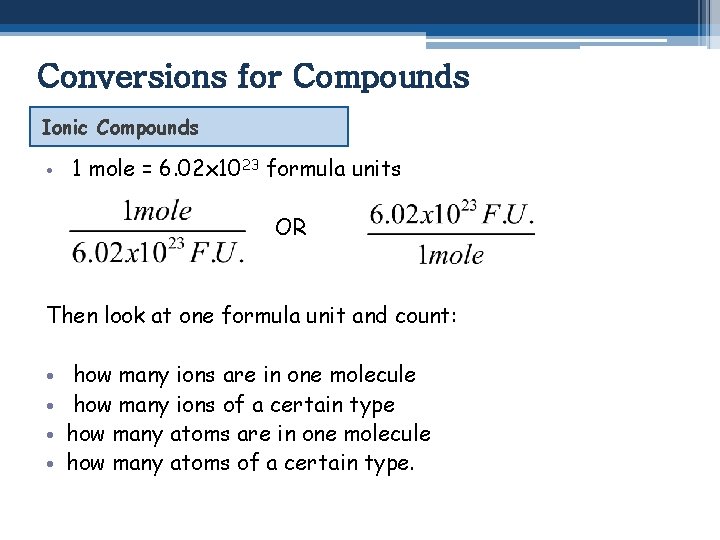
Conversions for Compounds Ionic Compounds • 1 mole = 6. 02 x 1023 formula units OR Then look at one formula unit and count: • • how many ions are in one molecule how many ions of a certain type how many atoms are in one molecule how many atoms of a certain type.
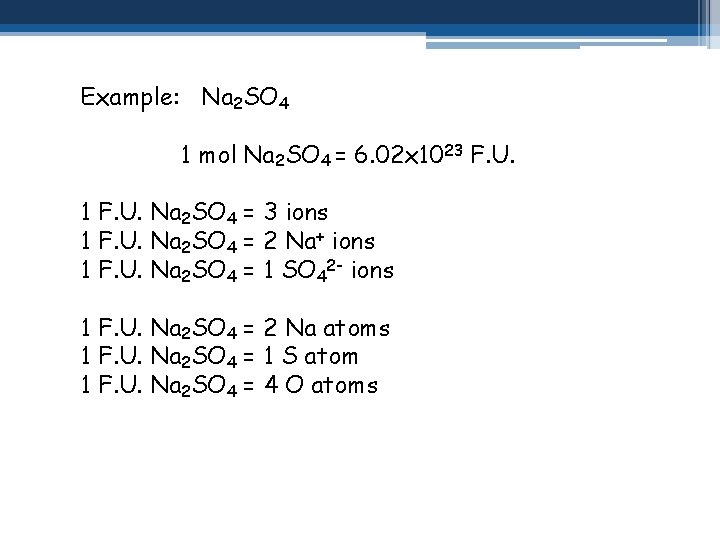
Example: Na 2 SO 4 1 mol Na 2 SO 4 = 6. 02 x 1023 F. U. 1 F. U. Na 2 SO 4 = 3 ions 1 F. U. Na 2 SO 4 = 2 Na+ ions 1 F. U. Na 2 SO 4 = 1 SO 42 - ions 1 F. U. Na 2 SO 4 = 2 Na atoms 1 F. U. Na 2 SO 4 = 1 S atom 1 F. U. Na 2 SO 4 = 4 O atoms
The Mole Road Map 1 mole = 6. 02 x 1023 molecules 1 mole = molar mass For Compounds grams moles 1 mole = what you count Molecules or Formula Units For Elements 1 mol=6. 02 x 1023 atoms STP 1 mol=22. 4 L SATP 1 mol=24. 4 L Volume Atoms or Ions
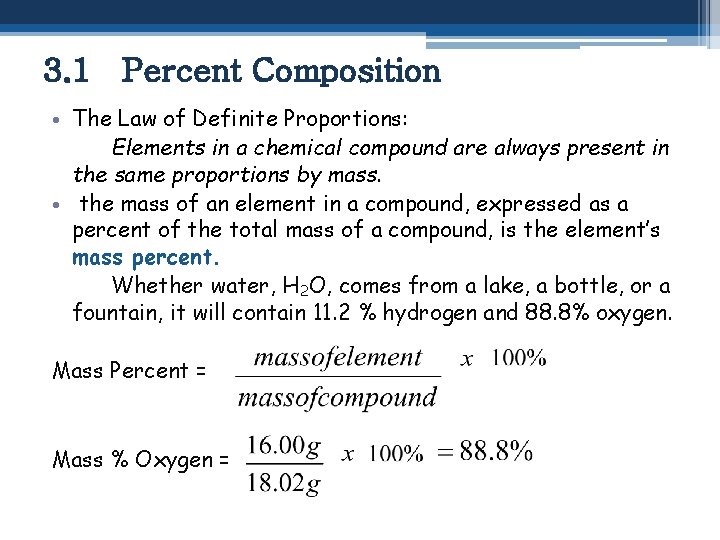
3. 1 Percent Composition • The Law of Definite Proportions: Elements in a chemical compound are always present in the same proportions by mass. • the mass of an element in a compound, expressed as a percent of the total mass of a compound, is the element’s mass percent. Whether water, H 2 O, comes from a lake, a bottle, or a fountain, it will contain 11. 2 % hydrogen and 88. 8% oxygen. Mass Percent = Mass % Oxygen =
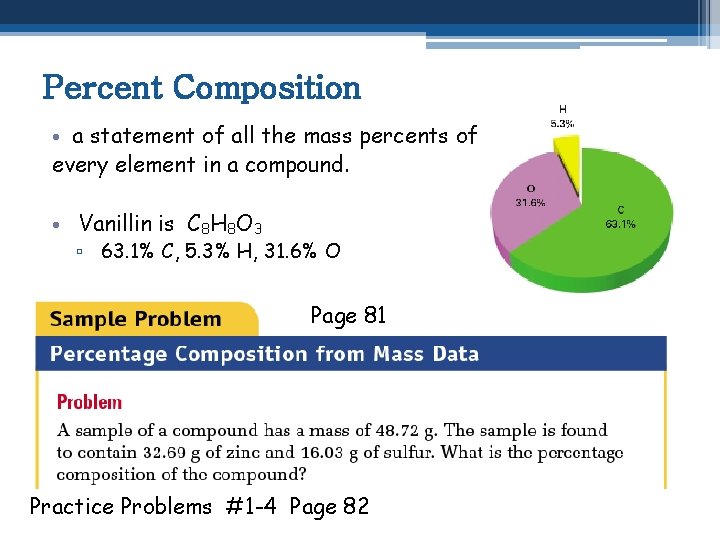
Percent Composition • a statement of all the mass percents of every element in a compound. • Vanillin is C 8 H 8 O 3 ▫ 63. 1% C, 5. 3% H, 31. 6% O Page 81 Practice Problems #1 -4 Page 82
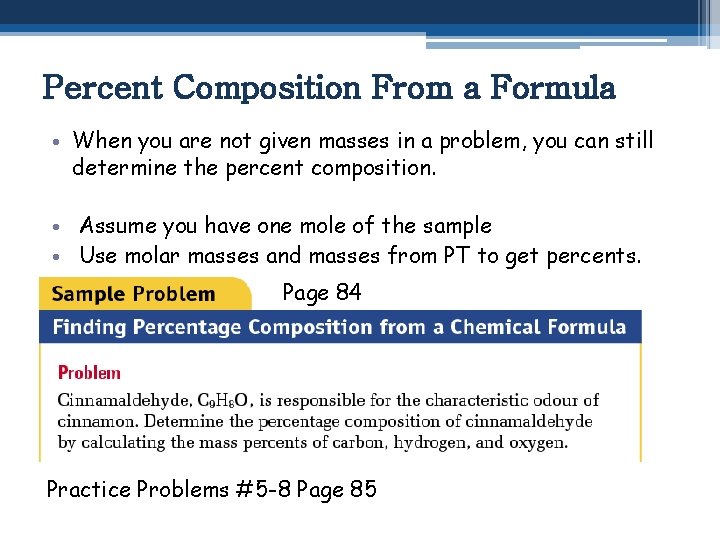
Percent Composition From a Formula • When you are not given masses in a problem, you can still determine the percent composition. • Assume you have one mole of the sample • Use molar masses and masses from PT to get percents. Page 84 Practice Problems #5 -8 Page 85
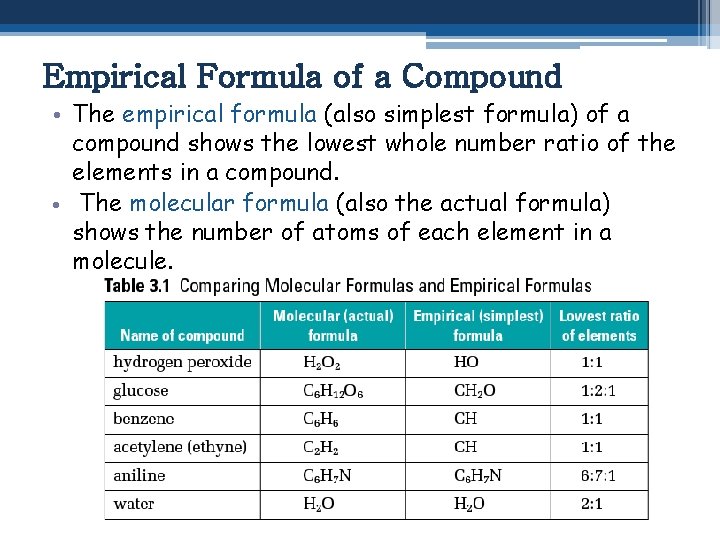
Empirical Formula of a Compound • The empirical formula (also simplest formula) of a compound shows the lowest whole number ratio of the elements in a compound. • The molecular formula (also the actual formula) shows the number of atoms of each element in a molecule.
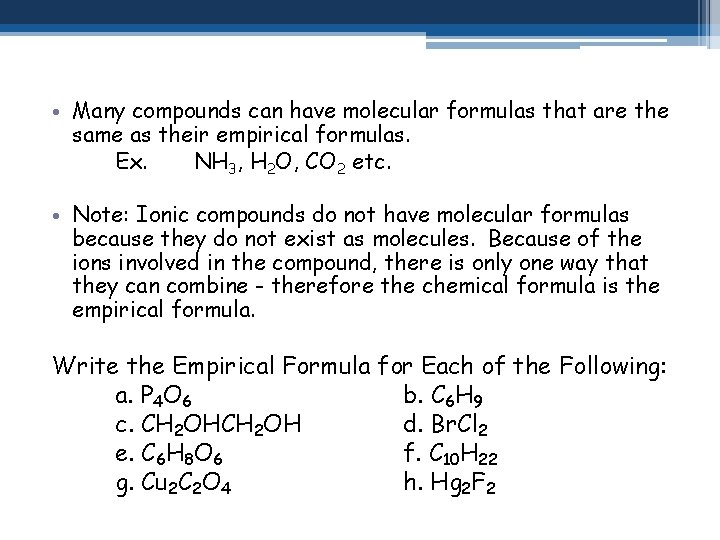
• Many compounds can have molecular formulas that are the same as their empirical formulas. Ex. NH 3, H 2 O, CO 2 etc. • Note: Ionic compounds do not have molecular formulas because they do not exist as molecules. Because of the ions involved in the compound, there is only one way that they can combine - therefore the chemical formula is the empirical formula. Write the Empirical Formula for Each of the Following: a. P 4 O 6 b. C 6 H 9 c. CH 2 OH d. Br. Cl 2 e. C 6 H 8 O 6 f. C 10 H 22 g. Cu 2 C 2 O 4 h. Hg 2 F 2
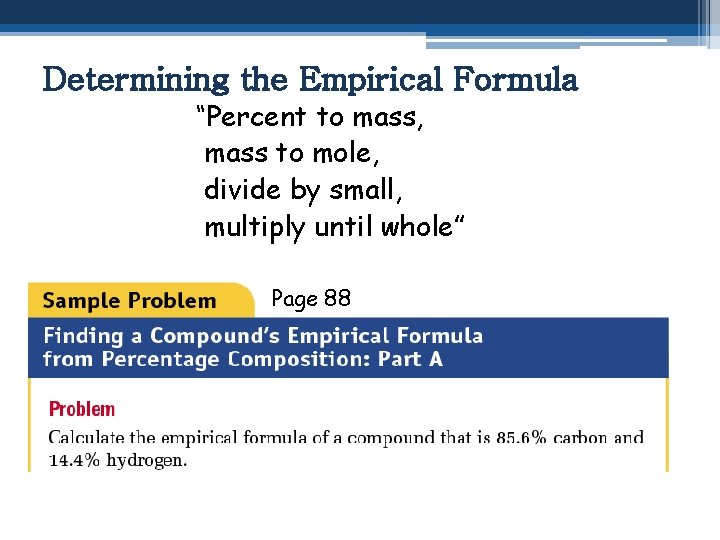
Determining the Empirical Formula “Percent to mass, mass to mole, divide by small, multiply until whole” Page 88
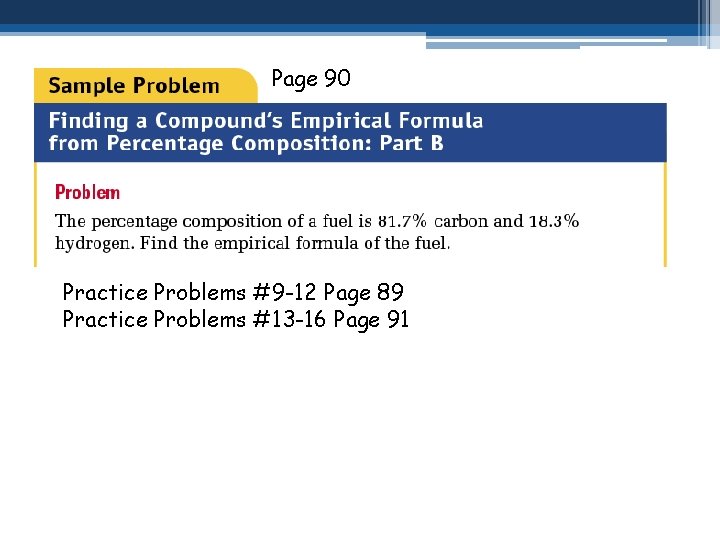
Page 90 Practice Problems #9 -12 Page 89 Practice Problems #13 -16 Page 91
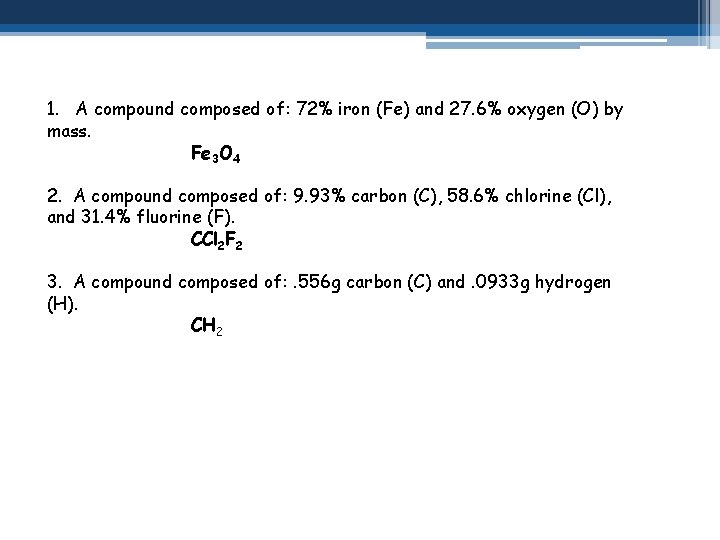
1. A compound composed of: 72% iron (Fe) and 27. 6% oxygen (O) by mass. Fe 3 O 4 2. A compound composed of: 9. 93% carbon (C), 58. 6% chlorine (Cl), and 31. 4% fluorine (F). CCl 2 F 2 3. A compound composed of: . 556 g carbon (C) and. 0933 g hydrogen (H). CH 2
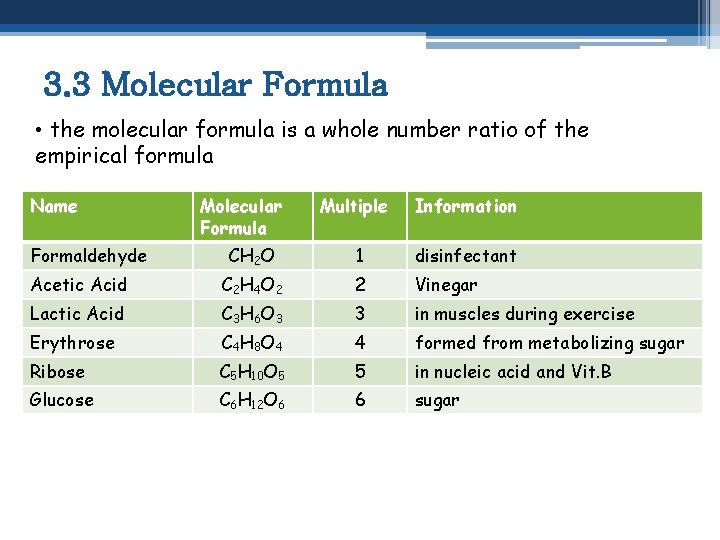
3. 3 Molecular Formula • the molecular formula is a whole number ratio of the empirical formula Name Formaldehyde Molecular Formula Multiple Information CH 2 O 1 disinfectant Acetic Acid C 2 H 4 O 2 2 Vinegar Lactic Acid C 3 H 6 O 3 3 in muscles during exercise Erythrose C 4 H 8 O 4 4 formed from metabolizing sugar Ribose C 5 H 10 O 5 5 in nucleic acid and Vit. B Glucose C 6 H 12 O 6 6 sugar
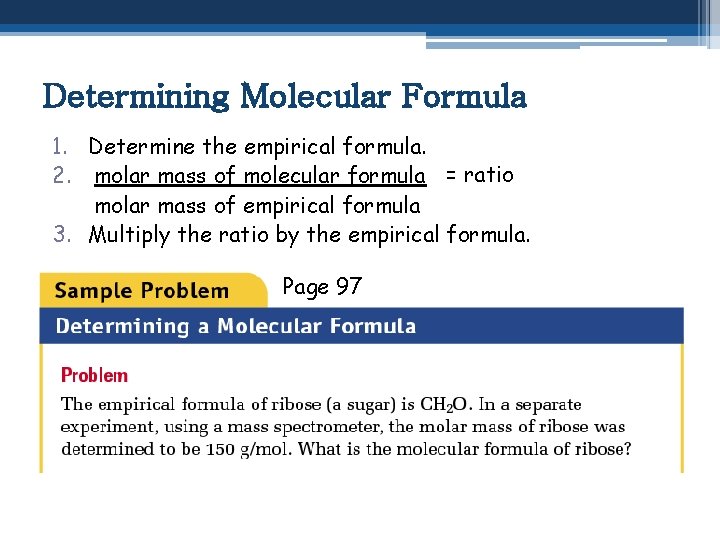
Determining Molecular Formula 1. Determine the empirical formula. 2. molar mass of molecular formula = ratio molar mass of empirical formula 3. Multiply the ratio by the empirical formula. Page 97
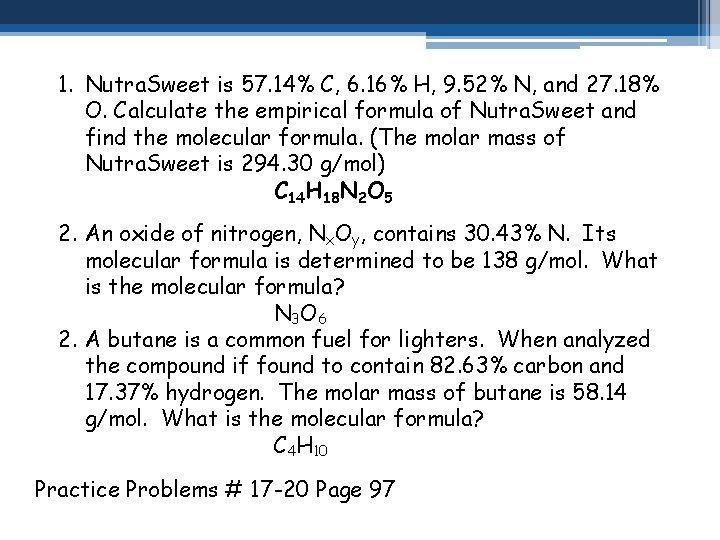
1. Nutra. Sweet is 57. 14% C, 6. 16% H, 9. 52% N, and 27. 18% O. Calculate the empirical formula of Nutra. Sweet and find the molecular formula. (The molar mass of Nutra. Sweet is 294. 30 g/mol) C 14 H 18 N 2 O 5 2. An oxide of nitrogen, Nx. Oy, contains 30. 43% N. Its molecular formula is determined to be 138 g/mol. What is the molecular formula? N 3 O 6 2. A butane is a common fuel for lighters. When analyzed the compound if found to contain 82. 63% carbon and 17. 37% hydrogen. The molar mass of butane is 58. 14 g/mol. What is the molecular formula? C 4 H 10 Practice Problems # 17 -20 Page 97
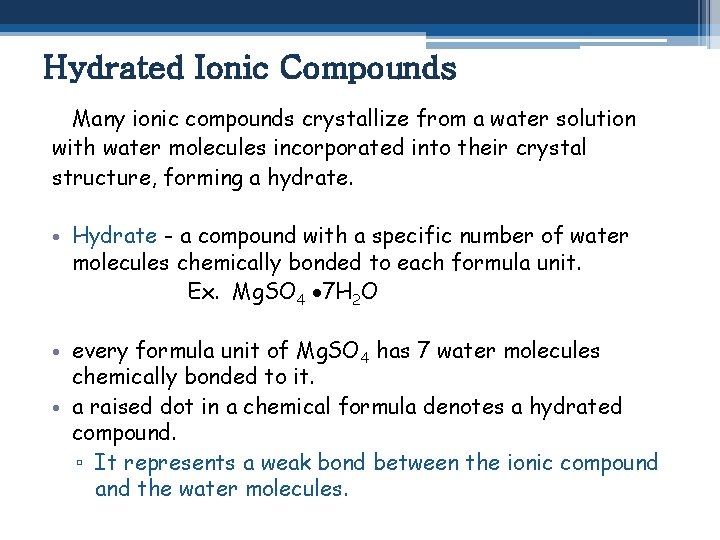
Hydrated Ionic Compounds Many ionic compounds crystallize from a water solution with water molecules incorporated into their crystal structure, forming a hydrate. • Hydrate - a compound with a specific number of water molecules chemically bonded to each formula unit. Ex. Mg. SO 4 7 H 2 O • every formula unit of Mg. SO 4 has 7 water molecules chemically bonded to it. • a raised dot in a chemical formula denotes a hydrated compound. ▫ It represents a weak bond between the ionic compound and the water molecules.
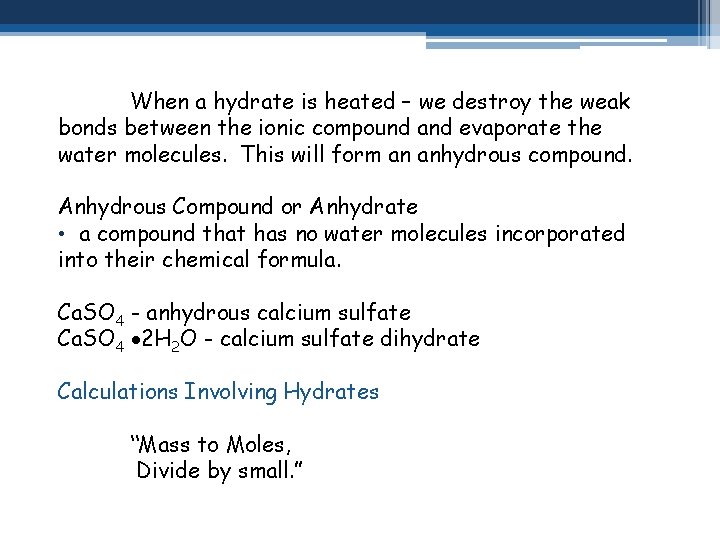
When a hydrate is heated – we destroy the weak bonds between the ionic compound and evaporate the water molecules. This will form an anhydrous compound. Anhydrous Compound or Anhydrate • a compound that has no water molecules incorporated into their chemical formula. Ca. SO 4 - anhydrous calcium sulfate Ca. SO 4 2 H 2 O - calcium sulfate dihydrate Calculations Involving Hydrates “Mass to Moles, Divide by small. ”
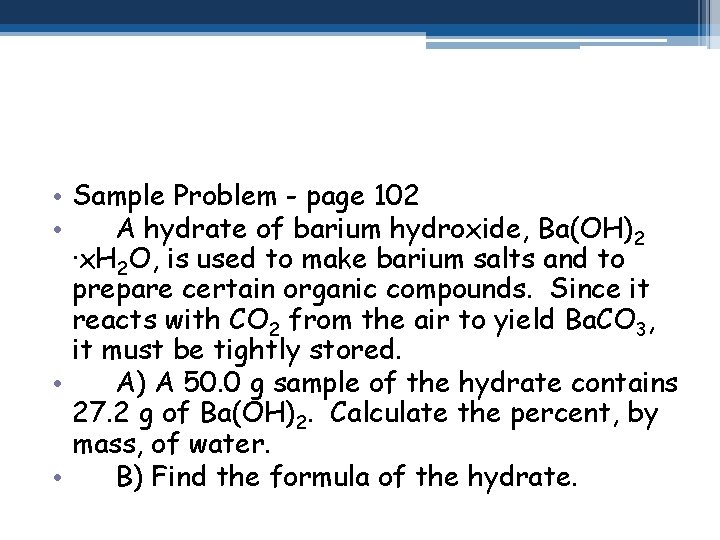
• Sample Problem - page 102 • A hydrate of barium hydroxide, Ba(OH)2 ∙x. H 2 O, is used to make barium salts and to prepare certain organic compounds. Since it reacts with CO 2 from the air to yield Ba. CO 3, it must be tightly stored. • A) A 50. 0 g sample of the hydrate contains 27. 2 g of Ba(OH)2. Calculate the percent, by mass, of water. • B) Find the formula of the hydrate.
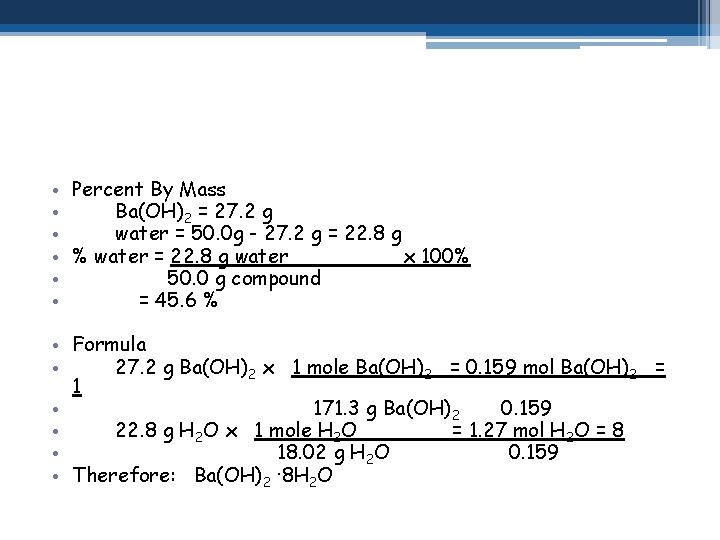
• Percent By Mass • Ba(OH)2 = 27. 2 g • water = 50. 0 g - 27. 2 g = 22. 8 g • % water = 22. 8 g water x 100% • 50. 0 g compound • = 45. 6 % • Formula • 27. 2 g Ba(OH)2 x 1 mole Ba(OH)2 = 0. 159 mol Ba(OH)2 = 1 • 171. 3 g Ba(OH)2 0. 159 • 22. 8 g H 2 O x 1 mole H 2 O = 1. 27 mol H 2 O = 8 • 18. 02 g H 2 O 0. 159 • Therefore: Ba(OH)2 ∙ 8 H 2 O
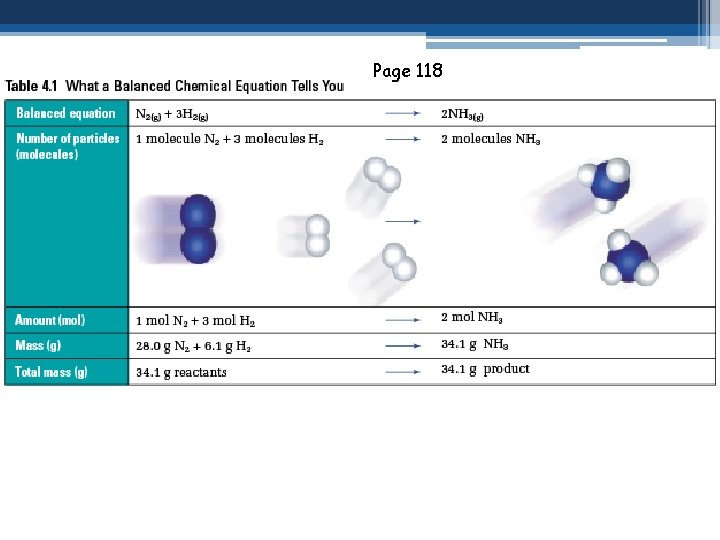
Stoichiometry Continued. . . • Balanced chemical equations are EXTREMELY important in chemistry. • The coefficients in front of the formulas and symbols for the compounds and elements tell you the ratio of particles involved in a chemical reaction. • The coefficients also tell us the ratio of the number of molecules in the equation. • The coefficients tell us the number of moles involved in the chemical equation. the mole ratio or the mole-mole relationship.
Page 118
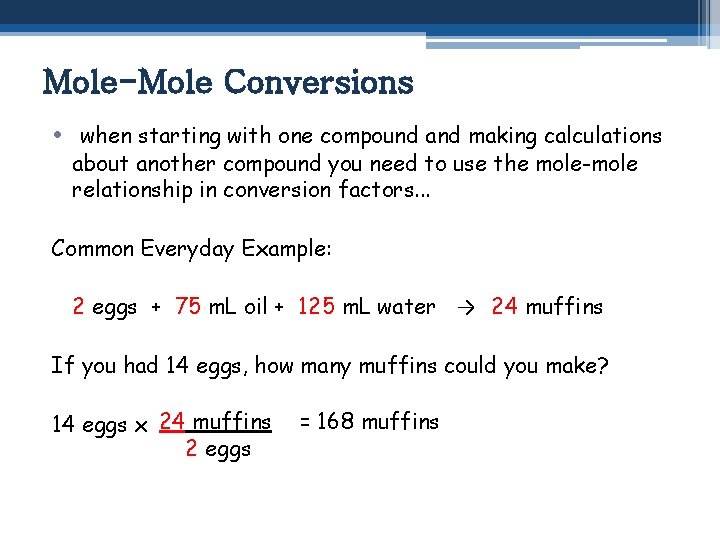
Mole-Mole Conversions • when starting with one compound and making calculations about another compound you need to use the mole-mole relationship in conversion factors. . . Common Everyday Example: 2 eggs + 75 m. L oil + 125 m. L water → 24 muffins If you had 14 eggs, how many muffins could you make? 14 eggs x 24 muffins 2 eggs = 168 muffins
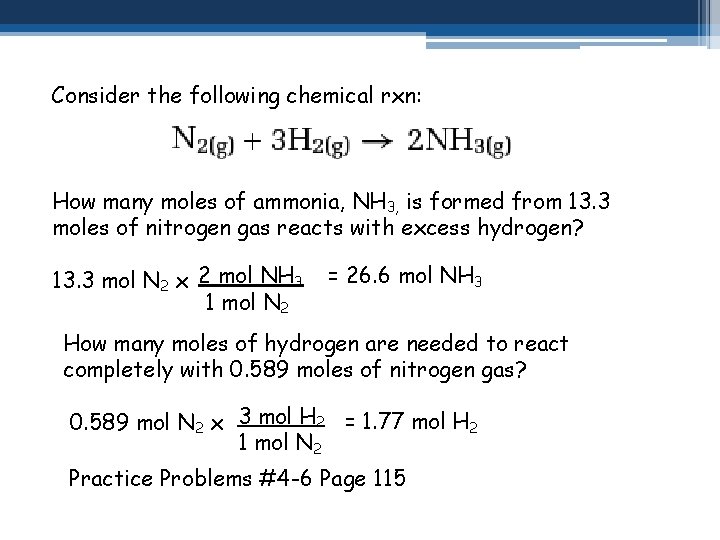
Consider the following chemical rxn: How many moles of ammonia, NH 3, is formed from 13. 3 moles of nitrogen gas reacts with excess hydrogen? 13. 3 mol N 2 x 2 mol NH 3 1 mol N 2 = 26. 6 mol NH 3 How many moles of hydrogen are needed to react completely with 0. 589 moles of nitrogen gas? 0. 589 mol N 2 x 3 mol H 2 = 1. 77 mol H 2 1 mol N 2 Practice Problems #4 -6 Page 115
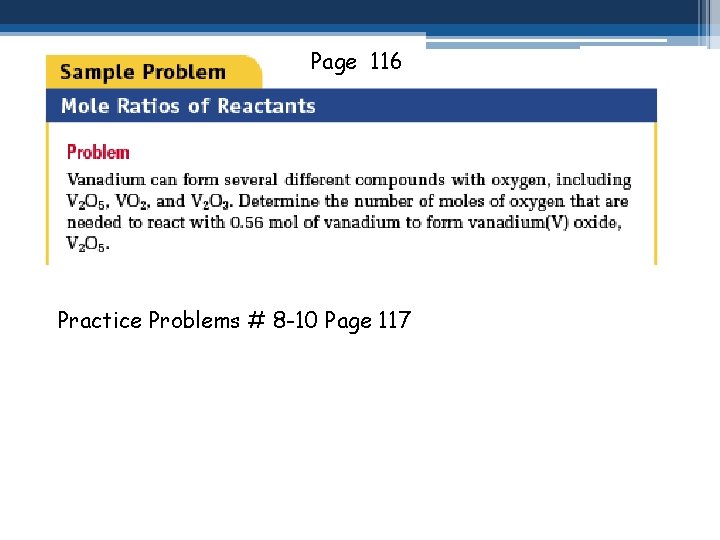
Page 116 Practice Problems # 8 -10 Page 117
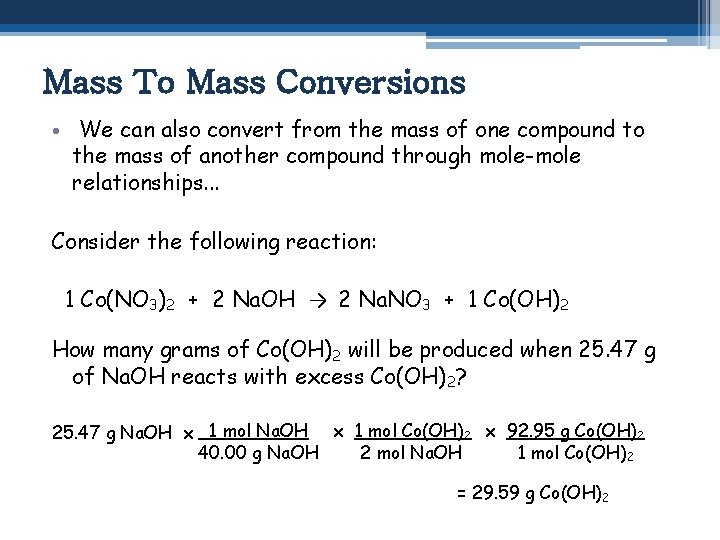
Mass To Mass Conversions • We can also convert from the mass of one compound to the mass of another compound through mole-mole relationships. . . Consider the following reaction: 1 Co(NO 3)2 + 2 Na. OH → 2 Na. NO 3 + 1 Co(OH)2 How many grams of Co(OH)2 will be produced when 25. 47 g of Na. OH reacts with excess Co(OH)2? 25. 47 g Na. OH x 1 mol Co(OH)2 x 92. 95 g Co(OH)2 40. 00 g Na. OH 2 mol Na. OH 1 mol Co(OH)2 = 29. 59 g Co(OH)2
Mass to mass conversion • P. 121 #11 -14 • ** In #14 you are also required to find the volume of a gas at STP. 22. 4 L/mol will be needed for the conversion.
Mixed Stoichiometry • P. 122 #15 -18 • P. 125 # 19 -22 These problems require conversions between mass, moles, particles, and volume to achieve the correct answer. (mole road map) **All your conversion skills are used here.
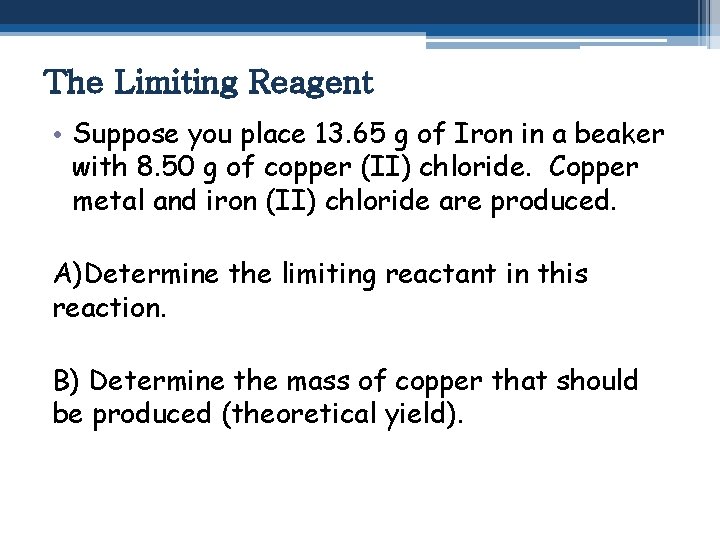
The Limiting Reagent • Suppose you place 13. 65 g of Iron in a beaker with 8. 50 g of copper (II) chloride. Copper metal and iron (II) chloride are produced. A)Determine the limiting reactant in this reaction. B) Determine the mass of copper that should be produced (theoretical yield).
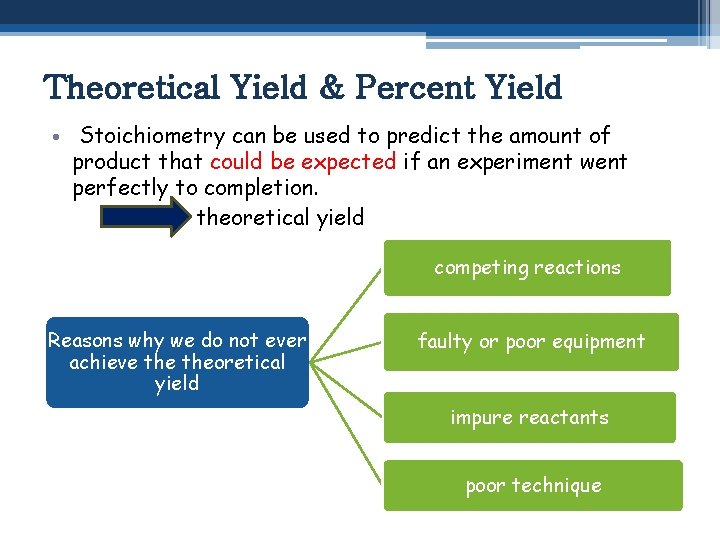
Theoretical Yield & Percent Yield • Stoichiometry can be used to predict the amount of product that could be expected if an experiment went perfectly to completion. theoretical yield competing reactions Reasons why we do not ever achieve theoretical yield faulty or poor equipment impure reactants poor technique
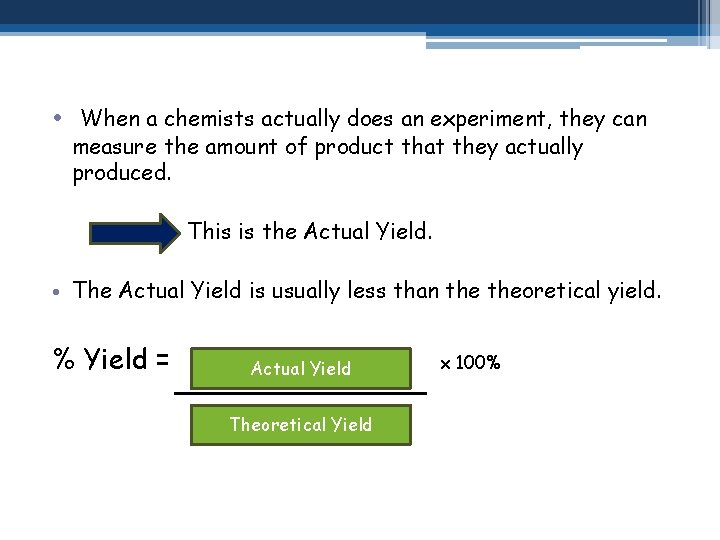
• When a chemists actually does an experiment, they can measure the amount of product that they actually produced. This is the Actual Yield. • The Actual Yield is usually less than theoretical yield. % Yield = Actual Yield Theoretical Yield x 100%
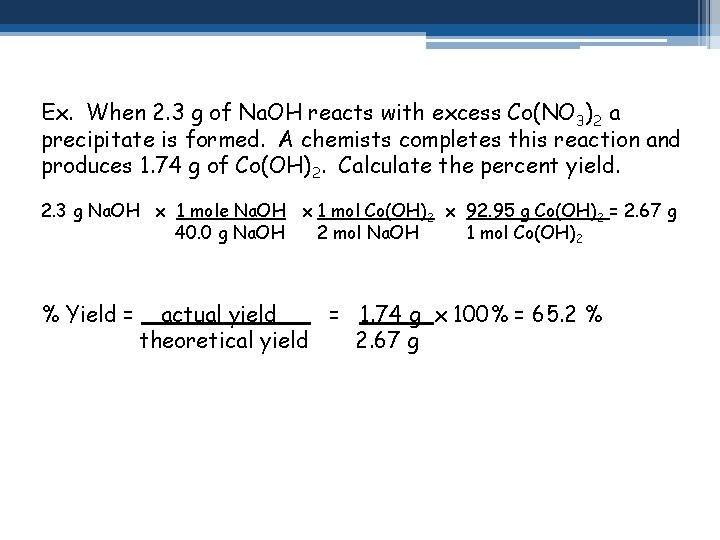
Ex. When 2. 3 g of Na. OH reacts with excess Co(NO 3)2 a precipitate is formed. A chemists completes this reaction and produces 1. 74 g of Co(OH)2. Calculate the percent yield. 2. 3 g Na. OH x 1 mole Na. OH x 1 mol Co(OH)2 x 92. 95 g Co(OH)2 = 2. 67 g 40. 0 g Na. OH 2 mol Na. OH 1 mol Co(OH) 2 % Yield = actual yield = 1. 74 g x 100% = 65. 2 % theoretical yield 2. 67 g