Space Environment Vacuum Environment in the ionosphere and

- Slides: 12
Space Environment Vacuum Environment (in the ionosphere and above range) Effects and Problem Issues Thermal effects Contamination (due to outgassing) UV radiation Mass loss (due to outgassing) Particulate (no kinetic energy) October 1, 2003 Lecture-6 and 7 H. Kirkici Istanbul Technical University
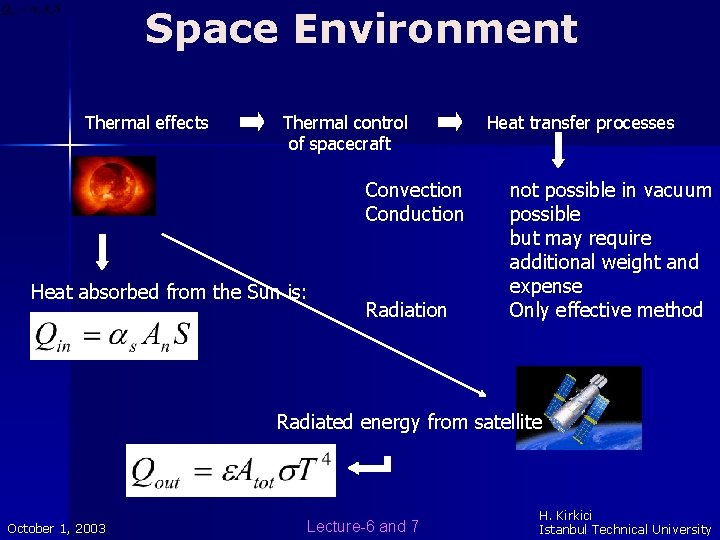
Space Environment Thermal effects Thermal control of spacecraft Convection Conduction Heat absorbed from the Sun is: Radiation Heat transfer processes not possible in vacuum possible but may require additional weight and expense Only effective method Radiated energy from satellite October 1, 2003 Lecture-6 and 7 H. Kirkici Istanbul Technical University
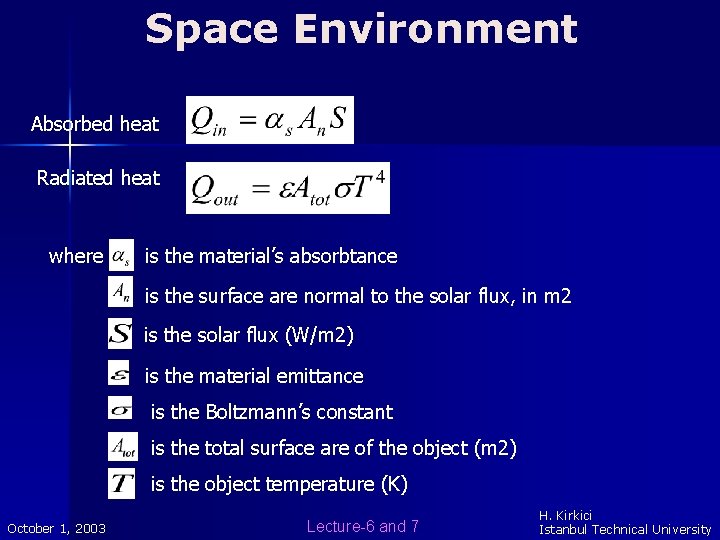
Space Environment Absorbed heat Radiated heat where is the material’s absorbtance is the surface are normal to the solar flux, in m 2 is the solar flux (W/m 2) is the material emittance is the Boltzmann’s constant is the total surface are of the object (m 2) is the object temperature (K) October 1, 2003 Lecture-6 and 7 H. Kirkici Istanbul Technical University
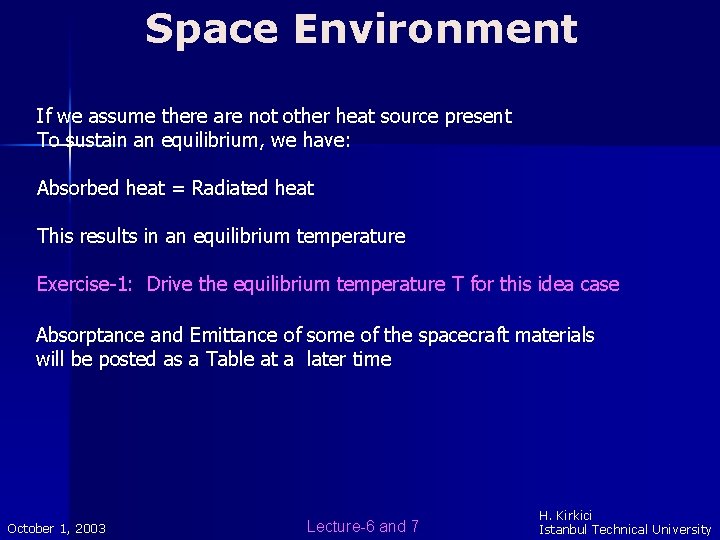
Space Environment If we assume there are not other heat source present To sustain an equilibrium, we have: Absorbed heat = Radiated heat This results in an equilibrium temperature Exercise-1: Drive the equilibrium temperature T for this idea case Absorptance and Emittance of some of the spacecraft materials will be posted as a Table at a later time October 1, 2003 Lecture-6 and 7 H. Kirkici Istanbul Technical University
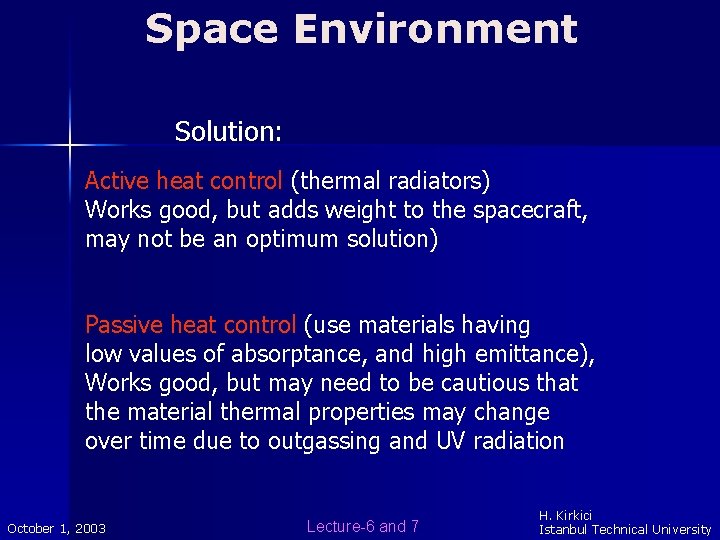
Space Environment Solution: Active heat control (thermal radiators) Works good, but adds weight to the spacecraft, may not be an optimum solution) Passive heat control (use materials having low values of absorptance, and high emittance), Works good, but may need to be cautious that the material thermal properties may change over time due to outgassing and UV radiation October 1, 2003 Lecture-6 and 7 H. Kirkici Istanbul Technical University
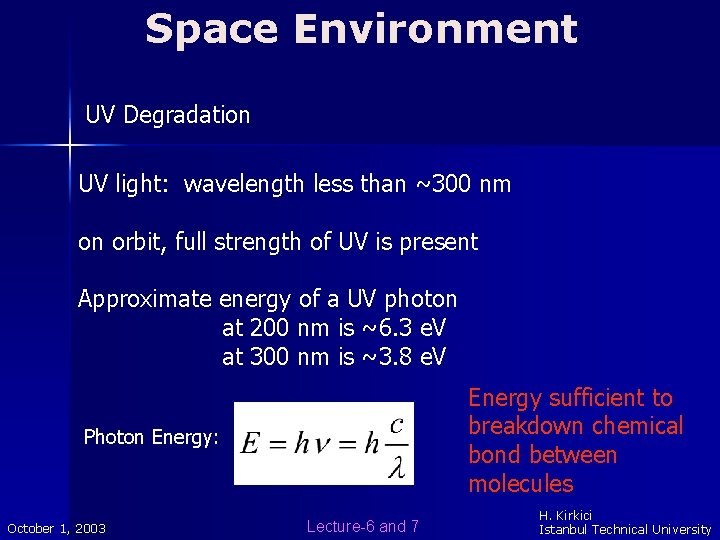
Space Environment UV Degradation UV light: wavelength less than ~300 nm on orbit, full strength of UV is present Approximate energy of a UV photon at 200 nm is ~6. 3 e. V at 300 nm is ~3. 8 e. V Energy sufficient to breakdown chemical bond between molecules Photon Energy: October 1, 2003 Lecture-6 and 7 H. Kirkici Istanbul Technical University
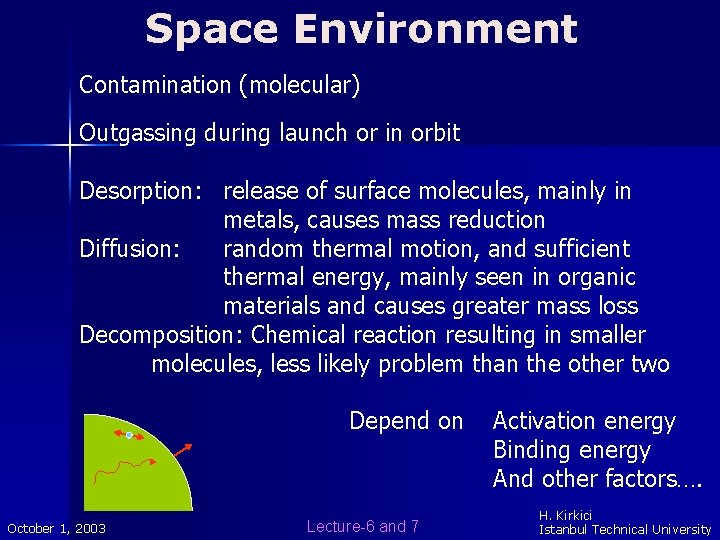
Space Environment Contamination (molecular) Outgassing during launch or in orbit Desorption: release of surface molecules, mainly in metals, causes mass reduction Diffusion: random thermal motion, and sufficient thermal energy, mainly seen in organic materials and causes greater mass loss Decomposition: Chemical reaction resulting in smaller molecules, less likely problem than the other two Depend on October 1, 2003 Lecture-6 and 7 Activation energy Binding energy And other factors…. H. Kirkici Istanbul Technical University
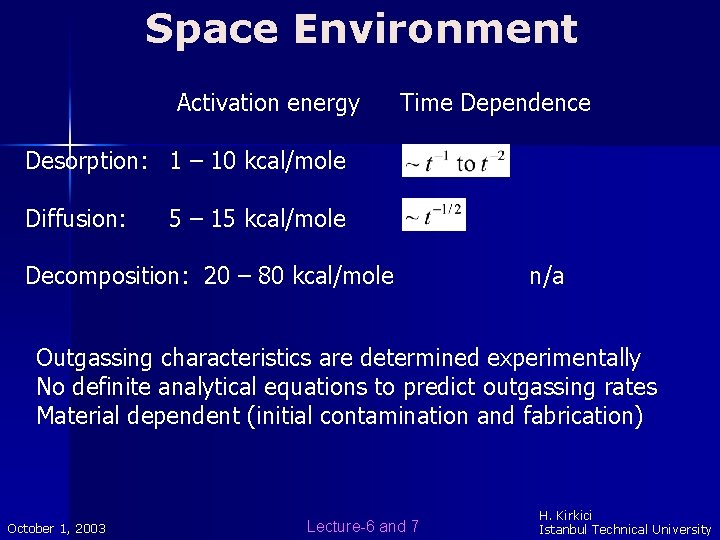
Space Environment Activation energy Time Dependence Desorption: 1 – 10 kcal/mole Diffusion: 5 – 15 kcal/mole Decomposition: 20 – 80 kcal/mole n/a Outgassing characteristics are determined experimentally No definite analytical equations to predict outgassing rates Material dependent (initial contamination and fabrication) October 1, 2003 Lecture-6 and 7 H. Kirkici Istanbul Technical University
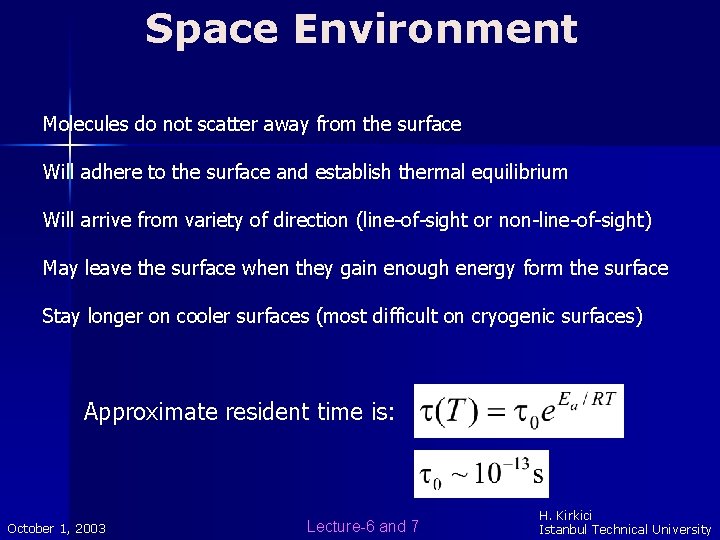
Space Environment Molecules do not scatter away from the surface Will adhere to the surface and establish thermal equilibrium Will arrive from variety of direction (line-of-sight or non-line-of-sight) May leave the surface when they gain enough energy form the surface Stay longer on cooler surfaces (most difficult on cryogenic surfaces) Approximate resident time is: October 1, 2003 Lecture-6 and 7 H. Kirkici Istanbul Technical University
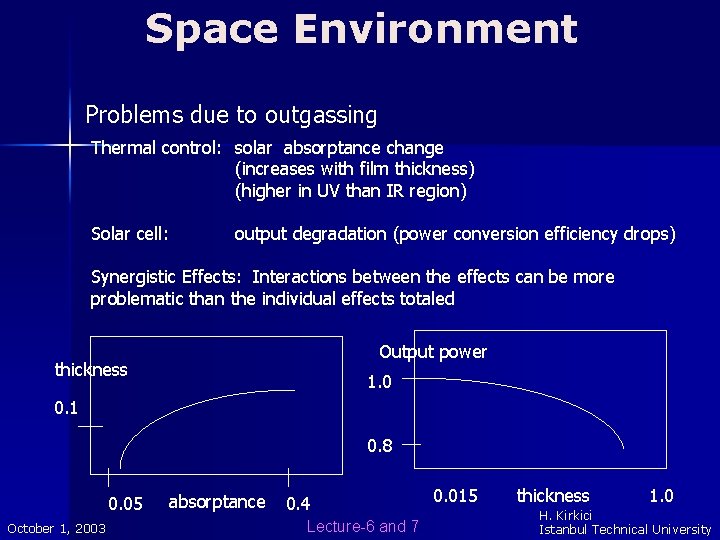
Space Environment Problems due to outgassing Thermal control: solar absorptance change (increases with film thickness) (higher in UV than IR region) Solar cell: output degradation (power conversion efficiency drops) Synergistic Effects: Interactions between the effects can be more problematic than the individual effects totaled Output power thickness 1. 0 0. 1 0. 8 0. 05 October 1, 2003 absorptance 0. 4 Lecture-6 and 7 0. 015 thickness 1. 0 H. Kirkici Istanbul Technical University
Space Environment Particulate contamination: Residual particles on the part during manufacturing and fabrication (not direct space environmental effect) From the spacecraft design and construction point, it is an important factor, many standards available Engineering problem!. . October 1, 2003 Lecture-6 and 7 H. Kirkici Istanbul Technical University
Space Environment Questions? October 1, 2003 Lecture-6 and 7 H. Kirkici Istanbul Technical University