WAMIPE Review Rodney Viereck NOAA Space Weather Prediction

- Slides: 15
WAM-IPE Review Rodney Viereck NOAA Space Weather Prediction Center Other Participants: SWPC: R. Akmaev, CIRES: T. Fuller-Rowell, N. Maruyama, CT Hsu, TW Fang, V. Yudin, H. Wang, M. Fedrizzi, T. Matsuo, D. Fuller-Rowell, G. Millward EMC: M. Iredell, W. Yang, S. Kar, K. Howard, J Wang NESII*: B. Oehmke, C. De. Luca, Li, G. Theurich, ESRL GSD: M. Govett, J. Middlecoff U. Maryland: D. Kleist, K. Ide JCSDA: T. Auligne Outline: • SWPC and its models • What is WAM+IPE = IDEA? • Why do we need it? • Status current activities • Deliverables and milestones • Issues and challenges * NESII = NOAA Environmental Software Infrastructure and Interoperability Group
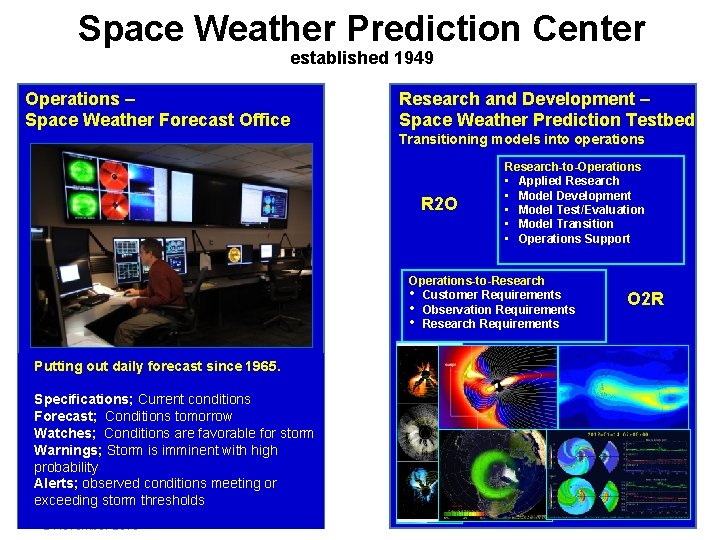
Space Weather Prediction Center established 1949 Operations – Space Weather Forecast Office Research and Development – Space Weather Prediction Testbed Transitioning models into operations R 2 O Research-to-Operations • Applied Research • Model Development • Model Test/Evaluation • Model Transition • Operations Support Operations-to-Research • Customer Requirements • Observation Requirements • Research Requirements O 2 R Putting out daily forecast since 1965. Specifications; Current conditions Forecast; Conditions tomorrow Watches; Conditions are favorable for storm Warnings; Storm is imminent with high probability Alerts; observed conditions meeting or exceeding storm thresholds 2 November 2016 2
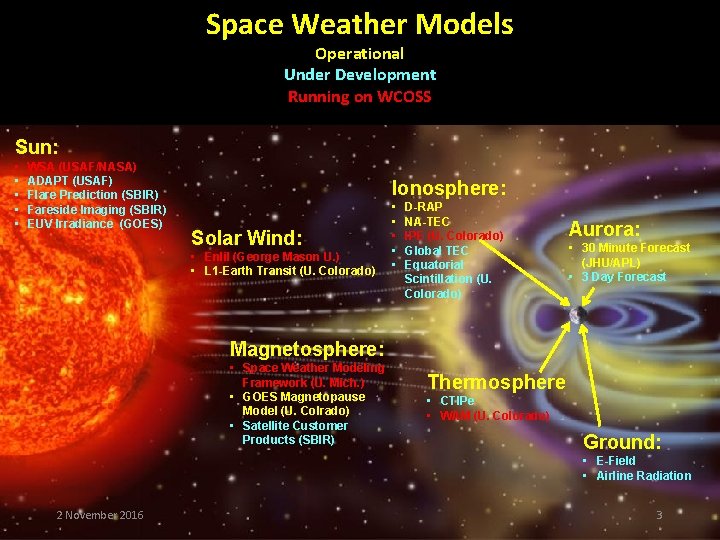
Space Weather Models Operational Under Development Running on WCOSS Sun: • • • WSA (USAF/NASA) ADAPT (USAF) Flare Prediction (SBIR) Fareside Imaging (SBIR) EUV Irradiance (GOES) Ionosphere: Solar Wind: • Enlil (George Mason U. ) • L 1 -Earth Transit (U. Colorado) • • • D-RAP NA-TEC IPE (U. Colorado) Global TEC Equatorial Scintillation (U. Colorado) Aurora: • 30 Minute Forecast (JHU/APL) • 3 Day Forecast Magnetosphere: • Space Weather Modeling Framework (U. Mich. ) • GOES Magnetopause Model (U. Colrado) • Satellite Customer Products (SBIR) Thermosphere • CTIPe • WAM (U. Colorado) Ground: • E-Field • Airline Radiation 2 November 2016 3
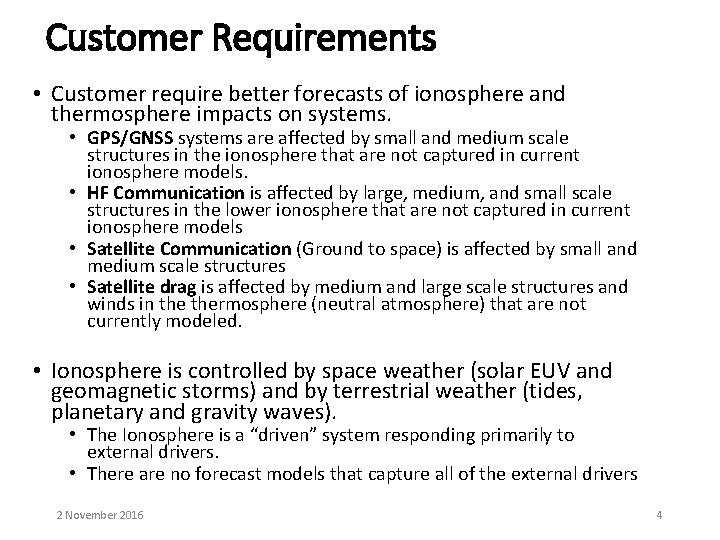
Customer Requirements • Customer require better forecasts of ionosphere and thermosphere impacts on systems. • GPS/GNSS systems are affected by small and medium scale structures in the ionosphere that are not captured in current ionosphere models. • HF Communication is affected by large, medium, and small scale structures in the lower ionosphere that are not captured in current ionosphere models • Satellite Communication (Ground to space) is affected by small and medium scale structures • Satellite drag is affected by medium and large scale structures and winds in thermosphere (neutral atmosphere) that are not currently modeled. • Ionosphere is controlled by space weather (solar EUV and geomagnetic storms) and by terrestrial weather (tides, planetary and gravity waves). • The Ionosphere is a “driven” system responding primarily to external drivers. • There are no forecast models that capture all of the external drivers 2 November 2016 4
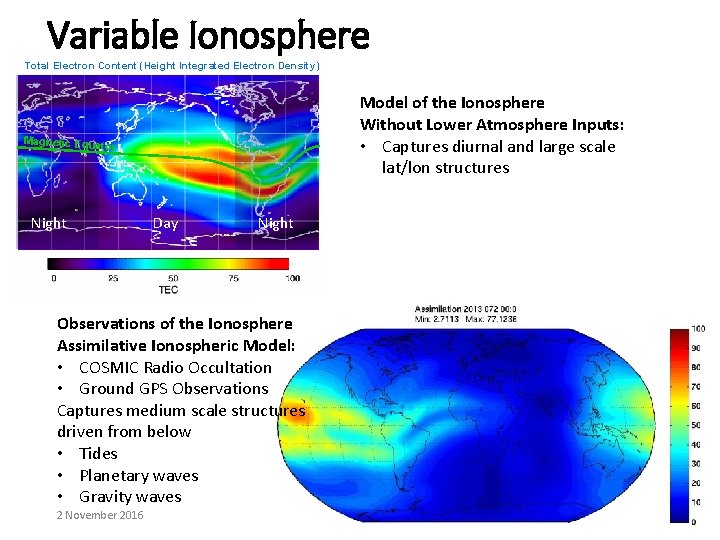
Variable Ionosphere Total Electron Content (Height Integrated Electron Density) Model of the Ionosphere Without Lower Atmosphere Inputs: • Captures diurnal and large scale lat/lon structures Magnetic Equat or Night Day Night Observations of the Ionosphere Assimilative Ionospheric Model: • COSMIC Radio Occultation • Ground GPS Observations Captures medium scale structures driven from below • Tides • Planetary waves • Gravity waves 2 November 2016 5
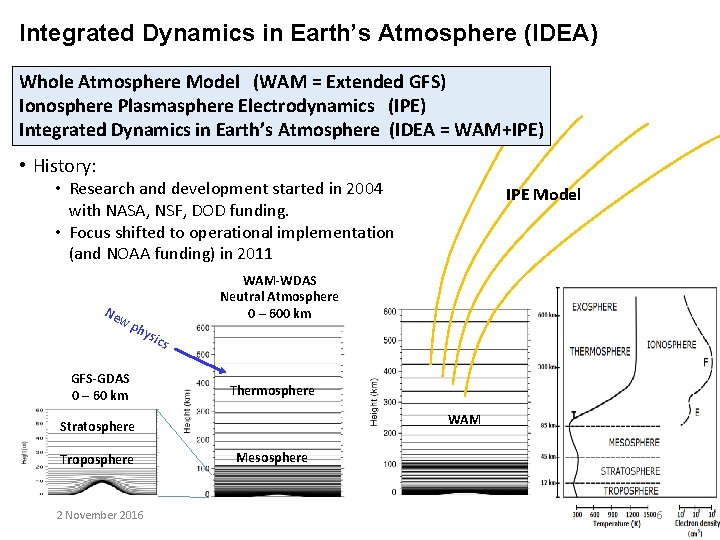
Integrated Dynamics in Earth’s Atmosphere (IDEA) Whole Atmosphere Model (WAM = Extended GFS) Ionosphere Plasmasphere Electrodynamics (IPE) Integrated Dynamics in Earth’s Atmosphere (IDEA = WAM+IPE) • History: • Research and development started in 2004 with NASA, NSF, DOD funding. • Focus shifted to operational implementation (and NOAA funding) in 2011 Ne wp hys i GFS-GDAS 0 – 60 km WAM-WDAS Neutral Atmosphere 0 – 600 km cs Thermosphere WAM Stratosphere Troposphere 2 November 2016 IPE Model Mesosphere 6
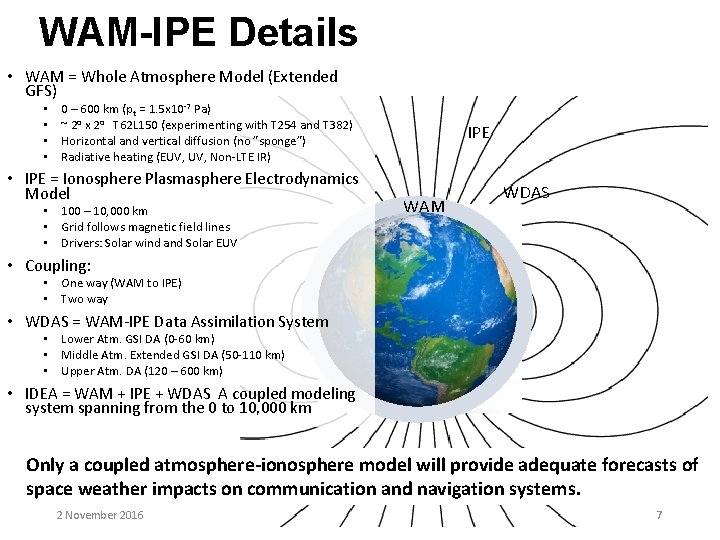
WAM-IPE Details • WAM = Whole Atmosphere Model (Extended GFS) • • 0 – 600 km (p t = 1. 5 x 10 -7 Pa) ~ 2 o x 2 o T 62 L 150 (experimenting with T 254 and T 382) Horizontal and vertical diffusion (no ”sponge”) Radiative heating (EUV, Non-LTE IR) • IPE = Ionosphere Plasmasphere Electrodynamics Model • 100 – 10, 000 km • Grid follows magnetic field lines • Drivers: Solar wind and Solar EUV IPE WAM WDAS • Coupling: • One way (WAM to IPE) • Two way • WDAS = WAM-IPE Data Assimilation System • Lower Atm. GSI DA (0 -60 km) • Middle Atm. Extended GSI DA (50 -110 km) • Upper Atm. DA (120 – 600 km) • IDEA = WAM + IPE + WDAS A coupled modeling system spanning from the 0 to 10, 000 km Only a coupled atmosphere-ionosphere model will provide adequate forecasts of space weather impacts on communication and navigation systems. 2 November 2016 7
WAM and IPE Status • WAM: • Real-time WAM has been running on WCOSS-dev and Theia for over a year • New WAM (Updated physics and SWx drivers) is implemented and tested on Theia. • Real-time New WAM on WCOSS-Dev in cycling mode with data assimilation was unstable during Q 1 -Q 2 of 2016. • SWPC and EMC are working to identify the problem and fix it. • Anticipate stable real-time New-WAM performance after debugging and additional tests on Theia with Parallel Analysis-Forecast cycling of NCEP/EMC under workflows 2 and 3. • IPE: • IPE validation ongoing (on Theia) • Porting IPE to WCOSS-Dev • Adding Scalable Modeling System (SMS) to WCOSS • SMS is a parallelization tool that translates Fortran code into a parallel version that runs efficiently on both shared and distributed memory systems. This software has been used successfully at NOAA ESRL since 1993 to parallelize and run many oceanic and atmospheric models. • Establishing IPE real-time runs 2 November 2016 8
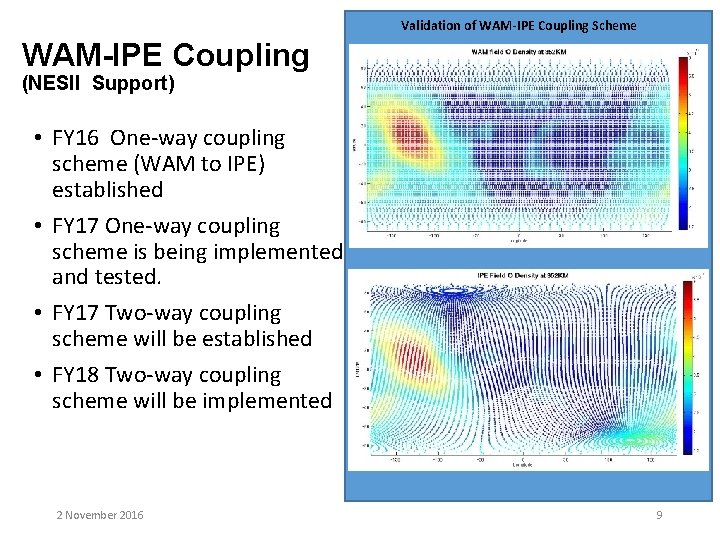
Validation of WAM-IPE Coupling Scheme WAM-IPE Coupling (NESII Support) • FY 16 One-way coupling scheme (WAM to IPE) established • FY 17 One-way coupling scheme is being implemented and tested. • FY 17 Two-way coupling scheme will be established • FY 18 Two-way coupling scheme will be implemented 2 November 2016 9
WDAS Status: • WDAS (Lower atmosphere) is fully operational and is used to drive WAM-real-time • Middle Atmosphere Data Assimilation (50 -120 km) is under development • Funding from NOAA R 2 O Testbeds/NGGPS • Should be implemented in WAM in FY 17 -18 • Upper Atmosphere/Ionosphere Data Assimilation (200 -600 km) • Research project (NASA funded) • Ready in FY 19? (NOAA funded? ) 2 November 2016 10
WDAS Data List (WDAS = WAM-IPE Data Assimilation System) • Lower Atmosphere: All of the data that goes into GFS • Middle Atmosphere (Stratosphere, Mesosphere, Lower Thermosphere) • • • Additional channels to SSMIS to ~80 -100 km altitude for temperature (historical only) Extend use of AIRS, IASI, CRIS, AMSUA for temperature. Microwave Limb Sounders for ozone, H 2 O, and temperature to 85 km OMPS ozone profiles (20 -70 km) SABER-TIMED temperature, ozone, O, and H 2 O profiles • Upper Thermosphere and Ionosphere • • • Ionospheric radio occultation e. g. , COSMIC-II (LOS TEC, S 4, σΦ) Ground-based dual frequency GPS receivers Ground-based magnetometers UV satellite imager (GOLD) for O/N 2 and/or high latitude and vertical drift at low latitude IRIDIUM-AMPERE Super. DARN Satellite accelerometer data for neutral density e. g. , GOCE, GRACE, SWARM Global network of Ionosondes/Dynasondes Incoherent Scatter Radars (MH, Arecibo, Jicamarca, AMISR, etc. ) • DSCOVR solar wind data at L 1 • Solar flux, F 10. 7 cm, GOES-EUV 2 November 2016 11
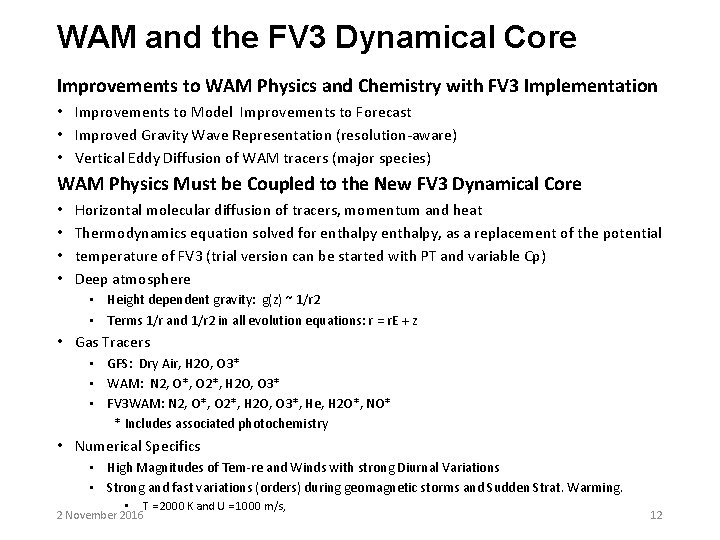
WAM and the FV 3 Dynamical Core Improvements to WAM Physics and Chemistry with FV 3 Implementation • Improvements to Model Improvements to Forecast • Improved Gravity Wave Representation (resolution-aware) • Vertical Eddy Diffusion of WAM tracers (major species) WAM Physics Must be Coupled to the New FV 3 Dynamical Core • • Horizontal molecular diffusion of tracers, momentum and heat Thermodynamics equation solved for enthalpy, as a replacement of the potential temperature of FV 3 (trial version can be started with PT and variable Cp) Deep atmosphere • Height dependent gravity: g(z) ~ 1/r 2 • Terms 1/r and 1/r 2 in all evolution equations: r = r. E + z • Gas Tracers • GFS: Dry Air, H 2 O, O 3* • WAM: N 2, O*, O 2*, H 2 O, O 3* • FV 3 WAM: N 2, O*, O 2*, H 2 O, O 3*, He, H 2 O*, NO* * Includes associated photochemistry • Numerical Specifics • High Magnitudes of Tem-re and Winds with strong Diurnal Variations • Strong and fast variations (orders) during geomagnetic storms and Sudden Strat. Warming. • T = 2000 K and U = 1000 m/s, 2 November 2016 12
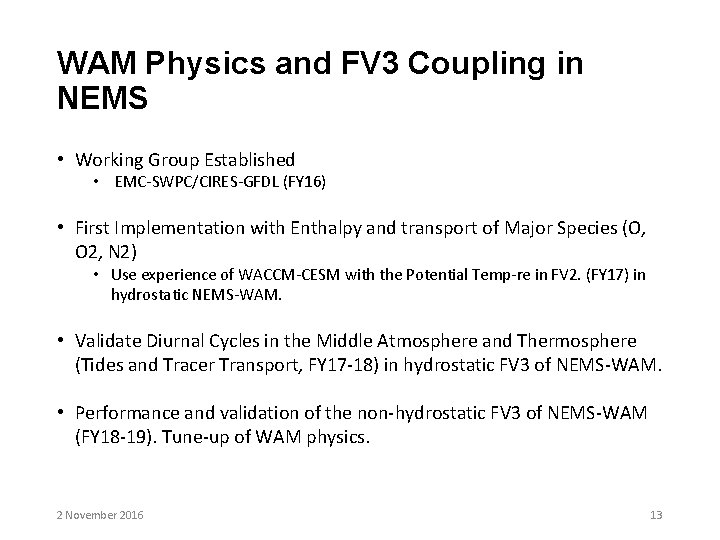
WAM Physics and FV 3 Coupling in NEMS • Working Group Established • EMC-SWPC/CIRES-GFDL (FY 16) • First Implementation with Enthalpy and transport of Major Species (O, O 2, N 2) • Use experience of WACCM-CESM with the Potential Temp-re in FV 2. (FY 17) in hydrostatic NEMS-WAM. • Validate Diurnal Cycles in the Middle Atmosphere and Thermosphere (Tides and Tracer Transport, FY 17 -18) in hydrostatic FV 3 of NEMS-WAM. • Performance and validation of the non-hydrostatic FV 3 of NEMS-WAM (FY 18 -19). Tune-up of WAM physics. 2 November 2016 13
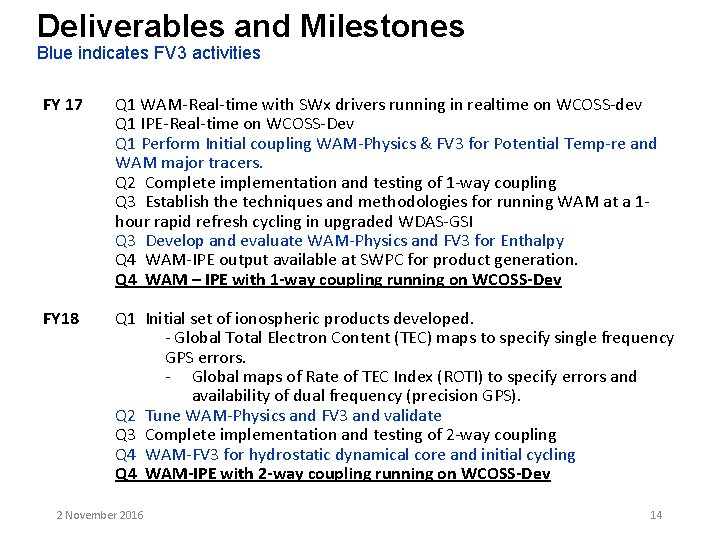
Deliverables and Milestones Blue indicates FV 3 activities FY 17 Q 1 WAM-Real-time with SWx drivers running in realtime on WCOSS-dev Q 1 IPE-Real-time on WCOSS-Dev Q 1 Perform Initial coupling WAM-Physics & FV 3 for Potential Temp-re and WAM major tracers. Q 2 Complete implementation and testing of 1 -way coupling Q 3 Establish the techniques and methodologies for running WAM at a 1 hour rapid refresh cycling in upgraded WDAS-GSI Q 3 Develop and evaluate WAM-Physics and FV 3 for Enthalpy Q 4 WAM-IPE output available at SWPC for product generation. Q 4 WAM – IPE with 1 -way coupling running on WCOSS-Dev FY 18 Q 1 Initial set of ionospheric products developed. - Global Total Electron Content (TEC) maps to specify single frequency GPS errors. - Global maps of Rate of TEC Index (ROTI) to specify errors and availability of dual frequency (precision GPS). Q 2 Tune WAM-Physics and FV 3 and validate Q 3 Complete implementation and testing of 2 -way coupling Q 4 WAM-FV 3 for hydrostatic dynamical core and initial cycling Q 4 WAM-IPE with 2 -way coupling running on WCOSS-Dev 2 November 2016 14
Questions: 2 November 2016 15