
Solving problems by searching 171 Class 2 Chapter
Solving problems by searching 171, Class 2 Chapter 3 1
Overview n Intelligent agents: problem solving as search n Search consists of n n n n state space operators start state goal states The search graph A Search Tree is an efficient way to represent the search process There a variety of search algorithms, including n n n Depth-First Search Breadth-First Search Others which use heuristic knowledge (in future lectures) 2
Example: Romania n n n On holiday in Romania; currently in Arad. Flight leaves tomorrow from Bucharest Formulate goal: n n Formulate problem: n n n be in Bucharest states: various cities actions: drive between cities Find solution: n sequence of cities, e. g. , Arad, Sibiu, Fagaras, Bucharest 3
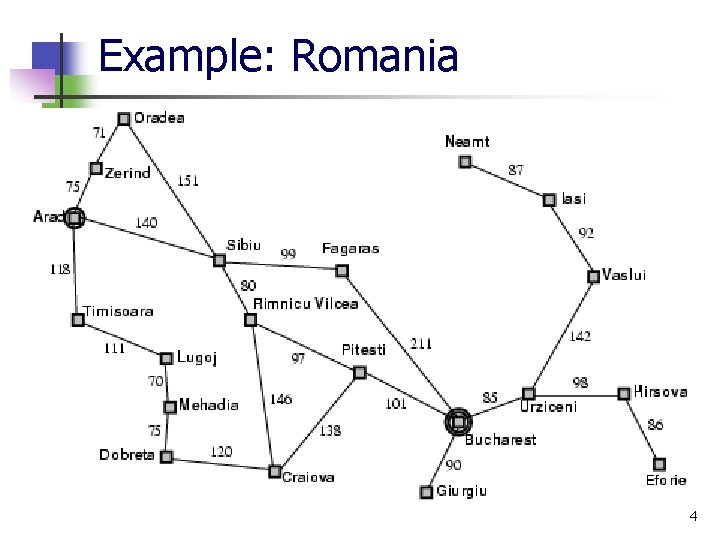
Example: Romania 4
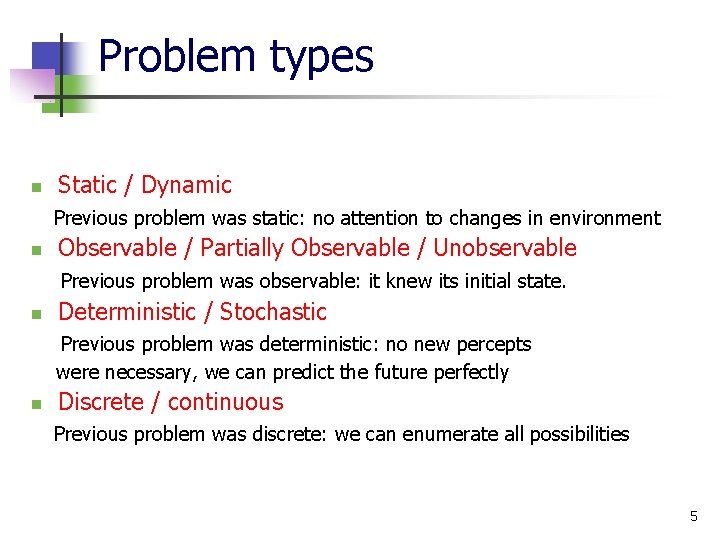
Problem types n Static / Dynamic Previous problem was static: no attention to changes in environment n Observable / Partially Observable / Unobservable Previous problem was observable: it knew its initial state. n Deterministic / Stochastic Previous problem was deterministic: no new percepts were necessary, we can predict the future perfectly n Discrete / continuous Previous problem was discrete: we can enumerate all possibilities 5
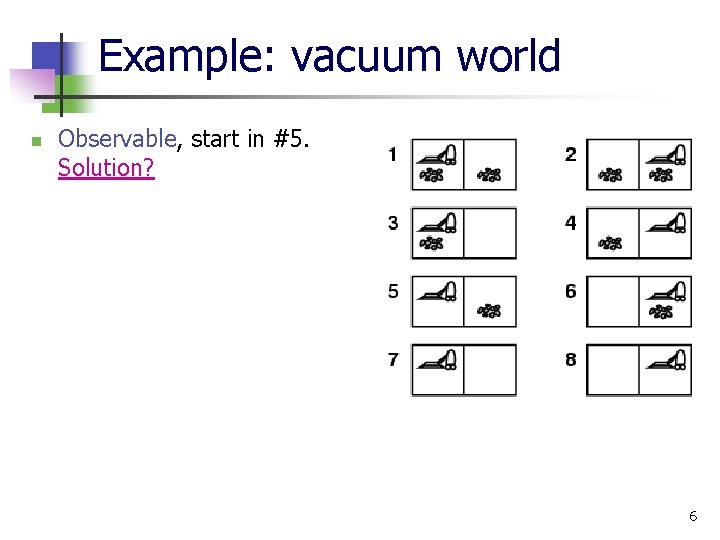
Example: vacuum world n Observable, start in #5. Solution? 6

Example: vacuum world n n Observable, start in #5. Solution? [Right, Suck] Unobservable, start in {1, 2, 3, 4, 5, 6, 7, 8} e. g. , Solution? 7
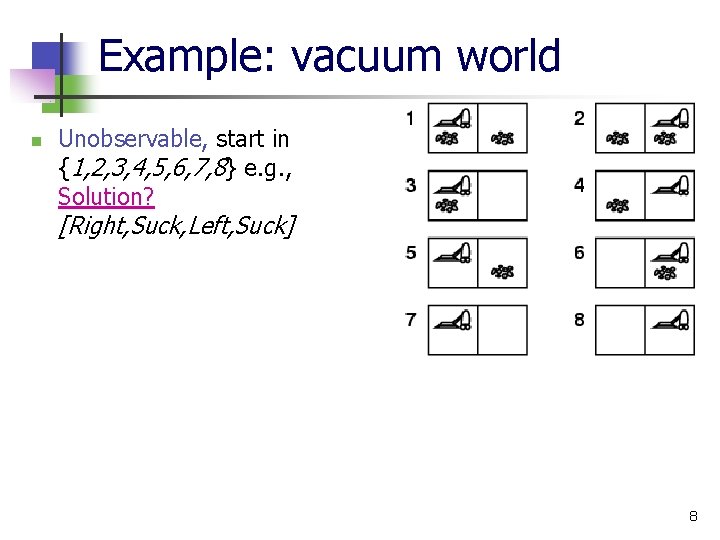
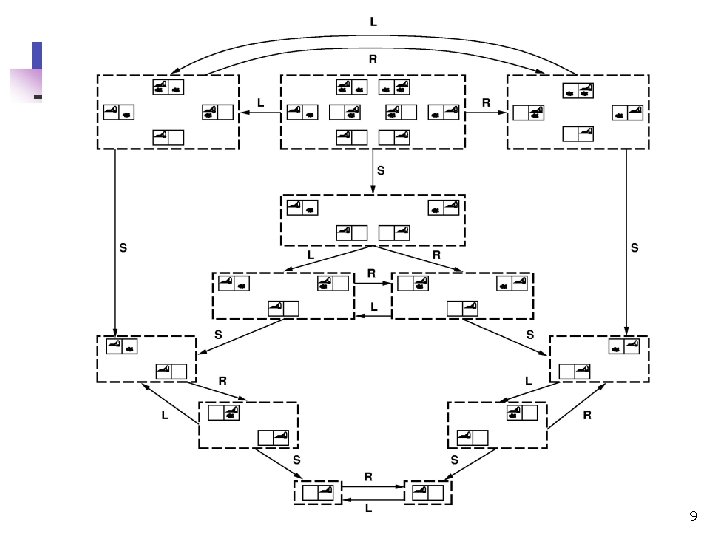
Example: vacuum world n Unobservable, start in {1, 2, 3, 4, 5, 6, 7, 8} e. g. , Solution? [Right, Suck, Left, Suck] 8
9

State-Space Problem Formulation A problem is defined by four items: initial state e. g. , "at Arad“ actions or successor function S(x) = set of action–state pairs n e. g. , S(Arad) = {<Arad Zerind, Zerind>, … } goal test, e. g. , x = "at Bucharest”, Checkmate(x) path cost (additive) n n e. g. , sum of distances, number of actions executed, etc. c(x, a, y) is the step cost, assumed to be ≥ 0 A solution is a sequence of actions leading from the initial state to a goal state 11
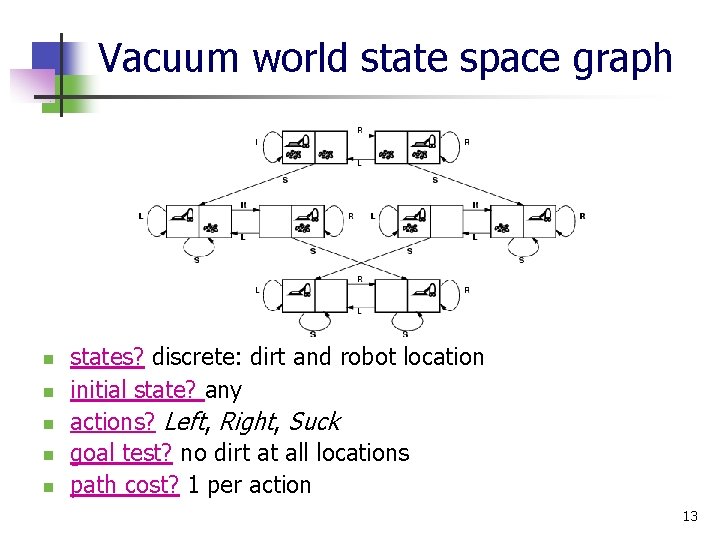
Vacuum world state space graph n n n states? discrete: dirt and robot location initial state? any actions? Left, Right, Suck goal test? no dirt at all locations path cost? 1 per action 13
Example: 8 -queen problem 14
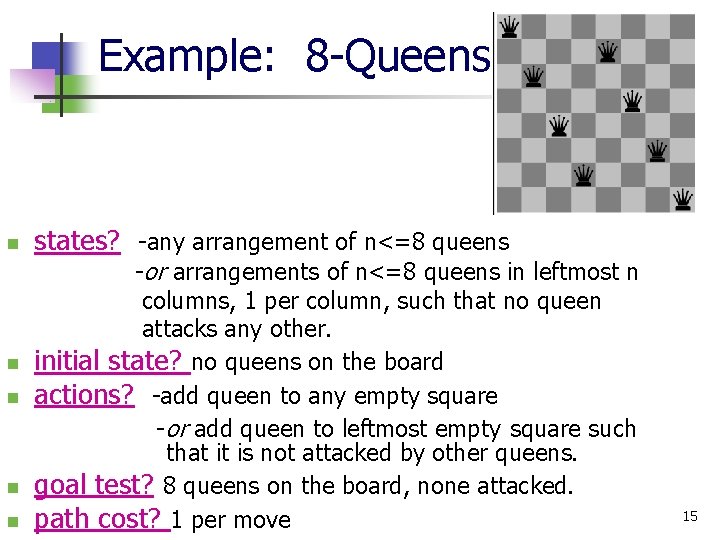
Example: 8 -Queens n n n states? -any arrangement of n<=8 queens -or arrangements of n<=8 queens in leftmost n columns, 1 per column, such that no queen attacks any other. initial state? no queens on the board actions? -add queen to any empty square -or add queen to leftmost empty square such that it is not attacked by other queens. goal test? 8 queens on the board, none attacked. path cost? 1 per move 15
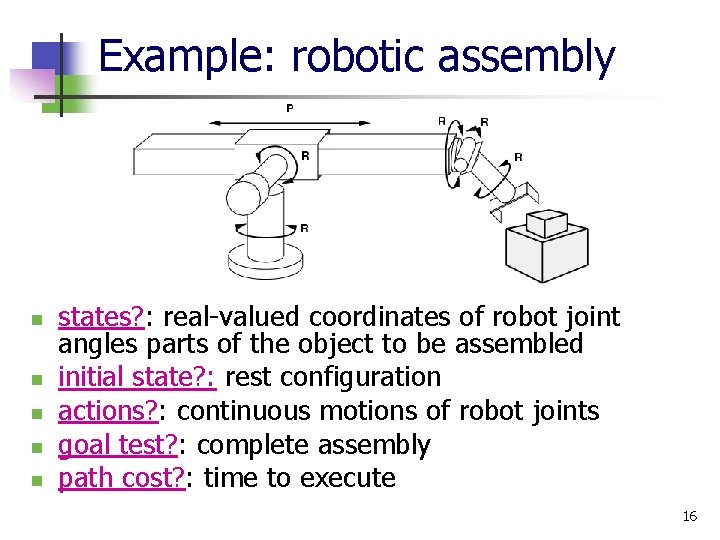
Example: robotic assembly n n n states? : real-valued coordinates of robot joint angles parts of the object to be assembled initial state? : rest configuration actions? : continuous motions of robot joints goal test? : complete assembly path cost? : time to execute 16
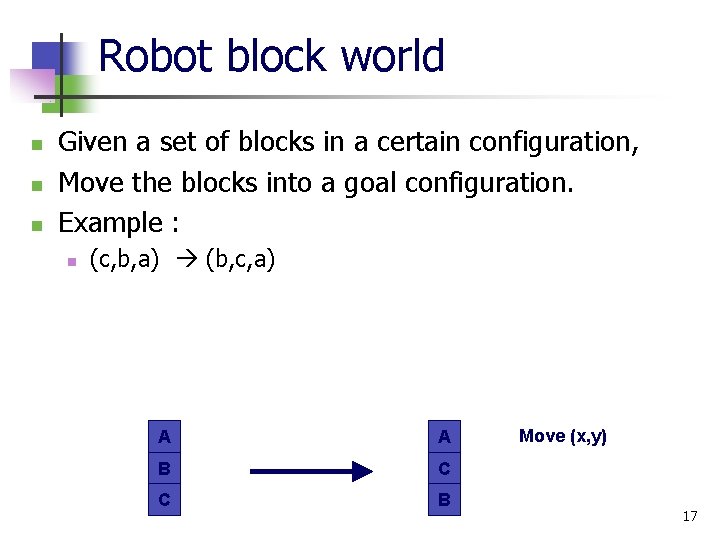
Robot block world n n n Given a set of blocks in a certain configuration, Move the blocks into a goal configuration. Example : n (c, b, a) (b, c, a) A A B C C B Move (x, y) 17
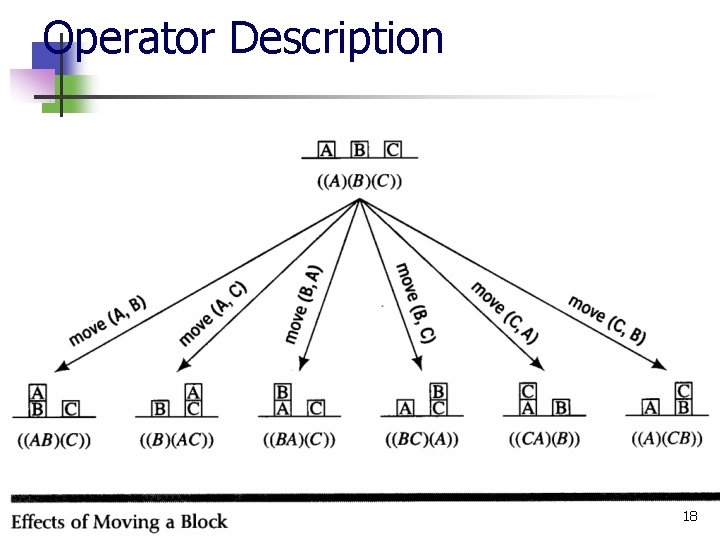
Operator Description 18
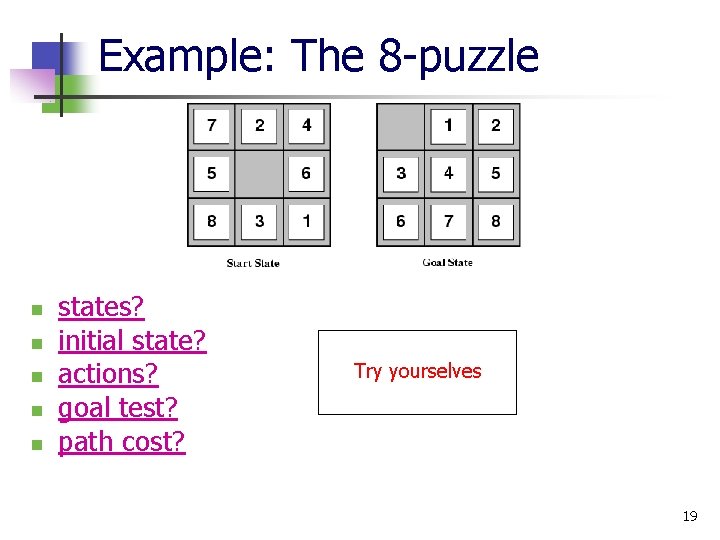
Example: The 8 -puzzle n n n states? initial state? actions? goal test? path cost? Try yourselves 19
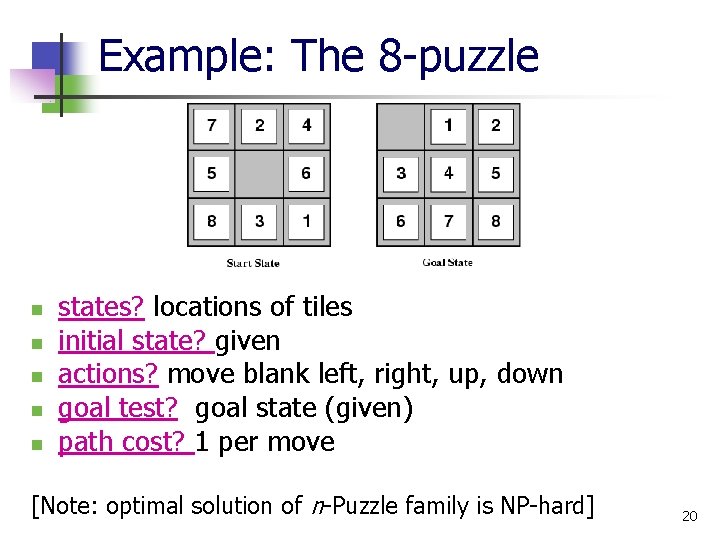
Example: The 8 -puzzle n n n states? locations of tiles initial state? given actions? move blank left, right, up, down goal test? goal state (given) path cost? 1 per move [Note: optimal solution of n-Puzzle family is NP-hard] 20
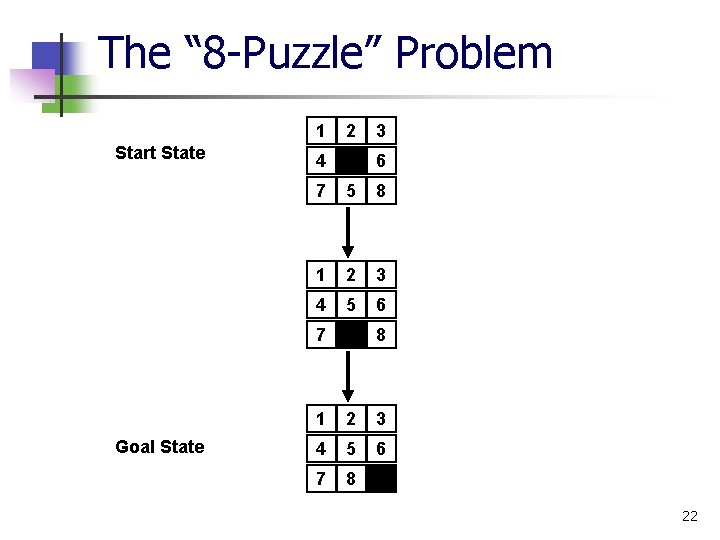
The “ 8 -Puzzle” Problem 1 Start State 2 4 6 7 5 8 1 2 3 4 5 6 7 Goal State 3 8 1 2 3 4 5 6 7 8 22
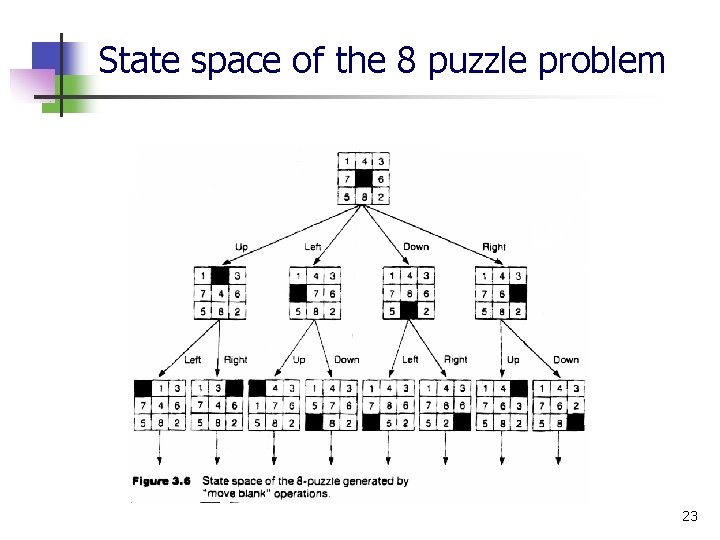
State space of the 8 puzzle problem 23
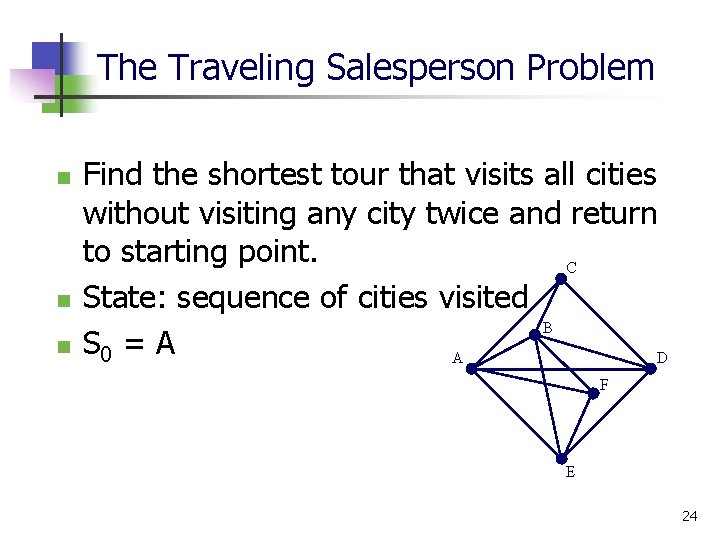
The Traveling Salesperson Problem n n n Find the shortest tour that visits all cities without visiting any city twice and return to starting point. C State: sequence of cities visited B S 0 = A A D F E 24
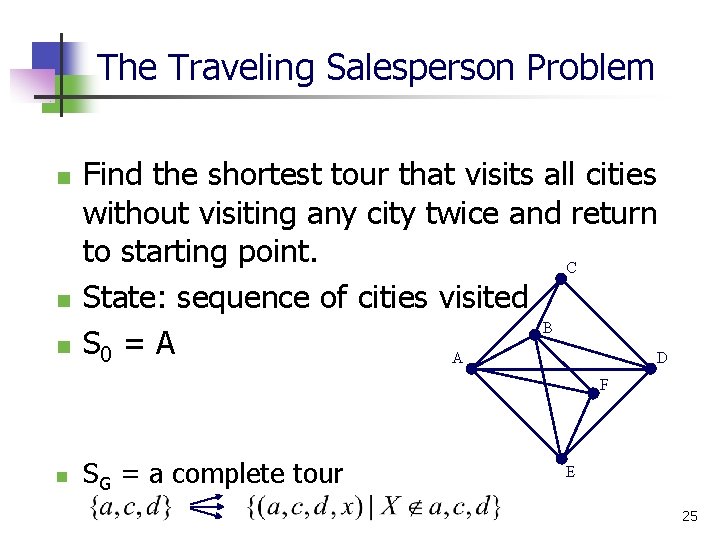
The Traveling Salesperson Problem n n n Find the shortest tour that visits all cities without visiting any city twice and return to starting point. C State: sequence of cities visited B S 0 = A A D F n SG = a complete tour E 25
The state-space graph n Graphs: n n Search graphs: n n States are nodes operators are directed arcs solution is a path from start to goal Problem formulation: n n nodes, arcs, directed arcs, paths Give an abstract description of states, operators, initial state and goal state. Problem solving: n Generate a part of the search space that contains a solution 26
Tree search algorithms n Basic idea: n n Exploration of state space graph by generating successors of already-explored states (a. k. a. expanding states). Every states is evaluated: is it a goal state? 27
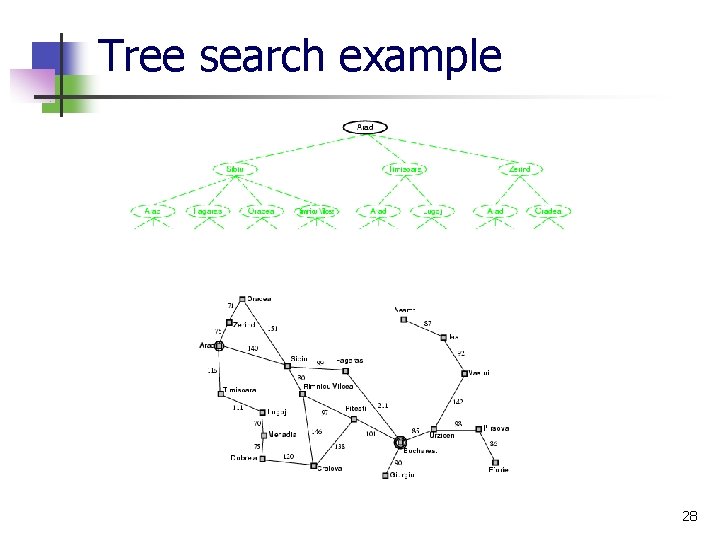
Tree search example 28
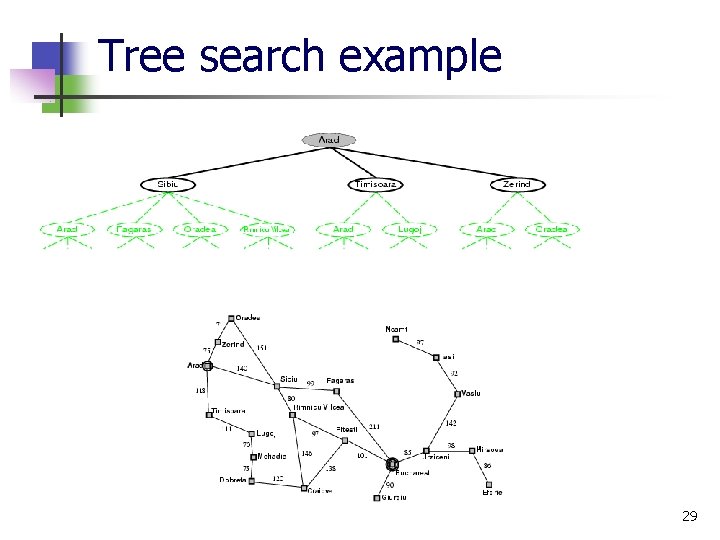
Tree search example 29
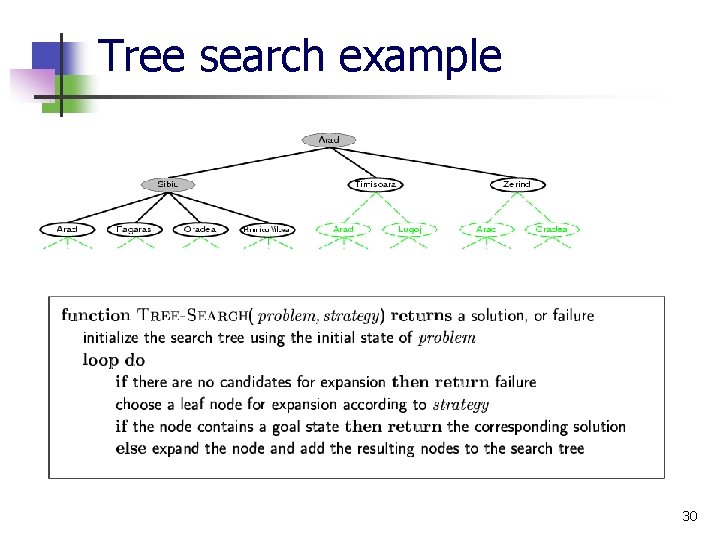
Tree search example 30
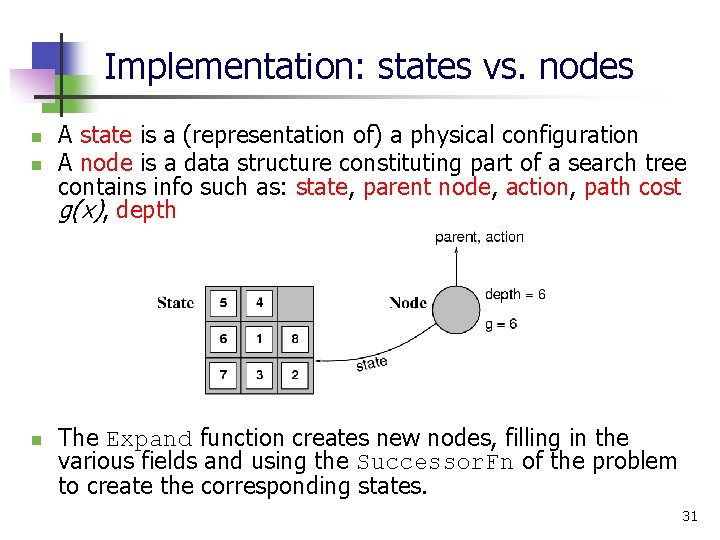
Implementation: states vs. nodes n n n A state is a (representation of) a physical configuration A node is a data structure constituting part of a search tree contains info such as: state, parent node, action, path cost g(x), depth The Expand function creates new nodes, filling in the various fields and using the Successor. Fn of the problem to create the corresponding states. 31
Search strategies n n A search strategy is defined by picking the order of node expansion Strategies are evaluated along the following dimensions: n n n completeness: does it always find a solution if one exists? time complexity: number of nodes generated space complexity: maximum number of nodes in memory optimality: does it always find a least-cost solution? Time and space complexity are measured in terms of n n n b: maximum branching factor of the search tree d: depth of the least-cost solution m: maximum depth of the state space (may be ∞) 32
Searching the search space n Uninformed Blind search n n n n Breadth-first uniform first depth-first Iterative deepening depth-first Bidirectional Branch and Bound Informed Heuristic search (next class) n Greedy search, hill climbing, Heuristics 33
Next time n Search Strategies Questions? 34
- Slides: 31