SOS Secure Overlay Services Angelos Keromytis Dept of

- Slides: 23
SOS: Secure Overlay Services Angelos Keromytis, Dept. of Computer Science Vishal Misra, Dept. of Computer Science Dan Rubenstein, Dept. of Electrical Engineering 1
SOS is a very small contribution to… r Columbia’s Networking Component of The Center for Resilient Networks in NYC [Columbia, Polytechnic U. , CCNY] r Columbia Networking Faculty: m m m m m Andrew Campbell Ed Coffman Predrag Jelenkovic Angelos Keromytis Aurel Lazar Nick Maxemchuk Vishal Misra Dan Rubenstein Henning Schulzrinne r and our students… 2
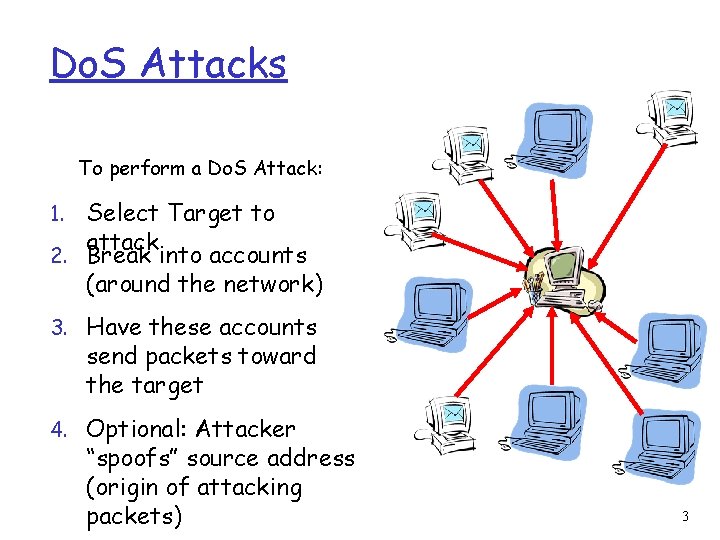
Do. S Attacks To perform a Do. S Attack: Select Target to attack 2. Break into accounts (around the network) 1. 3. Have these accounts send packets toward the target 4. Optional: Attacker “spoofs” source address (origin of attacking packets) 3
Goals of SOS r Allow moderate number of legitimate users to communicate with a target destination, where m m m Do. S attackers will attempt to stop communication to the target difficult to replicate (e. g. , info highly dynamic) legitimate users may be mobile (source IP address may change) r Example scenarios m FBI/Police/Fire personnel in the field communicating with their agency’s database m Bank users’ access to their banking records m On-line customer completing a transaction 4
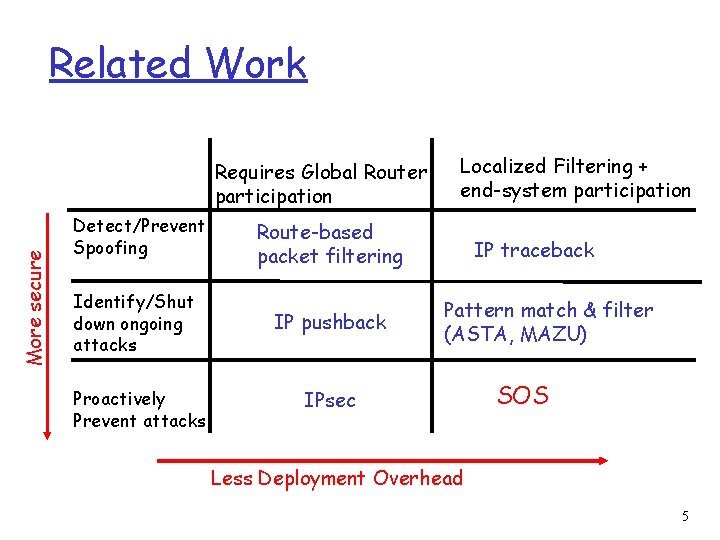
Related Work More secure Requires Global Router participation Detect/Prevent Spoofing Identify/Shut down ongoing attacks Proactively Prevent attacks Localized Filtering + end-system participation Route-based packet filtering IP pushback IP traceback Pattern match & filter (ASTA, MAZU) IPsec SOS Less Deployment Overhead 5
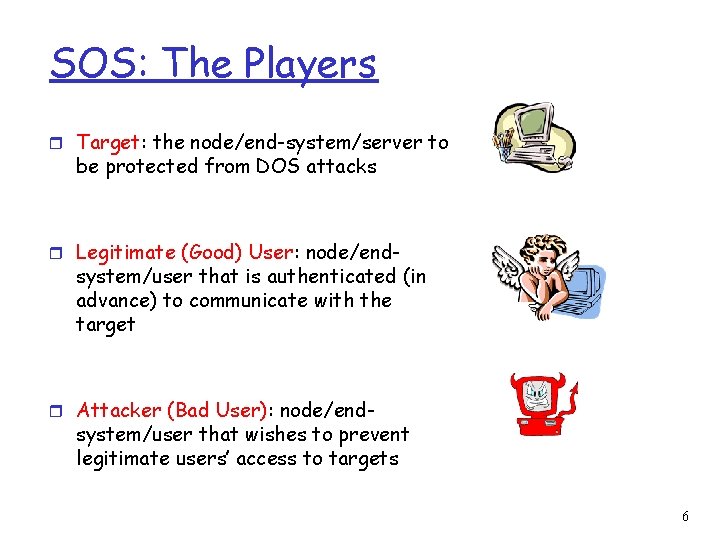
SOS: The Players r Target: the node/end-system/server to be protected from DOS attacks r Legitimate (Good) User: node/end- system/user that is authenticated (in advance) to communicate with the target r Attacker (Bad User): node/end- system/user that wishes to prevent legitimate users’ access to targets 6
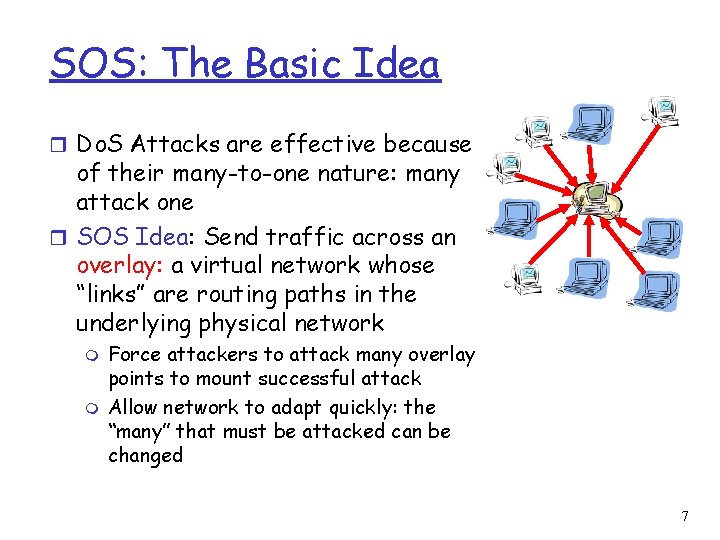
SOS: The Basic Idea r Do. S Attacks are effective because of their many-to-one nature: many attack one r SOS Idea: Send traffic across an overlay: a virtual network whose “links” are routing paths in the underlying physical network m m Force attackers to attack many overlay points to mount successful attack Allow network to adapt quickly: the “many” that must be attacked can be changed 7
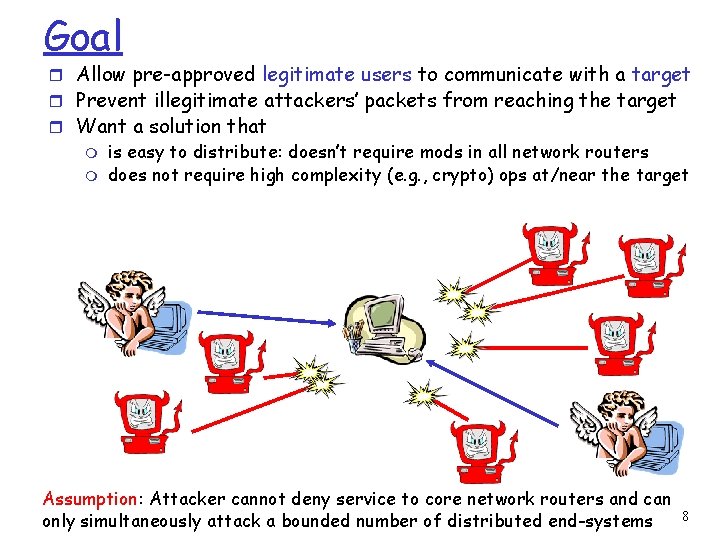
Goal r Allow pre-approved legitimate users to communicate with a target r Prevent illegitimate attackers’ packets from reaching the target r Want a solution that m is easy to distribute: doesn’t require mods in all network routers m does not require high complexity (e. g. , crypto) ops at/near the target Assumption: Attacker cannot deny service to core network routers and can only simultaneously attack a bounded number of distributed end-systems 8
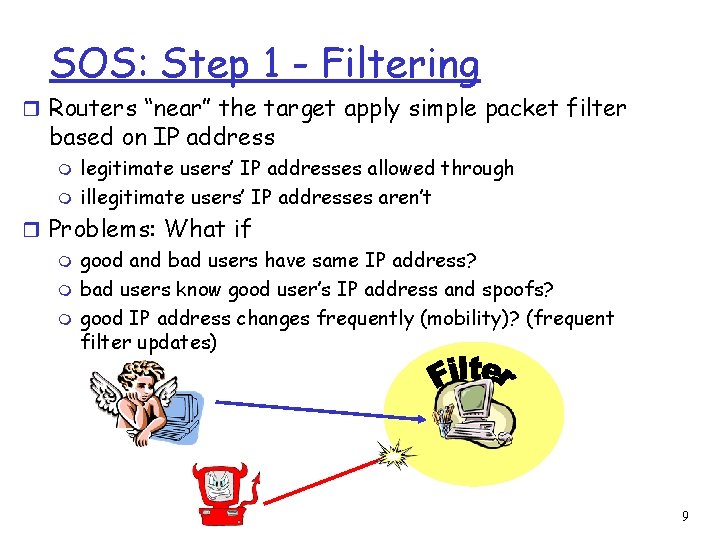
SOS: Step 1 - Filtering r Routers “near” the target apply simple packet filter based on IP address m m legitimate users’ IP addresses allowed through illegitimate users’ IP addresses aren’t r Problems: What if m good and bad users have same IP address? m bad users know good user’s IP address and spoofs? m good IP address changes frequently (mobility)? (frequent filter updates) 9
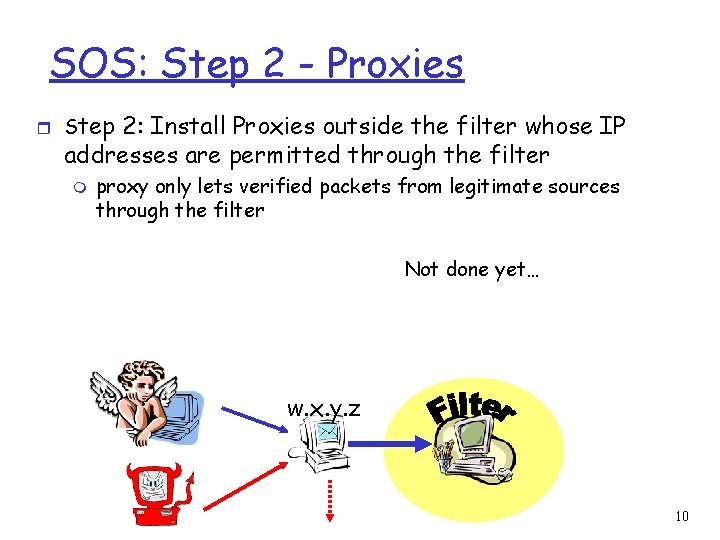
SOS: Step 2 - Proxies r Step 2: Install Proxies outside the filter whose IP addresses are permitted through the filter m proxy only lets verified packets from legitimate sources through the filter Not done yet… w. x. y. z 10
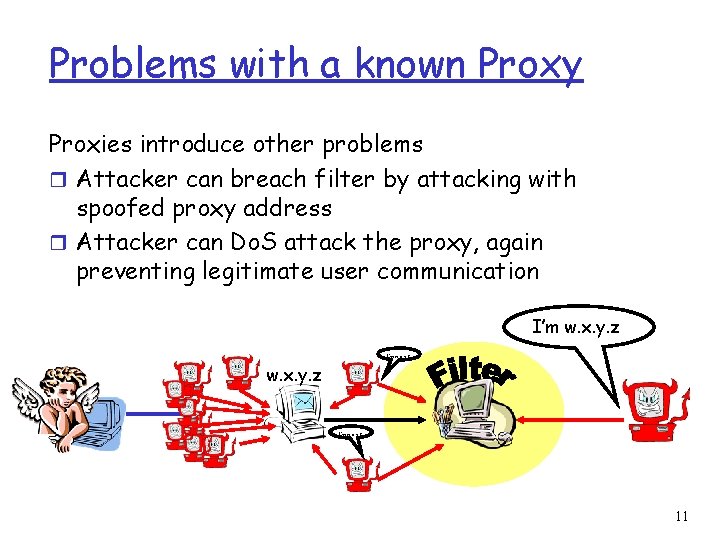
Problems with a known Proxy Proxies introduce other problems r Attacker can breach filter by attacking with spoofed proxy address r Attacker can Do. S attack the proxy, again preventing legitimate user communication I’m w. x. y. z I’m w. x. y. z 11
SOS: Step 3 - Secret Servlets r Step 3: Keep the identity of the proxy “hidden” m hidden proxy called a Secret Servlet m only target, the secret servlet itself, and a few other points in the network know the secret servlet’s identity (IP address) 12
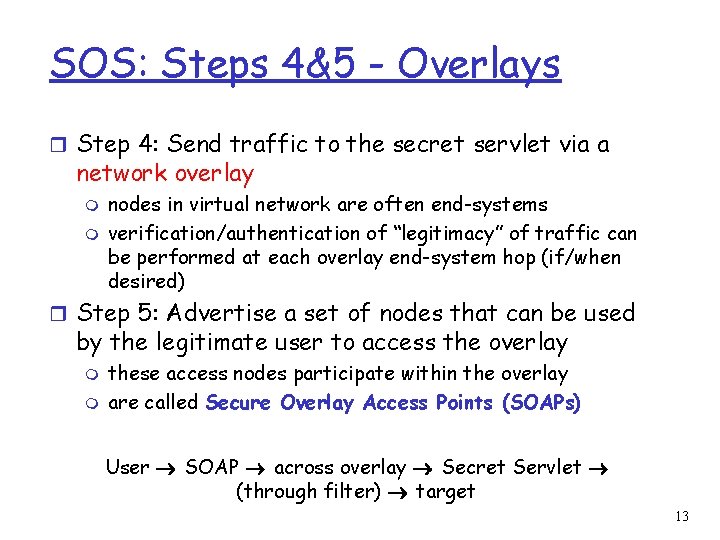
SOS: Steps 4&5 - Overlays r Step 4: Send traffic to the secret servlet via a network overlay m m nodes in virtual network are often end-systems verification/authentication of “legitimacy” of traffic can be performed at each overlay end-system hop (if/when desired) r Step 5: Advertise a set of nodes that can be used by the legitimate user to access the overlay m m these access nodes participate within the overlay are called Secure Overlay Access Points (SOAPs) User SOAP across overlay Secret Servlet (through filter) target 13
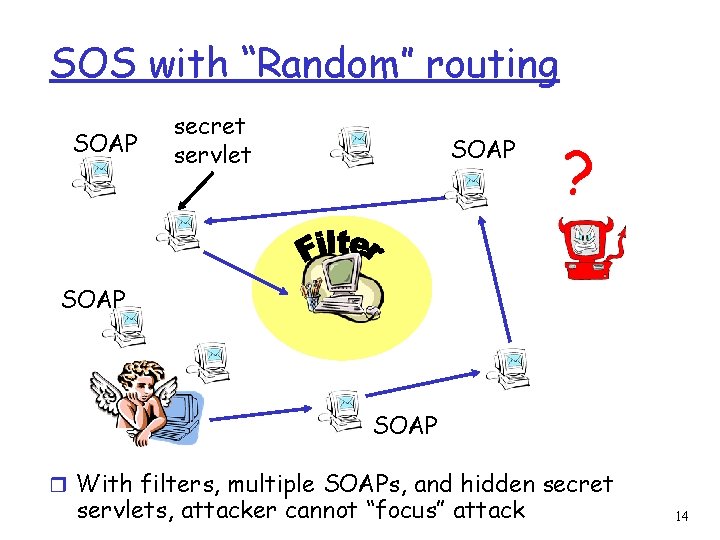
SOS with “Random” routing SOAP secret servlet SOAP ? SOAP r With filters, multiple SOAPs, and hidden secret servlets, attacker cannot “focus” attack 14
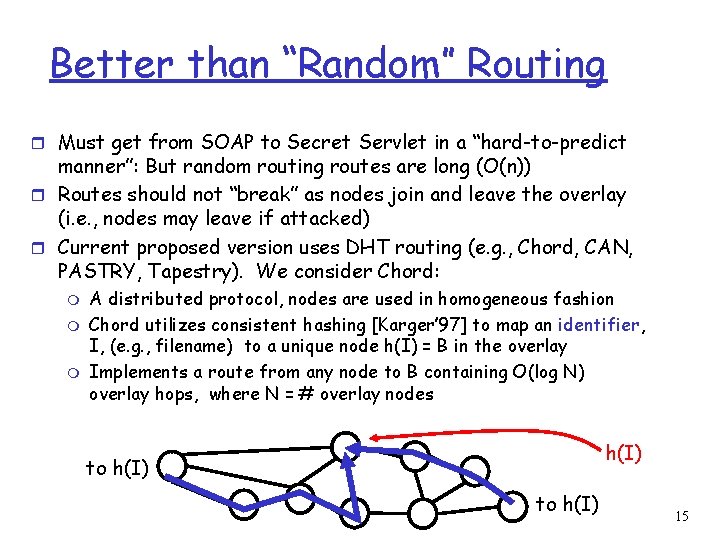
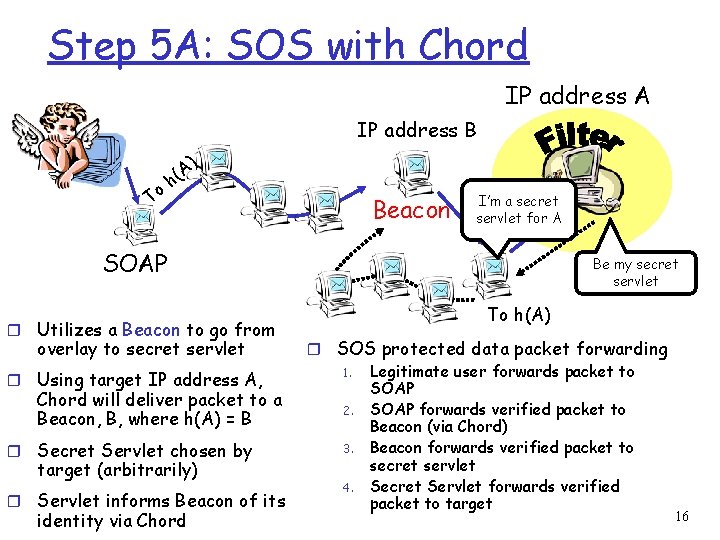
Better than “Random” Routing r Must get from SOAP to Secret Servlet in a “hard-to-predict manner”: But random routing routes are long (O(n)) r Routes should not “break” as nodes join and leave the overlay (i. e. , nodes may leave if attacked) r Current proposed version uses DHT routing (e. g. , Chord, CAN, PASTRY, Tapestry). We consider Chord: m m m A distributed protocol, nodes are used in homogeneous fashion Chord utilizes consistent hashing [Karger’ 97] to map an identifier, I, (e. g. , filename) to a unique node h(I) = B in the overlay Implements a route from any node to B containing O(log N) overlay hops, where N = # overlay nodes h(I) to h(I) 15
Step 5 A: SOS with Chord IP address A IP address B To ) A ( h Beacon I’m a secret servlet for A SOAP r r Utilizes a Beacon to go from overlay to secret servlet Be my secret servlet To h(A) r SOS protected data packet forwarding Using target IP address A, Chord will deliver packet to a Beacon, B, where h(A) = B 1. Secret Servlet chosen by target (arbitrarily) 3. Servlet informs Beacon of its identity via Chord 2. 4. Legitimate user forwards packet to SOAP forwards verified packet to Beacon (via Chord) Beacon forwards verified packet to secret servlet Secret Servlet forwards verified packet to target 16
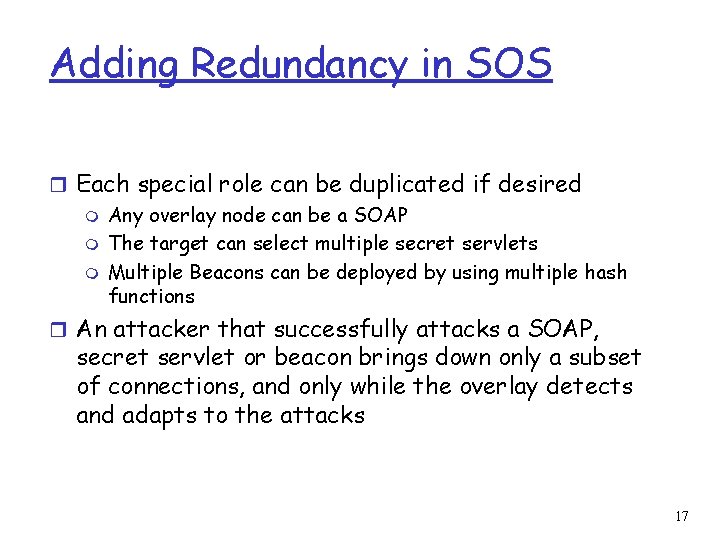
Adding Redundancy in SOS r Each special role can be duplicated if desired m Any overlay node can be a SOAP m The target can select multiple secret servlets m Multiple Beacons can be deployed by using multiple hash functions r An attacker that successfully attacks a SOAP, secret servlet or beacon brings down only a subset of connections, and only while the overlay detects and adapts to the attacks 17
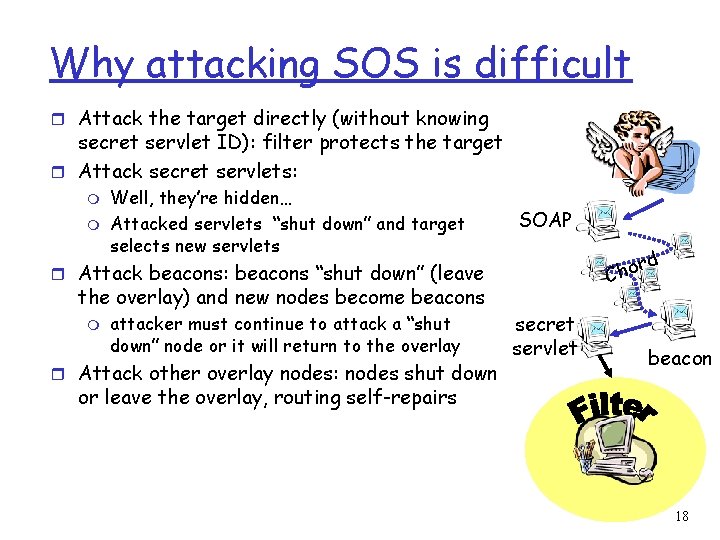
Why attacking SOS is difficult r Attack the target directly (without knowing secret servlet ID): filter protects the target r Attack secret servlets: m m Well, they’re hidden… Attacked servlets “shut down” and target selects new servlets SOAP rd Cho r Attack beacons: beacons “shut down” (leave the overlay) and new nodes become beacons m attacker must continue to attack a “shut down” node or it will return to the overlay r Attack other overlay nodes: nodes shut down secret servlet beacon or leave the overlay, routing self-repairs 18
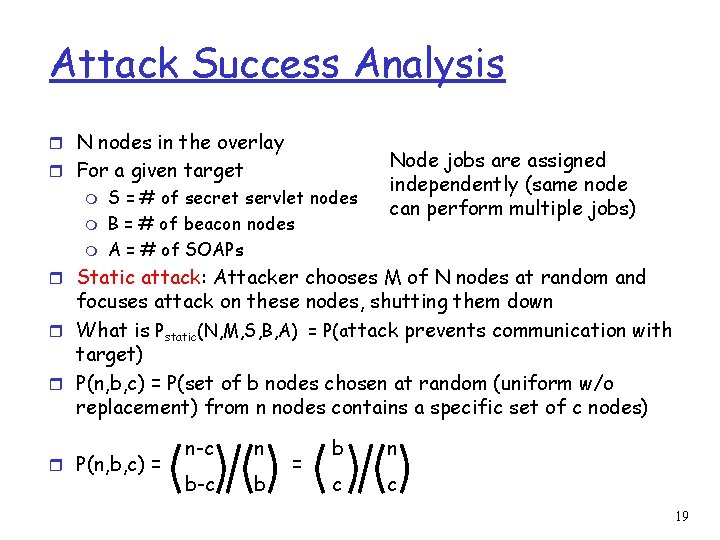
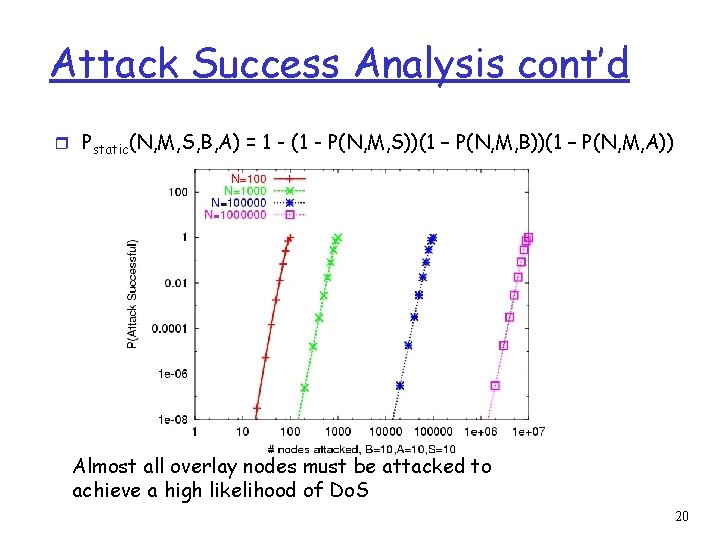
Attack Success Analysis r N nodes in the overlay r For a given target m m m S = # of secret servlet nodes B = # of beacon nodes A = # of SOAPs Node jobs are assigned independently (same node can perform multiple jobs) r Static attack: Attacker chooses M of N nodes at random and focuses attack on these nodes, shutting them down r What is Pstatic(N, M, S, B, A) = P(attack prevents communication with target) r P(n, b, c) = P(set of b nodes chosen at random (uniform w/o replacement) from n nodes contains a specific set of c nodes) r P(n, b, c) = n-c n b-c b = b n c c 19
Attack Success Analysis cont’d r Pstatic(N, M, S, B, A) = 1 - (1 - P(N, M, S))(1 – P(N, M, B))(1 – P(N, M, A)) Almost all overlay nodes must be attacked to achieve a high likelihood of Do. S 20
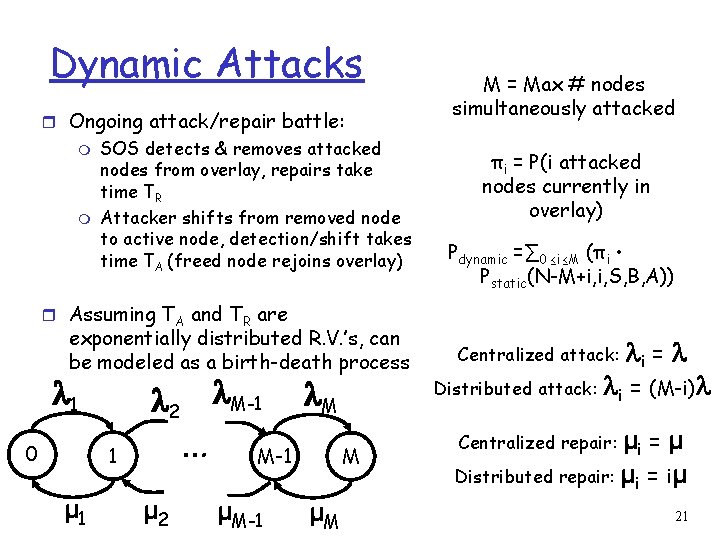
Dynamic Attacks r Ongoing attack/repair battle: m m SOS detects & removes attacked nodes from overlay, repairs take time TR Attacker shifts from removed node to active node, detection/shift takes time TA (freed node rejoins overlay) M = Max # nodes simultaneously attacked πi = P(i attacked nodes currently in overlay) Pdynamic =∑ 0 ≤i ≤M (πi • Pstatic(N-M+i, i, S, B, A)) r Assuming TA and TR are exponentially distributed R. V. ’s, can be modeled as a birth-death process 1 0 2 … 1 μ 2 M-1 M M-1 μM-1 M μM Centralized attack: Distributed attack: i = (M-i) μi = μ Distributed repair: μi = iμ Centralized repair: 21
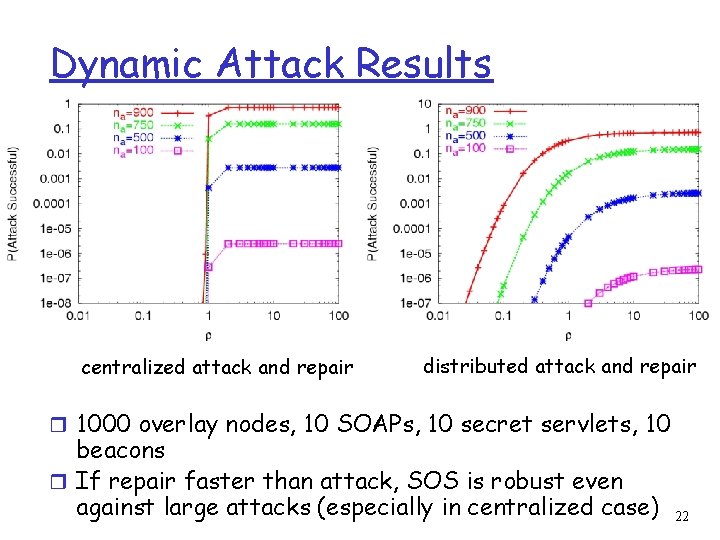
Dynamic Attack Results centralized attack and repair distributed attack and repair r 1000 overlay nodes, 10 SOAPs, 10 secret servlets, 10 beacons r If repair faster than attack, SOS is robust even against large attacks (especially in centralized case) 22
Conclusion r SOS protects a target from Do. S attacks m lets legitimate (authenticated) users through r Approach m Filter around the target m Allow “hidden” proxies to pass through the filter m Use network overlays to allow legitimate users to reach the “hidden” proxies r Preliminary Analysis Results m An attacker without overlay “insider” knowledge must attack majority of overlay nodes to deny service to target 23