
Peer to Peer Overlay Network for Sensor net
- Slides: 32
Peer to Peer Overlay Network for Sensor net Eng. Husam Alzaq Computer Engineering Department Islamic University of Gaza hzaq@iugaza. edu. ps 1
Agenda Introduction Background Design & Evaluation Conclusion Introduction Background on Wireless Sensor Network Peer to Peer Systems Concept Implementation Results Conclusion Peer to Peer Overlay Netzwerk für Sensorennetze Husam Alzaq 2/31
What are Wireless Sensor Nodes? Introduction Background Design & Evaluation Conclusion They are small electronic components capable of sensing many types of information from the environment. They are equipped with a certain amount of computational power, communication, storage and often actuation resources. Peer to Peer Overlay Netzwerk für Sensorennetze Husam Alzaq 3/31
What is WSN? Introduction Background Design & Evaluation Conclusion It is a network that has multiple nodes connected to each other wirelessly Sensor Network is distributed and is not structured. Peer to Peer Overlay Netzwerk für Sensorennetze Husam Alzaq 4/31
Constraints/Challanges Introduction Background Design & Evaluation Conclusion Hardware Power Consumption Software Issues to be addresses: Lifetime maximization Robustness and fault tolerance Self-configuration Algorithms Design of energy-aware algorithms Peer to Peer Overlay Netzwerk für Sensorennetze Husam Alzaq 5/31
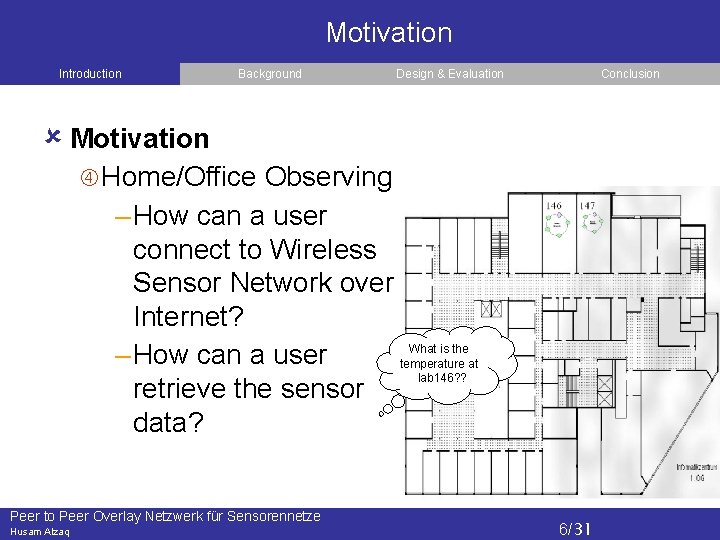
Motivation Introduction Background Design & Evaluation Conclusion Motivation Home/Office Observing – How can a user connect to Wireless Sensor Network over Internet? What is the – How can a user temperature at lab 146? ? retrieve the sensor data? Peer to Peer Overlay Netzwerk für Sensorennetze Husam Alzaq 6/31
Motivation Introduction Background Design & Evaluation Conclusion Solution Peer to Peer Systems provide an overlay network that is able to connect a user to a Wireless Sensor Network. Declarative Query would serve as a way to express user’s requests. Peer to Peer Overlay Netzwerk für Sensorennetze Husam Alzaq 7/31
A Middleware for Sensor Networks Introduction Background Design & Evaluation Conclusion A middleware for sensor networks supports the development, maintenance, deployment, and execution of sensing-based applications. Building a Peer to Peer application on existing WSN is important. The complexity of accessing different sensor nodes must be hidden. Many services can be offered. – Discovering Sensor gateway – Obtaining sensor data Distributed Wireless Sensor Networks (WSNs) can be observed. Peer to Peer Overlay Netzwerk für Sensorennetze Husam Alzaq 8/31
Peer to Peer Systems Introduction Background Design & Evaluation Conclusion A Peer to Peer system is defined as a class of systems and applications that employs distributed resources to perform a critical function in a decentralized manner. The resources encompass computing power, data, network bandwidth. . . etc. The critical function can be distributed computing, data/content sharing, communication and collaboration, or platform services. Peer to Peer Overlay Netzwerk für Sensorennetze Husam Alzaq 9/31
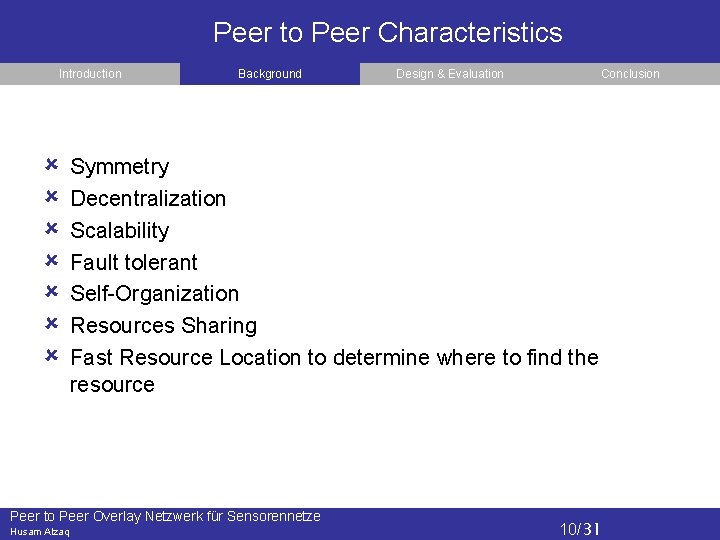
Peer to Peer Characteristics Introduction Background Conclusion Symmetry Decentralization Scalability Fault tolerant Self-Organization Resources Sharing Fast Resource Location to determine where to find the resource Peer to Peer Overlay Netzwerk für Sensorennetze Husam Alzaq Design & Evaluation 10/31
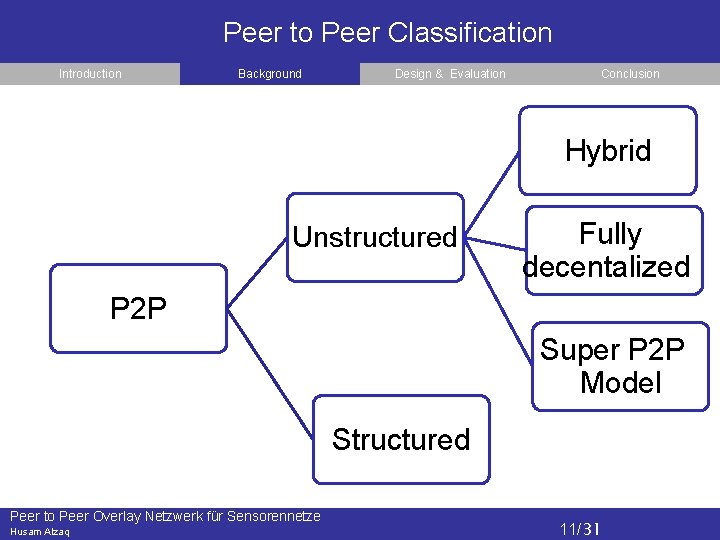
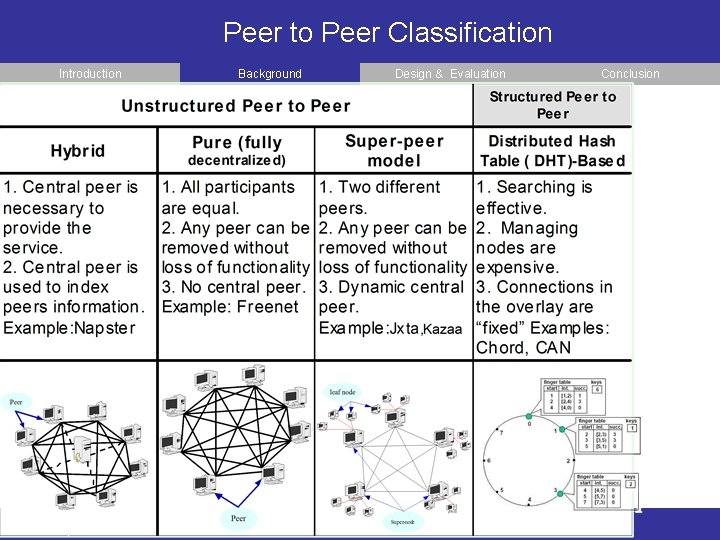
Peer to Peer Classification Introduction Background Design & Evaluation Conclusion Hybrid Unstructured Fully decentalized P 2 P Super P 2 P Model Structured Peer to Peer Overlay Netzwerk für Sensorennetze Husam Alzaq 11/31
Peer to Peer Classification Introduction Background Peer to Peer Overlay Netzwerk für Sensorennetze Husam Alzaq Design & Evaluation Conclusion 12/31
Why Jxta? Introduction Background Design & Evaluation Conclusion Jxta is a generic overlay network system. It consists of a set of protocols that are language, platform and network independent. Java based and C implementation It connects devices on the network ranging from embedded system and cellular phones to PCs and servers. Peer to Peer Overlay Netzwerk für Sensorennetze Husam Alzaq 13/31
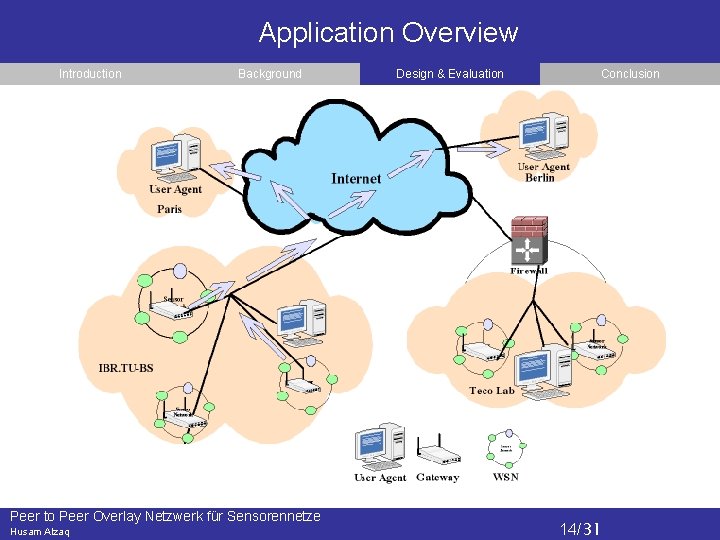
Application Overview Introduction Background Peer to Peer Overlay Netzwerk für Sensorennetze Husam Alzaq Design & Evaluation Conclusion 14/31
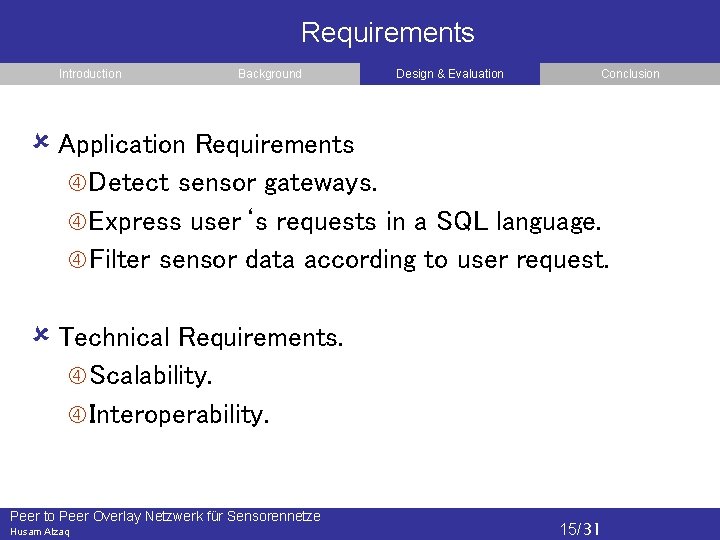
Requirements Introduction Background Design & Evaluation Conclusion Application Requirements Detect sensor gateways. Express user‘s requests in a SQL language. Filter sensor data according to user request. Technical Requirements. Scalability. Interoperability. Peer to Peer Overlay Netzwerk für Sensorennetze Husam Alzaq 15/31
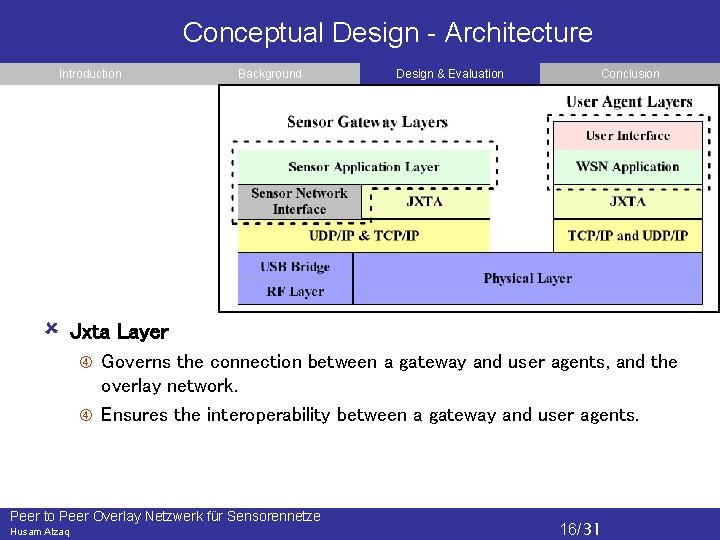
Conceptual Design - Architecture Introduction Background Design & Evaluation Conclusion Jxta Layer Governs the connection between a gateway and user agents, and the overlay network. Ensures the interoperability between a gateway and user agents. Peer to Peer Overlay Netzwerk für Sensorennetze Husam Alzaq 16/31
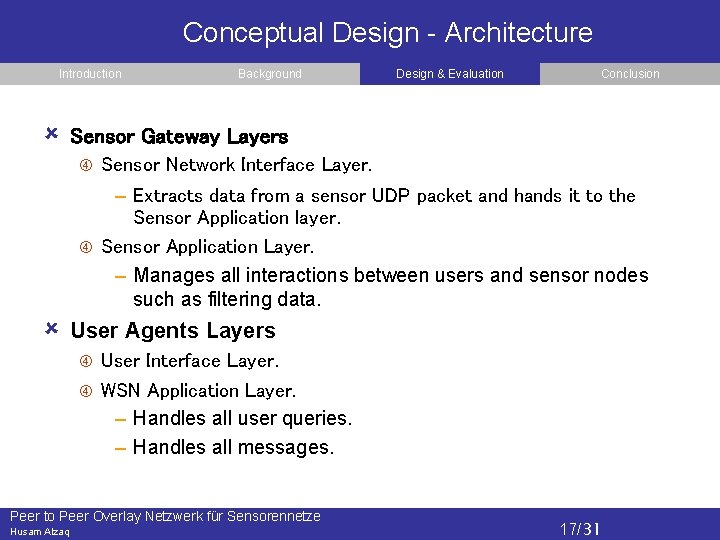
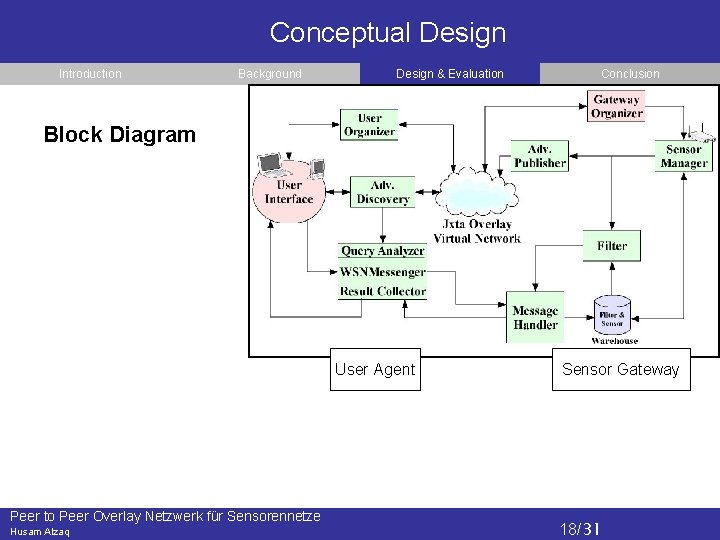
Conceptual Design - Architecture Introduction Background Design & Evaluation Conclusion Sensor Gateway Layers Sensor Network Interface Layer. – Extracts data from a sensor UDP packet and hands it to the Sensor Application layer. Sensor Application Layer. – Manages all interactions between users and sensor nodes such as filtering data. User Agents Layers User Interface Layer. WSN Application Layer. – Handles all user queries. – Handles all messages. Peer to Peer Overlay Netzwerk für Sensorennetze Husam Alzaq 17/31
Conceptual Design Introduction Background Design & Evaluation Conclusion Block Diagram User Agent Peer to Peer Overlay Netzwerk für Sensorennetze Husam Alzaq Sensor Gateway 18/31
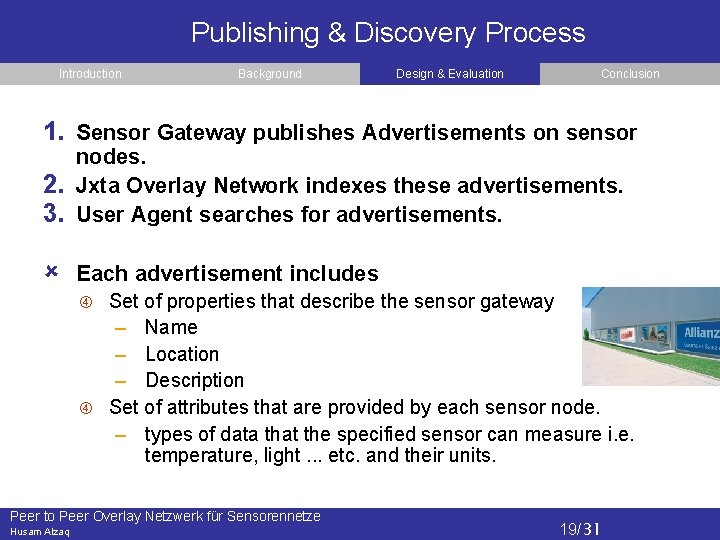
Publishing & Discovery Process Introduction Background Design & Evaluation Conclusion 1. Sensor Gateway publishes Advertisements on sensor nodes. 2. Jxta Overlay Network indexes these advertisements. 3. User Agent searches for advertisements. Each advertisement includes Set of properties that describe the sensor gateway – Name – Location – Description Set of attributes that are provided by each sensor node. – types of data that the specified sensor can measure i. e. temperature, light. . . etc. and their units. Peer to Peer Overlay Netzwerk für Sensorennetze Husam Alzaq 19/31
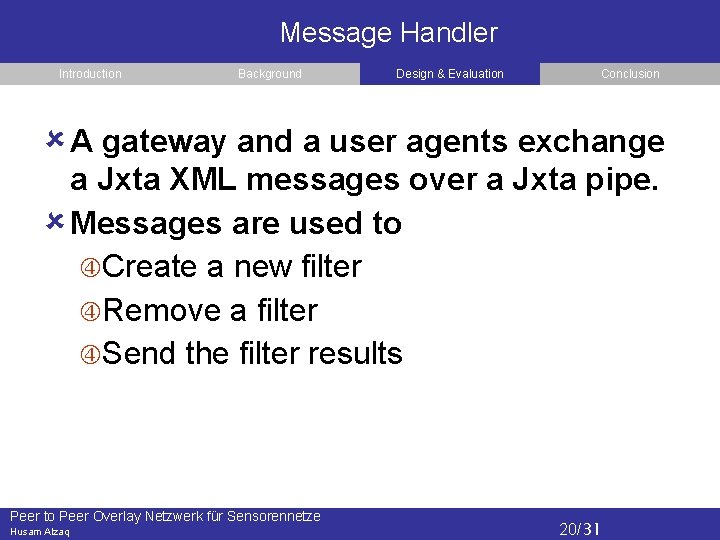
Message Handler Introduction Background Design & Evaluation Conclusion A gateway and a user agents exchange a Jxta XML messages over a Jxta pipe. Messages are used to Create a new filter Remove a filter Send the filter results Peer to Peer Overlay Netzwerk für Sensorennetze Husam Alzaq 20/31
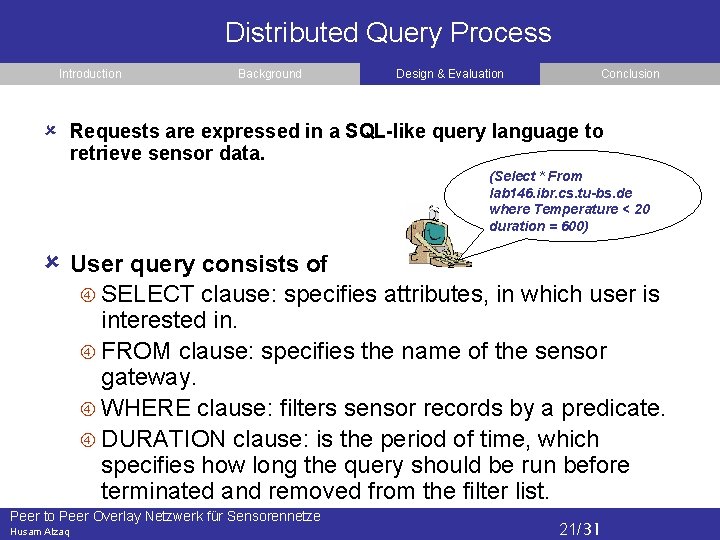
Distributed Query Process Introduction Background Design & Evaluation Conclusion Requests are expressed in a SQL-like query language to retrieve sensor data. (Select * From lab 146. ibr. cs. tu-bs. de where Temperature < 20 duration = 600) User query consists of SELECT clause: specifies attributes, in which user is interested in. FROM clause: specifies the name of the sensor gateway. WHERE clause: filters sensor records by a predicate. DURATION clause: is the period of time, which specifies how long the query should be run before terminated and removed from the filter list. Peer to Peer Overlay Netzwerk für Sensorennetze Husam Alzaq 21/31
Distributed Query Process Introduction Background Design & Evaluation Conclusion Query is distributively processed as follows: 1. 2. 3. 4. 5. The gateway name is extracted from the user query (specified in FROM) in order to establish a connection with the gateway. The WHERE clause is encapsulated in a Query XMLbased message. The Query message is sent out to the gateway. After that, the received results are displayed according to SELECT clause. Query is terminated either by user or by gateway. Peer to Peer Overlay Netzwerk für Sensorennetze Husam Alzaq 22/31
Filter Process Introduction Background Design & Evaluation Conclusion Filter process is a way to suppress sensor tuples from randomly propagation and hand them in graceful manner to all interested users Sensor tuples are a discrete raw of data generated at discrete time not stored in a data warehouse. Filter is created by a user query. Filter is activated for each received tuples. Filter is only deleted in two cases by user -> explicitly or implicitly time is up Peer to Peer Overlay Netzwerk für Sensorennetze Husam Alzaq 23/31
Filter Process Introduction Background Design & Evaluation Conclusion Filter mechanism is based on attributes, which are described by key-value-operator. Key indicates the semantics of the attribute Operator describes how attributes will match when two attributes are compared (<, >, =, . . . etc. ). . Typical attributes values – Sensor reading includes, temperature, voltage, light. . etc. – Meta-data encompasses general information about a sensor node e. g. sensor ID. – Internal state is any information that is not related to sensor reading, such as timestamps. Peer to Peer Overlay Netzwerk für Sensorennetze Husam Alzaq 24/31
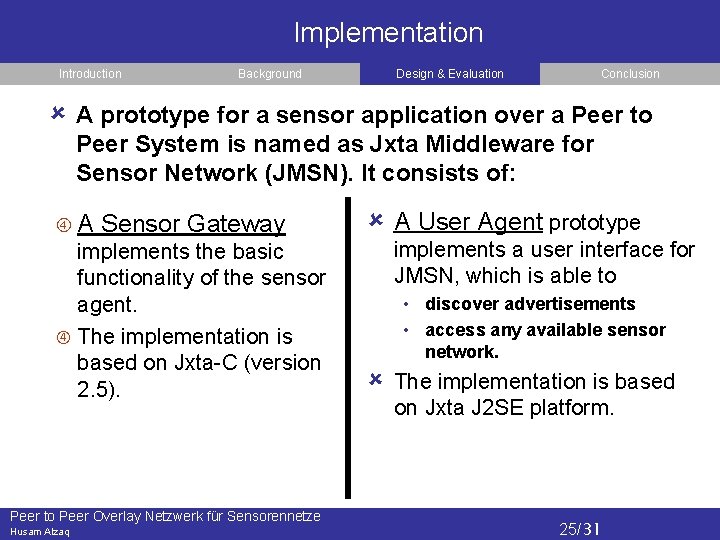
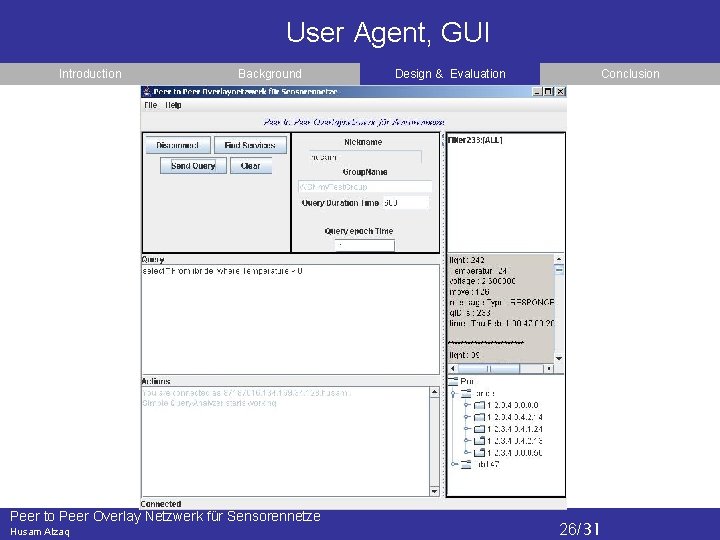
Implementation Introduction Background Design & Evaluation Conclusion A prototype for a sensor application over a Peer to Peer System is named as Jxta Middleware for Sensor Network (JMSN). It consists of: A Sensor Gateway implements the basic functionality of the sensor agent. The implementation is based on Jxta-C (version 2. 5). Peer to Peer Overlay Netzwerk für Sensorennetze Husam Alzaq A User Agent prototype implements a user interface for JMSN, which is able to • discover advertisements • access any available sensor network. The implementation is based on Jxta J 2 SE platform. 25/31
User Agent, GUI Introduction Background Peer to Peer Overlay Netzwerk für Sensorennetze Husam Alzaq Design & Evaluation Conclusion 26/31
Evaluation Introduction Background Design & Evaluation Conclusion Test-bed Equipments Tests ware performed at the Workstation pool of IBR, where twelve machines of identical hardware used. They are equipped with – Intel Pentium(r) D CPU 3. 2 GHz – 2. 00 GB of RAM – Fast Ethernet card. Half of them run Windows XP and the other run Debian GNU/Linux distribution. Peer to Peer Overlay Netzwerk für Sensorennetze Husam Alzaq 27/31
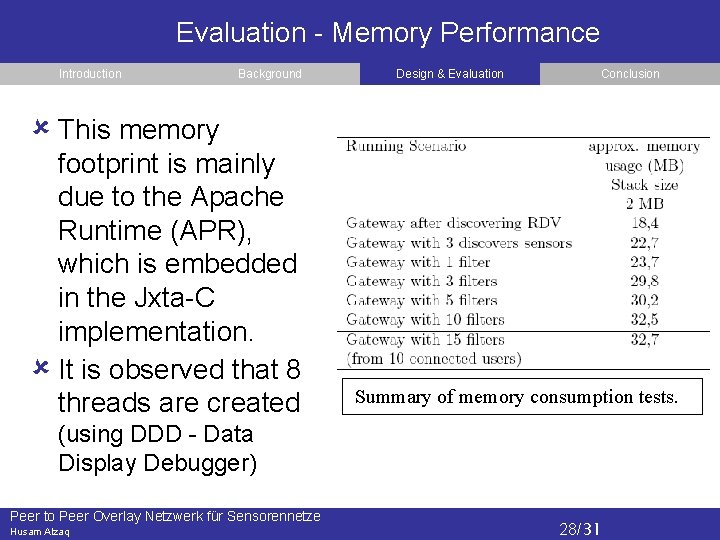
Evaluation - Memory Performance Introduction Background Design & Evaluation Conclusion This memory footprint is mainly due to the Apache Runtime (APR), which is embedded in the Jxta-C implementation. It is observed that 8 threads are created Summary of memory consumption tests. (using DDD - Data Display Debugger) Peer to Peer Overlay Netzwerk für Sensorennetze Husam Alzaq 28/31
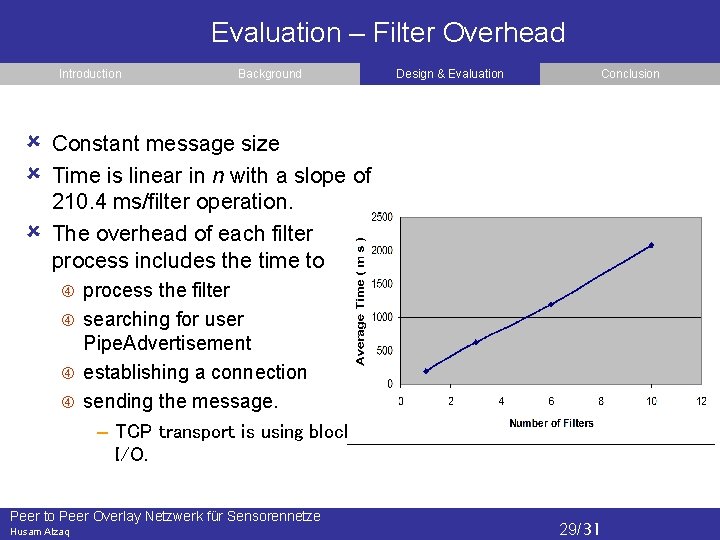
Evaluation – Filter Overhead Introduction Background Design & Evaluation Conclusion Constant message size Time is linear in n with a slope of 210. 4 ms/filter operation. The overhead of each filter process includes the time to process the filter searching for user Pipe. Advertisement establishing a connection sending the message. – TCP transport is using blocking I/O. Peer to Peer Overlay Netzwerk für Sensorennetze Husam Alzaq 29/31
Conclusion Introduction Background Design & Evaluation Conclusion Peer to Peer Systems provide a decentralized approach that does not require any costly infrastructure. Jxta was selected among other systems since it is a generic overlay network that connects devices on the network. The design of “Peer to Peer overlay network for sensornets” combines a peer service discovery with a distributed query processing. JMSN design doesn‘t come without cost. Results showed that the current implementation of Jxta-C consumes memory, which is not efficient for embedded system with limited memory. Peer to Peer Overlay Netzwerk für Sensorennetze Husam Alzaq 30/31
Future Work Introduction Background Design & Evaluation Conclusion It is essential to extend the current version of Jxta-C implementation to cope with the limited memory devices. It is necessary to enhance the user agent with complex query searching by partial names and attributes such as Location. Aggregate function such as Average, Max, Count. . . etc. Peer to Peer Overlay Netzwerk für Sensorennetze Husam Alzaq 31/31
Introduction Background Design & Evaluation Conclusion ﺷﻜﺮ ﻻﺳﺘﻤﺎﻋﻜﻢ Thanks for your attention Peer to Peer Overlay Netzwerk für Sensorennetze Husam Alzaq 32/31