SOFTWARE TOOLS FOR KLYSTRON DESIGN OPTIMIZATION Juliette Plouin



- Slides: 25
SOFTWARE TOOLS FOR KLYSTRON DESIGN OPTIMIZATION Juliette Plouin CEA, France www. cea. fr JUNE 18, 2019 ARIES WORKSHOP ON ENERGY EFFICIENT RF Juliette PLOUIN– ARIES Workshop on 1 Energy Efficient RF 18/06/2019
SUMMARY 1. How to develop a klystron design? 2. 1 D and 2 D steady state code 3. 2 D and 3 D Particle In Cell (PIC) codes 4. Codes results comparison 5. Conclusion June 18, 2019 Juliette PLOUIN– ARIES Workshop on Energy Efficient RF 2
1. HOW TO DEVELOP A KLYSTRON DESIGN? Juliette PLOUIN– ARIES Workshop on Energy Efficient RF 3 JUNE 18, 2019
THE KLYSTRON – A COMPLICATED OBJECT… Focusing coils magnetostatics Cavities RF propagation RF losses Electron gun electrostatics Beam dynamics Coupling with RF Collector Beam dynamics materials Output wave guide RF propagation The design of klystrons has long been a manual process guided by experience. . . Klystrons have been developed since the 1940’s, before computers . June 18, 2019 Juliette PLOUIN– ARIES Workshop on Energy Efficient RF 4
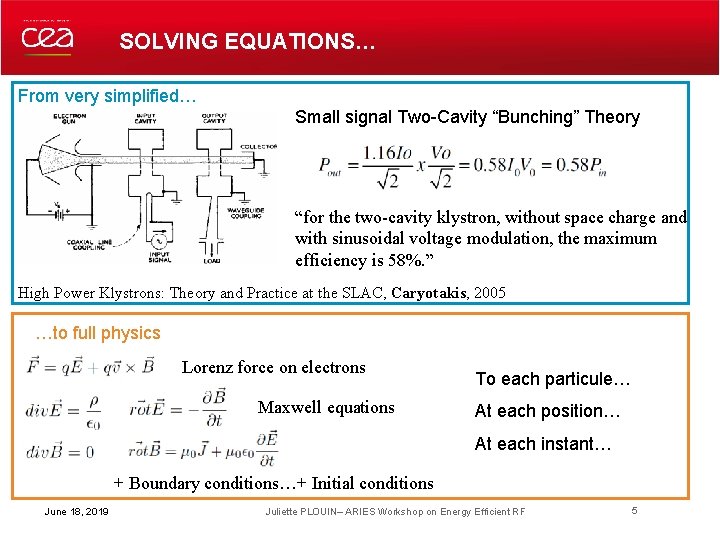
SOLVING EQUATIONS… From very simplified… Small signal Two-Cavity “Bunching” Theory “for the two-cavity klystron, without space charge and with sinusoidal voltage modulation, the maximum efficiency is 58%. ” High Power Klystrons: Theory and Practice at the SLAC, Caryotakis, 2005 …to full physics Lorenz force on electrons Maxwell equations To each particule… At each position… At each instant… + Boundary conditions…+ Initial conditions June 18, 2019 Juliette PLOUIN– ARIES Workshop on Energy Efficient RF 5
2. 1 D AND 2 D STEADY STATE CODES Juliette PLOUIN– ARIES Workshop on Energy Efficient RF 6 JUNE 18, 2019
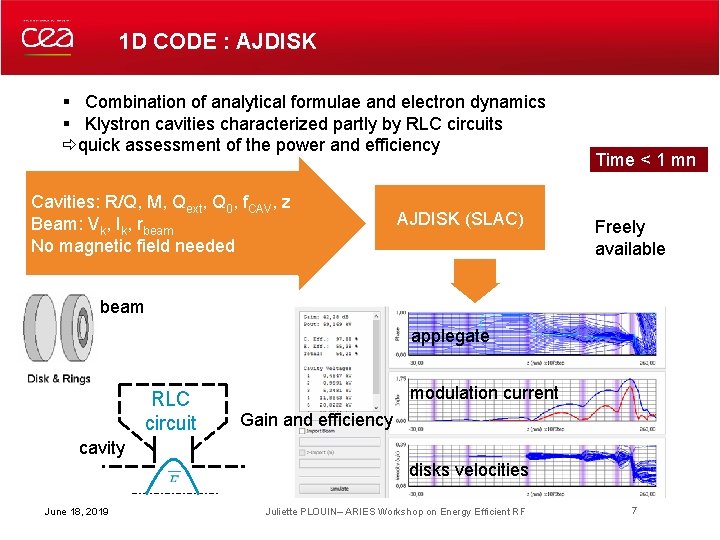
1 D CODE : AJDISK § Combination of analytical formulae and electron dynamics § Klystron cavities characterized partly by RLC circuits quick assessment of the power and efficiency Cavities: R/Q, M, Qext, Q 0, f. CAV, z Beam: Vk, Ik, rbeam No magnetic field needed AJDISK (SLAC) Time < 1 mn Freely available beam applegate RLC circuit modulation current Gain and efficiency cavity June 18, 2019 disks velocities Juliette PLOUIN– ARIES Workshop on Energy Efficient RF 7
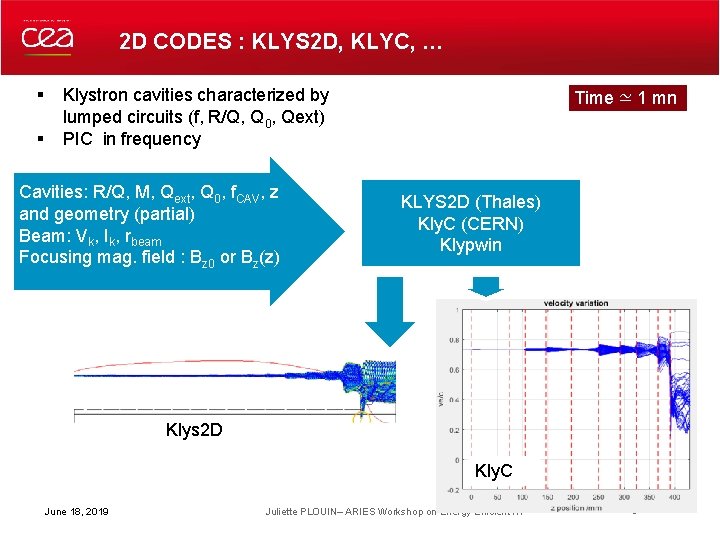
2 D CODES : KLYS 2 D, KLYC, … § § Klystron cavities characterized by lumped circuits (f, R/Q, Q 0, Qext) PIC in frequency Cavities: R/Q, M, Qext, Q 0, f. CAV, z and geometry (partial) Beam: Vk, Ik, rbeam Focusing mag. field : Bz 0 or Bz(z) Time ≃ 1 mn KLYS 2 D (Thales) Kly. C (CERN) Klypwin Klys 2 D Kly. C June 18, 2019 Juliette PLOUIN– ARIES Workshop on Energy Efficient RF 8
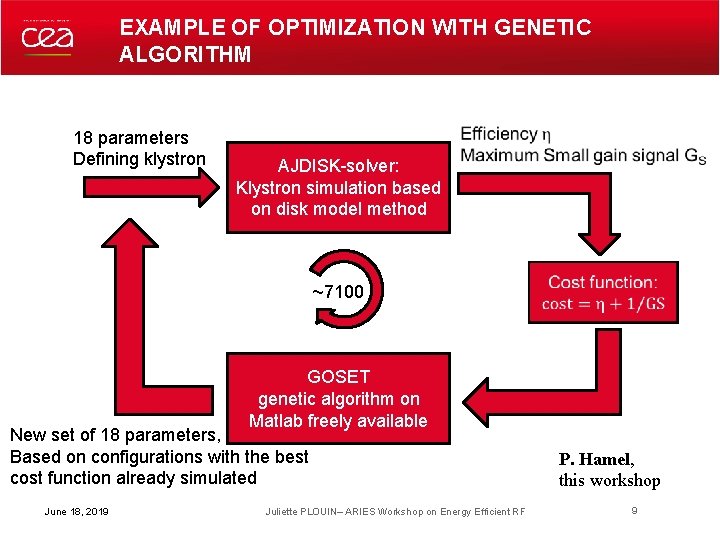
EXAMPLE OF OPTIMIZATION WITH GENETIC ALGORITHM 18 parameters Defining klystron AJDISK-solver: Klystron simulation based on disk model method ~7100 GOSET genetic algorithm on Matlab freely available New set of 18 parameters, Based on configurations with the best cost function already simulated June 18, 2019 Juliette PLOUIN– ARIES Workshop on Energy Efficient RF P. Hamel, this workshop 9
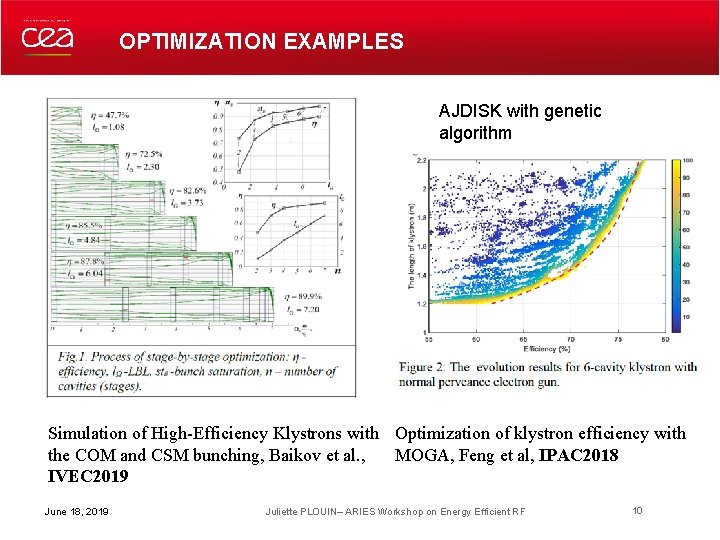
OPTIMIZATION EXAMPLES AJDISK with genetic algorithm Simulation of High-Efficiency Klystrons with Optimization of klystron efficiency with MOGA, Feng et al, IPAC 2018 the COM and CSM bunching, Baikov et al. , IVEC 2019 June 18, 2019 Juliette PLOUIN– ARIES Workshop on Energy Efficient RF 10
CONCLUSION ON STEADY STATE CODES Why we use these codes: They are fast, and allow optimization procedure They are essential for the development of a klystron Lab and companies tend to develop their own codes adapted to their specific needs. Their limits: They don’t take into account the whole physics and geometry of the klystron Some of them were developed for conventional klystrons and must be adapted to be valid for new klystron types (COM, BAC, kladistron…) They cannot predict instabilities June 18, 2019 Juliette PLOUIN– ARIES Workshop on Energy Efficient RF 11
3. 2 D AND 3 D PARTICLE IN CELL (PIC) CODES Juliette PLOUIN– ARIES Workshop on Energy Efficient RF 12 JUNE 18, 2019
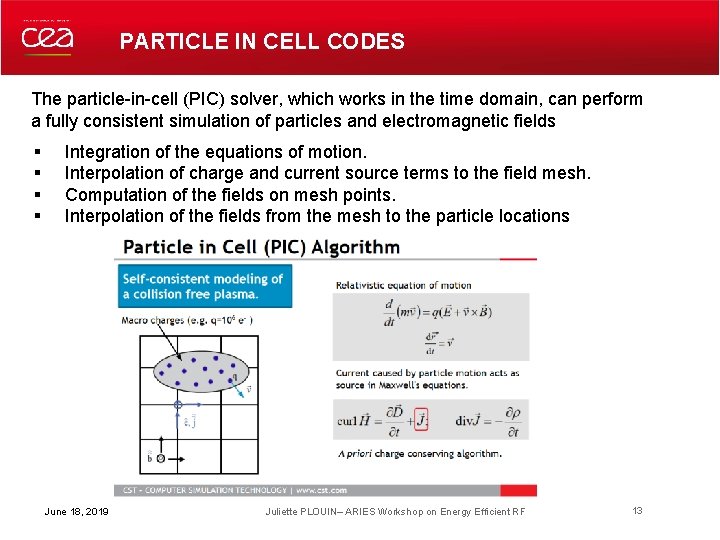
PARTICLE IN CELL CODES The particle-in-cell (PIC) solver, which works in the time domain, can perform a fully consistent simulation of particles and electromagnetic fields § § Integration of the equations of motion. Interpolation of charge and current source terms to the field mesh. Computation of the fields on mesh points. Interpolation of the fields from the mesh to the particle locations June 18, 2019 Juliette PLOUIN– ARIES Workshop on Energy Efficient RF 13
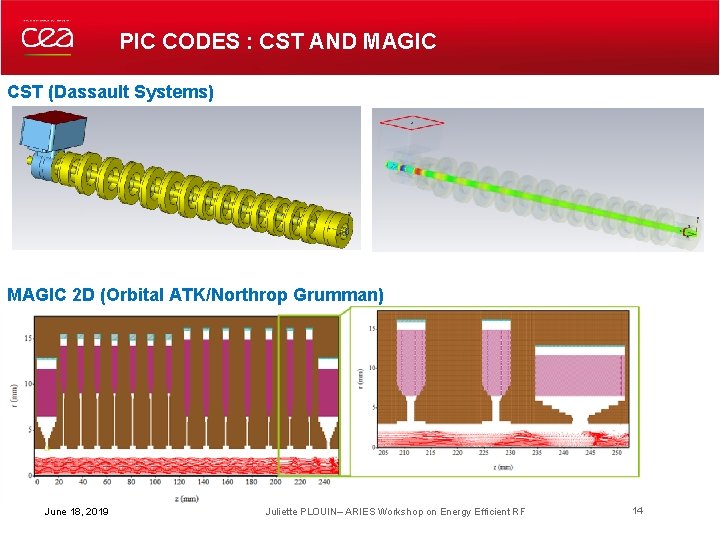
PIC CODES : CST AND MAGIC CST (Dassault Systems) MAGIC 2 D (Orbital ATK/Northrop Grumman) June 18, 2019 Juliette PLOUIN– ARIES Workshop on Energy Efficient RF 14
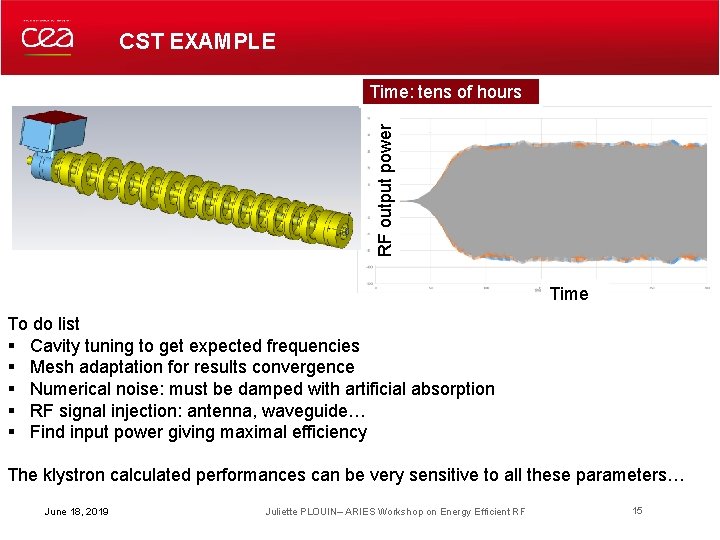
CST EXAMPLE RF output power Amplitude Time: tens of hours Time To do list § Cavity tuning to get expected frequencies § Mesh adaptation for results convergence § Numerical noise: must be damped with artificial absorption § RF signal injection: antenna, waveguide… § Find input power giving maximal efficiency The klystron calculated performances can be very sensitive to all these parameters… June 18, 2019 Juliette PLOUIN– ARIES Workshop on Energy Efficient RF 15
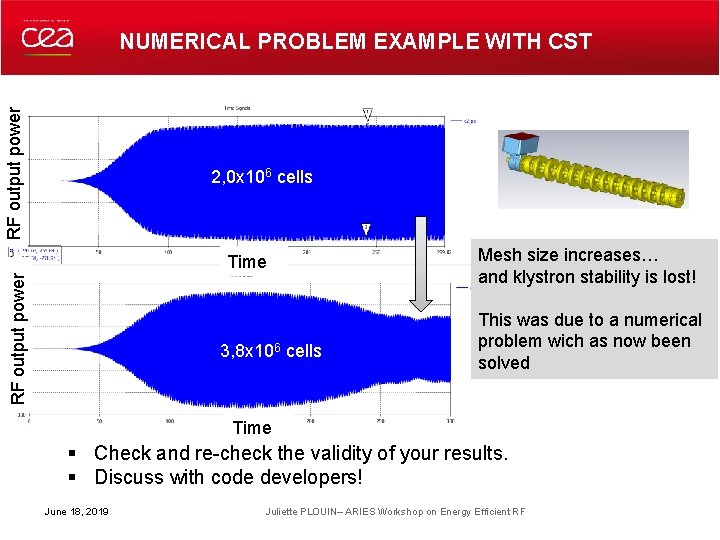
RF output power NUMERICAL PROBLEM EXAMPLE WITH CST 2, 0 x 106 cells RF output power Time 3, 8 x 10⁶ cells Mesh size increases… and klystron stability is lost! This was due to a numerical problem wich as now been solved Time § Check and re-check the validity of your results. § Discuss with code developers! June 18, 2019 Juliette PLOUIN– ARIES Workshop on Energy Efficient RF
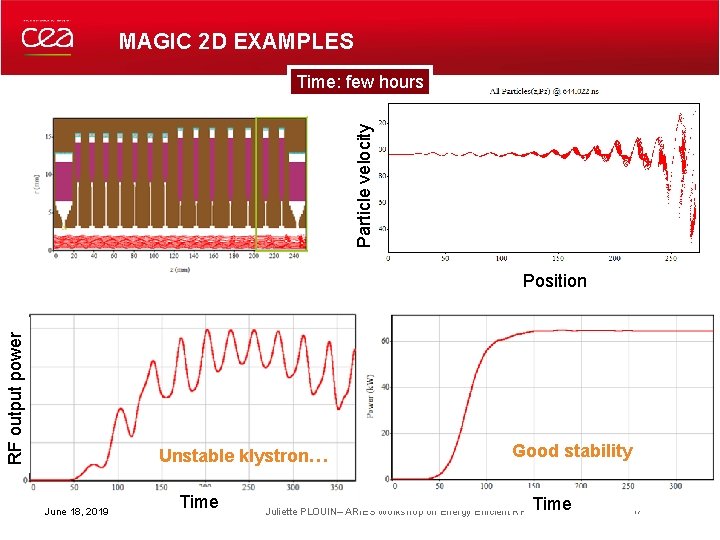
MAGIC 2 D EXAMPLES Particle velocity Time: few hours RF output power Position Unstable klystron… June 18, 2019 Time Good stability Juliette PLOUIN– ARIES Workshop on Energy Efficient RF Time 17
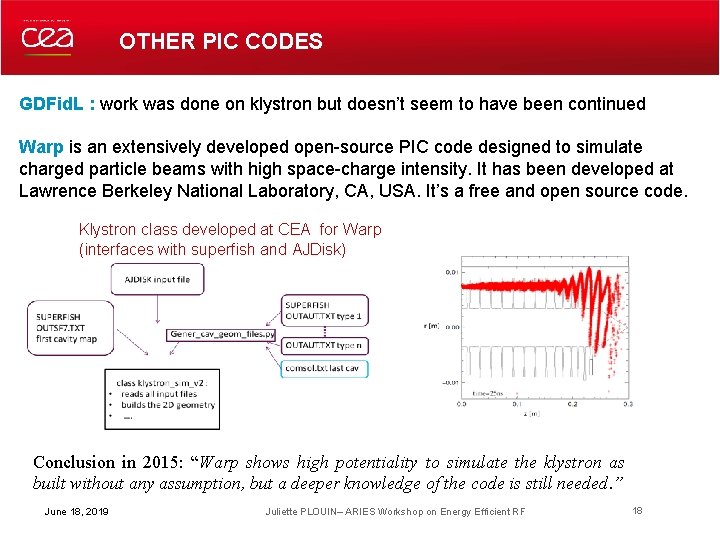
OTHER PIC CODES GDFid. L : work was done on klystron but doesn’t seem to have been continued Warp is an extensively developed open-source PIC code designed to simulate charged particle beams with high space-charge intensity. It has been developed at Lawrence Berkeley National Laboratory, CA, USA. It’s a free and open source code. Klystron class developed at CEA for Warp (interfaces with superfish and AJDisk) Conclusion in 2015: “Warp shows high potentiality to simulate the klystron as built without any assumption, but a deeper knowledge of the code is still needed. ” June 18, 2019 Juliette PLOUIN– ARIES Workshop on Energy Efficient RF 18
CONCLUSIONS ON PIC CODES Why we use these codes: Their agreement with geometry and physics of klystrons is much higher. They allow verification of the klystron performances after optimization These codes are developed and sold by private companies, are maintained, and propose technical support (CST people are very active in the microwave tubes community) Their limits and difficulties: They are time consuming, and are not fitted for optimization procedure. They require good knowledge of their operation to avoid fake results. June 18, 2019 Juliette PLOUIN– ARIES Workshop on Energy Efficient RF 19
4. CODE RESULTS COMPARISON Juliette PLOUIN– ARIES Workshop on Energy Efficient RF 20 JUNE 18, 2019
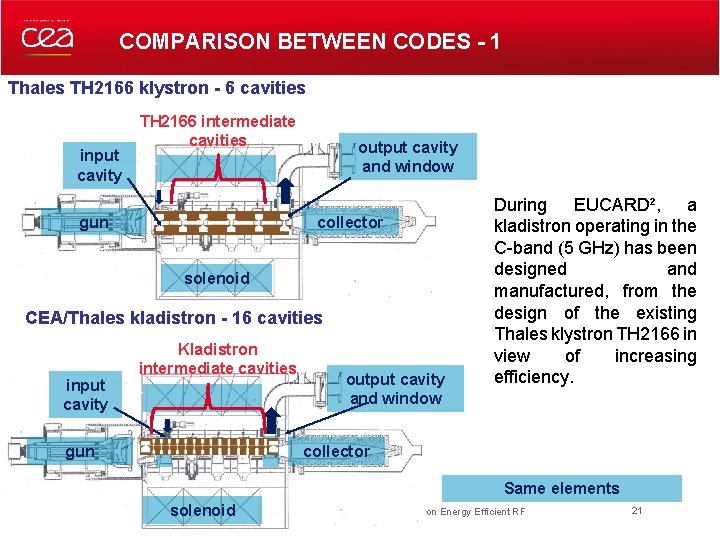
COMPARISON BETWEEN CODES - 1 Thales TH 2166 klystron - 6 cavities input cavity TH 2166 intermediate cavities gun output cavity and window collector solenoid CEA/Thales kladistron - 16 cavities input cavity Kladistron intermediate cavities gun output cavity and window During EUCARD², a kladistron operating in the C-band (5 GHz) has been designed and manufactured, from the design of the existing Thales klystron TH 2166 in view of increasing efficiency. collector Same elements June 18, 2019 solenoid Juliette PLOUIN– ARIES Workshop on Energy Efficient RF 21
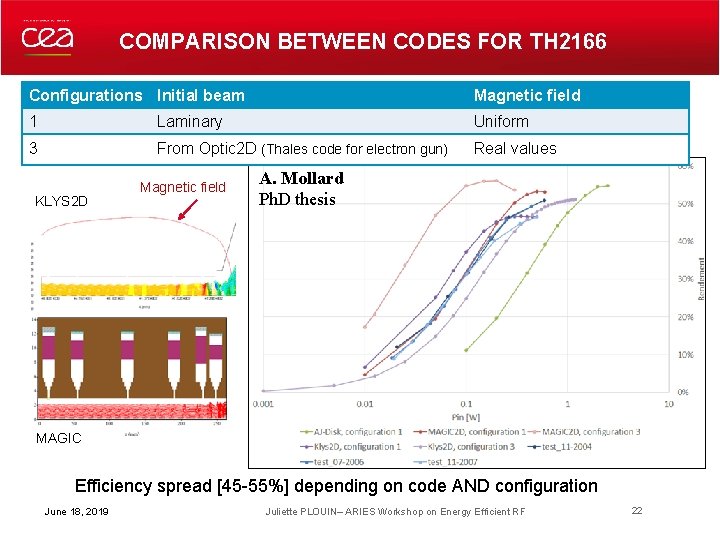
COMPARISON BETWEEN CODES FOR TH 2166 Configurations Initial beam Magnetic field 1 Laminary Uniform 3 From Optic 2 D (Thales code for electron gun) Real values KLYS 2 D Magnetic field A. Mollard Ph. D thesis MAGIC Efficiency spread [45 -55%] depending on code AND configuration June 18, 2019 Juliette PLOUIN– ARIES Workshop on Energy Efficient RF 22
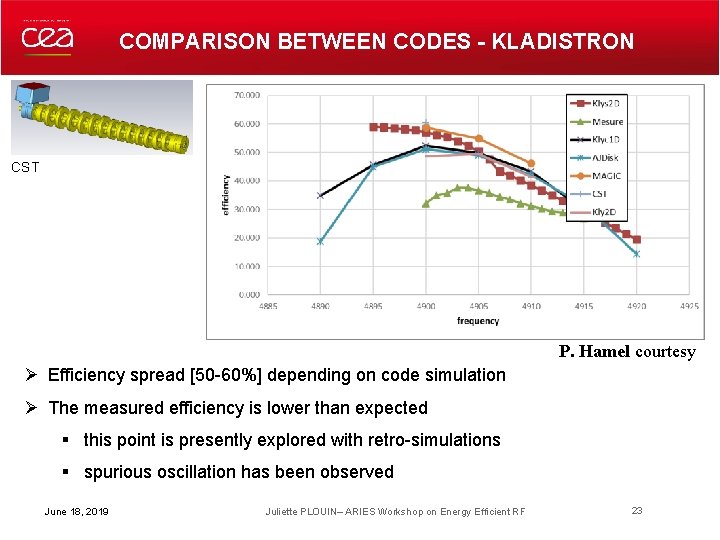
COMPARISON BETWEEN CODES - KLADISTRON CST P. Hamel courtesy Ø Efficiency spread [50 -60%] depending on code simulation Ø The measured efficiency is lower than expected § this point is presently explored with retro-simulations § spurious oscillation has been observed June 18, 2019 Juliette PLOUIN– ARIES Workshop on Energy Efficient RF 23
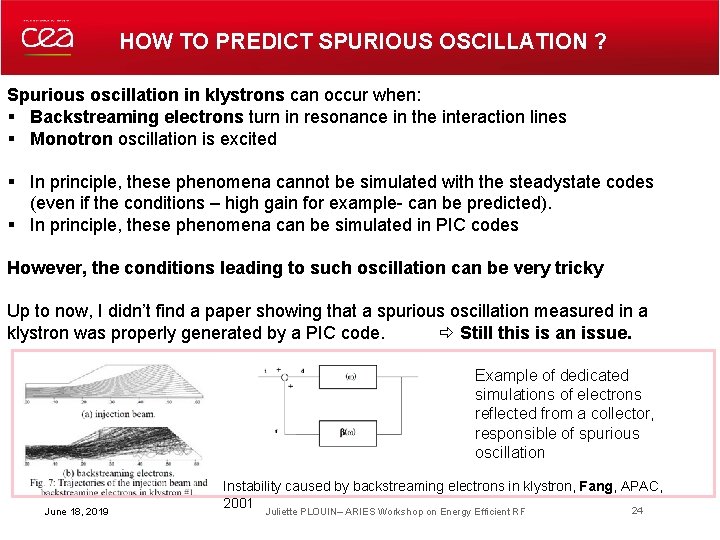
HOW TO PREDICT SPURIOUS OSCILLATION ? Spurious oscillation in klystrons can occur when: § Backstreaming electrons turn in resonance in the interaction lines § Monotron oscillation is excited § In principle, these phenomena cannot be simulated with the steadystate codes (even if the conditions – high gain for example- can be predicted). § In principle, these phenomena can be simulated in PIC codes However, the conditions leading to such oscillation can be very tricky Up to now, I didn’t find a paper showing that a spurious oscillation measured in a klystron was properly generated by a PIC code. Still this is an issue. Example of dedicated simulations of electrons reflected from a collector, responsible of spurious oscillation June 18, 2019 Instability caused by backstreaming electrons in klystron, Fang, APAC, 2001 Juliette PLOUIN– ARIES Workshop on Energy Efficient RF 24
CONCLUSION § No code will be a perfect representation of a klystron reality, and this has never stopped the fabrication of good klystrons. § The development of codes has allowed the study of more complicated, subtle interaction lines. § Those last years, new efficient bunching methods could be developed (COM, BAC, kladistron, …) and start to give good experimental results § Systematic optimization techniques, in particular with genetic algorithms, are probably a promising tool for the future § The complete simulation of a klystron in 3 D is now possible, and helps a lot for checking some issues, but is not a turnkey solution. June 18, 2019 Juliette PLOUIN– ARIES Workshop on Energy Efficient RF 25