Soft IP Hard Fast Trademarks and Copyright 101

- Slides: 26
Soft IP, Hard & Fast: Trademarks and Copyright 101 TAYLOR HARRISON, KASEY MCNAMARA, GABBY THOMA
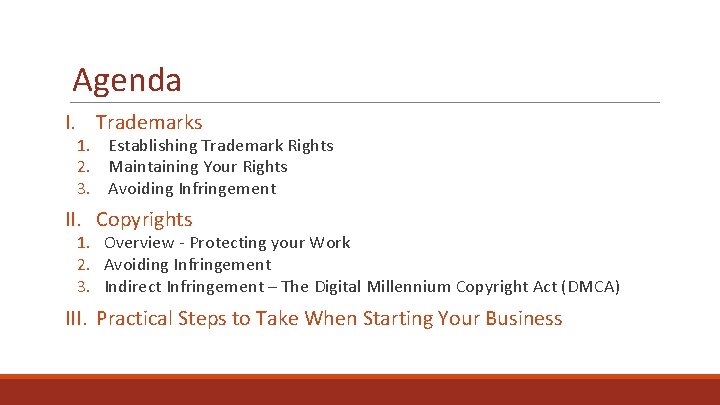
Agenda I. Trademarks 1. Establishing Trademark Rights 2. Maintaining Your Rights 3. Avoiding Infringement II. Copyrights 1. Overview - Protecting your Work 2. Avoiding Infringement 3. Indirect Infringement – The Digital Millennium Copyright Act (DMCA) III. Practical Steps to Take When Starting Your Business
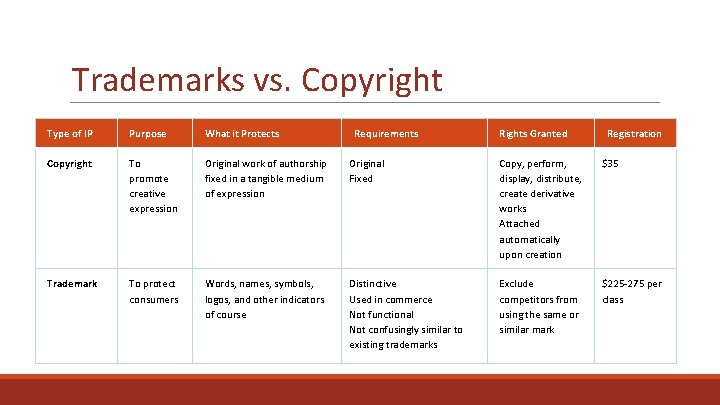
Trademarks vs. Copyright Type of IP Purpose What it Protects Requirements Rights Granted Registration Copyright To promote creative expression Original work of authorship fixed in a tangible medium of expression Original Fixed Copy, perform, display, distribute, create derivative works Attached automatically upon creation $35 Trademark To protect consumers Words, names, symbols, logos, and other indicators of course Distinctive Used in commerce Not functional Not confusingly similar to existing trademarks Exclude competitors from using the same or similar mark $225 -275 per class
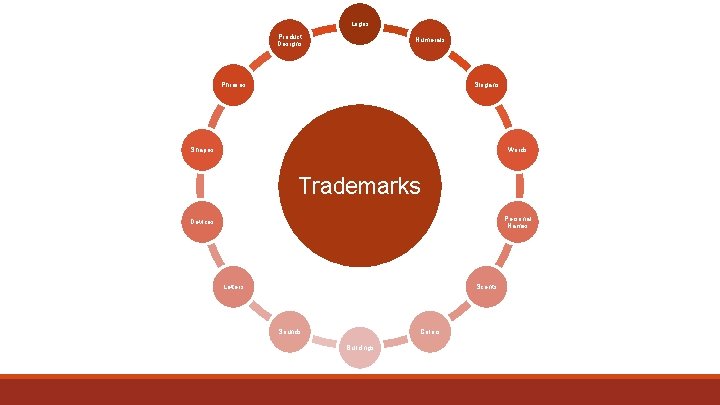
Logos Product Designs Numerals Phrases Slogans Shapes Words Trademarks Personal Names Devices Letters Scents Sounds Colors Buildings
Establishing Trademark Rights 1. Distinct 2. Not part of an unregistrable category 3. Used in commerce
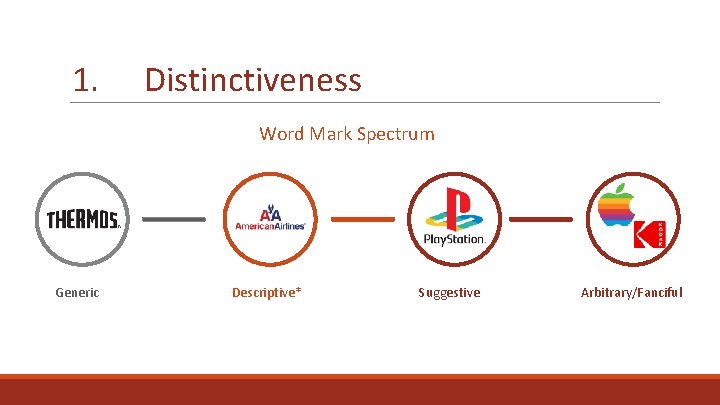
1. Distinctiveness Word Mark Spectrum Generic Descriptive* Suggestive Arbitrary/Fanciful
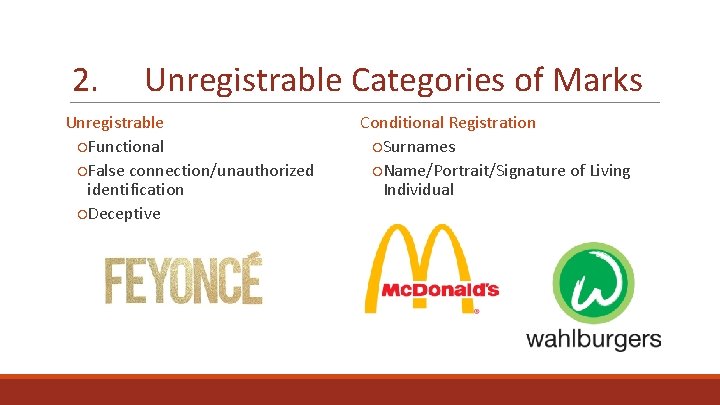
2. Unregistrable Categories of Marks Unregistrable ○Functional ○False connection/unauthorized identification ○Deceptive Conditional Registration ○Surnames ○Name/Portrait/Signature of Living Individual
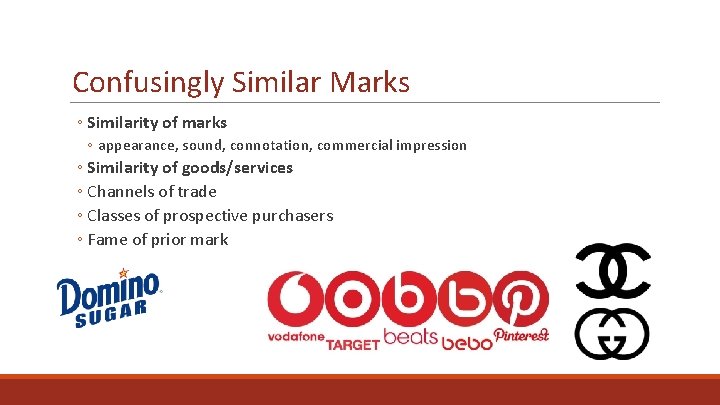
Confusingly Similar Marks ◦ Similarity of marks ◦ appearance, sound, connotation, commercial impression ◦ Similarity of goods/services ◦ Channels of trade ◦ Classes of prospective purchasers ◦ Fame of prior mark
3. Use in Commerce 1. Adoption 2. Use ◦ Use in interstate commerce, or ◦ Intent to use
® Benefits of Registration ◦ Evidence of validity, ownership, exclusive rights ◦ Constructive notice of nationwide use ◦ Limits grounds for cancellation after 5 years ◦ Unregistered trademarks are limited in scope
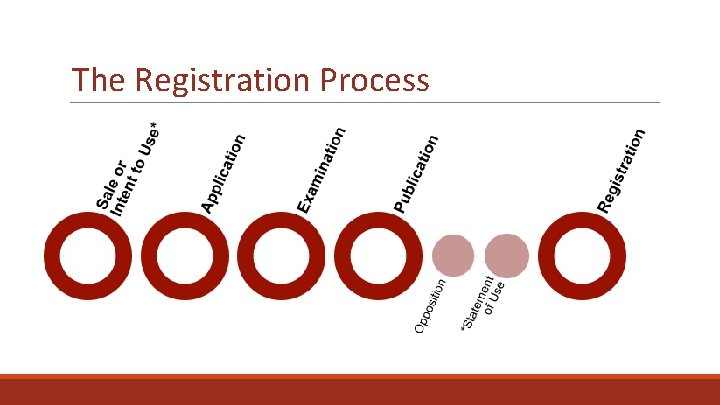
The Registration Process
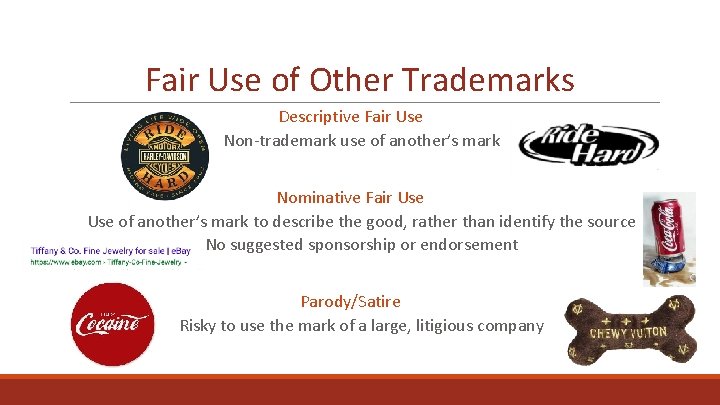
Fair Use of Other Trademarks Descriptive Fair Use Non-trademark use of another’s mark Nominative Fair Use of another’s mark to describe the good, rather than identify the source No suggested sponsorship or endorsement Parody/Satire Risky to use the mark of a large, litigious company
Copyright
Protecting Your IP: Copyright 17 USC § 102(a) - Copyright Requirements 1. Fixation ◦ Must be fixed in a tangible medium of expression, sufficiently permanent or stable 2. Originality ◦ Must be of independent creation ◦ Must possess a modicum of creativity
Protecting Your IP: Copyrightable Subject Matter Copyrightable - “Works of Authorship” 17 USC § 102(a) literary works ◦ musical works, including any accompanying words ◦ dramatic works, including any accompanying music ◦ pantomimes and choreographic works ◦ pictorial, graphic, and sculptural works ◦ motion pictures and other audiovisual works ◦ sound recordings ◦ architectural works ◦ Not Copyrightable 17 USC § 102(b) ideas ◦ procedures ◦ processes ◦ systems ◦ methods of operation ◦ concepts ◦ principles ◦ discoveries ◦
Protecting Your IP: Copyright Exclusive Rights 1. 2. 3. 4. 5. 6. Exclusive right to reproduce the work Exclusive right to make derivative works Exclusive right to distribute to the public Exclusive right to perform publicly Exclusive right of public display Moral rights (only for visual arts) Duration of Copyright: life of author plus 70 years; if created in scope of employment, duration typically 95 years from publication 17 USC §§ 408, 410 - © Registration - Registration not required to acquire copyright in work Registration is required in order to bring claim in federal court Cost of Registration with Copyright Office is typically $35 -$55
Protecting Your IP: Copyright Protections ● Copyright protects the author’s expression of an idea, but not the idea itself ○ When there a limited number of ways to express something, the expression is not protectable with copyright ○ Copyright does not protect things that are too brief or too short ● Copyright does not protect against independent creation - only copying
Software/Source Code o Protection: o. Protection for the actual code (Source code, NOT object code) o. Protection for the visual expression of the code (e. g. , website/app interface) o. Will not protect your idea against independent creation o Avoiding Infringement: o. Where does code come from? ◦ Does company utilize open source software (OSS)? ◦ Does your code infringe on someone else’s code (i. e. copied)?
Avoiding Copyright Infringement: Copyright Licensing ◦ Copyright holders can license out their copyrights ◦ Licensing Agreement will typically include: ◦ Whether exclusive license ◦ Duration of license ◦ Applicable territory ◦ Scope of use ◦ Field of use ◦ Fee for license
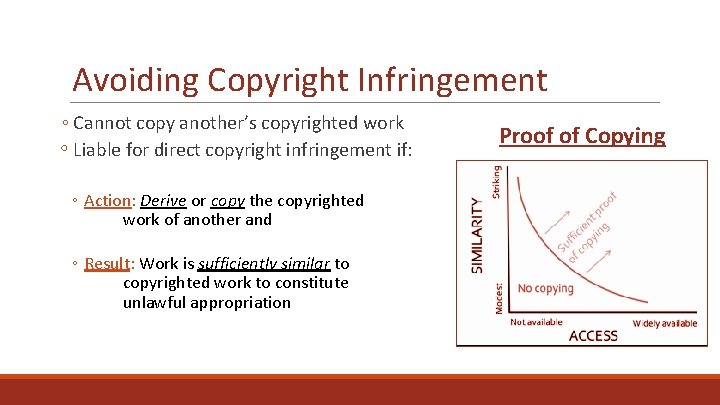
Avoiding Copyright Infringement ◦ Cannot copy another’s copyrighted work ◦ Liable for direct copyright infringement if: ◦ Action: Derive or copy the copyrighted work of another and ◦ Result: Work is sufficiently similar to copyrighted work to constitute unlawful appropriation Proof of Copying
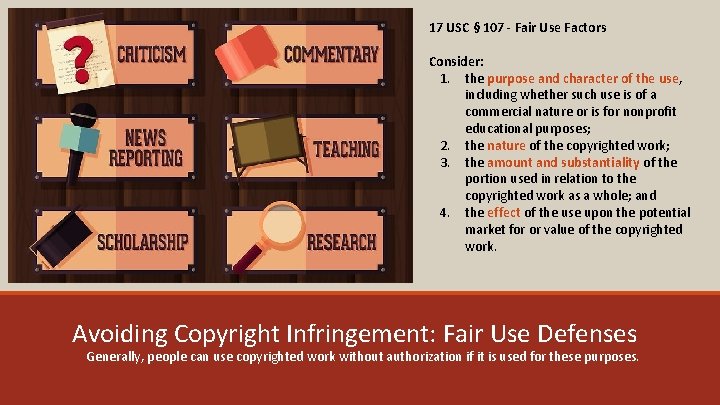
17 USC § 107 - Fair Use Factors Consider: 1. the purpose and character of the use, including whether such use is of a commercial nature or is for nonprofit educational purposes; 2. the nature of the copyrighted work; 3. the amount and substantiality of the portion used in relation to the copyrighted work as a whole; and 4. the effect of the use upon the potential market for or value of the copyrighted work. Avoiding Copyright Infringement: Fair Use Defenses Generally, people can use copyrighted work without authorization if it is used for these purposes.
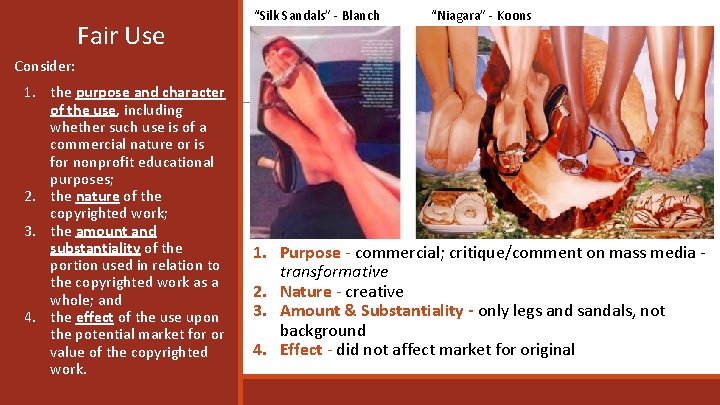
Fair Use “Silk Sandals” - Blanch “Niagara” - Koons Consider: 1. the purpose and character of the use, including whether such use is of a commercial nature or is for nonprofit educational purposes; 2. the nature of the copyrighted work; 3. the amount and substantiality of the portion used in relation to the copyrighted work as a whole; and 4. the effect of the use upon the potential market for or value of the copyrighted work. 1. Purpose - commercial; critique/comment on mass media transformative 2. Nature - creative 3. Amount & Substantiality - only legs and sandals, not background 4. Effect - did not affect market for original
Avoiding Infringement: Direct v. Indirect Liability Key Considerations: ◦ Knowledge ◦ Substantial Participation/Active Encouragement ◦ Direct Financial Benefit + Right and Ability to Control
Avoiding Infringement: Digital Millennium Copyright Act (DMCA) 1. Must be a ‘Service Provider’ 2. Must have notice and takedown policy 3. Cannot have actual knowledge of specific infringement 4. Cannot be willfully blind when there are red flags
Practical Steps & Things to Consider 1. IP Protection Strategy a. Registration b. Enforcement 2. Infringement Analysis
Questions? To learn more about the BU Startup Law Clinic and apply for our services visit: https: //sites. bu. edu/startuplaw/