Small Arms and Society SALW Control DDR and
- Slides: 17
Small Arms and Society: SALW Control, DDR, and Peace-building: El Salvador COST Meeting on Armed Violence Brussels, 17 March 2008 Chris Stevenson, Small Arms Survey, Geneva
In this presentation, I look at: A brief overview of El Salvador today n A summarized history of its peace process n DDR components n Arms control measures n Society interventions to reduce armed violence n
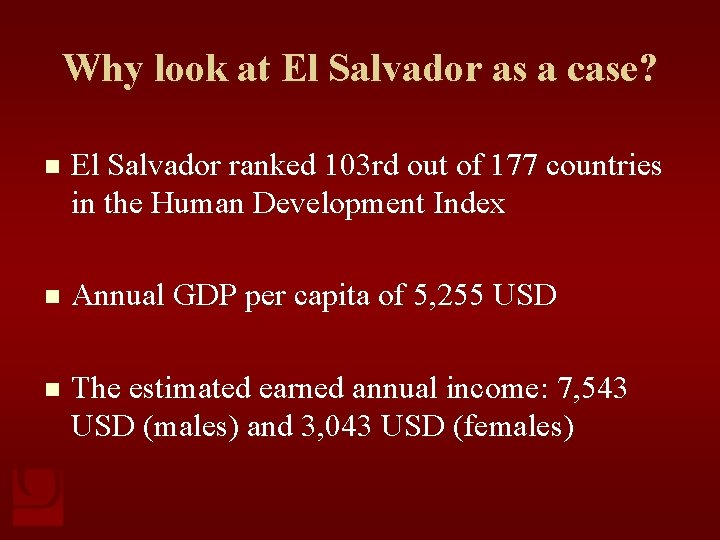
Why look at El Salvador as a case? n El Salvador ranked 103 rd out of 177 countries in the Human Development Index n Annual GDP per capita of 5, 255 USD n The estimated earned annual income: 7, 543 USD (males) and 3, 043 USD (females)
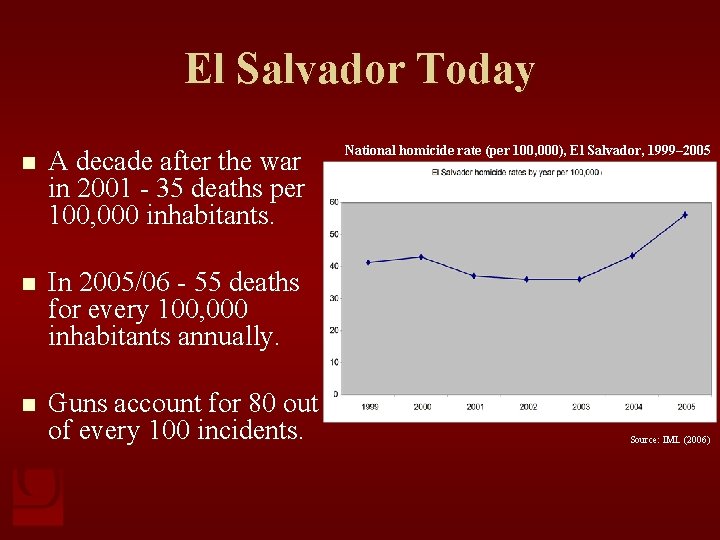
El Salvador Today n A decade after the war in 2001 - 35 deaths per 100, 000 inhabitants. n In 2005/06 - 55 deaths for every 100, 000 inhabitants annually. n Guns account for 80 out of every 100 incidents. National homicide rate (per 100, 000), El Salvador, 1999– 2005 Source: IML (2006)
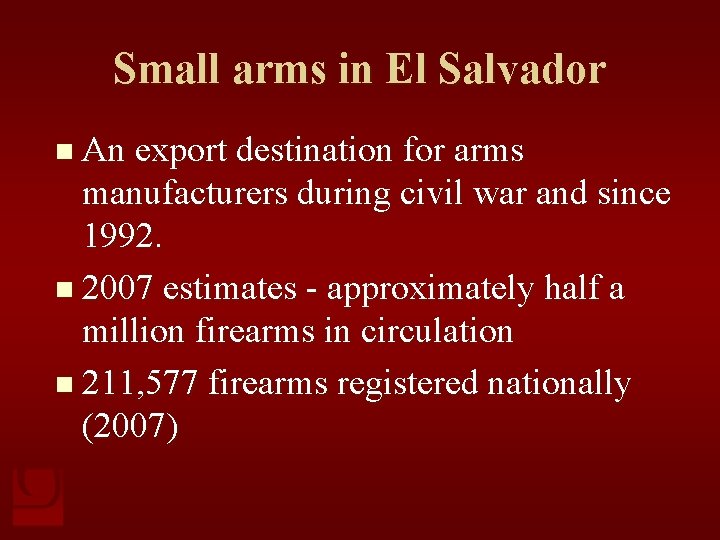
Small arms in El Salvador n An export destination for arms manufacturers during civil war and since 1992. n 2007 estimates - approximately half a million firearms in circulation n 211, 577 firearms registered nationally (2007)
El Salvador violence n Violence is now an urban phenomenon, concentrated in larger cities/suburbs and marginalized communities with high poverty rates. n Problems of Maras (gangs): number of members vary between 10, 500 to 50, 000 in Central America in 2006 - connections in the USA and region.
Historical summary 1838 - El Salvador becomes an independent republic, 1838 n Late 1800 - late 1900 s- Country is run by the wealthy coffee elite ‘Fourteen Families’ and military leaders n 1980 - Archbishop Romero assassinated, FMLN (Farabundo Martí Liberation Front) formally mobilized n 1980 -1992 - Civil war n 1987 - Esquipulas Peace Agreement n 1990 -1992 - Peace negotiations and accords n
El Salvador peace process n The UN mediated two-year peace agreement n Series of various meetings and agreements n Final accords were signed in Chapultepec Mexico in January, 1992. n Cease-fire was sustained
DDR in El Salvador peace process n DDR did not formally exist during the peace negotiations n Parties negotiated demobilization of forces and their reintegration into civilian, political, and institutional life n The FMLN negotiators rejected the term “demobilized” although widely used
DDR emerged… n A voluntary “cessation of armed conflict” (CAC) process n CAC encompassed four elements: n the cease fire; n the separation of forces; n the end of the military structure of the FMLN and reintegration of its members; n UN verification of the previous activities.
El Salvador arms controls n 1993 - National arms law created to regulate civilian possession and re-enacted in 1999. n 2002, significant reforms to the law: increased criminalisation of violations, tighter restrictions on carrying of guns, development of a psychological test for application of licenses. n National temporary prohibitions are mandated during holidays and in peak tourist areas.
Arms controls… n A firearms purchaser must register and obtain a license before buying the weapon from a licensed dealer. n Ammunition sold to those with a license for the weapon of the same calibre. n A Value Added Tax on firearms sales to contribute to FOSALUD, a national health fund. n Regular destruction of weapons - approximately 6, 669 SALW destroyed since 2001.
Other relevant laws n Decree 158, the Anti-Maras Act - adopted in October 2003 n Plans Mano Dura (Operation Hard Hand) - July 2003 - and Super Mano Dura -July 2004 n December 2006 Decree 176 weapon carrying prohibition n Mano Amiga (Friendly Hand) and the Mano Extendida (Extended Hand) - youth violence prevention and gang rehabilitation plans
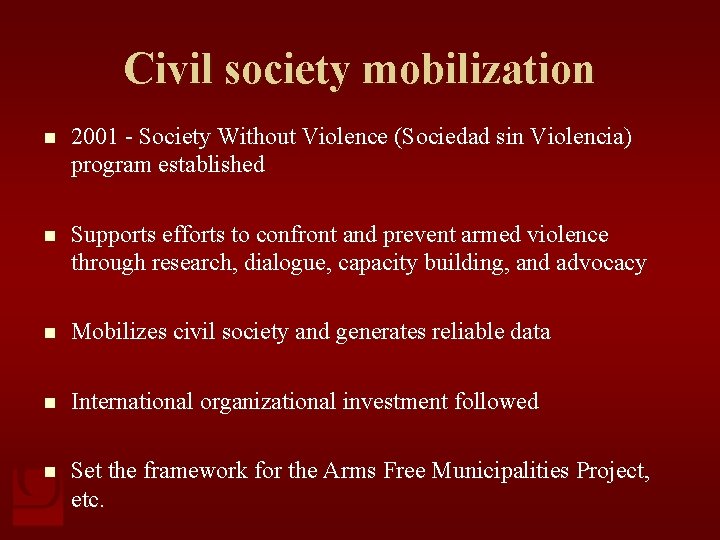
Civil society mobilization n 2001 - Society Without Violence (Sociedad sin Violencia) program established n Supports efforts to confront and prevent armed violence through research, dialogue, capacity building, and advocacy n Mobilizes civil society and generates reliable data n International organizational investment followed n Set the framework for the Arms Free Municipalities Project, etc.
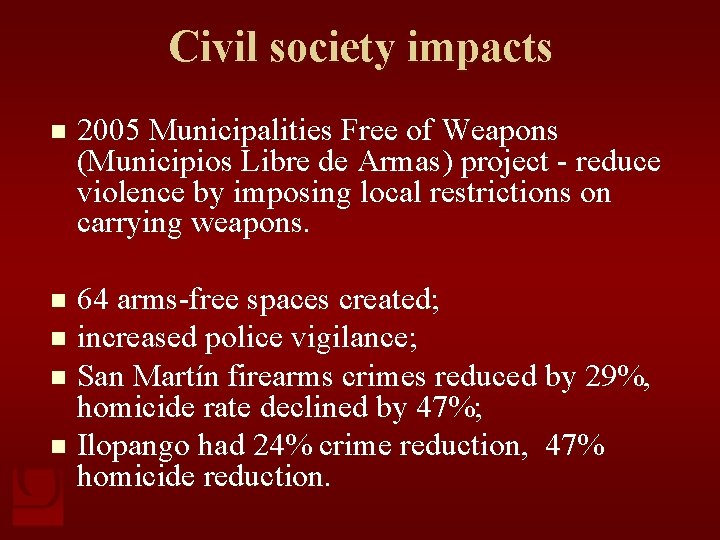
Civil society impacts n 2005 Municipalities Free of Weapons (Municipios Libre de Armas) project - reduce violence by imposing local restrictions on carrying weapons. 64 arms-free spaces created; n increased police vigilance; n San Martín firearms crimes reduced by 29%, homicide rate declined by 47%; n Ilopango had 24% crime reduction, 47% homicide reduction. n
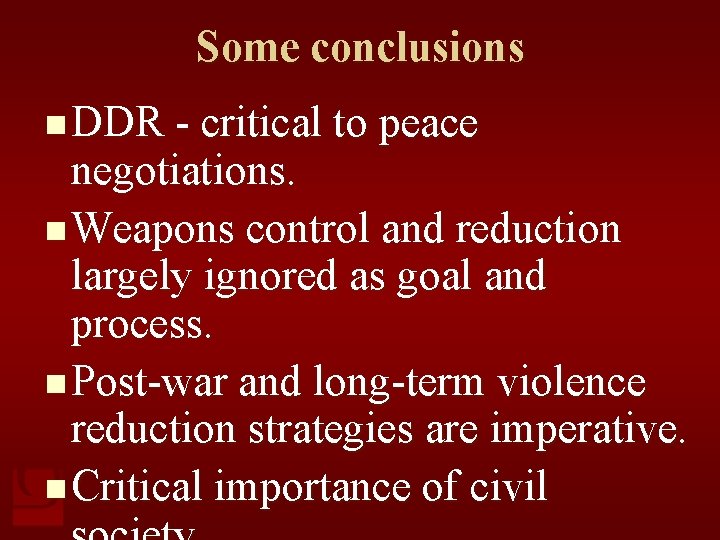
Some conclusions n DDR - critical to peace negotiations. n Weapons control and reduction largely ignored as goal and process. n Post-war and long-term violence reduction strategies are imperative. n Critical importance of civil
Thank You Chris Stevenson Small Arms Survey +41 22 908 5790 stevenc 6@hei. unige. ch