SIXTH EDITION CHAPTER 4 Information and communication in
- Slides: 51
SIXTH EDITION
CHAPTER 4 Information and communication in organisations
ORGANISATIONAL BEHAVIOUR Learning Outcomes Understand the role of information in organisations Know how perception operates and what are the barriers to perception Be aware of the implications and limitations created by information being asymmetrically distributed in the organisation Identify the constraints and errors produced by attribution mechanisms Copyright © 2018 Mc. Graw-Hill Education Chapter 4 - 3
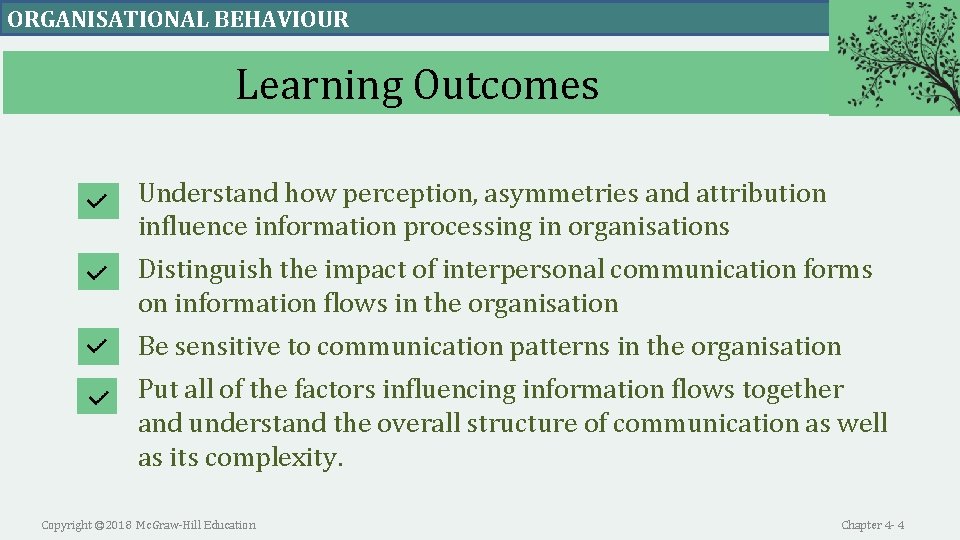
ORGANISATIONAL BEHAVIOUR Learning Outcomes Understand how perception, asymmetries and attribution influence information processing in organisations Distinguish the impact of interpersonal communication forms on information flows in the organisation Be sensitive to communication patterns in the organisation Put all of the factors influencing information flows together and understand the overall structure of communication as well as its complexity. Copyright © 2018 Mc. Graw-Hill Education Chapter 4 - 4
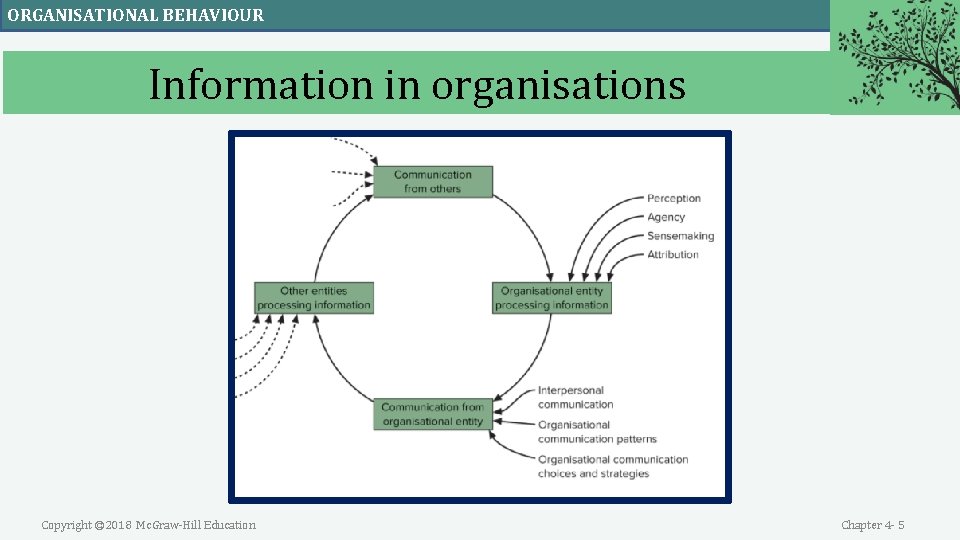
ORGANISATIONAL BEHAVIOUR Information in organisations Copyright © 2018 Mc. Graw-Hill Education Chapter 4 - 5
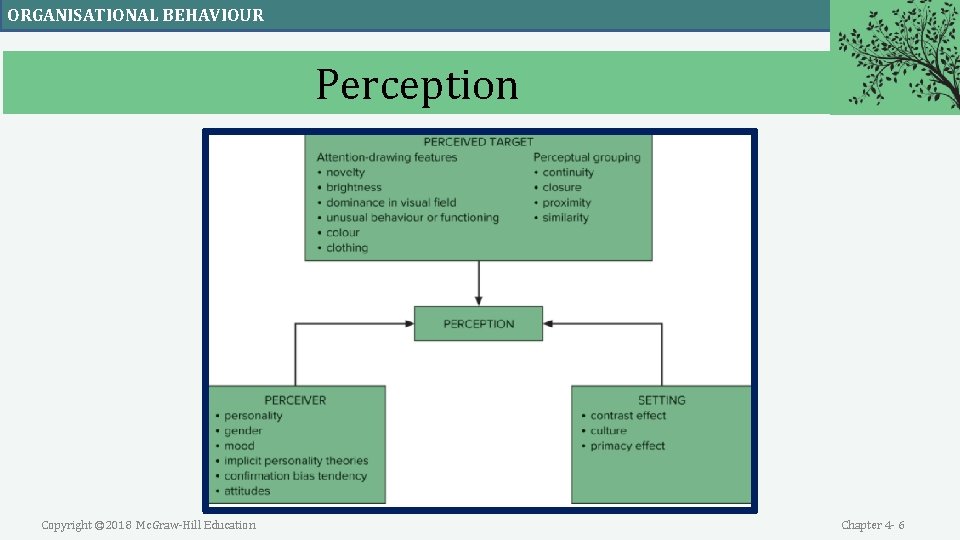
ORGANISATIONAL BEHAVIOUR Perception Copyright © 2018 Mc. Graw-Hill Education Chapter 4 - 6
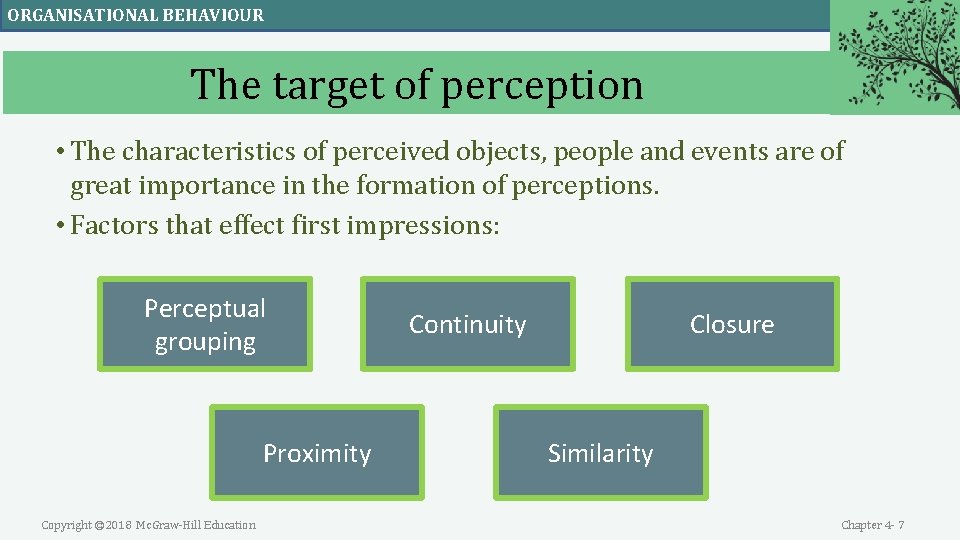
ORGANISATIONAL BEHAVIOUR The target of perception • The characteristics of perceived objects, people and events are of great importance in the formation of perceptions. • Factors that effect first impressions: Perceptual grouping Proximity Copyright © 2018 Mc. Graw-Hill Education Continuity Closure Similarity Chapter 4 - 7
ORGANISATIONAL BEHAVIOUR The setting Contrast effect • The tendency to perceive stimuli that differ from expectations as being more different than they really are National culture • The norms, behaviours, beliefs and customs existing in the population of a sovereign nation. Primacy effect • The effect by which the information first received often continues to colour later perceptions of individuals. Anchoring • A decision bias linked to the primacy effect, where initial information colours all subsequent information Copyright © 2018 Mc. Graw-Hill Education Chapter 4 - 8
ORGANISATIONAL BEHAVIOUR The perceiver • Characteristics of the perceiver may explain why the same event, person or object is perceived differently. • Men and women seem to have a different perception of which social -sexual behaviours they consider harassment. • People have the tendency to seek and interpret information that verifies existing beliefs (confirmation bias) Copyright © 2018 Mc. Graw-Hill Education Chapter 4 - 9
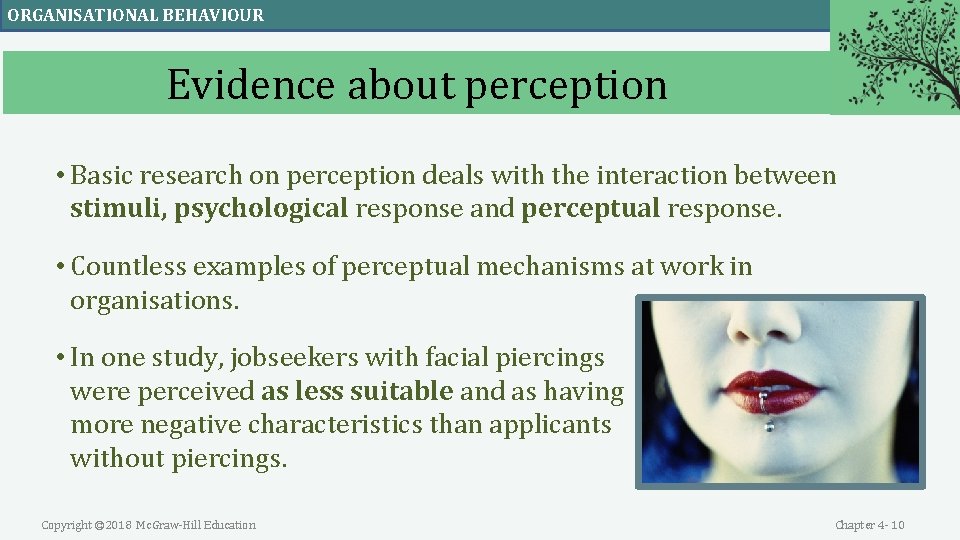
ORGANISATIONAL BEHAVIOUR Evidence about perception • Basic research on perception deals with the interaction between stimuli, psychological response and perceptual response. • Countless examples of perceptual mechanisms at work in organisations. • In one study, jobseekers with facial piercings were perceived as less suitable and as having more negative characteristics than applicants without piercings. Copyright © 2018 Mc. Graw-Hill Education Chapter 4 - 10
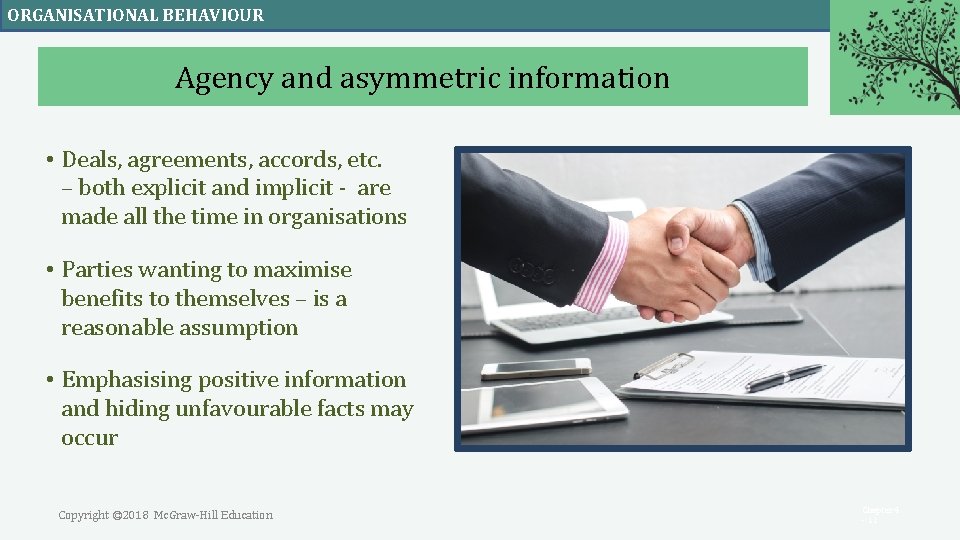
ORGANISATIONAL BEHAVIOUR Agency and asymmetric information • Deals, agreements, accords, etc. – both explicit and implicit - are made all the time in organisations • Parties wanting to maximise benefits to themselves – is a reasonable assumption • Emphasising positive information and hiding unfavourable facts may occur Copyright © 2018 Mc. Graw-Hill Education Chapter 4 - 11
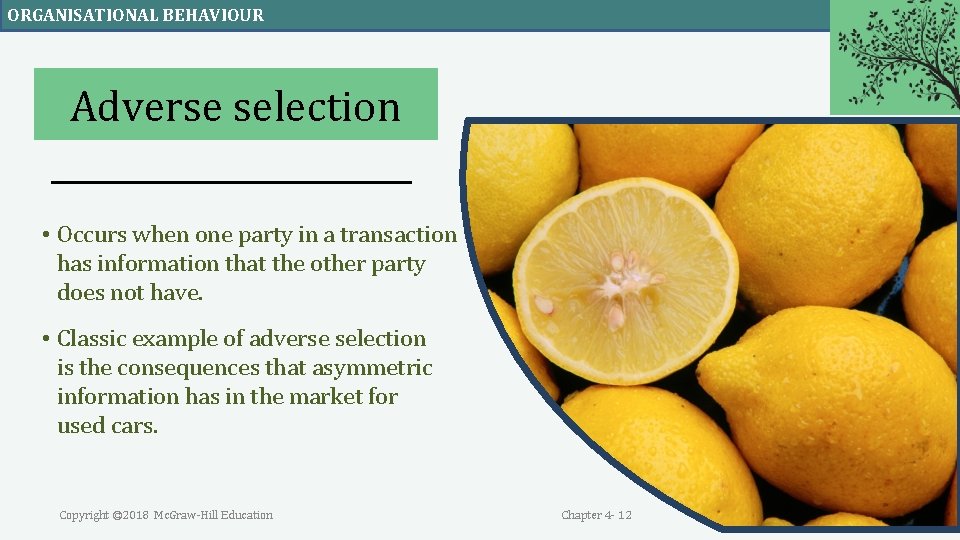
ORGANISATIONAL BEHAVIOUR Adverse selection • Occurs when one party in a transaction has information that the other party does not have. • Classic example of adverse selection is the consequences that asymmetric information has in the market for used cars. Copyright © 2018 Mc. Graw-Hill Education Chapter 4 - 12
ORGANISATIONAL BEHAVIOUR Moral hazard • Occurs when one party to a transaction takes risk and the cost of this risk is carried by the other party. • Comprehensive monitoring members of organisations is costly • Some formal monitoring is common – eg. ’clocking-in’ • Informal monitoring by co-workers • If work gets done inside the allocated time, managers may never know how long it really takes – and what the employee does if there is time to spare Copyright © 2018 Mc. Graw-Hill Education Chapter 4 - 13
ORGANISATIONAL BEHAVIOUR Evidence about asymmetric information • Evidence about adverse selection mechanisms at work inside organisations is rare. o In one study: the adverse selection model can be used to explain why projects are sometimes continued despite indications that they are failing • Evidence about moral hazard, caused by ‘hidden action’ is also difficult to come by. o May exist is in the structure of top managers’ pay Copyright © 2018 Mc. Graw-Hill Education Chapter 4 - 14
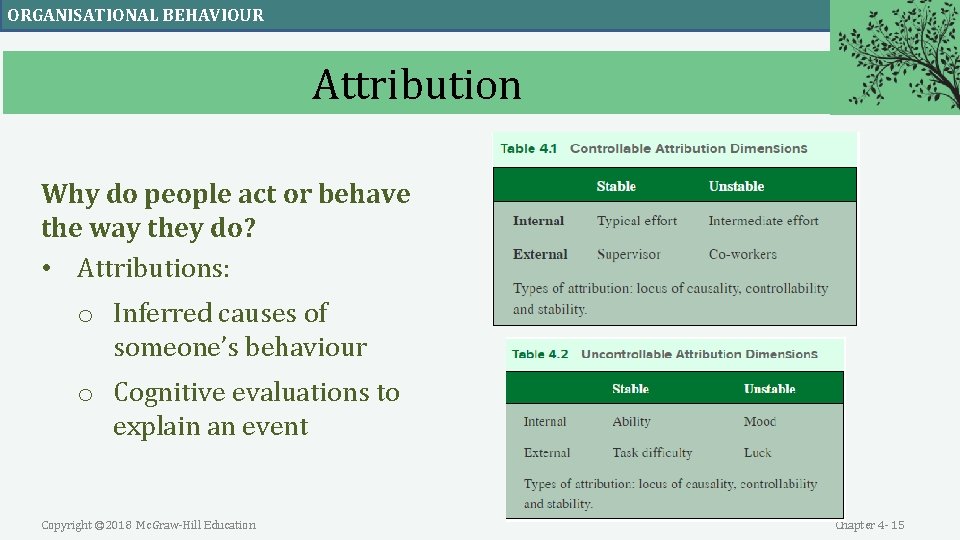
ORGANISATIONAL BEHAVIOUR Attribution Why do people act or behave the way they do? • Attributions: o Inferred causes of someone’s behaviour o Cognitive evaluations to explain an event Copyright © 2018 Mc. Graw-Hill Education Chapter 4 - 15
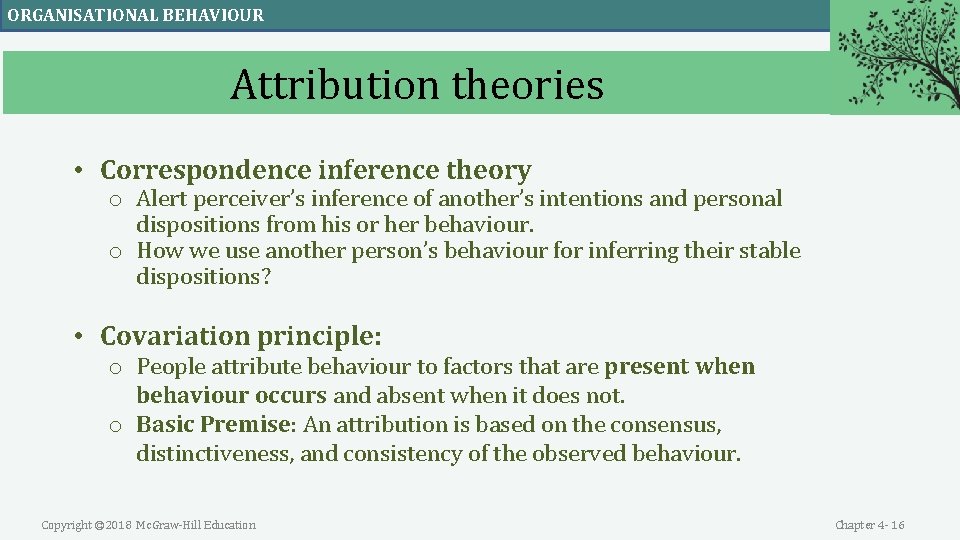
ORGANISATIONAL BEHAVIOUR Attribution theories • Correspondence inference theory o Alert perceiver’s inference of another’s intentions and personal dispositions from his or her behaviour. o How we use another person’s behaviour for inferring their stable dispositions? • Covariation principle: o People attribute behaviour to factors that are present when behaviour occurs and absent when it does not. o Basic Premise: An attribution is based on the consensus, distinctiveness, and consistency of the observed behaviour. Copyright © 2018 Mc. Graw-Hill Education Chapter 4 - 16
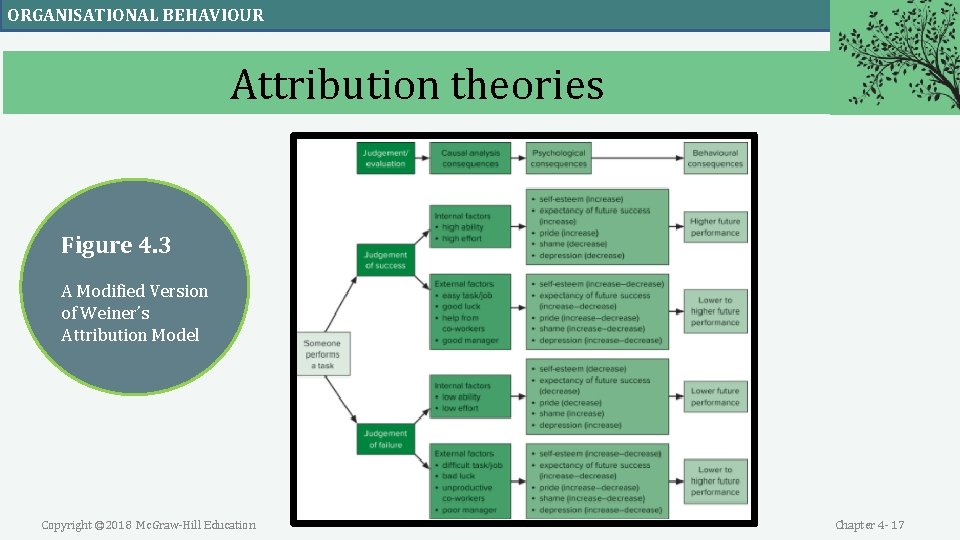
ORGANISATIONAL BEHAVIOUR Attribution theories Figure 4. 3 A Modified Version of Weiner’s Attribution Model Copyright © 2018 Mc. Graw-Hill Education Chapter 4 - 17
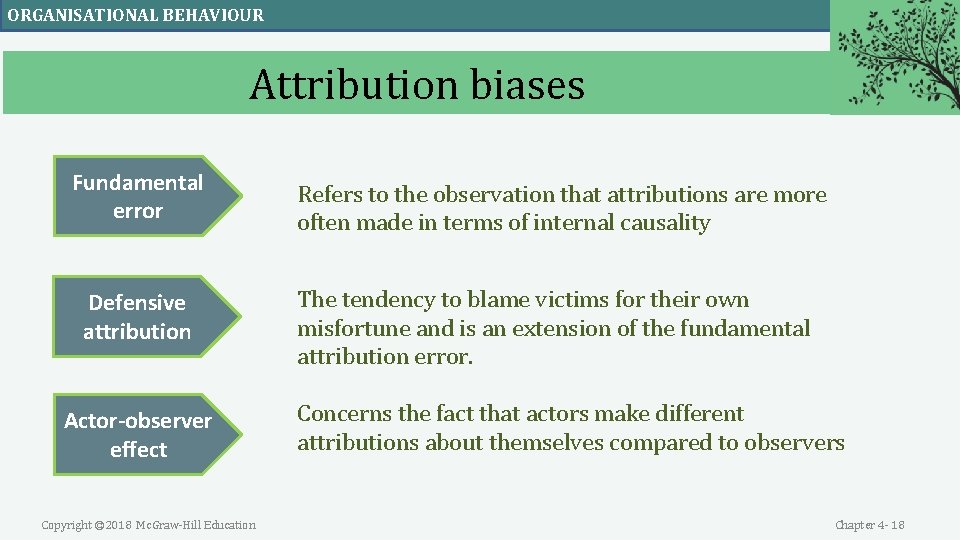
ORGANISATIONAL BEHAVIOUR Attribution biases Fundamental error Defensive attribution Actor-observer effect Copyright © 2018 Mc. Graw-Hill Education Refers to the observation that attributions are more often made in terms of internal causality The tendency to blame victims for their own misfortune and is an extension of the fundamental attribution error. Concerns the fact that actors make different attributions about themselves compared to observers Chapter 4 - 18
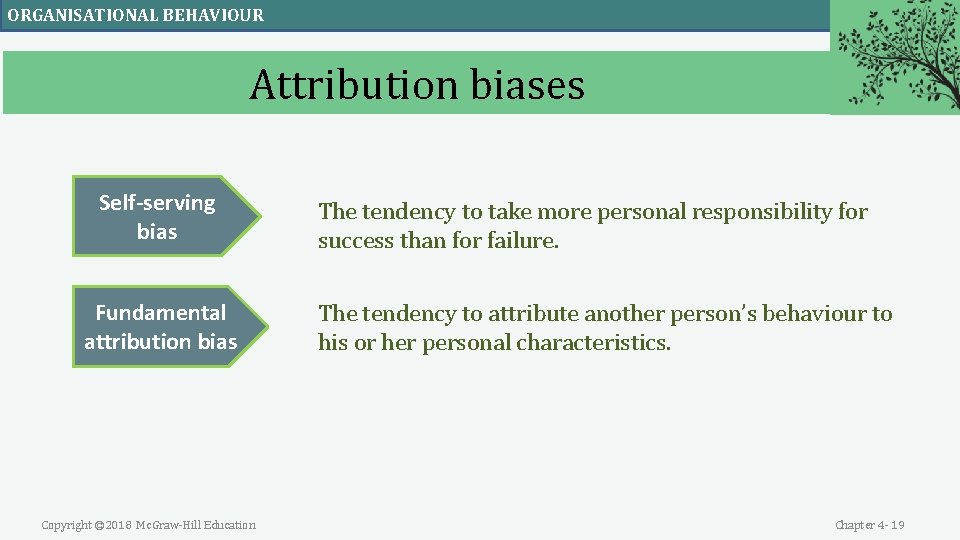
ORGANISATIONAL BEHAVIOUR Attribution biases Self-serving bias Fundamental attribution bias Copyright © 2018 Mc. Graw-Hill Education The tendency to take more personal responsibility for success than for failure. The tendency to attribute another person’s behaviour to his or her personal characteristics. Chapter 4 - 19
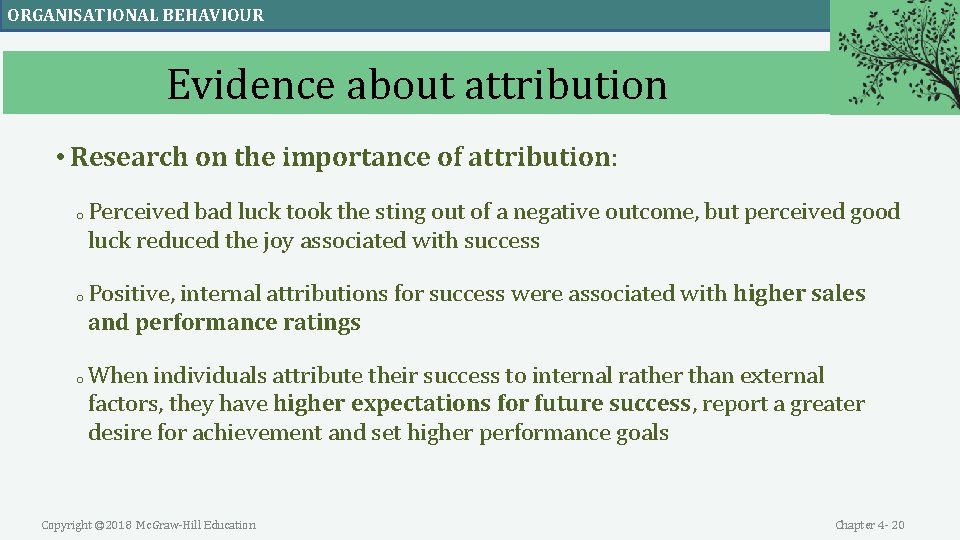
ORGANISATIONAL BEHAVIOUR Evidence about attribution • Research on the importance of attribution: o o o Perceived bad luck took the sting out of a negative outcome, but perceived good luck reduced the joy associated with success Positive, internal attributions for success were associated with higher sales and performance ratings When individuals attribute their success to internal rather than external factors, they have higher expectations for future success, report a greater desire for achievement and set higher performance goals Copyright © 2018 Mc. Graw-Hill Education Chapter 4 - 20
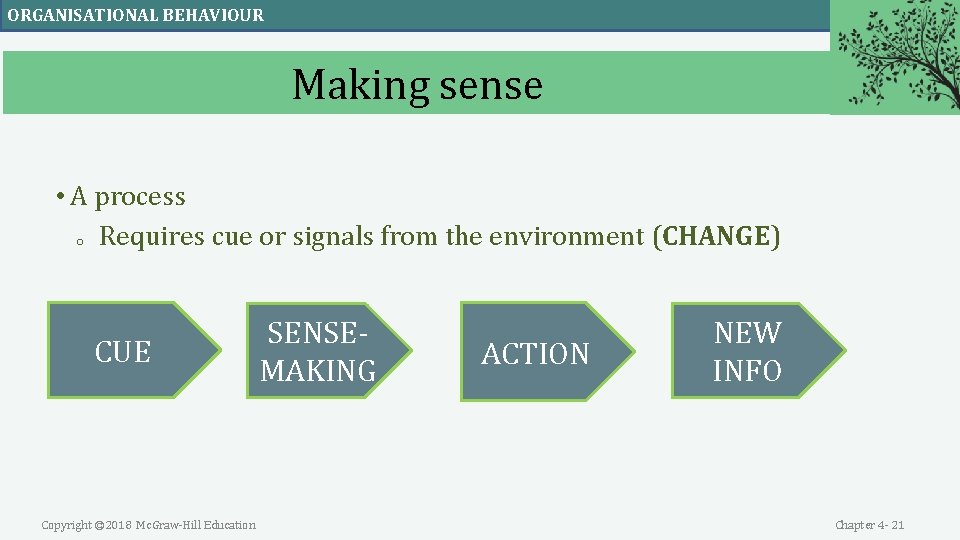
ORGANISATIONAL BEHAVIOUR Making sense • A process o Requires cue or signals from the environment (CHANGE) CUE Copyright © 2018 Mc. Graw-Hill Education SENSEMAKING ACTION NEW INFO Chapter 4 - 21
ORGANISATIONAL BEHAVIOUR Sensemaking as information processing • What’s the difference between sensemaking and information processing activities? o o o Sensemaking linked to people’s identities and where they fit within the organisation Organisations that apply sensemaking methods may be able to obtain a clearer picture of what is important to members. If cues are present and they don’t trigger sensemaking, individuals and organisations may continue as usual despite the existence of cues suggesting otherwise. Copyright © 2018 Mc. Graw-Hill Education Chapter 4 - 22
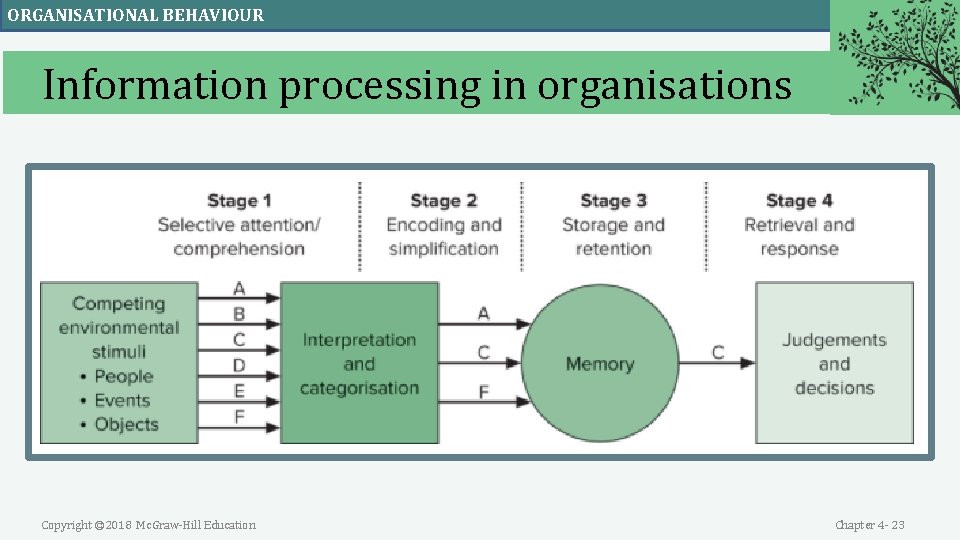
ORGANISATIONAL BEHAVIOUR Information processing in organisations Copyright © 2018 Mc. Graw-Hill Education Chapter 4 - 23
ORGANISATIONAL BEHAVIOUR Stage 1: Selective attention/comprehension • People selectively perceive subsets of stimuli • Attention is the process of becoming consciously aware of something or someone, plays a role. Ø Can be focused on information either from the environment or from memory. • Something is salient when it stands out from its context. Ø Social salience is determined by several factors including: novelty, brightness, unusual, extremely positive/negative, dominant Copyright © 2018 Mc. Graw-Hill Education Chapter 4 - 24
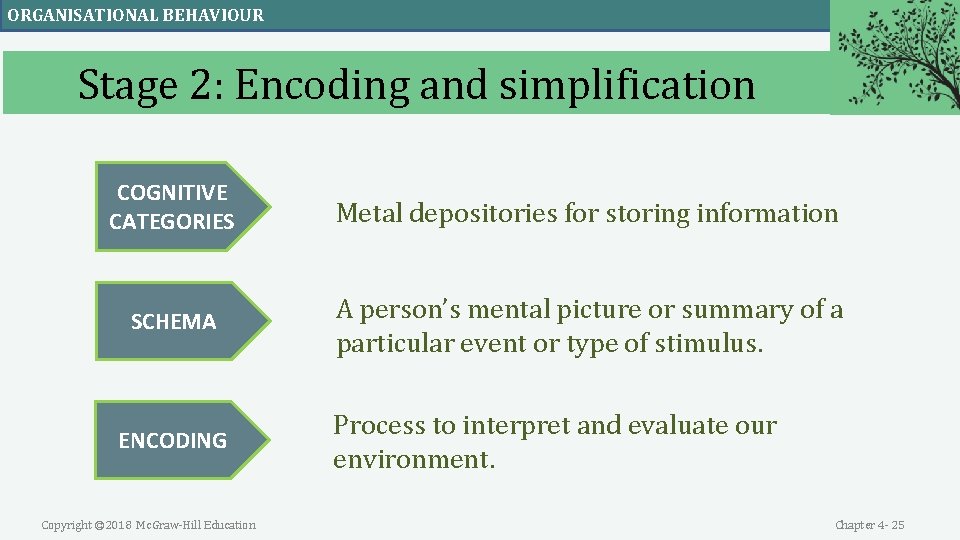
ORGANISATIONAL BEHAVIOUR Stage 2: Encoding and simplification COGNITIVE CATEGORIES Metal depositories for storing information SCHEMA A person’s mental picture or summary of a particular event or type of stimulus. ENCODING Copyright © 2018 Mc. Graw-Hill Education Process to interpret and evaluate our environment. Chapter 4 - 25
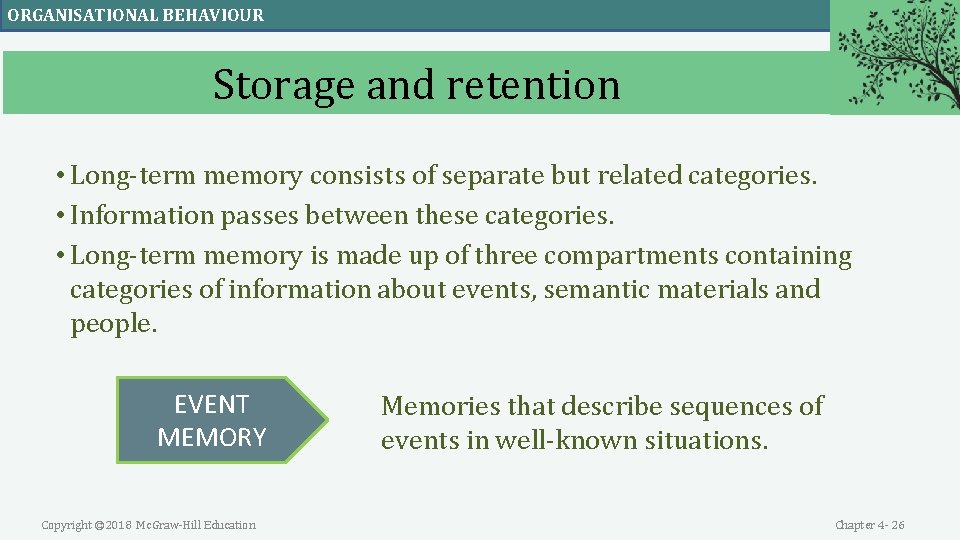
ORGANISATIONAL BEHAVIOUR Storage and retention • Long-term memory consists of separate but related categories. • Information passes between these categories. • Long-term memory is made up of three compartments containing categories of information about events, semantic materials and people. EVENT MEMORY Copyright © 2018 Mc. Graw-Hill Education Memories that describe sequences of events in well-known situations. Chapter 4 - 26
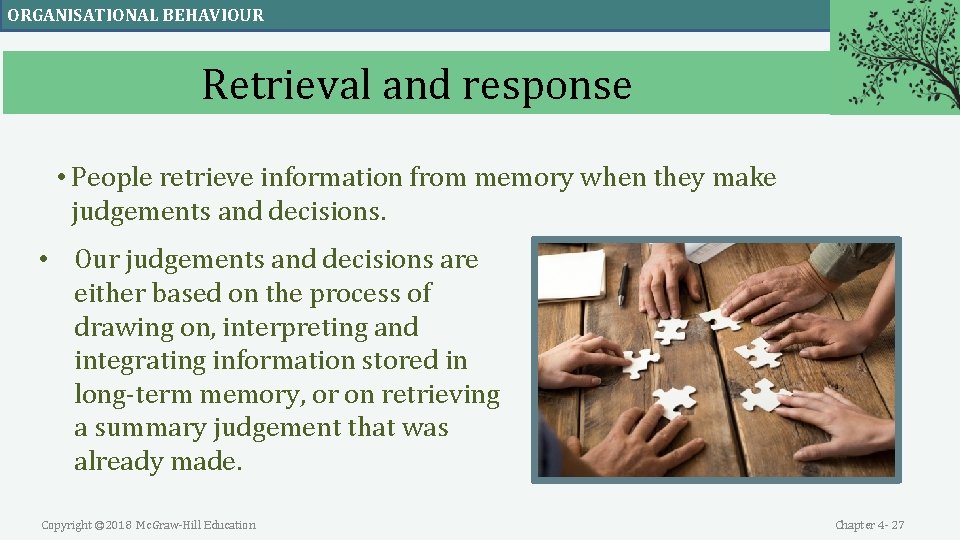
ORGANISATIONAL BEHAVIOUR Retrieval and response • People retrieve information from memory when they make judgements and decisions. • Our judgements and decisions are either based on the process of drawing on, interpreting and integrating information stored in long-term memory, or on retrieving a summary judgement that was already made. Copyright © 2018 Mc. Graw-Hill Education Chapter 4 - 27
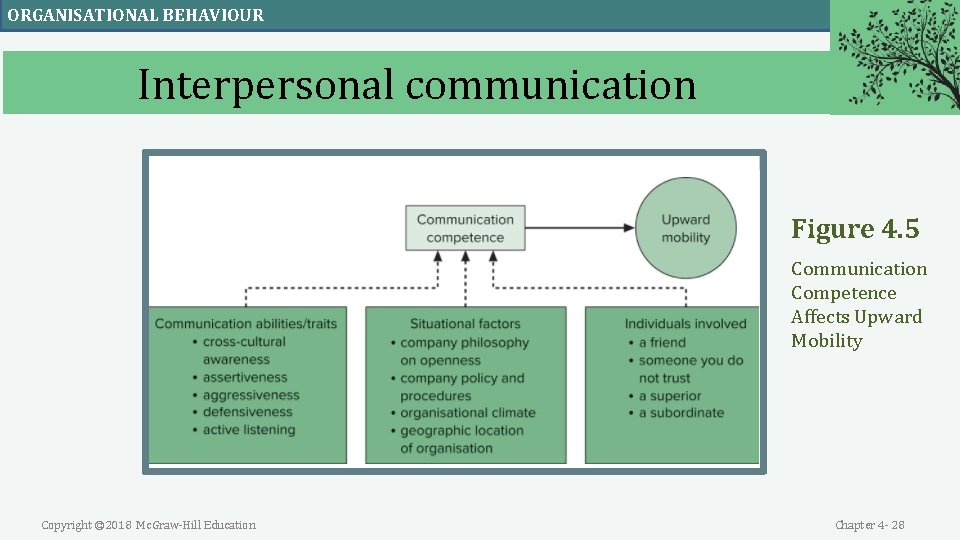
ORGANISATIONAL BEHAVIOUR Interpersonal communication Figure 4. 5 Communication Competence Affects Upward Mobility Copyright © 2018 Mc. Graw-Hill Education Chapter 4 - 28
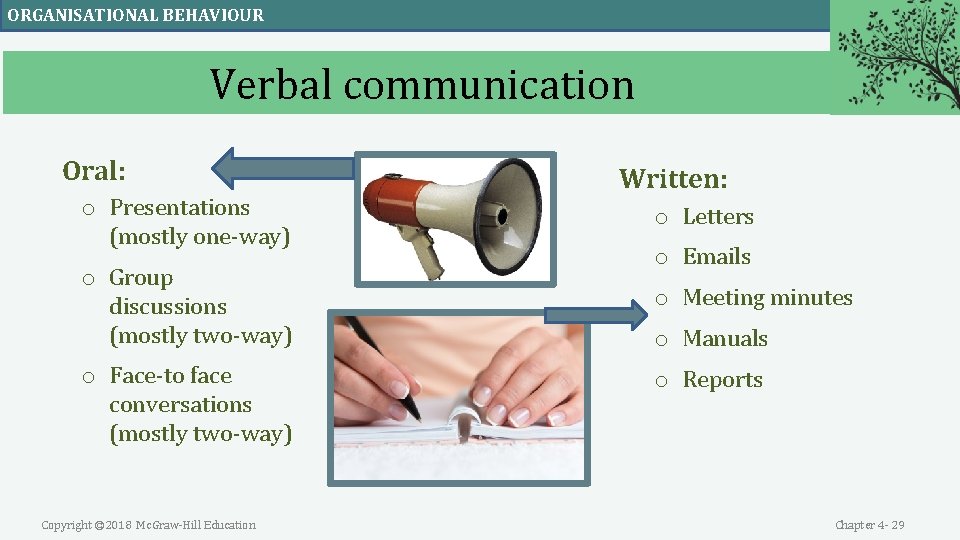
ORGANISATIONAL BEHAVIOUR Verbal communication Oral: o Presentations (mostly one-way) o Group discussions (mostly two-way) o Face-to face conversations (mostly two-way) Copyright © 2018 Mc. Graw-Hill Education Written: o Letters o Emails o Meeting minutes o Manuals o Reports Chapter 4 - 29
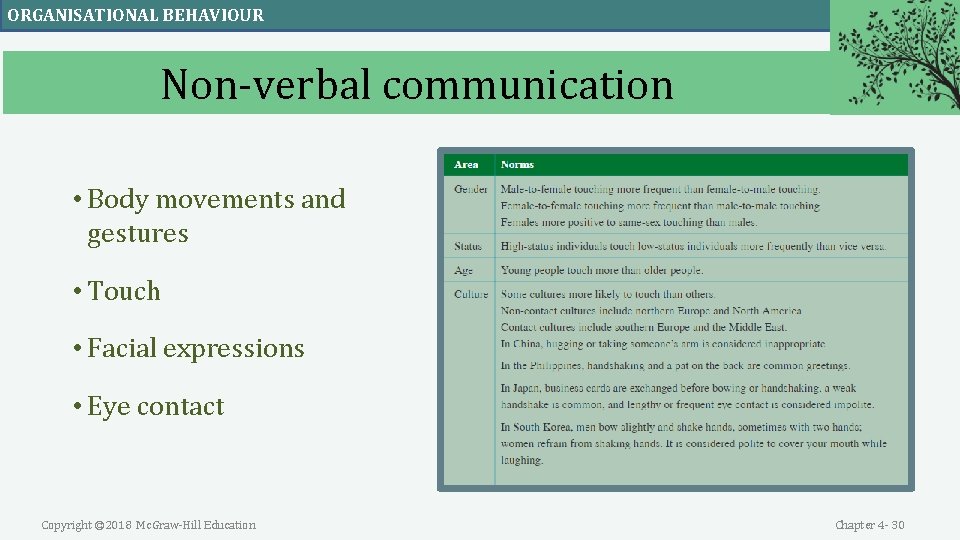
ORGANISATIONAL BEHAVIOUR Non-verbal communication • Body movements and gestures • Touch • Facial expressions • Eye contact Copyright © 2018 Mc. Graw-Hill Education Chapter 4 - 30
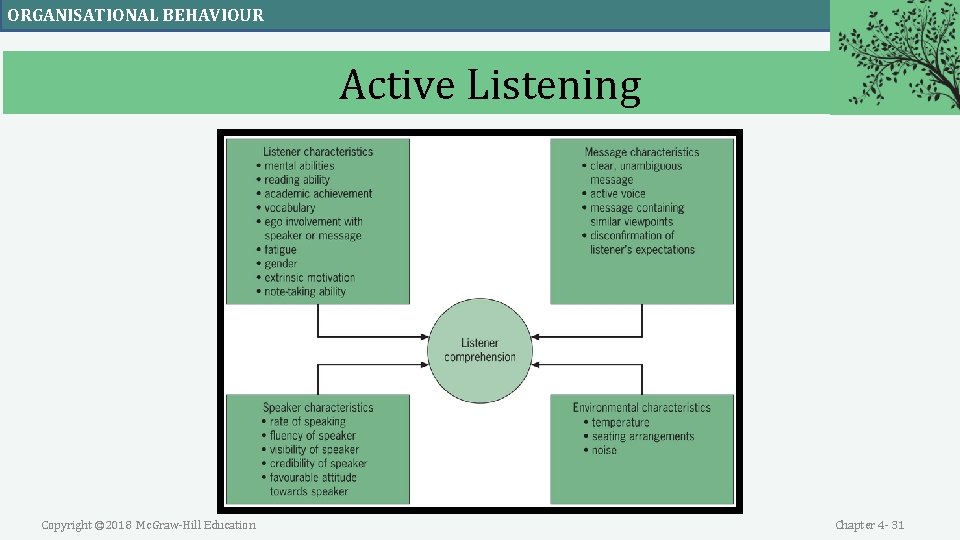
ORGANISATIONAL BEHAVIOUR Active Listening Copyright © 2018 Mc. Graw-Hill Education Chapter 4 - 31
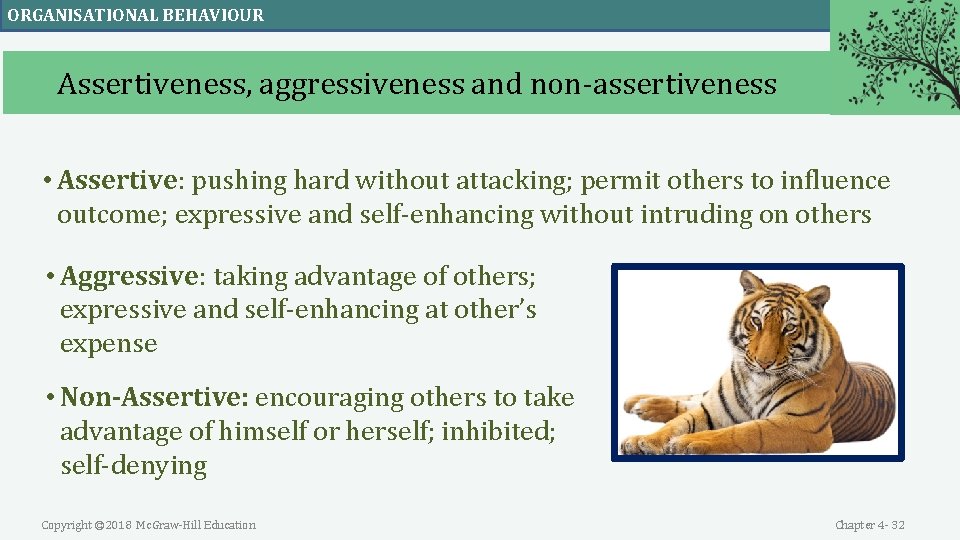
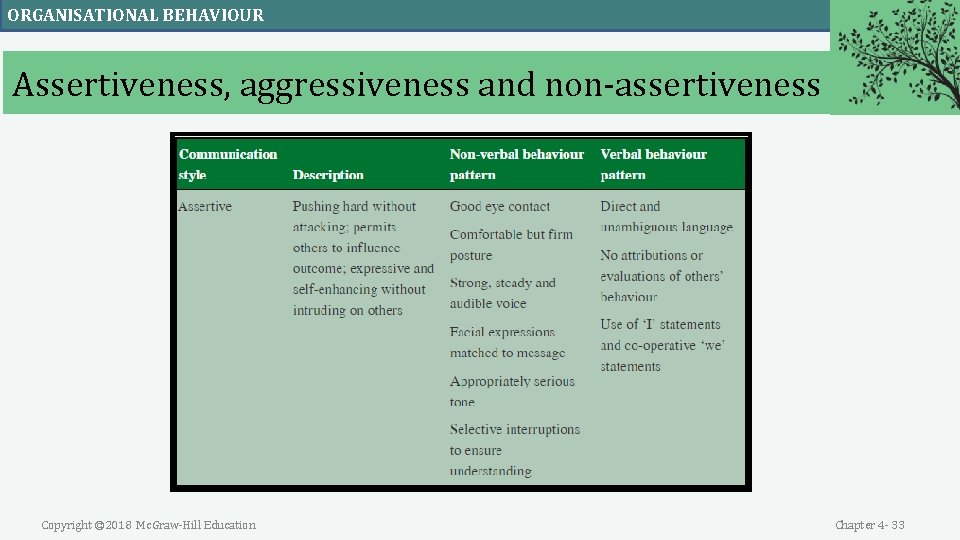
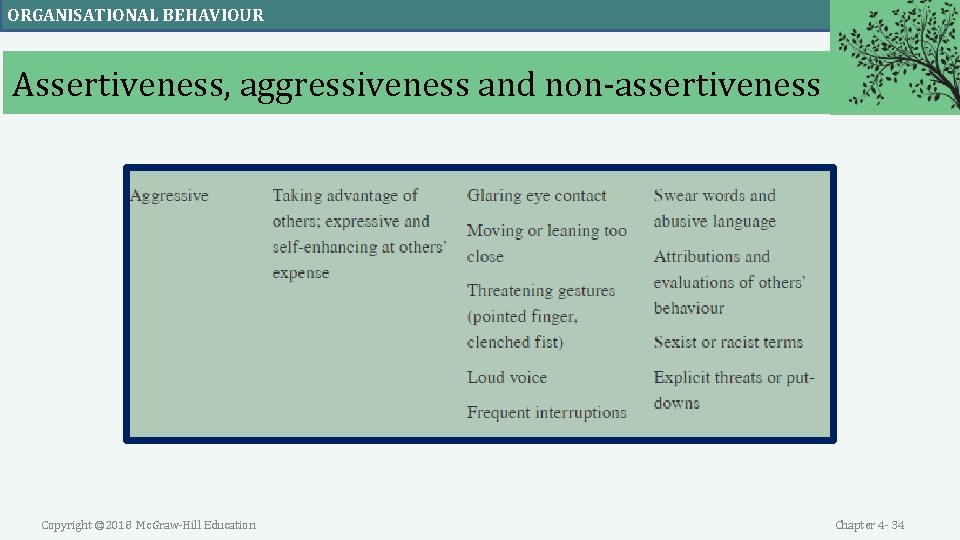
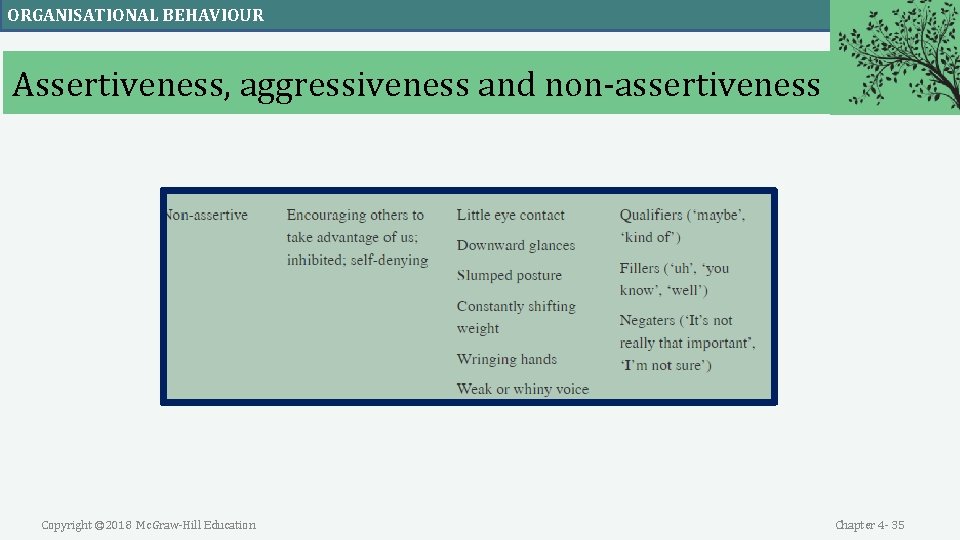
ORGANISATIONAL BEHAVIOUR Assertiveness, aggressiveness and non-assertiveness • Assertive: pushing hard without attacking; permit others to influence outcome; expressive and self-enhancing without intruding on others • Aggressive: taking advantage of others; expressive and self-enhancing at other’s expense • Non-Assertive: encouraging others to take advantage of himself or herself; inhibited; self-denying Copyright © 2018 Mc. Graw-Hill Education Chapter 4 - 32
ORGANISATIONAL BEHAVIOUR Assertiveness, aggressiveness and non-assertiveness Copyright © 2018 Mc. Graw-Hill Education Chapter 4 - 33
ORGANISATIONAL BEHAVIOUR Assertiveness, aggressiveness and non-assertiveness Copyright © 2018 Mc. Graw-Hill Education Chapter 4 - 34
ORGANISATIONAL BEHAVIOUR Assertiveness, aggressiveness and non-assertiveness Copyright © 2018 Mc. Graw-Hill Education Chapter 4 - 35
ORGANISATIONAL BEHAVIOUR Application of interpersonal communication • Describe the situation. Express your feelings and the impact the other’s behaviour has on you. • Empathise with the other person’s position / negotiate changes with the other person • Indicate in a non-threatening way, the possible consequences • Summarise the agreed action, making expectations clear Copyright © 2018 Mc. Graw-Hill Education Chapter 4 - 36
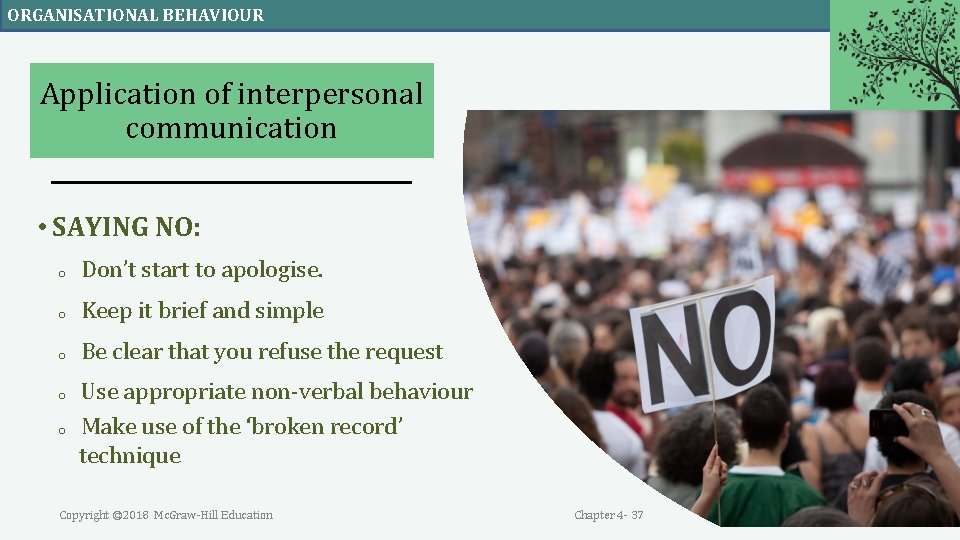
ORGANISATIONAL BEHAVIOUR Application of interpersonal communication • SAYING NO: o Don’t start to apologise. o Keep it brief and simple o Be clear that you refuse the request Use appropriate non-verbal behaviour o Make use of the ‘broken record’ technique o Copyright © 2018 Mc. Graw-Hill Education Chapter 4 - 37
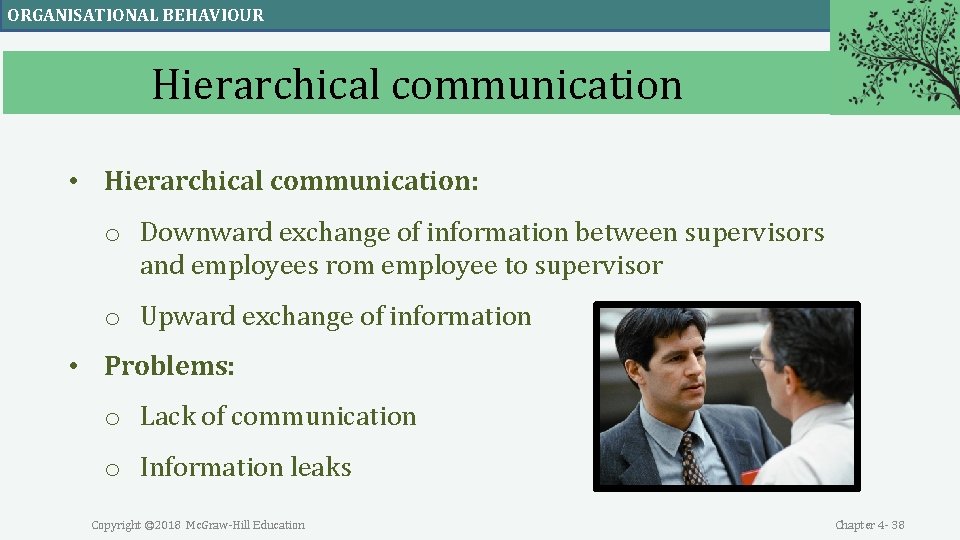
ORGANISATIONAL BEHAVIOUR Hierarchical communication • Hierarchical communication: o Downward exchange of information between supervisors and employees rom employee to supervisor o Upward exchange of information • Problems: o Lack of communication o Information leaks Copyright © 2018 Mc. Graw-Hill Education Chapter 4 - 38
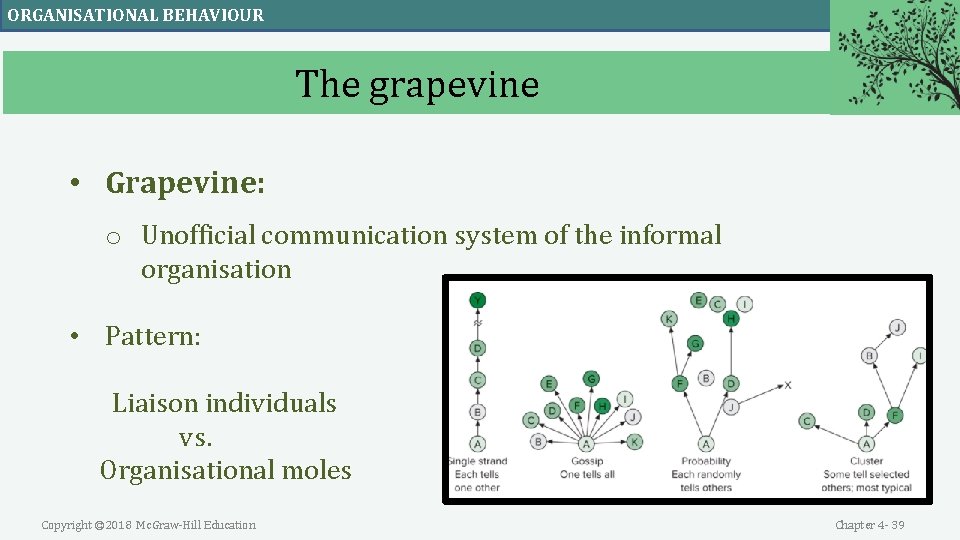
ORGANISATIONAL BEHAVIOUR The grapevine • Grapevine: o Unofficial communication system of the informal organisation • Pattern: Liaison individuals vs. Organisational moles Copyright © 2018 Mc. Graw-Hill Education Chapter 4 - 39
ORGANISATIONAL BEHAVIOUR Communication differences between men and women • Men are less likely to ask for information or directions in situations that would reveal their lack of knowledge • Women are more likely to downplay their certainty; men are more likely to downplay their doubts. • Women tend to apologise even when they have done nothing wrong. Men tend to avoid apologies as signs of weakness or concession. • Women tend to accept blame as a way of smoothing awkward situations. Men tend to ignore blame and place it elsewhere. • Women tend to temper criticism with positive buffers. Men tend to give criticism directly. Copyright © 2018 Mc. Graw-Hill Education Chapter 4 - 40
ORGANISATIONAL BEHAVIOUR Communication differences between men and women • Women tend to insert unnecessary and unwarranted thank-yous. Men may avoid thanks altogether as a sign of weakness • Women tend to ask “What do you think? ” to build consensus. Men often perceive that question to be a sign of incompetence or lack of confidence • Women tend to give directions indirectly, men perceive this as confusing, less confident or manipulative • Men tend to take ideas stated by women and claim them as their own. Women tend to allow this without protest. • Women use softer voice to encourage persuasion and approval. Men use louder voice to attract attention and maintain control. Copyright © 2018 Mc. Graw-Hill Education Chapter 4 - 41
ORGANISATIONAL BEHAVIOUR Evidence about communication patterns • Employees tend to engage in communication distortion because of workplace politics • Employees also tend to modify or distort information when they aspire to move upwards and when they do not trust their supervisors • The grapevine is faster than formal channels • The informal social network of employees has expanded significantly, making it possible to gossip to anyone and not just to your own social network Copyright © 2018 Mc. Graw-Hill Education Chapter 4 - 42
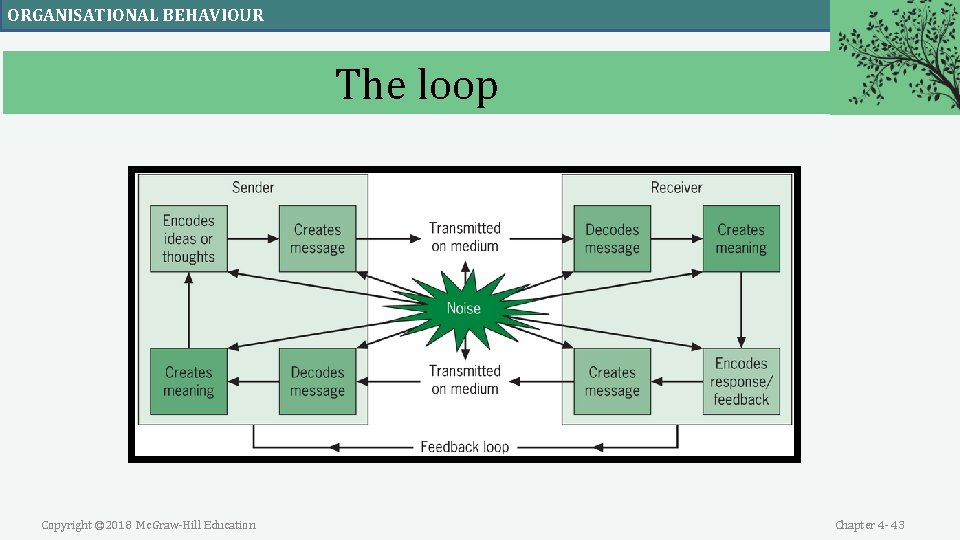
ORGANISATIONAL BEHAVIOUR The loop Copyright © 2018 Mc. Graw-Hill Education Chapter 4 - 43
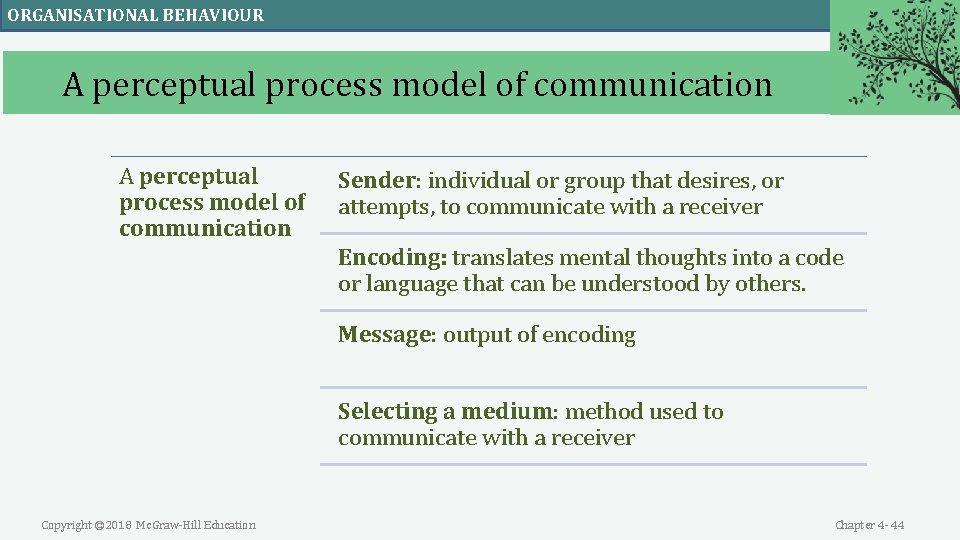
ORGANISATIONAL BEHAVIOUR A perceptual process model of communication Sender: individual or group that desires, or attempts, to communicate with a receiver Encoding: translates mental thoughts into a code or language that can be understood by others. Message: output of encoding Selecting a medium: method used to communicate with a receiver Copyright © 2018 Mc. Graw-Hill Education Chapter 4 - 44
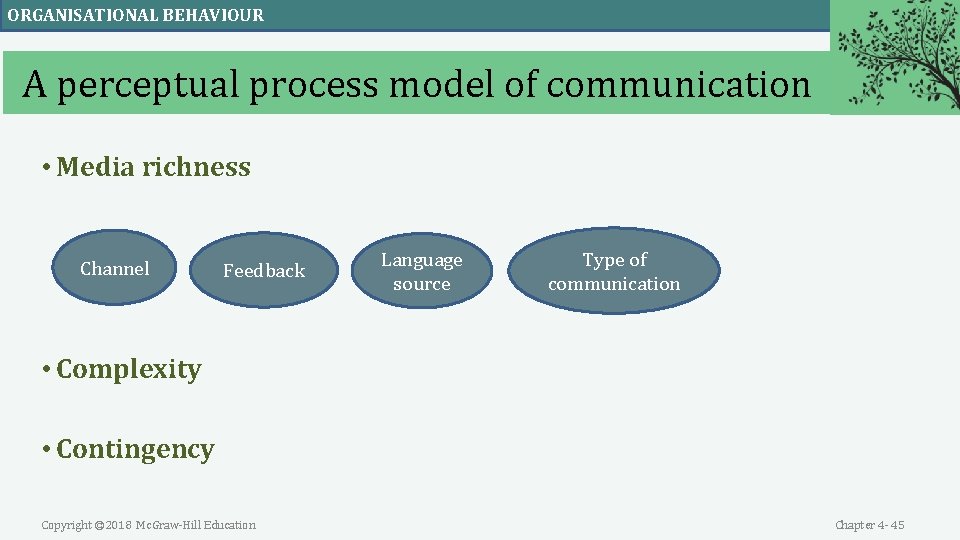
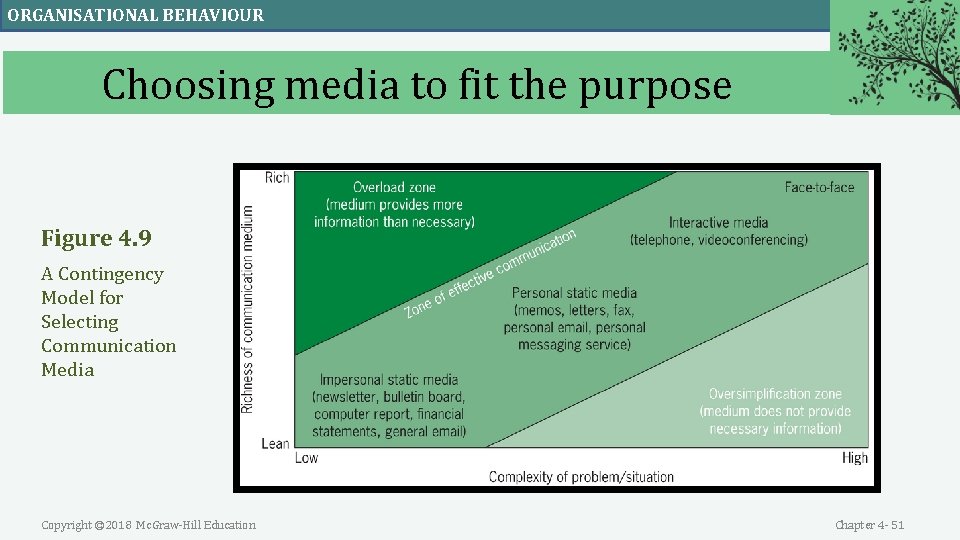
ORGANISATIONAL BEHAVIOUR A perceptual process model of communication • Media richness Channel Feedback Language source Type of communication • Complexity • Contingency Copyright © 2018 Mc. Graw-Hill Education Chapter 4 - 45
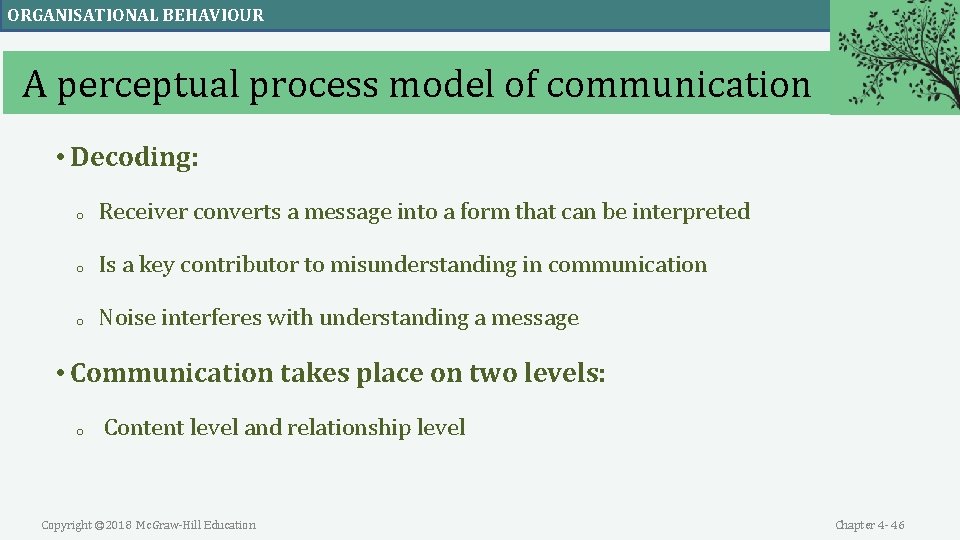
ORGANISATIONAL BEHAVIOUR A perceptual process model of communication • Decoding: o Receiver converts a message into a form that can be interpreted o Is a key contributor to misunderstanding in communication o Noise interferes with understanding a message • Communication takes place on two levels: o Content level and relationship level Copyright © 2018 Mc. Graw-Hill Education Chapter 4 - 46
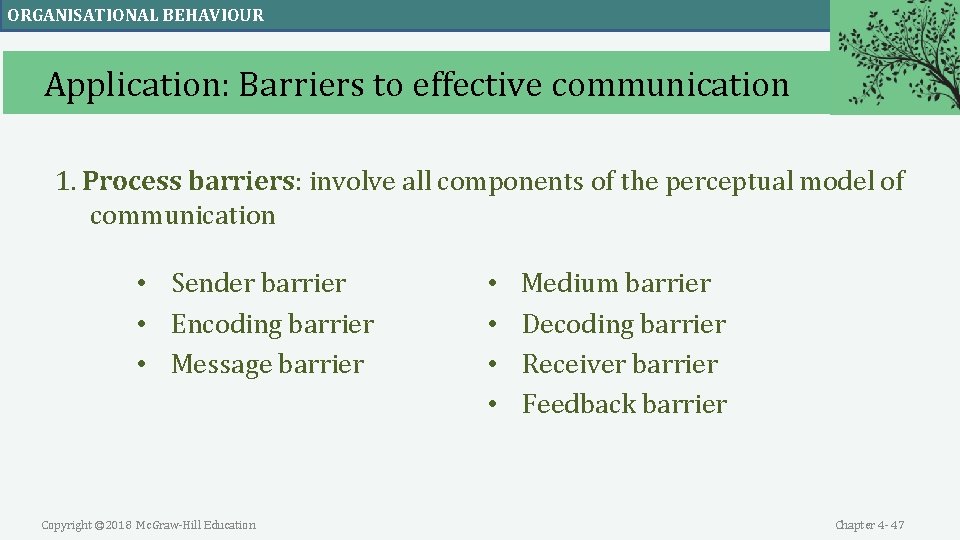
ORGANISATIONAL BEHAVIOUR Application: Barriers to effective communication 1. Process barriers: involve all components of the perceptual model of communication • Sender barrier • Encoding barrier • Message barrier Copyright © 2018 Mc. Graw-Hill Education • Medium barrier • Decoding barrier • Receiver barrier • Feedback barrier Chapter 4 - 47
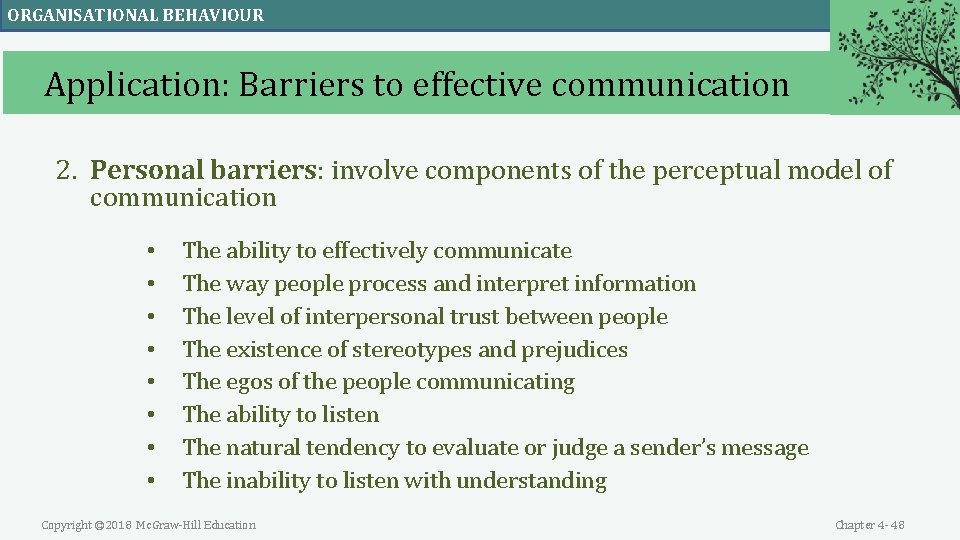
ORGANISATIONAL BEHAVIOUR Application: Barriers to effective communication 2. Personal barriers: involve components of the perceptual model of communication • • The ability to effectively communicate The way people process and interpret information The level of interpersonal trust between people The existence of stereotypes and prejudices The egos of the people communicating The ability to listen The natural tendency to evaluate or judge a sender’s message The inability to listen with understanding Copyright © 2018 Mc. Graw-Hill Education Chapter 4 - 48
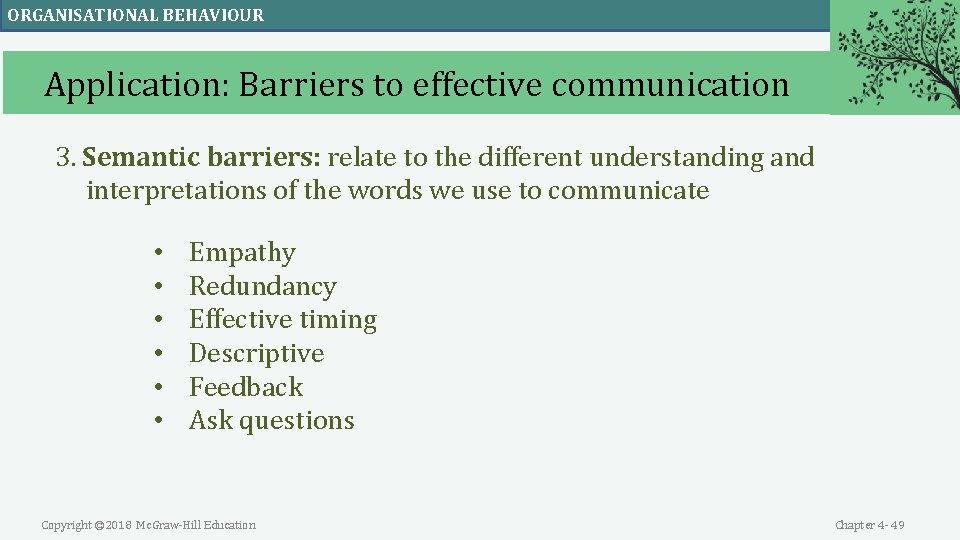
ORGANISATIONAL BEHAVIOUR Application: Barriers to effective communication 3. Semantic barriers: relate to the different understanding and interpretations of the words we use to communicate • • • Empathy Redundancy Effective timing Descriptive Feedback Ask questions Copyright © 2018 Mc. Graw-Hill Education Chapter 4 - 49
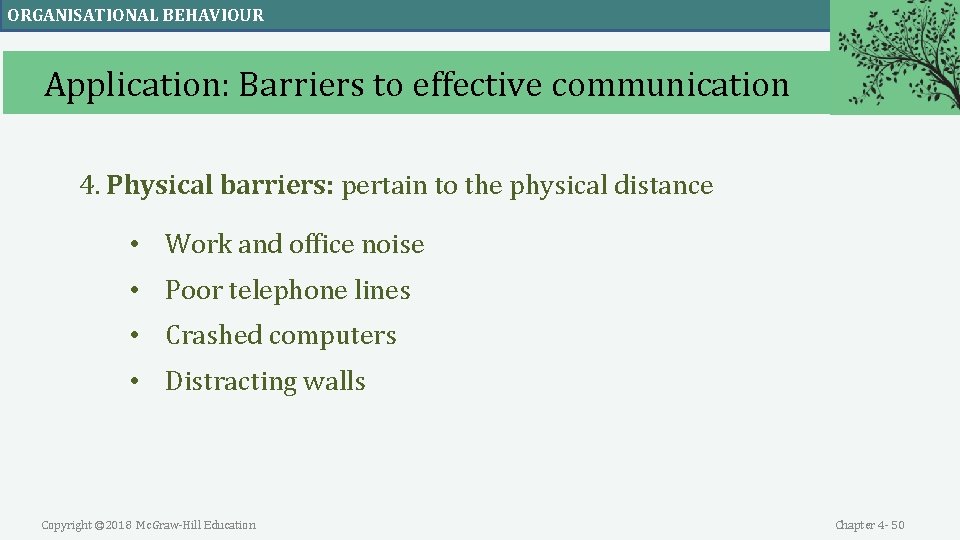
ORGANISATIONAL BEHAVIOUR Application: Barriers to effective communication 4. Physical barriers: pertain to the physical distance • Work and office noise • Poor telephone lines • Crashed computers • Distracting walls Copyright © 2018 Mc. Graw-Hill Education Chapter 4 - 50
ORGANISATIONAL BEHAVIOUR Choosing media to fit the purpose Figure 4. 9 A Contingency Model for Selecting Communication Media Copyright © 2018 Mc. Graw-Hill Education Chapter 4 - 51