
Site Protection in Forestry Operations Welcome We are

- Slides: 26
Site Protection in Forestry Operations Welcome
We are here to … § Minimize unnecessary disturbance due to forestry operations in the boreal forest
Our Goals § To increase understanding of site damage issues, and their impact on forest sustainability § To understand the policy and legal aspects of site damage § Review “best management practices” at every level
Agenda Day 1 § Background, definitions and Legislation § Six types damage § Site impacts § Sensitive sites § BMP’s § Case studies
Agenda Day 2 § Apply tools, skills and knowledge to § Assess site damage in the field § Identify sensitive sites, features and risks § Propose best management practices
Comfort Notes … § § Washrooms Snacks and breaks Phones …
Questions?
Background
Policy and Legislation § Required by EA Term and Condition 94 b § MNR’s evidence suggested that forestry operations were not causing significant harm to the environment § Crown Forest Sustainability Act ~ Sec 55 deals with “damage” by forest operations
Policy and Legislation § Forest Management Guidelines for the Protection of the Physical Environment (1997) § Originally intended to document existing practices for protection of sites during forestry operations
Policy and Legislation § Guidelines should primarily § Increase the level of awareness of site disturbance issues across the Province, and § Improve the standard of practice with respect to protection of the physical environment
Policy and Legislation § Guidelines for the Protection of the Physical Environment are part of Ontario’s forest legislation § Guidelines given legal strength through the regulated Forest Operations and Silviculture Manual
Key Definitions
Site Disturbance § Specific changes/impacts to forest sites resulting from forest management operations (harvest and forest renewal) § 6 key impacts have potential to result in site damage
Types of Site Disturbance § § § Compaction and rutting Erosion Nutrient loss Loss of productive land Hydrological impacts Damage to residual trees and vegetation
Site Disturbance § Site disturbance does not necessarily equate to site damage
Site Damage § Damage occurs when the site disturbance (due to forest management operations) results in long-term negative impacts on the health and productivity of a forest ecosystem
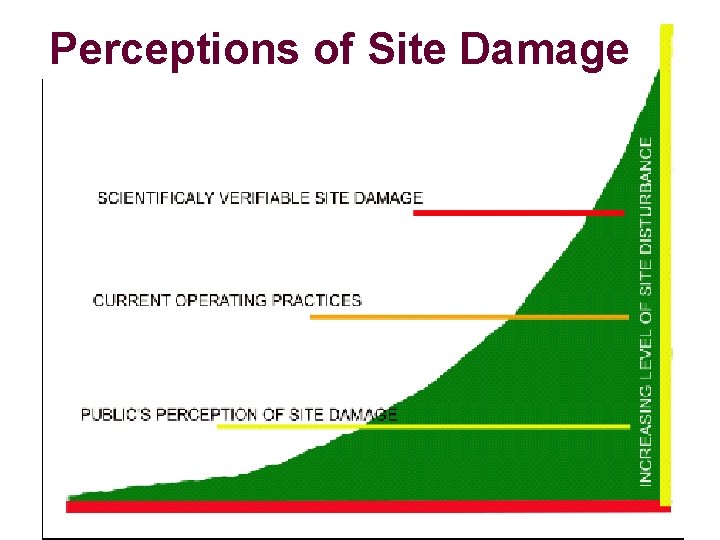
Site Damage § The point at which site disturbance becomes site damage is poorly defined § Public’s perception of damage undoubtedly occurs before real (scientifically provable) damage occurs
Perceptions of Site Damage
Site Productivity § Ability of a site to accumulate plant biomass over time § Maintaining timber yield and § The production of all plants and animals in a forest ecosystem (forest or ecosystem productivity)
Sensitive Sites § Sites which have a high probability of damage if managed according to the standard operating practices
Sensitive Sites § Sensitivity of many sites is influenced by weather and season § Sensitive sites may be operated without damage by using modified operating techniques (i. e. , Best Management Practices)
Best Management Practices § Sometimes called Good Management Practices § Operating techniques which are used to prevent or minimize site disturbance on sensitive sites § They are not mandatory techniques § They are not an exhaustive list of good practices
Discussion § Unrealistic to expect site disturbance to be eliminated § Site damage can be eliminated by § Increasing awareness of issues, and § Applying best management practices suited to local site and economic conditions
Discussion § Increasing awareness of site damage / site disturbance issues is the main challenge in improving the standard of practice in Ontario
Questions?