Short Sleep Duration and the Risk of Hypertension



- Slides: 19
Short Sleep Duration and the Risk of Hypertension and Diabetes Capstone Project, MPAS 218 Spring 2020 Presented By: Jacob Novick April 3, 2020
Disclaimer Jacob Novick has no actual or potential conflicts of interest in giving this presentation. Dr. Sunseri assisted in drafting of paper and topic formation.
PICOT: Are adults aged 18 and older (P), who are subjected to less than 7 hours of sleep per night (I), compared to adults of similar age who receive more than 7 hours of sleep each night (C), at an increased risk of developing hypertension and diabetes (O) throughout the duration of those sleep patterns and beyond (T)?
Key Issues Understand common sleep disorders Understand the magnitude of the effects of short sleep duration, and its prevalence on current society Review future areas of investigation and emerging topics of research in terms of sleep health Recognize the importance of embedding proper sleep hygiene within one’s future practice
Background Essence of sleep…. broken down: REM vs. NREM and the circadian rhythm Why is sleeping so hard? (insomnia vs insufficient sleep syndrome ) What is enough sleep? ~~gold standard answer
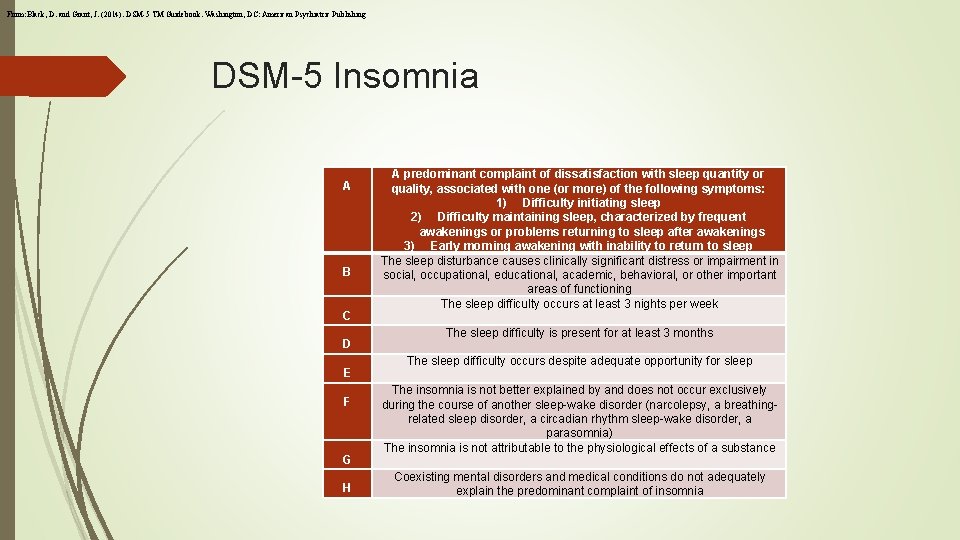
From: Black, D. and Grant, J. (2014). DSM-5 TM Guidebook. Washington, DC: American Psychiatric Publishing DSM-5 Insomnia A B C D E F G H A predominant complaint of dissatisfaction with sleep quantity or quality, associated with one (or more) of the following symptoms: 1) Difficulty initiating sleep 2) Difficulty maintaining sleep, characterized by frequent awakenings or problems returning to sleep after awakenings 3) Early morning awakening with inability to return to sleep The sleep disturbance causes clinically significant distress or impairment in social, occupational, educational, academic, behavioral, or other important areas of functioning The sleep difficulty occurs at least 3 nights per week The sleep difficulty is present for at least 3 months The sleep difficulty occurs despite adequate opportunity for sleep The insomnia is not better explained by and does not occur exclusively during the course of another sleep-wake disorder (narcolepsy, a breathingrelated sleep disorder, a circadian rhythm sleep-wake disorder, a parasomnia) The insomnia is not attributable to the physiological effects of a substance Coexisting mental disorders and medical conditions do not adequately explain the predominant complaint of insomnia
Background Why choose DM and HTN? ~ some numbers for context: Facts from 2016: 1 in 3 (75 million) w HTN + 1 in 3 w prehypertension=2/3 Americans 83 k deaths, roughly 12% of office/ER visits involved DM
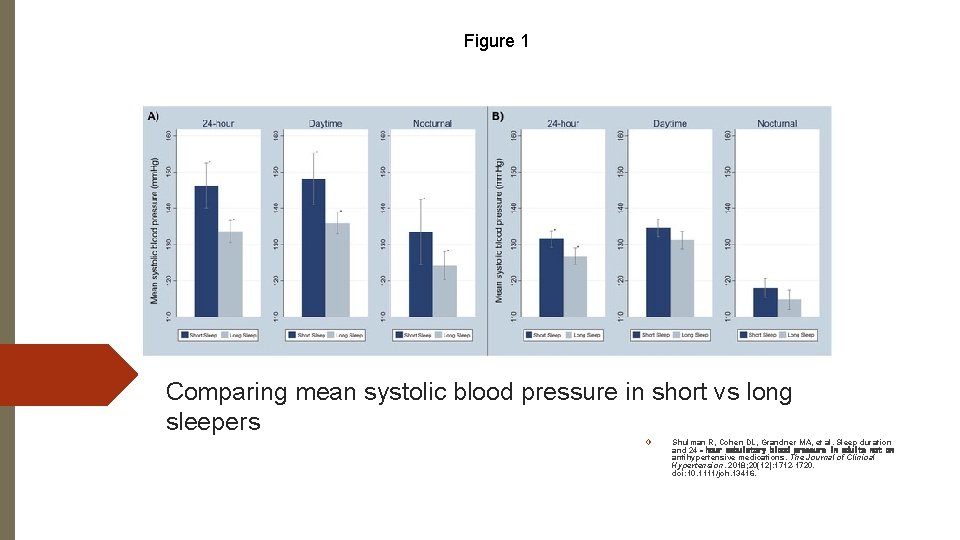
Evidence (HTN) Shulman et al. ~mean 24 hr SBP <7 hrs sleep=+12 mm Hg higher Increased risk uncontrolled or sustained HTN & increased 24 hr HR N= 219 ~~cross-sectional 2 studies: LIMBS & PISA
Figure 1 Comparing mean systolic blood pressure in short vs long sleepers Shulman R, Cohen DL, Grandner MA, et al. Sleep duration and 24‐hour ambulatory blood pressure in adults not on antihypertensive medications. The Journal of Clinical Hypertension. 2018; 20(12): 1712 -1720. doi: 10. 1111/jch. 13416.
Evidence (DM) Ferrie et al. ~markers such as fasting plasma glucose, 75 g GTT, Hgb A 1 C further support prevalence towards increased risk w <7 hrs Reverse J-shaped curve N=>10 K
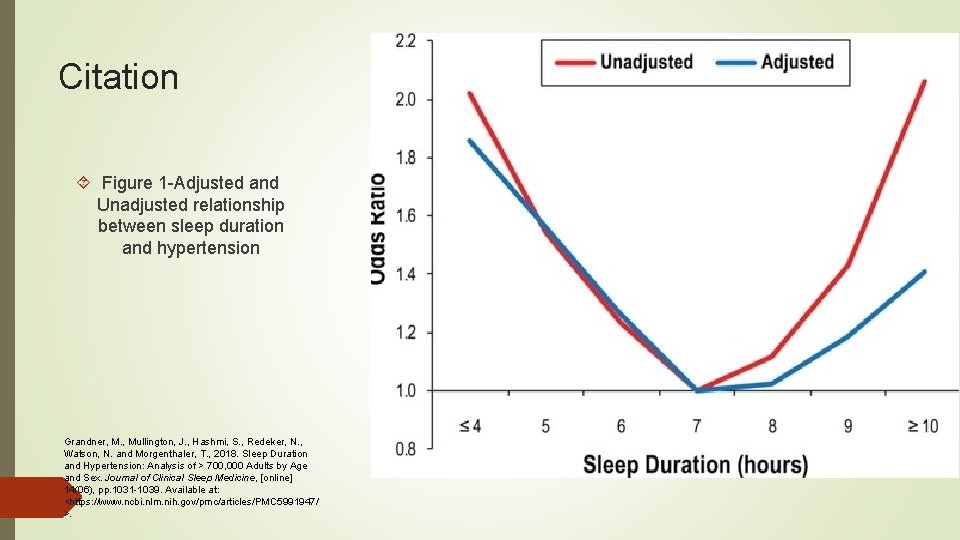
Summary of Evidence HTN: Wang et al. ~meta analysis Direct correlation between <7 hrs and >8 hrs with increased risk HTN Grimaldi et al. ~consistent sleep restriction (<5 hrs) increased HR & increased urine norepinephrine excretions nocturnal sympathetic activation
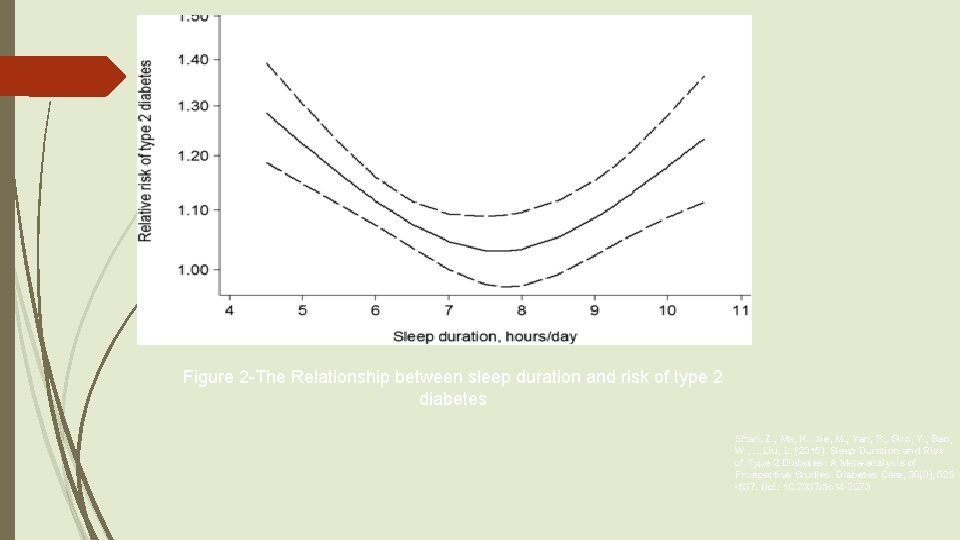
Summary of Evidence DM: Chaput et al. ~impaired glucose tolerance increased with <7 hrs sleep (FPG, insulin concentrations, total insulin levels) Shan et al. ~meta analysis T 2 DM risk increased with every hr <7 hrs
Figure 2 -The Relationship between sleep duration and risk of type 2 diabetes Shan, Z. , Ma, H. , Xie, M. , Yan, P. , Guo, Y. , Bao, W. , …Liu, L. (2015). Sleep Duration and Risk of Type 2 Diabetes: A Meta-analysis of Prospective Studies. Diabetes Care, 38(3), 529 -537. Doi: 10. 2337/dc 14 -2073
Citation Figure 1 -Adjusted and Unadjusted relationship between sleep duration and hypertension Grandner, M. , Mullington, J. , Hashmi, S. , Redeker, N. , Watson, N. and Morgenthaler, T. , 2018. Sleep Duration and Hypertension: Analysis of > 700, 000 Adults by Age and Sex. Journal of Clinical Sleep Medicine, [online] 14(06), pp. 1031 -1039. Available at: <https: //www. ncbi. nlm. nih. gov/pmc/articles/PMC 5991947/ >.
Conclusion~~Answering the PICOT Several markers demonstrate sleeping <7 hrs increases chances of HTN & DM HTN: Increased systolic BP, increased overall HR, increased urinary catecholamines DM: Increased fasting glucose, increased insulin concentrations Surprisingly or not…. >7 hours is associated with similar chances of developing HTN & DM
Implications for providers Large numbers of population affected by this research in one way or another As a provider, formulate plan to address this topic with patients One conversation urging more sleep could prevent millions of cases of preventable diseases
Gaps in knowledge/future research HTN: Nocturnal sympathetic activation: sleep deficiency autonomoic sympathetic response RAAS activation increased catecholamine production HTN DM Chronic inflammation neurohormone alteration changes in eating habits (dense food) Chronic inflammation increased inflammatory markers changes to neuroendocrine homeostasis
References 1) Depner, C. , Stothard, E. and Wright, K. (2014). Metabolic Consequences of Sleep and Circadian Disorders. Current Diabetes Reports, 14(7). 2) Nedeltcheva A, Scheer F. Metabolic effects of sleep disruption, links to obesity and diabetes. Current Opinion in Endocrinology & Diabetes and Obesity. 2014; 21(4): 293 -298. doi: 10. 1097/med. 000000082 3) Black, D. and Grant, J. (2014). DSM-5 TM guidebook. Washington, DC: American Psychiatric Publishing. 4) Cdc. gov. (2016). High Blood Pressure Fact Sheet|Data & Statistics|DHDSP|CDC. [online] Available at: https: //www. cdc. gov/dhdsp/data_statistics/fact_sheets/fs_bloodpressure. htm [Accessed 16 Dec. 2019]. 5) Cdc. gov. (2017). Fast. Stats. [online] Available at: https: //www. cdc. gov/nchs/fastats/hypertension. htm [Accessed 15 Dec. 2019]. 6) Cdc. gov. (2017). Fast. Stats. [online] Available at: https: //www. cdc. gov/nchs/fastats/diabetes. htm [Accessed 15 Dec. 2019]. 7) Wang Y, Mei H, Jiang Y-R, et al. Relationship between Duration of Sleep and Hypertension in Adults: A Meta-Analysis. Journal of Clinical Sleep Medicine. 2015. doi: 10. 5664/jcsm. 5024. 8) Shulman R, Cohen DL, Grandner MA, et al. Sleep duration and 24‐hour ambulatory blood pressure in adults not on antihypertensive medications. The Journal of Clinical Hypertension. 2018; 20(12): 1712 -1720. doi: 10. 1111/jch. 13416. 9) Grimaldi D, Carter JR, Cauter EV, Leproult R. Adverse Impact of Sleep Restriction and Circadian Misalignment on Autonomic Function in Healthy Young Adults. Hypertension. 2016; 68(1): 243 -250. doi: 10. 1161/hypertensionaha. 115. 06847. 10) Shan, Z. , Ma, H. , Xie, M. , Yan, P. , Guo, Y. , Bao, W. , …Liu, L. (2015). Sleep Duration and Risk of Type 2 Diabetes: A Meta-analysis of Prospective Studies. Diabetes Care, 38(3), 529 -537. Doi: 10. 2337/dc 14 -2073 11) Chaput, J. -P. , Bouchard, C. , & Tremblay, A. (2007). Association of sleep duration with type 2 diabetes and impaired glucose tolerance. Diabetologia, 50(11), 2298 -2304. Doi: 10. 1007/s 00125 -007 -0786 -x 12)Ferrie, J. E. , Kivimaki, M. , Akbaraly, T. N. , Tabak, A. , Abell, J. , Smith, G. D. , …Shipley, M. J. (2015). Change in Sleep Duration and Type 2 Diabetes: The Whitehall II Study. Diabetes Care, 38(8), 1467 -1472. Doi: 10. 2337/dc 15 -0186 13) Grandner, M. , Mullington, J. , Hashmi, S. , Redeker, N. , Watson, N. and Morgenthaler, T. , 2018. Sleep Duration and Hypertension: Analysis of > 700, 000 Adults by Age and Sex. Journal of Clinical Sleep Medicine, [online] 14(06), pp. 1031 -1039. Available at: <https: //www. ncbi. nlm. nih. gov/pmc/articles/PMC 5991947/>.
Questions?