SFS 2 Students will use various scientific techniques
- Slides: 25
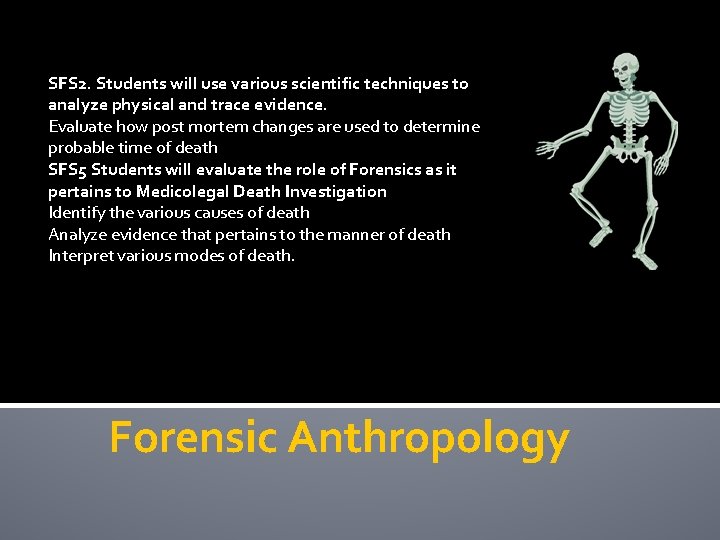
SFS 2. Students will use various scientific techniques to analyze physical and trace evidence. Evaluate how post mortem changes are used to determine probable time of death SFS 5 Students will evaluate the role of Forensics as it pertains to Medicolegal Death Investigation Identify the various causes of death Analyze evidence that pertains to the manner of death Interpret various modes of death. Forensic Anthropology
What Bones Can Tell Us � Osteology is the study of bones � There are 206 bones in an adult (if they have all they are supposed to have) and over 300 in a baby � Bones contain a record of the physical life. � Analyzing bones can reveal clues to such things as gender, age, height, and health. Forensic Science: Fundamentals & Investigations, Chapter 13 2
How Bones Connect � Bones are held together by: a. cartilage—wraps the ends of bones and keeps them from scraping one another. b. ligaments—bands that connect two or more bones together. c. tendons—connect muscle to bone. � Until about 30 years of age, bones increase in size. � Deterioration after 30 can be slowed with exercise. Forensic Science: Fundamentals & Investigations, Chapter 13 3
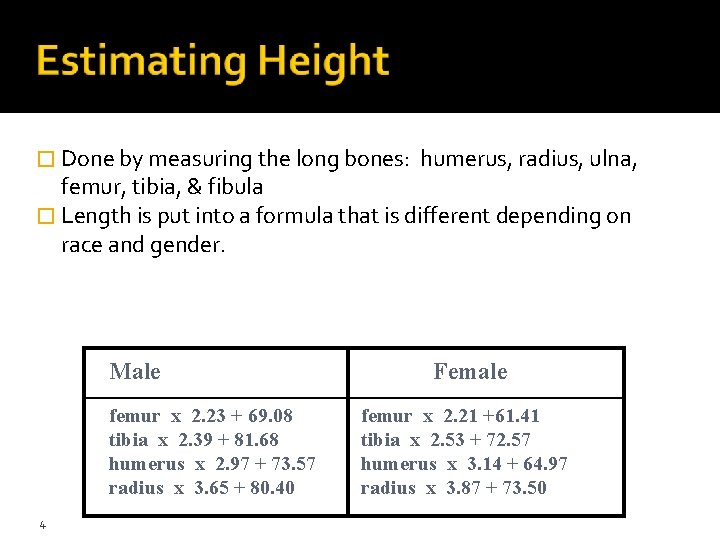
� Done by measuring the long bones: humerus, radius, ulna, femur, tibia, & fibula � Length is put into a formula that is different depending on race and gender. Male femur x 2. 23 + 69. 08 tibia x 2. 39 + 81. 68 humerus x 2. 97 + 73. 57 radius x 3. 65 + 80. 40 4 Female femur x 2. 21 +61. 41 tibia x 2. 53 + 72. 57 humerus x 3. 14 + 64. 97 radius x 3. 87 + 73. 50
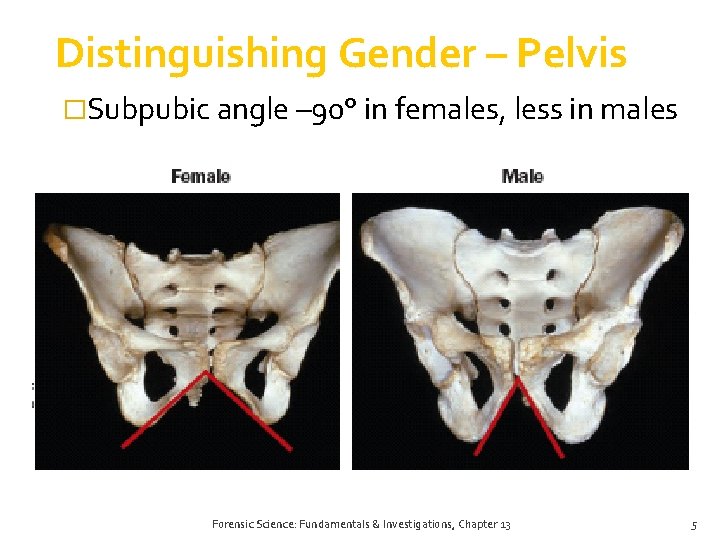
Distinguishing Gender – Pelvis �Subpubic angle – 90° in females, less in males Forensic Science: Fundamentals & Investigations, Chapter 13 5
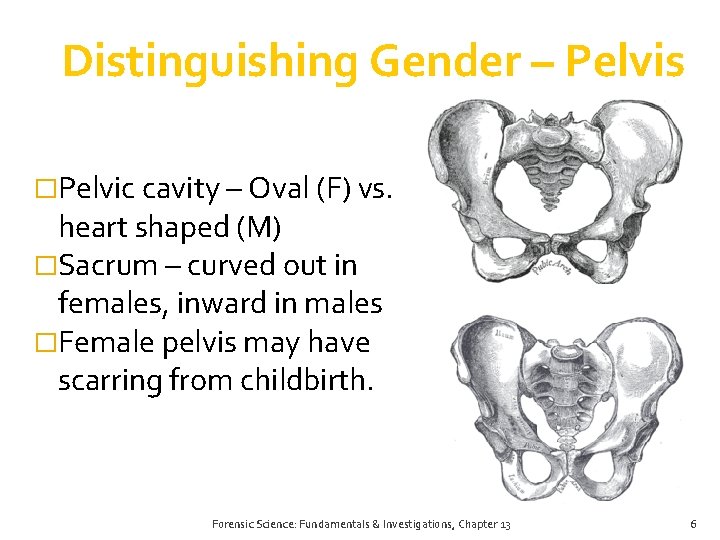
Distinguishing Gender – Pelvis �Pelvic cavity – Oval (F) vs. heart shaped (M) �Sacrum – curved out in females, inward in males �Female pelvis may have scarring from childbirth. Forensic Science: Fundamentals & Investigations, Chapter 13 6
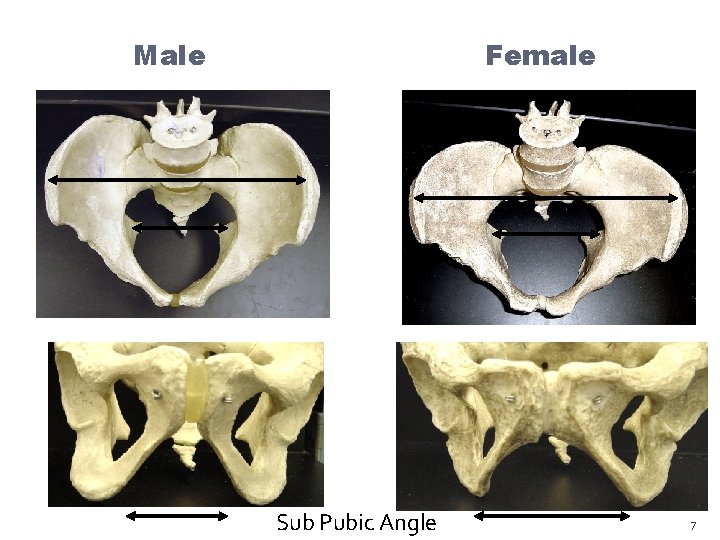
Male Female Sub Pubic Angle 7
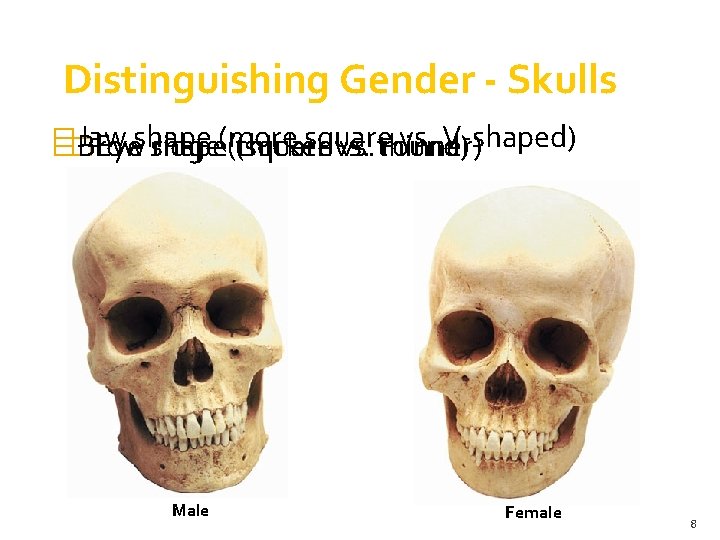
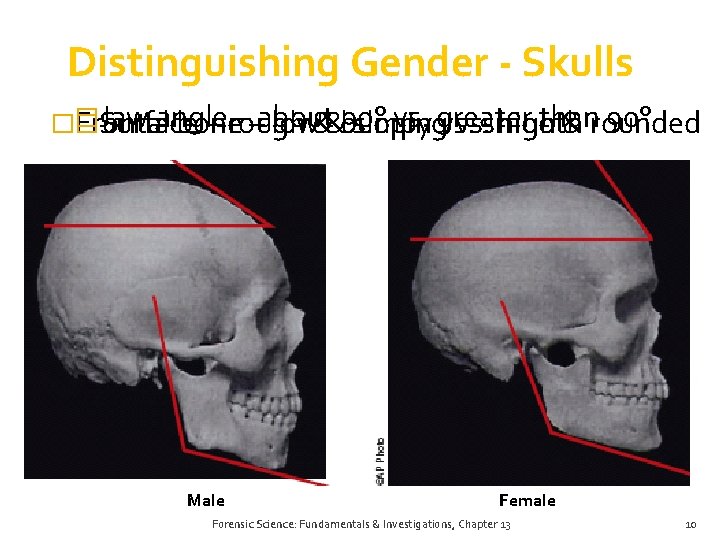
Distinguishing Gender - Skulls � Jaw square vs. V-shaped) �� Brow Eyeshape ridge(more (thicker (square vs. thinner) round) Male Female 8
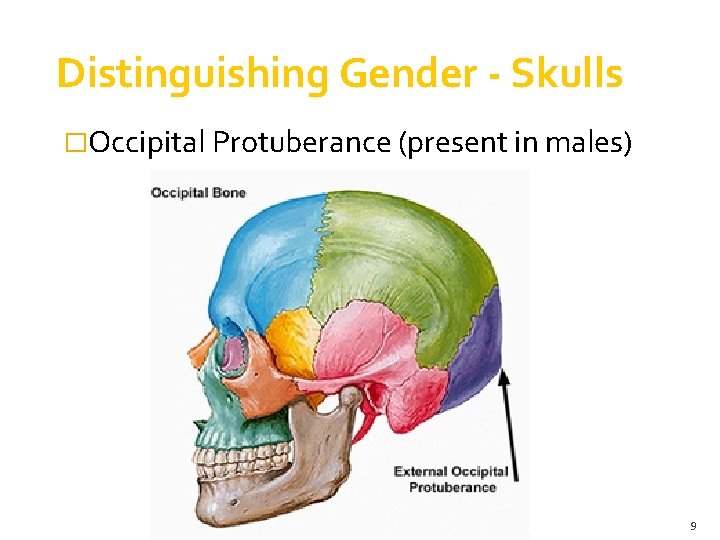
Distinguishing Gender - Skulls �Occipital Protuberance (present in males) Forensic Science: Fundamentals & Investigations, Chapter 13 9
Distinguishing Gender - Skulls Jaw angle ––about 90° vs. greater than 90° �� � Frontal Surface bone – rough low&&bumpy sloping vs. smooth high & rounded Male Female Forensic Science: Fundamentals & Investigations, Chapter 13 10
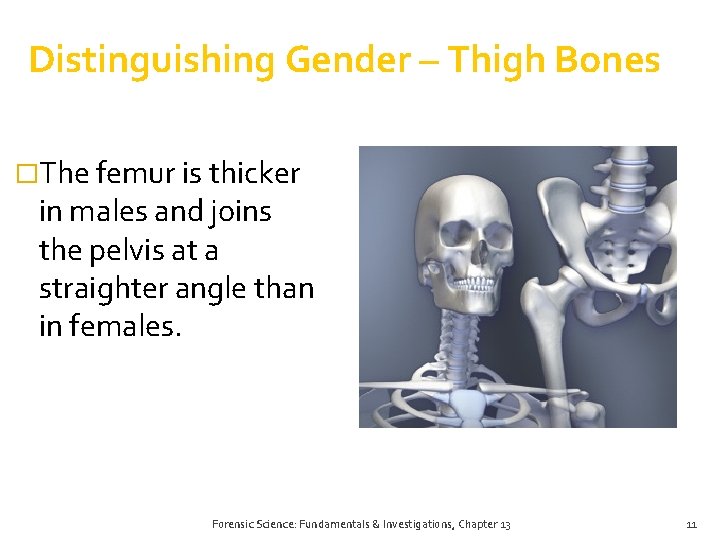
Distinguishing Gender – Thigh Bones �The femur is thicker in males and joins the pelvis at a straighter angle than in females. Forensic Science: Fundamentals & Investigations, Chapter 13 11
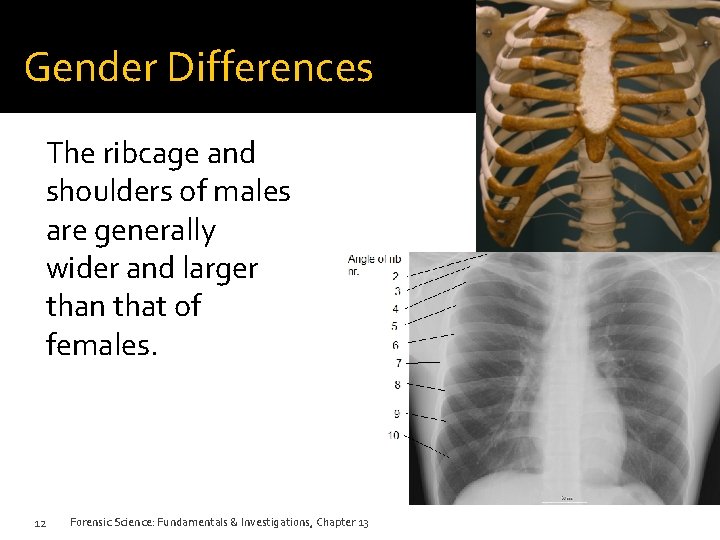
Gender Differences The ribcage and shoulders of males are generally wider and larger than that of females. 12 Forensic Science: Fundamentals & Investigations, Chapter 13
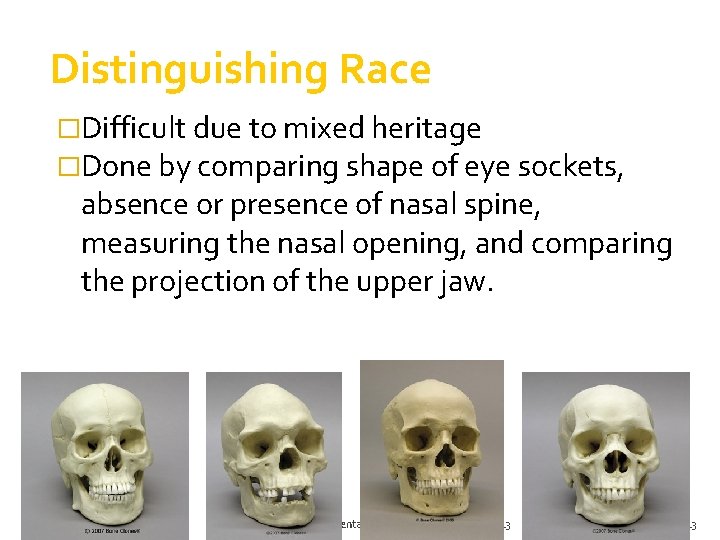
Distinguishing Race �Difficult due to mixed heritage �Done by comparing shape of eye sockets, absence or presence of nasal spine, measuring the nasal opening, and comparing the projection of the upper jaw. Forensic Science: Fundamentals & Investigations, Chapter 13 13
Race An experienced forensic anthropologist can generally place skulls into one of three groups: Caucasoid—European, Middle Eastern, and Indian descent Negroid—African, Aborigine, and Melanesian descent Mongoloid—Asian, Native American and Polynesian descent Forensic Science: Fundamentals & Investigations, Chapter 13 14
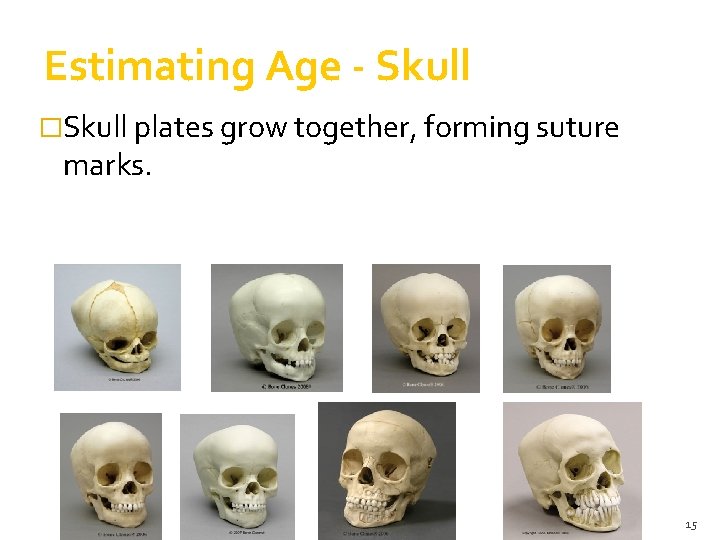
Estimating Age - Skull �Skull plates grow together, forming suture marks. 15
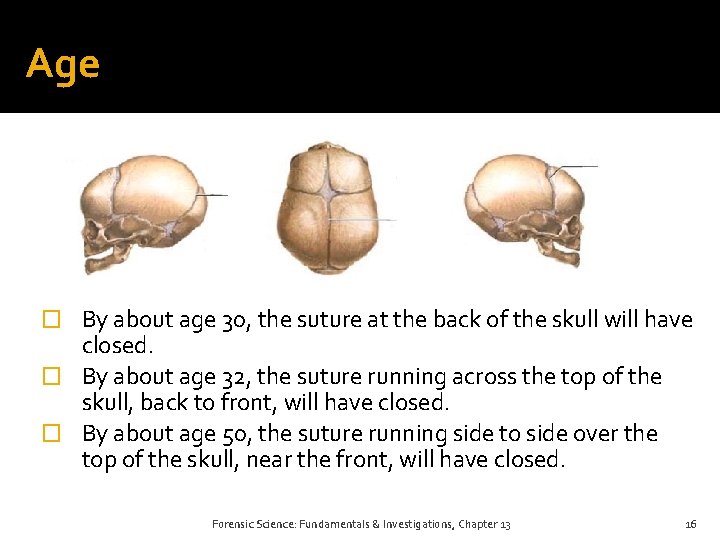
Age � By about age 30, the suture at the back of the skull will have closed. � By about age 32, the suture running across the top of the skull, back to front, will have closed. � By about age 50, the suture running side to side over the top of the skull, near the front, will have closed. Forensic Science: Fundamentals & Investigations, Chapter 13 16
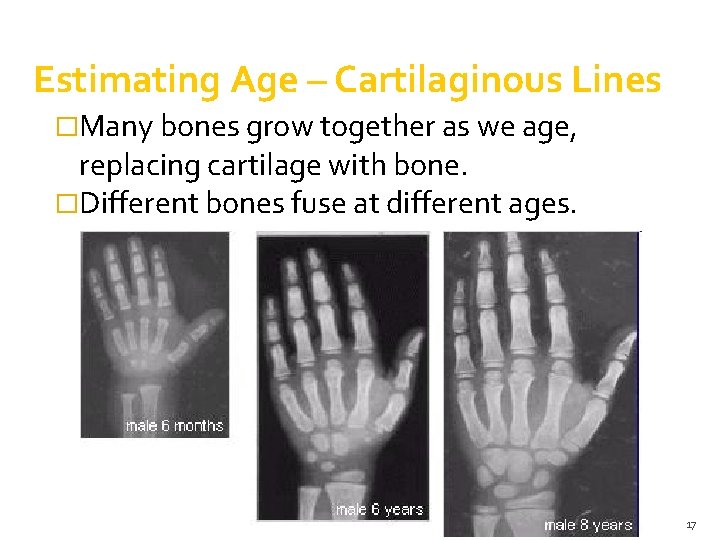
Estimating Age – Cartilaginous Lines �Many bones grow together as we age, replacing cartilage with bone. �Different bones fuse at different ages. Forensic Science: Fundamentals & Investigations, Chapter 13 17
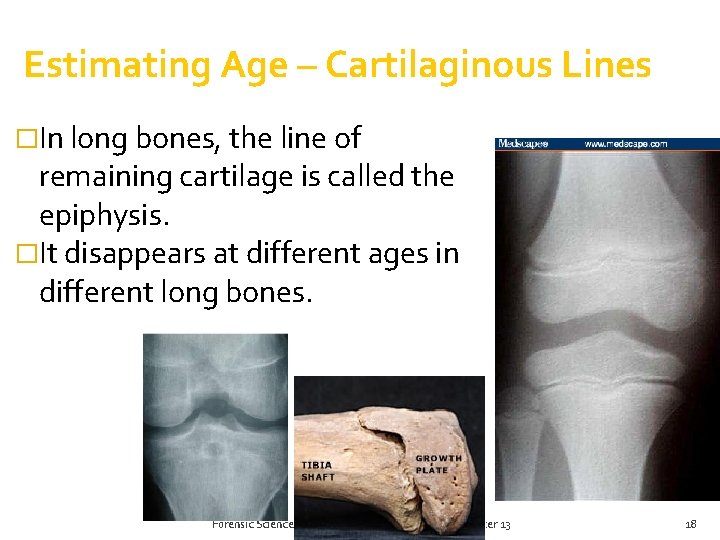
Estimating Age – Cartilaginous Lines �In long bones, the line of remaining cartilage is called the epiphysis. �It disappears at different ages in different long bones. Forensic Science: Fundamentals & Investigations, Chapter 13 18
Skeletal Trauma Analysis �Forensic anthropologists often determine if damage to bones occurred before or after death. �Definite distinctions exist between patterns on bones made by weapons and the patterns created by the environment after death. �Sharp-force trauma, blunt-force trauma, gunshot wounds, and knife wounds all have distinctive patterns. Forensic Science: Fundamentals & Investigations, Chapter 13 19
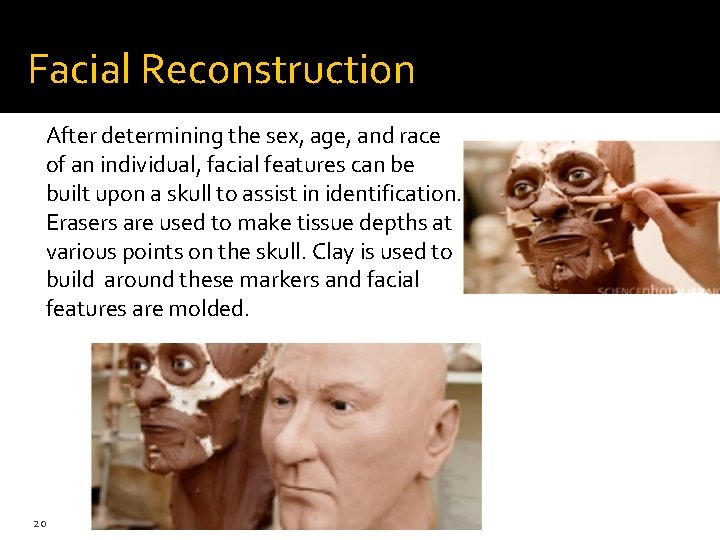
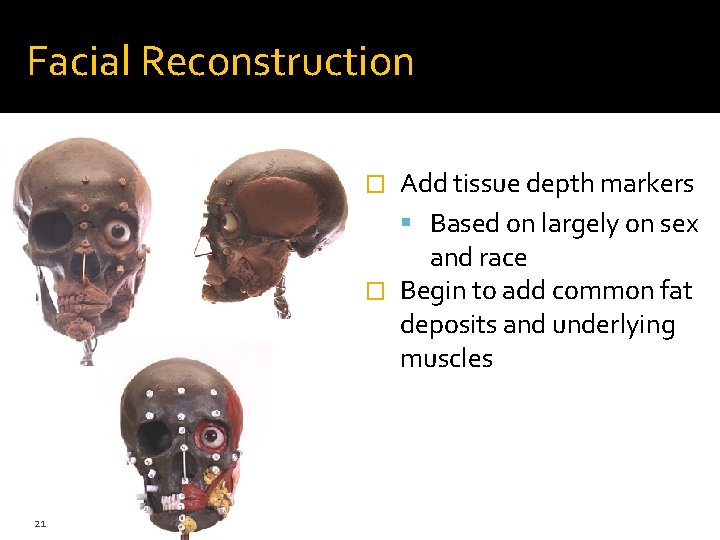
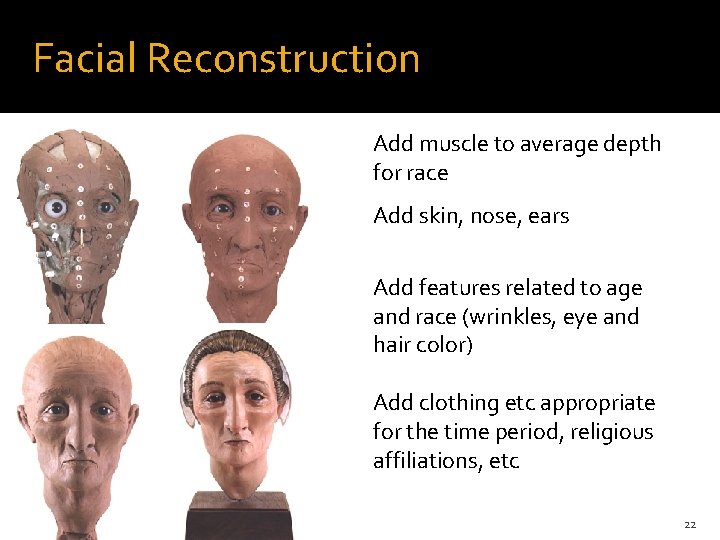
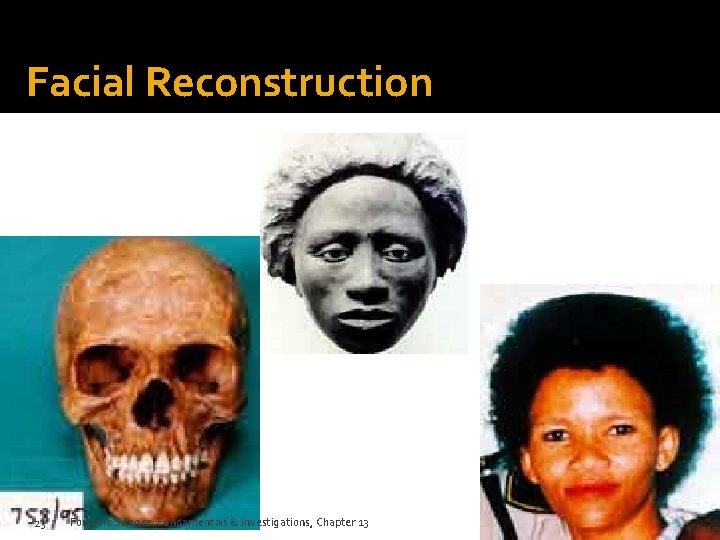
Facial Reconstruction After determining the sex, age, and race of an individual, facial features can be built upon a skull to assist in identification. Erasers are used to make tissue depths at various points on the skull. Clay is used to build around these markers and facial features are molded. 20
Facial Reconstruction Add tissue depth markers Based on largely on sex and race � Begin to add common fat deposits and underlying muscles � 21
Facial Reconstruction Add muscle to average depth for race Add skin, nose, ears Add features related to age and race (wrinkles, eye and hair color) Add clothing etc appropriate for the time period, religious affiliations, etc 22
Facial Reconstruction 23 Forensic Science: Fundamentals & Investigations, Chapter 13
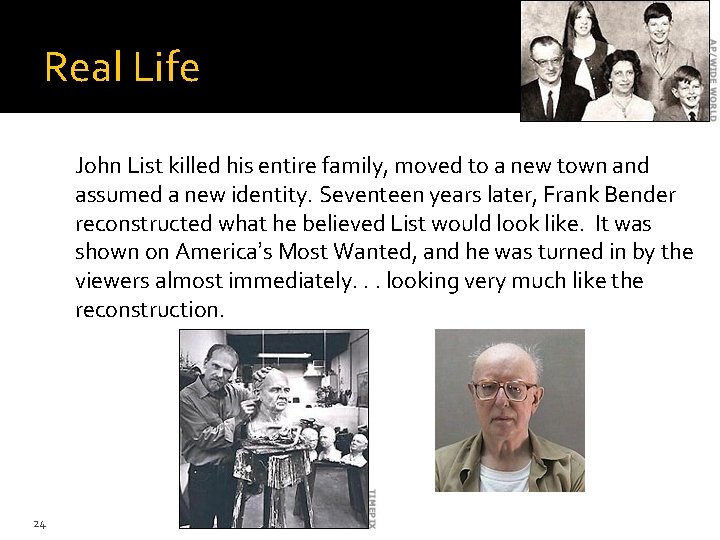
Real Life John List killed his entire family, moved to a new town and assumed a new identity. Seventeen years later, Frank Bender reconstructed what he believed List would look like. It was shown on America’s Most Wanted, and he was turned in by the viewers almost immediately. . . looking very much like the reconstruction. 24
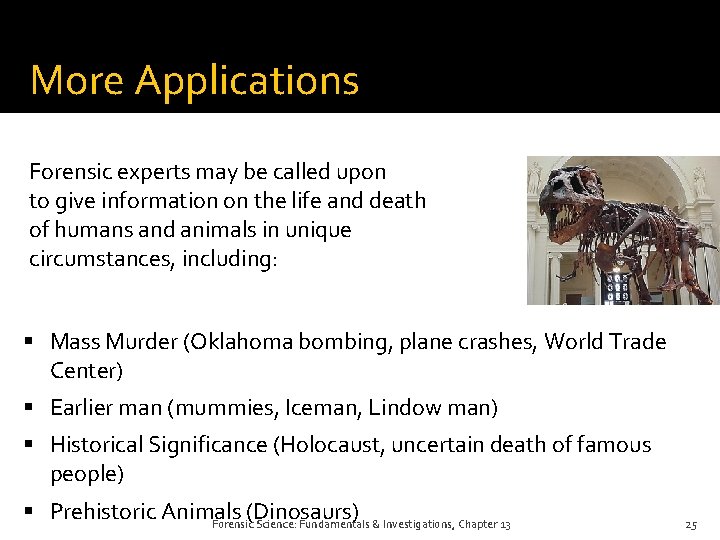
More Applications Forensic experts may be called upon to give information on the life and death of humans and animals in unique circumstances, including: Mass Murder (Oklahoma bombing, plane crashes, World Trade Center) Earlier man (mummies, Iceman, Lindow man) Historical Significance (Holocaust, uncertain death of famous people) Prehistoric Animals (Dinosaurs) Forensic Science: Fundamentals & Investigations, Chapter 13 25