
SPEC SFS 2014 An UndertheHood Review Sorin Faibish
SPEC SFS 2014 An Under-the-Hood Review Sorin Faibish Spencer Shepler 2015 File and Storage Technologies. ©Standard Performance Evaluation Corporation. All Rights Reserved.
Today’s Outline Intro / Contributions / Motivation r SPEC SFS 2014 Framework r SPEC SFS 2014 Reporting r Workloads / Business Metrics r VDA r VDI r SWBUILD r Database r 3 2015 File and Storage Technologies. ©Standard Performance Evaluation Corporation. All Rights Reserved.
Tonight’s BOF Drinks and Snacks r Open discussion and additional detail… r Tonight 9: 00 PM – 10: 00 PM r Camino Real Room r 4 2015 File and Storage Technologies. ©Standard Performance Evaluation Corporation. All Rights Reserved.
SPEC Standard Performance Evaluation Corporation r r The Standard Performance Evaluation Corporation (SPEC) is a non-profit corporation formed to establish, maintain and endorse a standardized set of relevant benchmarks that can be applied to the newest generation of high-performance computers. SPEC develops benchmark suites and also reviews and publishes submitted results from member organizations and other benchmark licensees www. spec. org 5 2015 File and Storage Technologies. ©Standard Performance Evaluation Corporation. All Rights Reserved.
Disclaimer r The SPEC SFS 2014 benchmark, as represented in this presentation, was released SW in November 4 th 2014. 6 2015 File and Storage Technologies. ©Standard Performance Evaluation Corporation. All Rights Reserved.
SPEC SFS 2014 Contributions EMC Tracing code, Validation, Testing, VDI Workload Hitachi Validation, Testing Huawei Validation, Testing IBM Reporting Tools, Validation, Testing, VDA Workload Iozone. org Source Code, Development, Testing, Validation, Binaries Microsoft Native Port to Windows, Validation, Testing, VDI Workload Net. App Validation, Testing, SWBUILD and DATABASE Workloads Oracle Validation, Testing, DATABASE Workload Seagate Validation, Testing 2015 File and Storage Technologies. ©Standard Performance Evaluation Corporation. All Rights Reserved. 7
Motivation for SPEC SFS 2014 8 2015 File and Storage Technologies. ©Standard Performance Evaluation Corporation. All Rights Reserved.
Motivation for SPEC SFS 2014 moves to Solution Benchmarking r Realistic, Solution-based workloads r r Workloads based on traces, like previous SFS 2008 r r Uses file system APIs at the client Advanced measurement – quality of service r r Modern scenarios based on standard solutions Benchmark measures application-level performance r r DATABASE, SWBUILD, VDA, VDI Ops and latency don’t tell the whole story → business metrics Ability to measure broad range of products and configurations r Clients, Servers, Local File Systems, Networking Transports r r All of these now contribute to measured performance of solution Allowing for multi-tiered storage solutions 9 2015 File and Storage Technologies. ©Standard Performance Evaluation Corporation. All Rights Reserved.
SPEC SFS 2014 Framework 10 2015 File and Storage Technologies. ©Standard Performance Evaluation Corporation. All Rights Reserved.
SPEC SFS 2014 Framework r Two components: r Load generator: netmist Highly customizable, powerful, workload generator r SPEC SFS 2014 license includes full version r r Wrappers: Sfs. Manager Provides ease of configuration r Coordinates running multiple load points (scaling) r Implements business metric logic r r r Framework features: r Multi-client support is fundamental r Supports many operating systems and virtual machines r Protocol/file system agnostic r Definable workloads Full source code included with SPEC SFS 2014 benchmark 11 2015 File and Storage Technologies. ©Standard Performance Evaluation Corporation. All Rights Reserved.
SPEC SFS 2014 Framework Benchmark execution phases r Validation r Initialization r Warmup r Measurement (Run) r Results r This sequence of execution phases repeats for each requested load point r 12 2015 File and Storage Technologies. ©Standard Performance Evaluation Corporation. All Rights Reserved.
SPEC SFS 2014 Reporting 13 2015 File and Storage Technologies. ©Standard Performance Evaluation Corporation. All Rights Reserved.
SPEC SFS 2014 Reporting Publication of Results r Prior to public disclosure, SPEC SFS 2014 results must be submitted for review by the SPEC SFS subcommittee r Results are peer-reviewed for consistency and compliance with the SPEC SFS 2014 Run and Reporting Rules r Disclosure r Accepted r must be adequate for reproducibility results are then published to the SPEC website Results can be released publicly without prior committee review – however, if asked, full disclosure must be provided to SPEC 14 2015 File and Storage Technologies. ©Standard Performance Evaluation Corporation. All Rights Reserved.
SPEC SFS 2014 Reporting Run and Reporting Rules r The SPEC SFS 2014 Run and Reporting Rules bound the measurement and configuration methodology r Primary goal of rules is to support SPEC’s philosophy of fair and open benchmarking r Secondary goal is to ensure sufficient disclosure for reproducibility and comparability 15 2015 File and Storage Technologies. ©Standard Performance Evaluation Corporation. All Rights Reserved.
SPEC SFS 2014 Reporting Run and Reporting Rules Highlights r r There is no Uniform Access Rule The WARMUP time may be set to between 5 minutes and 1 week for a publishable run There is no requirement to reinitialize file systems before a publishable run r However, detailed documentation of actions taken since system (re)initialization is required Single publication covers 1 workload r No requirement that all or more than one be reported at the same time 16 2015 File and Storage Technologies. ©Standard Performance Evaluation Corporation. All Rights Reserved.
SPEC SFS 2014 Reporting No “newfs” Requirement r r r Re-initializing the storage under the file system may not be possible or realistic r Cloud storage, complex tiered storage r More than one file system in the storage hierarchy Must document procedures and steps taken since last re -initialization r Must be generally available and recommended for customers – no “benchmark specials” r Documentation/review allows for reproducibility Can be used to simulate “aged” systems r Especially in conjunction with long WARMUP 17 2015 File and Storage Technologies. ©Standard Performance Evaluation Corporation. All Rights Reserved.
SPEC SFS 2014 Defining a Workload 18 2015 File and Storage Technologies. ©Standard Performance Evaluation Corporation. All Rights Reserved.
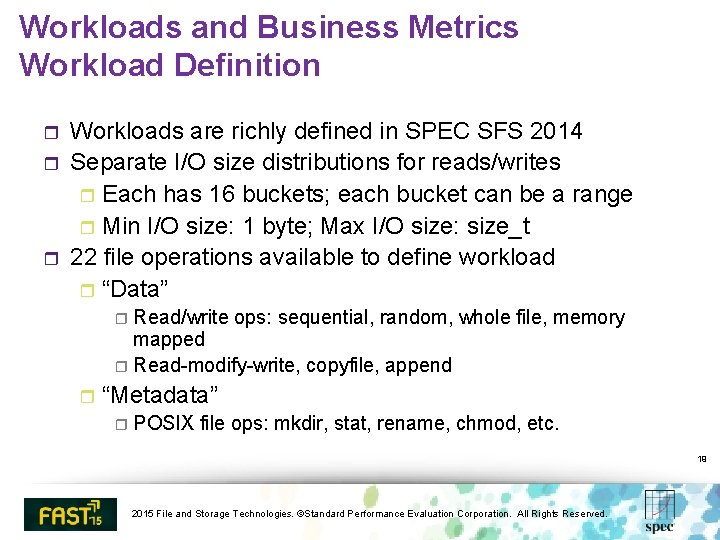
Workloads and Business Metrics Workload Definition r r r Workloads are richly defined in SPEC SFS 2014 Separate I/O size distributions for reads/writes r Each has 16 buckets; each bucket can be a range r Min I/O size: 1 byte; Max I/O size: size_t 22 file operations available to define workload r “Data” r Read/write ops: sequential, random, whole file, memory mapped r Read-modify-write, copyfile, append r “Metadata” r POSIX file ops: mkdir, stat, rename, chmod, etc. 19 2015 File and Storage Technologies. ©Standard Performance Evaluation Corporation. All Rights Reserved.
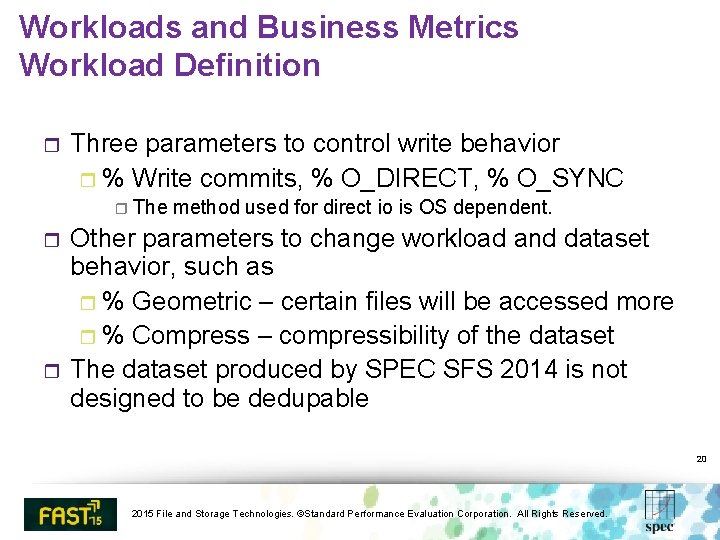
Workloads and Business Metrics Workload Definition r Three parameters to control write behavior r % Write commits, % O_DIRECT, % O_SYNC r The r r method used for direct io is OS dependent. Other parameters to change workload and dataset behavior, such as r % Geometric – certain files will be accessed more r % Compress – compressibility of the dataset The dataset produced by SPEC SFS 2014 is not designed to be dedupable 20 2015 File and Storage Technologies. ©Standard Performance Evaluation Corporation. All Rights Reserved.
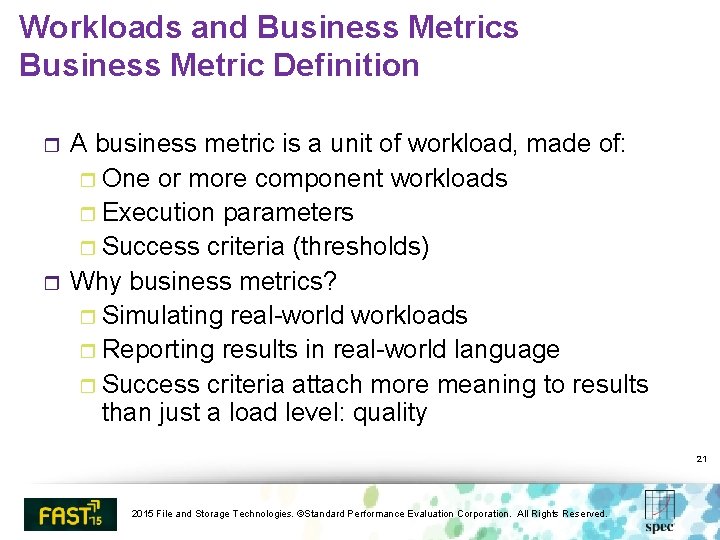
Workloads and Business Metrics Business Metric Definition r r A business metric is a unit of workload, made of: r One or more component workloads r Execution parameters r Success criteria (thresholds) Why business metrics? r Simulating real-world workloads r Reporting results in real-world language r Success criteria attach more meaning to results than just a load level: quality 21 2015 File and Storage Technologies. ©Standard Performance Evaluation Corporation. All Rights Reserved.
Workloads and Business Metrics Business Metric Scaling The definition of a single business metric is fixed r Discrete and independent units of workload r Load scaling is achieved by adding additional business metrics r As load increases, so does r r Proc count r Dataset size r The oprate of each proc is constant, however! 22 2015 File and Storage Technologies. ©Standard Performance Evaluation Corporation. All Rights Reserved.
Workloads and Business Metrics Business Metric Success Criteria r Business metric success criteria (thresholds) r Global oprate threshold monitors the average oprate of all procs r Proc oprate threshold monitors the oprate of all procs r Any single proc exceeding the threshold invalidates that load point r Achieved oprate must be >= x% of defined 23 2015 File and Storage Technologies. ©Standard Performance Evaluation Corporation. All Rights Reserved.
Workloads and Business Metrics Business Metric Success Criteria r Business metric success criteria (thresholds) r Workload variance threshold monitors ratio of global achieved oprates between all component workloads r This ratio must be within +/- x%, as defined in the threshold r Example: DATABASE has a 5: 1 oprate ratio between the DB_TABLE and DB_LOG component workloads r Ratio of achieved oprates must be within +/- 5% of 5: 1 2015 File and Storage Technologies. ©Standard Performance Evaluation Corporation. All Rights Reserved. 24
Workloads and Business Metrics Business Metric Success Criteria r Business metric success criteria (thresholds) r With these success criteria, a business metric demands a certain quality of service at all load points r If a success criteria is not met for a requested load point, that point is marked INVALID r An INVALID data point does not stop the benchmark run, but is not publishable 25 2015 File and Storage Technologies. ©Standard Performance Evaluation Corporation. All Rights Reserved.
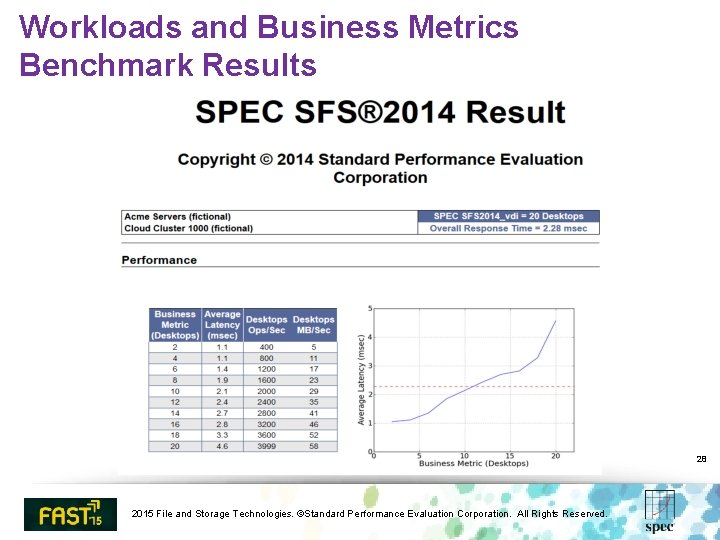
Workloads and Business Metrics Benchmark Results There are two principal measures of performance in SPEC SFS 2014 r Business Metrics r Overall Response Time r Achieved Oprate and Total KBps will be included in official publications as well r The sfssum file produced during a benchmark run contains all this info and more r 26 2015 File and Storage Technologies. ©Standard Performance Evaluation Corporation. All Rights Reserved.
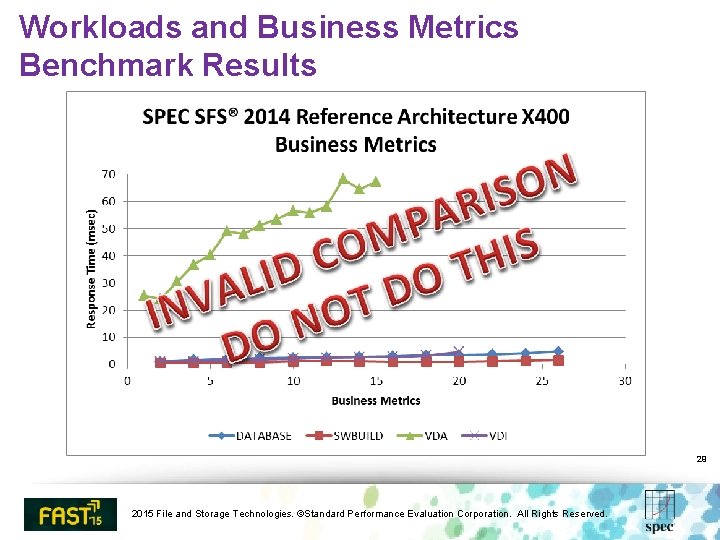
Workloads and Business Metrics Benchmark Results r Disclosure of results must include the summary result r Maximum achieved business metrics and overall response time of the entire benchmark run r Specific r format in Run and Reporting Rules The full disclosure report is published on the SPEC website r Visual: Business Metrics vs. Response Time 27 2015 File and Storage Technologies. ©Standard Performance Evaluation Corporation. All Rights Reserved.
Workloads and Business Metrics Benchmark Results 28 2015 File and Storage Technologies. ©Standard Performance Evaluation Corporation. All Rights Reserved.
Workloads and Business Metrics Benchmark Results 29 2015 File and Storage Technologies. ©Standard Performance Evaluation Corporation. All Rights Reserved.
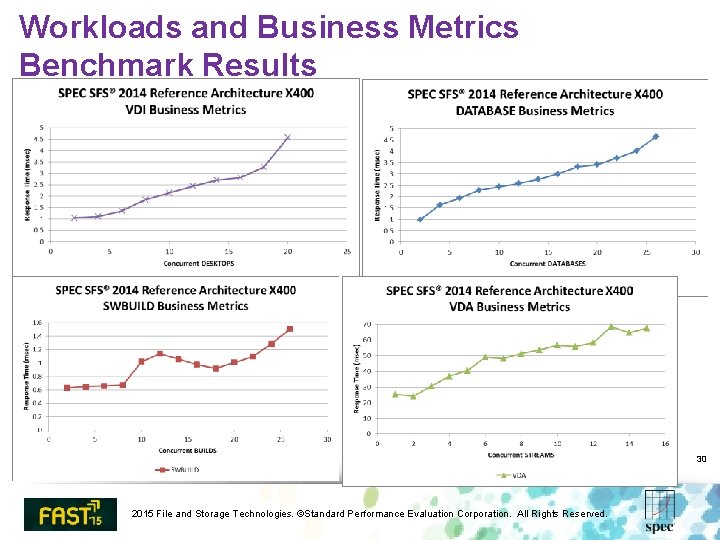
Workloads and Business Metrics Benchmark Results 30 2015 File and Storage Technologies. ©Standard Performance Evaluation Corporation. All Rights Reserved.
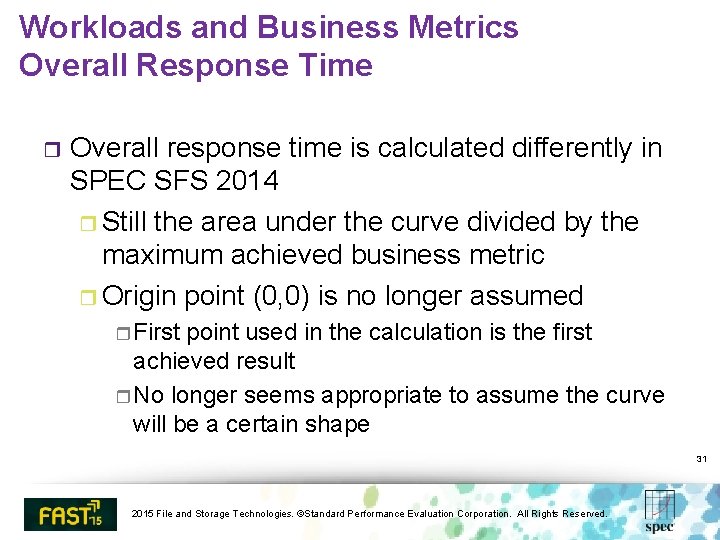
Workloads and Business Metrics Overall Response Time r Overall response time is calculated differently in SPEC SFS 2014 r Still the area under the curve divided by the maximum achieved business metric r Origin point (0, 0) is no longer assumed r First point used in the calculation is the first achieved result r No longer seems appropriate to assume the curve will be a certain shape 31 2015 File and Storage Technologies. ©Standard Performance Evaluation Corporation. All Rights Reserved.
SPEC SFS 2014 Workloads 32 2015 File and Storage Technologies. ©Standard Performance Evaluation Corporation. All Rights Reserved.
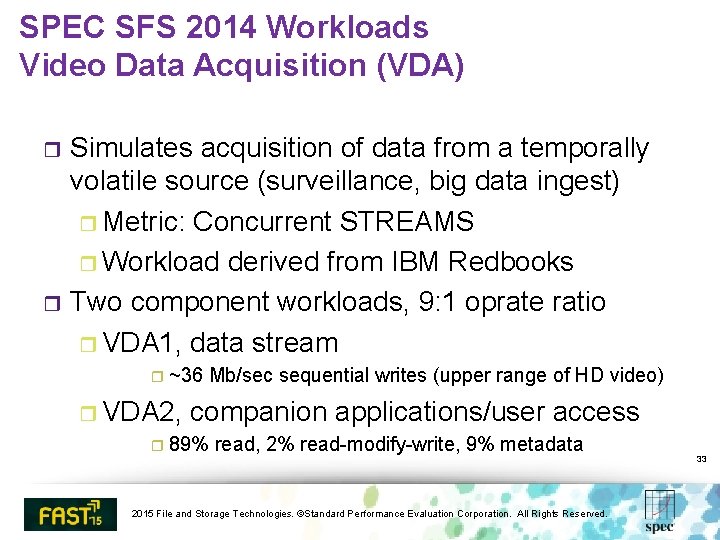
SPEC SFS 2014 Workloads Video Data Acquisition (VDA) Simulates acquisition of data from a temporally volatile source (surveillance, big data ingest) r Metric: Concurrent STREAMS r Workload derived from IBM Redbooks r Two component workloads, 9: 1 oprate ratio r VDA 1, data stream r r ~36 r VDA 2, Mb/sec sequential writes (upper range of HD video) companion applications/user access r 89% read, 2% read-modify-write, 9% metadata 2015 File and Storage Technologies. ©Standard Performance Evaluation Corporation. All Rights Reserved. 33
SPEC SFS 2014 Workloads Video Data Acquisition (VDA) r VDA 2 workload ensures that quality of data ingestion is maintained despite other activity r Starvation of reads or writes will be detected by success criteria violation r Per-proc oprate: >= 75% of requested r Overall oprate: >= 95% of requested r Component workload variance: <= 5% of defined 34 2015 File and Storage Technologies. ©Standard Performance Evaluation Corporation. All Rights Reserved.
SPEC SFS 2014 Workloads Virtual Desktop Infrastructure (VDI) Simulates the workload generated by a hypervisor to support a heavy steady-state knowledge worker workload r Workload derived from traces of ESXi, Hyper. V, and Xen environments r Metric: concurrent DESKTOPS r One component workload, 2 procs per desktop r Data-heavy workload: 1% metadata ops r 35 2015 File and Storage Technologies. ©Standard Performance Evaluation Corporation. All Rights Reserved.
SPEC SFS 2014 Workloads Virtual Desktop Infrastructure (VDI) Simulates steady-state VDI workload r Does not include boot storm or login storm r All writes use Direct I/O r Dataset consists of compressible (60%) large files (500 MB) r Dataset is not dedupable – simulates a VDI scenario using Full Clones r 36 2015 File and Storage Technologies. ©Standard Performance Evaluation Corporation. All Rights Reserved.
SPEC SFS 2014 Workloads Software Build (SWBUILD) Simulates large software project compilation or build phase of an EDA workflow r Workload derived from traces taken during software build activity and Clear. Case documentation r Metric: concurrent BUILDS r One component workload, 5 procs per build r Metadata-heavy: 87% metadata ops r 37 2015 File and Storage Technologies. ©Standard Performance Evaluation Corporation. All Rights Reserved.
SPEC SFS 2014 Workloads Software Build (SWBUILD) Reads and writes are done on a whole file r Average file size is a Gaussian distribution centered at 16 Ki. B, ~573, 000 files per build r Files are highly compressible (80%) r This workload has the most potential to be cached/modified by the load generating clients r Also most likely to introduce/measure a bottleneck on load generating clients vs. storage solution r 2015 File and Storage Technologies. ©Standard Performance Evaluation Corporation. All Rights Reserved. 38
SPEC SFS 2014 Workloads DATABASE Simulates an OLTP database consolidation scenario r Workload derived from data from Oracle r Metric: concurrent DATABASES r Two component workloads, 5: 1 oprate ratio r DB_TABLE r r Random reads and writes r DB_LOG r Mostly sequential writes 2015 File and Storage Technologies. ©Standard Performance Evaluation Corporation. All Rights Reserved. 39
SPEC SFS 2014 Workloads DATABASE r r r All DB_TABLE threads for an individual business metric share the same dataset r Multiple threads working the same tables Workload simulates moving hot spots in the dataset r These hot spots move over time Solution under test must provide good quality of service to both table and log I/O r Maximum component workload variance is <= 5% 40 2015 File and Storage Technologies. ©Standard Performance Evaluation Corporation. All Rights Reserved.
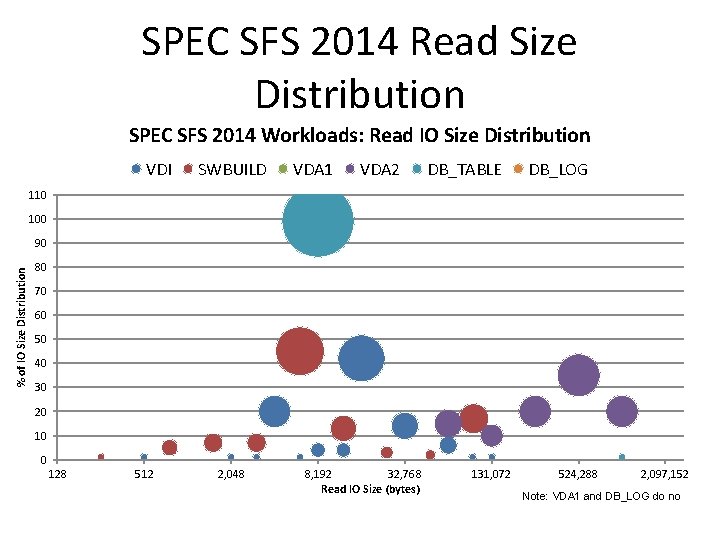
SPEC SFS 2014 Read Size Distribution SPEC SFS 2014 Workloads: Read IO Size Distribution VDI SWBUILD VDA 1 VDA 2 DB_TABLE DB_LOG 110 100 % of IO Size Distribution 90 80 70 60 50 40 30 20 10 0 128 512 2, 048 8, 192 32, 768 Read IO Size (bytes) 131, 072 524, 288 2, 097, 152 Note: VDA 1 and DB_LOG do no
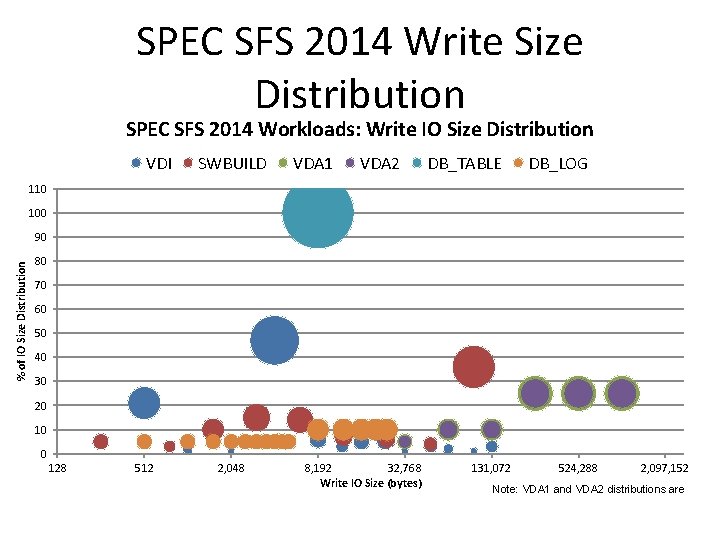
SPEC SFS 2014 Write Size Distribution SPEC SFS 2014 Workloads: Write IO Size Distribution VDI SWBUILD VDA 1 VDA 2 DB_TABLE DB_LOG 110 100 % of IO Size Distribution 90 80 70 60 50 40 30 20 10 0 128 512 2, 048 8, 192 32, 768 Write IO Size (bytes) 131, 072 524, 288 2, 097, 152 Note: VDA 1 and VDA 2 distributions are
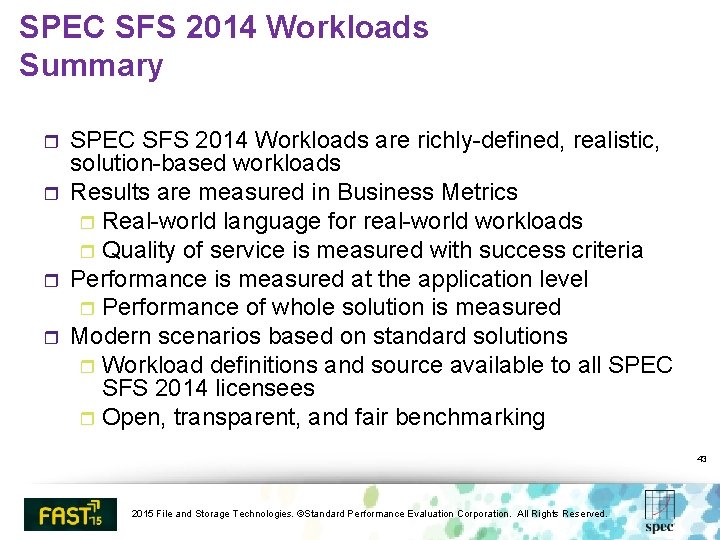
SPEC SFS 2014 Workloads Summary r r SPEC SFS 2014 Workloads are richly-defined, realistic, solution-based workloads Results are measured in Business Metrics r Real-world language for real-world workloads r Quality of service is measured with success criteria Performance is measured at the application level r Performance of whole solution is measured Modern scenarios based on standard solutions r Workload definitions and source available to all SPEC SFS 2014 licensees r Open, transparent, and fair benchmarking 43 2015 File and Storage Technologies. ©Standard Performance Evaluation Corporation. All Rights Reserved.
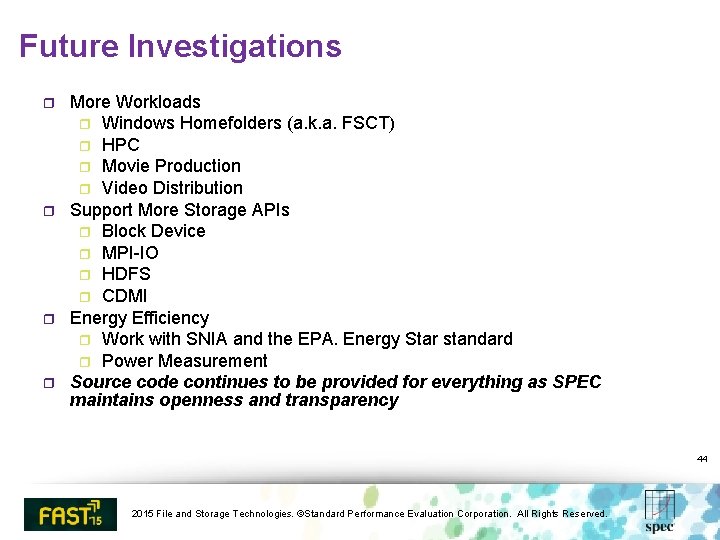
Future Investigations r r More Workloads r Windows Homefolders (a. k. a. FSCT) r HPC r Movie Production r Video Distribution Support More Storage APIs r Block Device r MPI-IO r HDFS r CDMI Energy Efficiency r Work with SNIA and the EPA. Energy Star standard r Power Measurement Source code continues to be provided for everything as SPEC maintains openness and transparency 44 2015 File and Storage Technologies. ©Standard Performance Evaluation Corporation. All Rights Reserved.
- Slides: 43