SEMINAR ON SESS PHYSICAL EDUCATION AND SPORTS PSYCHOLOGY




- Slides: 48
SEMINAR ON SESS PHYSICAL EDUCATION AND SPORTS PSYCHOLOGY ON 8 TH FEBRUARY 2015 VENUE: MSU BY TUAN HAJI ABDUL MUTALLIP GHANI IPG KAMPUS ILMU KHAS. KL Bac Edu(Physical Education and Health) UPM. Malaysia. Msc (Physical Education, Exercise and Sport Science) UCM, USA
DEFINITION OF PHYSICAL EDUCATION O Physical Education derived from two separate word“Physical”and“Education”. The dictionary meaning of word Physical is relating to body. It may relate to any one or all of the bodily characterstics. It may be physical endurance, organic development, physical appearance physical healths. The word “Education‟ means systematic instructions or training or preparation for life.
DEFINITION OF PHYSICAL EDUCATION O PHYSICAL EDUCATION IS DEFINED AS AN EDUCATIONAL PROCESS THAT USE PHYSICAL ACTIVITY AS A MEANS TO HELP INDIVIDUALS ACQUIRE SKILLS, FITNESS, KNOWLEDGE, AND ATTITUDE THAT CONTRIBUTE TO THEIR OPTIMAL DEVELOPMENT AND WELL- BEING. O IN THIS DEFINITION, THE TERM EDUCATION IS BROADLY DEFINED AS ONGOING PROCESS OF LEARNING THAT OCCURS THROUGHTOUT OUR LIFESPAN. (BUCHER 1999)
According to NPPER( A Report by Ministry of Education) O Physical Education is education through physical activities for development of total personality of the child, to it fullness and perfection in body, mind and spirit.
O The aim physical education as“the optimum development, integration, and physical mental, and social adjustment of the individual through guided instruction and participation in selected total body sports and in rhythmic and Gymnastic activities conducted according to social and hygienic stranded.
O PHYSICAL EDUCATION O Health O Worthy use of Leisure O Ethical Characters
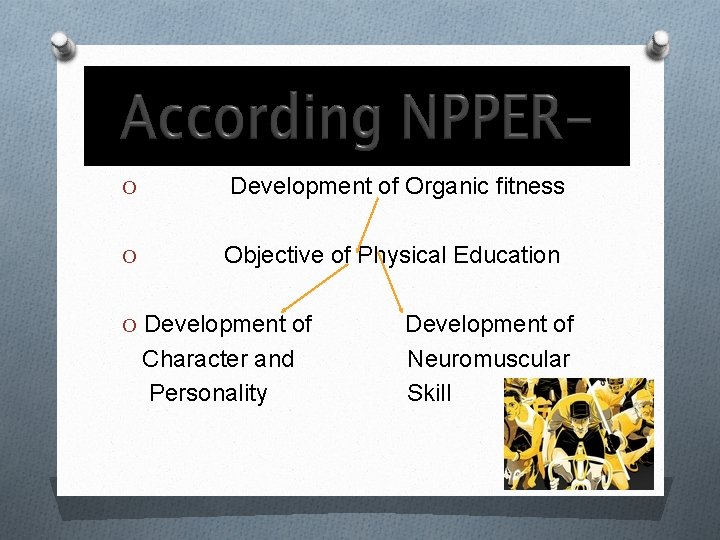
O Development of Organic fitness O Objective of Physical Education O Development of Character and Personality Development of Neuromuscular Skill
Physical Education Principles O Principle 1: Physical Education should be an exciting, rewarding, positive movement experience for ALL children. O ◊ Opposite = Physical Education is a place for athletes to excel, and for the aggressive and assertive to thrive and release their energy; a place for the meek and less-skilled to stand by and observe or learn to accept criticism, defeat and humiliation.
Principles 2 O Principle 2: Active play is an essential component of learning and development. It is through play that children become more fit, develop skills, learn to be and play fair, become creative thinkers, learn to be good teammates, and thrive as more responsible, motivated, self-driven citizens. O ◊ Opposite = Competition and skill development are king. Athletic performance achieved through drill, practice, and specific sport training is of utmost importance for all students. Kids who are not athletically gifted will not be able to help their schools achieve victory in sports and should therefore be disregarded.
PRINCIPLES 3 O Principle 3: All students should be actively engaged in EVERY activity in an emotionally and physically SAFE (nonthreatening) environment. O ◊ Opposite = Players are eliminated, intimidated, and harassed during competitive games. “Last man standing” is the reward for the gifted, assertive athlete, while “first one out” is the fate of the lessskilled, already defeated non-athletic student (who needs the opportunity to move the most!).
PRINCIPLES 4 O Principle 4: If all players are moving and having fun, ALL physical education standards are being met. Through constant movement and purposeful play, students will become better, more skilled movers – with increased fitness levels in every area. Through non-intimidating, success-enhancing, confidence-building activities that are FUN, rewarding, and enjoyable, students will value and pursue a lifetime of fitness, health, and wellbeing. O ◊ Opposite = Standards-based physical education is skill and drill oriented. Players are successful only if they score well on movement assessments, perform well during skill and drill activities, or if they WIN. Fitness and skill development are achieved through drills, calisthenics, and a regime of running, repetition, and waiting in line for a turn. Success is earned through skill. Athletes are rewarded, while the non-athletic and less fit students suffer in quiet despair, misery, and defeat – vowing repeatedly that given the choice, they will NEVER run again, that exercise is MISERABLE, and that fitness is NOT FUN – creating a lifetime pursuit of activity avoidance, poor health, and seeking solace in comfort foods.
PRINCIPLES 5 O Principle 5: All physical education standards are of EQUAL importance. Personal responsibility, cognitive awareness, and the value of social interaction are just as important to a successful physical experience as movement skills. Physical education is about respect for self and others, selfexpression, trying new things, getting up when you fall down, being a motivator, and knowing you are a winner because you played fairly and did your best! O ◊ Opposite = Physical education is about movement skills. Since you don’t evaluate kindness, acceptance, or personal responsibility in math or science, it has no place in physical education either. Valuing physical activity or the enjoyment of social interaction have no place in physical education and should not be a consideration when planning, teaching, or assessing the physical education experience.
PRINCIPLES 6 O Principle 6: As physical educators we have a responsibility to the nation and to each and every child to do everything possible to prevent and reduce childhood obesity. It is our highest order to lead through example, provide abundant and SAFE (emotionally and physically) movement experiences, and to educate today’s youth on nutrition, fitness principles, and why and how to be successful movers and shakers! Fit people move bigger mountains! O ◊ Opposite = Individual students don’t matter. The whole child is not important. Correct form on an overhand throw is more important than tackling obesity. Academic standards are more important than “play time. ” Obesity is genetic and environmental. Let the cafeteria staff deal with it. Physical education is simply the place to discover athletic talent, teach a movement standard, throw a ball out, dodge a few and call it a day.
Theories of Learning O Classical Conditioning O Operant Conditioning O Trial and Error Learning O Thorndike's Law O Feedback
BLOOM’S TAXANOMY cognitive domain 1. Knowledge – Definition : Remembers previously learned material Sample verbs- define, identify, label, list, name, recall, state. 2. Comprehension – Definition: Grasps the meaning of material (lowest level of understanding) Sample verbs- describe, discuss, explain, locate, give example, translate
Cognitive domain O 3. Application. Definition- uses learning in new and concrete situations (higher level of understanding) Sample verbs: apply, carry out, demonstrate, illustrate, prepare, solve, use. O 4. Analysis. Definition – Understand both content and structure of material. O Sample verbs: analyze, categorize, compare, contrast, discriminate, outline.
Cognitive domain O 5. Synthesis. Definition- Formulates new structures from existing knowledge and skills. Sample verbs: combine, construct, design, develop, generate, plan, propose O 6. Evaluation. Definition- Judges the value of material for a given purpose. Sample verbs: assess, conclude, evaluate, interpret, justify, select, support
PSYCHOMOTOR DOMAIN O 1. Perception. Definition- senses cues that guide motor activity. Sample verbs: detect, hear, listen, observe, perceive, recognize, view, watch O 2. Set. Definition – is mentally, emotionally and physically ready to act. Sample verbs: achieve a posture, assume a body stance, establish a body position
PSYCHOMOTOR DOMAIN O 3. Guided Response. Definition- imitate and practice skills. Sample verbs: copy, duplicate, imitat, , manipulate with guidance, practice, repeat, try. O 4. Mechanism. Definition- performs act with increase efficiency, confidence, proficiency. Sample verbs: complete with confidence, conduct, demonstrate, execute, make, pace.
PSYCHOMOTOR DOMAIN O 5. Complete Overt Response. Definition- Performs automatically. Sample verbs: act habitually, control, direct, guide, maintain efficiency, manage, master, organize, perfect O 6. Adaption. Definition – Adapts skill sets to meet problem situation. Sample verbs: adapt, recognize, alters, revise, changes
PSYCHOMOTOR DOMAIN O 7. Organization. Definition- Create new patterns for specific situations. O Sample verbs: designs, combines, composes, constructs
AFFECTIVE DOMAIN O 1. Receiving. Definition- Selectively attends to stimuli. Sample verbs: accept, acknowledge, be aware, listen, notice, pay attention, tolerate. O 2. Responding. Definition- Responds to stimuli. Sample verbs: agree to, answer freely, assist, care for, communicate, comply, consent, cooperate, contribute, follow, obey
AFFECTIVE DOMAIN O 3. Valuing. Definition- Attaches value or worth to something. Sample verbs: adopt, assume responsibility, behave according, choose, desire, exhibit loyalty, express, initiate. O 4. Organization. Definition. Conceptualize the value and resolves conflict between it and other values. Sample verbs: adapt, adjust, arrange, balance, classify, formulate
AFFECTIVE DOMAIN O 5. Internalizing. Definition – Integrates the value into a value system that controls behavior. Sample verbs: act upon, advocate, defend, exemplify, influence, justify behavior, maintain, serve, support.
Blooms Taxonomy for Physical Education O PSYCHOMOTOR OBJECTIVES The student will O O O demonstrate proficiency or show improvement in: *gaining muscular endurance, strength, cardiorespiratory, flexibility, agility, power, coordination, speed and balance. *acquisition of throwing, catching, kicking, striking, rolling, dribbling, shooting, passing and rebounding skills. *active participation. *finding his/her heart rate. *finding his/her target heart zone. *taking a resting and active heart rate.
Blooms Taxonomy for Physical Education O AFFECTIVE OBJECTIVES - The student will develop an appreciation of: O *personal living skills of respect for others, leadership, followership, risk taking & initiative. O *the concept of team work and cooperation. O *the emotional and physical well being necessary to participate in any sport, game, or activity. O *fitness as a part of one's lifestyle. O *individual skills of self and others.
Blooms Taxonomy for Physical Education O COGNITIVE OBJECTIVES - The student will be able O O O to: *demonstrate an understanding of safe participation in fitness activities. *understand the components of fitness (muscular endurance, strength, cardiorespiratory and flexibility). *determine fitness related activities that are available. *identify basic anatomical, biomechanical and physiological principles involved in fitness, sport and physical activity *demonstrate a knowledge of terminology, position, play situations and game strategies.
TEACHING STYLES IN PHYSICAL EDUCATION BY MUSKA MOSSTON O STYLE A – COMMAND TEACHERS MAKE ALL DECISIONS STYLE B – PRACTISE STUDENTS CARRY OUT TEACHERS – PRESCRIBE TASKS
TEACHING STYLES IN PHYSICAL EDUCATION O STYLE C – RECIPROCAL STUDENTS WORKS IN PAIRS, ONES PERFORM THE OTHER PROVIDES FEEDBACK STYLE D – SELF-CHECK STUDENTS ASSESS THEIR OWN PERFORMANCE AGAINST CRITERIA
TEACHING STYLES IN PHYSICAL EDUCATION O STYLE E – INCLUSION TEACHERS PLANNED STUDENT MONITORS OWN WORK STYLE F – GUIDED DISCOVERY STUDENTS SOLVE TEACHERS SETS MOVEMENT PROBLEMS WITH ASSITANCE
TEACHING STYLES IN PHYSICAL EDUCATION O STYLE G – DIVERGENT STUDENTS SOLVE PROBLEMS WITHOUT THE ASSISTANCE FROM THE TEACHER STYLE H – INDIVIDUAL TEACHER DETERMINE CONTENTS STUDENT PLAN THE PROGRAMME
TEACHING STYLES IN PHYSICAL EDUCATION O STYLE I – LEARNER INITIATED STUDENTS PLAN OWN PROGRAMME TEACHER IS ADVISOR STYLE J – SELF TEACHING STUDENTS TAKES FULL RESPONSIBILITY FOR THE LEARNING PROCESS
METHODOLOGY O CLASSROOM METHOD O GROUP METHOD O STATION METH 0 D CLASS FORMATION
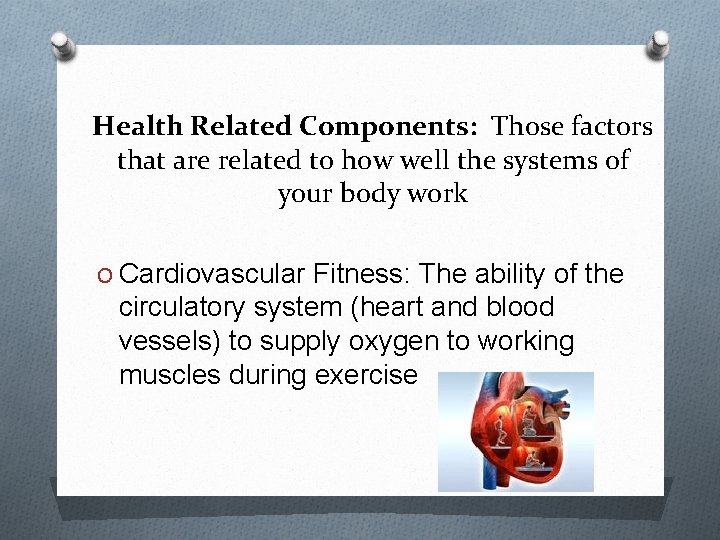
Health Related Components: Those factors that are related to how well the systems of your body work O Cardiovascular Fitness: The ability of the circulatory system (heart and blood vessels) to supply oxygen to working muscles during exercise
Health Related Components O Body Composition: The relative percentage of body fat compared to lean body mass (muscle, bone, water, etc)
Health Related Components O Flexibility: The range of movement possible at various joints.
Health Related Components O Muscular strength: The amount of force that can be produced by a single contraction of a muscle
Health Related Components O Muscular endurance: The ability of a muscle group to continue muscle movement over a length of time.
Skill Related Components: Those aspects of fitness which form the basis for successful sports participation. O Speed: The ability to move quickly from one point to another O Agility: The ability of the body to change direction quickly
Skill Related Components O Balance: The ability to maintain an upright posture while still or moving O Coordination: Integration with hand and/or foot movements with the input of the senses
Skill Related Components O Reaction Time: Amount of time it takes to get moving. O Power: The ability to do strength work at an explosive pace.
KSSR Kandungan Sukatan Aspek 1: Kemahiran Pergerakan Aspek 2: Aplikas. Pengetahuan dalam Pergerakan Aspek 3: Kecergasan Meningkatkan Kesihatan Aspek 4: Aplikasi Pengetahuan Dalam Meningkatkan Kecergasan Aspek 5: Kesukanan
RANCANGAN PENGAJARAN HARAIAN O KBSR (KURIKULUM BARU SEKOLAH RENDAH) O KSSR (KURIKULUM STANDARD SEKOLAH RENDAH)
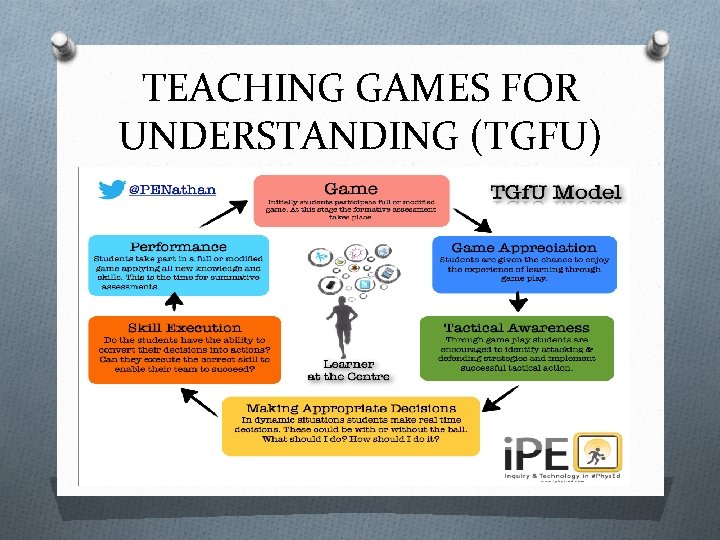
TEACHING GAMES FOR UNDERSTANDING (TGFU)
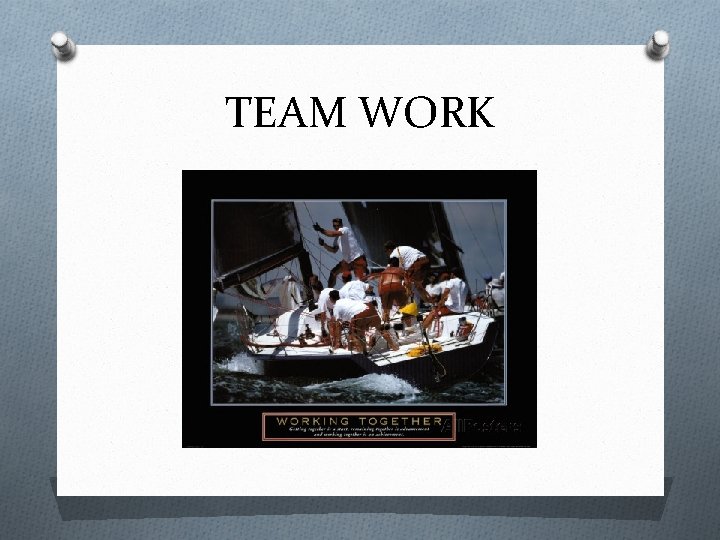
TEAM WORK
THANK YOU