
PHYSICAL EDUCATION COMMON FORMATIVE ASSESSMENTS OCM BOCES September
PHYSICAL EDUCATION & COMMON FORMATIVE ASSESSMENTS OCM BOCES September 24, 2012 Auddie Mastroleo, OCM BOCES Network Team 1
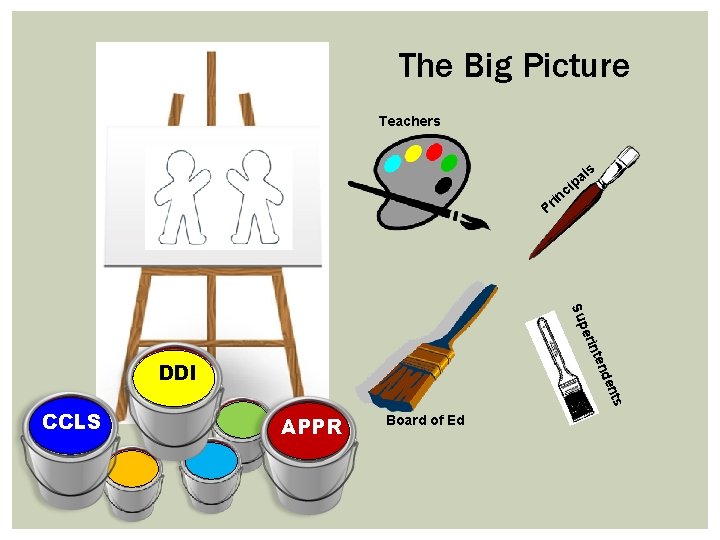
The Big Picture Teachers ls a p i c rin P inte per Su nts CCLS nde DDI APPR Board of Ed
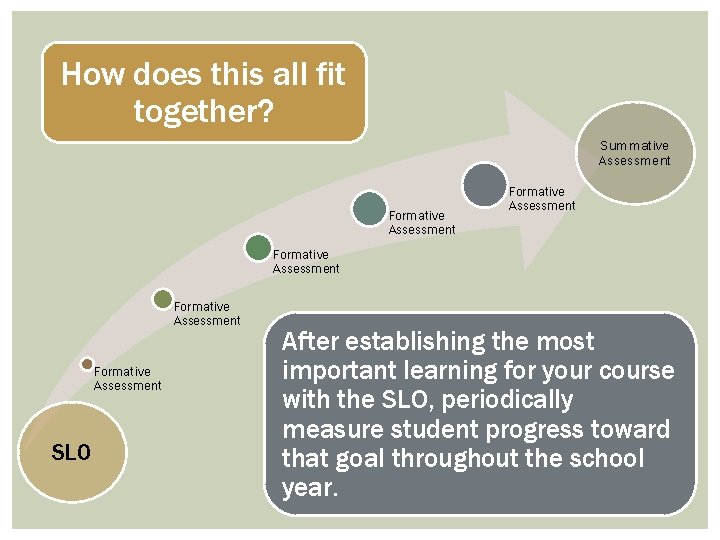
How does this all fit together? Summative Assessment Formative Assessment Formative Assessment SLO After establishing the most important learning for your course with the SLO, periodically measure student progress toward that goal throughout the school year.
Build Shared Knowledge
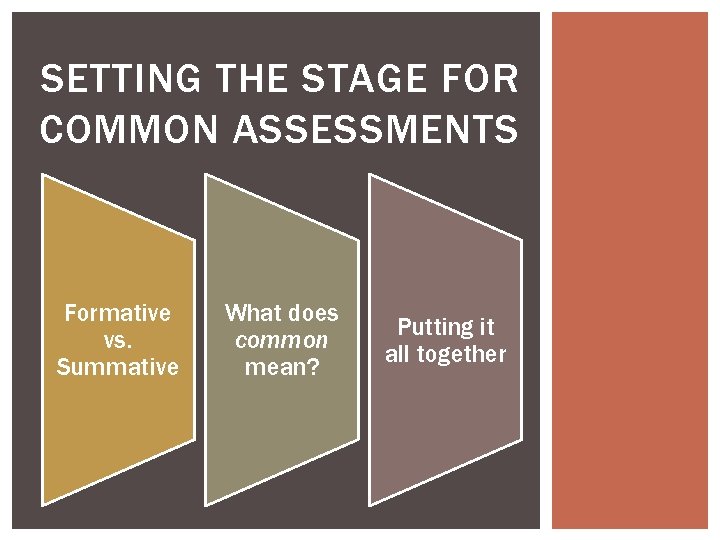
SETTING THE STAGE FOR COMMON ASSESSMENTS Formative vs. Summative What does common mean? Putting it all together
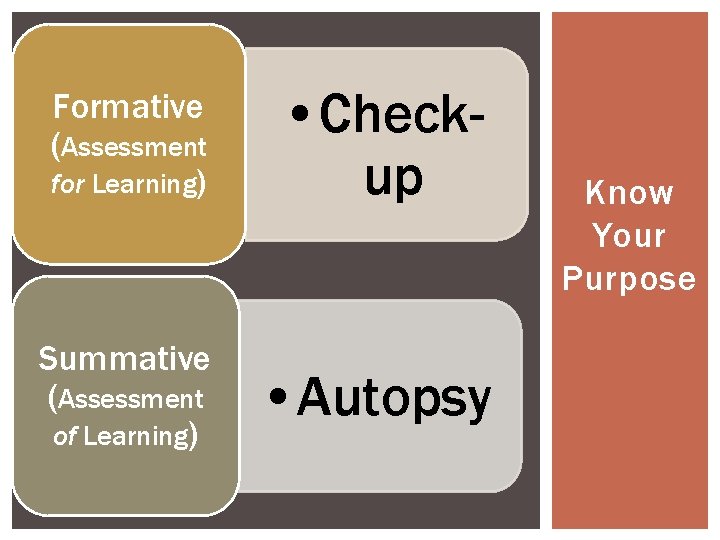
Formative (Assessment for Learning) • Checkup Summative (Assessment of Learning) • Autopsy Know Your Purpose
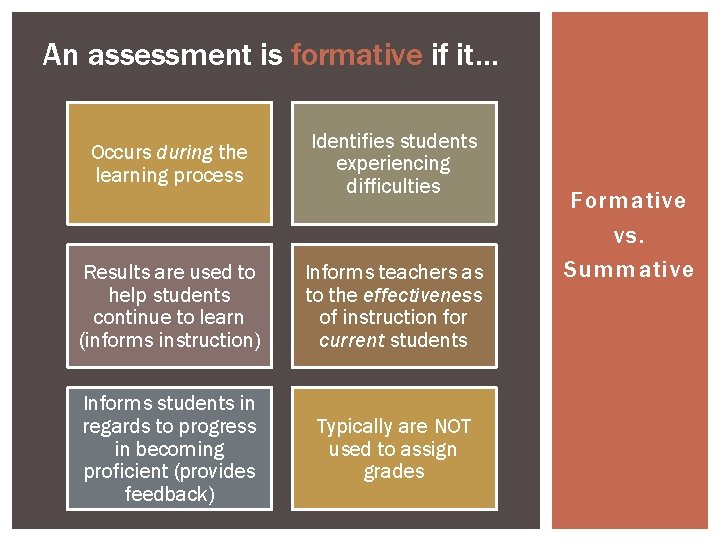
An assessment is formative if it… Occurs during the learning process Identifies students experiencing difficulties Results are used to help students continue to learn (informs instruction) Informs teachers as to the effectiveness of instruction for current students Informs students in regards to progress in becoming proficient (provides feedback) Typically are NOT used to assign grades Formative vs. Summative
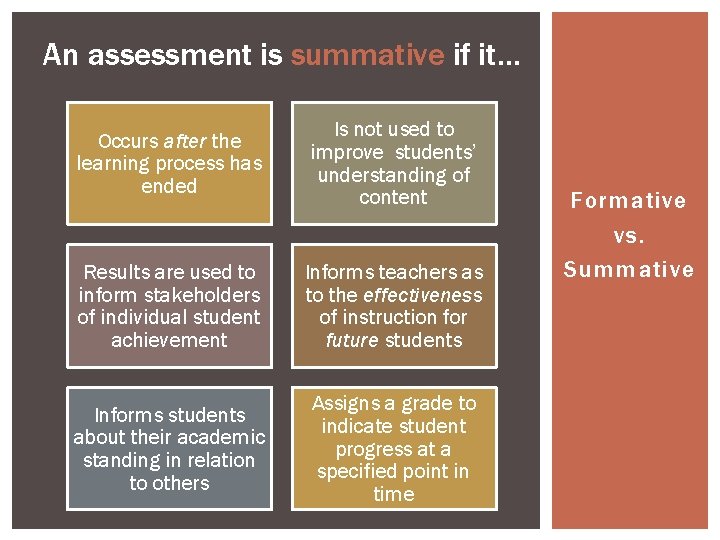
An assessment is summative if it… Occurs after the learning process has ended Is not used to improve students’ understanding of content Results are used to inform stakeholders of individual student achievement Informs teachers as to the effectiveness of instruction for future students Informs students about their academic standing in relation to others Assigns a grade to indicate student progress at a specified point in time Formative vs. Summative
FORMATIVE? SUMMATIVE? A Phys. Ed. teacher has students complete a graphic organizer identifying the relationship between physical activity and the prevention of illness, disease, and premature death. She grades the assignment and returns it to students. She speaks privately with a few students (who did not pass) to tell them that they’ll need to study more since this information will be on the unit test in a few weeks.
FORMATIVE? SUMMATIVE? A Phys. Ed. teacher observes his students to demonstrate the correct form for various weight training exercises He identifies those students who did not demonstrate proper technique and targets them for further instruction.
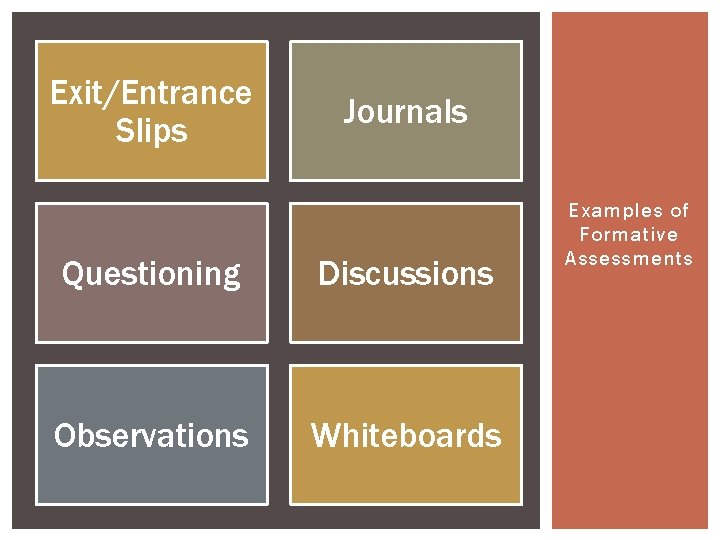
Exit/Entrance Slips Journals Questioning Discussions Observations Whiteboards Examples of Formative Assessments
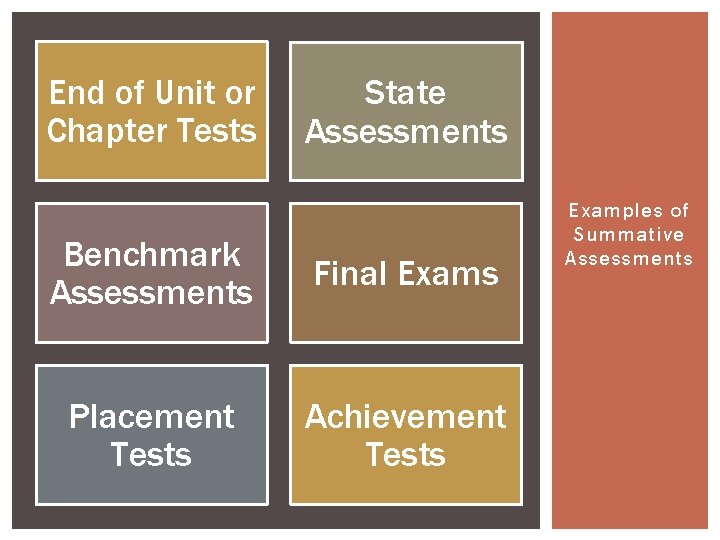
End of Unit or Chapter Tests State Assessments Benchmark Assessments Final Exams Placement Tests Achievement Tests Examples of Summative Assessments
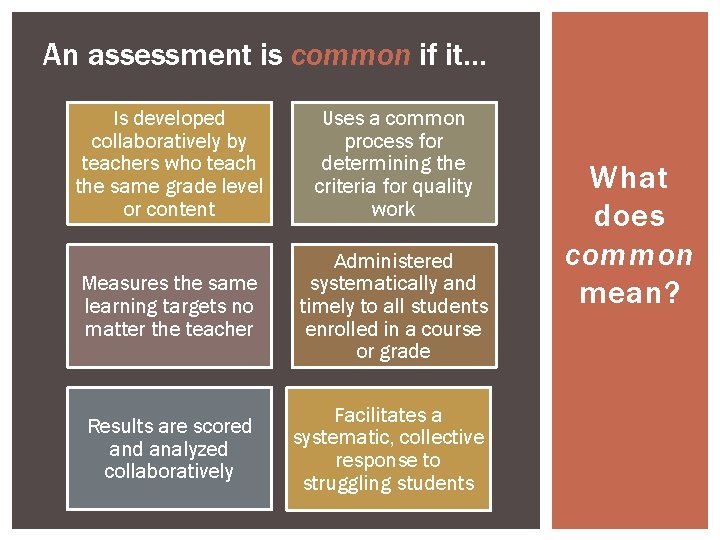
An assessment is common if it… Is developed collaboratively by teachers who teach the same grade level or content Uses a common process for determining the criteria for quality work Measures the same learning targets no matter the teacher Administered systematically and timely to all students enrolled in a course or grade Results are scored analyzed collaboratively Facilitates a systematic, collective response to struggling students What does common mean?
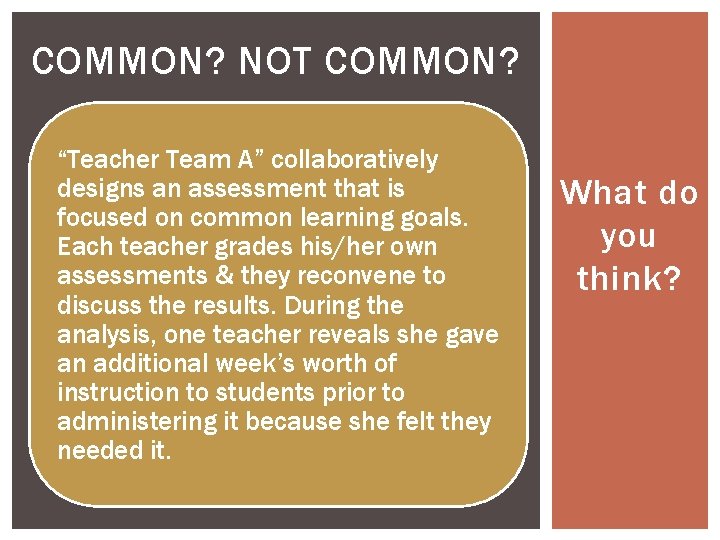
COMMON? NOT COMMON? “Teacher Team A” collaboratively designs an assessment that is focused on common learning goals. Each teacher grades his/her own assessments & they reconvene to discuss the results. During the analysis, one teacher reveals she gave an additional week’s worth of instruction to students prior to administering it because she felt they needed it. What do you think?
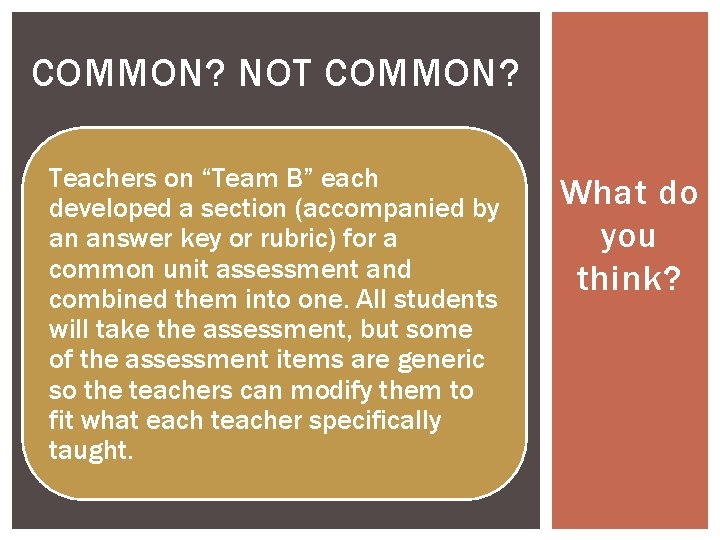
COMMON? NOT COMMON? Teachers on “Team B” each developed a section (accompanied by an answer key or rubric) for a common unit assessment and combined them into one. All students will take the assessment, but some of the assessment items are generic so the teachers can modify them to fit what each teacher specifically taught. What do you think?
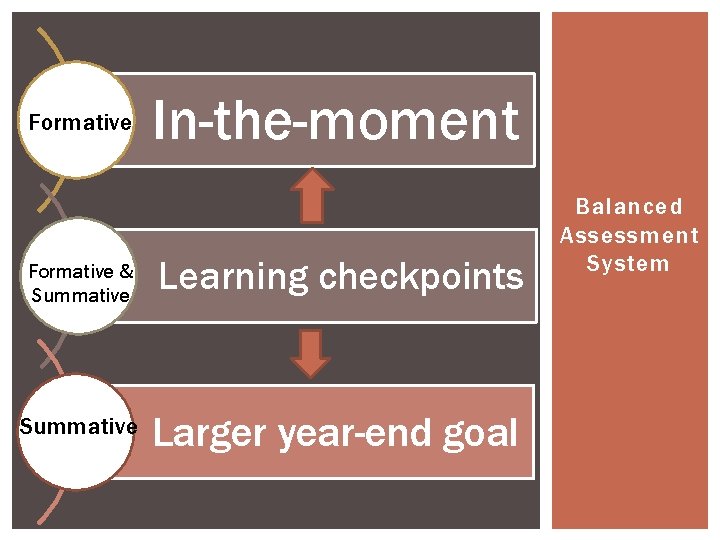
Formative In-the-moment Formative & Summative Learning checkpoints Summative Larger year-end goal Balanced Assessment System
DESIGNING QUALITY ASSESSMENTS Gather good information from the beginning! A Five Step Process
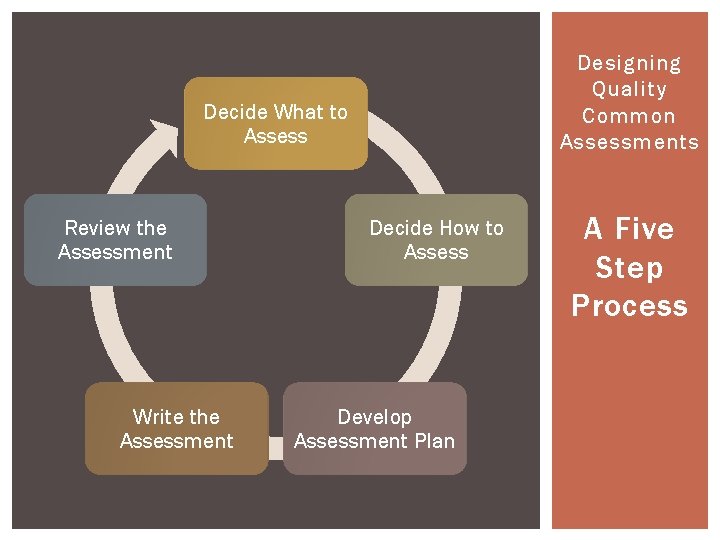
Designing Quality Common Assessments Decide What to Assess Review the Assessment Write the Assessment Decide How to Assess Develop Assessment Plan A Five Step Process
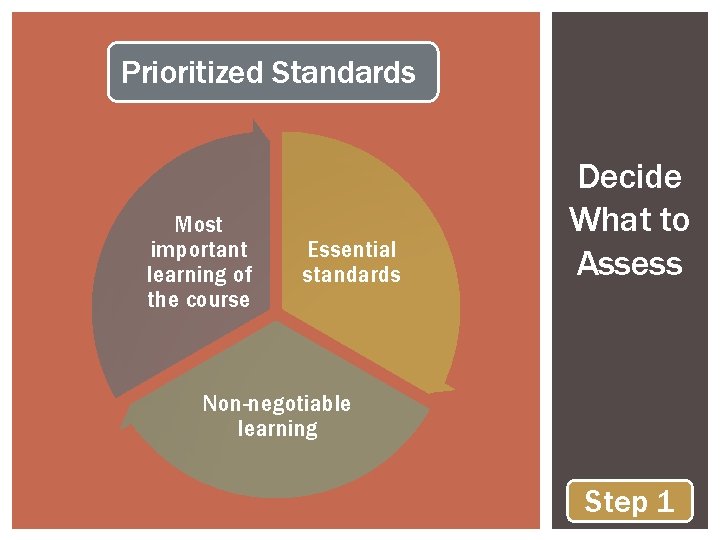
Prioritized Standards Most important learning of the course Essential standards Decide What to Assess Non-negotiable learning Step 1
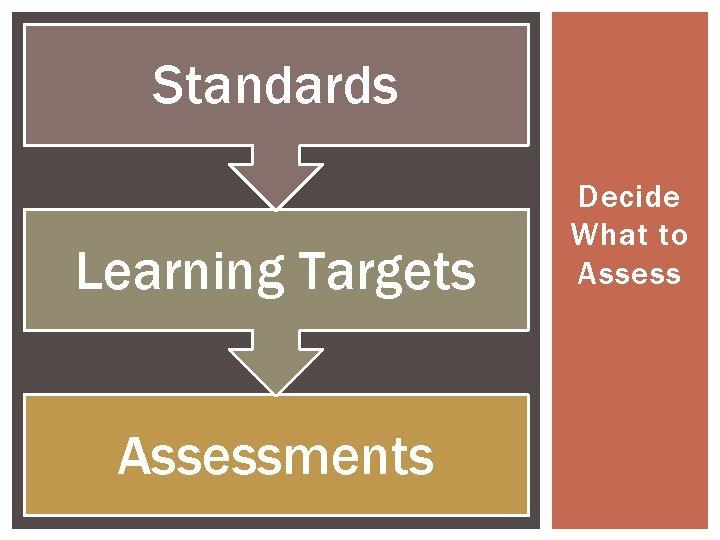
Standards Learning Targets Assessments Decide What to Assess
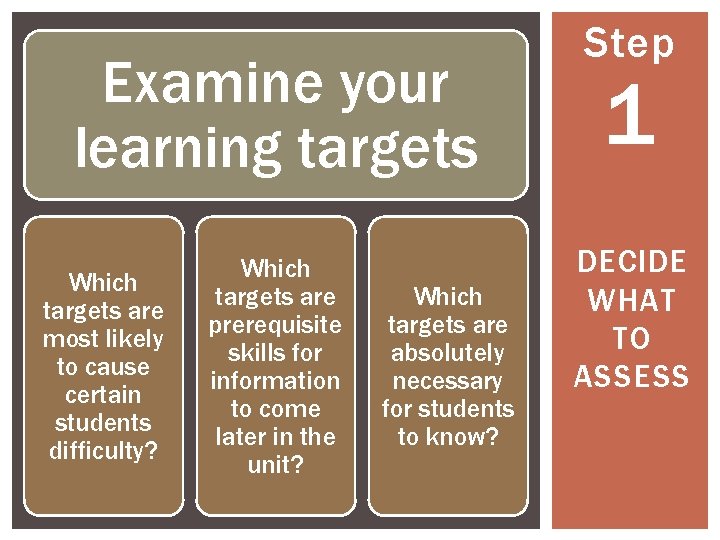
Examine your learning targets Which targets are most likely to cause certain students difficulty? Which targets are prerequisite skills for information to come later in the unit? Which targets are absolutely necessary for students to know? Step 1 DECIDE WHAT TO ASSESS
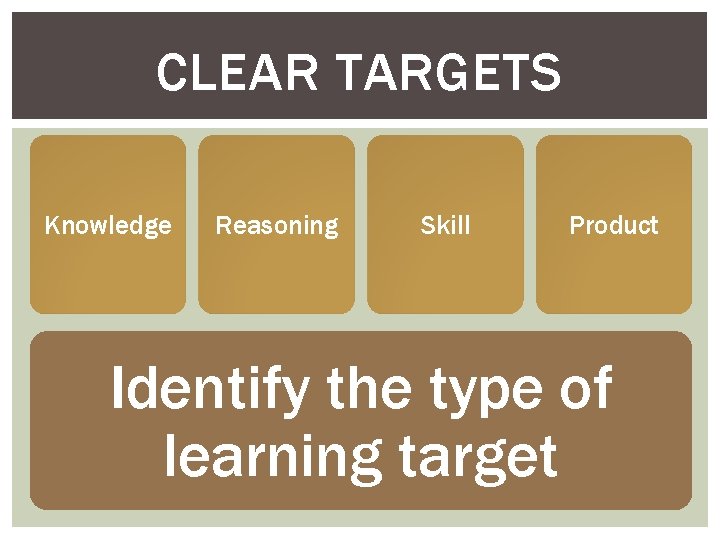
CLEAR TARGETS Knowledge Reasoning Skill Product Identify the type of learning target
http: //www. ocmboces. org/teacherpage. cfm? teacher=1805 HANDOUTS FOR SESSION
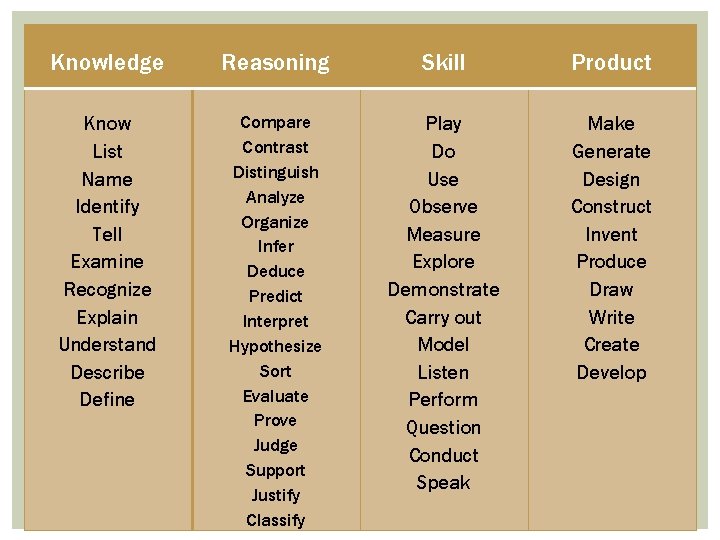
Knowledge Reasoning Skill Product Know List Name Identify Tell Examine Recognize Explain Understand Describe Define Compare Contrast Distinguish Analyze Organize Infer Deduce Predict Interpret Hypothesize Sort Evaluate Prove Judge Support Justify Classify Play Do Use Observe Measure Explore Demonstrate Carry out Model Listen Perform Question Conduct Speak Make Generate Design Construct Invent Produce Draw Write Create Develop
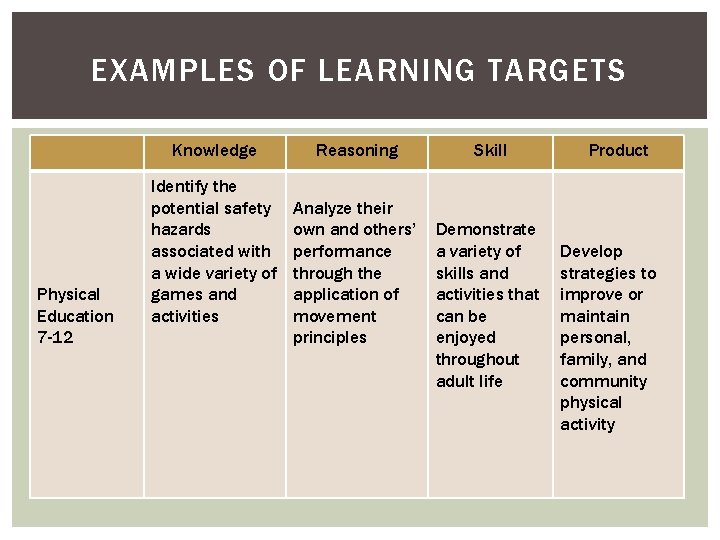
EXAMPLES OF LEARNING TARGETS Knowledge Physical Education 7 -12 Identify the potential safety hazards associated with a wide variety of games and activities Reasoning Analyze their own and others’ performance through the application of movement principles Skill Demonstrate a variety of skills and activities that can be enjoyed throughout adult life Product Develop strategies to improve or maintain personal, family, and community physical activity
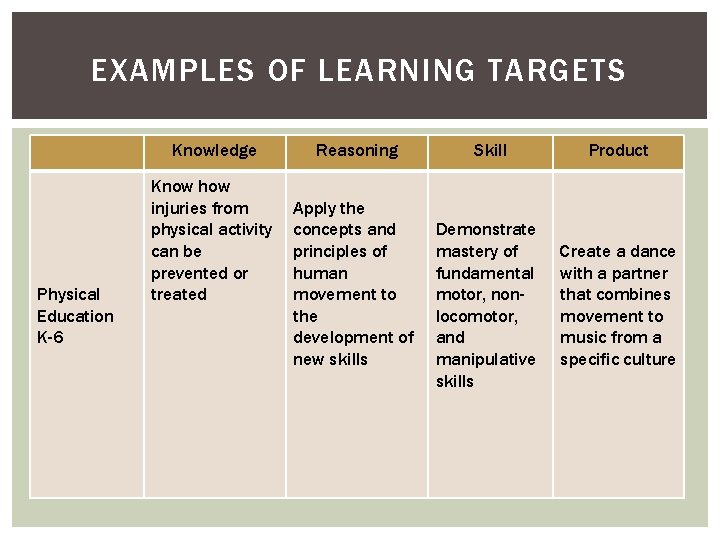
EXAMPLES OF LEARNING TARGETS Knowledge Physical Education K-6 Know how injuries from physical activity can be prevented or treated Reasoning Apply the concepts and principles of human movement to the development of new skills Skill Product Demonstrate mastery of fundamental motor, nonlocomotor, and manipulative skills Create a dance with a partner that combines movement to music from a specific culture
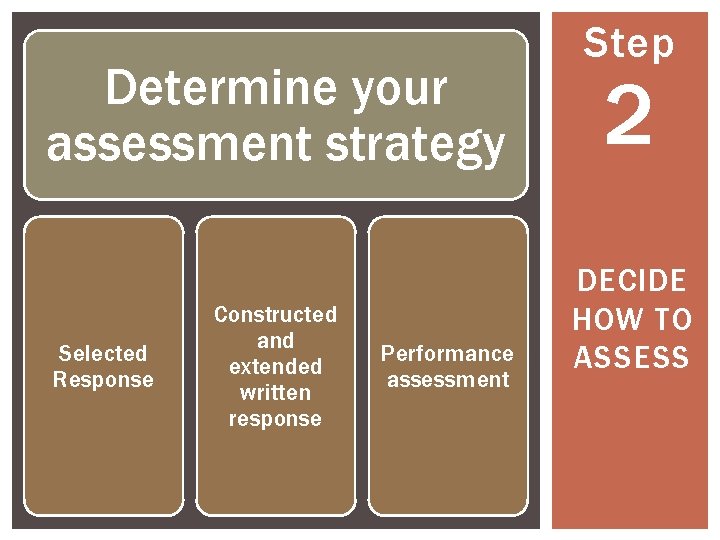
Determine your assessment strategy Selected Response Constructed and extended written response Performance assessment Step 2 DECIDE HOW TO ASSESS
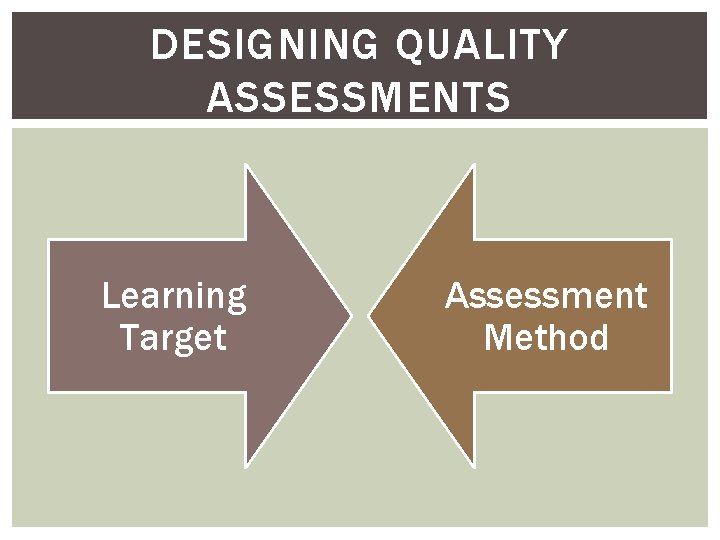
DESIGNING QUALITY ASSESSMENTS Learning Target Assessment Method
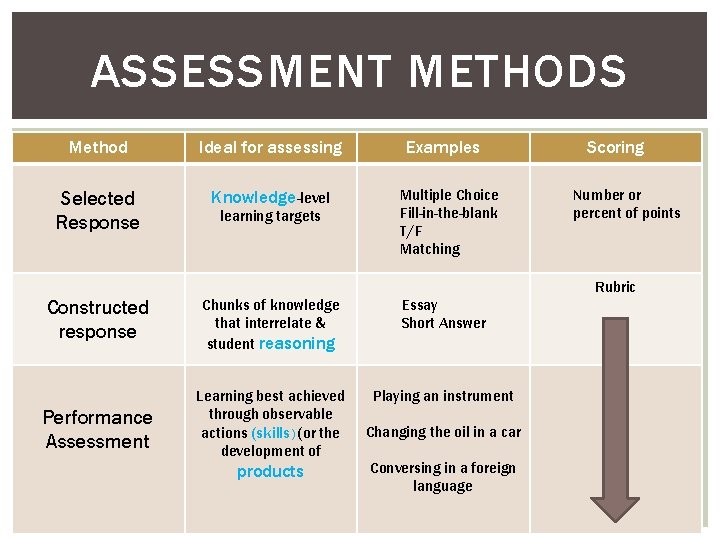
ASSESSMENT METHODS Method Ideal for assessing Selected Response Knowledge-level learning targets Examples Multiple Choice Fill-in-the-blank T/F Matching Scoring Number or percent of points Rubric Constructed response Chunks of knowledge that interrelate & student reasoning Essay Short Answer Playing an instrument Performance Assessment Learning best achieved through observable actions (skills) (or the development of products Changing the oil in a car Conversing in a foreign language
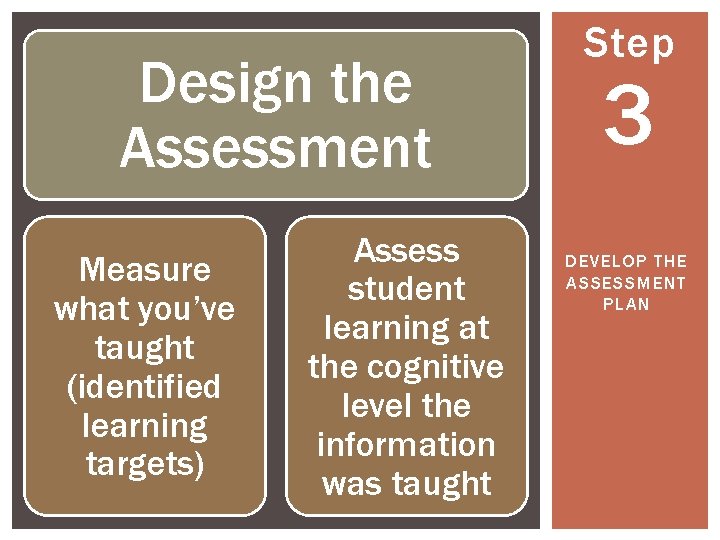
Design the Assessment Measure what you’ve taught (identified learning targets) Assess student learning at the cognitive level the information was taught Step 3 DEVELOP THE ASSESSMENT PLAN
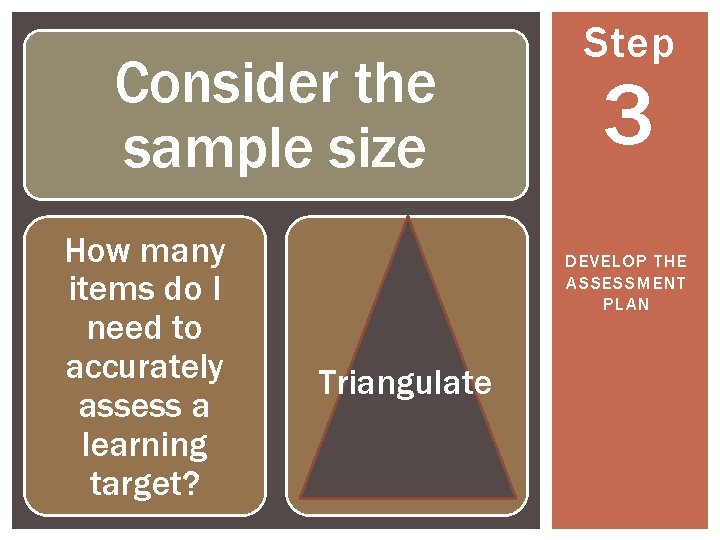
Consider the sample size How many items do I need to accurately assess a learning target? Step 3 DEVELOP THE ASSESSMENT PLAN Triangulate
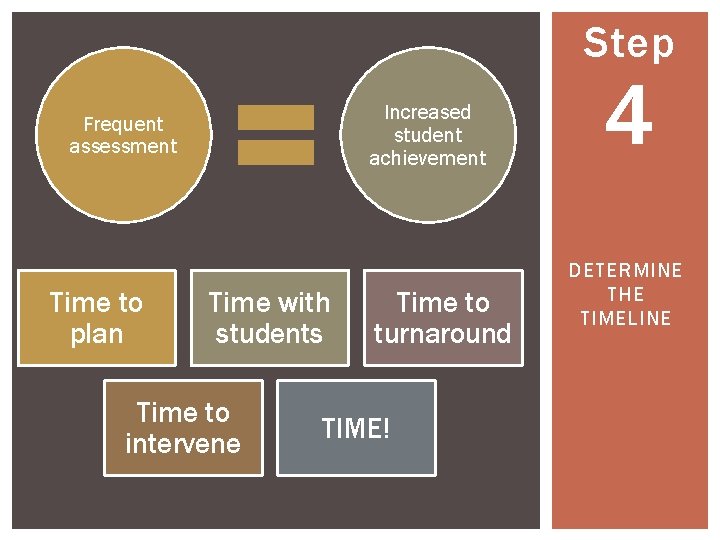
Step Increased student achievement Frequent assessment Time to plan Time with students Time to intervene Time to turnaround TIME! 4 DETERMINE THE TIMELINE
General Guidelines Selected Response Items Constructed Response Items Step 5 WRITE THE ASSESSMENT
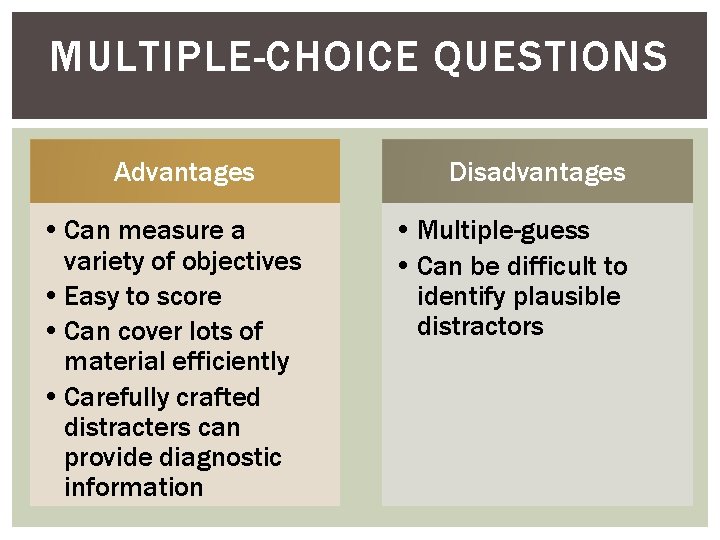
MULTIPLE-CHOICE QUESTIONS Advantages • Can measure a variety of objectives • Easy to score • Can cover lots of material efficiently • Carefully crafted distracters can provide diagnostic information Disadvantages • Multiple-guess • Can be difficult to identify plausible distractors
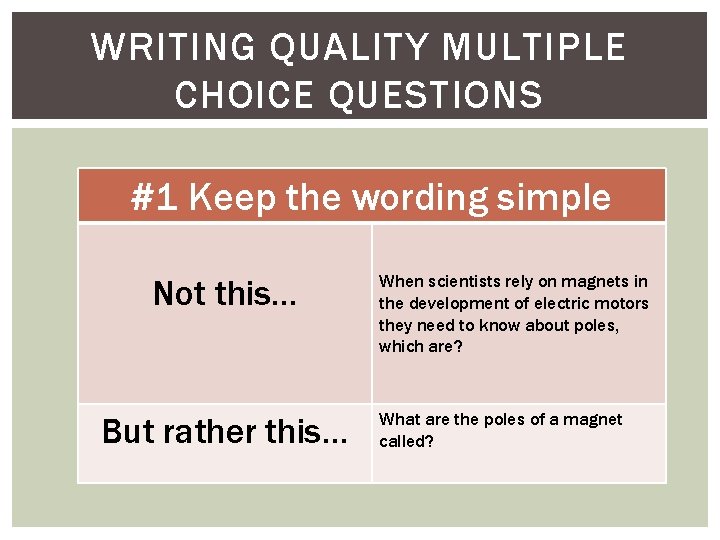
WRITING QUALITY MULTIPLE CHOICE QUESTIONS #1 Keep the wording simple Not this… But rather this… When scientists rely on magnets in the development of electric motors they need to know about poles, which are? What are the poles of a magnet called?
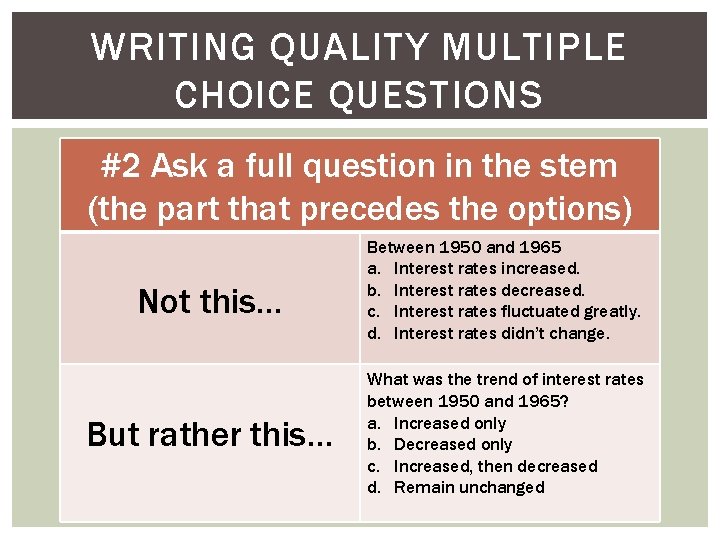
WRITING QUALITY MULTIPLE CHOICE QUESTIONS #2 Ask a full question in the stem (the part that precedes the options) Not this… But rather this… Between 1950 and 1965 a. Interest rates increased. b. Interest rates decreased. c. Interest rates fluctuated greatly. d. Interest rates didn’t change. What was the trend of interest rates between 1950 and 1965? a. Increased only b. Decreased only c. Increased, then decreased d. Remain unchanged
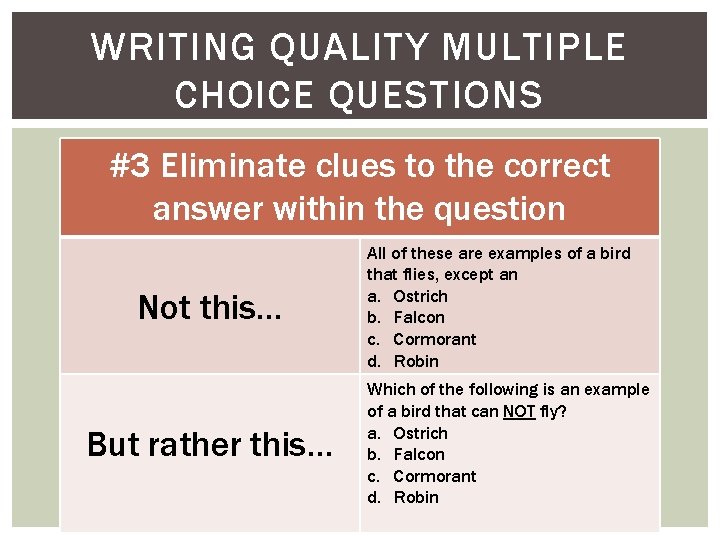
WRITING QUALITY MULTIPLE CHOICE QUESTIONS #3 Eliminate clues to the correct answer within the question Not this… But rather this… All of these are examples of a bird that flies, except an a. Ostrich b. Falcon c. Cormorant d. Robin Which of the following is an example of a bird that can NOT fly? a. Ostrich b. Falcon c. Cormorant d. Robin
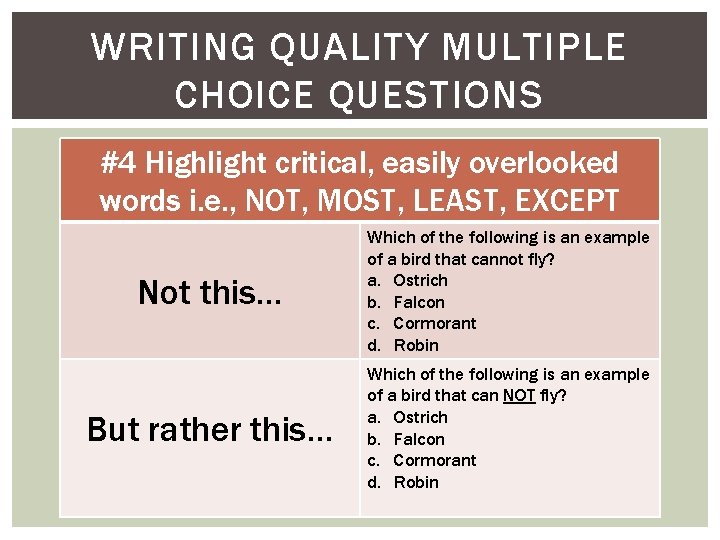
WRITING QUALITY MULTIPLE CHOICE QUESTIONS #4 Highlight critical, easily overlooked words i. e. , NOT, MOST, LEAST, EXCEPT Not this… Which of the following is an example of a bird that cannot fly? a. Ostrich b. Falcon c. Cormorant d. Robin But rather this… Which of the following is an example of a bird that can NOT fly? a. Ostrich b. Falcon c. Cormorant d. Robin
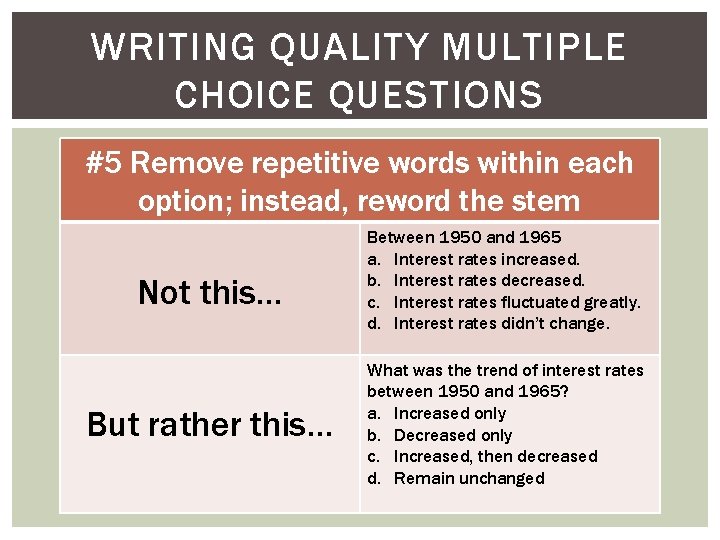
WRITING QUALITY MULTIPLE CHOICE QUESTIONS #5 Remove repetitive words within each option; instead, reword the stem Not this… But rather this… Between 1950 and 1965 a. Interest rates increased. b. Interest rates decreased. c. Interest rates fluctuated greatly. d. Interest rates didn’t change. What was the trend of interest rates between 1950 and 1965? a. Increased only b. Decreased only c. Increased, then decreased d. Remain unchanged
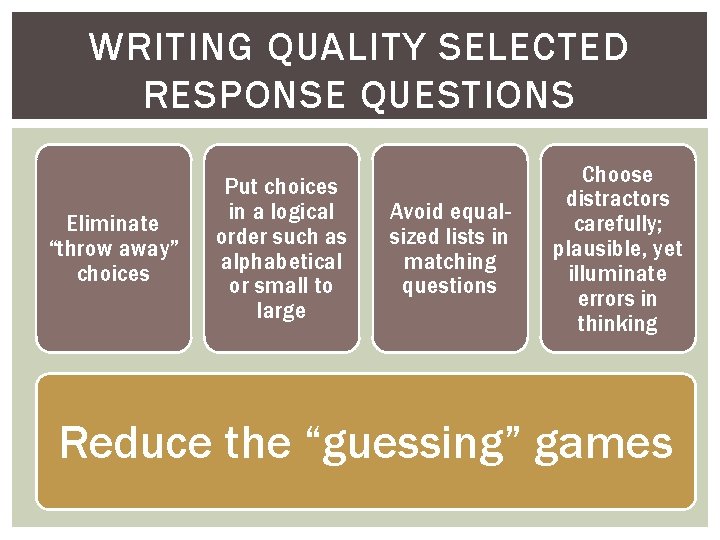
WRITING QUALITY SELECTED RESPONSE QUESTIONS Eliminate “throw away” choices Put choices in a logical order such as alphabetical or small to large Avoid equalsized lists in matching questions Choose distractors carefully; plausible, yet illuminate errors in thinking Reduce the “guessing” games
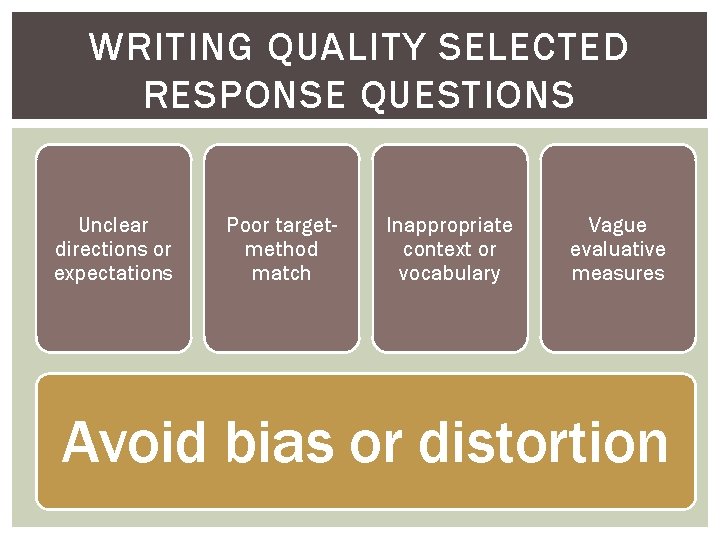
WRITING QUALITY SELECTED RESPONSE QUESTIONS Unclear directions or expectations Poor targetmethod match Inappropriate context or vocabulary Vague evaluative measures Avoid bias or distortion
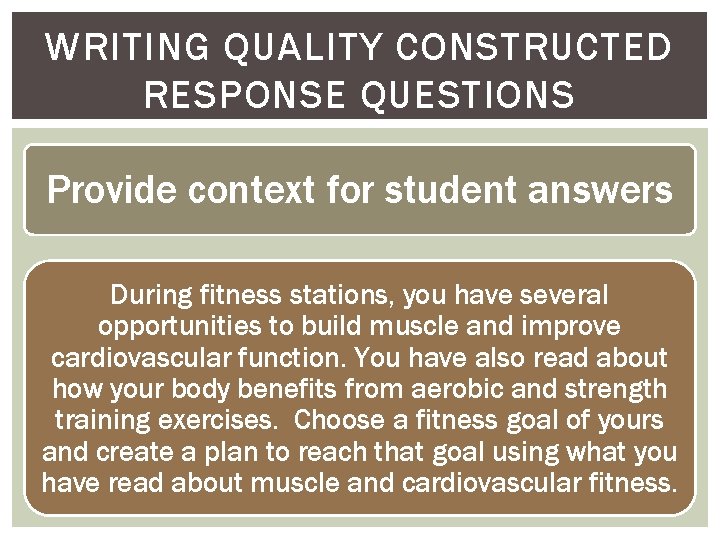
WRITING QUALITY CONSTRUCTED RESPONSE QUESTIONS Provide context for student answers During fitness stations, you have several opportunities to build muscle and improve cardiovascular function. You have also read about how your body benefits from aerobic and strength training exercises. Choose a fitness goal of yours and create a plan to reach that goal using what you have read about muscle and cardiovascular fitness.
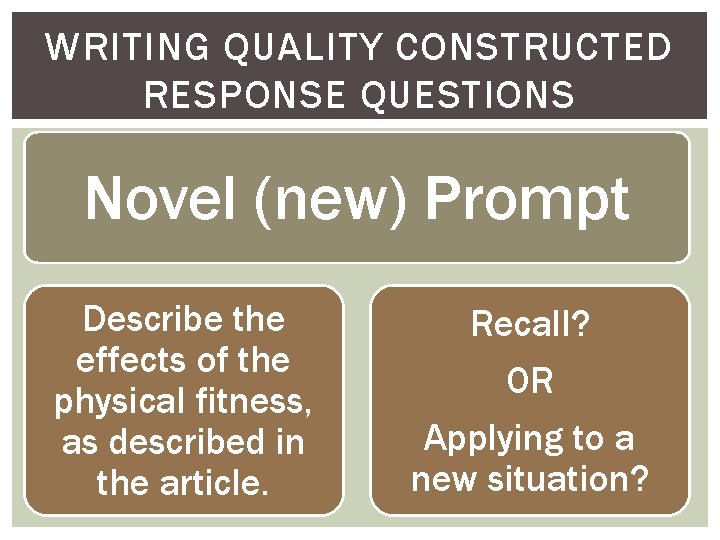
WRITING QUALITY CONSTRUCTED RESPONSE QUESTIONS Novel (new) Prompt Describe the effects of the physical fitness, as described in the article. Recall? OR Applying to a new situation?
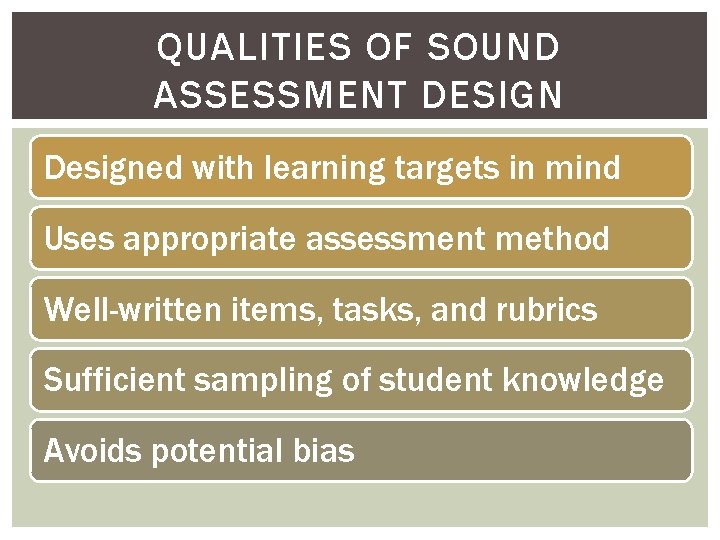
QUALITIES OF SOUND ASSESSMENT DESIGN Designed with learning targets in mind Uses appropriate assessment method Well-written items, tasks, and rubrics Sufficient sampling of student knowledge Avoids potential bias
PUTTING THE PROCESS INTO ACTION
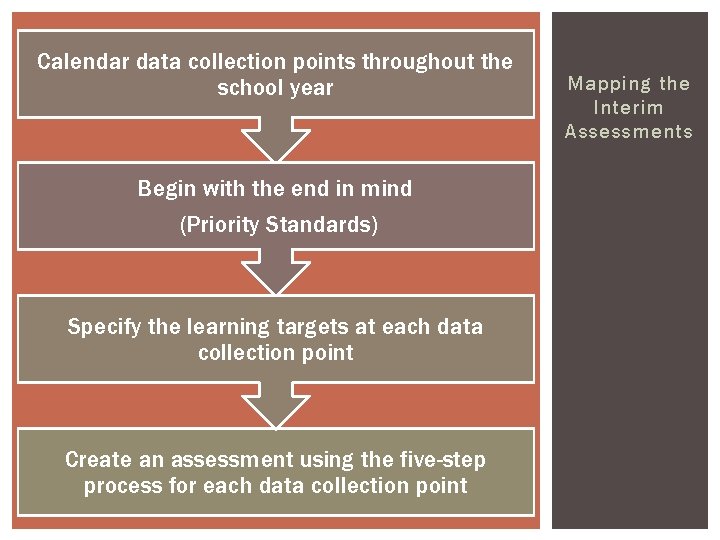
Calendar data collection points throughout the school year Begin with the end in mind (Priority Standards) Specify the learning targets at each data collection point Create an assessment using the five-step process for each data collection point Mapping the Interim Assessments
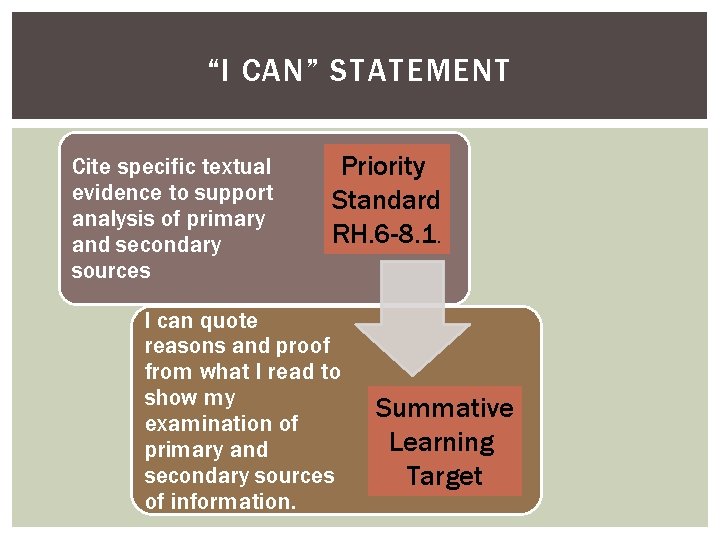
“I CAN” STATEMENT Cite specific textual evidence to support analysis of primary and secondary sources Priority Standard RH. 6 -8. 1. . I can quote reasons and proof from what I read to show my examination of primary and secondary sources of information. Summative Learning Target
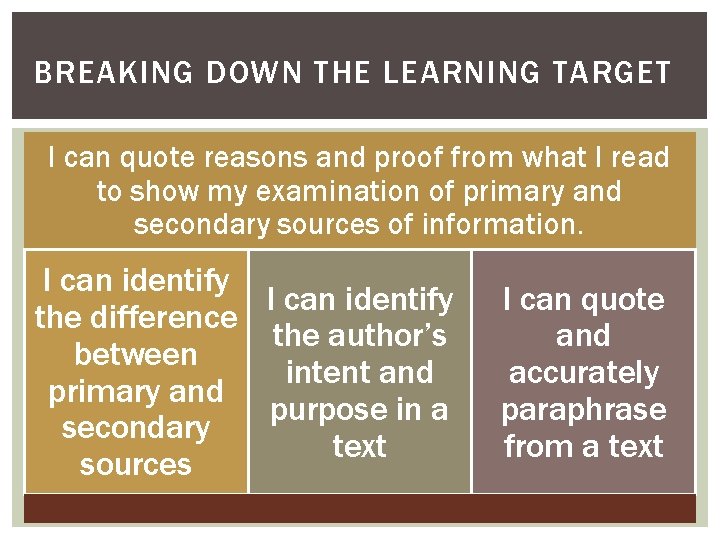
BREAKING DOWN THE LEARNING TARGET I can quote reasons and proof from what I read to show my examination of primary and secondary sources of information. I can identify the difference the author’s between intent and primary and purpose in a secondary text sources I can quote and accurately paraphrase from a text
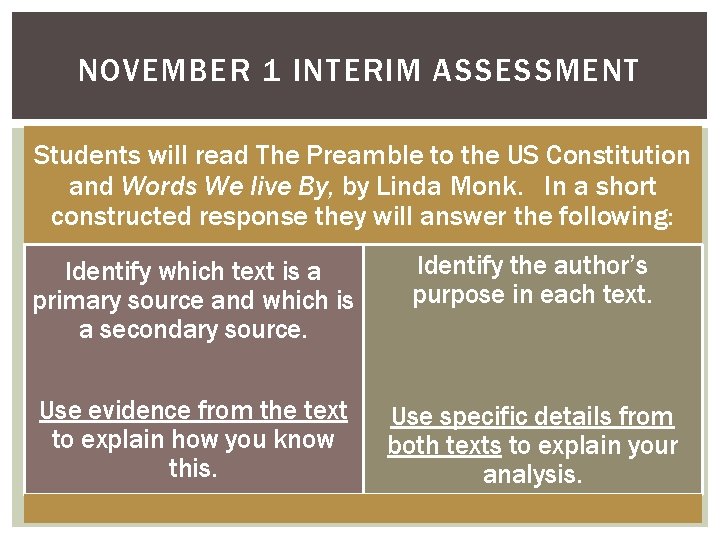
NOVEMBER 1 INTERIM ASSESSMENT Students will read The Preamble to the US Constitution and Words We live By, by Linda Monk. In a short constructed response they will answer the following: Identify which text is a primary source and which is a secondary source. Identify the author’s purpose in each text. Use evidence from the text to explain how you know this. Use specific details from both texts to explain your analysis.
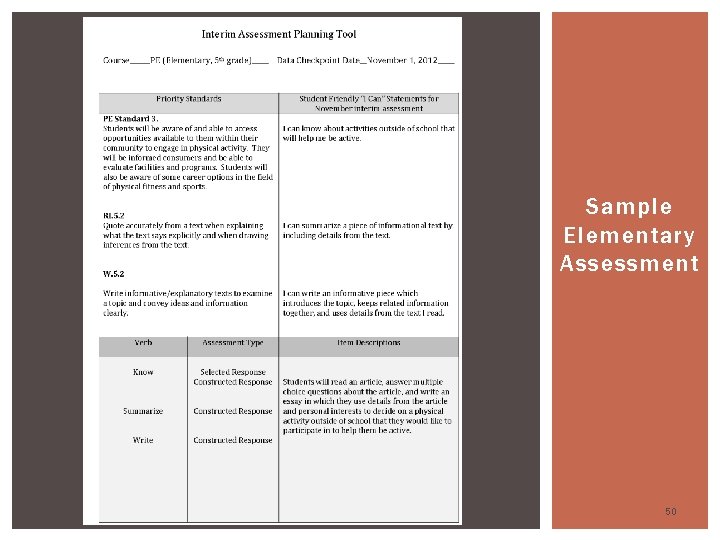
Sample Elementary Assessment OCM BOCES Network Team 50
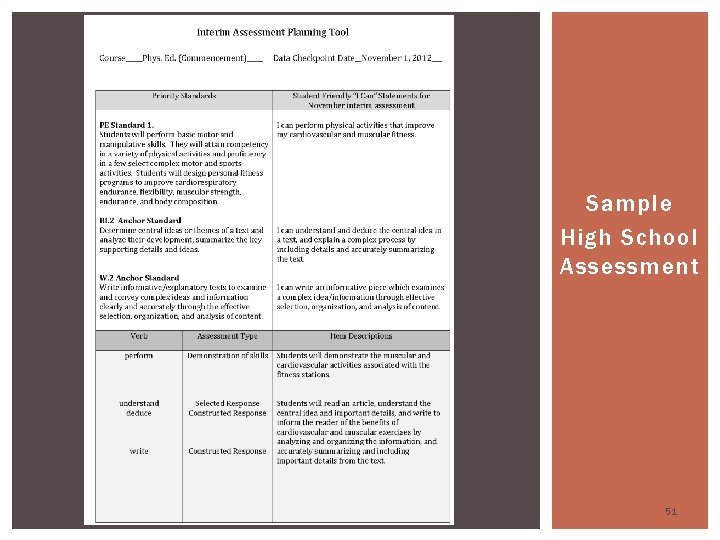
Sample High School Assessment OCM BOCES Network Team 51
Upcoming OCM BOCES: Instruction for All Students �Oct. 23, 24; Nov. 13, 27; Dec. 18; & Jan. 10 �Register online: My Learning Plan
CONTACT INFORMATION Auddie Mastroleo amastroleo@ocmboces. org OCM BOCES Network Team 53
- Slides: 53