Sem II Paper IV Gymnosperms Cycas Asso Prof
- Slides: 32
Sem. II, Paper IV Gymnosperms- Cycas Asso. Prof. Seema A. Gaikwad Dept. of Botany Vidnyan Mahavidyalaya, Sangola.
Introduction and Salient features of Gymnosperms. Introduction: The seed bearing plants known as phanerogams or spermatophytes are divided into two major i. e Angiosperms and Gymnosperms. In angiosperms the ovules are enclosed by ovary wall i. e vessels whereas in gymnosperms the ovules are not enclosed into the fruit. So Gymnosperm is a group of seed plants where the seeds are naked or exposed to the nature. So due to the protection afforded to the ovule and seed , the angiosperms are considered to the advanced than the gymnosperm.
Salient features of gymnosperms: - • The gymnosperms show an alternation of generation i. e gametophytic and sporophytic. The gametophytic generation is reduced in gymnosperms and completely dependent upon the sporophyte. • The sporophyte (plant body) of gymnosperms is differentiated into root stem and leaf. • All gymnosperms are woody. Generally trees or shrubs with many xerophytic characters. There are no herbs in the gymnosperms. • The tap root system becomes very well developed in gymnosperms. Sometimes specialized roots are developed as coralloid roots in Cycas and mycorrhizal roots in pinus. • The stem is generally branched (in cycas it is unbranched ). Covered with scale and bark. The branches are dimorphic i. e long shoots and dawarf shoots. • The leaves of gymnosperms are dimorphic foliage and scaly , evergreen with thick cuticle and sunken stomata. They vary in their shapes. They are pinnately compound (e. g Cycas) needle like (e. g Pinus ) or may be simple, opposite , entire , like dicot leaves. • The wood of gymnosperms is non porous because vessels are not found in the xylem of gymnosperms except Gnetales. Similarly there are no sieve tubes and companion cells and parenchyma are present. • Resin and gum canals are very common in gymnosperms. • The reproductive structure are in the form of compact cones (except female plant of cycas). The male and female cones are distinct due to their size, structure and shape in many genera. • The male and female cone are produced on seprate plants with few exception i. e most of the gymnosperms are dioecious. • The male and female cones can be compaired with flower or inflorescence. The flower or gymnospers is without perianth except Gnetum and Ephedra. • Large no. of microspores or pollens is produced in microsporangia , located on the lower surface of the microsporophyll in male cones. • The megaspores and ovules which are naked produced on the megasporophylls. The ovules are unitegmic with three distinct layers and are few in number. • . The microspore germinate to form male gametophyte and megaspore forms female
seprate. Both the gametophytes are very small or reduced in size as compared to the sporophyte (Main plant) • In many genera, the female gametophyte shows two to many archegonia. (They are absent in gnetum ) In archegonia there are no neck canal cells. • All gymnosperms are anemophilous (pollination by wind )and the pollengrains are directly fall on micropyle of the ovule because there is no stigma like angiosperms. The pollen grains are winged in pinus • The pollen grains are stored in pollen chamber present in ovule. The fertilization occurs with the fusion of male and female nuclei and zygote is formed. • The zygote further develops into an embryo and embryo into adult plant. Many genra show polyembryony. • Ovary , style and stigma are absent in gymnosperms. • As ovule are naked and ovary is absent in gymnosperms there is no fruit formation but naked seeds are formed. • The true endosperms is absent in gymnosperms because there is no double fertilization or triple fusion so called ‘endosperms’ in gymnosperms is megagametophytic tissue. • The seeds show generally two , sometimes one or many cotyledons. • In the life cycle of gymnosperms the sporophyte is dominant generation and is independent whereas the gametophytic generation is reduced , small and dependent.
Classification of Gymnosperms Several systems of classification of gymnosperms have been proposed from time to time by various workers. some of the systems are considered as modern systems. These systems were proposed by the workers like –Coulter and chamberlain (1910), chamberlain (1934), prof. Bribal Sahni(1920) D. D Pant(1957), Sporne (1965)Gangulee (1968) Bierhorst (1971) etc. Sporne’s (1965) system of classification of Gymnosperms. This is one of the recent system of classification for gymnosperms. In this system Sporne (1965) has given the classification for both extinct (fossils) and living gymnosperms , together form a division. The division gymnosperms are further divided into three classes. Each class is further divided into orders and each orders into families
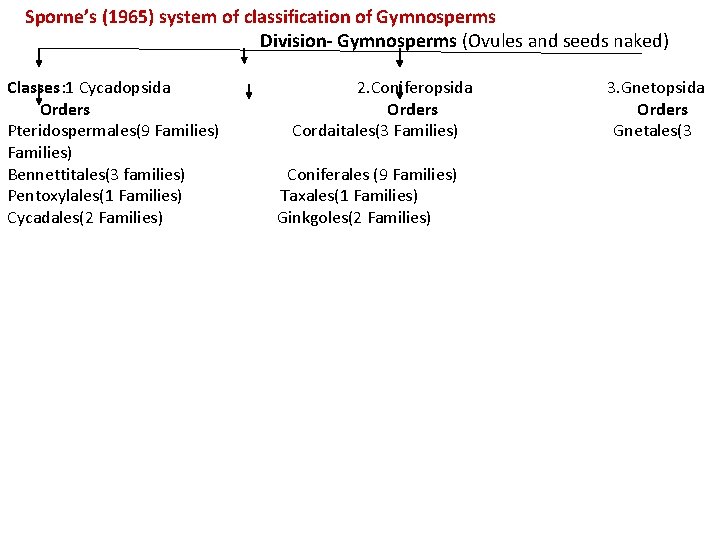
Sporne’s (1965) system of classification of Gymnosperms Division- Gymnosperms (Ovules and seeds naked) Classes: 1 Cycadopsida 2. Coniferopsida 3. Gnetopsida Orders Orders Pteridospermales(9 Families) Cordaitales(3 Families) Gnetales(3 Families) Bennettitales(3 families) Coniferales (9 Families) Pentoxylales(1 Families) Taxales(1 Families) Cycadales(2 Families) Ginkgoles(2 Families)
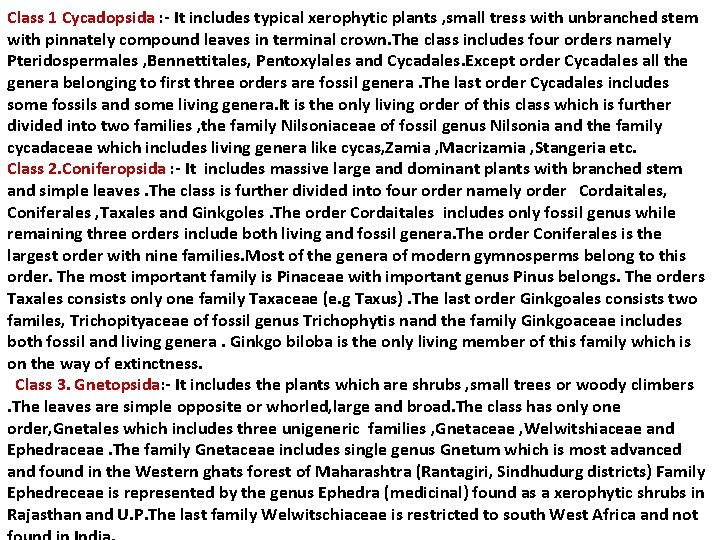
Class 1 Cycadopsida : - It includes typical xerophytic plants , small tress with unbranched stem with pinnately compound leaves in terminal crown. The class includes four orders namely Pteridospermales , Bennettitales, Pentoxylales and Cycadales. Except order Cycadales all the genera belonging to first three orders are fossil genera. The last order Cycadales includes some fossils and some living genera. It is the only living order of this class which is further divided into two families , the family Nilsoniaceae of fossil genus Nilsonia and the family cycadaceae which includes living genera like cycas, Zamia , Macrizamia , Stangeria etc. Class 2. Coniferopsida : - It includes massive large and dominant plants with branched stem and simple leaves. The class is further divided into four order namely order Cordaitales, Coniferales , Taxales and Ginkgoles. The order Cordaitales includes only fossil genus while remaining three orders include both living and fossil genera. The order Coniferales is the largest order with nine families. Most of the genera of modern gymnosperms belong to this order. The most important family is Pinaceae with important genus Pinus belongs. The orders Taxales consists only one family Taxaceae (e. g Taxus). The last order Ginkgoales consists two familes, Trichopityaceae of fossil genus Trichophytis nand the family Ginkgoaceae includes both fossil and living genera. Ginkgo biloba is the only living member of this family which is on the way of extinctness. Class 3. Gnetopsida: - It includes the plants which are shrubs , small trees or woody climbers . The leaves are simple opposite or whorled, large and broad. The class has only one order, Gnetales which includes three unigeneric families , Gnetaceae , Welwitshiaceae and Ephedraceae. The family Gnetaceae includes single genus Gnetum which is most advanced and found in the Western ghats forest of Maharashtra (Rantagiri, Sindhudurg districts) Family Ephedreceae is represented by the genus Ephedra (medicinal) found as a xerophytic shrubs in Rajasthan and U. P. The last family Welwitschiaceae is restricted to south West Africa and not
Economic importance of Gymnosperms: Economically the gymnosperms are relatively less important as compaired to angiosperms. Due to their asthetic value they are cultivated in the gardens and parks. Some yield products of commercial importance. Those are discussed as follows. A) Gymnosperms have food value: -1) The stems and seeds of some gymnosperms (Cycas) yield starch commonly called sago. 2) The seeds of Gnetum (chilgoza) and pinus species are edible. The tubers of Zamia are also edible. The starchy stem of Macrozamia can be ground and boiled in water and used as a food for pigs, poultry and calves. B) As a soft wood and timber: -The wood of gymnosperms is light , soft , resinous and non-porous (lack of vessels) Due to presence of resins, the wood is durable and used in many ways. 3)The wood obtained from different species of Pinus is used as a timber for making furniture , boxes, poles and toys. 4) Juniperus wood is used for boats and making lead pencils. 5) The wood of Abies and Cycas is used for making small boxes, dishes etc. C) As a gums and resins: The gums and resins are minor but important forest products. They are obtained from many gymnosperms and used in industrial products. 6) Turpentine obtained from different sps. of pinus is used in paints , varnishes , inks etc. 7) Canada balsam , a resin obtained from Abies balsamea is very useful mounting medium in biological preparations. 8) The gum of Araucaria and Cycas is a adcesive. 9) The ‘Green gum ‘or ‘Candle gum’ obtained from Agathis sps. is used in varnish making , preparation of plastics, polishes etc. D) Gymnosperms have medicinal values: 10) Ephedrine a drug obtained from Ephedra is very useful in asthama and colds. 11)The seed paste of Cycas in coconut oil is used for sores, swelling , wounds, boils and skin disease. 12) A liquid decoction of the seeds of Dioon is employed (in Mexico) for neuralgia. 13)The crushed seeds of C. circinalis are used as a fish poison. The leaf juice used in stomach disorders , skin
D) Gymnosperms have medicinal values: 10) Ephedrine a drug obtained from Ephedra is very useful in asthama and colds. 11)The seed paste of Cycas in coconut oil is used for sores, swelling , wounds, boils and skin disease. 12) A liquid decoction of the seeds of Dioon is employed (in Mexico) for neuralgia. 13)The crushed seeds of C. circinalis are used as a fish poison. The leaf juice used in stomach disorders , skin disease and vomiting. 14)The stem extract of C. pectinata is used as hair –wash. E) They are useful for aromatic essential oils: - An aromatic essential oils is obtained from many Gymnosperms. Due to aromatic nature , these oils are used in perfume industry. 15) The oil obtained from Juniperus , Pinus and Cedrus sps. is useful in perfume industry for different commercial products. F) As fiber plants : - The nonporous wood of gymnosperms mainly contains tracheids and fibers. 16) The wood of different species of Pinus , Abies , Tsuga and Larix is used for cellulose fibers for the preparation of paper pulp in paper industry. Higher grades of paper are made from it. 17) The fine fibers (called palm wool) found at the base of leaves of species of Macrozamia and Cycas are used for stuffing pillows and mattresses. 18) The surface fibers from the leaves of C. revoluta and C. circinalis have been made into cloth. G) Other uses: -19) Many genera like Cycas , Thuja , Araucaria , Cryptomeria , Cupressus and Agathis are grown as garden ornamentals. 20) The bark of Araucaria Picea, Tsuga sps. contain good quality of tannin therefore it is used in tanning industry. 21) The Pinus plantation keeps the air fresh and healthy therefore it is planted near T. B Hospitals. it prevents the soil erosion therefore used in afforestration and planted on hilly slopes.
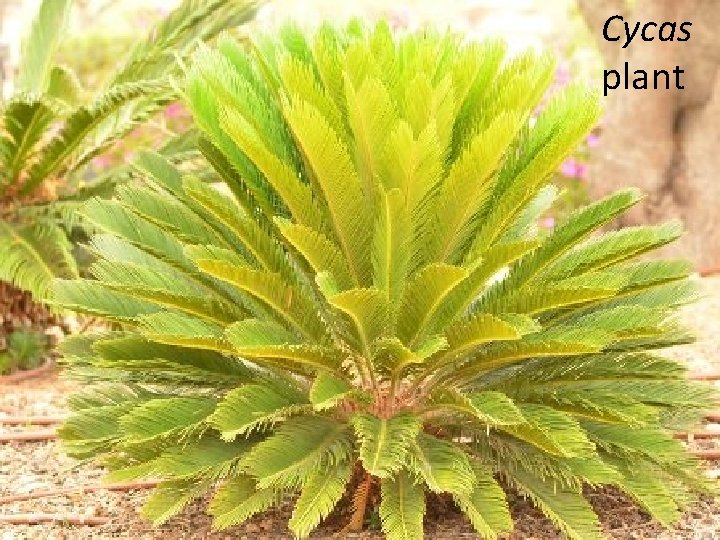
Cycas plant
Distribution and Habitat • There are 20 species of Cycas distributed in tropical and subtropical regions of eastern hemisphere of the world. 4 species occur naturally in our country. • Cycas revoluta (Crozier Cycas) grows in dry deciduous forests of southern India. • Cycas beddomei (Madras Cycas) grows in Eastern Ghats of our country. • Cycas pectinata (Nepal Cycas) grows in eastern India. • Cycas rumphii (Rumphious Cycas) grows in Andaman and Nicobar islands. • Cycas revoluta (Sago Cycas) is Japanese species grown as ornamental in India. • Two species grow naturally in our state. They are C. beddomei on Tirumala hills and C. circinalis in Eastern Ghats
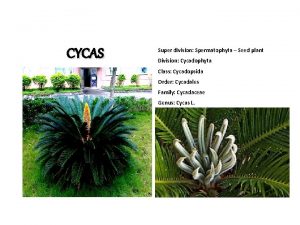
Systametic position Kingdom: Plantae – Presence of chlorophyll Division: Gymnosperms – Ovules & Seeds naked Class: Cycadopsida – Small trees with unbranched stem & palm like pinnately compound leaves Order: Cycadales –The plants are slow growing, woody palm like, unbranched trees with corolloid roots Family: Cycadaceae – The plants are Genus: Cycas – The pinnae are with central midrib but no lateral veins, megasporophylls are not aggregated in cones L. Type species C. circinalis
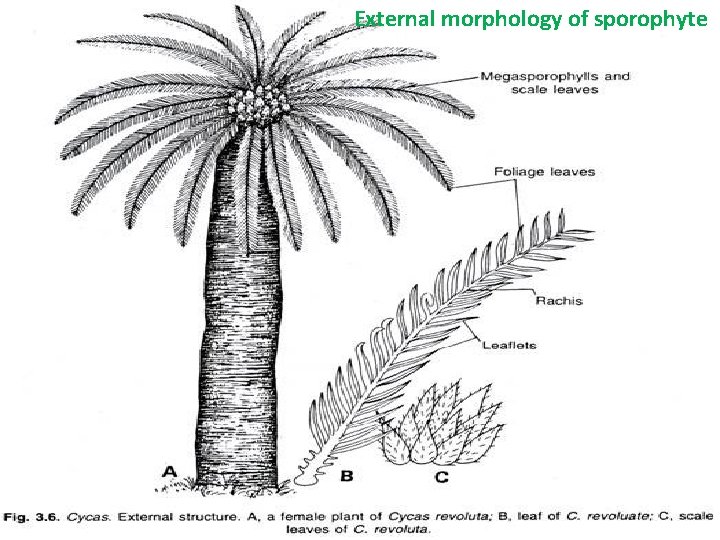
External morphology of sporophyte
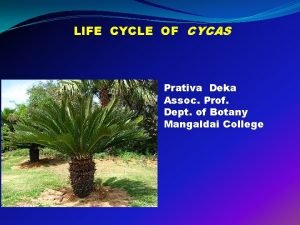
Cycas plant is slow growing, long-lived, evergreen, arborescent sporophyte. • It grows up to a height of 2 – 5 meters. • It has unbranched woody stem with a crown of unipinnate and paripinnate compound leaves at its apex. Stem is described as Caudex. Stem • Younger stems are tuberous, underground, stout and short. • Older stems are unbranched, woody, and aerial with armour of woody, persistent leaf bases. Leaf • Cycas shows habitual heterophylly with morphologically two different types of leaves. These leaves are foliage leaves and scale leaves.
Scale leaves • These are small, rough, dry, triangular and densely covered with brown hair known as ramenta (Fern character). • They are more than foliage leaves, persistent and protective in function. • They protect the younger foliage leaves, stem apex and other organs. • These arranged in close spiral succession alternate to the foliage leaves. Foliage leaves • Foliage leaves are spirally developed as terminal crowns. • One or two crowns are developed every year. • Each leaf is 1 – 3 cm in length, unipinnate paripinnate and attached to the stem by transversely broadened
Root • It has two types of roots known as normal roots and coralloid roots (Dimorphic roots). by blue green algae such as Anabaena cycadacearum and Nostoc punctiformae. Hence these are Normal root • Tap root system is developed at the beginning and in course of time it is replaced by adventitious root system arising from the base of stem. Coralloid Root. • These are apogeotropic, dichotomously branched, rough surfaced, coral like lateral roots arising from the lateral sides of normal roots reaching up to the surface of the ground. • They are inhabited symbiotic and show nitrogenous nutrition. • Lenticels present on coralloid roots help in respiration.
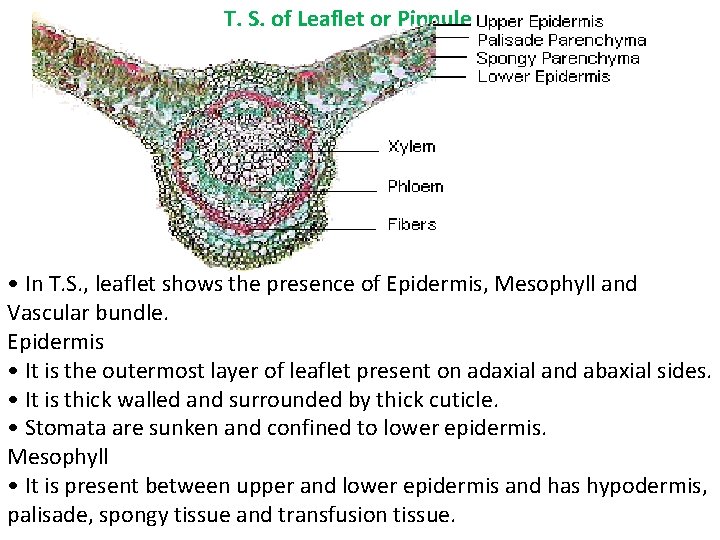
T. S. of Leaflet or Pinnule • In T. S. , leaflet shows the presence of Epidermis, Mesophyll and Vascular bundle. Epidermis • It is the outermost layer of leaflet present on adaxial and abaxial sides. • It is thick walled and surrounded by thick cuticle. • Stomata are sunken and confined to lower epidermis. Mesophyll • It is present between upper and lower epidermis and has hypodermis, palisade, spongy tissue and transfusion tissue.
Hypodermis • It is sclerenchymatous and present below the upper and lower epidermis. • In the wing region, it is one or two layered in the adaxial side and one layered in the abaxial side. In the midrib region it is 2 or 3 layered. • It acts as heat screen and protects the plant from over heating and excessive transpiration. Palisade tissue : • It is present below the upper hypodermis and has cylindrical cells with more number of chloroplasts. It takes part in photosynthesis. • It is confined to only wing region in C. circinalis. In Cycas revoluta, it is extended into the midrib region.
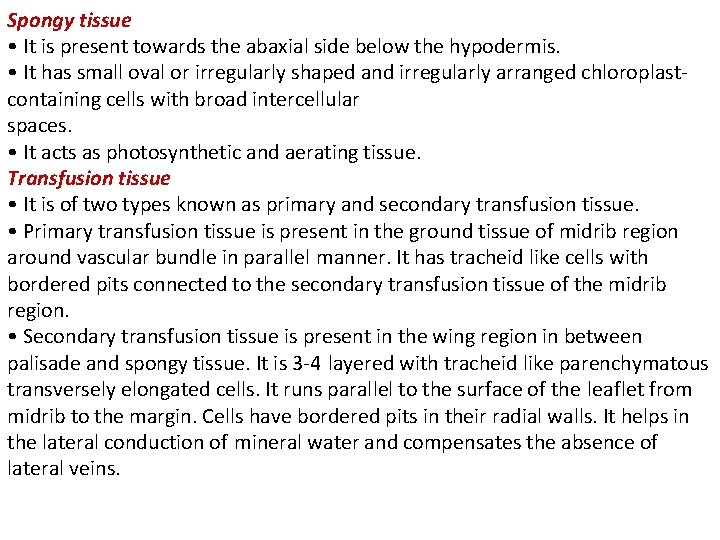
Spongy tissue • It is present towards the abaxial side below the hypodermis. • It has small oval or irregularly shaped and irregularly arranged chloroplastcontaining cells with broad intercellular spaces. • It acts as photosynthetic and aerating tissue. Transfusion tissue • It is of two types known as primary and secondary transfusion tissue. • Primary transfusion tissue is present in the ground tissue of midrib region around vascular bundle in parallel manner. It has tracheid like cells with bordered pits connected to the secondary transfusion tissue of the midrib region. • Secondary transfusion tissue is present in the wing region in between palisade and spongy tissue. It is 3 -4 layered with tracheid like parenchymatous transversely elongated cells. It runs parallel to the surface of the leaflet from midrib to the margin. Cells have bordered pits in their radial walls. It helps in the lateral conduction of mineral water and compensates the absence of lateral veins.
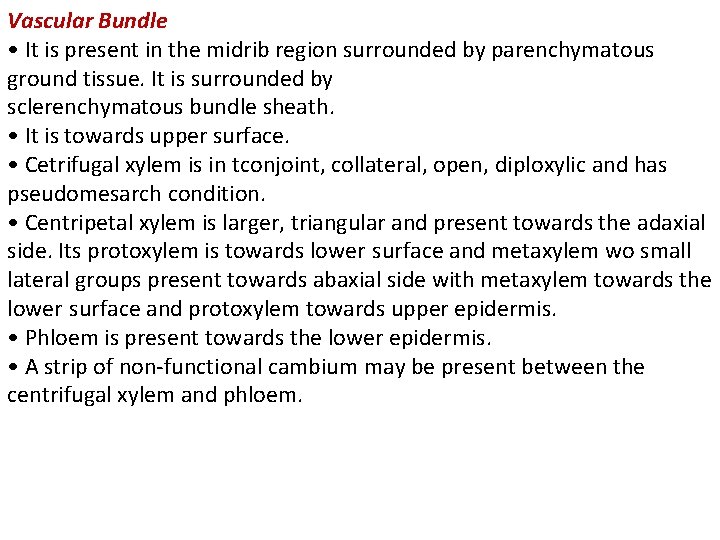
Vascular Bundle • It is present in the midrib region surrounded by parenchymatous ground tissue. It is surrounded by sclerenchymatous bundle sheath. • It is towards upper surface. • Cetrifugal xylem is in tconjoint, collateral, open, diploxylic and has pseudomesarch condition. • Centripetal xylem is larger, triangular and present towards the adaxial side. Its protoxylem is towards lower surface and metaxylem wo small lateral groups present towards abaxial side with metaxylem towards the lower surface and protoxylem towards upper epidermis. • Phloem is present towards the lower epidermis. • A strip of non-functional cambium may be present between the centrifugal xylem and phloem.
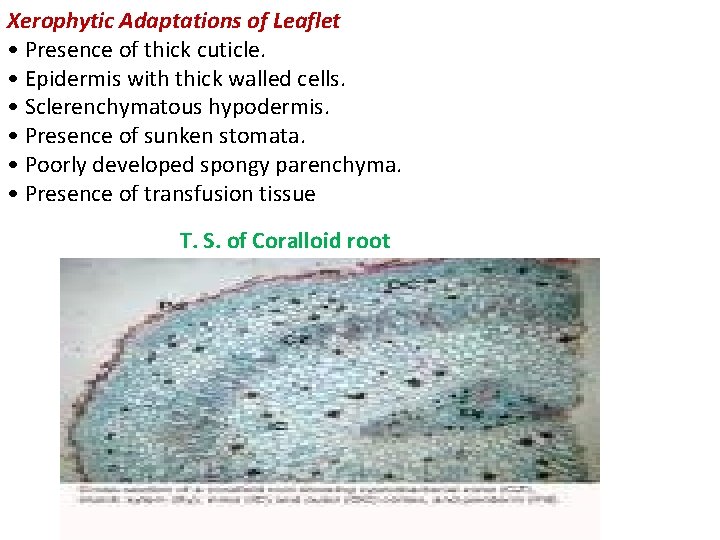
Xerophytic Adaptations of Leaflet • Presence of thick cuticle. • Epidermis with thick walled cells. • Sclerenchymatous hypodermis. • Presence of sunken stomata. • Poorly developed spongy parenchyma. • Presence of transfusion tissue T. S. of Coralloid root
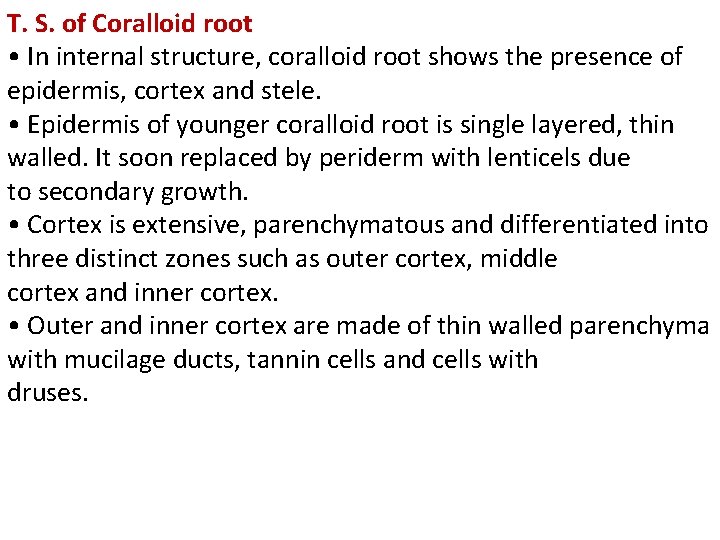
T. S. of Coralloid root • In internal structure, coralloid root shows the presence of epidermis, cortex and stele. • Epidermis of younger coralloid root is single layered, thin walled. It soon replaced by periderm with lenticels due to secondary growth. • Cortex is extensive, parenchymatous and differentiated into three distinct zones such as outer cortex, middle cortex and inner cortex. • Outer and inner cortex are made of thin walled parenchyma with mucilage ducts, tannin cells and cells with druses.
• Middle cortex is disorganised and it is inhabited by symbiotic nitrogen fixing blue-green algae such as Anabaena cycadacearum and Nostoc punctiformae. Hence this is called as algal zone. Cortex has single layered endodermis. • Stele has 2 -3 layered pericycle, radial vascular bundles and xylem shows exarch and triarch condition. • In normal root, the cortex is homogenous and shows diarch to tetrarch condition and periderm is absent
Reproduction • It reproduces vegetatively by bulbils or adventitious buds formed at the base of the stem. • During the germination of bulbils, adventitious roots are formed. • It reproduces through seeds only after 10 years of vegetative growth. • Cycas is dioecious and heterosporous. It produces both microspores and megaspores. • Microspores are produced in microsporangia of microsporophyll that together form male cone • Megaspores are formed in the ovule, which in return are formed on megasporophylls. These arranged loosely and do not form female cone. Male cone • It is singly formed every year at the apex of male plant after 10 years of vegetative growth of the plant. • During its formation the apical meristem is completely consumed and further growth is continued by a lateral bud present at the base of the cone. Hence the stem shows monopodial growth up to 10 th year and later sympodial growth (Cymose). • It is long, compact, oval or fusiform and has short stalk. It is surrounded by a crown of young leaves. • It woody and has 20 – 60 cm length. • Its axis has several compactly, spirally and acropetally arranged microsporophylls. • Some microsporophylls of apical and basal regions are sterile and do not produce microsporangia.
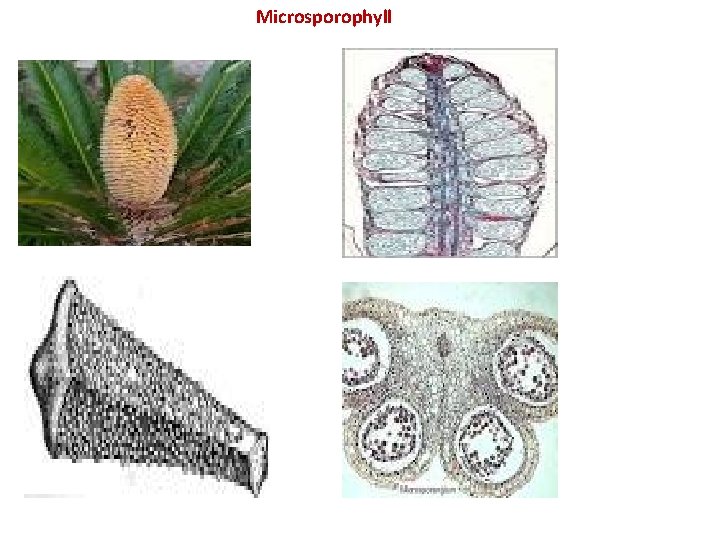
Microsporophyll
• It is flattened triangular structure with 3 – 3. 5 cm length and 1. 2 – 2. 3 cm width. • It has middle fertile and basal and apical sterile regions. • The apical sterile broad gradually tapering structure arranged parallel to the cone axis is called as Apophysis. • The remaining portion of the sporophyll is perpendicular to the cone axis. • 700 – 1000 microsporangia are borne as sori on the abaxial surface of middle fertile portion of sporophyll. • Each sorus has 2 – 6 microsporangia intermixed with 1 or 2 celled indusial hairs. It is a fern character.
Microsporangium • It is oval or elliptical with short stalk. It develops in eusporangiate manner. • It has 5 – 6 layered wall with outer most layer with fibrous wall thickenings known as Exothecium and innermost layer Tapetum. • Tapetum completely encircles the sporogenous tissue. Sporogenous cells divide and redivide mitotically and form the last generations of cells known as microspore mother cells. • Microspore mother cells divide meiotically and form haploid microspores in tetrads. These are separated from tetrads and rounded off as pollen grains. • At maturity the tapetum and the inner walls degenerate and only exothecium remain. • The microspores are liberated from microsporangium at 3 – celled stage due to vertical splitting of exothecium.
Megasporophyll
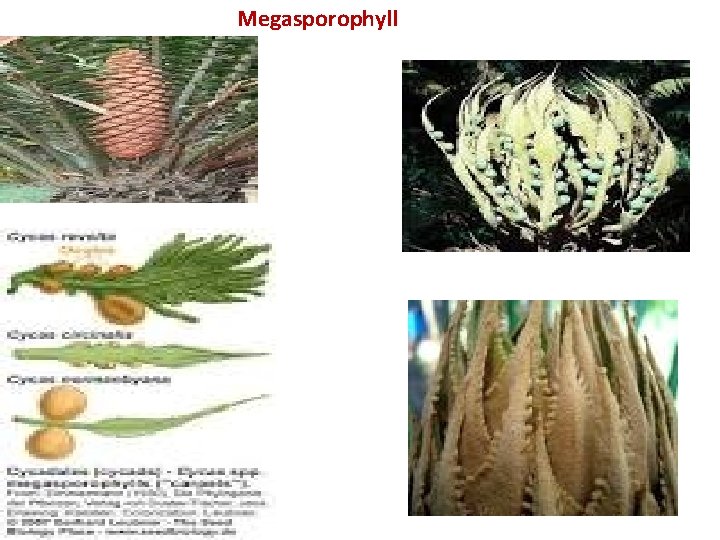
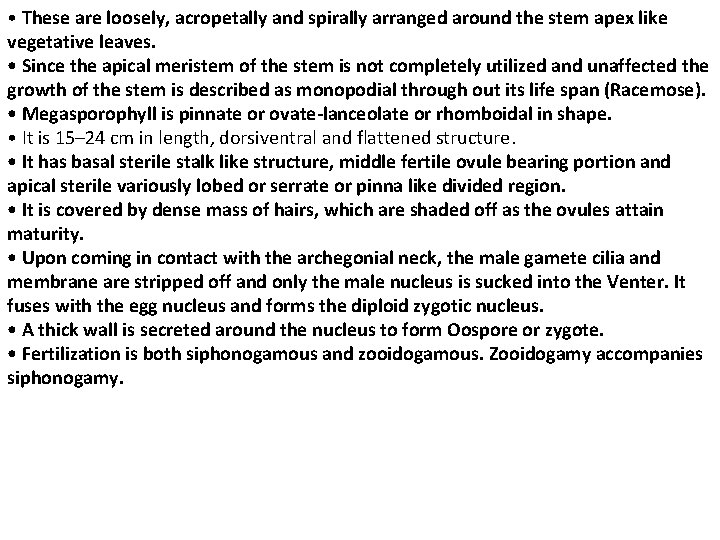
• These are loosely, acropetally and spirally arranged around the stem apex like vegetative leaves. • Since the apical meristem of the stem is not completely utilized and unaffected the growth of the stem is described as monopodial through out its life span (Racemose). • Megasporophyll is pinnate or ovate-lanceolate or rhomboidal in shape. • It is 15– 24 cm in length, dorsiventral and flattened structure. • It has basal sterile stalk like structure, middle fertile ovule bearing portion and apical sterile variously lobed or serrate or pinna like divided region. • It is covered by dense mass of hairs, which are shaded off as the ovules attain maturity. • Upon coming in contact with the archegonial neck, the male gamete cilia and membrane are stripped off and only the male nucleus is sucked into the Venter. It fuses with the egg nucleus and forms the diploid zygotic nucleus. • A thick wall is secreted around the nucleus to form Oospore or zygote. • Fertilization is both siphonogamous and zooidogamous. Zooidogamy accompanies siphonogamy.
Ovule or Megasporangium.
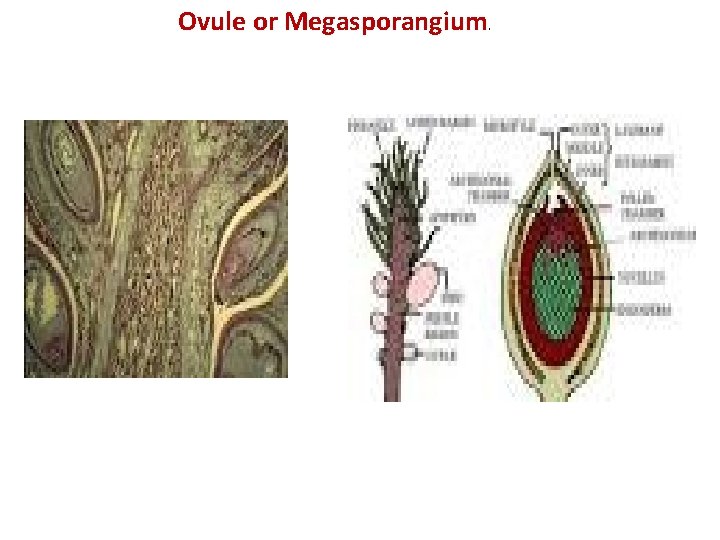
• It is the largest ovule in the plant kingdom with 6 × 4 cm in size. • It is orthotropous with massive nucellus surrounds by single integument differentiated into outer fleshy sarcotesta, middle hard sclerotesta and inner fleshy sarcotesta. • Nucellus and sarcotesta have vascular tissues. • Nucellus and the surrounding integument are fused except at the distal end leaving a narrow passage known as micropyle. • Nucellus is extended into the micropyle as a beak known as nucellar beak. • Cells of the nucellar beak degenerate and form pollen chamber. • The substance formed due to degeneration is secreted out through micropyle as a drop known as pollination or nectar drop. • Nectar drop helps in trapping the pollen grains carried through the agency of wind. • One of the cells of nucellus behaves as archesporial cell by showing enlargement. • It may directly behave as megaspore mother cell or divides to form a parietal cell and megaspore mother cell. • Megaspore mother cell divides meiotically and forms 4 haploid megaspores in a linear tetrad. The upper 3 micropylar megaspores degenerate and only the lower one is functional. • The functional megaspore has a thick outer papillate exospore and thin fibrillar inner endospore.
Thank You